Happy 2nd Anniversary to Weathervane Wednesday!
I posted my very first weather vane on 24 August 2011. It was the gilded centaur seen at Mack's Apples in Londonderry, New Hampshire. I never thought I'd still be posting weather vane photos two years later, but this is the 110th photo on my blog.
Weathervane Wednesday is an on-going series of photographs I post weekly, usually of weather vanes in the Nutfield, New Hampshire area, but sometimes they can be from anywhere. Occasionally they are elsewhere in New England, or very historical weather vanes from anywhere else. Sometimes my weather vanes are whimsical, but all are interesting. Often, my readers tip me off to some very unique and unusual weather vanes, too! Today's weather vane is from Boston, Massachusetts.
Do you know the location of weather vane #110? Scroll down to the bottom to see the answer!
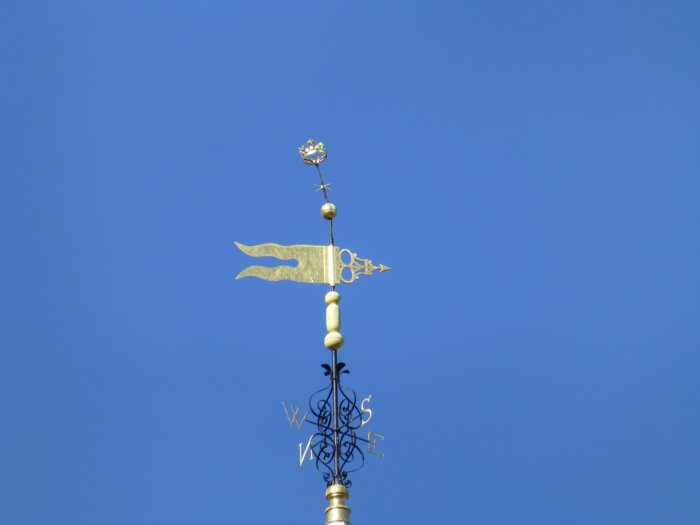
Today's weather vane is from the top of the steeple at the Old North Church in Boston. This is the church, and the famous steeple where the signal lights were hung for Paul Revere on the evening of 18 April 1775, when he set out on his famous ride to raise the alarm that "The Redcoats were coming!" This church is very difficult to photograph from the narrow streets. Below you can see church steeple photographed from the 33rd floor of 60 State Street, Boston (the old "Bay Tower Room" restaurant).
This weather vane is a six foot swallow tailed banner, made in 1740 by my relative Shem Drowne. Shem's father, Leonard Drown, married my 7th great grandmother, Mary Abbott, as her third husband. Only four surviving weather vanes can be attributed to tinsmith Shem Drowne. You can read more about Shem Drowne, our genealogy, and his most famous weather vane, the Faneuil Hall grasshopper, at this link:
http://nutfieldgenealogy.blogspot.com/2013/06/weathervane-wednesday-genealogical.html
The Old North Church website http://oldnorth.com/site/
Click here to see the entire collection of Weathervane Wednesday posts!
UPDATE: 1:22pm 20 August 2013
An email from reader Bill Olsen of Plymouth, Massachusetts
"August 25, 1954
High winds destroyed the spire of the Old North Church in Boston, which was the location of where the lanterns
were hung during Paul Revere's ride. It
was a replacement spire, after a hurricane in 1804 destroyed the original."
---------------------------------
Copyright 2013, Heather Wilkinson Rojo
Wednesday, August 21, 2013
Tuesday, August 20, 2013
Tombstone Tuesday ~ Old Dunstable Cemetery (Old South), Nashua, New Hampshire
The Old Dunstable Cemetery is also known as Old South Cemetery, and sometimes even known as Little's Station Cemetery. This last name was popular when there was a train station nearby, because there was a tavern next door to the cemetery, owned by a John Little. It’s the oldest cemetery in
Nashua, dating from when this land was once part of Massachusetts. You can find it on Daniel Webster Highway,
near the entrance to Royal Ridge Mall, at the traffic lights. The earliest
burial dates from 1687, and the most recent is 1966. There are about 250 graves here with lots of
early Dunstable and Nashua names such as Abbot, Bancroft, Blanchard, Colburn,
Lovewell, Roby/Robie, and Smith.
Inscription reads:
NEAR THIS SPOT IN 1684
THE SETTLERS OF DUNSTABLE
BUILT THEIR
SECOND MEETING HOUSE
REV. THOMAS WELD, MINISTER
THIS MEMORIAL ERECTED BY
MATTHEW THORNTON CHAPTER, D.A.R.
NASHUA, NH AD 1900
NEAR THIS SPOT IN 1684
THE SETTLERS OF DUNSTABLE
BUILT THEIR
SECOND MEETING HOUSE
REV. THOMAS WELD, MINISTER
THIS MEMORIAL ERECTED BY
MATTHEW THORNTON CHAPTER, D.A.R.
NASHUA, NH AD 1900
Also located inside the cemetery walls is the
Suburban School No. 1. It was built in
1841 and restored in 1976. This
historic brick schoolhouse is a popular field trip with fourth grade students
in Nashua. In New Hampshire the fourth
grade curriculum is the year that students study local and state history. The Kings Daughters Benevolent Association
hosts the visits to the school, and recreates the 19th century
experience for the children. The schoolmarm teaches penmanship (with dip ink
pens), arithmetic on slates, writing and recitation during a two hour session straight
out of 1842. Students are encouraged to
dress in long skirts and overalls, and to bring a cold lunch in a pail.
Why is the schoolhouse next to the cemetery? According to the website for the school, the
land was cheap! The town paid only $75
for the lot where it still stands now, surrounded by malls, parking lots and
chain stores.
An interesting slideshow of all the “winged skulls”
and portraits on the top of the headstones in the Old Dunstable Cemetery: http://www.flickr.com/photos/markturek/sets/72157625300823148/
Genealogical information on the families interred at
the Old Dunstable Cemetery can be found in the book Early Generations of the Founders
of Old Dunstable: Thirty Families, by Ezra S. Stearns, Boston: George
Littlefield Publishers, 1911
Also see the book History of the Old Township of
Dunstable: Including Nashua, Nashville, Hollis, Hudson, Litchfield and
Merrimac, NH, by Charles James Fox,
1846.
Website for District #1 Schoolhouse in Nashua http://nashuaschoolhouse.com/
---------------------
Copyright 2013, Heather Wilkinson Rojo
Monday, August 19, 2013
19 August 1692, Five People Hanged for Witchcraft in Salem, Massachusetts
![]() |
| The gravestone of George Jacobs Danvers, Massachusetts |
One month earlier the upstanding citizens Rebecca Nurse, Susannah Martin, Elizabeth Howe, Sarah Good, and Sarah Wildes were executed. Two months earlier, on June 10, Bridget Bishop was hanged in Salem as the first official execution of the Salem witch trials. Over that summer, nineteen innocent lives were lost to gossip, heresy and lies.
What has been learned since then? Did anyone change their ways because of this? Did we see the follies of our ways and become kinder and more forgiving to our neighbors? Did we become accepting of the "different" and less fortunate?
In 2011, modern “witches” have taken over Salem, Massachusetts- people like Laurie Cabot, who exploit the deaths of innocent people for their own profits. My daughter’s AP History Class took a field trip to the “Witch Museum” in Salem after reading Miller’s play The Crucible. I was shocked to hear myths being re-told during the presentation, and then the narrator invited the school children to the back of the museum to see a display of modern pagan witch artifacts “by the descendants of the original witches!” I was flabbergasted, as a chaperone, to know that these myths persist.
The truth is that none of the original nineteen people were witches, nor were they practicing witchcraft. The people of Salem were Puritans, however they did believe the Devil dwelt amongst them in Massachusetts. They falsely believed that witches lived among them, the cause of their problems and troubles. The Devil’s work was truly the gossip, lies and heresy told by neighbors and friends, and not the work of witchcraft. Over the years these innocent victims have all had their records expunged from the criminal court system.
If you want to see any actual sites related to the trials of 1692, you are better off going to Danvers, Massachusetts to visit the Archives where some of the original documents can still be read, or the memorial to the victims on the site of the original meeting house, or the well preserved Rebecca Nurse Homestead. In the city of Salem, there is a memorial (cenotaphs) to the executed victims, Judge Corwin’s house, and the disputed site of Gallows Hill. In Salem you will also find several museums of dubious quality and inaccurate displays. You are better off touring the world class Peabody Essex Museum in Salem than any of the other witch museums, and thank goodness the PEM has removed the display of George Jacob’s finger bones.
On this date in 1692 two of those five people hung on Gallows Hill were my 9x great grandfathers, George Jacobs and John Proctor. Bridget Bishop was my 9x great grandmother. In 1992 the descendants of George Jacobs removed his body from where it had been secretly buried on the Jacobs homestead, because the land was being sold for commercial development. We had his body re-interred with a very nice reproduction 17th century style headstone at the Rebecca Nurse Homestead in Danvers, Massachusetts. Laurie Cabot, nor any of the merchants profiting from “witchcraft” in modern Salem, did not donate a penny towards the re-internment. It is the only actual gravesite of a witch trial victim, since the others were buried in a crevice, and not allowed to be buried in the town burial grounds. Rebecca Nurse was reburied in secret on the grounds of the family farm. No one knows where she is located exactly, and hopefully she has been at peace ever since 1692.
George Jacobs
"Because I am falsely accused. I never did it."
Bridget Bishop
"I am no witch. I am innocent. I know nothing of it."
Margaret Jacobs
"... They told me if I would not confess I should be put down into the dungeon and would be hanged, but if I would confess I should save my life." [note: Margaret was forced to confess and to accuse her own grandfather, George Jacobs, of witchcraft]
Engraved on a cenotaph to Rebecca Nurse, at the Nurse Family Burial Ground in Danvers, Massachusetts:
“O, Christian martyr! Who for truth could die,
When all about thee owned the hideous lie!
The world, redeemed from superstitions sway
Is breathing freer for thy sake today.”
By John Greenleaf Whittier
Originally published on 19 August 2011 at the Nutfield Genealogy Blog
------------------
Heather Wilkinson Rojo, "19 August 1692, Five People Hanged for Witchcraft in Salem, Massachusetts", Nutfield Genealogy, posted August 19, 2013, ( https://nutfieldgenealogy.blogspot.com/2013/08/19-august-1692-five-people-hanged-for.html: accessed [access date]).
Saturday, August 17, 2013
Surname Saturday ~ WEEKS of Martha's Vineyard
![]() |
| Martha's Vineyard Island, Massachusetts |
WEEKS
The Wickes or Atwick or Weeks family lived in Staines,
England. In 1638 Robert Wickes died and
left a will which stated “to pay my son John Wickes now living in New England
200 pounds at the featst of the birth of our Lord God next coming” and to another
son “To my son William, 300 pounds, as follows, 30 pounds in three months and
the remainder in three years and he is to have 10 pounds paid to him every half
year in the meantime, and if he should die, or never come to claim it, then to
be divided between my sons John and Robert and their children”.
The son William Weeks was living on the island of Martha’s
Vineyard off the coast of Cape Cod, Massachusetts by the first recorded
division of land in 1653. On 10 April
1655 he was granted land “near the pines in the middle of the island”.
There was a legal complaint against William Weeks on 22
February 1660 by William Lambert. He is
mentioned as having an ordinary (tavern).
On 28 January 1661 he was fined for selling strong liquor and had to pay
Governor Thomas Mayhew 10 shillings.
There were more records of his tavern business and litigation in the
1680s. On 29 December 1688 he is on the records
for a land sale, and on 3 August 1689 his widow Mary sold the house lot. There was no will or inventory of William
Week’s estate.
There is an interesting record of William Weeks in 1667
involving a shipwreck in the Elizabeth Islands (next to Martha’s Vineyard). The local Indians looted his boat and his
provisions onboard, even taking clothing from his son. The record lists the goods that were
lost. It was signed by Governor Mayhew
on 22 November 1667.
For more Weeks family information see the book History
of Martha’s Vineyard, Dukes County, Massachusetts (three volumes) by Charles
Edward Banks, 1911, which is available online at this link: http://archive.org/stream/historyofmarthas00bank#page/n9/mode/2up
My Weeks Lineage:
Generation 1: Richard Atweeke or Atwick, died sometime
before 1592, Staines, Middlesex, England
Generation 2: Robert Wickes, died about 1638 in Staines;
married Sarah Enderley
Generation 3: William Weeks, born about 1620 in Staines,
died 1688 in Edgartown, Massachusetts on the island of Martha’s Vineyard; married Mary Butler. Six children.
Generation 4: Elizabeth Weeks, born about 1648 on Martha’s
Vineyard island; married 1 May 1667 in Barnstable, Massachusetts to John
Robinson, son of Isaac Robinson and Margaret Hanford. He was born about 1640 and died after 1714 in
Connecticut.
Line A:
Generation
5: Isaac Robinson, son of John Robinson and Elizabeth Weeks, born 30 January
1670; married first to Hannah Harper on 1 March 1690 in Barnstable. She was the daughter of Robert Harper and
Prudence Butler, born May 1670 in Sandwich, Massachusetts. Eight children.
Generation
6: Peter Robinson, born 15 December 1701 in Falmouth, died after 1772; married
on 18 July 1724 in Falmouth to Martha Green, daughter of Isaac Greene and Sarah
Unknown. She was born 28 October 1705 in
Falmouth. Seven children.
Generation
7: Jabez Robinson, born 9 June 1726 in Falmouth; married on 7 January 1748 to
Tabitha Green, daughter of William Green and Joanna Mendall. She was born 18 December 1726 in Falmouth.
Five children.
Generation
8: Elizabeth Robinson, born 17 June 1750 in Falmouth, died 27 June 1837;
married on 8 September 1774 to Ebenezer Crosby, son of Jonathan Crosby and
Hannah Hamblin. He was born 26 August
1747 in Mansfield, Connecticut, and died 26 February 1826 in Yarmouth, Nova
Scotia. Eleven children.
Generation
9. Rebecca Crosby m. Comfort Haley
Generation
10: Joseph Edwin Healy m. Matilda Weston
Generation
11: Mary Etta Healey m. Peter Hoogerzeil
Generation
12: Florence Etta Hoogerzeil m. Arthur Treadwell Hitchings
Generation
13: Gertrude Matilda Hitchings m. Stanley Elmer Allen (my maternal
grandparents)
Line B:
Generation
5: Mary Robinson, born 12 December 1683
in Falmouth, Massachusetts, and died in November 1721; married on 22 November
1704 in Falmouth to Benjamin Davis, son of John Davis, Jr. and Ruth Goodspeed. He was born 8 September 1679 in Barnstable,
and died in 1754. Nine children.
Generation
6: Ruth Davis m. John Mayhew
Generation
7: Mary Mayhew m. Caleb Rand
Generation
8: Mary Rand m. Asahel Bill
Generation
9: Reverend Ingraham Ebenezer Bill m. Isabella
Lyons
Generation
10: Caleb Rand Bill m. Anna Margareta Bollman
Generation
11: Isabella Lyons Bill m. Albert Munroe
Wilkinson
Generation
12: Donald Munroe Wilkinson m. Bertha Louise Roberts (my paternal grandparents)
---------------------------
Copyright 2013, Heather Wilkinson Rojo
Friday, August 16, 2013
The 123rd Locke Family Reunion, Concord, New Hampshire
Last weekend I attended one day of the three day long Locke Family Reunion. There has been a reunion of the descendants of Capt. John Locke of Rye, New Hampshire (1627 - 1696) and of William Locke of Woburn, Massachusetts (1628 - 1720) since 1891. Although DNA has proven that the two families are unrelated, there have been many marriages between both lineages, which make this an interesting family tree! This year the reunion was held in Concord, New Hampshire.
I was late to the Saturday meeting, but I got there just in time to participate in the raffle. I even won one of the donated items! Half of the table was covered with Locke Family Association genealogy books, T-shirts, mugs, etc, and some interesting photos. One very fascinating item was this engraving of London's Whitechapel, England, where my ancestor Capt. John Locke was baptized on 16 September 1627. His brother Nathaniel was baptized there on 11 November 1629. Their parents, Thomas Locke and Christena French were married there on 26 July 1624.
After a nice lunch together, the Locke descendants visited the New Hampshire Historical Society Museum in Eagle Square. We saw many fascinating items from New Hampshire history, and four very special items from the Locke family. The first one, the famous scythe Capt. Locke used to defend himself in 1696, is on display on the third floor. The other three items were pulled from storage by the curator, and shown to the group in a classroom. The museum was very kind to do this special presentation for the Locke Family Association.
Locke family members viewing Captain John Locke's sword, a piece of needle work and a chintz counterpane made in the 1800s by Locke descendants. The curator described the items, gave their provenance and the family history of the original owners who made the textiles and the descendants who donated them to the museum.
"This is the Sword of Capt. John Locke who was killed by the Indians Aug. 26, 1696 on Josselyn's Neck, also known as Locke's Neck, Rye, N.H.
Given to the N. Historical Society by Harvey Lock Alexandria who is the great-great-great-grandson of Capt. John Locke.
Presented to the Historical Society by George Locke, Manchester, N.H."
After viewing the Locke artifacts at the museum, it was a short walk to the New Hampshire Historical Society Library, where the librarian Bill Copley gave us an overview of the many Locke compiled genealogies in their collection of over 5,000 genealogies on New Hampshire families. He also had pulled several Locke manuscripts for us, including a diary and an autograph book. There was a large file of Locke photographs and many maps of Rye and Epsom, New Hampshire which featured Locke family member's grants and plots of land from the 1600's through the 1900's. After his presentation, we were free to use the reading room and to explore the building.
Saturday ended with a nice meal at the Newick's seafood restaurant in Concord. Many of the reunion members were from out of state and from outside of New England, including New York, Pennsylvania and as far away as Oregon. I noticed that nearly everyone enjoyed lobster, or other New England seafood for supper! It was fun to shared meals and meetup with "new cousins". The 2014 Locke Family Association Reunion will be in Gettysburg, Pennsylvania.
For more information:
The Locke Family Association website http://www.lockefamilyassociation.org/
Or on Facebook https://www.facebook.com/LockeFamilyAssociation
A History and Genealogy of Captain John Locke (1627 - 1696) of Portsmouth and Rye, New Hampshire and His Descendants, by Arthur H. Locke, 1916, The Rumford, Press, Concord, New Hampshire. There are two supplements to this volume.
--------------------------------
Copyright 2014, Heather Wilkinson Rojo
Thursday, August 15, 2013
Conferencia Iberoamericana de Genealogia
Brigham Young University and
FamilySearch.Org would like to announce a unique and exciting Spanish language
family history conference September 9 – 14, 2013, in Salt Lake City, Utah.
There has never been a conference like this in Utah and may not be another one
of this nature again for many years to come.
This
unique conference will feature expert genealogists from throughout the Hispanic
world. These teachers and presenters are experts in the areas they will be
presenting in. The Spanish experts will focus on many of the challenges and
resources for those with Latin and Hispanic heritage. This will be an
opportunity for attendees to connect with and get help from specialists from
genealogical communities in many Latin countries. These teachers will include Sonia Meza,
Javier Tobón, George Ryskamp, Luis José Prieto Nouel and others.
To
learn more about signing up for this unique family history conference, visit the Conferencia
Iberoamreicana de Genealogia webpage. To see a list all the classes
and other social events and experiences offered by the conference, visit the main blog page. There
will be a track of classes in Portuguese and another track in English; the
other five will be in Spanish.
Please
share this information with your friends, research societies, and anyone else
who might have ancestors from any of the Spanish speaking countries throughout
the world. This is a conference that you will not want to miss.
This
conference is a joint effort of Brigham Young University and FamilySearch.org.
------------------
Image by Army Sgt. Nina Ramon 345th Public Affairs Detachment (United States Army) [Public domain], via Wikimedia Commons
The 25th Annual Felton Family Reunion, Peabody, Massachusetts
Sometime in 1633 Nathaniel Felton settled in Salem, Massachusetts with his mother "Misstress Eleanor Felton", his sisters Judith and Margaret, and his Uncle Benjamin Felton. He was only 17 years old when he arrived in New England. He married Mary Skelton, the daughter of Salem's first minister, Reverend Samuel Skelton, and he built the house on Felton Hill in 1644. The Nathaniel Felton, Jr. house, next door, was built later. They both survive, surrounded by apple orchards. These two Felton houses are the property of the Peabody Historical Society.
The Nathaniel Felton, Sr. House, circa 1644
Felton Hill was part of Salem, Massachusetts in the 1600s. It was west of the town, on the "frontier" and the Felton house was a garrison. Today, the Peabody Historical Society runs tours of the homes, and rents them out for special events, as well as the Smith Barn across the street, and the Fire House Museum, which was moved to behind the barn. Surrounding the property are malls, stores, Routes 114 and Route 128, but when you are on Felton Hill it still seems like the 17th century.
The Nathaniel Felton, Jr. House, circa 1683
The 2013 Felton Family Reunion was held in July, and started at the Fire House Museum. Feltons and Felton descendants from all over the United States met for a business meeting, genealogy lectures, and tours. Everyone had a great time, even in the pouring rain on Friday, July 26th when I attended. I doubt there is another family reunion in the USA where descendants visit TWO of their ancestor's 17th century houses on one property!
Genealogist Richard Tivey told us all about our English ancestors, back to Charlemagne!
The Fire House Museum was Engine Co. No. 3, home of "The Torrent"
The Felton Family Association met upstairs, above the museum.
My cousin Charlie Wilkinson found his ancestor Frank Wilkinson's photo
on the staircase of the Fire House. Frank was a Peabody firefighter.
Roger Felton created a shield with Sir Thomas de Felton's coat of arms.
He showed it at the Felton Family Association meeting, and everyone loved it!
The Felton Family Association website http://www.feltonfamily.org/
Yours Truly was made the administrator of the Felton Family page on Facebook.
Please join us at this link: https://www.facebook.com/pages/Felton-Family-Association/260085384006425
The Peabody Historical Society http://www.peabodyhistorical.org/
Tours of the two Felton houses are free, and available by appointment by calling 978-531-0805
--------------------------
Copyright 2013, Heather Wilkinson Rojo
Wednesday, August 14, 2013
Weathervane Wednesday ~ A Red Apple
The Brookdale Fruit Farm specializes in apples, thus the bright red apple weather vane. They also grow lots of other yummy produce, including all sorts of fruits and berries. The farm is more than 165 years old, and were founded in 1847 by Edwin Hardy. The orchards were first planted in 1910, and in the past few years dwarf trees have been the staple fruit trees at Brookdale Farm. The farm store, shown here, sells produce, baked goods, flowers, plants, honey, cheeses and you-name-it!
Brookdale Fruit Farm website http://www.brookdalefarms.com/
Click here to see the entire collection of Weathervane Wednesday posts!
--------------------------
Copyright 2013, Heather Wilkinson Rojo
Subscribe to:
Posts (Atom)


