Showing posts with label Quakers. Show all posts

Tuesday, September 21, 2021

Sandwich Quaker Meeting House


The Sandwich Quaker Meeting was first gathered on 13 April 1657 at the home of William Allen on Spring Hill Road in East Sandwich, about 500 yards from the present meeting house.  Among the attendees was Nicholas Upsall who had been expelled from Boston for his heretical beliefs.  By 1658 there were sixteen Quaker families in Sandwich, meeting secretly to avoid punishment.  But in 1694 the town granted the Quakers land on Spring Hill for a burial ground and meetinghouse. This structure was built in 1810.   Today it is considered the home of the oldest continuous Quaker meeting in America.

This building was originally made on the Kennebec River in Maine and shipped to Sandwich.  It was reassembled according to the numbered timbers.  There are original carriage sheds on each side of the meetinghouse, and the privies behind were used until 1992 when the community house was connected to the town water.  The burial ground is behind the meetinghouse, but the earliest burials were unmarked by gravestones.  There is no known record of early burials.

Around this meetinghouse there was a large Quaker village with a Quaker school, the Wing and Hoxie family homesteads (now museum houses open to the public in the summer), and homes of other early Quaker families. Surnames include Bowman, Crocker, Holway, Gifford, Jones, Ewer, West, Russell and others.  The Religious Society of Friends is still continuing services at this meetinghouse, and worship is 10am every Sunday. Visitors are welcome. 


SANDWICH
MEETING of FRIENDS

Sandwich Monthly Meeting of Friends, established in 1657, is the
oldest continuous Quaker meeting in North America.  It consists
of congregations here, in West Falmouth and in Yarmouth.

This meetinghouse, the third on this site, was built in 1810.
Meetings for worship are held here at 10:00am each Sunday.

Meetings for worship are also held each Sunday throughout the
year at 10:00 am at the South Yarmouth Meetinghouse and
10:00am at the West Falmouth Meetinghouse.
-------------0---------------
Visitors are always Welcome


For the truly curious:

East Sandwich Friends Meeting House
6 Quaker Road
East Sandwich, Massachusetts 02537

Sandwich Monthly Meeting history webpage (from the Cape Cod Quakers website):  http://www.capecodquakers.org/smm_history.html 

A listing of burials in Sandwich Quaker Cemetery http://www.capecodgravestones.com/sandquaker.html 

“The Quaker Way of Life”, Cape Cod Times, 20 August 2007, https://www.capecodtimes.com/article/20070820/news/708200318

 ---------------------------

To Cite/Link to this post: Heather Wilkinson Rojo, "Sandwich Quaker Meeting House", Nutfield Genealogy, posted Sept 21, 2021, ( https://nutfieldgenealogy.blogspot.com/2021/09/sandwich-quaker-meeting-house.html: accessed [access date]). 

Tuesday, September 7, 2021

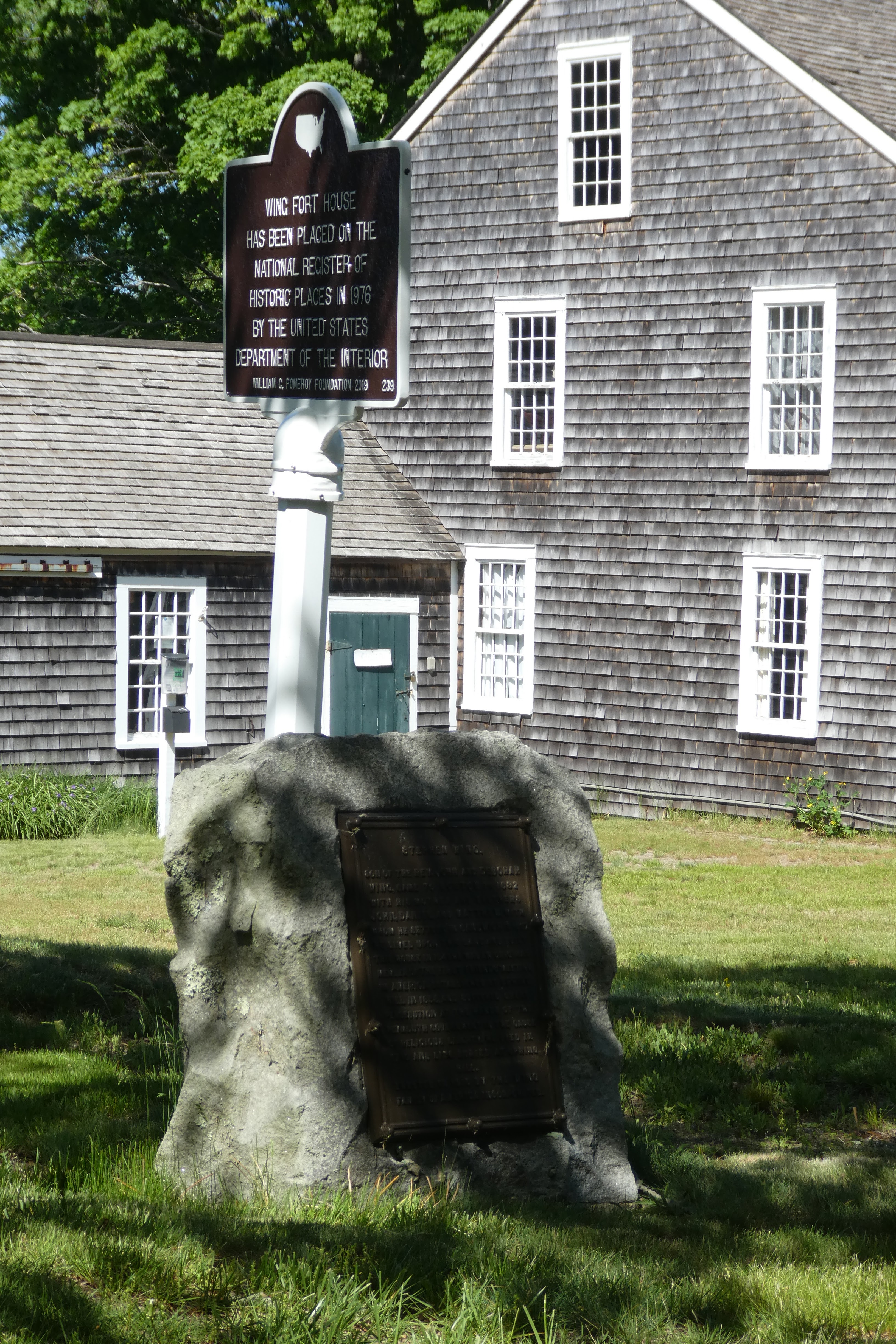
The Wing Fort House, Sandwich, Massachusetts


While we were exploring Cape Cod a few months ago we had a serendipitous discovery.  We were lost on a back road, searching for the Quaker cemetery, when we stumbled across this historic home.  It was the Wing Fort House on Spring Hill Road in Sandwich, Massachusetts.  Of course, we stopped to take a few photos before continuing our search. This house was built by an a relative who became a Quaker, so we knew we were very close to our destination!

This garrison home was built in 1641 by Stephen Wing.  (I descend from his grandfather, the Reverend Stephen Batchelder (1561 – 1656) through his two children Nathaniel (1590 – 1630) and Ann (b. about 1603) who married John Sanborn).  It is puzzling why this was built as a garrison, since the native Wampanoags were friendly to the English settlers on Cape Cod.  Stephen Wing lived here with his family and his mother, Deborah Batchelder (my 10th great aunt) who was the wife of the Reverend John Wing.

Stephen Wing was one of the first Quakers in Sandwich, Massachusetts.  The Plymouth Court records have some of the first legal proceedings against the early Quakers in Sandwich.  On March 2, 1657/8 “Lieut. Ellis, Stephen Winge and Thomas Butler, being summoned to answer for tumultuous carriage as aforesaid, [at a Quaker meeting] being examined, and not found so faulty as was supposed, were admonished and cleared.”  He was fined many times for refusal to take the oath of Fidelity because Quakers believed it a sin to take any oath. 

Descendants of the Wing family have lived in this house until 1942 when it was sold to the Wing Family of America (the family association) as a museum house.  Unfortunately, the tours run from June through September, so we missed seeing the inside of the house.  During the rest of the year the house is available by appointment to members of the Wing association.

 There have been several archaeological digs at the site of the Wing Fort House.  Most recently was an archaeological dig at this house in 2010 that revealed a small addition to the north side (a possible milk house?) and many 17th, 18th and 19th century artifacts.  See the link below for a report on what was found. 


WING FORT HOUSE
HAS BEEN PLACED ON THE
NATIONAL REGISTER OF
HISTORIC PLACES IN 1976
BY THE UNITED STATES
DEPARTMENT OF THE INTERIOR
WILLIAM G. POMEROY FOUNDATION 2019     239


STEPHEN WING

SON OF THE REV. JOHN AND DEBORAH
WING, CAME TO BOSTON IN 1632
WITH HIS MOTHER AND BROTHERS
JOHN, DANIEL, AND MATHEW, WITH
WHOM HE SETTLED IN SANDWICH IN 1637.
HE LIVED UPON THIS LAND AND BUILT
THIS HOUSE IN 1641.  HE WAS AN ORGINAL
MEMBER OF THE FIRST FRIENDS MEETING
IN AMERICA, ESTABLISHED AT SPRING
HILL IN 1658, AND SUFFERED GREAT
PERSECUTION AT THE HANDS OF THE
PLYMOUTH GOVERNMENT IN THE CAUSE
OF RELIGIOUS LIBERTY.  HE DIED IN
1710 AND LIES BURIED AT SPRING
HILL.
ERECTED IN 1910 BY THE WING
FAMILY OF AMERICA INCORPORATED.


For the truly curious:

The Wing Family of America website:    https://www.wingfamily.org/ 

“Tour the Wing Fort House from Your Own Home with Caretaker, Dave Wheelock”  (two parts)  via YouTube  https://www.youtube.com/watch?v=5zp8afIPBFk 

Click here to see the reports on the 2010 archaeological dig (report and artifacts)  http://www.plymoutharch.com/wing-fort-house-excavations/  

“Mystery of Missing Family Members Still Unsolved After Archaeological Dig”, The Sandwich Enterprise, July 28, 2017,  https://www.capenews.net/sandwich/news/mystery-of-missing-family-members-still-unsolved-after-archaeological-dig/article_4a4bd723-40c8-5427-ae4e-a539e03fdab6.html 

A slide show of a visit to the Wing Fort House (no narration or captions):  https://vimeo.com/28244835 

---------------

To Cite/Link to this post: Heather Wilkinson Rojo, “The Wing Fort House, East Sandwich, Massachusetts”, Nutfield Genealogy, posted September 7, 2021, ( https://nutfieldgenealogy.blogspot.com/2021/07/the-wing-fort-house-sandwich.html: accessed [access date]). 

Monday, August 6, 2012

The Walt Whitman Homestead

The Walt Whitman birthplace, built by his father
Walter Whitman, complete with lilacs by the kitchen door -
"When Lilacs Once in the Dooryard Bloom'd"
Poet Walt Whitman was born at this homestead on 31 May 1819, in the village of West Hills, Long Island, New York.  His father, Walter Whitman, was a Quaker carpenter, and was not a very successful farmer.  Walter built the entire house, and worked the farm. When son, Walt, was four years old they removed to Brooklyn.  At age eleven he entered the working world.  His early life was a struggle, but isn’t that true of some of the best American poets?

A statue donated by the Japanese
poet, Daisaku Ikeda

The Walt Whitman homestead was turned into a museum in the 1950s, and the interpretive center was built in the 1970s.  The entire Whitman house was restored back to its original condition when Walter Whitman built it in the early 1800s.  There are some signature features you can view on a guided tour, which were built into the home by Walter, including a penny at the top of the staircase used as a bolt, and rubbed for good luck by generations.  There are built in corner shelves on each fireplace mantel for candlesticks, and several built in cupboards not usually seen in modest homes of this time period.  In the attic space you can see hand hewn beams created by Walter Whitman himself.

The complex includes a visitor/interpretive center, the house where Walt Whitman was born, gardens and a community center for poetry readings and youth groups.  The entire place is surrounded by a wooden wall, so you would never know you were in a suburban setting, surrounded by strip malls and speeding traffic.  It is quiet and tranquil inside the historic site.  There are also historic museums in Brooklyn, New York, where the poet spent most of his childhood, having moved from Long Island at about age four or five years old when the family farm failed.


------------------------
For more information:

The Walt Whitman Homestead http://www.waltwhitman.org/
246 Old Walt Whitman Road
West Hills, NY 
------------------------

Copyright 2012, Heather Wilkinson Rojo

Saturday, March 10, 2012

Surname Saturday ~ Southwick of Salem, Massachusetts


SOUTHWICK
Shelter Island Map
Updated 7 December 2019

Lawrence Southwick does not appear in any official records until 1639 in Salem, when he was admitted to the church and given two acres of land for his glass and “earthenware” business.  He is supposed to be one of the first glass manufacturers in the New World according to family lore, although Jamestown, Virginia had an early glass business.  Lawrence, his wife Cassandra, and son Josiah and daughter Mary were fined, whipped and finally banished for being Quakers.    Lawrence and his wife died of exposure on Shelter Island, off Long Island, New York in 1659.

Their minor children, Daniel and Provided were sold into slavery by the General Court.  This episode was made into a poem by John Greenleaf Whittier called “The Ballad of Cassandra Southwick” (he switched the name of the mother and daughter, I guess the name Cassandra was more poetic than Provided).    See my blog post http://nutfieldgenealogy.blogspot.com/2009/11/ballad-of-cassandra-southwick.html for more on this story. 

Lawrence Southwick’s will, made before he was banished:
I, Lawrence Sethick, late of Salem in New England, now being at the house of Nathaniel Silvester, on Shelter Island, being weake in body but of sound mind and memory, do make and ordayne this my last will and testament, tenth day of fifth month, 1659.

I first give and bequeath unto my sonne Daniel Sethick my dwelling house at Salem, with all the houses, orchards, gardens and appurtenances; and Gyle's lot, provided that John Burnell shall have a house lott on the ground at the further end of the orchard newly fenct in.

Item. My will is that the lott which I had of Josiah Sethick shall return to him again.
Item. I give unto John Sethick the lott next to his owne.
Item. My will is that the great meadow which lyes at Ipswich River, fenct in, shall be divided Daniel Sethick and John Burnell equally.
Item. I give unto Samuel Burton forty shillings.
Item. I give unto John Burnell, if he stand faithful in the truth, two young steers and the first mare foal.
Item. I give unto Henry Traske Marshall's lott joining to his orchard, provided that Daniel may have liberty to mow a load of hay every year thereon.
Item. I give unto Mary Traske my daughter, wife of Henry Traske, ten pounds sterling.
Item. I give unto Deborah Sethwick and young Josiah, each of them fifty shillings sterling.
Item. I give unto Ann Potter forty shillings, in she thinks beneficial for her.
Item. I give unto Mary Traske, daughter to Henry Traske, one good serge suit of clothes; and unto Sarah and Hannah each of them a suit of clothes.

I give and bequeath unto Samuel and Sarah, John Sethick's children, to each of them thirty shillings sterling.

Furthermore my will is that Daniel my sonne, and Provided my daughter, shall possess and enjoy all that which remains of my estate after debts and legacies paid, and my will above mentioned fulfilled, equally to be divided between them so that Daniel may have that part which belongs to husbandry.

Lastly my will is that in case my wife survives me shee shall be my executrix and keep all possessions during her life, and after her decease my will to be performed according as above expressed; and I do ordayne William Robinson and Thomas Gardner to be overseers of this my last will and testament, signed and sealed by me the day and year above written with my hand and seal following.

In presence of
NATHANIEL SILVESTER, signed by
THOMAS HARRIS, LAWRENCE SETHICK.
WILLIAM DURAND,
This will was allowed by the court 29, 9 mo., 1660.
attest
HILLARD VEREN, Clericus.

The story of the Southwick family is exciting, and because there were many court records this family is fairly easy to trace.  I used the following sources:

Genealogical Dictionary of New England, by James Savage, Volume IV, pages 142 -3.

Genealogy of the Descendants of Lawrence and Cassandra Southwick of Salem, Massachusetts, by James Moore Caller and Maria A. Ober, Salem, Mass: JH Choate, 1881

A Study of Lawrence and Cassandra Southwick, by Janet Ireland Delorey, 1997

The Genealogist, Volume XII, pages 223-31 and Volume XVI, pages 40 -41.

Essex Institute Historical Collections, Volume 57, pages 177-179. (Burnap/Burnett family)

Note:  Sir Winston Churchill, President Richard Milhous Nixon and genealogist William Addams Reitwiesner were all descendants of Lawrence Southwick.

-------------------------
My Southwick Genealogy:

Generation 1.  Lawrence Southwick, son of Edward Southwicke and Anne Shelley, born in Tetenhall, Staffordshire, England, died 10 May 1659 at Shelter Island, New York; married about 1619 in England to Cassandra Burnell, daughter of Humphrey Burnell and Margaret Unknown.  She was born about 1598 in Kingswinford, Staffordshire, England and died about 13 May 1659 at Shelter Island.  Five children:
1. Mary Southwick married William Nichols
2. John Southwick (see below)
3. Josiah Southwick, born about 1632 married Mary Boyce
4. Daniel Southwick, born about 1637 in Salem, married Esther Boyce
5. Provided Southwick, born 6 December 1641 in Salem, married Samuel Gaskill

Generation 2. John Southwick, born 6 March 1625 in Kingswinford, died 25 October 1672 in Salem, married first about 1642 to Sarah Unknown, widow of Samuel Tidd, three children; married second on 12 May 1658 to Ann UNKNOWN, widow of Thomas Flint.   Four children. He married third on 3 February 1668/9 to Sarah Burnap/Burnett/Burnell, daughter of John Burnap/Burnett.

Generation 3.  John Southwick, born January 1667, died about 1742; married  on 23 December 1687 in Salem to Hannah Follett, daughter of Robert Follet and Persis Black.  She was born on 23 December 1664 in Salem.  Seven Children.

1. John Southwick (see below)
2. Joseph Southwick, born 1 January 1691
3. Sarah Southwick, born 9 February  1694, married Thomas Hutchins
4. Abraham Southwick, born 27 July 1696
5. Hannah Southwick, born 6 November 1698, married Ebenezer Hutchinson
6. Benjamin Southwick, born 22 January 1702, married Sarah Southwick (first cousin, daughter of Isaac Southwick and Ann Unknown)
7. Isaac Southwick, born 23 September 1704, married Esther Clark

Generation 4.  John Southwick, born 13 December 1688, died before 7 October 1771; married on 8 January 1710 in Salem to Mary Trask, daughter of William Trask and Anna Unknown.   She was born in March 1683 in Salem, died before 1767. Seven children, and I descend from two:

1. John Southwick, born 1710, married Elizabeth Wilson
2. William Southwick, born 1715,  married Sarah Elizabeth King
3. Mary Southwick, born 1717, married Ebenezer King
4. Anna Southwick, born 1719, married Zachariah King
5. Elizabeth Southwick, (see below)
6. Joseph Southwick, born about 1723, married Mary Wilson
7. George Southwick (see below)

First Lineage from Elizabeth Southwick:

Generation 5.  Elizabeth Southwick, born 1721; married about 24 May 1744 in Salem to Robert Wilson, son of Isaac Wilson and Mary Stone.  He was born about 1724, died before 20 July 1782. Four children.
Generation 6. Robert Wilson m.  Sarah Felton
Generation 7. Robert Wilson m. Mary Southwick, daughter of George Southwick and Sarah Platts
Generation 8. Mercy F. Wilson m. Aaron Wilkinson
Generation 9. Robert Wilson Wilkinson m. Phebe Cross Munroe
Generation 10. Albert Munroe Wilkinson m. Isabella Lyons Bill
Generation 11. Donald Munroe Wilkinson m. Bertha Louise Roberts (my grandparents)

Second Lineage from George Southwick:

Generation 5. George Southwick, born about 1726, died before 1808 in Danvers, Massachusetts; married on 18 December 1670 in Danvers to Sarah Platts, daughter of Moses Platts and Ruth Williams, and the widow of Francis Shatswell.  She was born 26 August 1735 in Gloucester, Massachusetts, died after 1803.  Seven children:
1. George Southwick, born about 1761, married Betsey Ashton
2. Francis Southwick, born about 1764,  married Hannah Mitchell
3. Sarah Southwick, born abut 1766
4. Mercy Southwick, born 19 March 1767, married Joseph Brown
5. Nathan Southwick, born about 1771, married Molly Moulton
6. Rebecca Southwick, born about 1774, married James Raddin
7. Mary Southwick, born 3 June 1777, married Robert Wilson (see above)

Click here to read a blog post about Shelter Island (where Lawrence and Cassandra Southwick died)
http://nutfieldgenealogy.blogspot.com/2012/08/a-visit-to-shelter-island.html  

---------------------------

To cite/link to this blog post:  Heather Wilkinson Rojo, "Surname Saturday ~ Southwick of Salem, Massachusetts", Nutfield Genealogy, posted March 10, 2012, ( https://nutfieldgenealogy.blogspot.com/2012/03/surname-saturday-southwick-of-salem.html: accessed [access date]).  

Saturday, February 18, 2012

Surname Saturday ~ Shaflin of Salem, Massachusetts

SHAFLIN

Michael Shaflin was a tailor from Salisbury, Wiltshire, England who came to America on board the ship "James" in 1635.  He settled first in Charlestown, Massachusetts and was in Salem by 1636. He was constable in Salem in 1645.  He was married first to an Elizabeth, and then to Alice Temple, the widow of George Booth.  The Booths had two daughters, Alice and Elizabeth, who testified against their neighbors (John Willard, Elizabeth and John Proctor, and Giles Corey) during the witchtrials of 1692.  There was a Lawrence Shaflin in the court records, but I cannot place him in this family due to the lack of records.

He made this depostion in 1685:

Deposition of Michael Shaflin, aged about 80 years
"I this deponent doe testifie & saye yt about 33 years agoe, when William King was wooinge of my daughtr Katherine, to her her to wife and I understanding that his mother Doritha King widdow & relict unto William King Senr had a claime of two shillings p weeke for some tyme of her son William, whereupon I made a demurr In giving my consent to the matche.  And the sd Doritha seeing how it was & how resolved wth mee, did freely aquit & discharge her sd son William King of ye sd dew of two shillings p weeke as aforesd apon weh I gave my consent for ye sd William King to marry wth my sd daughtr July ye 1st 1685 before ye Court at Salem"  [Essex County Registry of Deeds and Probate]


He is often listed in court records and lived near several known Quaker families: King, Stone, etc. but it is unknown if he was an early Quaker. On 1 July 1646 he was presented to court for withdrawing a child from baptism.  His will in 1686 names his daughters Katherine King and Sarah Stone, and also names his wife Alice.


My Shaflin lineage:

Generation 1:  Michael Shaflin, born about 1605 in Salisbury, Wiltshire, England and died 12 December 1686 in Salem, Massachusetts; married first Elizabeth Unknown; married second after 1682 to Alice Temple, widow of George Booth.  Two known daughters (the name Shaflin doesn't appear in other records in New England, except for the mysterious Lawrence Shaflin mentioned above):

1.  Sarah Shaflin (see below)
2.  Katherine Shaflin, died 17 December 1718; married William King

Generation 2: Sarah Shaflin, died 22 August 1708 in Salem,; married Robert Stone. Four children.

Generation 3:  Samuel Stone married Mary Treadwell
Generation 4:  Mary Stone married Isaac Wilson
Generation 5. Robert Wilson married Elizabeth Southwick
Generation 6.  Robert Wilson married Sarah Felton
Generation 7. Robert Wilson married Mary Southwick
Generation 8. Mercy F. Wilson married Aaron Wilkinson
Generation 9. Robert Wilson Wilkinson married Phebe Cross Munroe
Generation 10. Albert Munroe Wilkinson married Isabella Lyons Bill
Generation 11. Donald Munroe Wilkinson married Bertha Louise Roberts (my grandparents)

---------------
For more information:

The Genealogical Dictionary of New England, by James Savage, Baltimore: Genealogical Publishing Company, 1969, page 58 for a sketch on  Michael Shaflin.

History of Salem, by Sidney Perley, Salem, Volume III, p. 73 and other mentions

New England Marriages Prior to 1700, by Clarence Almon Torrey, Boston: New England Historic Genealogical Society, 2011, Volume II, page 1354

Passenger list of the ship "James" http://www.packrat-pro.com/ships/james1.htm 

----------------
Copyright 2012, Heather Wilkinson Rojo

Saturday, February 11, 2012

Surname Saturday ~ Stone of Salem, Massachusetts


STONE

the grave of "Robart Stone of Salem"
at the Tower Hill Cemetery of Edgartown
on the island of Martha's Vineyard
from http://history.vineyard.net/cemetery/th/th32.htm 

There are many, many Stone families in New England so this was a tricky line to research.   It is unknown where the original immigrant Robert Stone came from, nor his origins or birthdate. Robert Stone and his sons appear in several Salem, Massachusetts court records starting about 1651 and in Perley’s History of Salem.    I had great help from a book found at NEHGS (see below Descendants of William Russell).  

On 14 December 1665, William King, Robert Stone’s brother-in-law sold land to him for 47 pounds: “'About twenty acres upland and one and one half acres salt marsh adjoining it being ye one half of my forty acres upland and three acres marsh adjoining situated and lying at ye head of Basse river and bounded with ye said river to ye east and with the land of Abram Warren to the northwest and west, on ye South west with ye land of John Bachelor ... being the one half of all ye land I have lying in that place at Basse River Head the whole containing forty three acres with one half of all the housing.” [Ryal Side from Early Days of Salem Colony, by Calvin P. Pierce, Beverly Historical Society, 1931, page 49]

Apparently the Stones and other families who lived nearby were Quakers, and in November 1660 [Records of the Quarterly Courts for Essex County, volume 2, page 265]  Robert Stone’s wife, Sarah, was presented at court along with Katherine King and Elizabeth Kitchin for “frequent absence from the public ordinances; and as a member of the jury, Thomas Rbbins was obliged to pass judgment on the conduct of his neighbors.  Mrs. King and Mrs. Kitchin were persistent absentees, and as all were apprehended and fined on so many occasions, they were finally threatened with ‘imprisonment at the gaol at Ipswich’”  [Ryal Side from Early Days of Salem Colony,  page 53]

There are many connections between Stone family members and the testimonies given at the Salem witch trials in 1692.  Elizabeth Proctor, wife of John Proctor who was hung as a witch, testified that she argued with Robert Stone twice over non-payment at her tavern.   Robert Stone’s mother-in-law, Alice (Temple) (Booth) Shaflin, had  daughter, Elizabeth Booth, who testified against the Proctors on 8 June 1692, and told the court that John Proctor and his wife had killed Robert Stone, Jr. and Sr.   She had seen an apparition of both Roberts, and they told her they had been murdered.   This is interesting to me because both Sarah Shaflin and John Proctor are my 9x Great Grandparents.

“Elesebeth Booth
The testimony of Elesebeth Booth Aged 18 years or their a Bout testifieth that one the 8 day of June Robert Stone Sinyer Apered unto me. & told me that John procter Senyer & Elesebeth his wife Kiled him Because they had som diferance in a redninge & also. at the Same time Robert Stone Juner Apered unto me & told me that John prockter & Elesebeth his wife Kiled him be Cause he tooke his fatheirs part
Elesebeth Booth
(Reverse) Booth agt procter”

[Essex County Archives, Salem -- Witchcraft Vol. 1 Page 26]


According to the Stone Family Association website, Robert Stone of Salem is supposed to be the same Robert Stone buried at Edgartown on Martha’s Vineyard, in the Tower Hill Cemetery.  I have no idea why they believe this is the same Robert Stone of Salem, and I have not been able to find proof to prove or disprove this claim.  A photo can be seen at this link: http://history.vineyard.net/cemetery/th/th32.htm and that epitaph reads:

Here lies buried ye Body of
ROBART STONE, Sen.
Aged 65 years
departed this life
12 day of March 1689.
-
This is in place of the oldest
gravestone on Martha's Vineyard.
Erected by Joseph Dunham 1863.
The old stone lies here defaced.
Sixty rods southeast from this
grave may be seen the ruins of
the cellar of the House of the first
white settler who came to the Island
1650.
-
This granite tablet replaced
the old marble tablet in 1992
The Anniversary of Edgartown
350th year.


My Stone lineage:
Generation 1: Robert Stone died about 1694 in Salem, Massachusetts; married Sarah Shaflin, daughter of Michael Shaflin and Elizabeth Unknown, She died 22 August 1708 in Salem. Four children:

1. Samuel Stone (see below)
2. Robert Stone, born 24 June 1662 in Salem, married Hannah Eager
3. Benjamin Stone, born 28 Feb 1665, died unmarried
4. Sarah Stone, born 28 Feb 1667, married Jacob Manning

Generation 2: Samuel Stone, born 23 January 1657 in Salem, Massachusetts, died 6 January 1723 in Salem;  married on 28 January 1684 in Salem Village (now Danvers), Massachusetts to Mary Treadwell, daughter of Nathaniel Treadwell and Abigail Wells. She was born on 22 October 1665 in Ipswich, Massachusetts; died 6 January 1722 in Salem.  Eleven children:

1. Samuel Stone, born 15 January 1684/5; married Hannah Unknown
2. Robert Stone, born 7 January 1686, married Elizabeth Hardy
3. Elizabeth Stone, born 1 February 1688, married Thomas Symonds (son of the famous furniture maker James Symonds)
4. Katherine Stone, born 15 April 1691
5. Mary Stone, born 21 February 1692/3, died 14 March 1692/3
5. Mary Stone (see below)
6. Sarah Stone
7. Abigail Stone was "bereaved of her reason, and living in 1724" [Perley, Vol. III, p. 11]
8. Esther Stone
9. Hannah Stone
10. Lydia Stone
11. Mercy Stone

Generation 3:  Mary Stone,  married 9 January 1718 in Salem to Isaac Wilson, son of Robert Wilson and Elizabeth Cook, born about 1691. Six children.

Generation 4. Robert Wilson married Elizabeth Southwick
Generation 5.  Robert Wilson married Sarah Felton
Generation 6. Robert Wilson married Mary Southwick
Generation 7. Mercy F. Wilson married Aaron Wilkinson
Generation 8. Robert Wilson Wilkinson married Phebe Cross Munroe
Generation 9. Albert Munroe Wilkinson married Isabella Lyons Bill
Generation 10. Donald Munroe Wilkinson married Bertha Louise Roberts (my grandparents)

For more information on Robert and Samuel Stone of Salem, Massachusetts:


Descendants of William Russell of Salem, Mass, 1674, by George Ely Russell, Middletown, MD: Catoctin Press, 1989. 

History of Salem by Sidney Perley, Volume III, page 11

----------------
Copyright 2012, Heather Wilkinson Rojo

Friday, February 10, 2012

How the Women Went From Dover


Three Quaker women from England appeared in Dover, New Hampshire in 1662 to preach against the established church.  These women spoke out against the customs of the established minister John Reynor.   Major Richard Waldron, a local magistrate,  issued this decree:

“To the constables of Dover, Hampton, Salisbury, Newbury, Rowley, Ispwich, Wenham, Lynn, Boston, Roxbury, Dedham, and until these vagabond Quakers are carried out of this jurisdiction.
You, and every one of you, are required, in the King’s Majesty’s name, to take these vagabond Quakers, Anne Colman, Mary Tomkins and Alice Ambrose, and make them fast to the cart’s tail, and driving the cart through your several towns, to whip them upon their naked backs not exceeding ten stripes apiece on each of them, in each town; and so to convey them from constable to constable till they are out of this jurisdiction, as you will answer it at your peril; and this shall be your warrant.”
Richard Waldron
Dated at Dover, December 22, 1662

According to Sewall’s History of the Quakers:

"The women thus being whipped at Dover, were carried to Hampton and there delivered to the constable . . . The constable the next morning would have whipped them before day, but they refused, saying they were not ashamed of their sufferings. Then he would have whipped them with their clothes on, when he had tied them to the cart. But they said, 'set us free, or do according to thine order.' He then spoke to a woman to take off their clothes. But she said she would not for all the world. 'Why,' said he, then I'll do it myself.' So he stripped them, and then stood trembling whip in hand, and so he did the execution. Then he carried them to Salisbury through the dirt and the snow half the leg deep; and here they were whipped again. Indeed their bodies were so torn, that if Providence had not watched over them, they might have been in danger of their lives."

The order was carried out in Dover and at Hampton, (both now in New Hampshire) with the idea of running the women all the way to Rhode Island.   In the town of Salisbury, which is now on the Massachusetts side of the border) the constable, Robert Pike, refused to follow the order.   A man named Dr. Walter Barefoot convinced the constable to name him as a deputy, and he took them to safety in Kittery, Maine. 

Strangely, the women eventually returned to Dover, where over one third of the people converted to the Quaker religion.   The towns people prophesized that Waldron’s victims would be avenged.  Prophetically, he was killed in an Indian raid a few years later. 

John Greenleaf Whittier, a Quaker poet, wrote this poem for the Atlantic Monthly, Volume 51, issue 308, page 805 -6 in June 1883.  He was an ardent progressive, and the Atlantic Monthly was a liberal Boston journal.  Whittier lived in nearby Haverhill, Massachusetts, on the New Hampshire border.   Many of Whittier’s poems are based on New Hampshire legends, or Quaker history, such as the Ballad of Cassandra Southwick, which I blogged about at this link: http://nutfieldgenealogy.blogspot.com/2009/11/ballad-of-cassandra-southwick.html

Just like Cassandra Southwick, I am related to one of the characters in his poem about the three Quaker women from Dover, New Hampshire.  Unfortunately this time it is the villain, Richard Waldron.   Waldron married Ann Scammon, sister to my 9x great grandmother, Elizabeth Scammons who married Thomas Atkins.  Richard Waldron was born 6 January 1615 in Warwickshire, England, and died on 17 June 1689 in Dover, New Hampshire during the Cochecho Massacre.  His cruelty was not just a figment of Whittier’s rich imagination.  Even the Penacook Indians were so angry with his reign over them that:

 The Indians rushed into Major Walderne's garrison. He attempted to defend himself with a sword but was quickly overpowered and tied to a chair. The furious Penacooks each slashed the 74 year old man across the chest with his own sword, crying out " I cross out my account!" They hacked off his nose and ears then thrust them into his mouth. Finally, they forced him to fall upon his sword. Even in death, the Indians were not done with vengeance: they cut off the hand that had cheated them by holding down down the scales during trading. The final act of revenge was to burn the house to the ground, and murder or take captive the rest of Walderne's family.”

From the 1909 Heritage Walk Tour Booklet at the Dover, New Hampshire Public Library, http://www.dover.lib.nh.us/DoverHistory/cocheco.htm 

----------------------
How the Women Went From Dover 
by John Greenleaf Whittier

The tossing spray of Cocheco's fall
Hardened to ice on its rocky wall,
As through Dover town, in the chill, gray dawn,
Three women passed, at the cart-tail drawn!
Bared to the waist, for the north wind's grip
And keener sting of the constable's whip,
The blood that followed each hissing blow
Froze as it sprinkled the winter snow.
Priest and ruler, boy and maid
Followed the dismal cavalcade;
And from door and window, open thrown,
Looked and wondered gaffer and crone.
"God is our witness," the victims cried,
"We suffer for Him who for all men died;
The wrong ye do has been done before,
We bear the stripes that the Master bore!
"And thou, O Richard Waldron, for whom
We hear the feet of a coming doom,
On thy cruel heart and thy hand of wrong
Vengeance is sure, though it tarry long.
"In the light of the Lord, a flame we see
Climb and kindle a proud roof-tree;
And beneath it an old man lying dead,
With stains of blood on his hoary head."
"Smite, Goodman Hate-Evil!--harder still!"
The magistrate cried, "lay on with a will!
Drive out of their bodies the Father of Lies,
Who through them preaches and prophesies!"
So into the forest they held their way,
By winding river and frost-rimmed bay,
Over wind-swept hills that felt the beat
Of the winter sea at their icy feet.
The Indian hunter, searching his traps,
Peered stealthily through the forest gaps;
And the outlying settler shook his head,--
"They're witches going to jail," he said.
At last a meeting-house came to view;
A blast on his horn the constable blew;
And the boys of Hampton cried up and down,
"The Quakers have come!" to the wondering town.
From barn and woodpile the goodman came;
The goodwife quitted her quilting frame,
With her child at her breast; and, hobbling slow,
The grandam followed to see the show,
Once more the torturing whip was swung,
Once more keen lashes the bare flesh stung.
"Oh, spare! they are bleeding!" a little maid cried,
And covered her face the sight to hide.
A murmur ran round the crowd: "Good folks,"
Quoth the constable, busy counting the strokes.
"No pity to wretches like these is due,
They have beaten the gospel black and blue!"
Then a pallid woman, in wild-eyed fear,
With her wooden noggin of milk drew near.
"Drink, poor hearts!" A rude hand smote
Her draught away from a parching throat.
"Take heed," one whispered, "they'll take your cow
For fines, as they took your horse and plow.
And the bed from under you." "Even so,"
She said. "They are cruel as death I know."
Then on they passed, in the waning day,
Through Seabrook woods, a weariful way;
By great salt meadows and sand-hills bare,
And glimpses of blue sea here and there.
By the meeting-house in Salisbury town,
The sufferers stood, in the red sun-down,
Bare for the lash! O pitying Night,
Drop swift thy curtain and hide the sight!
With shame in his eye and wrath on his lip
The Salisbury constable dropped his whip.
"This warrant means murder foul and red;
Cursed is he who serves it," he said.
"Show me the order, and meanwhile strike
A blow at your peril!" said Justice Pike.
Of all the rulers the land possessed,
Wisest and boldest was he, and best.
He scoffed at witchcraft; the priest he met
As man meets man; his feet he set
Beyond his dark age, standing upright,
Soul-free, with his face to the morning light.
He read the warrant: "These convey
From our precincts; at every town on the way
Give each ten lashes." "God judge the brute!
I tread his order under my foot!
"Cut loose these poor ones and let them go;
Come what will of it, all men shall know
No warrant is good, though backed by the Crown,
For whipping women in Salisbury town!"
The hearts of the villagers, half released
From creed of terror and rule of priest,
By a primal instinct owned the right
Of human pity in law's despite.
For ruth and chivalry only slept,
His Saxon manhood the yeoman kept;
Quicker or slower, the same blood ran
In the Cavalier and the Puritan.
The Quakers sank on their knees in praise
And thanks. A last, low sunset blaze
Flashed out from under a cloud, and shed
A golden glory on each bowed head.
The tale is one of an evil time,
When souls were fettered and thought was crime,
And heresy's whisper above its breath
Meant shameful scourging and bonds and death!
What marvel, that hunted and sorely tried,
Even woman rebuked and prophesied,
And soft words rarely answered back
The grim persuasion of whip and rack!
If her cry from the whipping-post and jail
Pierced sharp as the Kenite's driven nail,
O woman, at ease in these happier days,
Forbear to judge of thy sister's ways!
How much thy beautiful life may owe
To her faith and courage thou canst not know,
Nor how from the paths of thy calm retreat
She smoothed the thorns with her bleeding feet. 

For the truly curious:

This blog post is about the Cocheco Massacre, which was revenge by the native people on Richard Waldron.  The Quakers and the native population were just some of the victims of Waldron's cruelty:   https://nutfieldgenealogy.blogspot.com/2015/05/cochecho-massacre-27-june-1689-dover.html  

---------------

To cite/link to this blog post:  Heather Wilkinson Rojo, "How the Women Went From Dover", Nutfield Genealogy, posted February 10, 2012, ( https://nutfieldgenealogy.blogspot.com/2012/02/how-women-went-from-dover.html: accessed [access date]). 

Saturday, January 21, 2012

Surname Saturday ~ Buffum of Salem, Massachusetts


BUFFUM

Robert Buffum was born about 1590 at Buffum, Yorkshire and was married twice in England before coming to Salem, Massachusetts.  In October 1649 he was granted 40 acres in what is now known as “Buffum’s Corner” (near Boston and Essex Streets in Salem).   The Buffums were early Quakers.  His family was fined regularly for not attending the preferred meetings of worship (they skipped Puritan services), and so they show up in court records. 

Robert Buffum’s will was witnessed by his Quaker friends and neighbors who would not “swear on the book” and so the document was refused by the court.   His wife Tamosin was administrix of his estate.   The inventory was made on 15 November 1669 and this named his children.

“On Nov 25 1668, Mary Neale testified that when her father, Robert Buffum was sick, she tended to him until he died, and heard her mother, Tamosin asked her father several times to make a will: of which he seemed to take little notice till a little before his death when he said that he would have his son Joshua have a double portion, and for the rest of the children, he would make no difference betwixt them, for, he said, that they are yours as well as mine. About the same time other testimony was taken, Gertrude Pope, widow, testified that being at the house of Robert Buffum, while he lay at his death bed, he would have me and Elizabeth Kitchen take notice of what he has said, as to his estate, he would leave to his wife, for she had helped him to get it and the children were hers. Testimony of Elizabeth Kitchen to the same effect. Petition of john Wilson, William Beanes and Jeremiah Neale, children and heirs of Robert Buffum humbly showth that 'whereas our father Robert Buffum died intestate and an inventory of his estate was brought in by relict Tomosin and she appointed administratrix, etc, who since that time has disposed of the same according to her fancy or affection led her, or else keepeth the same still in her hands; we your petitioners, being children of the deceased, humbly conceive that as children, we ought to according to the law of God and this jurisdiction each of us to have a share or portion which is our right, and therefore humbly do supplicate this honored Court as fathers of this country to our causes into your pious and Christian consideration and be fathers to us in helping us to that we who are the children may not be deprived of which we humbly conceive according to law of God and this jurisdiction is ours. We subscribe yours in all service to command.”  From One Hundred and Sixty Allied Families by John O. Austin, Salem Press, 1893.

Robert Buffum was buried in the Old Burying Ground in Peabody, but his remains were removed to Harmony Grove Cemetery near the western entrance.   In 1991 the Buffum Family Association erected a memorial stone which you can see at this link to his sketch at FindAGrave.com http://www.findagrave.com/cgi-bin/fg.cgi?page=gr&GRid=7885479

The Buffum genealogy, showing my lineage from Robert Buffum:

Generation 1:  Robert Buffum, born about 1590, son of James Bougham and Margery Raylton, died before 2 December 1669 in Salem, Massachusetts; married first to Margaret Blessing on 23 August 1613 at St. Nicholas Church, Great Yarmouth, Norfolk, England (no surviving children); married second to Tamoson Ward on 11 August 1634 at the Church of St. Lawrence,  South Walasham, Norfolk, England.  She was the daughter of George Ward and Dionis Burrow, born about 1606 and died 23 March 1688 in Salem, Massachusetts.  She married first to John Thompson on 29 November 1632 at the St. Nicolas Church, Great Yarmouth, and had one child, Margaret, born about 1632. 

Children by Tamosen, born in Salem:
1.  Joshua Buffum, born 22 February 1635, married Damaris Pope
2.  Mary Buffum, born about 1637, married Jeremiah Neal
3.  Deborah Buffum, born 1639 (see below)
4. Damaris Buffum, born 30 January 1641
5.  Robert Buffum, born 30 November 1643, died June 1645
6. Lydia Buffum, born 19 February 1644, died 1718
7.  Sarah Buffum, born about 1648, married William Bean
8.  Caleb Buffum, born 29 July 1650, married Hannah Pope, sister to Damaris above.

Generation 2:  Deborah Buffum,  born 1639, died about 1668; married on 12 August 1658 in Marblehead, Massachusetts to Robert Wilson, born about 1630 and died on 18 September 1675 in Deerfield, Massachusetts at the Bloody Brook Massacre.  Two children.   You can read about the tragic story of Deborah Buffum, persecuted for showing up naked to the Salem village Puritan meeting and for being a professed Quaker, at this link:

Generation 3:  Robert Wilson married Elizabeth Cook
Generation 4: Isaac Wilson married Mary Stone
Generation 5: Robert Wilson married Elizabeth Southwick
Generation 6: Robert Wilson married Sarah Felton
Generation 7: Robert Wilson married Mary Southwick
Generation 8: Mercy F. Wilson married Aaron Wilkinson
Generation 9: Robert Wilson Wilkinson married Phebe Cross Munroe
Generation 10:  Albert Munroe Wilkinson married Isabella Lyons Bill
Generation 11:  Donald Munroe Wilkinson married Bertha Louise Roberts (my grandparents)

For more information:

Buffum Family History, compiled by Owen A. Perkins, Fort Worth, TX,  1975  (two volumes)

Buffum Family Association
2945 Peppertree Drive
Lexington, KY  40513
859-219-8632


Buffum Family Museum
8335 Boston Colden Road
Colden, NY 114033

There is a sketch in Massachusetts and Maine Families in the Ancestry of Walter Goodwin Davis, by Walter Goodwin Davis, Baltimore: Genealogical Publishing Co, 1996, Volume III, pages 405-8. 

------------------------

To cite/link to this blog post:  Heather Wilkinson Rojo, "Surname Saturday ~ Buffum of Salem, Massachusetts", Nutfield Genealogy, posted January 21, 2012, ( https://nutfieldgenealogy.blogspot.com/2012/01/surname-saturday-buffum-of-salem.html: accessed [access date]).