Showing posts with label ghost town. Show all posts

Wednesday, May 29, 2024

The Mile Away Restaurant, Milford, NH for Weathervane Wednesday

 The Mile Away Restaurant is located on Federal Hill Road, Milford, New Hampshire.


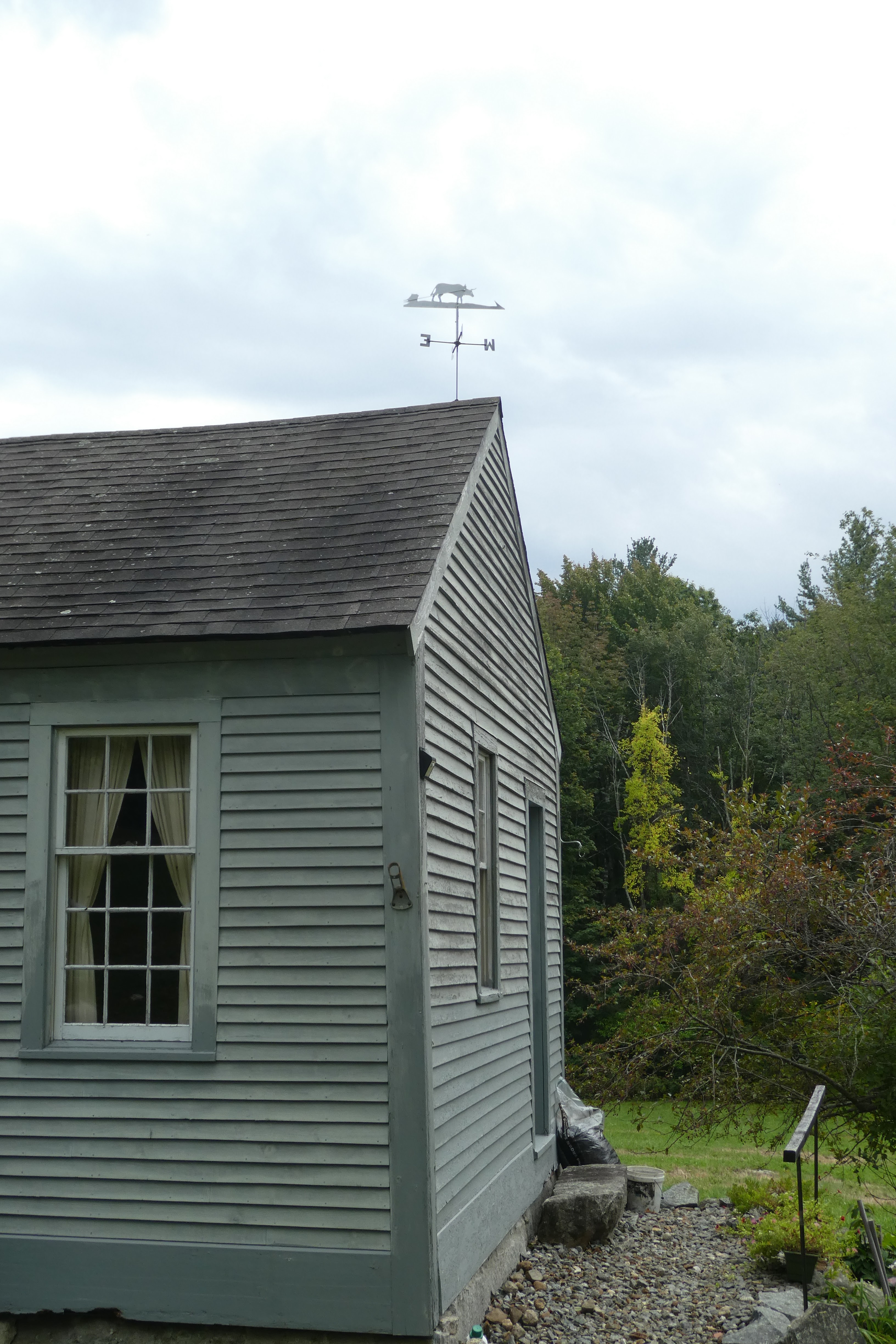
The Mile Away Restaurant is one mile away from the location of where the locals were going to build the village meetinghouse in Monson, New Hampshire.  Monson was incorporated as a town in 1746, the same year this farm house was built.  But the town of Monson was abandoned by the 1770s and the meetinghouse was never built.  The land for the town of Monson was divided up by the nearby towns of Milford, Hollis, and Brookline.  This area is now a historic site with signs on the cellar holes and stone walls.  Only one house survives, and is open some weekends and by chance as an educational center about the history of Monson.  

The Mile Away was turned in to a restaurant by two families from Switzerland in 1967.  The Murphy family bought the restaurant in 1996 and continues to operate a restaurant, with some of the original recipes from Switzerland like Swiss potatoes and Viener Schnitzel. The current executive chef lived in Switzerland for many years. 

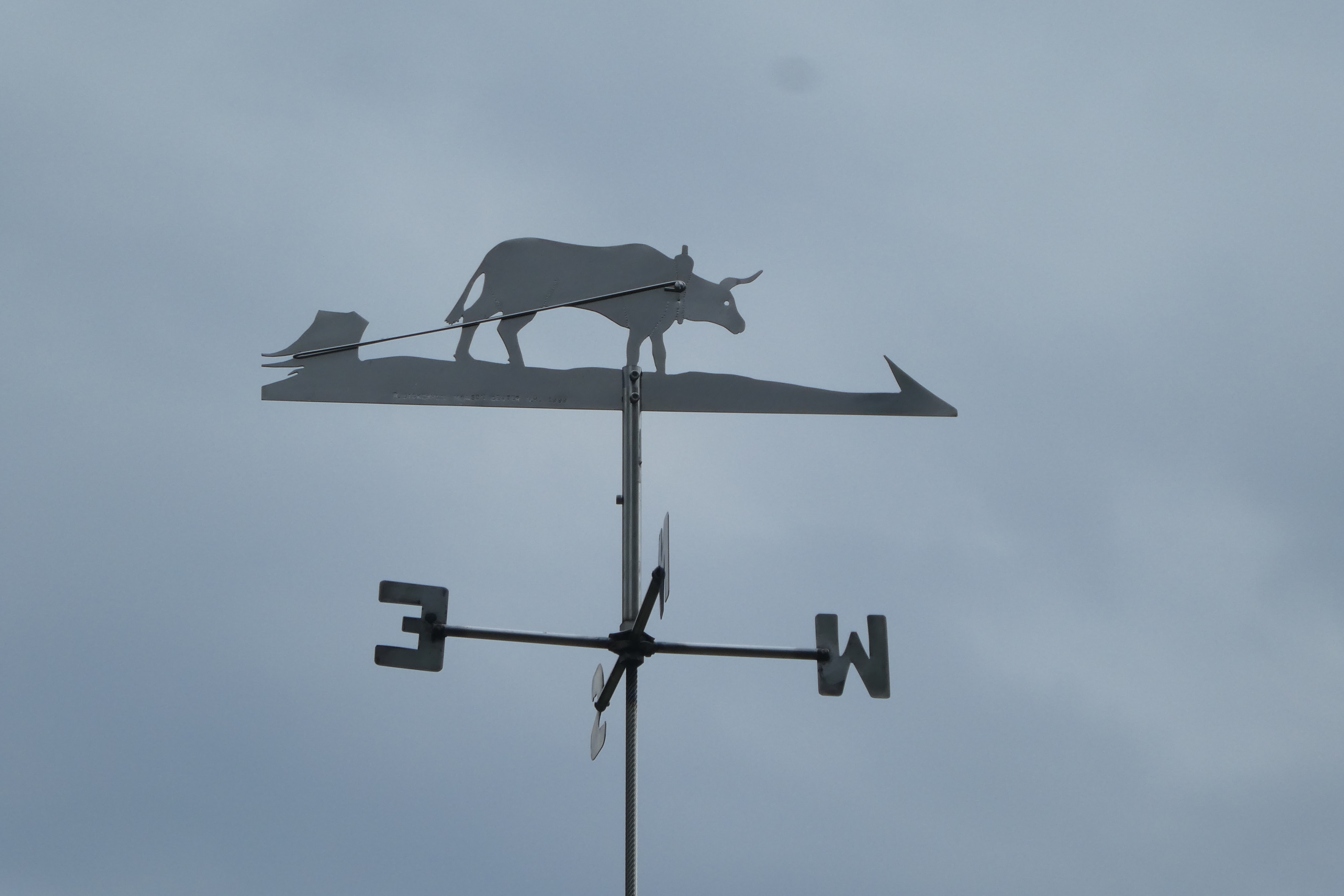
The banner weathervane atop the roof of the main restaurant has the cut out numbers of 1746, honoring the year this farm house was built.  It is a very simple weathervane, appropriate for the humble beginnings of this property as a farm over 250 years ago. 

For the truly curious:

The Mile Away Restaurant and Tented Venue

603-673-3904     https://www.mileawayrestaurantnh.com/   

52 Federal Hill Road

Milford, New Hampshire

Click here to read two more blog posts about the ghost town of Monson, New Hampshire, which is "a mile away" from this restaurant.

2022 "A Walk Through Abandoned Monson, New Hampshire"    https://nutfieldgenealogy.blogspot.com/2022/12/a-walk-through-abandoned-monson-new.html   

2012 "The Abandoned Town of Monson, New Hampshire"     https://nutfieldgenealogy.blogspot.com/2012/09/the-abandoned-town-of-monson-new.html   


Click here to read over 500 more Weathervane Wednesday posts!   https://nutfieldgenealogy.blogspot.com/search/label/Weathervane%20Wednesday  

-------------------------------

To cite/link to this blog post: Heather Wilkinson Rojo, "The Mile Away Restaurant, Milford, NH for Weathervane Wednesday", Nutfield Genealogy, posted May 29, 2024, ( https://nutfieldgenealogy.blogspot.com/2024/05/the-mile-away-restaurant-milford-nh-for.html: accessed [access date]). 

Tuesday, December 20, 2022

A Walk Through Abandoned Monson, New Hampshire

Ten years ago I posted a similar story about a walk through Monson.  It was time for another walk... (see my post at https://nutfieldgenealogy.blogspot.com/2012/09/the-abandoned-town-of-monson-new.html


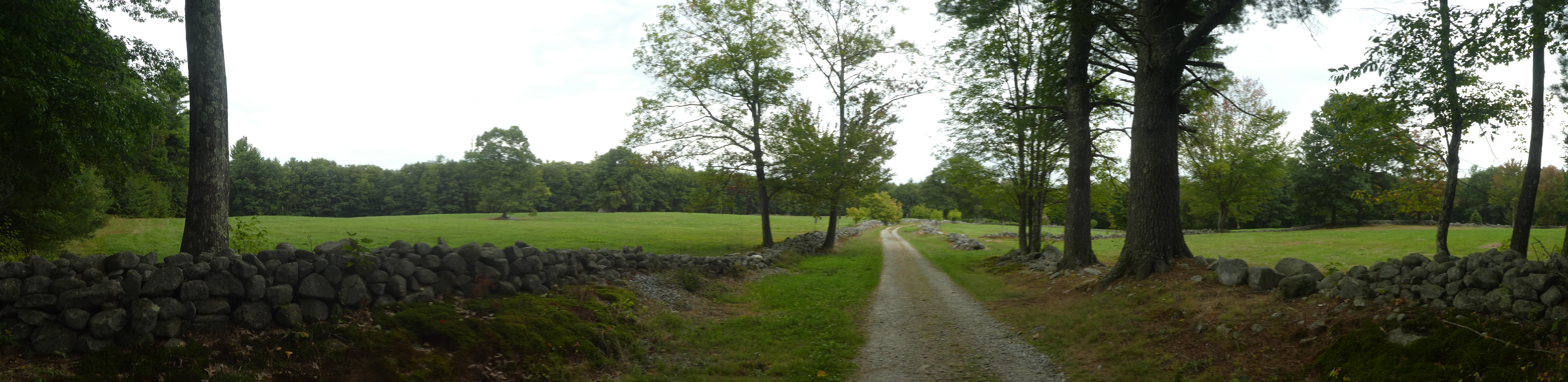
Monson was a town in southern New Hampshire between the 1730s and 1770s, originally part of the state of Massachusetts, but it became part of New Hampshire in 1746.  It was abandoned, and this site now belongs to the two towns of Hollis and Milford, New Hampshire.  It is like stepping back into time.  There are no signs of anything modern except for the information kiosk at the entrance.  All that exists are stonewalls, and one surviving homestead, the Gould house.  This land was donated by Russ and Geri Dickerman. 


There are thriving chestnut trees along the road into Monson Center.  


The Gould House is a small home in the center of Monson, open by chance or by appointment by. We were lucky, Russ Dickerman and his friends were there for a clean up day, and we were able to peek inside for the first time. We also met his dog, Niki II.  


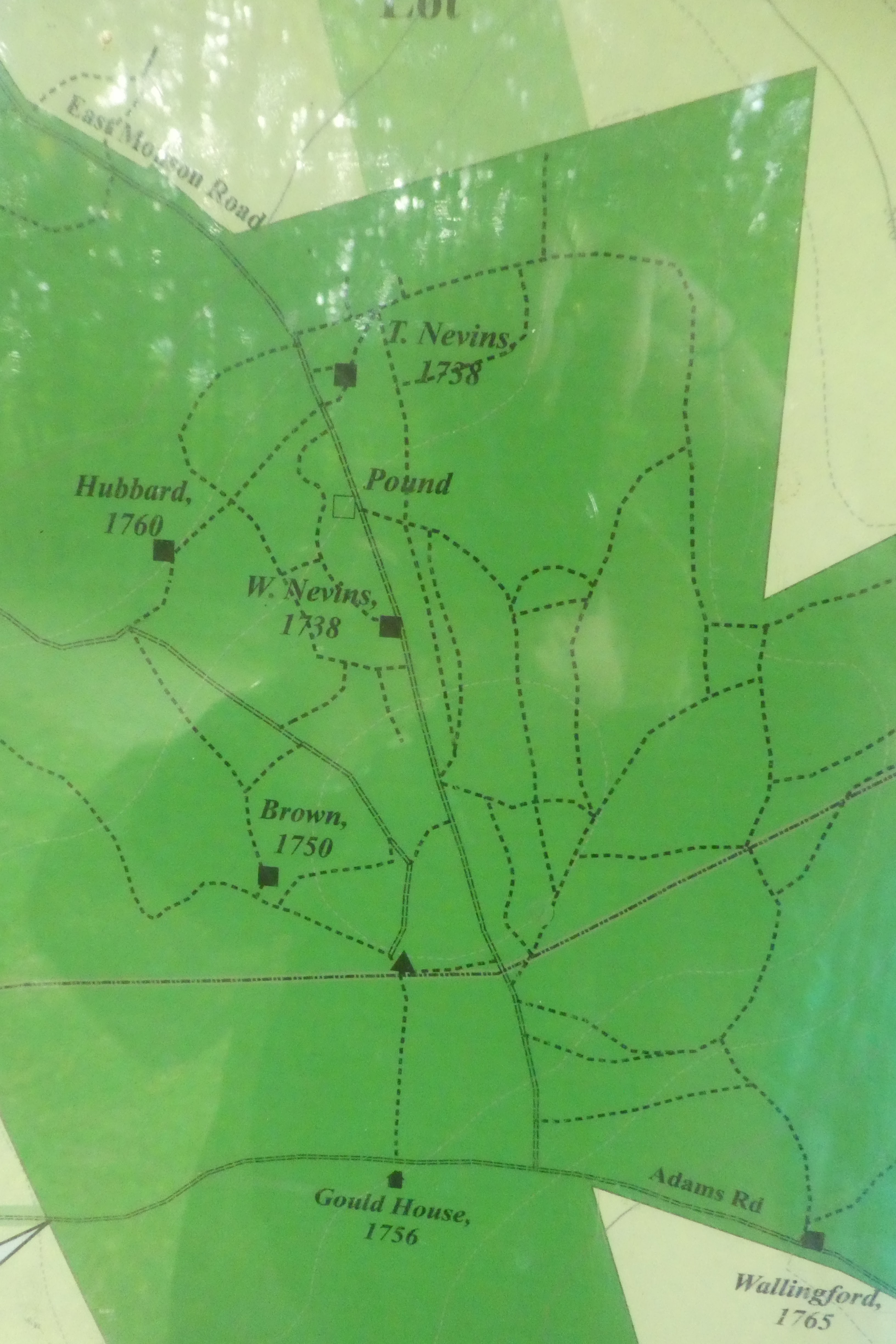
We walked through the fields and forest along these roads and paths to see the cellar holes (which are well marked) for families such as the Wallingford, Brown, Nevins, and Bayley families. There is a stone enclosure that was an animal pound. 


Russ Dickerman's dog, Niki, is buried along the stone wall that circles the meadow. 


Across from the Gould homestead is the cellar hole for another home.  There is a photo of this home, and inside the Gould house is a painting of this home in the early 20th century when a family lived here.  The man who owned this home was Russ Dickerman's uncle. 


This map is on the kiosk at the entrance to Monson Center,
and it is also available online (see the link below)

-----------------

For the truly curious:

The Abandoned Town of Monson, New Hampshire, 2012   https://nutfieldgenealogy.blogspot.com/2012/09/the-abandoned-town-of-monson-new.html   

Society for the Protection of New Hampshire Forests, Monson Center:   https://forestsociety.org/property/monson-center  

Map of Monson Center:      https://forestsociety.org/sites/default/files/Monson%20Village%20Map.pdf  

I've blogged about exploring other "ghost towns" - Monson, NH; Dogtown, MA; Chinese Camp, CA; and Zealand, NH.  You can find them at this link:   https://nutfieldgenealogy.blogspot.com/search/label/ghost%20town  

New Hampshire Magazine, "The Mystery of Monson", 2019:     https://www.nhmagazine.com/the-mystery-of-monson/  

-------------------------

To cite/link to this blog post: Heather Wilkinson Rojo, "A Walk Through Abandoned Monson, New Hampshire", Nutfield Genealogy, posted December 20, 2022, ( https://nutfieldgenealogy.blogspot.com/2022/12/a-walk-through-abandoned-monson-new.html: accessed [access date]). 

Thursday, October 29, 2015

Boo! Some Scary Stories for Halloween!

Derry, New Hampshire's Civil War Monument

Here is a list of spooky ghost stories, ghost towns, witches, body snatchers, and other scary stories from the Nutfield Genealogy blog over the past six years!


The Murder of Josie Langmaid, Pembroke, NH, posted October 14, 2009: http://nutfieldgenealogy.blogspot.com/2009/10/murder-of-josie-langmaid-pembroke-new.html

The Haunted Pinkerton Tavern, Derry, NH, October 28, 2009 (since demolished):  http://nutfieldgenealogy.blogspot.com/2009/10/pinkerton-tavern-ghosts.html

The Haunted Coach Stop Restaurant, Londonderry, NH, January 22, 2010: http://nutfieldgenealogy.blogspot.com/2010/01/coach-stop-restaurant-and-tavern.html

The Lady in Black at Fort Warren, Boston, MA  February 15, 2010: http://nutfieldgenealogy.blogspot.com/2010/02/fort-warren-boston-harbor.html  

Tammy Younger, the Witch of Dogtown, February 22, 2010:  http://nutfieldgenealogy.blogspot.com/2010/02/tammy-younger-witch-of-dogtown.html  

A visit to the Rebecca Nurse Homestead, March 9, 2010: http://nutfieldgenealogy.blogspot.com/2010/03/visit-to-rebecca-nurse-homestead.html  

Body Snatchers, 1819, posted April 30, 2020:

Ghosts at the Towne Family Burial Ground, Londonderry, NH  September 28, 2010: http://nutfieldgenealogy.blogspot.com/2010/09/tombstone-tuesday-towne-family-burial.html  


The Willey Family of Crawford Notch, October 28, 2010: http://nutfieldgenealogy.blogspot.com/2010/10/happy-halloween-story-of-willey-family.html  

The Ghost Town of Chinese Camp, California, September 5, 2011:

The Abandoned Ghost Town of Monson, NH  September 6, 2012:   https://nutfieldgenealogy.blogspot.com/2012/09/the-abandoned-town-of-monson-new.html    

Haunted Hannah Jack’s Tavern, Merrimack, NH  October 30, 2014:  http://nutfieldgenealogy.blogspot.com/2014/10/haunted-hannah-jacks-tavern.html  

A visit to “Blood Cemetery”   October 31, 2014: http://nutfieldgenealogy.blogspot.com/2014/10/halloween-visit-to-blood-cemetery.html  

Enjoy! 

--------------------------------------


To Cite/Link to this blog post: Heather Wilkinson Rojo, "Boo!  Some Scary Stories for Halloween!", Nutfield Genealogy, posted October 29, 2015, (  http://nutfieldgenealogy.blogspot.com/2015/10/boo-some-scary-stories-for-halloween.html: accessed [access date]). 

Thursday, September 6, 2012

The Abandoned Town of Monson, New Hampshire

In this area lay
the center of
the old town of
MONSON
1746 - 1770

I've previously written about ghost towns or abandoned towns like Dogtown near Gloucester, Massachusetts, or Zealand, New Hampshire, or even Chinese Camp in California.  I was surprised to learn that there was an abandoned town just minutes away from me.  Monson was settled in 1737 and abandoned in the 1770s.  It straddles the borders of Hollis and Milford, New Hampshire.

It is like stepping back in time to enter Monson.  You can find it off Silver Lake Road in Hollis, down Federal Hill (a dirt road) and Adams Road (no cars allowed).  You must park about a half mile from the marker pictured above showing the center of Monson.  There are no paved roads, some open fields and cellar holes.  The trail map, available at the Gould homestead, shows a town pound and family names for the cellar holes. It is an easy walk, and very interesting.

Monson, New Hampshire

You can read about Monson in Chapter six, pages 85-94 of the History of Hollis, New Hampshire by S. T. Worcester.  In 1770 the settlers of Monson appealed to New Hampshire's General Court to repeal their charter.  This unusual request came with this explanation: "That the Land in and about the Center of Monson is so very poor, Broken, Baron and uneven, as cannot admit of many settlers, so that those Families that are in Town, are almost all planted in the Extreme parts of it. We have no prospect of ever Building a Meeting-House in the Center or elsewhere, any ways to accomodate us, by which Difficulties we think the Gospel will not be settled among us while in the present situation.  We therefore pray, &tc."


Doc Brown's cellar hole, flashback of the
movie "Back to the Future"! 

This is interesting to me because in 1743 in Hollis, New Hampshire Daniel Emerson, brother of my 6 x great grandfather Brown Emerson, was ordained to be the minister of the newly settled West Parish of Dunstable, Massachusetts.  Shortly afterwards this became incorporated as the town of Hollis, New Hampshire, which absorbed part of the settlement of Monson, and the neighboring town of Milford absorbed the rest.  At about this time, Monson disappeared from the map.


The cornerstone on this stone wall reads "1834"


In 1988 the area faced development into luxury homes, and several neighbors took action to preserve the history of Monson.  Russ and Geri Dickerman headed up an effort to protect Monson, by purchasing the entire tract for the Society for the Protection of New Hampshire Forests. The Dickermans restored the Gould house, the only building still standing in Monson.  There are now trail maps, markers for cellar holes and plaques giving the history of the landscape.  Some of the family names on the cellar holes are HUBBARD, BROWN, BAYLEY, GOULD, WALLINGFORD and NEVINS.

Society for the Protection of Forests website http://forestsociety.org.

A PDF trail map with information   https://forestsociety.org/sites/default/files/Monson%20Village%20Map.pdf

---------------------

To Cite/Link to this blog post: Heather Wilkinson Rojo, "The Abandoned Town of Monson, New Hampshire", Nutfield Genealogy, posted September 6, 2012, ( https://nutfieldgenealogy.blogspot.com/2012/09/the-abandoned-town-of-monson-new.html: accessed [access date]). 

Thursday, June 21, 2012

Stone Wall Stories - #3 Dogtown, Massachusetts


Near Cherry Street in Gloucester, in a large tract of conservation land surrounding the reservoir, you can find the remnants of an early village.   This was the earliest settled place in Gloucester, when the town grew up inland.  After the War of 1812 the people felt safer about living near the harbor, and most left this area to move to the coast.  Only the poorest people stayed behind in what became known as “Dogtown” because of the abandoned dogs who scrounged the cellar holes and shacks.  Widows, vagabonds and the insane were left behind with the dogs.

This Babson boulder marks the spot
of Dogtown Square

During the Great Depression in the 1930s, Gloucester resident Roger Babson hired Italian stonemasons to carve inspirational quotations on 22 boulders in Dogtown.  At the time, the land was clear of trees, and there were numbers marking the cellar holes of colonial residents identified in his grandfather John James Babson’s “History of Gloucester”.  Now, the area is heavily wooded, and hikers have to search for the numbers, cellar holes and Babson boulders.

An antique postcard showing what Dogtown looked like
before it was swallowed up with forest

I had several ancestors and their relatives live in Dogtown.  I previously posted a story “Tammy Younger, the Witch of Dogtown” at this link: http://nutfieldgenealogy.blogspot.com/2010/02/tammy-younger-witch-of-dogtown.html

Today’s post is part of a series of stories I wrote for this week all about stones and stone walls:


One of Roger Babson's inspirational boulders

Wikipedia story on Dogtown, Massachusetts - http://en.wikipedia.org/wiki/Dogtown,_Massachusetts

This Dogtown website http://www.thedacrons.com/eric/dogtown/visiting_dogtown_gloucester.php has maps and history, including the location of most of the Babson boulders.

------------------

Copyright 2012, Heather Wilkinson Rojo

Tuesday, September 6, 2011

Tombstone Tuesday- Chinese Camp Cemetery


The winding dirt road from Rt. 49 up to the cemetery

When I remembered that I had a distant Wilkinson relative buried in Chinese Camp, California, we made a special effort to return to this ghost town to see the cemetery.  I had no idea it would be such a stereotypical burial ground, seeming to pop right out of a Western cowboy movie.  Even though I had seen a few gravestones from this cemetery posted on www.FindAGrave.com  I was unprepared for the sight.  As a New Hampshire resident, I was not accustomed to such a barren place


The first thing I feared was rattlesnakes.  It was just about noon when we arrived, and it was hot and dusty.  The few clumps of dry grass were tall and rustled in the wind.  The ground was pockmarked with holes and I was certain they were rattlesnake holes (but what do I know!).  It took all my courage to get out of the car and open the rusty gate.  I was petrified!  But we had made this detour to Chinese Camp just for genealogy purposes, so I bravely ventured out into the cemetery...

A recent gravestone with a Western theme carved into it

In Loving Memory
RICHARD M. DOWLER
SEPT. 3, 1925
MAY 6, 2009
HUSBAND FATHER GRANDFATHER FRIEND

a not so recent gravestone
After wandering around, and avoiding tall grass, rocky areas, holes and areas where snakes could hide, we gave up on finding our gravestone.  I will say that everyone hurried quickly to the car, where we all discovered that each person (all four of us!) found the cemetery a bit spooky!  This is the only graveyard where I have had that creepy feeling.  Usually I find cemeteries quite peaceful and lovely.

The grave we were looking for was that of Anna Norcross, the fourth wife of Harry Duran Wilkinson.  For some strange reason she was buried in Chinese Camp, although she had died in Sonora, California, which is about 10 miles north.   Anna was born on the island of Nantucket, in Massachusetts.  I can't imagine any other relative of mine having such a diversity in residences from a lush, fog covered island off New England to a dry, barren ghost town in Gold Rush country, California.  Even stranger, I found a tombstone here with a Mayhew name on it.  Just about every third person on Martha's Vineyard (another Massachusetts island) is named Mayhew.  Coincidence?

Harry D. Wilkinson is one of the few Wilkinsons who left New England and settled elsewhere.  Because we were too chicken to poke around in the tall grass, we couldn't find Anna's gravestone in the Chinese Camp cemetery, and according to Find A Grave's website, there is an Anna buried there with similar dates 1884 - 1965, but with the last name of "Bush".   Is this Anna Norcross Wilkinson?  Did she remarry?  Does anyone know her story?

Genealogy:

Harry Duran Wilkinson, son of William Henry Wilkinson and Estelle V. Saunders, born 26 June 1876 in Effingham, New Hampshire, died 29 August 1946 in Napa, California, buried in the Golden Gate National Cemetery in San Bruno, California (served in the Spanish American War 1898 - 1901); married four times:

1st wife Maude Glenini Eddy, daughter of Issac Sylvanus Eddy and Mahala Nellie Bugbee,  born 11 October 1882 in Venus, Nebraska, died 29 July 1919 in Seattle, Washington, one child, Lloyd Harland Wilkinson (1904 - 1945).

2nd wife married about 1922 in Oakland, California to Lucy Mary Mesa, daughter of Francisco Mesa and Maria del Rosario Briones (Yahoo! another Wilkinson married someone with a Spanish surname! She was a descendant of the old Californio Briones family)  born 30 November 1875 in Bolinas, California, died 28 August 1944 in San Leandro, California, one child.

3rd wife Elizabeth Maria Koenig, daughter of Ludwig Koenig and Wilhemina Hallijo, born on 12 October 1872 in Hanover, Germany, died on 27 January 1937 in Oakland.  Three children.

4th wife Anna Norcross, born 13 March 1883 in Nantucket, Massachusetts, died 25 November 1965 in Sonora, California.

-----------------------

Find A Grave website    www.FindAGrave.com

The link to the gravestone of Anna A. Bush  https://www.findagrave.com/memorial/search?firstname=anna&middlename=&lastname=bush&birthyear=&birthyearfilter=&deathyear=&deathyearfilter=&location=Chinese+Camp%2C+Tuolumne+County%2C+California%2C+United+States+of+America&locationId=city_16574&memorialid=&datefilter=&orderby=

------------------------

To cite/link to this blog post: Heather Wilkinson Rojo, "Tombstone Tuesday- Chinese Camp Cemetery", Nutfield Genealogy, posted September 6, 2011, ( https://nutfieldgenealogy.blogspot.com/2011/09/tombstone-tuesday-chinese-camp-cemetery.html: accessed [access date]).

Monday, September 5, 2011

Chinese Camp, Tuolumne County, California


We were driving to Yosemite National Park from San Francisco, when we passed several dusty, small towns between Stockton and Mariposa.  One had just a few houses and a closed general store with a sign “Chinese Camp”.  The name of the town made us all smile, as it certainly looked like a ghost town from the Gold Rush era.  A few miles later I remembered that one of my distant Wilkinson cousins in my genealogical database was buried in the cemetery at Chinese Camp, California.  We vowed to stop again for a photo the next time we passed by.

An abandoned building at Chinese Camp
Well, it took seven years, but recently we did the drive again to Yosemite from San Francisco, and remembered to stop in Chinese Camp along Route 49.    Some of the very first Chinese laborers in California were settled here in 1849.  Although the population of Chinese Camp was only 126 souls in 2010, at one time there were over 5,000 Chinese people living here.  Several historical markers tell the history of the town, but it mostly abandoned and does not appear to be visited by many tourists.  It certainly is not commercialized or a "Disney" place to visit, and actually is quite spooky and overgrown.  We never would have stopped if I didn't have a distant relative buried nearby. 
This was the old post office, and
also served as a Wells Fargo office

This appeared to have once been a home
We drove around the town, but it seemed to be mostly abandoned buildings near the highway, with the houses near the store apparently lived in, although we only saw two people.  The general store is only open on weekends.  Across the street from the store is the gate to the cemetery, which is not visible from the road.  It is located about a half mile up the dirt road, and through another gate.  Neither gate was locked, but we had to get out of the car, open it up, and then close it as we passed through.   I’ll post the cemetery photos for Tombstone Tuesday.


For the truly curious:

History of Chinese Camp, by the Tuolumne County Historic Preservation Review Commission, 1994

Woman Keeps Chinese Camp History AliveThe Union Democrat, 29 November 2009, by Joshua Wolfson, story at this link http://www.uniondemocrat.com/2005112985769/News/Local-News/Woman-keeps-Chinese-Camp-history-alive

A slide show of abandoned Chinese Camp http://www.youtube.com/watch?v=bloCr4PI3nk

Click here for a blog post about our visit to the Chinese Camp cemetery:
https://nutfieldgenealogy.blogspot.com/2011/09/tombstone-tuesday-chinese-camp-cemetery.html 


--------------------

Heather Wilkinson Rojo, "Chinese Camp, Tuolumne County, California", Nutfield Genealogy, posted September 5, 2011, ( https://nutfieldgenealogy.blogspot.com/2011/09/chinese-camp-tuolumne-county-california.html: accessed [access date]). 

Thursday, October 7, 2010

Where the heck is Zealand, New Hampshire?

I found ancestors in a ghost town! Zealand, New Hampshire exists only on birth and death records. It no longer exists on maps, gazetteers or even on line at places like mapquest.com or Google Earth. Sure, I can find a Zealand River, and Zealand Notch ( a notch is a gap or mountain pass in New England), and there is a Zealand Hut as part of the Appalachian Mountain Club trail system. My daughter hiked the Zealand Trail on snowshoes several years ago and stayed overnight in the Zealand Hut. All are remnants of a once thriving town.

In the Great North Woods there were towns that sprung up overnight as “company towns” for the logging and forestry industries. And so they died as quickly as they sprung up. A large part of the Great North Woods became the White Mountains National Forest in 1918, in three non-contiguous areas. There are more than 780,000 acres of protected land in the National Forest, and a large section of land is also New Hampshire or Maine State parkland. These lands became protected areas due to the horrific clear cutting, erosion, large forest fires, and poor land management that occurred at the end of the nineteenth century- just about the same time someone in my family tree was born in Zealand, New Hampshire.

In 1884 the Zealand Valley Railroad ran into the heart of the White Mountain National Forest area, and suddenly a million acres of virgin forest was available for lumber. Around these lumber areas grew company towns, a paternal system of control similar to the textile mill system seen in the Merrimack River valley. The homes, the stores, hotels, railroads and even the hospitals were run by the lumber company of James E. Henry in Lincoln, Fabyans (another ghost town) and Zealand. There were similar towns in Conway and other parts of the Great North Woods. There were strict rules imposed by the lumber companies such as “Any person found throwing food or making unnecessary and loud talk at the tables will be fined” [The Story of Mount Washington, by F. Allen Burt, Hanover, NH, 1974] .

In its heyday 53 million feet of timber were floated down the Connecticut River. Paper production became a major industry in northern New Hampshire. [New Hampshire: Crosscurrents in its Development, by Nancy Coffey Hefferman and Ann Page Stecker, University Press of New England, Lebanon, NH, 2004, page 162] Unfortunately, the number of paper mills has dwindled in the past dozen years, and now tourism reigns in the Great North Woods as the number one industry. The White Mountains National Forest is now one of the most visited parks in the eastern United States. Only hikers can visit Zealand Notch. There are no longer any roads to Zealand, and the Zealand hiking trail follows the path of the old logging train. An area that had been laid waste by fires in 1888 and 1903 is now again hardwood forest.

Note: One member of my family tree who lived in Zealand, New Hampshire is Mabel Boyle, daughter of James Boyle and Catherine McFarlin, born in Zealand on 22 July 1881, d. 25 March 1975 in Franconia, New Hampshire; married on 3 September 1923 to Oscar Sumner Carroll, son of Leslie Carroll and Elnora Mary Wilkinson. Mr. Boyle was found in the 1880 census record in Carroll, New Hampshire, and it lists him as being born in Canada, with his wife and seven children.
The Zealand Trail
Photo by Mike Kautz, National Geographic Society, 2007
 http://www.nationalgeographic.com/

For more information:

The Appalachian Mountain Club http://www.outdoors.org/

Chronicles of the White Mountains by Frederick Wilkinson Chadbourne, Houghton Mifflin, Boston, 1916.

J. E. Henry’s Logging Railroads: The History of the East Branch & Lincoln and Zealand Valley Railroads, by Bill Gove, Bondcliff Books, 1998 [I couldn’t locate a copy of this book at a library nor to view at Google books, but it is on Amazon.com as a used book ]

http://www.logginginlincoln.com/ Bill Gove’s website (Gove is a retired forester who has written three books on New Hampshire’s logging railroads) see the link http://www.logginginlincoln.com/Zealand%20Gove%20Gallery/Zealand%20and%20the%20Zealand%20Valley%20Railroad/ for photos and maps of the Zealand logging railroad http://www.logginginlincoln.com/Page.html has a page about J. E. Henry and his company towns.

http://freepages.history.rootsweb.ancestry.com/~gtusa/usa/nh.htm  A guide to NH “Ghost Towns” (most are associated with logging camps and company towns)

---------------------

To cite/link to this blog post: Heather Wilkinson Rojo, "Where the heck is Zealand, New Hampshire?", Nutfield Genealogy, posted October 7, 2010, ( https://nutfieldgenealogy.blogspot.com/2010/10/where-heck-is-zealand-new-hampshire.html

Monday, February 22, 2010

Tammy Younger, the Witch of Dogtown


A "Babson Boulder" marking the former location
of Dogtown Square


Timeline of Tammy Younger's life:

28 July 1753 Thomasine Younger was born at Gloucester
19 April 1775 - Battle of Lexington, start of the American Revolution
23 August 1775, Tammy married to James McCormick
1812- War of 1812, many Gloucester men were impressed at sea
24 February 1829, Tammy died at Gloucester

---------------------------------------

Thomasine Younger was born in 1753 in Gloucester, Massachusetts to William Younger and Lucy Foster. Her brothers grew up to be seamen, which is not surprising. Her younger brother, Levi, is my 5x great grandfather. Gloucester was a major fishing seaport in New England, famous for the Gorton’s frozen fish packing plant and the statue of the fisherman’s memorial. The majority of men in town were sailors or fishermen, the lucky few were ship builders, merchants and sea captains, and the paupers of Gloucester lived in Dogtown. For some reason, unknown to anyone, Tammy Younger became a resident of Dogtown.

Gloucester today is built up around the harbor. However, in the earliest days of its settlement the colonists hid inland and up on a hill, away from pirates and the native tribes. When the conditions became safer, especially after the war of 1812, the townspeople took advantage of moving to the water front and built their town at one of the best deep water harbors in Massachusetts. The abandoned inland village became home to sailor’s widows, vagabonds and free blacks, who were either too poor or not accepted in town society. When the last of these people died, only abandoned dogs were left, and the area became known as Dogtown.

Some of these last old women in Dogtown were known as witches. They probably didn’t deserve the epithet; they were poor, old and had no family or husband to defend them. Tammy lived on Fox Hill in Dogtown, and she was so poor that she would lie in wait for passing wagons, and “place a curse” on the oxen until the driver gave her food.

Little more is known about Tammy Younger, except for anecdotes in local history books. It is unknown whether she had children, or what happened to her husband. It is my guess that he died at sea, and this sad event started her downward spiral into poverty. She died intestate (of course!) Supposedly money and a snuff box were found in her cellar hole.

Today, if you visit Dogtown, it is forested and part of the town of Gloucester’s Conservation Land. The streets are now walking trails, dotted with cellar holes that have been numbered to identify the original owners from Babson’s book “The History of Gloucester.” Babson’s grandson employed Italian stonecutters during the Great Depression to carve inspirational quotations on dozens of boulders. It is a fun hike through Dogtown today, to look for the cellar holes and to find the “Babson Boulders.”

Today, visitors approach Dogtown by Cherry Street, going uphill to the parking area. This is Fox Hill where Tammy Younger once lived with her aunt, Luce George. This is the hill where she bewitched the oxen struggling to carry corn or dried fish from Gloucester Harbor. Poor Aunt Luce was also reported to be a witch, since she begged for fish at the wharves, and threatened the fishermen with curses until they gave her a portion. Living on the margins of society, these women were the subject of gossip, myth and legend.

I previously wrote about the Younger family on my blog posting on January 14, 2010 in the posting “Levi Younger, Mariner and Prisoner of War” at http://nutfieldgenealogy.blogspot.com/2010/01/levi-younger-mariner-and-prisoner-of.html  

My "Surname Saturday" link for the Younger Family:   https://nutfieldgenealogy.blogspot.com/2016/12/surname-saturday-younger-of-gloucester.html  

-----------

For more information:

History of Gloucester by John James Babson and Samuel Chandler, published by the Proctor Brothers, 1860 (a book of “Notes and Additions” was written by Babson in 1876.)

In the Heart of Cape Ann; or The Story of Dogtown by Charles E. Mann, 1896 - This book described the inhabitants of Dogtown, with maps showing the cellar holes

The Last Witch of Dogtown by Francis Blessington, The Curious Traveller Press, 2001.

The Last Days of Dogtown by Anita Diamant, published by Scribner, New York, 2005. A novel based on the history of Dogtown, and the characters are based on the inhabitants named in Mann’s book, including Luce George and Tammy Younger. My book club read this book in 2006, and then we took a hike through Dogtown and I photographed the boulder you see at the top of this blog post.

Dogtown: Death and Enchantment in a New England Ghost Town by Elyssa East, Simon & Schuster, New York, 2009. This is the most recent book about Dogtown, Gloucester, Massachusetts.

---------------

To cite/link to this blog post:  Heather Wilkinson Rojo, "Tammy Younger, the Witch of Dogtown", Nutfield Genealogy, posted February 22, 2010,  ( http://nutfieldgenealogy.blogspot.com/2010/02/tammy-younger-witch-of-dogtown.html: accessed [accesss date)]. 

Submitted for the Carnival of Genealogy, 91st Edition, A Tribute to Women!
http://creativegene.blogspot.com