Showing posts with label Philadelphia. Show all posts

Tuesday, October 8, 2024

Benjamin Franklin's Burial Site, Philadelphia, Pennsylvania

 These tombstones were photographed at the Christ Church Burial Ground in Philadelphia, Pennsylvania.


BENJAMIN 
                                  And                FRANKLIN
DEBORAH   
                     1790


BENJAMIN FRANKLIN
SIGNER OF
THE CONSTITUTION OF THE UNITED STATES
SEPTEMBER 17, 1787
--------------------------------------
PRESENTED BY
THE PENNSYLVANIA STATE SOCIETY
DAUGHTERS OF THE AMERICAN REVOLUTION
SEPTEMBER 17, 1987


The Body of
B. Franklin, Printer,
Like the Cover of an old Book,
Its Contents torn out,
And stript of its Lettering & Gilding,
Lies here, Food for Worms.
But the Work shall not be lost,
For it will as he believ'd
appear once more
In a new and more elegant Edition
Corrected and improved
By the Author.
---------
(This epitaph written by Franklin as a young
man, was not intended to be used.  His nearby
gravestone was prepared in exact accordance
with the instructions contained in his will.)
-----------
This gravesite restored
by the Poor Richard Club
of Philadelphia


THE LAST RESTING PLACE OF
BENJAMIN FRANKLIN 
1706 - 1790
< 0 >
"VENERATED FOR BENEVOLENCE,
ADMIRED FOR TALENTS,  ESTEEMED
FOR PATRIOTISM, BELOVED FOR
PHILANTHROPY."
                                           WASHINGTON
<  0 >
"THE SAGE WHOM TWO WORLDS
CLAIMED AS THEIR OWN"
                                        MIRABEAU
< 0 >
"HE TORE FROM THE SKIES THE
LIGHTNING AND FROM TYRANTS
THE SCEPTRE."
                                   TURGOT
< 0 >

I have written several previous blog posts about Benjamin Franklin, since he is my first cousin, 8 generations removed.  His mother, Abiah Folger (1667 - 1752) and my 7th great grandmother, Bethshua Folger (1650 - ?) were sisters.  When we were visiting Philadelphia recently, seeing Franklin's house and burial site were on the top of my list of things to do.

The Christ Church Burial Ground in Philadelphia was established in 1719.  Five signers of the Declaration of Independence are buried here. 

This burial ground is easy to find, since it is across the street from the Visitor Center and National Park Visitor Center in Philadelphia.  It is open to the public for a fee of $5 for adults. If it is closed, there is a wrought iron railing in an opening in the brick wall surrounding the cemetery, so you can see Franklin's grave.  It is a tradition to leave a penny on Franklin's grave.  The family plot was restored in 2017 (see the Christ Church webpage below for more information.  

Benjamin and Deborah Franklin are buried to the right of his daughter, Sarah and her husband Richard Bache.  Next to Benjamin's gravemarker is his son who died young,  and Francis F. Franklin (1732 - 1736).  There are nearby markers for Deborah's parents and other Bache family members. 

For the Truly Curious: 

The Christ Church webpage for the burial ground (including a map of the cemetery):  https://christchurchphila.org/burial-grounds/  

Christ Church Burial Ground, at Wikipedia: https://en.wikipedia.org/wiki/Christ_Church_Burial_Ground  

My "Surname Saturday" post for my FOLGER lineage:    https://nutfieldgenealogy.blogspot.com/2014/11/surname-saturday-folger-of-watertown.html  

Other posts about Benjamin Franklin:    https://nutfieldgenealogy.blogspot.com/search/label/Franklin  

-------------------------------

To cite/link to this blog post: Heather Wilkinson Rojo, "Benjamin Franklin's Burial Site, Philadelphia, Pennsylvania", Nutfield Genealogy, posted October 8, 2024, ( https://nutfieldgenealogy.blogspot.com/2024/10/benjamin-franklins-burial-site.html, accessed [access date]).  

Wednesday, September 25, 2024

Carpenters Hall, Philadelphia, for Weathervane Wednesday

 This weathervane was photographed in Philadelphia, Pennsylvania.


A view of Carpenters Court, in front
of Carpenters' Hall

Carpenters' Hall is a historic landmark in Philadelphia, about a block away from Independence Hall.  It was the site of the First Continental Congress in 1774, and also it was where Franklin installed his Library Company. It is open to the public and FREE since 1857 when it was the first private US building open as a historic monument.  Carpenters' Hall was built in 1770 by a Scots architect, Robert Smith, with advice from Benjamin Franklin on fireproofing the building, which would become a library. 

The Continental Congress of the Thirteen Colonies used Carpenters Hall as their first meeting house in 1774.  The hall served as a hospital for British and American soldiers during the Revolutionary War.  Many organizations have used this building including Franklin's Library Company, the American Philosophical Society, and the First and Second Banks of the United States. 

This building was declared a National Historic Landmark in 1970. 

The weathervane is a simple gilded banner style vane, with a Masonic symbol as a finial on top of a cupola. The Carpenters Company was made up of many master craftsmen members who were part of the Masonic fraternity, as well as many members of the Continental Congress. It is possible that the Masons met inside this hall, too, at some point in history. 

According to the official website of the Carpenters Company, the building was originally very plain, with unfinished brickwork, but the cupola, ball and weathervane were original to 1774.  The brickwork was not finished until 17 years later, after the war.  [ https://www.carpentershall.org/architectural-history ]

For the Truly Curious:

Carpenters Hall Company:    https://www.carpentershall.org/  

Carpenters Hall at Wikipedia:    https://en.wikipedia.org/wiki/Carpenters%27_Hall#:~:text=The%20First%20Continental%20Congress%20of,moderate%20Provincial%20Assembly%20of%20Pennsylvania  

Click here to see almost 550 more Weathervane Wednesday posts:

https://nutfieldgenealogy.blogspot.com/search/label/Weathervane%20Wednesday    

----------------------------

To cite/link to this blog post:  Heather Wilkinson Rojo, "Carpenters Hall, Philadelphia, for Weathervane Wednesday", Nutfield Genealogy, posted September 25, 2024, ( https://nutfieldgenealogy.blogspot.com/2024/09/carpenters-hall-philadelphia-for.html: [accessed] access date.) 

Wednesday, September 18, 2024

The Merchant Exchange Building, Philadelphia, Pennsylvania for Weathervane Wednesday

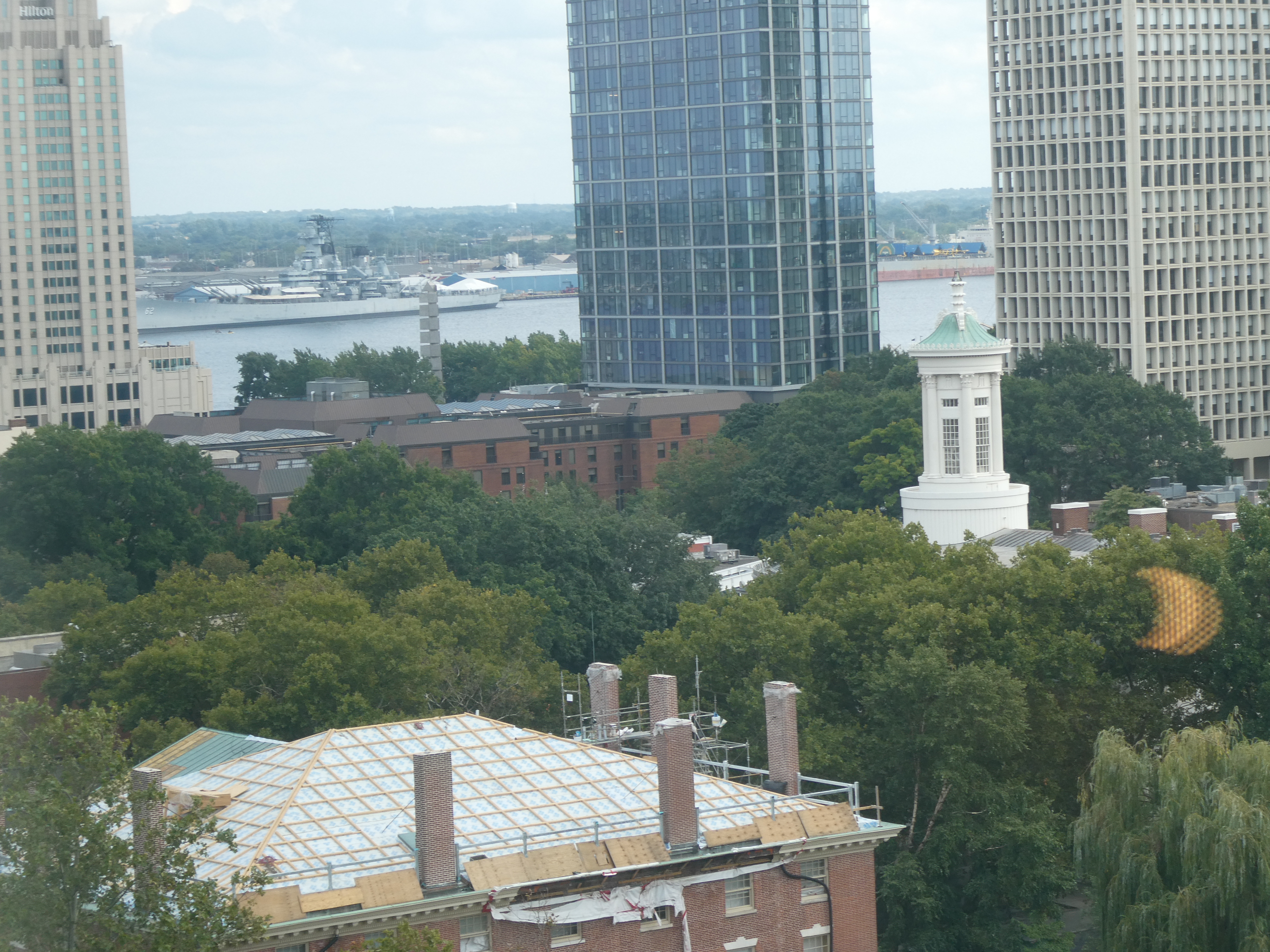
 This weathervane was photographed from our hotel room window in Philadelphia, Pennsylvania.


This was our view from our hotel window, the Marriott Renaissance, located between Independence Hall and the Museum of the American Revolution.  It was a beautiful, gilded weathervane, and it took a long time on Google Maps and the internet to figure out which historic building had this weathervane.  Finally we discovered it was atop the Merchant Exchange Building.  

Merchants' Exchange Building - photo from NPS 

This impressive building was built in 1834 in the Greek Revival style.  It looks like a temple with the round walls and columns.  This building was used as a stock exchange, post office, and housed insurance companies over the years.  Now it is the National Park headquarters, and there is a small exhibit on the first floor entrance open 8:30 to 4:30 Monday to Friday. It is located at 143 South 3rd Street in Philadelphia. 

The Merchants' Exchange was remodeled and restored in 2014.  The copper cupola was restored, and weathervane was cleaned and gilded "in-situ". [ Kreilick Conservation, LLC, "Merchants' Exchange Building 2014", https://www.kreilickconservation.com/merchants-exchange-building-2014  accessed September 17, 2024]  The bright golden weathervane caught our eye from our hotel room.  It was not visible at street level.  

For the truly curious:

Merchants' Exchange Building, Philadelphia, at Wikipedia:   https://en.wikipedia.org/wiki/Merchants%27_Exchange_Building_(Philadelphia)  

Click here to see almost 550 other Weathervane Wednesday posts!

https://nutfieldgenealogy.blogspot.com/search/label/Weathervane%20Wednesday   

-----------------

To cite/link to this blog post:  Heather Wilkinson Rojo, "The Merchant Exchange Building, Philadelphia, Pennsylvania for Weathervane Wednesday", Nutfield Genealogy, posted September 18, 2024, ( https://nutfieldgenealogy.blogspot.com/2024/09/the-merchant-exchange-building.html: accessed [access date]). 

Wednesday, August 14, 2024

Just for fun! A Lego Weathervane - Weathervane Wednesday

 This weathervane was photographed at the Legoland amusement park in Goshen, New York.


Today's featured weathervane was spotted on a family vacation to Legoland New York.  We had fun with all the Lego workshops, Lego art installations, Lego rides, and Lego themed fun.  Inside "Mini-land" there were hundreds of historic sites from all over the USA built out of Lego bricks.  We saw national parks, Las Vegas, New York City, Washington DC, and then there was a miniature Lego Philadelphia.  Their replica of Independence Hall was beautiful, right down to all the colonial details including this Lego weathervane.

I have previously featured Independence Hall and its weathervane on this blog.  You can read all about it at this link:   https://nutfieldgenealogy.blogspot.com/2013/12/weathervane-wednesday-historic-site.html Independence Hall was the meeting place of the Founding Fathers and the place where the Declaration of Independence was signed.  The weathervane in Philadelphia was completely restored and regilded in 2010. 

The Mini-land inside Legoland is a fantastic art exhibition featuring historic sites, including humor and whimsy for all ages.  It's a great way to get generations of children interested in history, geography, and the science and engineering of building with Lego bricks.  I hope you can all visit Legoland, too.  

Legoland's Mini-land seen from a distance
This view shows the Lego version of
New York City

For the truly curious:

My 2013 Weathervane Wednesday blog post on Independence Hall:    https://nutfieldgenealogy.blogspot.com/2013/12/weathervane-wednesday-historic-site.html

Legoland New York:  https://www.legoland.com/new-york/  

The National Park Service Independence Hall website:   https://www.nps.gov/inde/planyourvisit/independencehall.htm 

Click here to see over 500 Weathervane Wednesday blog posts:    https://nutfieldgenealogy.blogspot.com/search/label/Weathervane%20Wednesday


A Lego version of Philadelphia, Pennsylvania, including Independence Hall

------------------------

To cite/link to this blog post:  Heather Wilkinson Rojo, "Just for fun!  A Lego Weathervane - Weathervane Wednesday", Nutfield Genealogy, posted August 14, 2024, ( https://nutfieldgenealogy.blogspot.com/2024/08/just-for-fun-lego-weathervane.html: accessed [access date]). 

Saturday, July 4, 2020

Happy 4th of July!

The Liberty Bell inside Independence Hall,  Philadelphia

Betsy Ross House, Philadelphia, 1974

Happy Fourth of July!
These images were scanned from slides of a Girl Scout trip I took to Philadelphia in 1974. 
Not bad for a twelve year old Girl Scout? I wish I had taken more photos! 


--------------------

Cite/Link to this post:  Heather Wilkinson Rojo, "Happy 4th of July!", Nutfield Genealogy, posted July 4, 2020, ( https://nutfieldgenealogy.blogspot.com/2020/07/happy-4th-of-july.html: accessed [access date]).

Wednesday, December 11, 2013

Weathervane Wednesday ~ A Historic Site

Every Wednesday for more than two years I've been posting photographs of weather vanes located in or near the Nutfield area (the former name for the land where Londonderry, Derry and Windham, New Hampshire are now located). Most are historically interesting or just whimsical and fun weather vanes. If you know an interesting weather vane, please send me an email or leave a comment below.

Today's weather vane can be found on a very historic building in Pennsylvania. Have fun guessing where you may have seen this weather vane.

Do you know the location of weather vane #128? Scroll down to see the answer....


Today's weather vane was seen on the steeple above Independence Hall in Philadelphia, Pennsylvania. This beloved building is a UNESCO World Heritage Site and a National Historic Landmark. The tower above the hall was built between 1750 and 1753.   In 2010 the tower section of Independence Hall underwent extensive renovations, including new clock faces, replacing the structure that held up the weather vane, and updating the lightning protection systems.  You can see photographs of the restoration and re-gilding of the weathervane by Kreilick Conservation Company at this link: http://www.kreilickconservation.com/projects/Objects/IndependenceHallWV.html

For more information:

National Park Service- Independence Hall  http://www.nps.gov/inde/independence-hall-1.htm/index.htm

Visit Philadelphia - Independence Hall
http://www.visitphilly.com/history/philadelphia/independence-hall/?gclid=CM_4m7XX47cCFRQOOgodyyQARA


-------------------------------
The URL for this post is
http://nutfieldgenealogy.blogspot.com/2013/12/weathervane-wednesday-historic-site.html

Copyright 2013, Heather Wilkinson Rojo

Wednesday, July 4, 2012

4th of July ~ Celebrate the Signers of the Declaration of Independence

The Matthew Thornton homestead in Merrimack, NH
is now a restaurant "The Common Man".
It was formerly a restaurant called "Hannah Jack" his wife's maiden name. 
If you live in one of the thirteen original colonies, then somewhere near you lived someone who signed the Declaration of Independence.  This is what the 4th of July is all about, not hot dogs, fireworks, or parades.  Most of these men are relatively unknown heroes, except for a few who have famous names like Benjamin Franklin and Thomas Jefferson.  New Hampshire was the home state of three signers, all are fairly unknown souls: Matthew Thornton, Josiah Bartlett (not the president on the TV show "West Wing"), and William Whipple.  Thornton and Bartlett were both physicians.

Matthew Thornton was born in Northern Ireland and settled as a doctor in Londonderry, New Hampshire (did you know three of the signers were born in Ireland?).  He became a colonel of the Londonderry militia, and led his men to Louisburg, Nova Scotia in 1745.  As a doctor he was able to keep his casualties down to only six men, although the army suffered great losses in that expedition.  During the American Revolution he was too old to serve again in the army, but served instead in the many provincial congresses and was chairman of the Committee of Safety in 1775.   He was elected to the Continental Congress but did not arrive in Philadelphia until November of 1776, and was allowed to sign the Declaration of Independence after the fact.


Across the street from the Thornton homestead is this grand memorial.
Matthew Thornton is NOT buried here, but is buried several yards south
in the family plot, with his wife and several children.
The actual Thornton family plot
Erected
To the Memory of
the Honble
MATTHEW THORNTON
who died june 27th
1803
Aged 89 Years
The Honest Man

After his retirement from public life he removed to Merrimack, New Hampshire.  He farmed and operated a ferry across the Merrimack River.  This part of Merrimack is still known as Thornton's Ferry. He died while visiting his daughter in Newbury, Massachusetts.  He is buried in Merrimack in a simple grave that reads "An Honest Man".  The large memorial obelisk was raised in his honor many years later.

A previous blog post about Matthew Thornton:
http://nutfieldgenealogy.blogspot.com/2010/07/fourth-of-july-matthew-thornton-signer.html

A webpage about the Thornton Cemetery from Janice Webster Brown's website:
http://www.nh.searchroots.com/HillsboroughCo/Merrimack/thornton-cemetery.html

-----------------------

To cite/link to this blog post:  Heather Wilkinson Rojo, "4th of July ~ Celebrate the Signers of the Declaration of Independence", Nutfield Genealogy, posted July 4, 2012, ( https://nutfieldgenealogy.blogspot.com/2012/07/4th-of-july-celebrate-signers-of.html: accessed [access date]).

Thursday, May 17, 2012

Two Cousins


Can you guess these two famous cousins of mine?  Both were named “Benjamin”.

Both men grew up within twelve miles of each other, near or in Boston, Massachusetts.  They were contemporaries and lived through the American Revolution.  One was considered a patriot, and one a traitor.

Both men were scientists, and both invented household items like stoves and forms of central heating.  Both were honored by European Scientific Societies.  Both developed theories in thermodynamics.

Both men were philanthropists and endowed educational pursuits in America.

Both men had illegitimate children.  

Both men were statesmen and politicians.  Both were honored in European royal courts.  One took a title of nobility, and the other refused to take a title.  Both were also considered philosophers.

I don’t know if they ever met, and neither was related to the other, but both are my first cousins, one 6 generations removed, the other 8 generations removed.

--------------------------------

Cousin #1, Benjamin Thompson AKA Count Rumford

If you have a can of Rumford Baking Powder on your shelf, you have seen his silhouette.  He was born in Woburn, Massachusetts on 26 March 1753, the son of Benjamin Thompson and Ruth Simonds.   Ruth was the sister to my 5x great grandfather, Caleb Simons (1720 – 1811).    At age thirteen he was apprenticed to a Salem merchant, where he learned mathematics and the physical sciences.  When the merchant lost his business due to the strained relations between Britain and the colonies, Benjamin Thompson returned home to Woburn to work in a dry goods store.  He eventually became a school teacher and took a few classes at Harvard.

In 1772 he served as a British major in a New Hampshire regiment.  When the war broke out he sided with the Loyalists.  When the British evacuated Boston in March 1776 he fled to England and left his New Hampshire wife behind.  He was elected to the Royal Society in 1779.  He returned to America briefly during the war and was knighted in 1784.  He served the Prince of Bavaria for the next 18 years (the Prince was a relative of King George of England). 

He was made a count of the Holy Roman Empire, and took the name “Count Rumford” for his former wife’s hometown (Rumford was the former name of Concord, New Hampshire). He was married to the widow of the famous chemist Lavoisier.  He wrote the theory that heat was a form of motion, and was the father of thermodynamics.  The Rumford fireplace was one of the inventions that changed chimney design forever after making rooms smoke free.  He endowed the Rumford chair of science at Harvard and the Rumford Medals of the Royal Society and the American Academy of Arts and Sciences.  He is buried in the Auteuil Cemetery in Paris, France.

Cousin #2 Benjamin Franklin

Benjamin Franklin is the better known of the two cousins.  He was born on 6 January 1706 on Milk Street in Boston, the son of Josiah Franklin and Abiah Folger.  Abiah was the sister of my 7x great grandmother, Bethshua Folger (born about 1650 on the island of Nantucket).   Benjamin Franklin was the youngest son of a soapmaker.   At age 12 he was apprenticed to his brother James, a printer.  At age 17 Benjamin Franklin ran away to Philadelphia to start a new life.

In Philadelphia he became a printer, and started a subscription library in 1731.  This library continues today as The Library Company, a research library with rare books and manuscripts. He became a Freemason and entered into a common-law marriage with Deborah Read.  He had an illegitimate son, William, who would become the last Loyalist governor of New Jersey.

Franklin became an author, first with Poor Richard’s Almanack, and then he became an inventor.  He never patented his creations, which included the lightning rod, the Franklin Stove, and bifocal glasses.  He became postmaster, and founded the American Philosophical Society.   He was awarded the Royal Society’s Copley Medal in 1753 and 1756 for his work with electricity.   In 1753 he was awarded honorary degrees from both Harvard and Yale.

Politically active, he traveled to London many times as a delegate for Pennsylvania against the Stamp Act.  He became a delegate to the Second Continental Congress and a member of the committee that drafted the Declaration of Independence. Following the Revolution he was Ambassador to France and minister to Sweden.   In 1787 he was a delegate to the Constitutional Convention. 

Benjamin Franklin died 17 April 1790 in Philadelphia and left 1,000 pounds to both Boston and Philadelphia for education to be used 200 years after his death.   Philadelphia’s portion had grown to more than $2 million and they spent it on scholarships, while Boston’s portion grew to almost $5 million which was used to found the Franklin Institute of Boston. 

--------------------

President Franklin Delano Roosevelt stated that Sir Benjamin Thompson ( Count Rumford), Benjamin Franklin and Thomas Jefferson were “the three greatest minds America has produced”.

Click here for a previous post on the "Count Rumford House" in Woburn, Massachusetts: http://nutfieldgenealogy.blogspot.com/2012/05/count-rumford-house.html

--------------------
Copyright 2012, Heather Wilkinson Rojo


Friday, July 2, 2010

Fourth of July - Matthew Thornton- Signer of the Declaration of Independence

Matthew Thornton's gravesite at Merrimack, NH

Fifteen or twenty years ago, when my daughter was in elementary school, we visited Philadelphia, Pennsylvania. We toured the city, saw the Liberty Bell, Ben Franklin’s house, and ate some cheese steak sandwiches. Of course, we didn’t miss Independence Hall, either. The tour was guided. When we came to the room where the Continental Congress delegates met, my daughter raised her hand and asked to see in which chair Matthew Thornton sat. The other tourists looked puzzled but the guide smiled and said “YOU must be from New Hampshire!”

He is not as famous as Thomas Jefferson, or John Hancock, or Benjamin Franklin, but nonetheless little Londonderry, New Hampshire produced Dr. Matthew Thornton. Like many other Nutfield Settlers, he was born in Northern Ireland, and immigrated when only three years old first to Wiscasset, Maine and then to Worcester, Massachusetts before settling in a part of Londonderry now known as Derry in 1740. He was a physician, justice of the peace, and a member of the militia. Locally, he was a Londonderry selectman, a representative to the Provincial Assembly, and the first President of the Committee of Safety which produced New Hampshire’s first draft of its constitution after the royal government was dissolved.

Later he was elected to the Continental Congress in Philadelphia. He arrived too late to participate in the debates, but he did sign the Declaration of Independence. He became the first president of the new New Hampshire House of Representatives. He retired from his medical practice in 1780 and removed across the river to the part of Merrimack, New Hampshire known as Thornton’s Ferry. He died on 24 June 1803 whilst staying with his daughter in Newburyport, Massachusetts, but he is buried in the Thornton Cemetery in Merrimack with his wife and other members of the family.

According to myth, Dr. Thornton had promised Hannah Jack he would marry her when she was a child unwilling to take some nasty medication. She was 18 and he was 46 years old when they married. Her family members were also Scots-Irish Presbyterians.

Of the 56 signers of the Declaration of Independence, six arrived in time to only sign (not participate in drafting the document), eight were foreign born (three were born in Ireland), and four were doctors. Matthew Thornton was all three of these! There is a memorial to Dr. Thornton along Rt. 3 in Merrimack, a plaque in front of his home in Derry, and a school named in his honor in Londonderry. The town of Thornton, New Hampshire was named for Dr. Matthew Thornton.

Across the street from this graveyard on Daniel Webster Highway stands the Thornton homestead.  It was a tavern style restaurant in named “Hannah Jack’s” but it is now part of the Common Man Restaurant chain.  If you stop by the restaurant, the rooms are decorated with information and images from the Thornton family, especially Matthew Thornton.  The staff will gladly show you around!

----------------------------
Matthew Thornton’s family tree:

Generation 1: James Thornton, born about 1684 in Northern Ireland, died 7 November 1754 in Londonderry, New Hampshire; married to Elizabeth Jenkins, arrived in Boston on 17 August 1718 from Northern Ireland. Eight children, including:
Generation 2: Matthew Thornton, born about 1714 in Northern Ireland and died 24 June 2803 in Newburyport, Massachusetts; married in 1760 to Hannah Jack, daughter of Andrew Jack and Mary Morrison of Chester, New Hampshire, born 1742 and died 5 December 1786, Five children:

1. James, b.20 December 1763 in Londonderry and married to Mary Parker
2. Andrew, b. about 1766 in Londonderry, died 22 April 1787
3. Mary, b. 1768 in Londonderry, married to Hon. Silas Betton of Salem, New Hampshire
4. Mathew, b. 1770 in Londonderry and married to Fanny Curtis
5. Hannah, b. 25 Jul 1774 in Merrimack, married to John McGraw, of Newburyport, Massachusetts

For more information:

http://www.nh.searchroots.com/HillsboroughCo/Merrimack/familytrees3.html Family Trees of Merrimack, New Hampshire

http://bioguide.congress.gov/scripts/biodisplay.pl?index=T000242 from the Biographical Dictionary of the United States Congress

-----------------

Heather Wilkinson Rojo, "Fourth of July - Matthew Thornton-  Signer of the Declaration of Independence", Nutfield Genealogy, posted July 2, 2010, ( https://nutfieldgenealogy.blogspot.com/2010/07/fourth-of-july-matthew-thornton-signer.html: accessed [access date]). 

Thursday, June 17, 2010

Ona Judge Staines, A Slave Runs away to New Hampshire

A story for Juneteenth

How did a runaway slave from Philadelphia come to New Hampshire? And why was she instantly recognized? Well, she belonged to George Washington, and he had served the last part of his presidency in Philadelphia. Elizabeth, daughter of Senator John Langdon, had seen this slave woman when visiting the First Lady. The Chief Secretary to Washington was Tobias Lear, a Portsmouth native, who also knew the runaway by sight.

Ona Judge Staines was the daughter of an English indentured servant, Andrew Judge, and a black slave mother for the Washington family. She had belonged to Martha Washington’s first husband, Daniel Parke Custis. Children born to slave mothers were property of the slave holder. Ona was a seamstress, and Martha’s personal maid. She didn’t want to return to Virginia at the end of George Washington’s term, so she ran off and took passage on board a ship, the “Nancy”, bound for Portsmouth, New Hampshire. This advertisement appeared in the Pennsylvania Gazette on 24 May 1796:

Advertisement.

Absconded from the household of the President of the United States, ONEY JUDGE, a light mulatto girl, much freckled, with very black eyes and bushy hair. She is of middle stature, slender, and delicately formed, about 20 years of age.
She has many changes of good clothes, of all sorts, but they are not sufficiently recollected to be described—As there was no suspicion of her going off, nor no provocation to do so, it is not easy to conjecture whither she has gone, or fully, what her design is;—but as she may attempt to escape by water, all matters of vessels are cautioned against admitting her into them, although it is probable she will attempt to pass for a free woman, and has, it is said, wherewithal to pay her passage.
Ten dollars will be paid to any person who will bring her home, if taken in the city, or on board any
vessel in the harbour;—and a reasonable additional sum if apprehended at, and brought from a greater
distance, and in proportion to the distance.
FREDERICK KITT, Steward.
May 23


Somehow word made it back to Philadelphia that Ona was in New Hampshire. In November 1796 Washington wrote to Joseph Whipple, the Portsmouth Custom Collector, about returning his slave. Whipple obviously had anti-slavery feelings when he wrote back that a slave who returned voluntarily was “infinitely more value in the estimation of her employer than one taken forcibly like a felon to punishment."

By January 1797 Ona had married Jack Staines. Washington had asked his nephew, who was taking a trip to Portsmouth, to seize Ona and any children she might have had. The nephew, Burwell Bassett, arranged to have dinner with Senator Langdon. The Senator sent a message to Ona, who fled to Greenland, New Hampshire with her baby. She hid with a free black family, the Jacks. When Washington died three months later, she thought she was free.

In New Hampshire Ona found a marriage, religious freedom, and learned to read and paint. She had three children. She worked as a live-in maid for the Bartlett family of Portsmouth, and then removed to Greenland to live with the Jacks family, her former protectors. When she outlived her children, and could no longer work she was reduced to poverty. Ona was supported by several benevolent people of Greenland, and the town records show she received donations of firewood. She died on February 25, 1848. The Staines and Jacks family grave site is located off Dearborn Avenue in Greenland, New Hampshire.

The story of Ona Judge Staines was been made into play recently performed in Portsmouth in 2000. “Thirst for Freedom” was written by Emory Wilson. Several children’s books have been written about her, as well as a popular poem in 1900 written by poet M. O. Halls of Greenland, New Hampshire “Ona, Washington’s Runaway Slave”.

Ona, Washington's Runaway Slave

By M. O. Halls (1900)

But what I have to tell, is, how a slave was hid,
A maid of Martha Washington, a little kid,
And almost white; she had some help and found a way
To make escape upon a schooner down the bay.
The vessel came with wood; behind a pile she hid,
Until, just as the vessel sailed, she thought and did

Just what occasion prompted, slipped on board and hid
Again, and there she stayed in fear until they bid
Her to come on deck, and have no fear, for she was safe;
And all were drawn in pity to the little waif
Of fifteen years. The vessel, bound for Portsmouth, kept
Right on until she reached her port, and then she wept
For joy. Liberty is sweet (bear this in mind)
To all-to bird and beast, as well to all mankind.

A man by name of Staines took her to wife. By her
He had two daughters. 'Liza lived, and many were
The presents made to pave the way to see a slave
Of Washington. Now, when 't was known he wished to save
This chattel, she was warned and fled to this retreat.

The course pursued was very wise; he was discreet.
His letter showed the noble man he always was.
"His wife would like her back, but would not be the cause
Of any strife, take any action, give offence,"
He said, "if public feeling had become intense."
Charles Sumner, senator and statesman (this maintains,)
Was written the collector of the port 'bout Mrs. Staines.
And when the story spread, that she was wanted back,

She sought and found a shelter in the house of Jack.
The Jacks were very jealous of attentions paid
To this lone widow woman, and, when some were made
In common, took the lion's share, scoop in the whole
And treated little Staines as though she had no soul.

The ground where once the cottage stood, there by the brook,
To-day is all smoothed down, and in this garden nook,
Where once sweetwilliams, daffodils, and beds of rue,
Old fashioned flowers, perfumes mixed and drank the dew.

There's nothing left to tell the tale of daily strife,
Of constant struggle, ending only with the life.
They are all buried in a lonely, far-off spot,
Away from human kind-a lonely pasture lot.
Now let us leave this lovely, lonely, sacred dell.


----------------------

For the truly curious, more information on Ona Judge Staines:

https://www.seacoastonline.com/story/news/local/portsmouth-herald/2017/04/03/portsmouth-s-ona-judge-is/21642021007/  Ona Judge Staines from Seacoast Online, Portsmouth, New Hampshire 

http://en.wikipedia.org/wiki/Oney_Judge from Wikipedia

http://www.ushistory.org/presidentshouse/slaves/oneyinterview.htm Ona’s story from the website of The President’s House in Philadelphia, including an interview in 1846 that appeared in The Liberator newspaper.

------------------------

To cite/link to this blog post: Heather Wilkinson Rojo, "Ona Judge Staines, A Slave Runs away to New Hampshire", Nutfield Genealogy, posted June 17, 2010, ( https://nutfieldgenealogy.blogspot.com/2010/06/ona-judge-staines-slave-runs-away-to.html: accessed [access date]).  

Friday, July 31, 2009

Nutfield's Royal Connection


Doña María del Rosario Cayetana Alfonsa Victoria Eugenia Francisca Fitz-James Stuart y Silva

The Duchess of Alba, the grandest grandee in Spain, is said to be able to cross the country from north to south without leaving her estates, and to possess more titles than the Queen of England. She is one of the wealthiest women in the entire world. She has 44 noble titles and 150 hereditary titles. Her name is splashed on headlines in Europe more than the Octomom, Michael Jackson and Angelina Jolie combined in the United States.

I married a Spaniard, and in all our trips to visit the in-laws in Madrid, we often pass the Duchess of Alba’s grand mansion. Of course, I only see it whilst jammed into a public bus, peeking out between the elbows of other Madrileños. We all hope to see the Duchess perhaps in her limo, or out watering the roses.

I recently saw that on top of all her titles, she was applying, with her sisters to belong to DAR. Now, here in lowly Londonderry, membership in the Daughters of the American Revolution and the Society of Mayflower Descendants might be the closest your average Jane Doe can attain to having a “title.” I guess Doña Cayetana wanted to pile another title on her crown.

When I found out how she qualified for DAR membership, I had to chuckle. The lineage was public knowledge, and is easily found with a little time spent googling on the internet. Now thousands of Americans may claim her as a cousin, and perhaps want to crash on her sofa while taking in the sites in Madrid!

William McKean (pronounced McCain, like the presidential candidate) was a Scots Irish immigrant from Northern Ireland, just like most of the first settlers in Nutfield. He, like so many of the Scots Irish, didn’t stay put in New Hampshire, but he removed to Pennsylvania. His grandson, Thomas McKean, was a lawyer and politician, as well as a Revolutionary War officer. He married well twice, and lived in luxury in Philadelphia. He became a signer of the Declaration of Independence, a Continental Congressman, President of Delaware and Governor of Pennsylvania, among other triumphs. I guess grand titles run in this family!

His daughter, Sarah, was only a teenager when she caught the eye of a Spanish grandee at a state dinner in Philadelphia. Señor Don Carlos Martinez d’Yrugo quickly married her and had three children before returning to Spain. Their son Don Carlos Fernando Martinez de Yrujo y McKean became prime Minister of Spain, and the second Marquis de Casa Yrujo, Duke of Sotomayor. He married even better than his grandfather and mother, and his children and descendants began collecting titles, estates and power in Spain. Thus a dynasty was born in lowly Londonderry!

Doña Cayetana FitzJames Stuart is also a direct descendant of the King James II of England by his illegitimate son James FitzJames, 1st Duke of Berwick by his mistress Arabella Churchill.


The Family Tree....

  • Gen. 1. William McKean b. 1704 Northern Ireland d. 18 Nov 1769 in Londonderry, New Hampshire m. Letitia Finney

  • Gen 2: Thomas McKeen b. 19 Mar 1733/4 in New London, Pennsylvania d. 24 Jun 1817 in Philadelphia, Pennsylvania m. Sarah Armitage on 3 Sep 1774 in Newcastle, Delaware

  • Gen 3: Sarah Maria Teresa McKean b. 8 Jul 1777 in Newark, Delaware d. 4 Jan 1841 in Madrid, Spain m. Carlos Martinez on 10 Apr 1798 in Philadelphia

  • Gen 4: Carlos Fernando Martinez b. 14 Dec 1802 Washington, DC d. 26 Dec 185 in Madrid, Spain m. Gabriela de Acazar

  • Gen 5. Carlos Manuel Martinez b. 5 Apr 1846 in London, England d. 14 Sep 19 in San Sebastian, Spain m. Maria Caro

  • Gen 6. Pedro Martinez b. 3 Oct 1882 d. 5 Sep 1957 San Sebastian, Spain m. Ana Maria Arazcoz Labayen on 26 Oct 1910

  • Gen 7. Luis Martinez b. 17 Nov 1919 in Madrid, Spain d. 6 Sep 1972 in Houston, Texas m. Maria del Rosario Fitz-James Stuart on 12 Oct 1947 in Seville, Spain as her first husband. 
      The children of her first husband are eligible for DAR or to join the "Descendants of the Signers of the Declaration of Independence" and other patriotic organizations because of this marriage.  

-----------------
Copyright 2009, Heather Wilkinson Rojo