Showing posts with label DNA. Show all posts

Thursday, March 28, 2019

Science Cafe NH - A Conversation about DNA and Forensic Genealogy

Panelists at the Science Cafe event, March 27th, in Concord, NH
Left to right, Buzz Scherr, Kim Rumrill, and Beth Wilkes

Every month there are several Science Cafe events around the state of New Hampshire.  Although I have been reading Dave Brooks as "The Granite Geek" in his science column in the Concord Monitor, I hadn't paid attention to these gatherings. Then I saw this event on Facebook for the March 27th event in Concord for "How Forensic Genealogy is Cracking Decades Old Cold Cases" and I jumped at the chance to attend.  Vincent, the science buff (and MIT graduate) was interested in the topic, too.

Vincent and I arrived just in time to grab the last seats at a table at Makris restaurant, where the Science Cafe is now meeting every fourth Wednesday of the month. After we were seated, a few more chairs were brought out and squeezed into corners, and a half dozen people stood along the walls, and about 15 people were turned away.  According to Dave Brooks, who was the moderator for this night's panel discussion, said that he had never anticipated such a large crowd. There were over 90 in this dining room.

Forensic DNA, as well as DNA in general, has made genealogy and genealogy websites very popular in the last few years.  The constant commercials on TV for DNA testing, as well as several very infamous crime cases on the news media have made DNA intriguing to the general public. This is probably why so many people turned up for this particular Science Cafe event.  However, most of the general public still doesn't understand how DNA works, and how the ethics of these cases has changed crime fighting and privacy issues.

Since this was a "Science Cafe", the panel members were not genealogists, even though the word "genealogy" was prominent in the title of the event.  Milli Knudsen, who was the forensic genealogist for the New Hampshire state police on the Bear Brook case, or other forensic genealogists, were not on this panel. The panelists chosen for this night were Buzz Scherr, from the UNH School of Law, an expert on genetic laws and privacy (he penned last year's legislation for privacy which passed by 80% on the NH ballot); Kimberly Rumrill, a criminalist with the New Hampshire State Police Forensic Laboratory; and Beth Wilkes, a professor of genetics at NHTI.

The questions posed from the audience to the panel were very interesting, and they also showed that members of the audience had varying degrees of knowledge on the subject of DNA.  The very first question posed was from an audience member who wanted to know the ethics of Ancestry selling his DNA to insurance companies (answer: they are not selling his information to insurance companies).  The second question was about CRISPR and gene editing, a more advanced topic.  Another audience member had a question about the Bear Brook mystery (for people outside of New Hampshire - this was a cold case about several bodies found buried in steel barrels on the grounds of Bear Brook State Park in Allenstown.  The case was solved using DNA and genealogy - see the link below for a podcast about the case, or Google "Bear Brook Case" for news stories).

One audience member wanted to know if our DNA is 99.9% identical (between any two humans), how could the differences point out a suspect in a crime case?  This is where the panel could have used an actual forensic genealogist.  Although the panelists explained how certain markers are examined for mutations and differences in the code, they didn't know which commercial DNA companies (Ancestry, 23andMe, GEDmatch were mentioned) used Y or mtDNA (none of them, only FamilyTreeDNA does the paternal or maternal testing).  They didn't know how to explain triangulation, or centimorgans, DNA Painter, Ancestry Thrulines, or any of the other methods genealogists use to find family members (cousin connections).  Genealogists were mentioned, especially Parabon Nano-Labs in the context of being part of the team to help solve the crimes.

The panel was excellent at explaining the ethical problems in criminal cases, and in explaining the science of genes, chromosomes, phenotyping, etc.  Vincent, although he was an MIT graduate, was glad he had already learned about genetic DNA at RootsTech, the Southern California Genealogy Society Jamboree, NERGC, and from genealogy speakers like Judy Russell and Blaine Bettinger.  Although this is a science topic, it crosses over into law, ethics, government and other disciplines.

Vincent and I were intrigued enough by this event to put some of the other Science Cafe, NH programs on our calendar.  There are Science Cafe events in Manchester (SEE Science Center's Science on Tap), Portsmouth, Nashua, Holderness (hosted by the Squam Lake Association), and Lebanon (hosted by Dartmouth College).  The Nashua Science Cafe is held at the Riverwalk Cafe at 6pm on the second Wednesday of each month.  The Concord Science Cafe is held at Makris Lobster and Steak Restaurant at 6pm on the fourth Wednesday of the month.  Dave Brooks joked that per capita, New Hampshire has more Science Cafe's than any other state.  Considering that we are such a tiny state with a tiny population, maybe he is right!

Look for this show on Concord TV in a week or two (also will air in several other communities in New Hampshire and nation wide)  https://www.yourconcordtv.org/projects/science-cafe-concord/ 

If you are interested in DNA and genetic genealogy, don't forget that in two weeks the New England Regional Genealogy Conference (NERGC 2019) will be in Manchester, New Hampshire April 3 - 6, 2019 at the Double Tree Hotel on Elm Street  http://www.nergc.org/  .  Genetic DNA is so popular right now, that Blaine Bettinger's pre conference DNA day on Wednesday April 3rd has sold out.  You can still follow the DNA track of workshops, lectures and presentations on April 4, 5, and 6 (attend all three days, or just one or two days).  See the conference brochure with a schedule of all the events, including DNA and genetic genealogy at this link: http://www.nergc.org/wp-content/uploads/2018/12/NERGC-2019.pdf 


Science Cafe, NH on Facebook  https://www.facebook.com/sciencecafenh/

The Science Cafe, NH website  http://sciencecafenh.org/ 

New Hampshire Public Radio's podcast on the Bear Brook Cold Case, solved using forensic genealogy:  https://www.bearbrookpodcast.com/ 

NERGC 2019 (New England Regional Genealogy Conference April 3-6)  http://www.nergc.org/

--------------------------------

Heather Wilkinson Rojo, "Science Cafe NH - A Conversation about DNA and Forensic Genealogy", Nutfield Genealogy, posted 28 March 2019, ( https://nutfieldgenealogy.blogspot.com/2019/03/science-cafe-nh-conversation-about-dna.html: accessed [access date]).

Wednesday, January 23, 2019

Weathervane Wednesday ~ Weathervanes of a famous English University

I posted a series of weather vane photographs every Wednesday.  This started with images of weathervanes from the Londonderry, New Hampshire area, but now I've found interesting weather vanes all across New England and across the globe.  Sometimes my weather vanes are whimsical, or historical, but all are interesting.  This series is drawing to a close next week when I publish my 400th weathervane post!

Today's weather vanes were photographed in England.

Do you know the location of weathervane post #399?  Scroll down to find the answer.


These weathervanes were photographed when we toured Cambridge University in England as part of the General Society of Mayflower Descendants Historic Sites Tour in 2017.  We visited Cambridge because the passenger William Brewster attended Peterhouse College at Cambridge.  And the pastor to the Pilgrims, Rev. John Robinson, my 11th great grandfather on both my maternal and paternal sides of the family tree, received a Bachelor of Arts degree in 1596 from Corpus Christi College and he earned his Master of Arts in 1599. 

This weathervane and the two below are just interesting banner weathervanes we spotted as we wandered the streets of Cambridge.  I'm not sure what the buildings are, but they are part of the University.

-------------------------------------------------------


-------------------------------------


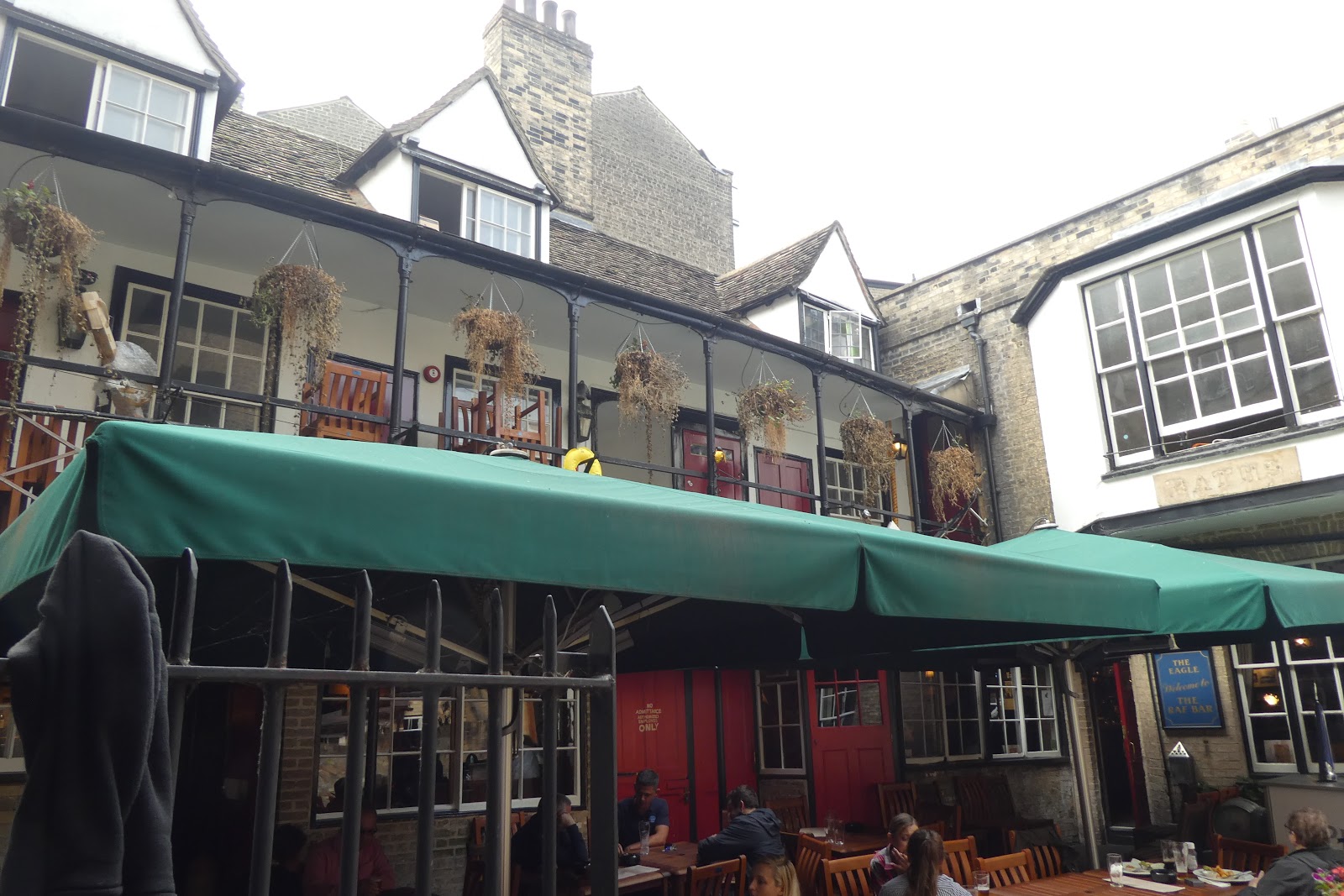
These two weathervanes were on two buildings directly across the lane from famous Eagle pub where Watson and Crick relaxed in between their research on DNA at Cambridge University.  You can read more about our visit to this pub at this link:  https://nutfieldgenealogy.blogspot.com/2018/04/where-did-watson-and-crick-hang-out.html   

I love the dragon weathervane, and I'm sure there is a story to this choice, but I couldn't find it.  The banner weathervane next door appears to have a design embossed into the metalwork, but it is impossible to see if it is just decorative, or perhaps it is numbers or words? 

----------------------------------------------


This odd weathervane was above the tower of St. Benet's Parish Church.  I can't decide if this is a banner style weathervane, or perhaps a wind paddle with an interesting counterweight.  This is the oldest church in Cambridgeshire, and the oldest building in the town of Cambridge.  The tower was probably built between 1000 AD and 1050 AD.  It is next to Corpus Christi College at Cambridge University. 


------------------------------

Heather Wilkinson Rojo, "Weathervane Wednesday ~ Weathervanes of a famous English University", Nutfield Genealogy, posted January 23, 2019,(https://nutfieldgenealogy.blogspot.com/2019/01/weathervane-wednesday-weathervanes-of.html: accessed [access date]). 

Wednesday, April 25, 2018

Where did Watson and Crick hang out when not working on DNA?

April 25th is National DNA Day!


While we were on our trip to England with the Mayflower Society Historic Sites tour, we went to Cambridgeshire, home of passenger John Howland, who was born in Fenstanton.  Nearby was Cambridge University.  Did you know that passenger William Brewster attended Peterhouse College at Cambridge?  The pastor to the pilgrims, Rev. John Robinson, also received a Bachelor of Arts degree in 1596 from Corpus Christi College, and in 1599 he earned a Master of Arts.  Robinson is my 11th great grandfather on both my maternal and paternal sides of the family tree. 


The Eagle pub is owned by Corpus Christi College.  In the rear of this building is the RAF bar, where pilots used to hang out during World War II.  It is covered with military insignia and graffiti from the era.  Do you know who used to hang out here after the war?  Francis Crick and James Watson used to have lunch here, and on 28 February 1953 they stood up in the bar and announced their discovery!  We celebrate DNA Day as April 25 because on that day in 1953 they published their discovery in the journal Nature.  I rather like the pub story better!


And so, because Vincent is an Aero Space engineer, and because I'm a genealogist, we decided to have lunch at the Eagle pub, too.  Here are the photos of our visit.  Happy DNA Day! 


A special beer on tap in the RAF bar


This plaque marks the table where Watson and Crick used to sit:

The Eagle Cambridge
Discovery of DNA
On this spot, on February 28, 1953, Francis Crick
and James Watson made the first public
announcement of the discovery of DNA with the
words "We have discovered the secret of life".
Throughout their early partnership Watson & Crick
dined in this room on six days every week.


We enjoyed a pint or two of the DNA ale!

--------------------------------------

Heather Wilkinson Rojo, "Where did Watson and Crick hang out when not working on DNA?", Nutfield Genealogy, posted April 25, 2018,  ( https://nutfieldgenealogy.blogspot.com/2018/04/where-did-watson-and-crick-hang-out.html: accessed [access date]).

Monday, September 7, 2015

DNA Results Help Uncover The Unusual, but Sad, Life of George W Ravell

A guest blog post by Charles K. Wilkinson, my 4th cousin.

Central Cemetery, Beverly, Massachusetts

JOHN A. RAVEL
1838 - 1915
MARGARET HIS WIFE
1843 - 1892
ABBIE F. WILKINSON
1876- 1913


Mystery: 
My DNA results identified a probable third cousin (PTC) on Ancestry.  This means that PTC and I should have common great-great grandparents.   PTC ‘s tree was quite extensive having over 66,000 people.   PTC identified seven of 8 pairs of great-great grandparents, none of which matched any of my great-great grandparents.

Observation:
PTC’s great-grandfather, for which the great-great grand-parents were not identified, was George W. Rowell.  I had a great-grandfather named John Ravell.   John Ravell had a younger brother named George W.  Ravell. 

Question: 
Could George W. Rowell and George W. Ravell be one and the same person?

Central Cemetery, Beverly, Massachusetts

1830 CHARLOTTE S. ROWELL 1914
1896 THOMAS T. STEEVES 1956
1894  ETHEL W., HIS WIFE  1982
1871  CLARENCE W. McNUTT  1926
1872 CHARLOTTE R. HIS WIFE  1950
DAUGHTERS
1897  MINERVA   1897
1891  MILDRED R. BALL 1965


Research on George W.  Ravell   

George W Ravell was born in Salem, MA to parents John and Eliza Jane (Ashby) Ravell on November 18, 1840, the 7th of 10 children consisting of 7 girls and 3 boys.   George’s father died in an accident in 1850 when George was 9 and his mother died of consumption in 1853 when George was 13.  Four of the five oldest children, all girls, died between 1848 and 1852.  Benjamin, the second youngest offspring, died about 5 months after his mother’s death; he was living with his great-uncle and namesake Benjamin Pickering Ravell in Lynn.  (The elder Benjamin was born just 4 months before his nephew, George’s father.)  The MA 1855 census revealed the location of the 5 remaining Ravell children.    The two youngest living children, both girls, – Martha and Emeline (Emma) – lived with their older sister Ellen (Ravell) Buxton in South Danvers.   The two boys did not live with family.   John, my great-grandfather, age 17, was living with the Hood family in Danvers; George, now 15, was living with the Tyler family in Middleton.  The occupations of the heads of both of those households were shoemakers.

George Ravel married Eliza Ann Reed in South Danvers, MA in 1860.  He and Eliza were listed in the 1860 Federal Census (last name spelled Ravels).   George registered for the Civil War Draft in 1863 (last name spelled as Ravell), and was listed in the 1865 MA census with his wife and 2 children,  Benjamin P. – age 4, and Eliza E. – age 1.  In the two listings in 1860, George’s occupation was shoemaker.  In the 1863 Draft Registration and the 1865 Census, his occupation was morocco dresser[1].   The family resided in South Danvers[2] in all the above listings.  After 1865, George Ravel (Ravell) disappeared from the records, with one notable exception which will be discussed later.  His wife Eliza and 2 children appeared in the both the 1870 and 1880 Federal Censuses, residing in Peabody with Eliza’s aunt, Harriet Very.

Research on George W. Rowell:

George W. Rowell was listed in both the 1870 and 1880 Federal Censuses.  His wife was Charlotte (Steele) and they had four children born between 1869 and 1875.   The oldest, George Washington Rowell, was born in Pennsylvania and the other three in Delaware.  George’s ages, 29 and 39 respectively, were consistent with a birth-date in late 1840.   His occupation in both censuses was morocco dresser, the same as George W. Ravel.  George’s place of birth was MA, and Charlotte’s was New Brunswick.  Their 1870 residence was in Wilmington Division 28, New Castle, Delaware.   By 1880 they had moved to Beverly, MA.   There were two revealing entries in the 1880 Federal Census: 1. George was suffering from liver problems, and 2. he had been unemployed for 6 months during the census year.

Death Record for George W. Ravel, alias Rowel:

The Massachusetts, Town and Vital Records, 1620-1988, Bridgewater Deaths for 1887 gave the death record for ‘George Ravel, alias Rowel’.   He died at the Bridgewater State Farm[3], the cause of death was ‘insane’, and place of burial was ‘Salem’.  As was common in most records of the past, there were certain discrepancies: he was recorded as single, as having been born in Beverly, his parents were listed as ‘Jake and Eliza’ instead of John and Eliza, and his age was given as 47, not 46.  These could have been recording errors or intentional misinformation by either George or whoever was responsible for him.  Without doubt, this is our George W. Ravell, alias George W. Rowell.

Charlotte Steele:

Charlotte Steele’s death record, filled out by her daughter, Charlotte Steele McNutt in January 1915 gives useful information about Charlotte, the widow of George W. Rowell.  Charlotte was born in St John’s, New Brunswick on Nov. 26 1830 of parents Joseph Steele and Charlotte Jackson, both born in New Brunswick.   How did George, as a married man, meet Charlotte Steele?  One first suspects as logical that George might have been on duty down south during the Civil War when he met Charlotte Steele.  The records provide a very plausible, quite different,  explanation.  In June of 1868, George’s youngest sister, Emma, married John Steele, Jr.  John emigrated from New Brunswick in 1862 according to the 1900 Federal census.  The 1861 Canadian census listed John, age 14, his parents John and Charlotte, and siblings Charlotte, age 30, and Christopher, age 7, living in St. Andrews, New Brunswick.  Emma’s marriage to John Steele took place approximately 2 years before George W. Rowell and Charlotte were living in Delaware with an 11 month old son.  Circumstances between George and Charlotte in MA in 1868 appeared to have forced them to make a decision to flee rather than stay and face the consequences of their actions.

Comments:

If Charlotte’s father was indeed Joseph, and not John, she possibly was the half sibling of John, Jr. and Christopher.  I have found no evidence of a certificate of marriage for George W. Rowell and Charlotte Steele.  Charlotte was 10 years older than George and, while ‘married’ to George, lied about her age.  In the 1870 Census she was listed as 33, not 39; in 1880 she was listed as 45, not 49.

George’s parents were John Ravell and Eliza Jane Ashby.  His father John Ravell's parentage is not well documented, but the similarity of given family names point strongly to John being the grandson of Adam Ravell and Elizabeth Pickering of Salem; he was possibly the son of their son John, or the illegitimate son of one of their younger daughters.  Eliza Ashby's brother Nathanial (born the same year as the Prophet Joseph Smith) became a Mormon, and travelled west with a large group.  The Ashbys have a rich history as shipwrights in Salem, MA.


[1] "Morocco" was a type of goat skin leather that was much lighter in weight than what had been typically used in shoe manufacturing.. The "dresser" was the person who actually tanned or softened the leather.

[2] South Danvers separated from Danvers and incorporated as a town on May 18, 1855.  The name was changed to Peabody, after George Peabody, on April 30, 1868.

[3] The Bridgewater State Farm was one of three state Almshouses that cared for the ‘Sick Poor’ of Massachusetts. Bridgewater existed as an Almshouse from 1854-1887, at which time it was called a State Farm.  Later it evolved into Bridgewater State Hospital for the care of the insane. 

--------------------------

To cite/link to this blog post:  Charles K. Wilkinson and Heather Wilkinson Rojo, "DNA Results Help Uncover The Unusual, but Sad, Life of George W Ravell", Nutfield Genealogy,  posted September 7, 2015 ( http://nutfieldgenealogy.blogspot.com/2015/09/dna-results-help-uncover-unusual-but.html : accessed [access date]). 

Thursday, June 5, 2014

A New Hampshire Yankee at Jamboree ~ Day One

Jo-Anne Mountain, Bennett Greenspan, Diahan Southard,
and Jake Byrnes, with moderator Blaine Bettinger

I'm in Burbank, California at the DNA Day preceding the Southern California Genealogy Society's annual Jamboree.  Last night Ancestry.com made a timely announcement, which is on everyone's mind today.  They announced that they are discontinuing their MtDNA and Y-DNA tests, to focus on the autosomal DNA testing.

I was with CeCe Moore and Judy Russell after the luncheon today for a minutes or two as they discussed their conversation during a group conference call with some bloggers and Ancestry.  One was under the impression that the samples would not be kept, and the other thought that Ancestry stated that they were still considering what would happen to samples.  Until there is public clarification from Ancestry, no one is sure what will happen to those samples.  What is sure, is that you have only until September 5th, 2014 to download your test results before they are deleted from the Ancestry website.

But the controversy remains that no-one is clear on the fate of the samples already submitted to Ancestry.  Bennett Greenspan repeated his company's guarantee twice today- that samples submitted to Family Tree DNA are kept for 20 years.  This is important for people who submitted their grandparent's samples, and now their grandparent's have passed away.  As new tests become available, they would like their grandparent's DNA tested again.  Greenspan also gave the caveat that although the samples are kept, they are not always viable, or they do not always work with some of the newer testing.  At least you can try with FTDNA, which is impossible if Ancestry destroys samples.

Now because of this new information from Ancestry, the classes today have been full of questions.  Everyone wants to know if their parents and relatives can "bank" their DNA.  According to Greenspan, his company is looking into this possibility. I have no idea about the other companies such as National Geographic, 23 and Me, Britain's DNA, African Ancestry, etc.  Perhaps their representatives are discussing this right now in the other sessions still going on at this conference today?

In March we visited Spain.  My father-in-law living in Madrid is elderly and suffers from Parkinsons, so we had him give a sample for the Ancestry Autosomal test.  Now I'm wondering when we will be returning to Spain so I can bring an FTDNA test, or some other test because of this controversy.  I don't know how long he will live, or if he will even live until we can get back to Spain.  It is sad to thing this way, but it is important to consider.

I'm very glad I decided to participate in the DNA Day today as part of Jamboree!

"Ancestry.com Pulls the Plug on Several Sites" from Geneabloggers
http://geneabloggers.com/ancestrycom-pulls-plug-sites/

"Ancestry.com Officially Retires Y-DNA and mtDNA Testing" from Your Genetic Genealogist
http://www.yourgeneticgenealogist.com/2014/06/ancestrycom-officially-retires-y-dna.html

-----------------------
The URL for this post is
http://nutfieldgenealogy.blogspot.com/2014/06/a-new-hampshire-yankee-at-jamboree-day.html

Copyright 2014, Heather Wilkinson Rojo

Friday, March 14, 2014

Is Everyone Irish on St. Patrick’s Day?


Most of my ancestors are from England with a few exceptions. Sprinkled among my English ancestors are a Dutch stowaway, a Hessian Soldier, a 1650 Scots Prisoner of War, and several Ulster Presbyterians with Scots roots.  There are also several noble connections in my family tree which lead back to Normans (Vikings), Plantagenets with Spanish and French brides, and more Scots.  According to the “Ethnicity Estimate” for my DNA at Ancestry.com I tested for 100% European, with a breakdown of 79% Europe West, 18% Ireland and 3% Iberian Peninsula and less than 1% Great Britain.  


The 18% Irish DNA has me stumped.  Of course there are plenty of brickwall maiden names in my tree, and I have only traced my WILKINSON maiden name back to London around 1690. So who are these Irish ancestors that are supposed to be hanging off my family tree? Did some of my Ulster Presbyterian ancestors have Irish spouses?  Were some of my English ancestors of Irish heritage in the centuries past? Were some of my Scots originally from Ireland?  I haven't yet found proof of a single Irish man or woman in my research.

My most heavily researched Scots lineage is MUNROE.  My immigrant ancestor in this line was William MUNROE, my 7th great grandfather, captured in 1650 at the Battle of Worcester and marched to London as a prisoner of war.  He was put on a ship to Boston and sold into servitude on the wharf at Charlestown, Massachusetts.  His descendants have been heavily researched and documented in New England.  

According to the Clan Munroe website, the surname MUNROE refers to the River Roe in Ireland, their ancient homeland.   The River Roe is located in County Londonderry in Northern Ireland.   The fact that I live today in Londonderry, New Hampshire where one of the first Scots Irish settlements was established in 1719 seems like serendipity.   Everything has come full circle?


Another puzzle is my husband’s DNA test.  He is a first generation American, with parents from Spain.  His test came back 3% African, 96% European and less than 1% West Asian. The breakdown reads 3% North African (the “Moorish” influence on his ancestry), 61% Iberian Peninsula, 21% Italy/Greece, 10% Ireland, 3% Great Britain, 1% Europe West and less than 1% Middle East.   His DNA is typical of the invading Moors, Romans, and invading Celts and other Mediterranean tribes.  What stumps me is that he has more Great Britain DNA than me, and there is a significant amount of Irish in him!  

We’ll both be wearing green on St. Patrick’s Day!

Celebrate your possible Irish roots with free access to selected Irish records at Ancestry.com this weekend, through Saint Patrick's Day (March 17th)-
 http://www.ancestry.com/cs/us/irish?o_xid=59482&o_lid=59482&o_sch=Email 

---------------------------
The URL for this post is
http://nutfieldgenealogy.blogspot.com/2014/03/is-everyone-irish-on-st-patricks-day.html

Copyright © 2014, Heather Wilkinson Rojo

Monday, July 30, 2012

A Genealogist Visits the DNA Learning Center

Dolan DNA Learning Center
Cold Springs Harbor, Long Island, New York
Lucky me to visit the Dolan DNA Learning Center in Cold Springs Harbor, New York!  According to their website, it is the “first science center devoted entirely to genetics education”.   It is a combination museum and educational lab, serving field trips, summer camps, teacher training, and all sorts of classes.  There are Saturday DNA classes for the general public, and several DNA and genetics related films in their theater.  They also offer fellowships for college and university students and staff.

In my peek at the facility, I not only enjoyed their current exhibit, “The Genes We Share”, but I learned about how scientists James Watson and Francis Crick, who discovered and described the double helix shape of the DNA strand, were aided by Cold Springs Harbor Lab scientists.  James Watson made his announcement of his discovery at the Cold Springs Harbor symposium in 1953.  Later he became the director for thirty five years.

The model made by Watson and Crick
to show the double helix structure
of the DNA strand

A photo of Watson and Crick
with their DNA model
The facility was full of elementary and high school aged students on the afternoon I visited.  They were busy in state of the art laboratories and computer labs, learning things I wish I had learned at their age.  If I lived closer I would definitely be taking classes at the Dolan DNA Learning Center.  I remember taking a half year class in high school on genetics and DNA, but it was back in the 1970s, before all the current wonderful discoveries and genome mapping projects.  Since this facility is associated with the Cold Springs Harbor Laboratories, I’m sure that the latest discoveries are explained to the students, teachers and public here.

There are also Dolan DNA learning centers in Harlem and Lake Success, New York.  Check their website for several online classes, too.

For more information:
Dolan DNA Learning Center www.dnalc.org
334 Main Street
Cold Spring Harbor, NY  11724
Phone (516) 367-5170

Cold Springs Harbor Laboratory http://www.cshl.edu/about-us/

Image Archive on the American Eugenics Movement (circa 1910 – 1940) at Cold Springs Harbor Laboratory, (some of these images and text use offensive words for 21st century tastes, but are historically accurate) http://www.eugenicsarchive.org/eugenics/list3.pl/  Included are archives on sterilization laws and immigration restrictions all imposed on the public due to research flaws and racism.

---------------------
Copyright 2012, Heather Wilkinson Rojo

Saturday, March 19, 2011

Spring News and Other Happenings

Wow! I guess someone is reading my blog! First Nutfield Genealogy appeared on the Family Tree Magazine Top 40 and now more recognitions!

Thanks Wendy, Dave
Leslie and Nancy!
I was tickled pink to receive the One Lovely Blog Award four times! Thanks to Wendy B. the blogger at “Shaking Leaveshttp://shaking-leaves.blogspot.com/ , Dave Weller, the author of the blog "Tree Rings" at http://wellerharvey.wordpress.com/, from Leslie Albrecht Huber at “The Journey Takers” blog http://www.thejourneytakers.blogspot.com/, and from Nancy at “My Ancestors and Me” at the link http://nancysfamilyhistoryblog.blogspot.com/ . I no longer participate in the blog awards by listing my favorites, because there are simply too many to list. But I appreciate your thoughtfulness! I enjoy these blog honorifics because I always learn new blogs to follow. Please click on these links and check out Dave’s, Wendy’s, Leslie’s and Nancy’s blogs!

If you are in the area, there is a very active Genealogy Club meeting on the second Friday of every month at the Rogers Memorial Library in Hudson, New Hampshire. I’ve attended a few times, and the last meeting had about thirty attendees! The next meeting will be April 9th, 2011 at 1:30 and there will be a showing of a DNA video, followed up by a presentation at the May meeting on Genealogy and DNA by Richard Guilmette. http://www.rodgerslibrary.org/

Don’t miss NERGC on April 6-9, 2011 in Springfield, Massachusetts. The New England Regional Genealogical Conference http://www.nergc.org/ is held every other year, and this year’s theme is “Exploring New Paths to Your Roots”. There is a great line up of speakers and workshops.

The New Hampshire Society of Genealogists is having their Spring Meeting on April 2nd at the Manchester City Library from 10AM – 3PM. See the link http://nhsog.org/nhsog/mtgs/mtg1104.htm for more information. The Meeting is free and open to the public.

The Maine Genealogical Society is also having a spring conference day on April 23rd in Winslow, Maine http://www.rootsweb.ancestry.com/~megs/workshop.html John Phillip Colletta, who is also speaking at NERGC will giving a lecture on "Using Federal Records for Genealogical Research".

At his genealogy blog “Transylvania Dutch” John Newmark announced a new eZine for genealogists called “Generations of Poetry” at the link http://geneapoetry.com/ if you are interested in submitting a poem please consult the submission guidelines at http://geneapoetry.blogspot.com/p/submission-guidelines.html This is a great new spring project! April is National Poetry Month.

Speaking of literature, the annual Five Colleges Used Book Sale is April 23 – 24 in Lebanon, New Hampshire. This event (since 1962!) is well worth the drive, as proceeds benefit scholarships to five distinguished women’s colleges (Mt. Holyoke, Simmons, Smith, Vassar and Wellesley) http://www.nhliving.com/events/fivecollegesbooksale/index.shtml

Spring is full of new beginnings!

Plimoth Plantation reopened on March 19th, and the Mayflower II is back in at Plymouth Harbor from its winter berth at Fairhaven. http://www.plimoth.org/ Strawbery Bank Museum in Portsmouth opens on May 1st, 2011. http://www.strawberybanke.org/ Canterbury Shaker Village in Canterbury, New Hampshire will reopen for the season on May 14, 2011. http://www.shakers.org/ The American Independence Museum in Exeter, New Hampshire will be reopening in mid-May http://www.independencemuseum.org/

National DNA Day is April 15th. http://www.genome.gov/10506367 I’m looking forward to some of the testing companies to have their annual sales. 23andMe had a big discount last year. http://www.23andme.com/ I hope my prediction is right!

------------------
Copyright 2011, Heather Wilkinson Rojo

Thursday, March 17, 2011

From Northern Ireland, to Nutfield Genealogy

Happy St. Patrick’s Day! Many of the descendants of Scots Irish settlers, and local New Hampshire folks, read my blog, but it seems that I have quite a few readers from Northern Ireland. I recieve a lot of comments from folks over there, and also quite a bit of email. Here are a few emails from Northern Ireland I would like to share for St. Patrick's Day.
-------------------------------
1 November 2010
"I know of the Nutfield, Londonderry, McKean family as that is my family. I headed up the McCain family DNA project. The family came over in 1718 as you know, I work mainly on our history in Ireland and Scotland pre1600. An amazing amount of data collected on this family via DNA testing. My Mississippi McCains, which includes my cousin Senator McCain, and the Nutfield McKeens are the same family; we discovered that early on the testing. The common male ancestor circa mid 1600s. I also located where the family lived in Argyll, they migrated to Ireland circa 1570s. There was a influx of what is called Redshank Scots into east Donegal in the 1500s, and the McCains were one of those families.

I am doing an interview with the BBC this week in fact about the McCain family. On the Kist o'Wurds Program, BBC Northern Ireland, on Friday. I am finishing up a book, a memoir, called, 'Finding The McCains.' They have an interest in it.

Our McCain family stays in touch with one another, I often get emails from my New England cousins. I've been over to Ireland many times to visit our McCain cousins there also. Very dramatic how DNA testing can add to family history.

Send me a note some time.

Cheers,
Barry R McCain
Ulster Heritage
http://www.ulsterheritage.com/ (the Ulster Heritage Website)
http://uhblog.ulsterheritage.com/ (the Ulster Heritage Magazine)"

--------------------------------
[Also, on the same day from Barry McCain]

"....attached a photo of Barry R McCain, Ian McKean of Porthall, Donegal, and Ivan Knox (his mother a McCain in our line) of Corcam Donegal. After 279 years, I reunited the McCain family, it was a lot of fun also. The Y chromosome DNA testing is an excellent tool. It will prove kinship, in a black and white manner, brutally honest. The Mississippi McCains descend from a Alexander and Hugh McKean living in Donegal settlement PA Colony, circa 1722.

We received the DNA from the New England McKeens and the kinship was proven; it was very close kinship chronologically. Given the early date of the Donegal settlement, it appears Alexander and Hugh were on the 1718 fleet that came into Boston. DNA test are not perfect, as it can not tell between 1st cousins and brothers, as the DNA is so often identical; but the geneticists are make so many advances I expect pretty soon they will sort that one out also. The Nutfield settlement sent families to the PA Colony early, so that link pretty easy to establish…

Stay in touch,
Barry"

UPDATE
On 11 January 2012 I received a comment from a reader regarding this McKeen DNA project:


"Unfortunately, the DNA project led by Barry McCain has proven that William McKeen is not grandfather to Thomas McKean the Signer. There is the possibility of a link further back that DNA testing may eventually uncover, but at this point the current link, as described in oft repeated family writings, is invalid."
Jack MacKeen
jmackeen@verizon.net


(see comment section below)

----------------------------------
19 January 2011

"Funny coincidences. I am working on a paper on the 1718 emigration to NH, to be given in March to the Family History Society in Belfast, Northern Ireland. One of the main topics will be Robert Dinsmoor and his family's story; I was searching the web for an image or two to show them and found your (very interesting) blog. Amazed that you were thinking about him in New Hampshire, at the exact same time that I was thinking about him in Ireland. The whole story is full of interest. Anyhow, now that I'm talking to you, may I use one or two of your images in a Powerpt presentation? They'll not be re-published; just flashed up for a minute/ And if I can help you with any Ulster background, do get in touch

I was going to comment on your blog, but it won't let me without a profile; not to worry, hope this reaches you. Your site is very impressive, and I think I should have got in touch with you before I wrote the paper! Maybe we can talk more about these matters

best wishes
Linde Lunney
I now live in Dublin, but I grew up in northern Ireland. my mother is from Aghadowey. When I get through that, I will catch up with your blog properly. talk more sometime soon
Linde
http://www.1718migration.org.uk/ (The Scots Irish Journey To the New World website)"

[Linde Lumney is referencing a blog post from 17 January 2011 about the Windham, New Hampshire poet Robert Dinsmoore http://nutfieldgenealogy.blogspot.com/2011/01/amanuensis-monday-robert-dinsmore.html I have changed the settings on my blog so anyone can leave a comment, even anonymously. Linde Lumney has send quite a bit more email since January.]

Copyright 2011, Heather Wilkinson Rojo

Sunday, November 29, 2009

PBS Genealogy Series “Faces of America”

Genetic Genealogy TV Series by Dr. Henry Louis Gates


Mario Batali's DNA?

On November 17, 2009 Professor Henry Louis Gates of Harvard was at the New England Historic Genealogical Society Library in Boston to film scenes for his newest project, “Faces of America.” It is a series for PBS to air beginning on February 10, 2010, featuring DNA testing and genealogical research for several celebrities. This seems to be similar to the British TV series “Who Do You Think You Are?” which is also scheduled for an American version on NBC for 2010. Dr. Gates previously hosted a PBS special “African American Lives” which focused on using DNA to help trace the heritage of Americans with roots in Africa.

According to the chatter on the internet and other blogs, “Faces of America” is a four part series hosted and co-produced by Dr. Gates. Again, he will use DNA and genealogy, this time to research well-known Americans of different races and ethnicities. Some of the celebrities include chef Mario Batali, comedian Stephen Colbert, cellist Yo Yo Ma, and actress Meryl Streep. I have posted the YouTube link for the preview below, and it is very moving to see the reactions on their faces as Dr. Gates shows them previously unknown branches of their family trees. It’s nice to know that the high and mighty react the same way as we peons when we find a fun fact in our genealogy!

Now I can’t wait to see this!

Press release from PBS
http://www.cpb.org/pressroom/release.php?prn=638

Photos of Dr. Gates at NEHGS at
http://www.newenglandancestors.org/events/event_photos.asp

A preview available on YouTube can be seen at:
http://www.youtube.com/watch?v=sRgsmiFlTv0

------------------
Copyright 2009, Heather Wilkinson Rojo