Showing posts with label Ministers. Show all posts

Tuesday, April 9, 2024

Reverend Ebenezer Coffin, died 1816 Newbury, Massachusetts for Tombstone Tuesday

 This tombstone was photographed at the First Parish Burial Ground in Newbury, Massachusetts.


In memory of
EBENEZER COFFIN, A.M.
aged 45
Faith, hope and Charity
His soul possesses the three.
Erected by his son
Robert Stevenson Coffin
1826


Ebenezer Coffin was born 15 February 1769 in Newbury, Massachusetts, the son of Reverend Joshua Coffin and Sarah Bartlett. He went to Harvard College, and graduated in 1789. He was ordained as a Congregational pastor at the church in Brunswick, Maine in 1792.   Ebenezer married Mary Newhall on 25 September 1793 in Brunswick. She was the daughter of Samuel Newhall and Elizabeth Sprague of Newburyport. They had five children born in Brunswick and removed back to Newbury in 1802 where he was the school teacher.  Ebenezer died on 26 January 1816.  

Robert Stevenson Coffin was the second child of Rev. Ebenezer Coffin.  He was born in Brunswick and when the family relocated to Newbury he was apprenticed to a printer. During the War of 1812 he was a sailor aboard a ship that was captured by the British and the entire crew was imprisoned, and later released. He worked at a printer in Boston and in Philadelphia. He was a poet known as the "Boston Bard", but later became "intemperate" and died in Rowley, Massachusetts in 1827.  Robert Stevenson Coffin never married. 

Ebenezer Coffin's other children were Newhall, Eloisa, Horace, and Cazneau Bayley, who died in September 1826 when struck by lightning on the ship Hogart off the coast of Texas.   

-------------------------

To cite/link to this blog post: Heather Wilkinson Rojo, "Reverend Ebenezer Coffin, died 1816 Newbury, Massachusetts for Tombstone Tuesday", Nutfield Genealogy, posted April 9, 2024, ( https://nutfieldgenealogy.blogspot.com/2024/04/reverend-ebenezer-coffin-died-1816.html: accessed [access date]). 

Tuesday, November 7, 2023

Sarah Martyn Barnard, died 1770, Newbury, Massachusetts - Tombstone Tuesday

 This tombstone was photographed at the First Parish Burying Ground in Newbury, Massachusetts.


This Stone is erected to ye memory
of Madam SARAH BARNARD
Relict of the Revd.
JOHN BARNARD of Andover,
who through along course of years, by
eminency of devotion irreproachable
purity & Sanctity of manners and
an enlarged benevolence, exhibited the
christian character to great advantage
with an unshaken faith in ye Redeemer,
and longing after a better world, She
??? Novr. 23, 1770 AEtat. 72. 


Sarah Martin,  was born 16 August 1672, the daughter of Edward Martyn and Sarah White of Boston.  She married Reverend John Barnard on 20 October 1715.  The Reverend Barnard was buried 14 June 1757 at the Old North Parish Burying Ground in North Andover, Massachusetts.  Apparently the widow Sarah was living in Newbury with her daughter Sarah, wife of the Reverend Dr. Tucker, after the Reverend Barnard passed away.  The Parson Barnard House was built in Andover in 1715, and in 1950 it was donated to the North Andover Historical Society.

John Barnard was born 26 February 1689/90 in Andover, the son of the Reverend Thomas Barnard and Elizabeth Price. John Barnard Senior was the junior minister under the Reverend Francis Dane in Andover. He graduated from Harvard in 1709, and taught school in Andover. When his father died he was invited to be his successor in 1718. John Barnard and Sarah Martin had six children, including Thomas (minister of the Second Church of Newbury and the First Church of Salem); Edward; Sarah (mentioned above);  John who died at age 16 while a student at Harvard, and two daughters named Elisabeth who died young.  [see the Andover Vital Records]. 

The elder Reverend Barnard was present during the witch trials of 1692 that spilled out of Salem into Andover, Massachusetts.  Both ministers Barnard and Dane signed a petition in support of the accused. In 1697 Reverend Dane died and Reverend Barnard became the sole minister to Andover.  


For the truly curious:


Rev. John Barnard's memorial at Find A Grave:   https://www.findagrave.com/memorial/69213325/john-barnard    

"Early Records of the Barnard Family of Andover" compiled by Charlotte Helen Abbott at the Andover Public Library (see page 18)   https://mhl.org/sites/default/files/files/Abbott/Barnard%20Family.pdf     

An interesting manuscript about some silver donated to Rev. John Barnard's church by his mother-in-law, Sarah White  Martin. This silver tankard has disappeared from the church.   https://search.library.wisc.edu/digital/AUR6IVKS4RP2CT9C/pages/AF63VJEMJVH3O482?as=text   

-------------------------

To cite/link to this blog post: Heather Wilkinson Rojo, "Sarah Martyn Barnard, died 1770, Newbury, Massachusetts - Tombstone Tuesday", Nutfield Genealogy, posted November 7, 2023, ( https://nutfieldgenealogy.blogspot.com/2023/11/sarah-martyn-barnard-died-1770-newbury.html: accessed [access date]). 

Tuesday, August 10, 2021

The Mary Baker Eddy Birthplace


BIRTHPLACE
OF
MARY BAKER EDDY
DISCOVERER AND FOUNDER
OF
CHRISTIAN SCIENCE

Nearby our home in Manchester, New Hampshire off Route 3A and the Merrimack River is a historic site we never visited until just a few weeks ago.  We drive by it all the time on our way to Concord, passing through the small town of Bow.  There is a small wooden sign "The Birthplace of Mary Baker Eddy", but usually we are too busy to stop, or it is winter and the entrance is snowed in, or the gate is closed, or some other mundane reason.  Finally, we stopped by to see this spot.

The entrance is on Baker Road, up a steep hill from busy Route 3A. The trees form a tunnel, which is lush and quiet.  By the time you reach the top of the hill it is silent except for the distant sounds of traffic on Route 93 nearby.  This little wooded park is squeezed in between routes 3A and 93.  At the time of Mary Baker Eddy's birth in 1821 the area was heavily deforested farm land.  It is hard to imagine her family farm now, since the buildings no longer exist and the landscape has changed so much.

Mary Morse Baker was born on July 16, 1821 to her parents Mark Baker and Abigail Barnard Ambrose.  The family removed from Bow to Sanbornton Bridge (now the town of Tilton) in 1836.  She married George Washington Glover in 1843, but he died of Yellow Fever after only six months. She remarried in 1853 to Daniel Patterson, a local dentist, but divorced him in 1872.  In 1875 she published her book Science and Health, which was her guide to her new movement which became known as Christian Science.  Today there are over 1,500 Christian Science churches in over 70 countries. 

In 1877 she married Asa Gilbert Eddy, and became Mary Baker Eddy.  In 1882 the couple removed to Boston, and Gilbert Eddy died the same year.  She established her own church in Boston, and in 1888 opened a reading room which sold her books and bibles.  The founded the Christian Science Monitor newspaper in 1908.  She died at age 89 on 3 December 1910 at 400 Beacon Street in Newton, Massachusetts, and was buried at the Mount Auburn Cemetery in Cambridge, Massachusetts.  

In 1921 a granite pyramid weighing 100 ton was installed at her birthplace in Bow.  It was blown up (dynamite) in 1962, and her former home in Concord was destroyed, too, because the Christian Science church believed they would become pilgrimage spots.  Her homes in Swampscott, Amesbury, Stoughton, Lynn and Newton (all in Massachusetts) are owned by the Longyear Museum and open to visitors. 


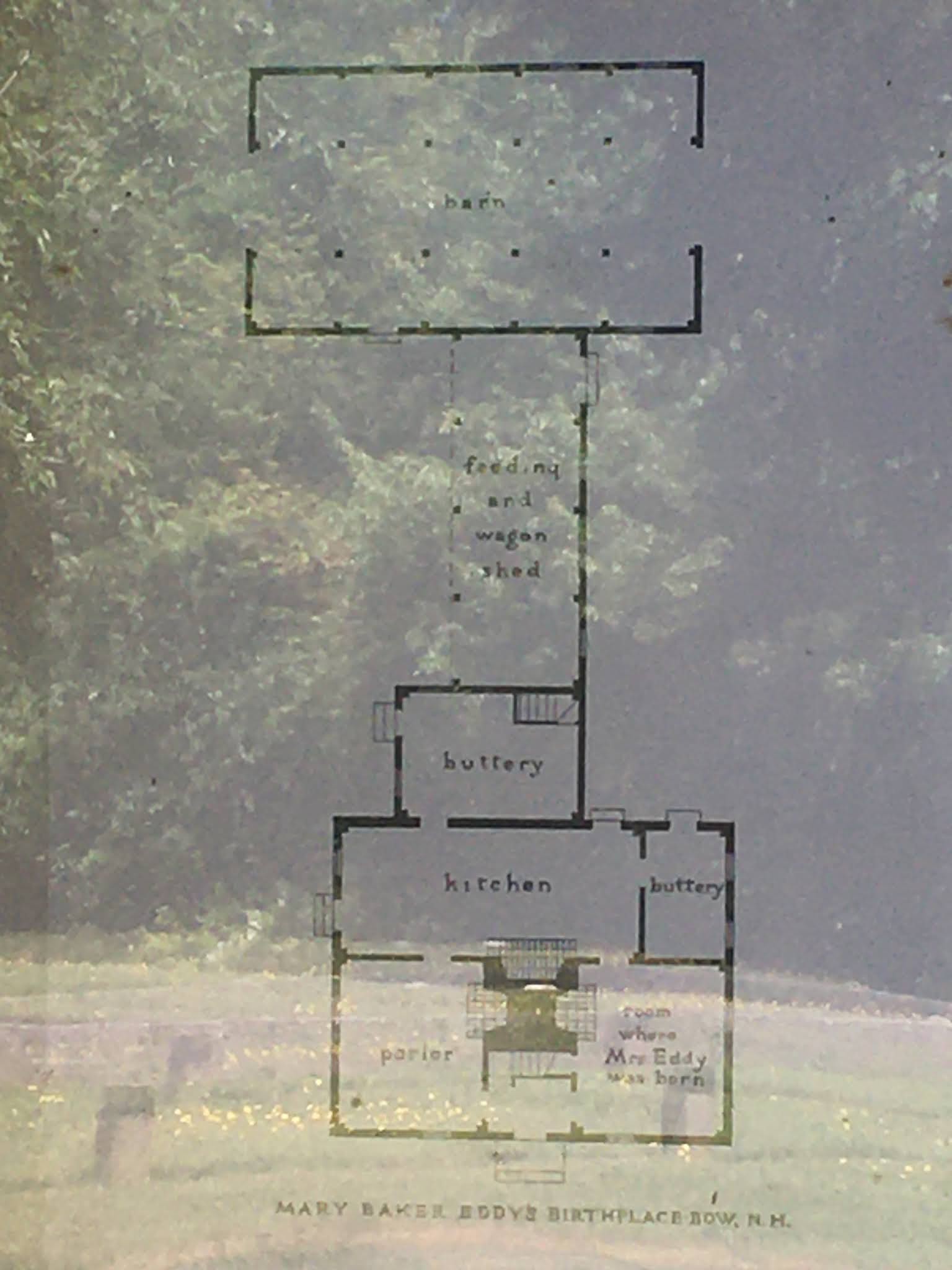
Signs at the birthplace parking area show how the farm and dwelling would have looked in 1821


This engraving was made in 1898 by Mary Baker Eddy's cousin, Rufus H. Baker

--------------------------

For the truly curious:

"The Dearest Spot On Earth: The Birthplace of Mary Baker Eddy", a blog post from the Mary Baker Eddy Library   https://www.marybakereddylibrary.org/research/the-dearest-spot-on-earth-the-birthplace-of-mary-baker-eddy/  

The Longyear Museum and the Mary Baker Eddy Historic Houses:  https://www.longyear.org/   

Wikipedia article on Mary Baker Eddy:  https://en.wikipedia.org/wiki/Mary_Baker_Eddy   

The Ancestry of Mary Baker Eddy, edited by William Montgomery Clemens, 1924, published by the University of Wisconsin - Madison.  Available to read or download for free online at Google Books at this link:  https://www.google.com/books/edition/The_Ancestry_of_Mary_Baker_Eddy/SIZIAAAAMAAJ?hl=en     

--------------------------

To Cite/Link to this post:  Heather Wilkinson Rojo, "The Mary Baker Eddy Birthplace", Nutfield Genealogy, posted August 10, 2021, ( https://nutfieldgenealogy.blogspot.com/2021/08/the-mary-baker-eddy-birthplace.html: accessed [access date]). 

Monday, March 22, 2021

Was your ancestor a Freethinker?

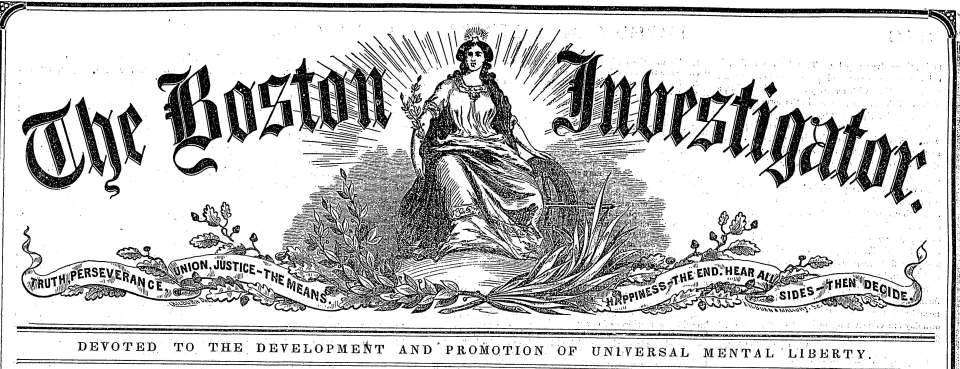
The Boston Investigator
Truth, Perseverance, Union, Justice - The Means.  Happiness - The End.  Hear All Sides - then decide.
Devoted to the development and promotion of universal mental liberty


Did you see “Freethinker” describing one of your ancestors in a biographical sketch? Newspaper article? In a flowery Victorian era obituary?
   Did you think it was just an interesting personality trait? A poetic description of your eccentric ancestor? It is time to learn more about the Freethinker Movement, and the entire history of this interesting society!

I had seen my ancestor Romanus Emerson (1782 – 1852) described as a freethinker (or sometimes capitalized as Freethinker) in a compiled genealogy.  I knew he was an atheist and an abolitionist, so I thought that perhaps the author was trying to cover up his controversial, progressive beliefs with a bit of affectation.  But it turns out that this was EXACTLY the proper identification of his beliefs. 

The Freethinkers emerged as a movement in the United States in the early nineteenth century. They took up the cause of Thomas Paine and other earlier deists and atheists at a time when it was still considered blasphemous and sometimes illegal.

In Boston, The Boston Investigator emerged as a Freethinking newspaper, which was founded in 1831 by Abner Kneeland.  Several famous New Englanders such as Ralph Waldo Emerson, William Lloyd Garrison and Bronson Alcott all defended Kneeand when he spent 60 days in jail for blasphemy.  My ancestor Romanus Emerson was a friend of Kneeland, and he often wrote for The Investigator. While Kneeland was jailed, the compositor for the newspaper, Horace Seaver, took over as editor, and Seaver eventually ran the newspaper when Kneeland left Boston to establish a utopian community in the mid-West. 

Horace Seaver ran The Investigator for over fifty-one years, and was a best friend to my 4th great grandfather, Romanus Emerson.  It seems that Freethinking ran in families.  My ancestor Romanus Emerson began his career in theology school to prepare for the ministry, just like his famous cousin Ralph Waldo Emerson, but both set aside these plans for more progressive beliefs like Freethinking and philosophy.  Horace Holley Seaver was named for a famous Unitarian minister, and began his career as a minister, too, but turned to journalism to spread his new views through his Freethought newspaper. 

When Horace Seaver’s wife, Celinda Griffin, died in 1858, he held a “social funeral” that was published in The Investigator. It was the pre-cursor to today’s secular memorial services held in funeral homes.  Romanus Emerson had previously died in 1852, and his final wish was to have his friend Seaver read his self-written eulogy instead of having a Christian service and funeral sermon.  These wishes were not kept by Emerson’s family and friends, and so Seaver instead published the eulogy in The Investigator.  Perhaps this cemented his belief in a secular funeral for his freethinking wife.  Today, this is not considered unusual at all. 

In 1836 the Free Thinkers were founded at a national convention in Saratoga Springs, New York.  At the convention of 1845 Seaver brought up the word Infidel to be adopted as a title for all atheists. Seaver and Emerson founded The Infidel Relief Society of Boston.  Seaver even built the Paine Memorial Hall in Boston for the infidels, with offices for his newspaper upstairs, because infidel meetings were not welcome at other theaters.  The Paine Hall became popular with progressive orators of the time, especially with abolitionists like Garrison, and for meetings for woman suffrage. The Infidel Relief Society even hosted dances and social events such as picnics, and met regularly until the Civil War.  From atheist to infidel to Freethinkers, their beliefs were the same, and they continue today. 

Freethinkers definition:  Freethinkers are often defined by their rejection of religion, or at least of any organized form of religion.  The Freedom from Religion Foundation describes a freethinker as someone “who forms opinions about religion on the basis of reason, independently of tradition, authority, or established belief”.  Today, freethinking is intricately linked with secularism, atheism, agnosticism, and humanism.

The Cambridge English dictionary: “Someone who forms their own opinions and beliefs, especially about religion or politics, rather than just accepting what is officially or commonly believed or taught”.

The Oxford English dictionary: “…the free exercise of reason in matters of religious belief, unrestrained by deference to authority; the adoption of the principles of a free-thinker”. 

Trivia:  Freethinkers Day is commemorated every year on the birthday of Thomas Paine, January 19th as a day to challenge arbitrary authority and question the status quo.

Famous Freethinkers:

Thomas Paine

Robert Frost

Frederick Douglass

Elizabeth Cady Stanton

Benjamin Franklin

Robert Green Ingersoll (famous orator)

Thomas Jefferson

Emma Lazarus

Abraham Lincoln

Albert Einstein


For the Truly Curious:

Freethinkers: A History of American Secularism by Susan Jacoby, 2005

Black Freethinkers: A History African American Secularism, by Christopher Cameron, 2019

Annie Laurie Gaylor, “Horace Seaver”, Freedom From Religion Foundation website, (  https://ffrf.org/news/day/dayitems/item/14517-horace-seaver  accessed 13 March, 2021)

A webpage from Boston's West End Museum about Abner Kneeland:

https://thewestendmuseum.org/wordpress/wp-content/uploads/2015/04/06_Frame-Abner-the-Blasphemer-2-9-15.pdf?   


My blog post about Romanus Emerson’s self written eulogy (that was no read at his funeral) all about his Freethinking beliefs: 

https://nutfieldgenealogy.blogspot.com/2021/02/romanus-emersons-self-written-eulogy.html 


------------------------------

To Cite/Link to this post:  Heather Wilkinson Rojo, "Was your ancestor a Freethinker?", Nutfield Genealogy, posted March 23, 2021, ( https://nutfieldgenealogy.blogspot.com/2021/03/was-your-ancestor-freethinker.html: accessed [access date]). 

Tuesday, February 23, 2021

The Obituary of Jemima (Burnham) Emerson, 1868 - The Christian Wife of an Infidel

The Col. Joshua Burnham Tavern, photo 2001
where Jemima Burnham grew up, Milford, New Hampshire

My 4th great grandmother was born as Jemima Burnham.  Her name is listed as Jemima Wyman Burnham on an SAR application dated 20 August 1957 for Emerson Francis Thayer McLean, a distant cousin.  I've never seen her listed with a middle name on any other vital record or documentation.  Her mother's name was Jemima Wyman, so it could be possible.  Jemima was born 9 May 1783 in Milford, New Hampshire.  It is often difficult to learn about the lives of our women ancestors, but bits and pieces of Jemima's life have become revealed to me over 40 years of searching for clues.

Her father was Colonel Joshua Burnham.  He was a local character, a veteran of the Revolutionary War, a local hero who was present at the Battle of Bunker Hill and served in New York, Philadelphia and Canada.  The history of Milford states that he was an eyewitness when George Washington took command of the Continental Army.  He built a large farm and tavern near the banks of the Souhegan River, which is still standing on River Road.  He later sold his tavern and property to Jesse and Polly Hutchinson, who raised their thirteen children there in Milford.  These children were famous as the Hutchinson Family singers who sang songs of temperance, abolition, women's suffrage, and other progressive movements all over the USA and even in Europe.  

Although Col. Burnham sold his farm to the Hutchinson family, he remained in Milford, and remained a good friend to Jesse Hutchinson.  He must have agreed with all the progressive beliefs, and discussed them with the Hutchinson's various friends who included P. T. Barnum, William Lloyd Garrison and Frederick Douglass.  These famous singers gave their very first concert at the Baptist church in Milford.  The Hutchinson Singers toured England with Douglass in 1845, and some moved to Lynn, Massachusetts to live next door to him.  

Local history and various Hutchinson journals and books remember Col. Burnham as an old veteran who would wander the property, often stuffing his pockets with apples from the orchard.  The Burnham family and the Hutchinson family lie side by side in a small burial ground, the North Yard Cemetery,  within site of the Col. Burnham tavern on River Road.  Joshua Hutchinson wrote the epitaph for Joshua Burnham "Soldier of the revolution zealous in his country's cause, Faithful to the constitution and obedient to its laws"

These stories are what I know of Jemima's life in Milford.  Of course, she had married by 1810 to Romanus Emerson and removed to South Boston where her children were born.  Her family had been members of the Baptist Church in Milford, listed on the records.  The same Baptist church that held the first concerts for the Hutchinson family who sang about abolition before the Civil War.  Although the Baptist church is considered conservative today, they supported very progressive ideas in the early nineteenth century. 

I was not surprised that she married Romanus Emerson.  He came from a family of ministers.  They were Congregationalists going back to Puritan times.  The Emerson family included early ministers such as Rev. Joseph Emerson, born in England about 1620, who married Elizabeth Bulkely, the daughter of Rev. Edward Bulkely (1614 - 1696) the first minister of Concord, Massachusetts.  Even Ralph Waldo Emerson (1803 - 1882), son of a Concord minister, also studied for the ministry at Harvard.  Romanus Emerson had three brothers who became ministers, and he himself studied for the ministry but gave up due to a speech impediment.  

It was during his time studying theology that Romanus Emerson had a change of heart.  He became an atheist.  He said that "Freethinking" without the constraints of religion and other social mores opened his mind to progressive thoughts and more independent beliefs.  He joined the Free Soil movement, the abolitionists, and the Infidel Society.  He called himself an "Infidel" for the rest of his life, and wrote his own eulogy describing his "Infidel" beliefs. 

I have no idea what Jemima thought of all this during her married life with Romanus, the atheist.  I believe that she agreed with his progressive thoughts and politics.  But to be an atheist, or an "Infidel", at this time was considered quite shocking.  As a Baptist all her life, this was probably somewhat of a problem at home. Or was it? Women were considered to be obedient and quiet in those days. But we know that was not always the case.  

Romanus died in 1852.  He was a famous Bostonian, with his obituaries carried in newspapers across the country.  His last wish was to not have a Christian funeral, but to be buried in South Boston "At the point" and for his best friend, Horace Seaver, to read his self written eulogy.  However, his family (Jemima?) did not follow his final wishes, and gave him a funeral officiated by the Rev. Capen of the Hawes Place Church (next door to their house) and he was laid to rest in the Hawes Burying Ground.  Was it out of spite that she ignored her husband's final wishes? or did Jemima truly love her husband and worry about his immortal soul? 

As a widow, Jemima Emerson was enumerated in the 1855 Massachusetts State Census and the1860 Federal Census living in the Boston home of Melzar Stetson, her son-in-law, husband to her daughter Emily.  Her death certificate lists her place of death as 88 Emerson Street, her home address on the street in South Boston named after her Infidel husband, Romanus. 

Jemima died in 1868. Unlike her famous husband, I found only one mention of Jemima's death (other than short death notices in Boston newspapers) in The Christian Watchman (a Boston Baptist journal), dated Thursday, 27 August 1868, on page 7. See the obituary transcribed below.  She was laid to rest at the Mount Hope Cemetery in the Mattapan section of Boston, and Romanus was reinterred from the Hawes Burial Ground to lie next to her.  I like to think that perhaps it was out of love that she had him moved to be next to her for eternity.

"Obituary

Mrs. Jemima Emerson

In South Boston, August 5, Mrs. Jemima Emerson, at the advanced age of 86 years, widow of the late Romanus Emerson.  When 18 years of age she was converted, and baptized in Milford, N. H.  Afterwards united with the Dudley Street Church, Roxbury, and then with the South Baptist Church, and finally became a constituent member of the Fourth Street Baptist Church.  Her early Christian experience began with deep conviction of sin, from which, after long struggles, she was delivered by the power of Christ.  This, together with the opposition she encountered in following the Lord in baptism, determined, in great measure, the marked features of her subsequent life.  She loved the doctrines of grace, and clung with ever increasing tenacity to the great pillars of eternal truth.  She loved the assembly of God's people, and even until within a few weeks of her death her voice was frequently heard in the prayer meeting, as she bore cheerful testimony to the faithfulness of God.  Her children have lost a faithful, godly mother, whose prayers for their spiritual welfare ended only with her life.  The church she honored has lost a firm friend.  The community, which for forty years has been growing around her, has lost a beacon of light.  She now enjoys the rest which for many years she has anticipated, and she "being dead yet speaketh."  "Those that be planted in the house of the Lord shall flourish in the courts of our God.  They shall still bring forth fruit in old age."

For the truly curious:

"Romanus Emerson's Boston Obituaries 1852", published February 9, 2021: https://nutfieldgenealogy.blogspot.com/2021/02/romanus-emersons-boston-obituaries-1852.html   

"Romanus Emerson's Obituaries 1852" (published across the United States), posted on this blog on October 1st, 2020:  https://nutfieldgenealogy.blogspot.com/2020/10/romanus-emersons-obituaries-1852.html    

My Surname Saturday post on the EMERSON family:   https://nutfieldgenealogy.blogspot.com/2015/01/surname-saturday-emerson-of-ipswich.html    

My Surname Saturday post on the BURNHAM family:     https://nutfieldgenealogy.blogspot.com/2014/05/surname-saturday-burnham-of-chebacco.html  

"Tombstone Tuesday ~ Col. Joshua Burnham, Milford, New Hampshire":     https://nutfieldgenealogy.blogspot.com/2013/10/tombstone-tuesday-col-joshua-burnham.html  

------------------------

To Cite/Link to this post:  Heather Wilkinson Rojo, "The Obituary of Jemima (Burnham) Emerson, 1868 - The Christian Wife of an Infidel", Nutfield Genealogy, posted February 23, 2021, ( https://nutfieldgenealogy.blogspot.com/2021/02/the-obituary-of-jemima-burnham-emerson.html: accessed [access date]).  

Thursday, February 18, 2021

Romanus Emerson's Self Written Eulogy 1852


As I wrote in my blog post last week, my 4th great grandfather, Romanus Emerson (1782 - 1852) wrote his own funeral eulogy, with instructions that he NOT be given a Christian funeral or burial. This was ignored by his family, who had Rev. Capen of the Hawes Place Church give a sermon and he was laid to rest in the Hawes Burying Ground in South Boston. Later he was reinterred at the Mount Hope Cemetery in Mattapan where he lays beside his wife, Jemima (Burnham) Emerson (1783 - 1868).  The newspapers across Boston, and Massachusetts, and even across the country, all carried his obituary and the scandalous nature of his funeral where his final wishes were not carried out by friends and family. 

His final wish was to have a simple burial, and for the editor, Horace Seaver, of the Boston Investigator (a progressive newspaper) to read this self written eulogy or statement.  Romanus was an avowed atheist, or as they were known at the time, an "infidel". This was considered quite improper in Boston.  Horace Seaver was his friend, and Romanus Emerson had written several articles for the Boston Investigator.  Horace Seaver carried this funeral address in the 20 October 1852 issue of the newspaper. 

"FUNERAL ADDRESS OF ROMANUS EMERSON

          WRITTEN BY HIMSELF

                                     Boston, June 17, 1849

To all my nearest relatives who may be my survivors, and to ALL who are relatives or friends who may be my survivors: -

      Being in good health and sound mind, calm and composed, I do hereby, in pursuance of a long and well settled intention, request, order, and direct, that, at the time of my decease, funeral, or burial, or at any time thereafter, there shall be no funeral sermon or other religious discourse delivered at any place on the account of my decease, either by the consent or request of any of the forenamed relatives or friends.  Also, that no priest or minister of the Gospel or pious religionist of any kind be allowed to speak, address, or exhort at the time or during any part of the funeral ceremonies.  And further - that honest, liberal, free-thinking men be selected to take charge of the order of the proceedings, in pursuance of the advice and request of my nearest relatives, my survivors.  All which I soberly and seriously enjoin.

      Whereas it is a fact, that daily experience and observation corroborate, that all who are born must die, I have thought it most fit and proper that I should write my own funeral address, inasmuch as I am decidedly opposed to the services of a clergyman of any denomination at my own funeral; and also, that I may leave to my survivors my own own sentiments in regard to the order of Nature and what is commonly called Theology.

      I consider that death and decomposition leave us just where we were before we were born; that there is no identity to any of mankind after death and decomposition; that mankind were formed from the elements, or composed of the elements, and as certainly return to the elements; that there is no part or parcel of the creature man that survives his decomposition.

     This, I consider to be the inflexible, unalterable, and universal order of Nature.  To this, mankind must all arrive, without single exception, whether their imaginations are wrought up to a high pitch, in anticipation of future bliss beyond the grave, or whether their reason and philosophy confine their speculations to this world and the system to which it belongs.  "In this warfare there is no discharge."

     I consider Theology, so called, a system of deception and fraud, whereby one class of citizens obtain a rich living by exciting the hopes and fears of their fellow beings in regard to a place of happiness and a place of misery somewhere away from this globe or world which we inhabit; and also, in regard to beings or existences not material, nondescripts, residing nowhere and yet everywhere present.

     Also, said Theology maintains that one of these wonderful beings has written a book called the Bible, and that mankind are bound to believe what that Bible says, upon the penalty of eternal damnation.

     Out of this Theology, whether Christian, Mahomedan, or Hindoo, have arisen all those belligerent and contending sects, who have in turn destroyed each other and even desolated the fair face of Nature.

     The morality of said book, the Bible, I believe will not compare, as a whole, with the writings of the ancient philosophers.  Let everyone impartially examine both, and render his own verdict.

     My relatives and friends are hereby exhorted to reject every system of Theology which may be offered for their acceptance, as tending only to distract the mind and lead it away from the cause of humanity. To do as you would wish to be done unto, and to love your neighbor as yourself, is better than all the religious systems of the world put together.  As one who speaks to you from the grave, I exhort you to live peaceably with all mankind; view the whole human family as a universal brotherhood; maintain inflexibly, on every occasion, the truth; and set it down as an invariable consequent, that deception and fraud work their own ruin and give no peace and comfort to the mind.

     The individual interest of each is advanced in proportion as each advances the good of the whole.  Seek, therefore, to establish and perpetuate a rational, practical, and useful education for the masses, so that no child shall be without a competent education for the transaction of any business in the ordinary concerns of life.  And as children are not responsible for their birth, or the time or place of their birth, or the circumstances which may surround them, the generation who conduct the affairs of the world for the time being are responsible and should give to every child, however poor it may be, a good, rational, and practical education.  Furthermore, as many children are left with relatives to protect them, the State should establish institutions which should feed, clothe, and educate them so that they may be equal to their fellows of the same generation.

    Nothing will elevate the masses, and raise them to their proper position in the world, but an equal education for one and for all.  Nothing, to my mind, is of so vast importance as this, for the well-being of society and the good of the world.  Nothing but this will preserve the free institutions of these United States from decay and corruption.  This being done, free institutions will grow and flourish and improve with their age, and root out the evils which through ignorance they my labor under.

N.B. - This, my funeral address, is to read at my funeral by a liberal-minded, well-disposed freethinker, and either he or some other liberalist may address the audience as occasion may serve; and this my funeral address, I wish to have published, after my decease, in as many of the newspapers of the day as choose to do it.

    And furthermore, I order that my grave-clothes shall be of the most common and cheap kind, and my coffin of pine and the most ordinary sort.

    In testimony whereof, I subscribe my name in my own hand-writing,

                   ROMANUS EMERSON"

For the truly curious:

"Romanus Emerson's Boston Obituaries 1852", published February 9, 2021: https://nutfieldgenealogy.blogspot.com/2021/02/romanus-emersons-boston-obituaries-1852.html   

"Romanus Emerson's Obituaries 1852" (published across the United States), posted on this blog on October 1st, 2020:  https://nutfieldgenealogy.blogspot.com/2020/10/romanus-emersons-obituaries-1852.html    

My Surname Saturday post on the EMERSON family:   https://nutfieldgenealogy.blogspot.com/2015/01/surname-saturday-emerson-of-ipswich.html    

--------------------

To Cite/Link to this post:  Heather Wilkinson Rojo, "Romanus Emerson's Self Written Eulogy 1852", Nutfield Genealogy, posted February 18, 2021,  ( https://nutfieldgenealogy.blogspot.com/2021/02/romanus-emersons-self-written-eulogy.html: accessed [access date]). 

Tuesday, January 12, 2021

The Old Manse in Concord, Massachusetts


Last week we took a walk by the Old Manse in Concord, Massachusetts.  I have never seen the inside of this historic house museum, even though I am related to the Emerson family of Concord.  It was built in 1770 by the Reverend William Emerson, just in time to experience one of the first battles of the American Revolution.  It is located by Concord’s Old North Bridge where the battle of April 19, 1775 was fought between the American patriots and the British.

First, a little family history! The Rev. William Emerson is my 2nd cousin, seven generations removed. We share Joseph Emerson (about 1621 – 1680) and his wife Elizabeth Bulkely (1638 – 1693) as our common ancestor.  My line of Emerson ancestors lived nearby Concord in Reading, Massachusetts until the 1800s when my ancestor Romanus Emerson (1782 – 1852) removed to South Boston.  He was from a family of eleven children, and eight brothers.  Of those eight brothers, four lived to adulthood and became ministers. Romanus studied for the ministry, too, but due to a “speech impediment” (according to a compiled genealogy of the family) he went to Boston and became a famous atheist!

The great writer and philosopher Ralph Waldo Emerson (1803 – 1882) lived in Concord and was the grandson of Rev. Phebe Bliss. Ralph Waldo Emerson was from a line of five out of six generations of minister Emerson ancestors in a row, and he studied to be a minister, too. His brief ministry included being ordained at Boston's Second Church and being the chaplain of the Massachusetts legislature, but it all ended when he began to doubt his faith. He went to Europe and returned to Concord to become a popular lecturer, and later a philosopher and writer.  It was perhaps the influence of this famous writer and his transcendentalist friends, including Nathaniel Hawthorne, that made this house so important and historic. 


From this sign by the Old Manse:

"The Reverend William Emerson (1743 - 1776), grandfather of writer Ralph Waldo Emerson (1803 - 1882), built this house in 1769-70.  On April 19, 1775, family members watched from the house as British soldiers and local militia fought the battle that started the American Revolution.

The Old Manse then played an important role in America's literary and cultural revolutions.  Ralph Waldo Emerson (1803-1882) wrote Nature here in 1834-35, an essay that sparked the Transcendental movement.  Nathaniel Hawthorne (1804 - 64) lived here from 1842 - 45).  His collection of short stories, Mosses from an Old Manse, gave the house its nickname, a Scottish term for 'minister's house." 


Rev. William Emerson became a chaplain to the Continental Army, then died in October 1776 on his way home from Fort Ticonderoga. His widow remarried to his successor, the Rev. Ezra Ripley, and continued living at the Old Manse.  Ralph Waldo Emerson lived here with his step-grandfather in 1834 while writing Nature

Nathaniel Hawthorne and his new bride, Sophia Peabody, moved here in 1842, and Henry David Thoreau dug them a garden.  One famous legacy that Hawthorne and his wife left at the Old Manse was a a short passage they etched in the window of his study with her wedding ring diamond. He also wrote many of his tales here, some which were included in Mosses from an Old Manse (1846), and others published later. New Hampshire's only US president, Franklin Pierce, was a guest of the Hawthorne's while they lived at the Old Manse.  Hawthorne removed to Salem in 1845, and returned to Concord in 1852 to live at the historic house called The Wayside.  

The house was owned by the Ripley family until 1939 when it was donated to the Trustees of Reservations.  It was a National Historic Landmark in 1966.  The house is open for guided tours by the Trustees of Reservations in the summer, see the website (below) for more information. It is located adjacent to the Old North Bridge, the Minuteman Statue, and the battlefield.  There is a restroom across the path to the Old North Bridge, and if you follow across the bridge and up the hill, you will reach the US National Historic Site interpretive center with more restrooms, giftshop, and small museum. It is also within walking distance of the Concord Common and the Sleep Hollow Cemetery with Author's Ridge where Henry David Thoreau, Nathaniel Hawthorne, Ralph Waldo Emerson, William Ellery Channing, Louisa May Alcott and others are buried. 

For the truly curious:

The Old Manse, 269 Monument Street, Concord, Massachusetts

The Old Manse website:   https://thetrustees.org/place/the-old-manse/   

The US National Park Service website:  https://www.nps.gov/places/the-old-manse.htm   

My EMERSON Surname Saturday sketch, with eight generations of Emersons from Thomas Emerson the immigrant to Ipswich, Massachusetts down to my great great grandmother, Mary Katharine Emerson (1847 - 1932):  https://nutfieldgenealogy.blogspot.com/2015/01/surname-saturday-emerson-of-ipswich.html    

------------------------

To Cite/Link to this post: Heather Wilkinson Rojo, "The Old Manse in Concord, Massachusetts", Nutfield Genealogy, posted January 12, 2021, ( https://nutfieldgenealogy.blogspot.com/2021/01/the-old-manse-in-concord-massachusetts.html: accessed [access date]).

Thursday, October 1, 2020

Romanus Emerson's Obituaries, 1852

Richmond Dispatch (Richmond, Virginia) 21 October 1852, page 1


Romanus Emerson, born 1 September 1782 in Townsend, Massachusetts, and died 10 October 1852 in South Boston, Massachusetts was a curious character.  His parents, John Emerson and Katherine Eaton, were quite religious.  John was a deacon, and Katherine’s lengthy obituary was written up in the August 1809 magazine, The Panoplist and Missionary Magazine United (a religious tract).  They had eleven children, including eight boys (seven lived to adulthood).  Of those seven living sons, five became ministers.  You can read her obituary HERE.

The Emerson family was from a long line of ministers that go back to Rev. Joseph Emerson, born in England about 1620 who was a minister in Mendon, Massachusetts, and several other towns.  He married Elizabeth Bulkely, the daughter of Rev. Edward Bulkely (1614 – 1696) the first minister of Concord, Massachusetts. This is the family of Ralph Waldo Emerson (1803 – 1882), son of a Concord minister, who studied for the ministry at Harvard, yet later reconsidered religion and became a transcendentalist philosopher.
Romanus Emerson, my 4th great grandfather, and cousin to “The Sage of Concord” Ralph Waldo Emerson, also studied for the ministry like his brothers.  Somewhere along the way he changed his mind about religion, too, and began to espouse atheism.  It was quite shocking for his time period, and he was well known in Boston, being a founding member of the Boston Infidel Society.  But he was also an ardent abolitionist, and a member of the Humane Society, and other progressive organizations that made him a popular, but controversial, figure in Boston society.  Emerson Street in South Boston was named for him, since he had his house and land there before it was developed into a neighborhood of Boston and all the surrounding streets are named for numbers and letters of the alphabet. 

I was surprised to learn that Romanus Emerson’s obituary was carried in newspapers across the United States in 1852.  When I used Genealogy Bank and put in his name and didn’t limit it to Massachusetts, results poured in from all over. Five years ago, the last time I had searched his name in newspapers I had limited it to just Massachusetts.  This was a big shock to learn that news of his death was carried outside of New England!

Richmond Dispatch (Richmond, Virginia) 21 October 1852, page 1
"Romanus Emerson, Esq., an old citizen of Boston, died a few days ago. He was, it is said, a confirmed infidel, and the main support of all the infidels in that city.  His dying request was that no clergyman should officiate at his funeral, but that an address written by himself, avowing his principles, should be read.  This request was not complied with."

The Courier-Journal (Louisville, Kentucky), 22 October 1852
"Death of an Old Resident - Romanus Emerson, Esq., one of the oldest residents in South Boston, died on Saturday last, aged 70 years.  Mr. Emerson, in 1809, took up his residence in South Boston, and built a house on the old road, just before Mt. Washington, in what is now known as the Lower Village.  In this house he continued to reside until his death, a period of 43 years.  When he first lived in South Boston, there were but about six houses in the place, and he has lived to watch the rapid growth of the place until he had gathered about him a population of 15,000 souls.  In early life, Mr. Emerson was a firm Baptist.  about 18 years since, he suddenly became infidel, and continued so until his death, avowing to his end that there was no God, no Heaven, no Hell, and denying the immortality of the soul.  He has been for some time the main supporter of the infidels in this city. His dying request was that no clergyman should officiate at his funeral, but that an address written by himself, avowing his principles, should be read.  This request is not to be complied with, and he was buried yesterday afternoon from the Hawes place church.  Boston Times, October 14."

Romanus never traveled, and he was not famous, so I do not know why he was in the out of state newspapers except for the curious fact that he was an “infidel” or an avowed atheist.

Finding all this interesting information on my ancestor, Romanus Emerson, also sent me back to Find A Grave to re-search his name in the Boston Cemeteries.  I had read some of the Boston obituaries years ago, and like above, they all mentioned the Hawes Burial Ground in South Boston, not far from where his house stood.  I had searched this cemetery on foot and not found any Emersons.  But, according to Find A Grave I finally found him!  "Gravesite details - AE 71 y, 1 m, 9d (b. 1781?) orig. interred at Hawes Cemetery, re-interred Nov. 1852 at Mount Hope"  No photo, but I put in a photo request and hope to visit Mount Hope when the pandemic is over.

Thus, it paid off well to re-search for Romanus Emerson twice where I did not expect to find him!

For the truly curious, I did a series of blog posts on Romanus Emerson back in 2010:
Part 1 - "The 'Odd' Romanus Emerson"
https://nutfieldgenealogy.blogspot.com/2010/03/madness-monday-odd-romanus-emerson-part.html

Part 2 - "Romanus Emerson Died an Infidel"
https://nutfieldgenealogy.blogspot.com/2010/03/amanuensis-monday-romanus-emerson-died.html

Part 3 - "Romanus Emerson buried in a Christian Cemetery, whether he liked it or not!"
https://nutfieldgenealogy.blogspot.com/2010/03/tombstone-tuesday-romanus-emerson.html

Part 4 - "Romanus Emerson, in his own words" (He wrote his own eulogy which was NOT read at his funeral):
https://nutfieldgenealogy.blogspot.com/2010/03/romanus-emerson-in-his-own-words-part-4.html

Part 5- "Romanus Emerson, a few words from the Infidels":
https://nutfieldgenealogy.blogspot.com/2010/03/romanus-emerson-in-his-own-words-part-4.html

Romanus Emerson's 1852 Last Will and Testament blog post:
https://nutfieldgenealogy.blogspot.com/2015/09/romanus-emersons-1852-last-will-and.html 

My Surname Saturday post about my EMERSON lineage:
https://nutfieldgenealogy.blogspot.com/2015/01/surname-saturday-emerson-of-ipswich.html

UPDATE 2 February 2021
I published some of the Boston Obituaries for Romanus Emerson! Lots of good biographical information for Romanus were included in these newspaper articles...

---------------------------------

Cite/Link to this post:  Heather Wilkinson Rojo, "Romanus Emerson's Obituaries, 1852", Nutfield Genealogy, posted October 1, 2020, ( https://nutfieldgenealogy.blogspot.com/2020/10/romanus-emersons-obituaries-1852.html

Thursday, January 9, 2020

Researching Ancestors Who Were Religious Leaders

Rev. Ingraham Ebenezer Bill
My 3rd great grandfather


I've found quite a few ministers in my family tree.  Are there clergy, rabbis, or any other religious leaders in your family?

When tracing the protestant ministers in my family, I came to the conclusion that in early colonial New England the ministers' children married mostly the children of other ministers.  This pattern was quite common in the 1600s and 1700s, but I can see it also in the 1800s.  Perhaps it was a social class distinction.  Ministers were well educated, but often very poor, so their children tended to marry teachers and other ministers instead of lawyers and other businessmen?  Perhaps it was due to the fact that they led a strict upbringing?  This is just my theory. What do you think?

Most religious leaders had some sort of formal education, but not all.  Take advantage of this education to find where they attended schools, colleges and universities.  Some of the Puritan ministers who came over with John Winthrop's fleet in the 1630s went to Cambridge and Oxford Universities in England, and that is a great place to look for personal family information.  Harvard was founded as a place to instruct these ministers in the New World.  You can contact the colleges, universities, and religious institutions in the areas where your family lived to find out if they attended, and what records might be available.  Even if the school is no longer in existence, the records were often moved to another school's archives or library.

Sometimes someone in your family tree will just "see the light" or have a calling to the ministry.  This is what happened to my ancestor Ingraham Ebenezer Bill, who was the son of Asahel Bill, a Connecticut farmer who relocated to Nova Scotia during the planter movement in the 1760s.  Ingraham Ebenezer Bill was the youngest of eleven children, born in 1805 in "Billtown", Nova Scotia.  During his youth he experienced a religious conversion to the Baptist faith.  He was uneducated beyond grade school, yet went on to be one of the founders of the Baptist school Acadia College in 1831, and was later granted an honorary Doctorate of Theology.

Once I found Rev. Bill's connection to Acadia College (now Acadia University), I contacted their archive and received a large envelope with copies and newsclippings of his activities, photographs, sermons, and travels through Canada, all the eastern USA, and England.  The college also had a copy of his personal journal, and a biography written by one of his sons!  You can be sure that I wrote a nice donation to the Acadia library in lieu of regular copy charges.  You can read about the Bill family at this link:  https://nutfieldgenealogy.blogspot.com/2013/03/surname-satruday-bill-of-boston.html 

Finding a religious figure in your family tree can open up lots of information.  Just Google all the variations of your ancestor's name and see all the results.  Try "Rev. John * Smith"  or "Reverend *Smith" or "Rev. Smith DD", etc.   Each denomination and religion has it's own variations. Google can bring up sermons, weddings, funerals, newspaper articles, and obituaries this way.

Make a time line to see where your religious leader may have lived.  Some led one congregation for their entire life, and others moved from town to town, state to state, or even from country to country.  Timelines can be invaluable for genealogy research.

If your family was Roman Catholic, often there were siblings (great aunts and uncles) who entered religious service as nuns, priests, and or monks.  These family members didn't leave descendants (unless they were widows or widowers, and even rarer, divorced), and often changed their names, making them difficult to trace  (census records will use their religious name, not their birth name).  However, there are patterns in some families about which religious orders they preferred, which can help you to find the convent or monastery, and often the catholic schools other family members attended.  Once you find the religious order this relative entered, you can write to the order, or visit your own parish priest for help.  Once you find the religious order, you will find they kept very good records on their members, including birth place, parents names, burials, and more.

For the truly curious:

Is a Rabbi Hiding in Your Family Tree?  Lessons from Genetic Genealogy for Traditional Genealogists   https://www.academia.edu/18659950/Is_a_Rabbi_Hiding_in_Your_Family_Tree_Lessons_from_Genetic_Genealogy_for_Traditional_Genealogists 

Rabbinical Genealogy: Sources at the Center for Jewish History
https://www.cjh.org/pdfs/Rabbis.pdf 

Finding Family in Religous Service, by Juliana Smith
http://blogs.ancestry.com/circle/?p=3243 

Researching Irish Catholic Priests, Nuns and Religious Brothers, by Kyle J. Betit
https://www.irishrootsmedia.com/img/products/Sample%20issue%20108_1.pdf 

Colonial American Ministers Project at geni.com
https://www.geni.com/projects/Colonial-American-Ministers/13900 

The Colonial Clergy and the Colonial Churches of New England, by Frederick Lewis Weiss, reprinted by the Genealogical Publishing Company of Baltimore, Maryland, 1936  (there are similar books by Weiss for Maryland, Delaware, Georgia, New York, New Jersey, Pennsylvania, Virginia, North Carolina, and South Carolina).  Some of these are available online - check Google books.

Society of the Descendants of the Colonial Clergy
http://colonialclergyorg.blogspot.com/  

The Society of the Descendants of the Colonial Clergy has sponsored a book Pedigrees of the Descendants of the Colonial Clergy, by Robert Glenn Thurtle, 1976 available online at the Hathi Trust website:  https://catalog.hathitrust.org/Record/005802358

A handy list of the New England Puritan ministers and their approximate time of arrival from England (1630 - 1641):  http://sites.rootsweb.com/~genepool/preacher.htm 


----------------------------

Heather Wilkinson Rojo, "Researching Ancestors Who Were Religious Leaders", Nutfield Genealogy, posted January 9, 2020, ( https://nutfieldgenealogy.blogspot.com/2020/01/researching-ancestors-who-were.html: accessed [access date]).

Wednesday, September 11, 2019

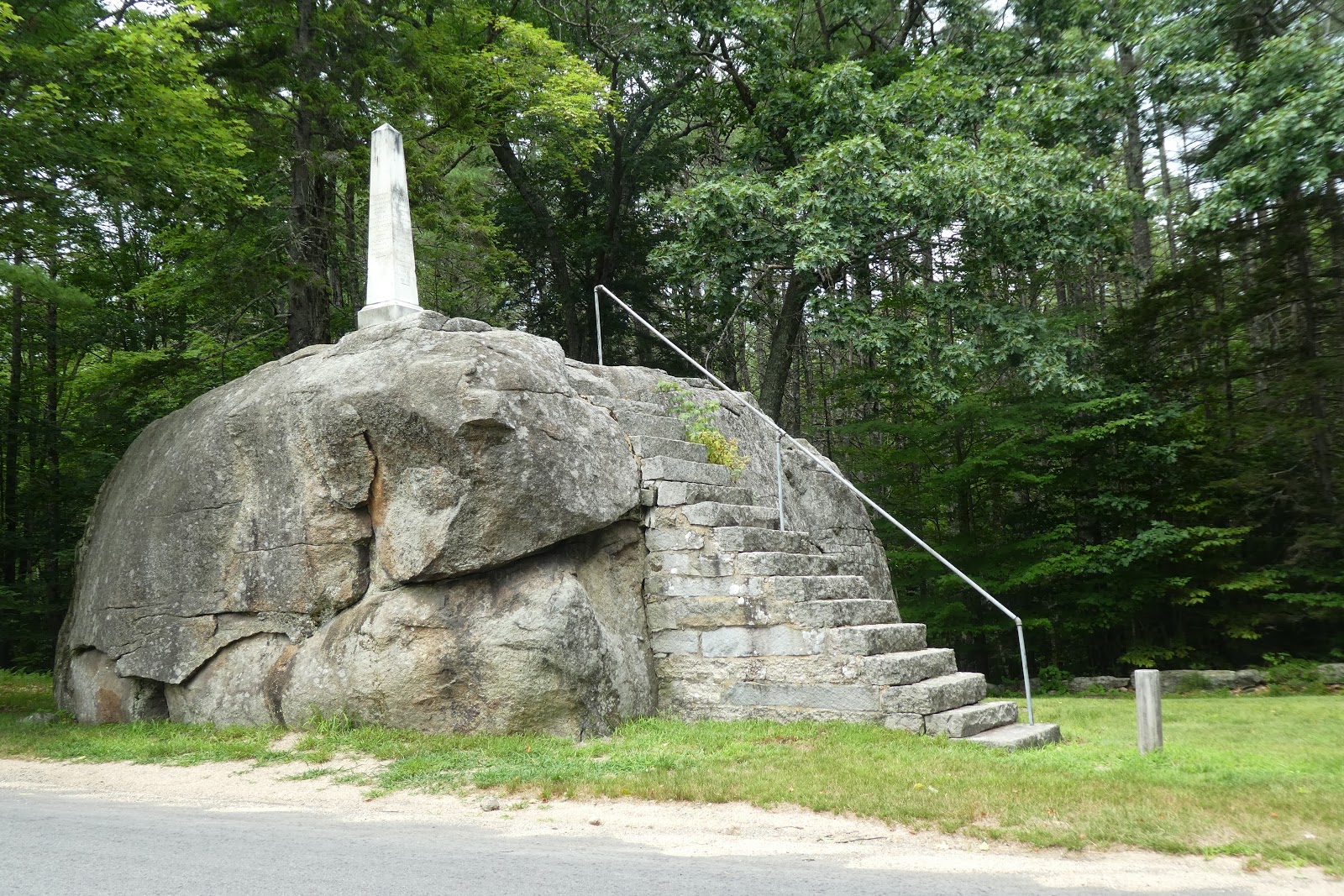
Ordination Rock, Tamworth, New Hampshire

This curious memorial is located on Cleveland Hill Road in Tamworth, New Hampshire.


About a mile from the village of Tamworth, this boulder marks the spot where Rev. Samuel Hidden was ordained in 1792 as the first minister of Tamworth, New Hampshire.  The marble monument on the top of the boulder was installed in 1862.  The granite steps climb to the top of the boulder for visitors to read the inscriptions.

Samuel Hidden graduated from Dartmouth College just before his ordination.  He was a veteran of the Revolutionary War.  Rev. Hidden was also a music teacher, supervised the town schools, and started the Tamworth Social Library.  He is buried across the street from this memorial in the town cemetery.

Here are transcriptions of the inscription on the obelisk [see the NEHGS Register Volume 22, page 72]:

South

"Memorial of the Ordination on this ROCK, Sept. 12, 1792, of the Rev. SAMUEL HIDDEN as Pastor of the Congregational Church Instituted on that day."

East

"Born in Rowley, Mass., Feb. 22, 1760.
Served in the War of the Revolution by four Enlistments 1777 - 1781.
Graduated at Dart. College, 1791.
Minister in Tamworth 46 years died Feb. 13, 1837, AEt. 77."

North

"He came into the Wilderness and left it a Fruitful field."

West

"To perpetuate the memory of his virtues and Public Services
a Grandson, bearing his honored name Provided for the erection of this Cenotaph, 1862"

On the base:

"Town Chartered 1766.  Settled in 1771.  40 Families in 1792.  Census in 1860 - 1717"


Here is a link to a YouTube video of a 2016 Tamworth town ceremony at Ordination Rock:
https://www.youtube.com/watch?v=m0yZgUBUkLo 

-------------------------

To cite/link to this blog post: Heather Wilkinson Rojo, "Ordination Rock, Tamworth, New Hampshire", Nutfield Genealogy, posted September 11, 2019, ( https://nutfieldgenealogy.blogspot.com/2019/09/ordination-rock-tamworth-new-hampshire.html: accessed [access date]).

Saturday, February 9, 2019

CLARK – Descendants of Nutfield Minister Rev. Matthew Clark


[Note:  I will be doing a series of genealogical sketches on the early Nutfield settlers in advance of the 300th anniversary of Founders Day, April 12 - 14, 2019 in Derry, New Hampshire.  If you have additional notes on the first few generations of the Clark family, please comment below or send me an email at vrojomit@gmail.com, and I will edit this sketch.  These sketches will be used and distributed to the public and to descendants at the Founders Day activities.]

Matthew Clark, born about 1660 in Northern Ireland, and died in Londonderry, New Hampshire in February 1735/6 .  He was a Lieutenant during the Siege of Derry from 19 April to 10 July 1689, where he was wounded in the temple.  His wound never healed and he always wore a black patch. He was ordained in 1697 and served in Kilrea and Boveedy in County Derry.  On 28 April 1729 Matthew Clark left his congregation and came to Londonderry, New Hampshire to meet up with kin who were probably his children.

The Rev. James MacGregor had just died in Londonderry, New Hampshire when Rev. Clark arrived.  Since the town needed a minister they made him an offer, which he first refused, but then took the second offer and stayed as their minister for six more years.  He married Rev. MacGregor’s widow, Mary Anne Cargill, and died 27 February 1735/6. .  When he died, according to legend, his coffin was carried by fellow veterans of the Seige of Derry.

It is not proven that these were his children by a first marriage, but since they all named descendants “Matthew” he was probably their father or close kin.

      1.       Matthew, died 28 May 1781 by drowning near Amoskeag Falls; married to Elizabeth Lindsay on 15 April 1722.  Children:  Margaret, Jean, George. 

      2.       James, born about 1692, died 13 October 1768 age 77 years.  He was one of the original sixteen Nutfield grantees. James Clark married first to Elizabeth Fulton, widow of James Wilson on 22 May 1722 (the mother of Ocean Born Mary Wilson); married second to Margaret Unknown. Children born in Londonderry: John born 31 March 1723 married his cousin Margaret Clark; Samuel born 12 April 1726, died 27 November 1792, married Mary Unknown and resided in Windham; George born 15 April 1728; married Mary Wilson and had thirteen children; Elliner born 20 April 1730, died 21 September 1808, married Robert Hemphill of Windham and had nine children; Matthew born 30 June 1732, died 22 January 1805; married first Margaret Anderson, married second Margaret Unknown; and Mary born about 1740 and married William McAllister and lived in Antrim, New Hampshire.

      3.       John, died 12 January 1720/1 and was the first death recorded in Londonderry, New Hampshire.  The land he was granted in 1722 was deeded by his brothers James and Matthew on 28 January 1725/6 (NH Deed 14: 445)

      4.       Agnes, married Samuel McKeen on 15 August 1723, and had eleven children.

      5.       Thomas, arrived in 1720 to Londonderry as a servant of James McKeen.  Was granted land with his brother George.  Disappears from the Londonderry, New Hampshire records by 1733.

      6.       George, also a servant to James McKeen, also disappeared from the Londonderry records by 1733. 

      7.       Alexander, married Jane McGregor, daughter of Rev. James MacGregor, was a doctor in Portsmouth.  Jane was buried at Forest Hill in East Derry with the epitaph “Mrs. Jane Clark, relict of Dr. Alexander died Sept. 25, 1778 in her 67th year”.
    

      Note:


          There is also a Robert Clark who appears to be completely unrelated to the above CLARK , was born about 1720, died 20 April 1775, married Letitia Cochran. He came to New England about 1725 and lived northwest of Beaver Pond.  Eight children: William, married Anne Wallace and removed to New Boston;  John, married Nancy Stinson; Samuel, married Sarah Holmes and Janet Barnett; Ninian, married Mary Ramsey and removed to New Boston; Jane, married James Crombie who removed to New Boston; Letitia, married Samuel Wallace and Robert Moor; Agnes, married William Anderson; and Elizabeth, married Andrew Mack


For more information:

“Rev. Matthew Clark of Ireland and Londonderry, N. H.” by John B. Threlfall, The American Genealogist, Volume 48 (1972), pages 21 – 26.

History of Londonderry, by Rev. Edward L. Parker


Click here for links to the sketches of all sixteen first Nutfield settlers: 
https://nutfieldgenealogy.blogspot.com/p/nutfields-first-16-settlers.html 


------------------------

Heather Wilkinson Rojo, "CLARK – Descendants of Nutfield Minister Rev. Matthew Clark", Nutfield Genealogy, posted February 9, 2019, ( https://nutfieldgenealogy.blogspot.com/2019/02/clark-descendants-of-nutfield-minister.html: accessed [access date]).