Showing posts with label San Juan. Show all posts

Wednesday, May 4, 2016

Weathervane Wednesday ~ Two Found on a Rooftop across the street from a 16th Century Fortress

Weathervane Wednesday is an on-going series of photographs I post weekly.  I started out by publishing only weather vanes from the Londonderry area, but now I've been finding interesting weather vanes from all over New England.  Sometimes these weather vanes are whimsical, or historical, but all are very unique.  Often, my readers tip me off to some very special and unusual weather vanes.

Today's weather vane is not located in New England, nor in the continental United States.

Do you know the location of weather vane #259?  Scroll down to see the answer...


We photographed this rooftop from the ramp to San Cristobal Fortress in San Juan, Puerto Rico.  You can see that this house, on the corner of Calle de La Luna and Calle Norzagaray, has a rooftop display as whimsical as the colors of the homes along the street.  Not only is there both a pig and a rooster weathervane, but there are street signs (in English), tables, chairs, colorful plants and the Puerto Rican flag on a flagpole.

If you want a good look at these weathervanes, just take the free tourist trolley to stop #18 at the entrance of Castillo San Cristobal and climb up the stone ramp. This fortress was built between 1634 and 1790, with modifications up to the 20th century when it was used by the United States for Civil Defense.  This fort was designed to protect the city walls from an attack by land, and the other large fort in San Juan, El Morro, was designed to protect the city from an attack by sea or a harbor invasion.  It is the largest fort ever built by the Spanish in the New World.  The tunnel system is fascinating, spooky and a cool escape from the tropical sun, so don't forget to explore the tunnels during your visit!

For the truly curious:

Wikipedia article Castillo San Cristobal  https://en.wikipedia.org/wiki/Castillo_San_Crist%C3%B3bal

A five minute video tour of Castillo San Cristobal  https://www.youtube.com/watch?v=W-40H0eihhg


Click here to see all the previous Weathervane Wednesday posts!  


-----------------------------------

Heather Wilkinson Rojo, "Weathervane Wednesday ~ Two Found on a Rooftop across the street from a 16th Century Fortress", Nutfield Genealogy, posted May 4, 2016 (  http://nutfieldgenealogy.blogspot.com/2016/05/weathervane-wednesday-two-found-on.html:  accessed [access date]).

Wednesday, April 27, 2016

Weathervane Wednesday ~ On a Lighthouse added to a famous Fortress

Weathervane Wednesday is an on-going series of photographs I post weekly.  I started out by publishing only weather vanes from the Londonderry area, but now I've been finding interesting weather vanes from all over New England.  Sometimes these weather vanes are whimsical, or historical, but all are very unique.  Often, my readers tip me off to some very special and unusual weather vanes.

Today's weather vane is not in New England, nor in the Continental United States!

Do you know the location of weather vane #258?  Scroll down to see the answer...


This weathervane was photographed above the lighthouse on the top of the fortress San Felipe del Morro at the entrance to the harbor in San Juan, Puerto Rico.  This fort was built over many centuries, beginning in 1539 by the King of Spain, Charles V.    The walls of the fort are 18 feet thick, and there are six levels of batteries from sea level to 145 feet.  The lighthouse was originally built in 1843, but it was damaged in the Spanish American War in 1898.  The US government rebuilt the lighthouse in 1908.  The castle fortress covers over 70 acres of land on a promontory above the harbor entrance.  The words "El Morro" mean "the promontory" in Spanish.

You can see that the lighthouse weathervane is Spanish because besides the cardinal point "N" and "S" and "E" there is an "O" for the word oeste, which is Spanish for "west".   There is no figure on the vane, just an arrow. 

El Morro was used during World War II when modern concrete bunkers were added facing the sea.  In 1961 the US Army abandoned the fortress and it became part of the United States National Park Service.  In 1983 the San Juan National Historic Site (including the waslls of Old San Juan, the smaller fortress Fortín San Juan de la Cruz (El Canñelo)  and the San Cristobal fortress) were declared a World Heritage Site by the United Nations. 

We were visiting El Morro and San Juan this past winter to sell my husband's childhood home.  It was a bittersweet moment, because we knew that we would not be visiting Puerto Rico much after selling the home.  My husband spent a lot of time at this last tour of El Morro reminiscing about exploring the fortress as a little boy, and discovering its many nooks and crannies with his Dad.  Although I had been to the El Morro dozens of times, it was the first time I noticed that there was a weathervane there!

For the truly curious:

San Juan National Historic Site website:  http://www.nps.gov/saju/index.htm  

A short video with a history of El Morro   https://www.youtube.com/watch?v=XkG1CZ-7CtE  


Click here to see all the previous Weathervane Wednesday posts!


-------------------------------

Heather Wilkinson Rojo, "Weathervane Wednesday ~ On a Lighthouse added to a famous Fortress", Nutfield Genealogy, posted April 27, 2016, ( http://nutfieldgenealogy.blogspot.com/2016/04/weathervane-wednesday-on-lighthouse.html:  accessed [access date]).

Thursday, March 3, 2016

Vincent's visit to his old prep school


We recently visited Puerto Rico, and the places where Vincent spent his childhood.  I realized that although he lived in San Juan from middle school through high school graduation, there would be very few paper records that showed his residency there.  He was born in New York, married in Massachusetts, and the only census taken during his possible time in Puerto Rico was 1980 when he was at school at MIT.  Was he enumerated in Puerto Rico at all?  The catholic church records won't show his confirmation in San Juan because he wasn't confirmed until he moved to New England.  What's left?  Maybe a driver's license? School records?

Vincent attended Colegio San Ignacio de Loyola, a Jesuit prep school for young men, from grades seven through twelve.  He hadn't been back to visit since a reunion about 15 years ago.  We called ahead and got a nice tour from someone in the alumni office.  The school has changed a lot since Vincent graduated, adding a chapel, several classroom buildings and a computer lab. He did a lot of reminiscing as we walked around the campus.

The school symbol, and the lion mascot.
This symbol is on the class rings

This new chapel was added since Vincent graduated in the 1970s.

The campus is spread out in many small buildings over a tropical landscape.
There are over 750 students from grades seven to twelve

The gymnasium is open to the outside -
very different from my Massachusetts high school gym! 

The school song


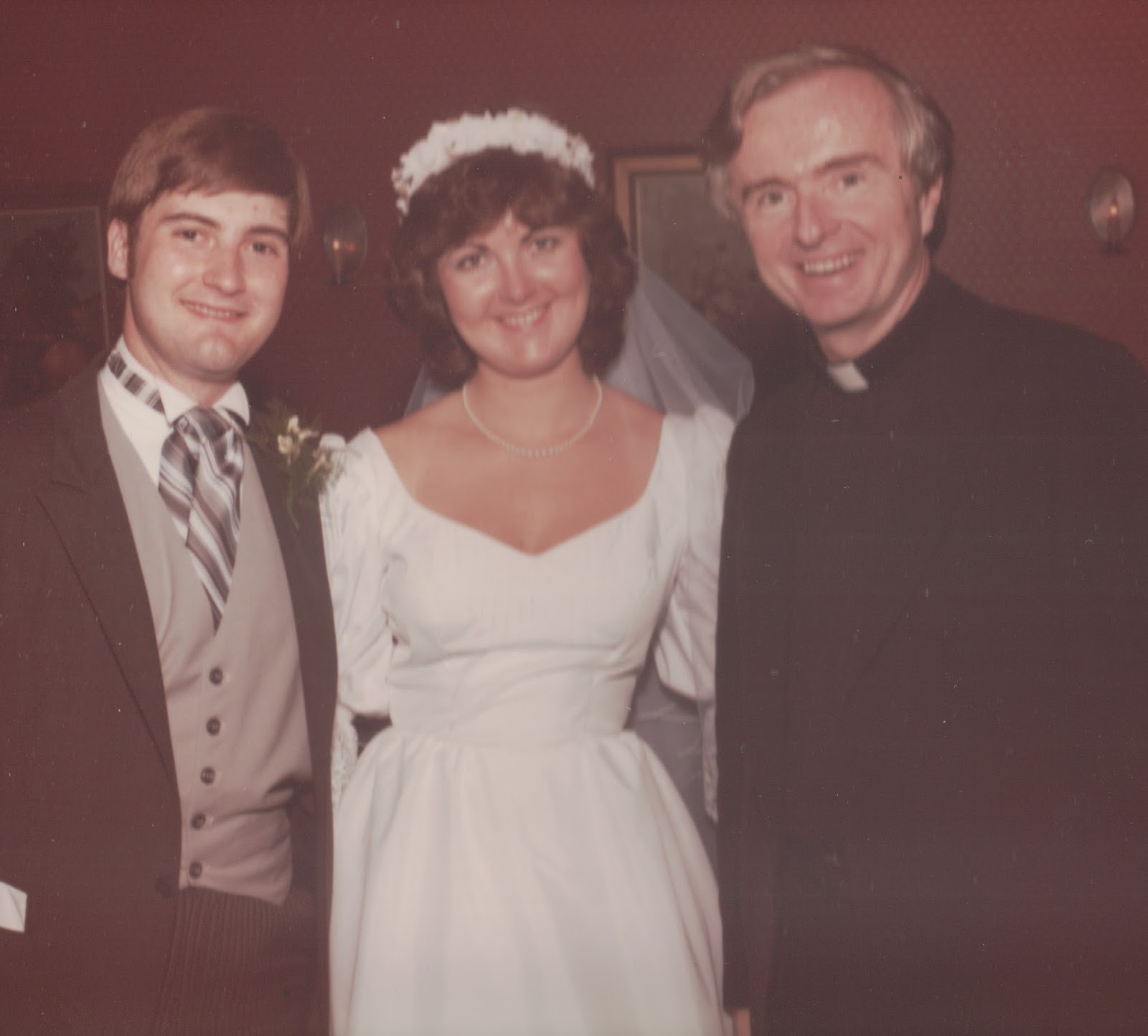
We were pleased to see a memorial display to Father Charles Bierne near the alumni office.  Charlie was the principal of the school while Vincent was a student, and he was also a chaplain at Harvard University while Vincent was at MIT.  Charlie married us, and baptized our daughter.  We kept in touch with him over the years because even when he was at universities in California and New York, or stationed in Central America, he would often visit his sister in Massachusetts.  Charlie died in 2010.

Our visit included a stop at the alumni office where they asked Vincent to update his profile on their computer.  This included current address, contact information, job history, where he went to college, degrees and other interesting questions. The staff at the office pulled out his old yearbook, and we had a good laugh looking at the photos and found a few more photos of Charlie Bierne. Not every school has an alumni office, but it reminded me that asking for school records would be a great genealogical resource.  I don't know if our descendants would think of looking for Vincent's high school in Puerto Rico, so hopefully someone in the future has access to my files!

My daughter and my nephew have both worked in development and alumni relations at colleges, including Simmons College, MIT, the Boston Conservatory and the Boston Architectural College.  They tell me that these institutions of higher learning keep meticulous files on alumni, and hire researchers to write biographies and investigate possible donors.  What a genealogical goldmine! Your high school may have similar, but smaller, archives.

Here are two stories on searching college records I have written in the past using college archive resources:

Caroline Wilkinson, Simmons College Class of 1907
http://nutfieldgenealogy.blogspot.com/2011/07/caroline-wilkinson-simmons-college.html

Good old college days
http://nutfieldgenealogy.blogspot.com/2010/04/old-college-days.html


This poster of Charlie was inside the alumni office

Charlie at our wedding in Holden, Massachusetts

For the truly curious:

The Collegio San Ignacio de Loyola website   https://www.edline.net/pages/Colegio_San_Ignacio

A short wikipedia article for Collegio San Ignacio de Loyola
https://en.wikipedia.org/wiki/Colegio_San_Ignacio_de_Loyola_(San_Juan)

A wikipedia article about Father Charles Bierne (and a funny story about how he was sent to Puerto Rico by accident and became the principal at San Ignacio)
https://en.wikipedia.org/wiki/Charles_Beirne


---------------------------

Published under a Creative Commons License
Heather Wilkinson Rojo, "Vincent's visit to his old prep school", Nutfield Genealogy, posted March 3, 2016, (  http://nutfieldgenealogy.blogspot.com/2016/03/vincents-visit-to-his-old-prep-school.html:  accessed [access date]).

Monday, February 29, 2016

17th and 18th Century Graffiti

Vincent at the Castillo San Cristobal, the largest fortress in the walled city of San Juan, Puerto Rico

This is a dungeon cell, with an open window in the castle wall at the end of the passage.

This tunnel system is part of the Castillo San Cristobal in San Juan, Puerto Rico.  Off one side of the main tunnel is a dungeon where prisoners, pirates, and political dissenters were jailed.  In one cell Vincent photographed the remains of some 17th century graffiti.  Experts believe that a naval officer must have been the artist of the five ships scratched into the plaster because the level of detail in the ship rigging is very accurate. The graffiti is mostly Spanish, but also English and French. 


The recognizable Spanish word mierda  ( in English this translates to "shit") was scratched by an unfortunate prisoner inside the dungeon off tunnel 1A in San Cristobal.  


There are several large and small fortresses and castles as part of the defensive system of San Juan.  They were built between 1539 and the 19th century.  You can find both linguistic and figurative graffiti on the walls of these forts.  The written graffiti is in several languages, and the drawings include shops, soldiers, horses and other animals.   The scholarly paper described below is a report on this graffiti and other graffiti found in the forts around San Juan.

We were fascinated with the graffiti, and by the fact that it has survived the ages in a fortress built in the 1600s.  This dungeon cell is also exposed to the elements by a large open window that overlooks the waves crashing onto the rocks at the foot of the castle walls.  All sorts of tropical humidity, rain, hurricanes, and other adverse weather have not faded these drawings and words.

The National Park Service gives guided tunnel lantern tours several times a week at Castillo San Cristobal.  Otherwise, the tunnels are open for self guided tours during the regular National Park hours.

This is the main passage of tunnel 1A under San Cristobal
fortress.  The dungeon cell can be seen on the left.


For the truly curious:

"Historical Ship Graffiti on the Walls of San Juan's Spanish Defense System: An Interim Report", by Isabell C. Rivera Collazo, The International Journal of Nautical Archaeology, (2006), Volume 35, pages         (available online at  https://www.academia.edu/920732/Historical_Ship_Graffiti_on_the_Walls_of_San_Juans_Spanish_Defence_System_An_Interim_Report   )

Wikipedia article Castillo San Cristobal   https://en.wikipedia.org/wiki/Castillo_San_Crist%C3%B3bal

A five minute video tour of Castillo San Cristobal
 https://www.youtube.com/watch?v=W-40H0eihhg 


--------------------------

To cite/link to this blog post:  Heather Wilkinson Rojo, "17th and 18th Century Graffiti", Nutfield Genealogy, posted February 29, 2016, (  http://nutfieldgenealogy.blogspot.com/2016/02/16th-century-graffiti.html: accessed [access date]).

Sunday, April 20, 2014

Happy Easter!


Easter Morning
Old San Juan, Puerto Rico
1992

This photo was taken at La Plaza de la Barandilla.
The statue is a bust of Patricio Rijos "Toribio", famous for playing the "guicharo"
(a hollow gourd played as a musical instrument)

Other Easter posts at this blog:

2013 Easter Parade 1963, 5th Avenue, New York City
http://nutfieldgenealogy.blogspot.com/2013/03/easter-parade-1963-fifth-avenue-new.html

2010  Easter Photo 1965
http://nutfieldgenealogy.blogspot.com/2010/04/not-so-wordless-wednesday-easter-photos.html


----------------------------------
The URL for this post is
http://nutfieldgenealogy.blogspot.com/2014/04/happy-easter.html

Copyright (c) 2014, Heather Wilkinson Rojo

Friday, December 20, 2013

Photo Friday - A Photo Rescue Mission


Earlier this month we went to San Juan, Puerto Rico.  My husband's family has an apartment near the beach. The last time I visited this apartment, about four years ago, I had examined the family photo albums and I was dismayed to see their condition.  Each photo was discolored and faded.  The albums were falling apart.  I knew that someday soon I would need to rescue those photographs. It is a very hot, humid climate.  While we were there there was 11 inches of rain!  The windows are always open to the ocean breeze.  Salt, humidity, time and heat have done their damage to the "peel and stick" albums and to the photographs.  

So during this last visit, we spent some time every night removing the photographs from 22 large albums, and packing them up in ziploc baggies to be carried home in our luggage.  The photos are faded, foxed and even moldy.  I will spend a lot of time in the coming year scanning them, sorting them, and Photo Shopping some of the more precious family photographs to restore them.  Most of the originals will have to be destroyed.  I hate to get rid of them, but their condition is just that horrid - we can't keep them because of the mold and destruction. 

Fortunately most of the photos are labeled on the back, and some even had typed descriptions on the their reverse.  We wrapped up each set in paper, with a written description of the vacation, year, dates, people, etc.  My husband's mother worked for Iberia airlines in the 1960s to the 1980s so there were lots of fantastic photographs of trips to Spain, as well as Egypt, Japan, Hong Kong, Brazil, Argentina, and all over Europe.  I found some photographs of my first trip to Puerto Rico in 1980, and Vincent found some of his baby photographs.  It was a trip down memory lane to see these, even though they were faded and damaged by the tropical climate. 

My friend from New Hampshire helped us to recover the photographs.
We also spent a lot of time reminiscing about people and places!

Vincent was delighted to find this photo of himself as a newborn baby!

It was difficult to remove some photos from the sticky pages,
and others were already falling out, and the plastic
covering was breaking into pieces.


We bundled the photos in groups, labeled with
dates, geography, names of people, etc.

It took five nights to recover all the photos from over 22 albums


This is one of the oil paintings damaged by the tropical climate.
It has darkened and is almost totally obscured.  You can barely see the Madonna.
The artwork and books will be moved by an express company next year. 


--------------------------------
The URL for this post is
http://nutfieldgenealogy.blogspot.com/2013/12/photo-friday-photo-rescue-mission.html 

Copyright (c) 2013, Heather Wilkinson Rojo

Sunday, July 10, 2011

National Piña Colada Day

"Do you like Piña Coladas?...."


Thanks for the reminder, Thomas MacEntee, at his post today at GeneaBloggers http://www.geneabloggers.com/genealogy-blogging-beat-sunday-july-10-2011/

This is my daughter, at the place where the Piña Colada was first created, at the Barrachina Restaurant in Old San Juan, Puerto Rico.  She was finally old enough to order her own cocktail, but they also have free samples here.  There are several rival places in Puerto Rico that all claim to be the birthplace of this delicious tropical drink!

-------------------------
Copyright 2011, Heather Wilkinson

Monday, December 13, 2010

Advent Calendar- Holiday Travel to Puerto Rico

My husband's family is from Spain, but they still own an apartment in San Juan, Puerto Rico, where my husband spent his school years.  His father was a professor for many years at a university in San Juan.  It is always fun to escape cold New Hampshire to visit here anytime, especially at Christmas.  Here you trade Santa for the Three Kings, Christmas Trees for palm trees on the beach, and dinner is pasteles and roast pigs.  The Christmas light displays are much more elaborate than anything in New Hampshire.
The whole family in front of
La Fortaleza, El Palacio Santa Catalina,
the Governor's residence in San Juan, Puerto Rico
built between 1533 and 1540

Illumination displays of the Three Kings
near the beach

Public light displays in the Condado
neighborhood of San Juan  (The Three Kings again!)

Illuminated displays in Old San Juan,
Plaza Colon, with the walls of the city.
Our family visit with the Three Kings
(the Hispanic version of Santa Claus)
in a mall in San Juan

-------------------------
Copyright 2010, Heather Wilkinson Rojo

Saturday, January 2, 2010

Colonial American History and San Juan, Puerto Rico


It’s always fun to combine family reunions, history and vacations. We’ve traveled to most of the interesting places on the map that pertain to Colonial American History, and I’ve always found a genealogical connection. We’ve gone to Williamsburg, Jamestown, Quebec City, Plymouth, Bermuda, Boston, and Louisburg, Nova Scotia. However, San Juan, Puerto Rico is the ultimate colonial city in the United States, being the oldest city under the US flag, founded in 1521. It is second only to Santo Domingo, in the Dominican Republic for a European established city in the Americas. It is well worth the trip for anyone who enjoys American history.

In December we went to San Juan, Puerto Rico to meet up with my in-laws from Spain and to celebrate their 50th wedding anniversary. They had lived for many years in San Juan, and still have a residence near the Condado beach section of the city. It was a chance for my daughter to see where my husband spent his teen years, and where he went to high school. And it was a chance to walk the city streets that were built in the 1500s.

The famous explorer Juan Ponce de Leon founded the original colony in 1508, just west of present day San Juan. In 1509 the settlement was moved to the harbor and called Puerto Rico, Spanish for “Rich Port.” In 1521 the town was called San Juan Bautista de Puerto Rico, for John the Baptist, which was the name Christopher Columbus originally called the island.


San Juan is a fortified city, with most of its walls still intact today. There are a ring of fortresses around the walls, to protect the harbor. The first attack was by the French in 1528. Attacks on the city were lead by Sir Frances Drake in 1595, the Dutch in 1625, the English again in 1797, and so on until the Spanish American war in 1898. Pirates and pirateers were also a concern, as the gold and silver laden Spanish ships would stop in San Juan to resupply before crossing the Atlantic to return home with their booty.

In Colonial times the city was quite large, including the Fortresses of San Felipe del Morro, San Cristobal and the fortified Palacio de Santa Catalina (now the governor’s home). There were large palatial homes such as the Casa Blanca, home to the Ponce de Leon family. Many churches, including the Cathedral which was began in the 1520s, were already built before the pilgrims even landed in Massachusetts. During our Christmas Mass last week the priest announced the 500th anniversary of the Catholic Church on the island of Puerto Rico. All this happened before the English had a foothold in the Americas. By 1530 San Juan had a university, a hospital and a library.

My father-in-law was born in Spain, yet he grew up in the care of the Jesuit fathers in the new world when he was a young man. After serving for over ten years in the United Nations and becoming an American citizen, he decided to remove to San Juan, Puerto Rico. My husband attended prep school in San Juan, and then came to Massachusetts for college and never lived in Puerto Rico again. If you looked at the vital records of the family, no was born, married or died in Puerto Rico, yet the family lived there for 30 years. I imagine that in the future, a genealogist tracing the family might not know they even lived in San Juan.

My father-in-law was professor in Puerto Rico, and he taught about the colonial beginnings of the Spanish in the New World. I’m a history buff, descended of Mayflower passengers and many colonial figures from New England. However, a trip to Puerto Rico makes the history of New England seem like current events! Even the explorations of John Cabot, John Smith and Bartholomew Gosnold along the New England coast seem like afterthoughts to what was happening in Puerto Rico and other Spanish settlements in North America.

---------
Copyright 2010, Heather Wilkinson Rojo

Friday, January 1, 2010

San Juan Cemetery, Puerto Rico


For the past two weeks we've been on vacation visiting Puerto Rico. It's the perfect place to explore early American Colonial History. San Juan was founded in 1521, and the explorer Ponce de Leon was one of it's early governors. You can visit the walled city, its half dozen fortresses, and even Ponce de Leon's house. The narrow streets of Old San Juan are perfect for exploring by foot, and there is even a "Duck Tour" so you can have a guided trip inside the city and view the walls from the harbor.

This photo is in San Juan, Puerto Rico, at the little cemetery outside the walls of the El Morro fortress, part of the U.S. National Park system. At the left you can see the walls of the fortress, and the guy in the blue shirt is a tourist exploring El Morro. The cemetery is outside the walls of the city, and the National Park service did not advice visitors to explore it, and the gates were locked anyways. The guys in green shirts were a cleaning crew raking the grounds.

El Morro is a Spanish Colonial era fortress built between 1539 and the mid 19th century. The Santa Barbara Bastion (an old tower) was first built in 1539, and the rest followed. There is also a gun turret on top that dates from the Spanish American War, and a lookout from WWI or WWII added by the Americans. A lighthouse was also added to the top of El Morro in 1908, so it is very much a working fortress, and part of lots of Puerto Rican History.

I noticed that most of the cemeteries in greater San Juan seemed to be locked, which is unusual for me. Here in New England the only cemetery I can recall being locked from visitors is the Hawes Burial Ground in South Boston. I would have loved to explore the headstones and the area. You can see the ocean just beyond the walls of the city. Most cruise tourists don’t notice this cemetery as they pass the El Morro fortress at the entrance to San Juan Harbor.

You can see a few graves from this cemetery at www.findagrave under "Cementerio Antiguo de San Juan" It seems that quite a few heroes and popular Puerto Rican figures are buried here.

----------
Copyright 2010, Heather Wilkinson Rojo