Showing posts with label Serendipity. Show all posts

Tuesday, January 10, 2023

Newly discovered Civil War photos of my Great Great Grandfather

 Over Christmas break my distant cousin contacted me with some genealogy questions.  One was a question about a photo she saw on Find A Grave for my great great grandfather Abijah Franklin Hitchings (1841 - 1910).  I had never seen this photo before!


I contacted the gentleman who contributed this photo to Frank Hitchings memorial at Find A Grave https://www.findagrave.com/memorial/15836442/abijah-franklin-hitchings  His name was Peter Maugle, and according to his profile at Find A Grave, he is a staff member at Fredericksburg National Military Park. He has added photos to over one thousand memorials while attempting to establish the identities of the marked graves at Fredericksbury National Cemetery.  Frank Hitchings was wounded at Fredricksburg, but did not die there.  He died in 1910 at his home in Salem, Massachusetts. 

According to Peter Maugle, he found this photo at the Library of Congress digital collection.  You can see the information at this link identifies Frank Hitchings as the soldier seated in the photograph.  https://www.loc.gov/item/2022630776/    This photo was donated to the Library of Congress in September 2020.  It pays to keep looking at those Find A Grave memorials every year to see if new information has been added! 

I have previously blogged about Great great grandpa Hitchings at several blog posts.  I'll add those links to the end of this post, and if you are interested you can read those stories.  He had served twice in the Civil War, first in the "Minute Men of '61" (Co. I, 8th Reg. Mass. Vol. Infantry) which rescued Old Ironsides (the USS Constitution) from Annapolis, and then again in Co. H, 19th Reg. Vol. Infantry, and was in the Battle of Fredericksburg.  Here is the digital version of his carte de viste- the original hangs on my mother's living room wall. This would have been his colorful Zouave uniform from the "Minute Men". 


Frank Hitchings served in the invalid corps during the end of the Civil War.  He had been a sailmaker before his military service, and after the war he began working at the Salem Custom House.  Eventually he became the Deputy Customs Collector.  His office is preserved in the Salem National Historic Park at the old Custom House on the waterfront. 

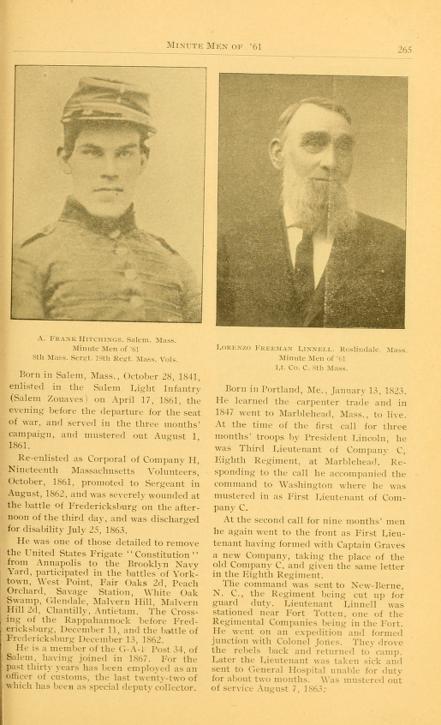
My grandmother was born in 1905. She remembers her "Dada Hitchings" walked with a limp.  He had his leg examined many times by the doctors at the Boston Veterans Hospital in Charlestown, and those records are preserved in his pension file.  His wife Hanna Eliza Lewis Hitchings (1844 - 1921) received a widow's pension when Frank died in 1910.  His obituaries are full of testimonies and information about his military service and his participation in many GAR events.  I wasn't surprised to see at the Library of Congress website many links to mentions of his name including the book History and Complete Roster of the Massachusetts Regiments: Minute Men of '61 who responded to the first call of President Abraham Lincoln, April 15, 1861, to defend the Flag and Constitution of the United States, by George W. Nason, 1910.  

This book at the LOC included this page about A. Frank Hitchings (page 265) 

Just when you think you've found all the existing material (ephemera, photos, information) on an ancestor, something new pops up!  Never stop looking and communicating with your cousins. 

For the Truly Curious:

Abijah Franklin Hitchings Find A Grave Memorial   https://www.findagrave.com/memorial/15836442/abijah-franklin-hitchings  

Photograph at the Library of Congress    https://www.loc.gov/item/2022630776/  

"How to find your American Veteran Ancestors (A. Frank Hitchings" November 10, 2009   https://nutfieldgenealogy.blogspot.com/2009/11/how-to-find-your-american-veteran.html   

"My Great Great Grandfather, the Deputy Customs Collector, June 26, 2015   https://nutfieldgenealogy.blogspot.com/2015/06/my-great-great-grandfather-deputy.html   

My Hitchings Surname Saturday post, October 4, 2014    https://nutfieldgenealogy.blogspot.com/2014/10/surname-saturday-hitchings-of-lynn.html  

------------------------

To Cite/Link to this blog post: Heather Wilkinson Rojo, "Newly discovered Civil War photos of my Great Great Grandfather", Nutfield Genealogy, posted January 10, 2023, ( https://nutfieldgenealogy.blogspot.com/2023/01/newly-discovered-civil-war-photos-of-my.html: accessed [access date]). 

Friday, March 10, 2017

Top Ten Genealogy "Close Calls"


What’s a “Genealogy Close Call”?  It happens when I research an ancestor and realize that if fate didn’t intervene I wouldn’t be here today.  Some of our ancestors narrowly escaped disasters, only to live on and produce a descendant that led to YOU!   Read down the list, and you’ll instantly know what I mean.  I’m sure there are many “close calls” in your family tree, too.  Why don’t you tell me about some of these bits of serendipity in the comments?

Close Call No. 1:
John Howland (1592 – 1673) is my 9th great grandfather on both my mother’s side, and my father’s side of the family.  He had a very close call on his way to Massachusetts on board the ship Mayflower in 1620. Halfway across the Atlantic the Pilgrims encountered a great storm. For some unknown reason, the passenger John Howland was on deck instead of below with the other Pilgrims.  He fell overboard, but miraculously grabbed a rope that was hanging over the side of the ship, and he was hauled to safety.  Young John was described in William Bradford’s journal “though he was somewhat ill with it, yet he lived many years after.”  He later married Elizabeth Tilley, another passenger, and had many children, including the two daughters, Hope and Desire, from whom I descend.  If not for that rope, I wouldn’t be here today.

Close Call No. 2:
I have many ancestors who were involved in the 1692 Witchcraft Hysteria that hit Salem, Massachusetts. Three were hanged, many others were imprisoned, brought to trial, accused and otherwise abused.  The ones who were hanged (Bridget Bishop, John Proctor and George Jacobs) were past their prime, with grown children, so their deaths did not mean that my lineage never occurred.  However, I had one ancestress, Elizabeth Collston (b. 1676), my 7th great grandmother, who was arrested and imprisoned with her mother and grandmother.  At some point 16 year old Elizabeth Collston escaped.  And she escaped a second time weeks later!  Considering that she could have been brought to trial and hanged like the three ancestors mentioned above, she also could have died in jail because the conditions were appalling.  Lucky Elizabeth escaped, married in 1703, and had a daughter, Mary Collston, who was my 6th great grandmother.  Thank you Elizabeth!

Close Call No. 3:
My 7th great grandfather, William Munroe (1625 – 1718) was a Scots warrior in the Battle of Worcester on 3 September 1651.  The Scots lost the battle, and survivors were rounded up and marched without food to London to be shipped on board the John and Sarah to Boston to be sold into servitude.  If you read about the Scots prisoners of war, there were not many survivors of this bloody battle.  There were not many survivors of this forced march to London.  Some died on board the ship on their way to the New World. Somehow young William survived all this to be sold on the docks into servitude.  The Scots were not welcome in Puritan Boston, but most of these men survived and married and left many descendants.  William married in 1665 to Martha George and had four children, including my 6th great grandfather, George Munroe (about 1672 – 1747), and remarried twice more and had ten more children!  There are many descendants who feel quite grateful that William was a survivor!

Close Call No. 4:   
My 4th great grandfather, Johann Daniel Bollman (about 1751 – 1833) was born in Hammersleben, Saxony, Germany.  He was a surgeon, and a Hessian officer during the American Revolutionary War.  He served with Baron de Riedesel’s Brunswick Regiment.  They fought at the Battle of Bennington in August 1777 where about 200 Hessians were killed and 700 were captured.  Then they fought in September at the Battle of Saratoga where my ancestor was captured.  Most of the Germans were marched to prison camps near Boston.  However, since he was a doctor, he was one of the first men to be included in a prisoner exchange and sent to Halifax.  He settled in the town of Lunenburg, Nova Scotia – not far from Halifax.  He survived two bloody battles and being captured.  Dr. Bollman became a politician, as well as the town doctor.  He was a member of the House of Assembly and represented Lunenburg from 1793 - 1809.   He was a physician for 54 years and died at age 82.   Click this link to learn more about this ancestor:  https://nutfieldgenealogy.blogspot.com/2014/03/surname-saturday-bollman-my-hessian.html  

Close Call No. 5:
My 5th great grandfather, Levi Younger (1756 – 1806) served in the Revolutionary War as a seaman.  This wasn’t unusual because he was a mariner from Gloucester, Massachusetts.  However, what was unusual was that he was captured and sent to the prison ship “Favorite” in New York harbor.  If you read or Google what the conditions were like on those British prison ships you will wonder how Levi Younger survived this ordeal.  Then he was brought to Forten Prison at Gosport near Portsmouth in England.  Googling the story of Forten Prison will make your hair stand on end. Somehow young Levi survived all this, returned to Gloucester, and married in 1784.  He had five children, including Levi, Jr. (1786 – 1858), my 4th great grandfather.

Close Call No. 6:
Levi Younger, Jr. (1786 – 1858) is my 4th great grandfather.  His father  (see above) was captured as a seaman during the Revolutionary War.  Levi, Jr., was also a mariner, and when the War of 1812 occurred, he stepped in to serve his country in defense of the New England coast.  You guessed it – Levi was one of the many American sailors “impressed” into the British navy during the War of 1812.  He was listed as “refusing to do so service [and] have been punished”.  Like father like son.  He also survived his ordeal and was married in 1816 in Boston and had five children, including my 4th great grandmother, Mary Esther (Younger) Emerson described below.

Close Call No. 7:
This one is quite a story!  James Stilson, my 7th great grandfather, was born about 1680 in Maine near the Pemaquid River.  He was captured in 1689, along with his mother, two sisters and a brother, and taken by the Indians to Quebec, Canada.  His mother was redeemed after a few years, but James was not ransomed for 12 years.  He heard that a New England woman was still being held prisoner, and he went back to see her, and liked what he saw.  Her name was Hannah Odiorne, the widow of John Batson of Cape Porpoise, Maine.  He ransomed and married her in the Roman Catholic church of Notre Dame in Montreal.  They had both been baptized Roman Catholic during their captivity.  Their first child, Marie Anne Stilson dit Dutilly Odiorne was baptized Roman Catholic on 8 March 1707.  They were remarried in Boston upon returning to New England.   The baby baptized in Montreal is my 6th great grandmother, Hannah (AKA Marie Anne) who married Thomas Mead on 2 May 1725 in New Castle, New Hampshire.

Close Call No. 8:
Mary Esther Younger (1826 -1913) was my 3rd great grandmother. Her father was a mariner from Gloucester who lived in Boston.  Her mother died very young, leaving Esther motherless, and two little brothers also died at the same time.  Her father remarried, but there must be more to the story because Esther was adopted by her father’s sister and her husband, David Harris.  She was raised by the David Harris family (this was another longer story on how I puzzled out her real parents).   What kind of dreadful disease or accident took the mother and brothers? Was Mary Esther lucky to have survived?

Close Call No. 9:
George Emerson (1817 – 1890) was my 3rd great grandfather.  He was a young husband with a wife (Mary Esther Younger, above) and two small children when gold was discovered at Sutter’s Mills in California in 1848.  On February 4, 1849 George was one of the 100 members of the New England and California Trading and Mining Company that left Boston on board the ship Leonore for San Francisco.  Yes, he was “49er”!  They arrived 150 days later via Cape Horn in San Francisco Bay.  There are a few surviving diaries from other members of this group of gold miners, and one describes George Emerson as sick and dying, left by the side of a California creek to write his will.   Somehow George survived, and made his way home to Boston where he had six more children.  One was Mary Katharine Emerson, my great great grandmother.  She wouldn’t have been born if he had died in California, like many other 49ers.  Click this link to learn more about my '49er ancestor:  https://nutfieldgenealogy.blogspot.com/2009/08/george-emerson-forty-niner.html  

Close Call No. 10:
My great great grandfather, Abijah Franklin Hitchings (1841 – 1910) served twice in the Civil War. His second enlistment brought him with Company H, 19th Massachusetts Volunteer Infantry to the Battle of Fredricksburg where he was shot in the leg on 13 December 1862.  He was discharge for his wounds on 25 July 1863 at Boston.  His leg wound was horrific, but he refused to let them amputate.  He suffered for the rest of his life from terrible diseases like necrosis.  I have a 100 page pension report with lots of pages of medical reports from his annual trips to the medical facilities at the Old Soldier’s Home in Chelsea, Massachusetts.  He walked with a cane for the rest of his life.  Fortunately, he was well enough to marry on 22 September 1864 and had two children, including my great grandfather, Arthur Treadwell Hitchings (1868 – 1937).   Personally, I think this is quite a miracle since we all know how terrible the medical attention was during the Civil War battles (not just from TV, but from historical accounts), and he lived through infections and necrosis in the years before antibiotics became available.  Look up necrosis – it’s quite nasty.   Click this link to learn more about A. F. Hitchings:  https://nutfieldgenealogy.blogspot.com/2009/11/how-to-find-your-american-veteran.html   


The image above is from the journal Blast from the Ram's Horn, 1902, page 249 https://archive.org/stream/blastsfromramsho00unse/blastsfromramsho00unse#page/n256/mode/1up

-----------------------------------

Alona Tester, an Australian genealogy blogger, was inspired by this blog post and wrote her own about her Australian ancestors and their "Close Calls".  You can read these stories at this link:
http://www.lonetester.com/2017/03/genealogy-close-calls/

-----------------------------------

Heather Wilkinson Rojo, "Top Ten Genealogy "Close Calls", Nutfield Genealogy, posted March 10, 2017, (  http://nutfieldgenealogy.blogspot.com/2017/03/top-ten-genealogy-close-calls.html: accessed [access date]). 

Thursday, August 11, 2016

Is there an Olympian in your Family Tree?

[This is an edited version of a post published at this blog on August 2, 2012 during the last Olympics in London]

Our Wilkinson family tree is not full of athletes.  In fact, we are all much better at sitting in our armchairs and cheering on the Red Sox or Patriots than getting out and tossing around a ball.  A few Wilkinsons were athletes in high school or college.  Some still jog or do yoga, and a few cousins have expanded this to 10K races and marathons.  But one, and only one Wilkinson, a descendant of Thomas Wilkinson (about 1690 - before 1739) of Portsmouth, New Hampshire, has made it to the Olympics.

Brett Wilkinson
from www.Row2K.com 
In 2004 my fourth cousin, Brett Wilkinson, competed in the Athens, Greece Olympic games. Brett and I share a common 3x great grandfather, Aaron Wilkinson, who was born in South Berwick Maine in 1802 and died in Peabody, Massachusetts in 1879.

Brett is a rower, and competed in the men’s fours (quadruple sculls).   His boat came in eleventh, and a Russian boat took the gold medal during the 2004 Olympics.  If you are unfamiliar with rowing, a scull is a boat with the rowers pulling two oars each (one in each hand).  When the rowers have one long oar (both hands on one oar), it is known as a sweep.

I’ve never met Brett, and I only know about his athletic history because another cousin has filled me in on the details of this side of the family.  I was surprised to hear we had an Olympian in the family. And even more surprised to hear he was a rower.  If you hear you have an Olympian in your family tree, Google can lead you to lots of Olympic history, with lists of athletes, statistics, medal winners, biographies, interviews, and maybe even a video!  Every sport has it's own website, and for rowing I checked the archives at www.Row2K.com and www.USRowing.org . High school and college athletic departments often have great websites, with lots of statistics and photos.  Since Brett Wilkinson won a gold medal, I found his biography at Wikipedia, which led me to many other sources of information on this cousin. 

How do I know so much about rowing?  My own daughter rowed in high school and then for the Simmons College crew.  She also rowed in the 2006 Head of the Charles Regatta in Boston.  She rowed in a collegiate 8+ race (eight women and a coxswain).  Brett Wilkinson was also at the 2006 HOCR, rowing out of the same boathouse (Simmons college uses the Riverside Boat House), in the Championship Men’s Doubles,  and he came in 3rd  place. This same year my daughter’s rowing coach, Nikolay Kurmakov, a former Soviet Union National Champion, won the gold medal in the HOCR Senior Master Men’s Eight race, rowing out of Riverside.  He won gold at the 2006, 2007, 2008 and 2009 Head of the Charles Regattas, and set a course record in 2007.  

Former Ukranian and Soviet National Champion, Simmons Coach Nikolay Kurmakov,
gives a pep talk to the 2006 Simmons College 8+ boat before the HOCR

The 2006 8+ boat shoves off for the HOCR from Riverside Boat House.
My daughter is in the number 4 seat.
Considering that we spent all day during the Head of the Charles Regatta 2006 at the Riverside Boat House, we must have bumped into Brett at some point.   We also spent all weekend of the 2005 and 2007 HOCRs at Riverside Boat House, too. I know that Brett Wilkinson participated in all the HOCRs between 1997 and 2008, and placed in the top 5 spots several times.  Nikolay and Brett, as team mates, must have known each other.   Perhaps he is in some of our family photos, warming up or cheering on his team mates?  Perhaps we made some passing remark to him about the weather, or the regatta, as we stood on the docks? But we’ll never know, will we?

The first modern Olympics took place in Athens, Greece in 1896.  This means that if you found an Olympic athlete in your family tree, he or she is probably not many generations removed from you.  Ask the living members of your family closest in relationship for more information, and you will have a good start in researching your relative.  Use the resources of the US Olympic Committee online, and through correspondence, to find out more on the athletic career of your relative.  College archives, team archives, newspapers and YouTube may turn up more information.  Small town newspapers are especially rich with information on local heroes.  If you are lucky, your athlete may still be living, and you can correspond with him or her directly!

Simmons College parents cheering from the peanut gallery
at the Riverside Boathouse during the 2007 Head of the Charles Regatta
-----------------------
For more information:


Brett Wilkinson (rower) at Wikipedia
https://en.wikipedia.org/wiki/Brett_Wilkinson_(rower)

Team USA website -  http://www.teamusa.org/   
-----------------------

Heather Wilkinson Rojo, "Is there an Olympian in your Family Tree?", Nutfield Genealogy, posted August 11, 2016,  (http://nutfieldgenealogy.blogspot.com/2016/08/is-there-olympian-in-your-family-tree.html: accessed [access date]). 

Monday, June 13, 2016

Genealogical Collaboration from Down Under

When you hang out online with social media you can learn about new genealogy resources every day. I’ve been doing genealogy research since the 1970s, but from my friends online I learn every day about new books, places to visit, websites and more.   I belong to many genealogy groups on Facebook that cover New England and the entire globe.

One morning I read that Australian genealogy blogger, Caitlin Gow, was successful at newspaper research on an Australian website called Trove. Being from the US I was not familiar with Trove. But, I was intrigued because I have one member of my family tree who lived for a long time in Australia in the 1800s.  Was he mentioned in a newspaper in Australia? Caitlin gave me the link and I tried it out.  And I was successful, too!  I found several newspaper mentions of my great great Uncle Edward Manning Bill, who was a school teacher in Diamond Creek, Victoria. 

 One of the first newspaper notices I found was Uncle Edward’s marriage to a woman named Charlotte Grace on 6 June 1857 in the Wesleyan Methodist Parsonage in Ballarat, Victoria, Australia.  Caitlin found a copy of the wedding certificate online at the Victorian Births Deaths and Marriages Index at this link:  https://online.justice.vic.gov.au/bdm/indexsearch.doj  


[transcription]
Butcher, age 25, Ballarat, Ingram Bill, clergyman
                                                 Isabella Lyons
"             age 25, Ballarat,  Joseph Grace, Butcher
                                                Mary Jeffrey
Edward Manning Bill          In the presence of              Charles Lane
Charlotte Grace                                                              Fanny Bickford

                                        James Bickford (officiating Minister)


I shared with Caitlin a photo of Edward and Grace standing in front of the schoolhouse in Diamond Creek in about 1870.  We wondered if the school house was still standing, and Caitlin said “Now I wish I lived in Victoria and could go look!”.  I used Google and found that there was still a Diamond Creek Primary School, and their website said “Diamond Creek Primary School is situated in the heart of Diamond Creek. The school has occupied the site since 1870 and boasts a rich history of education within the area. The school’s original building has been refurbished as a Library and Music Centre, making it a metaphoric embodiment of the school’s motto, ‘where tradition meets the future’."

That's Uncle Edward Bill holding the parrot, and probably his wife next to him.

I decided to email the school and I sent a copy of the photo. Overnight I received a prompt message from the school that surprised me. 

I have attached a piece that mentions E M Bill and some details about the first years of our school.  This information was in a book produced for our 125th year in 1995.  We are approaching 150 years soon!!
The building you talk about is still in use today, has been renovated, restumped and reroofed over time.  Last year we installed new carpet and it has a bright coat of paint internally.   The exterior needs painting as it is some 20 years since the last one but unfortunately money doesn't grow on trees!  It has only been our persistence that sees the building still standing as it was in quite a bad state a few years ago and the Education department would quite happily have knocked it down.
Currently the building houses our grade 1 and 2 students and is a beautiful space for them to work in.
We have 213 children here and it is a fabulous place to work.  I have worked here for 20 years and my own children attended here, with my two eldest having started their school time in this very building.
Hope this is helpful,
Jennie Mitchell
Business Manager

The attachment was from a history book of the school, and on pages 2 it mentions “In 1869, the head teacher Mr. Bill reported that there were 73 [pupils] on the roll of who 28 were Primitive Methodist and the total fees for the six months were £22.10.6 of which the Primitive Methodists paid £14.16.0…”   Further on page 2 it also mentions “On the 1st July 1870 the Nullumbik School No. 1003 was opened as a Common School with Mr. Edward M. Bill (previously at No. 752) as head teacher.  His wife was appointed Work Mistress in February 1871… Mr. Bill received a salary of £37.10.0 plus a bonus of £50.11.2 for his results making his total wage for the six months £88.1.2.   Mrs. Bill received £15 for the same period.” 

It was wonderful that Caitlin was so very helpful to me.  After receiving the wonderful email from the school and sharing it with Caitlin, I realized that this was second time someone from Australia had assisted me in researching Great great Uncle Edward M. Bill.  The first time was when a woman in Australia had contacted me about him, because she was a relative of their adopted child.  This Australian assisted me with much information about Uncle Edward’s wife and child, and it was she who had sent me the photo of the school. 

Those Australian genealogists are wonderful!  Every single one I have met in person or online has been helpful, gracious and generous helping me to research Uncle Edward.  He went from being a mystery to a person with a very interesting life story.  As I told, Caitlin, I wish I had more Australian relatives!

Thank you Caitlin, and thank you Helen Swaine, who contacted me back in 2008 with the photo of the Diamond Creek School.

More about “Great great Uncle Edward”:

Edward Manning Bill, the son of the Reverend Ingraham Ebenezer Bill and his wife, Isabella Lyons, was born 27 March 1831 in Nictaux, Nova Scotia, Canada, and died 18 December 1904.  He married Charlotte Grace, the daughter of Joseph Grace and Mary Jeffrey, on 6 June 1857 at the Wesleyan Methodist parsonage in Ballarat, Victoria, Australia.  They had no children, but “adopted” Harriet Young Cox, the daughter of Matthew Dillon Thomas Cox and Mary Katharine Bathhurst. 

Harriet, known as “Etta”, was born 27 October 1878 in Australia, and died 23 September 1947 in Santa Cruz, California.  Etta was a successful singer in Australia, England and the United States.  She married Charles Anson, a real estate agent, and had one son, Carl Ansell Anson on 28 October 1909 in Seattle, Washington.  Carl married Margaret Lillian Spink of England.

  
My previous blog post about Great Great Uncle Edward Manning Bill in Australia, with the photo of the Diamond Creek School:


Diamond Creek Primary School website –  http://www.diamondcreekps.vic.edu.au/ 

Caitlin Gow’s blog “Genealogically Speaking” from Brisbane, Australia

--------------------------------

Heather Wilkinson Rojo, "Genealogical Collaboration from Down Under", Nutfield Genealogy, posted June 13, 2016, (  http://nutfieldgenealogy.blogspot.com/2016/06/genealogical-collaboration-from-down.html: accessed [access date]). 

Monday, February 23, 2015

Insanity, Guardianship, Account Books and Family History

Account Book, Jonathan Batchelder (1800 - 1847)

Jonathan Batchelder's Account
                       Book
of Chichester           
New Hampshir        
1831  January the 12

Back in 2004 a wonderful thing happened to me.  A gentleman who had bought a box of books on the West Coast found a small account book dating from 1831.  The name Jonathan Batchelder of Chichester, New Hampshire was written on the first page.  This gentleman spent much time trying to find a descendant of Jonathan.  Someone at the Chichester Historical Society found my online family tree because Jonathan Batchelder is my 4th great grandfather.

Note:  I had posted a query about Jonathan Batchelder at a bulletin board at GenForum in 2000.  It’s still there fifteen years later, and it still brings me email about the Batchelder family.  It pays to plaster the names of your ancestors everywhere- forums, Facebook, blogs, bulletin boards, wikis, everywhere.  You never know what will happen or who will contact you.

Back in 2009, when my blog was new, I wrote a post about how I received Jonathan Batchelder’s account book.  You can read that story by clicking HERE.  Since that time I have been researching the life of Jonathan Batchelder and his family.  It’s a very sad story.  But it’s amazing that his little book ended up on the West Coast and somehow found its way back to me.

There was nothing of genealogical value written inside this account book.  Of course, there are lots of names of people who lived near Jonathan and probably lived in Chichester, New Hampshire in the 1830s and 1840s. It is fascinating community information.  Some of the names might be relatives because there are quite a few Batchelders and Lanes listed.  Prices listed of items and labor traded are interesting.  The spelling is atrocious.  The biggest surprise was this slip of paper stuck inside:


This is a wonderful find!  This paper has much more information than what I found in the probate records online.   I first went to Family Search where I found an index of probate in this time period, where I found this index card:


Using the date and the docket number from this index card I was able to find the record in this volume and page here:


"New Hampshire, County Probate Records, 1660-1973," images, FamilySearch (https://familysearch.org/pal:/MM9.3.1/TH-1942-32660-11094-71?cc=2040537&wc=M797-G68:347815801,348206601 : accessed 18 February 2015), Merrimack > Dockets 1844-1858 no 2275-4869 > image 76 of 339; county courthouses, New Hampshire.

And here is a close up of this case:


Why was Nancy Batchelder named guardian to 14 year old Pauline Ann Batchelder? Well, it’s a long story…

Jonathan Batchelder was born about 1800 in Hampton, New Hampshire, the son of Elisha Batchelder and Sarah Lane.   On 11 February 1822 in Belmont, New Hampshire he married Nancy Thompson.  She was born about 1804 in Gilmanton, New Hampshire.  They had two children born in Chichester: George born in 1822 and Pauline Ann born in 1828.

 In the newspaper New Hampshire Patriot and State Gazette on 21 November 1840, I found a notice on page 3 stating that Jonathan Batchelder had emancipated his son George.  My 3rd great grandfather, George, had just reached the age of 18, and went off on his own to earn a living.  This was a common notice in those days.

However, as I was searching the newspapers I found a more sinister notice in the New Hampshire Patriot and State Gazette on 3 December 1846, page 4:

Guardian’s Notice:
Notice is hereby given, that the subscriber has been duly appointed by the Judge of Probate for the county of Merrimack, guardian of the person and estate of Jonathan Batchelder, of Chichester, in said county, decreed to be an insane person.  All persons indebted to the said Jonathan Batchelder are requested to make immediate payment to the subscriber, and all having claims to present them for adjustment.
David M. Carpenter, Guardian
Chichester, Nov. 24, 1846


A few months later this was found in the New Hampshire Patriot and State Gazette, 11 March 1847, page 4:

Guardian's Sale
"By virtue of a license from the Judge of Probate for the county of Merrimack, the subscriber as guardian of Jonathan Batchelder, of Chichester, in said county, who has been decreed an insane person, will sell at public auction on Wednesday, the 24th day of March next, at ten o'clock in the forenoon, all the right and interest the said Batchelder has in the homestead place on which he the said Batchelder has heretofore resided, containing about fifty five acres of first rate land, on which there is a good lot of timber and wood; the house large and two stories, and recently painted; the barn and shed not old.  Said farm is within about two miles of Pittsfield Village, and on the main road from Pittsfield to Concord and Manchester, on which road Stages pass and repass every day.  Also, about fifteen acres of pasture and wood land, lying about one half of a mile from said farm, adjoining and of David Brown and others.  Terms of payment liberal.  Sale on the premises.
D. M. Carpenter, Guardian
Chichester, Feb. 24, 1847

This was followed by another notice in the fall of the same year, New Hampshire Patriot and State Gazette, 4 November 1847, page 3:

Administrator's Notice
"The subscriber hereby gives notice that he has been duly appointed administrator of the estate of Jonathan Batchelder, late of Chichester, deceased, intestate.  All persons indebted to said estate are requested to make immediate payment, and all having claims to present them to the subscriber for adjustment.
D. M. Carpenter, Adm'r
Chichester, Sept 29, 1847

It is never easy to read that an ancestor was insane and died so young.  The family home was sold and the courts at this time granted guardianship of the minor child, Pauline, to her mother.  This was also common at the time.  Mothers were not  automatically given their children upon the death of the father. 

One clue I have is that according to the book Batchelder, Batcheller: Descendants of Rev. Stephen Bachiler by Frederick Clifton Pierce written in 1898, it states that Jonathan Batchelder died in Concord, New Hampshire.  No date given.  No other details about his life, not even a maiden name for his wife, Nancy.  From the newspaper notices we can guess that he died before 4 November 1847.  There was a state insane asylum in Concord at the time, just a few miles away from Chichester.  Jonathan’s death was not recorded in any vital records.

Nancy Batchelder drops out of the records after her guardianship was recorded.  She is not in any census, nor is she in the vital records as remarrying or dying. I’d love to know what happened to her.  She was my 4th great grandmother, and I don’t know her origins, parents nor her birthday.  I only learned her maiden name from Pauline’s death record.  Nancy Thompson is a true brickwall ancestor.

Pauline grew up to marry David C. Watson of Vermont sometime before 1849 when her first son, Charles, was born in Pittsfield, New Hampshire.  About 1851 she had another son, and she named him George.  David Watson had a clothing business in Boston on Howard Street with his brother Charles.  David died in Sutton, New Hampshire in 1903, and Pauline died in 1911.

Pauline’s brother, George E. Batchelder, is my 3rd great grandfather.  He spent the rest of his life in Chichester as a farmer, like his father.  He also died young, at age 26, in 1848.  He married Abigail M. Locke of South Boston in 1845 and had two children before his early death, Abby Ann, born in 1847 and died two weeks old, and George E. Batchelder, Jr., born posthumously on 8 October 1848, one month after his father’s death.  George, Jr. is my great great grandfather. 

You can see that after more than 20 years of researching this family, there still are lots of details yet to find!

Click here to read my previous blog post about Jonathan Batchelder's account book:

----------------------------

The URL for this post is
 http://nutfieldgenealogy.blogspot.com/2015/02/insanity-guardianship-account-books-and.html
Copyright © 2015, Heather Wilkinson Rojo


Tuesday, September 23, 2014

Tombstone Tuesday~ Another case of genealogical serendipity!

I photographed these two tombstones while I was wandering around the Central Cemetery in Beverly, Massachusetts looking for my 3rd great grandparent’s gravestones (Peter Hoogerzeil and Eunice Stone).  I never found my ancestors, but I thought that perhaps I was related to these Emersons.


I was right! These are two wives of Rev. Joseph Emerson (he was married three times).  He was called to be the first minister of the Third Congregational Church of Beverly on 21 September 1803.  He was my 2nd cousin six generations removed, born in Hollis, New Hampshire on 13 October 1777.  His grandfather, Daniel Emerson (1716 – 1801) was the brother of Brown Emerson (1704 – 1774), my 6th great grandfather.  This family was full of ministers.  The first Emerson in this lineage was Reverend Joseph Emerson (1620 – 1680) of Concord, Massachusetts, who married the daughter of Rev. Edward Bulkeley (1614 – 1696), Concord’s first minister.   My 4th great grandfather, Romanus Emerson (1782 – 1852) had four brothers- all ministers (Romanus had a speech impediment and never made it to being a pastor).  Even cousin Ralph Waldo Emerson (1803 – 1882), studied to be a minister, too, at Harvard Divinity School and was an assistant at Boston’s Second Congregational Church.


"MY REDEEMER LIVETH"

Holy
Bible

Nancy, the wife of Joseph Emerson
born May 28, 1779. married Oct. 19
1803. died June 15, 1804.

"A virtuous woman is a crown to her husband"
What armies of endearments throng the soul!
My Nancy, I'm become thy pupil now,
"Now will I take my leave, so soon to follow."
May her dying counsels live in the hearts of
her surviving friends, may her living virtues
and graces flourish in their lives; and the
sublime serenity of her death prove more
than a pillow for theirs.


O DEATH!  WHERE IS THY STING

ELEANOR

The wife of Joseph Emerson was
born Dec. 19, 1777, married July 15,
1805, and died Nov. 7, 1808.

She was remarkable for mental vigor
and bodily infirmities, for animat-
ing cheerfulness under much pain,
for rich resources of mind with
little reading; for performing the 
useful labors of a long life in a few
years; for the most lively and tender
attachment to her connexions and
friends; with the most sublime and
diffusive benevolence to all mankind.
----------------
Fond pupil pause, with deep concern receive
The solemn lesson that the dead can give.
What tho for thee, she toils and weeps no more
Nor charms thee now with intellectual store:
[the rest is buried under the sod]


Researching ministers is wonderful.  If you have a minister in your family, you are very lucky because they leave lots of documents and records behind for you to find.  I usually start with Google.  There might be links to sermons, ceremonies, books, biographies and even church bulletins at the Google Book search.  I found the Simmons College thesis that mentioned Rev. Joseph Emerson (see below) via Google.  Most ministers go to a college, university or divinity school, and these places have archives you can search online, visit in person, or call and speak to an archivist.  Many churches have historians or secretaries, and it is worth getting friendly with them by email or in person (bring coffee and cookies). Schmoozing with church staff is perfectly acceptable, especially if you make a donation of any size.   You might find your minister ancestor’s grave right in the church yard, or nearby.  Don’t forget to search WorldCat.org for sermons and papers by or about your minister.

The Third Parish in Beverly, Massachusetts was formed from a dissenting group of Calvinists in 1802.  Most of their members came from the First Parish, which had become Unitarian.  Eventually this parish became the Dane Street Congregational Church in 1837.  This is the same church where my Dad went to Sunday school, and where I was baptized.  This church is located within walking distance of the Central Cemetery, and these tombstones face Dane Street, near the fence on the sidewalk.  Isn’t that serendipity?

Reverend Joseph Emerson graduated Harvard College in 1801.  He was ordained at Beverly as pastor of the Third Church on 21 September 1803 and resigned in 1816 for health reasons. He established the Young Ladies’ Seminary in 1821 (Mary Lyon, who founded Mt. Holyoke College, was his student).  He died at Wethersfield, Connecticut on 13, May 1833.  He married first Nancy Eaton on 19 October 1803.  She died in 1804 (see the tombstone above).  He married second to Eleanor Read in July 1805, and she died in 1808.  He married third to Rebecca Haseltine in 1810.

Rev. Joseph Emerson and Rebecca Haseltine had a son, Luther (1810 – 1867) who was the minister in Amherst and Highland County, Virginia.  You can see his grave, at the Shemariah Church Cemetery in Augusta County,  at this link http://www.findagrave.com/cgi-bin/fg.cgi?page=gr&GRid=23261746 .  Reverend Luther Emerson was born in Beverly in 1810.

Another son, Alfred Emerson (1812 – 1896) graduated from Yale and from the Andover Theological Seminary.  He was a professor at Western Reserve College, and then served as a Congregational pastor at South Berwick, Maine and in Fitchburg, Massachusetts.   See this link for a biography: http://wheatoncollege.edu/college-history/1890s/reverend-alfred-emerson/   I told you that the Emerson family was full of ministers, and here is more proof! 

-------------------------------------
For the truly curious:

If you have New England Puritan or Congregational ministers in your family tree, an invaluable resource is the Congregational Church Library, 14 Beacon Street, Boston, Massachusetts  http://www.congregationallibrary.org/ and telephone 617-523-0470.  Their library is open Monday through Friday, 9am – 5pm and by appointment, free to the public.

Book on Rev. Joseph Emerson, Life of Rev. Joseph Emerson, Pastor of the Third Congregational Church in Beverly, Massachusetts, by Rev. Ralph Emerson, 1834 (Ralph was the brother of Joseph Emerson, also a Congregational minister in Norfolk, Connecticut and a professor of Ecclesiastical History at Andover Theological Seminary).

A Master’s Degree thesis from Simmons College mentions Rev. Joseph Emerson and the history of the Third Parish:   “Congregationalism Divided: A Case Study of Beverly, Massachusetts’ First Parish Congregational Church Split, 1802 – 1834” by Caitlin Lampman, 30 April 2013, online at this link:

The Dane Street Congregational Church website  http://www.danestchurch.org/about/history

For more information on the Emerson family and their many ministers, see the book The Bulkeley Genealogy by Donald Lines Jacobus, 1933.

-------------------------------
The URL for this post is
http://nutfieldgenealogy.blogspot.com/2014/09/tombstone-tuesday-another-case-of.html

Copyright ©2014, Heather Wilkinson Rojo

Thursday, July 3, 2014

Wedding Serendipity in Holden, Massachusetts

On 27 February 1787, my 5th great grandparents, Stephen Cree and Hannah Smith, were married in Holden, Massachusetts. Hannah was born in Worcester on 22 May 1763, the daughter of Joseph Smith. Stephen Cree was born in Topsfield, Massachusetts on 30 October 1760.  There is no evidence that they lived in Holden, and all five of their children were born in Topsfield, where Stephen and Hannah both died.  In 1787 Holden was a new town in central Massachusetts, broken off from North Worcester, first established a few years earlier in 1741.


In 1969 my family moved to Holden from Beverly, Massachusetts. We joined the First Congregational Church, and had no idea that our ancestors were married in that same church.  My parents were very active in committees at this church, and my mother still volunteers in the thrift shop.  I had my confirmation and wedding there, my nephew was baptized at this church, and my father had his funeral here. 

This week will be our 31st wedding anniversary.  

Vincent traveled 1,600 miles from Puerto Rico to Holden, Massachusetts to marry me.  And I'm still wondering what brought my 5th great grandfather 70 miles all the way to Holden 227 years ago to find a bride.  I'm glad they did, or I wouldn't be telling you this tale!

First Congregational Church in Holden, Massachusetts http://www.fccholden.org

------------------------
The URL for this post is
http://nutfieldgenealogy.blogspot.com/2014/07/wedding-serendipity-in-holden.html

Copyright (c) 2014, Heather Wilkinson Rojo 

Thursday, June 26, 2014

The Hunt for Alva A. Hunt, Civil War Veteran

Today's blog post was written by a guest blogger, Penny Webster.  I first met Penny through the Londonderry Historical Society.  She is also a member of the New Hampshire Mayflower Society, and she serves on the board as Elder.  I read about this story on Penny's Facebook page, and she agreed to write it up for my blog.  Thanks, Penny!

-------------------


Alva A. Hunt is my 2nd great grandfather.  He was born on May 20, 1843 in Nassau, NY and sometime during the mid 19th Century crossed over the Massachusetts border with his parents and siblings and settled in Pittsfield, MA.  There he worked as a teamster.  On March 19, 1864 he enlisted for a 3 year shift as a member of the 57th Regiment of Massachusetts Volunteers fighting against the Confederacy during the Civil War.  Alva’s military career would be cut short for he would be seriously wounded at the Battle of Spotsylvania Court House in Spotsylvania, VA.  A bullet that disabled his right arm led to his discharge.

Before being discharged, Alva married Julia Baker on October, 10, 1864.   They remained married for a little over 20 years and during that time Julia would give birth to 9 children.  Sadly, she would die from pneumonia in 1886 at the age of 36, a little over a month after the birth of her daughter, Grace.  Upon his discharge from the Army Alva continued working as a teamster but by the next census, he is listed merely as a farmer and this continued until his death in Pittsfield in 1901.  

Last fall I decided to take a trip to Pittsfield.  It was a new revelation to learn that my mother’s family came from Pittsfield.  I wanted to see Alva’s grave.  So my mother and I headed to Pittsfield and easily found the large cemetery on Wahconah Street.  I inquired at the cemetery office.  They told me what section of the cemetery to look for his grave but they had no indication if there was a gravestone or not.  We searched and searched but found no Hunt marker.  I returned to the office and asked for more assistance. This time I was given the surnames of his graveyard “neighbors.”  We found the neighbors, but no stone.  Was my great-great grandfather so poor that he couldn’t afford a grave marker?  Was it too hard to be a one-armed teamster or farmer?  Saddened we left Pittsfield. 

I remembered, a few months later that the Veteran’s Administration would pay for a marker for a Veteran’s unmarked grave. So I applied in February, filled out the FORM 1330 and coordinated with the Cemetery to validate my request and receive the marker.  Excitement was building.  The marker would be delivered to the cemetery in a couple of months and I would feel like I did something significant for Alva and my family. 


Recently, my mother and I made a second trip to Pittsfield to view the marker. It looked great but it seemed to be in an unfamiliar area.  To our surprise as we surveyed the ground we found a sizable monument nearby with A.A. Hunt’s name on the bottom! Also inscribed was Julia’s name with her birth and death dates. What a shock! It seems that last time we were sent to the wrong area. Alva wasn't in an unmarked grave after all! I feel better knowing that Alva wasn't poor.  He had bought this sizable monument for his wife when she died in 1886.  I wonder why his children neglected to inscribe his dates on it after his death,.   At least the VA marker solves this problem.     It does make me happy to know that Alva has received recognition for his Civil War service since his death.  We found an American flag planted next to our unpredicted find.


------------------------------------

To cite/link to this blog post:  Penny Webster and Heather Wilkinson Rojo, "The Hunt for Alva A. Hunt, Civil War Veteran", Nutfield Genealogy, posted June 26, 2014, (  
http://nutfieldgenealogy.blogspot.com/2014/06/the-hunt-for-alva-h-hunt-civil-war.html: accessed [access date]). 

Friday, February 21, 2014

Photo Friday ~ Ordinary objects with Famous Names

This photo was taken at the Concord Museum....


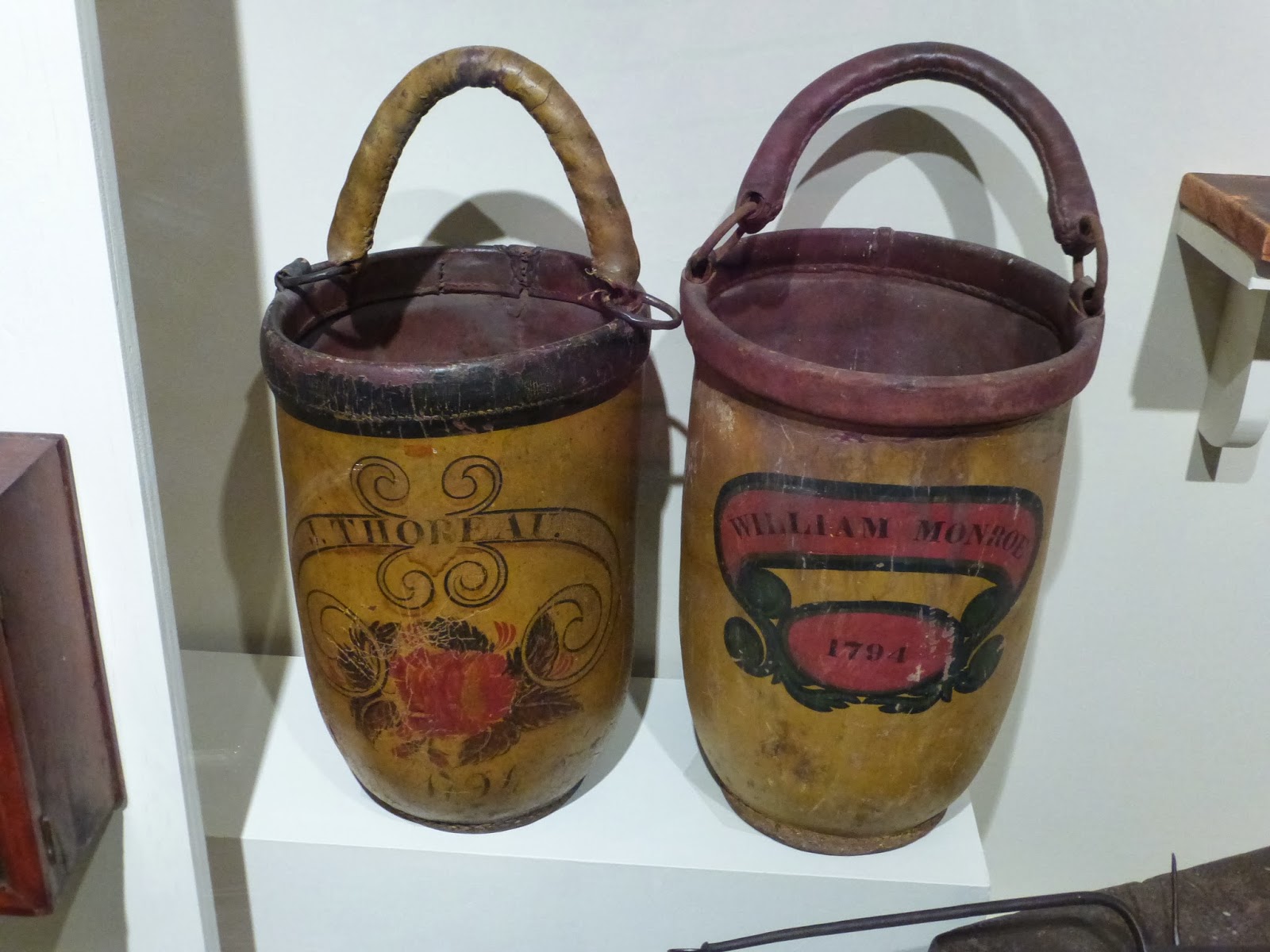
Here are two fire buckets I saw, and Vincent photographed them because of the name "William Munroe", my distant cousin in Concord, Massachusetts.  In the old days, before organized fire fighting departments, each family had a fire bucket by the front door.  It was full of sand or water, depending on the season, and would be borrowed or brought to a fire in the neighborhood for a "bucket brigade".  The names painted on the buckets insured that each family would receive his proper bucket again after the fire incident.

It wasn't until after Vincent took the photo that we noticed the other bucket was labeled "J. Thoreau".  This was John Thoreau, father to the famous writer, Henry David Thoreau, and neighbor to William Munroe.

Small world!

There is a research strategy in genealogy called "FANs" where one studies the friends, acquaintances, and neighbors in order to understand the family history of an ancestor, or to perhaps break down a brick wall in your research.  Finding the names of these FANs in censuses, city directories, tax lists, manuscripts and maps is the usual route.  Finding their fire buckets in a museum is unique!  In the old days we used to call FANs "cluster research".

For more photographs of scenes around Concord concerning Thoreau, please see Barbara Poole's blog post "Some of Henry David Thoreau's Houses" at this link:
http://lifefromtheroots.blogspot.com/2014/01/some-of-henry-david-thoreaus-houses.html

----------------------------------
The URL for this post is
http://nutfieldgenealogy.blogspot.com/2014/01/photo-friday-ordinary-objects-with.html 

Copyright (c) 2014, Heather Wilkinson Rojo

Tuesday, March 26, 2013

Discoveries from RootsTech 2013


The speaker's bag (yellow) and the regular
conference goer bag on the right (blue)


1. I discovered that every conference goer receives one of these cool RootsTech bags.   But I also learned to pack light since it's a long day and all the goodies you collect at the Expo will magically and exponentially weigh more by about 5pm.

2. I learned some new vocabulary, and my favorite new word is “Geneajaunt”- from Australian genealogist Jill Ball.

3. And I learned even more new vocabulary, like “Flying monkeys”- a collective term for all of Thomas MacEntee’s bloggers and followers.  Another “new to me” moment.

4. I saw David Pogue live on stage and learned that he is much more than just a geeky technology writer (he is also a pianist, composer, comic as seen in this video of his keynote address at www.rootstech.org on Saturday, March 23rd at 8:30am  )

ZUCA rolling bag

5.  I discovered the wonderful ZÜCA bag while waiting in line for a session to start.  The woman who owned it raved about it, and showed me all the features.  It is the ultimate gadget for genealogists at http://www.zuca.com/  This expensive rolling travel bag also comes in a carry-on size, too (but it’s even more expensive).   It is very light (aluminum) and has a built in seat for waiting in those long lines, or to support a second load piled on top.  This bag is perfect for the long walks in Salt Lake City between your hotel, the Family History Library and the convention center, or to carry all your stuff during the day.  I saw two people using this bag at RootsTech.  Beware - It costs as much as a new mobile device! But it is super cool.  These are the things you learn while waiting in lines…

6. I learned that there are battery phone cases and capacitor chargers to extend the life of your mobile devices at conferences, in the FHL, on the plane with a capacitor that stores energy for hours, or a super capacitor that stores enough energy for days at a time.  The battery mobile phone cases double the life of your regular phone battery and the capacitor chargers (also called external battery chargers) can be used on your laptop or tablet.   Thank you to Jill Ball from Australia and Marie Doughan from Scotland for introducing these to me.  They used them on those long airplane trips to RootsTech.


7. I also learned about the value of Blogger beads- You must wear them everywhere- to the FHL, to restaurants, around town to spark conversation (speak up at the first raised eyebrow) and be prepared with a ten second "elevator" speech and business cards with your URL.   These beads are not just a fun accessory; they are a powerful media tool.  The blogger bead subtle advertising is so successful that I am going to supply beads at NERGC 2013 in Manchester.

8. Be prepared to hug in the oddest places. Suddenly a complete stranger will come up to you in the restroom, or the elevator, or when you have your mouth full at breakfast and introduce themselves as a blog fan, Twitter follower, or Facebook friend.

9. Also be prepared to act like a complete fool and gush like a groupie when you find out you are sitting next to Cyndi Howell of cyndislist.com or MaureenTaylor, the “Photo Detective”.  More hugs usually follow this encounter, too.

10. I learned that even when you fly across country to a national convention, there will always be a New England Yankee, or someone who lived briefly in your state, or someone with New England roots sitting right next to you at a session, or at the same table at the luncheons. This happened to me at all three luncheons, every session and even at the keynotes. Even at the FHL because it was busy and every table was full. A gentleman sitting right next to me at the NGS luncheon lived on Alexander Road, Londonderry, NH in the 1980s!   Strangers from New England introduced themselves even on the street waiting to cross at the lights because apparently I have some sort of accent when I pronounce the word “car”…

11. Another important lesson- If you want to enjoy an adult beverage, be prepared to walk away from Temple Square to other hotels and restaurants. It is still possible to enjoy a lovely evening at the Roof with Pellegrino as the only bubbly in your glass.

12. I discovered the joy of belonging to the Geneabloggers community!  Many, many times my fellow Geneabloggers have helped me solve technical problems on my blog, or helped me stop sploggers, or even gently suggested edits and corrections.  I've also made cousin connections with dozens of Geneabloggers, and shared lineage information.  We find time to share meals, cheer each other on before presentations, and support the newbies.  

At RootsTech I found time, even with a busy schedule, to return the Geneablogger karma.  I filled in on a panel that needed an additional genealogist, I found information at the FHL for someone who commented on Dear Myrtle’s HOA video show, and I was able to steer several other bloggers towards good resources for New England research at the Family History Library.  What goes around comes around.  And it’s fun, too!

--------------------------
Copyright 2013, Heather Wilkinson Rojo