Showing posts with label Canada. Show all posts

Wednesday, July 17, 2024

Notre-Dame de Québec Basilica-Cathedral for Weathervane Wednesday

This weathervane was photographed in the Old Quebec City, Canada.


Last week I featured a weathercock above the Quebec City church Notre Dame des Victoires, and today I'm featuring another weathercock from Quebec City also from a church named Notre Dame.  This building is the basilica catheral of Notre Dame de Quebec.  This Roman Catholic church was originally built at the site of a chapel built by Samuel de Champlain in 1633. The tower with the weathercock was built in 1744, and you can see in the plans below, the weathercock was included.  

This church building was destroyed twice, first during the Siege of Quebec in 1759 during the French and Indian War, and then in 1922 it was destroyed by fire.  At first the Ku Klux Klan was blamed for the destruction, but the American thief Ray Marsden confessed to the crime, to cover his burglary. In 1874 it was the first church in North America to be elevated to a basilica.  It is the oldest parish in Canada and celebrated it's 350th anniversary in 2014.  Quebec's first bishop, Francois de Laval, is buried in the crypt. 

The weathercock is an important Christian symbol, often found on Roman Catholic churches.  This one is particularly fancy and detailed, in three dimensions with an elaborate cross.  


These are the plans for the cathedral from 1744, used to reconstruct the church in 1759.
The weathercock was included in the original plans.

By Gaspard-Joseph Chaussegros de Léry - Élévation de la basilique de Québec, Chaussegros de Léry, 1744, BAC, FR CAOM 3DFC 424A. - facebook.com, Public Domain, https://commons.wikimedia.org/w/index.php?curid=45830176

For the truly curious:

Cathedral Basilica of Notre Dame de Quebec at Wikipedia -  https://en.wikipedia.org/wiki/Cathedral-Basilica_of_Notre-Dame_de_Qu%C3%A9bec   

The parish website for Notre Dame de Quebec  -  https://www.notre-dame-de-quebec.org/copie-de-basilique-cathedrale   

Click here to read over 500 more Weathervane Wednesday posts:

----------------------------------------

To cite/link to this blog post: Heather Wilkinson Rojo, "Notre-Dame de Québec Basilica-Cathedral for Weathervane Wednesday", Nutfield Genealogy, posted July 17, 2024, ( https://nutfieldgenealogy.blogspot.com/2024/07/notre-dame-de-quebec-basilica-cathedral.html: accessed [access date]). 

Wednesday, June 26, 2024

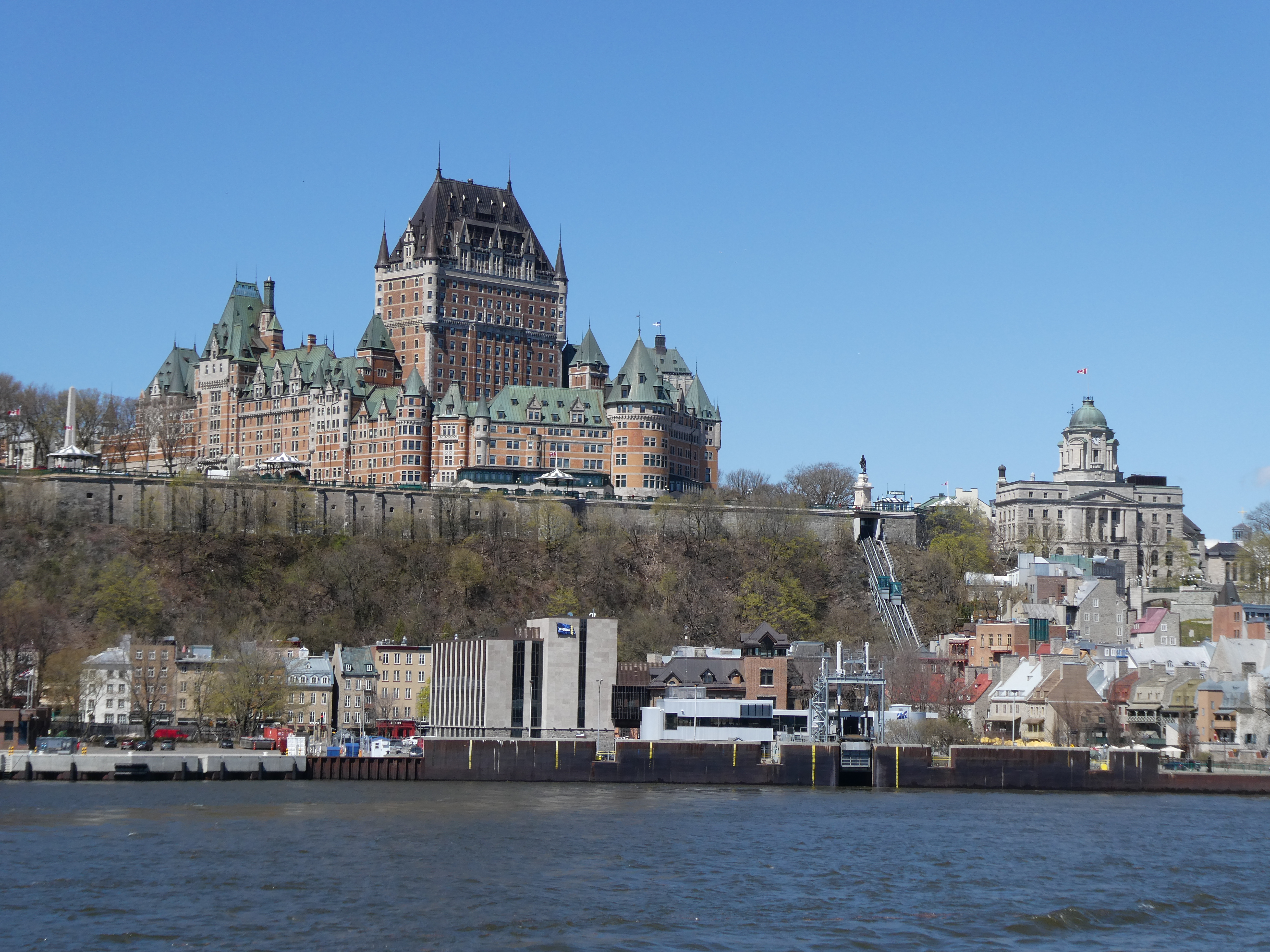
The Chateau Frontenac Hotel in Quebec City for Weathervane Wednesday

 This weathervane was photographed in Old Quebec City, Canada. 


A view of the Chateau Frontenac
from the ferry across the St. Lawrence River to Levis

In May we drove to Quebec City and stayed at the Chateau Frontenac hotel, recreating our honeymoon 40 years ago.  This massive hotel has 610 guest rooms, 18 floors, and many towers and turrets.  Even though it resembles a castle with many towers, this is the only weathervane I could see on the hotel.  The weathervane resembles a banner, which is appropriate for the castle theming.  The very first weathervanes are considered to be banners flying on buildings like castles and forts. 

The Chateau Frontenac sits above the Terrasse Dufferin overlooking the Saint Lawrence River.  It is considered to be the most photographed hotel in the world. It was designated as a National Historic Site of Canada in 1981.  It has been featured in movies, including the Alfred Hitchcock film I Confess. Many celebrities and political figures have stayed here, such as FDR, Sir Winston Churchill, Celine Dion, Queen Elizabeth II, and many Canadian prime ministers.  

For the truly curious: 

Chateau Frontenac at Wikipedia:    https://en.wikipedia.org/wiki/Ch%C3%A2teau_Frontenac  

Fairmont Chateau Frontenac website   https://www.fairmont.com/frontenac-quebec/   

Click here to see over 500 more Weathervane Wednesday posts:   https://nutfieldgenealogy.blogspot.com/search/label/Weathervane%20Wednesday  

-------------------------

To cite/link to this blog post:  Heather Wilkinson Rojo, "The Chateau Frontenac Hotel in Quebec City for Weathervane Wednesday", Nutfield Genealogy, posted June 26, 2024, ( https://nutfieldgenealogy.blogspot.com/2024/06/the-chateau-frontenac-hotel-in-quebec.html: accessed [access date]). 

Wednesday, June 19, 2024

Chalmers Wesley United Church in Quebec City for Weathervane Wednesday

 This weathervane was photographed in Quebec City, Canada.


The Chalmers Wesley United Church is located on 78 Rue Sainte-Ursule, in Old Quebec City, Canada.  It is between Porte Saint Louis and the citadel.  This protestant, English language church was built between 1851 and 1853, and in 1925 became part of the United Church of Canada. 

Like most protestant churches, their weathervane is very simple.  It is a an arrow with no cardinal points. It was very difficult to photograph the church because of the narrow streets, but we did get some nice photos of the weathervane from many blocks away.  Most of the Roman Catholic churches in Quebec City featured weathercocks or more elaborate weathervanes. Click HERE to see the weathercock from Notre Dame des Victoires in Quebec, my June 12th Weathervane Wednesday subject.  


For the truly curious:

The website for Chalmers Wesley United -  https://chalmerswesley.org/   

The Facebook group for the Chalmers Wesley United Church    https://www.facebook.com/groups/chalmer 

To see over 500 more Weathervane Wednesday posts, click here:   https://nutfieldgenealogy.blogspot.com/search/label/Weathervane%20Wednesday  

--------------------

To cite/link to this blog post:  Heather Wilkinson Rojo, "Chalmers Wesley United Methodist Church in Quebec City for Weathervane Wednesday", Nutfield Genealogy, posted June 19, 2024, ( https://nutfieldgenealogy.blogspot.com/2024/06/chalmers-wesley-united-methodist-church.html: accessed [access date]).

Wednesday, June 12, 2024

Notre Dame des Victoires, Quebec City for Weathervane Wednesday

 Today's weathercock was photographed in Quebec City, Canada.


The narrow streets and tiny square, Place Royale, in front of the Notre Dame des Victoires church in Lower Quebec City made this weathercock very difficult to photograph!  I had first visited this church during our honeymoon in Quebec over 40 years ago.  But now the church is closed except on Sundays and special days for mass only.  We could not visit the inside of this historic church when we were there in May this year.

This church is very old, and it was erected between 1687 and 1723.  According to Wikipedia "The church is one of the oldest in North America."  In September 1759 the church was bombarded by the British before the Battle of the Plains of Abraham.  It was restored and reopened in 1816. There is a model of a ship hanging from the ceiling of the church - it is a model of the Brézé which was commanded by the Marquis of Tracy. 

The weathervane above the steeple is a three dimensional weathercock above a pointer and some very fancy cardinal points marking the directions in French. The weathercock is a very common weathervane for Roman Catholic churches.  Weathercocks are weathervanes with roosters. There was a papal edict in medieval times that cockerels should be displayed on each church in memory of Peter's betrayal of Jesus "I tell thee, Peter, the cock shall not crow this day, before that thou shalt thrice deny that thou knowest me." Luke 22:34.  Many of the cocks or roosters ended up on top of steeples as weathervanes.


We took this interior photo in 1983
on our honeymoon in Quebec City

For the truly curious:

Notre Dame des Victoires at Wikipedia:    https://en.wikipedia.org/wiki/Notre-Dame-des-Victoires_Church  

The parish of Notre Dame des Victoires:  https://www.notre-dame-de-quebec.org/notre-dame-des-victoires-church  

Click here to see over 500 more Weathervane Wednesday posts:  https://nutfieldgenealogy.blogspot.com/search/label/Weathervane%20Wednesday   

-----------------------

To cite/link to this blog post:  Heather Wilkinson Rojo, "Notre Dame des Victoires, Quebec City for Weathervane Wednesday", Nutfield Genealogy, posted June 12, 2024, ( https://nutfieldgenealogy.blogspot.com/2024/06/notre-dame-des-victoires-quebec-city.html:  accessed [access date]). 

Thursday, February 7, 2019

Throwback Thursday ~ Honeymoon in Quebec City 1983

This is part two of a blog post I posted two weeks ago about scanning the photo slides of our honeymoon trip in 1983.  We hadn't looked at these slides in many years, and they are yellowing and deteriorating.  It's a good thing we are digitizing them before they disintegrate! You can see part one at this link:
https://nutfieldgenealogy.blogspot.com/2019/01/throwback-thursday-honeymoon-in-vermont.html

After an overnight at the Hanover Inn in Vermont, we drove on to Quebec City.  These are the only photos we have of our honeymoon trip, and you can see that they have faded and yellowed in just 35 years.

We stayed in a tower room of the Chateau Frontenac.
I remember the room was round and overlooked the boardwalk

Yours truly on the boardwalk "Terrasse Dufferin"

At the changing of the guard,
the mascot was a goat

Changing of the guard at the Citadelle


Yes, it rained on our wedding, and on our honeymoon.
This is the Jeanne D'Arc (Joan of Arc) garden in Quebec.

Vincent on the walls of Quebec City

-------------------------------

Heather Wilkinson Rojo, "Throwback Thursday ~ Honeymoon in Quebec City 1983", Nutfield Genealogy, posted February 7, 2019, ( https://nutfieldgenealogy.blogspot.com/2019/02/throwback-thursday-honeymoon-in-quebec.html: accessed [access date]). 

Monday, May 18, 2015

Cochecho Massacre, 27 June 1689, Dover, New Hampshire


The Damm Garrison House in Dover, New Hampshire
is located inside this pavilion at the Woodman Institute

This map is located inside the Damm Garrison at the Woodman Institute in Dover, New Hampshire
It explains the events of Cochecho Massacre, and maps out the locations of the garrisons

The first recorded captives carried to Quebec, Canada to be sold to settlers and native Indians occurred at the Raid on Dover, also known as the Cochecho Massacre, in Dover, New Hampshire on 27 June 1689.  This makes this raid very interesting to genealogists, since some of the women and children who were taken north converted to the Catholic religion.  These same English people later married French spouses and left descendants in Canada.  Some of the captives were redeemed and came home, and some of the redeemed refused to return because they preferred life in Canada!

At the beginning of King William’s War (1688- 1697) there were many raids on New England settlements by the French, and the English raided French villages in Penobscot Bay and Chedabouctou (Guysborough, Nova Scotia).   In June 1689 several hundred Abenaki and Pennacook Indians raided Dover and killed more than 20 and took 29 captives.  This was one quarter of the Dover population. The raid was quite a blow to the English settlements in New Hampshire.

The Dover Raid was revenge on Major Richard Waldron who had  tricked and captured many Abenaki and Wampanoag in 1676 during King Phillip’s War.  These Indians he captured were taken to Boston where some were executed and some were sold into slavery in the Caribbean.  Twelve years later the Abenaki retaliated with the help of the French in Canada.


Waldron's garrison was attacked with a vengeance.  The Major was singled out for a particularly horrendous torture and execution.  His nose and ears were removed and stuffed in his throat.  Each Indian slashed his chest, and he was forced to fall on his own sword.  Waldron had been well known as a cheat at trade with the Indians and he had been a particularly cruel leader to the English settlers (especially to Quakers).  You can read more about Waldron at this blog post:

There were five garrison houses in town at Dover, and others in outlying areas.  Five Indian women came into town and asked to shelter at the garrisons, one at each.  In the middle of the night, each woman opened the gates of the garrison to the attackers.  The rest was history…

According to the book New England Captives Carried to Canada, pages 142 -  these are some of  the identified captives, all traced to French records in Quebec:

John Church (sometimes misspelled Chase)
John Evans
Sarah Gerrish,  7 year old granddaughter of Major Waldron,
Mrs. Elizabeth Hanson, wife of Tobias
----- Heard “a young woman of Cochecho”
Esther Lee, daughter of Richard Waldron, along with her child
Grizel Otis, wife of Richard, daughter of James Warren
Margaret Otis, rebaptized Christine in Quebec
Rose Otis
John Otis
Stephen (rebaptized Joseph Marie)
Nathaniel (rebaptized Paul), son of Stephen Otis and Mary Pitman
Joseph Buss
William Buss

Here is a list of some members of my family tree who were victims of the Cochecho Massacre:

I'm forced to admit that I'm closely related to Major Richard Waldron (1615 – 1689).  He was married to my 9th great aunt, Ann Scammon.  I descend from Ann’s sister, Elizabeth (about 1625 – abut 1680) who married Thomas Atkins.   Major Waldron, as I described above, was killed, along with most of his family, and his garrison was burned to the ground, along with his grist mills and trading post.

I'm proud to tell you about Elizabeth Hull Heard (about 1628 – 1706),  my 8th great grandmother.  According to stories in Cotton Mather’s Magnalia Christi Americana and Belknap’s History of New Hampshire and other books, she was a witness to Waldron’s deceit in 1676, and sheltered a young native Abenaki boy from death.   On the night of the Cochecho Massacre she was hiding In the woods when an Indian pointed his weapon at her, but suddenly spared her life and ran away.  The Heard garrison house was one of the few homes that were successfully defended that night by William Wentworth because Elizabeth's husband had died a few months before the attack.  It is suggested that the Indian who spared her life was the young Abenaki boy in 1675.   Elizabeth's children survived, too, including her daughter Mary (1650 - 1706), my 7th great grandmother, and her husband John Ham and children. 

[You can see that I am related to both the villain and the heroine of this massacre]

For more information:

New England Captives Carried to Canada Between 1677 and 1760 During the French and Indian Wars, by Emma Lewis Coleman, published in 1925, reprinted by the New England Historic Genealogical Society, 2012.

From the Dover, New Hampshire Public Library website

An online article from Portsmouth, New Hampshire historian J. Dennis Robinson

Magnalia Christi Americana, or "The Ecclesiastical History of New-England, from its First Planting in the year 1620 Unto the Year of Our Lord, 1698", Cotton Mather, in seven books (reprint), New Haven, CT,1820

The Hull Family in America, Compiled by Col. Weggant, Hull Family Association 

"A Genealogical Memoir of the Family of Richard Otis" -- 1851 -- by Horatio N. Otis. NEHGR for July 1848 & April 1850 has the Genealogy of the Otis Family Descending from John Otis, who immigrated to New England & settled in Hingham, Mass. about 1635.

Click here for blog post about the DAMM family garrison, which survived the Cochecho massacre in 1689.  The DAMM garrison was built in 1675, and is the oldest surviving garrison house still standing in New Hampshire. 

UPDATE -  3 June 2015
Roger W. Lawrence has written a new book "English Captives and Prisoners Remaining in New France" (for those with ancestors who were carried to Canada from New England in the colonial period). You can pre-order this book from the American Canadian Genealogical Society at this link www.acgs.org 


-----------------------------------

To cite/link to this blog post: Heather Wilkinson Rojo, "Cochecho Massacre, 27 June 1689, Dover, New Hampshire", Nutfield Genealogy, posted May 18, 2015, (http://nutfieldgenealogy.blogspot.com/2015/05/cochecho-massacre-27-june-1689-dover.html: accessed [access date]). 

Monday, January 19, 2015

Who was Jenkins? What happened to his Ear? How did the War of Jenkins’ Ear affect the migration of my ancestors?


There really was a War of Jenkins’ Ear (1739 – 1748) It was a conflict between Spain and England, part of the bigger war known as the War of Austrian Succession.   This war didn’t involve France or England until they were also drawn in as allies of Austria.   To make this more confusing, this whole war was part of King George’s War, which was the third of four French and Indian Wars.  I’ll bet you didn’t know that there were four separate French and Indian Wars, did you?

King George’s War (1744 – 1748) involved New England, New York and the French in Nova Scotia.  It all wasn’t resolved until the fourth French and Indian War (just to be more confusing, this was known as the Seven Year’s War), when Wolfe defeated Montcalm and France at the Battle of the Plains of Abraham in Quebec, and France lost their claim to most of Canada.

What is important to know is that since King Phillip’s War (1675 – 1678) until the Seven Year’s War (1754 – 1763) there was almost continual fighting for the borders and territory between the French, English and Spanish which also involved the native Indian tribes and settlers trying to carve out homesteads.   In New England you can see this especially in the settlement of Maine, New Hampshire and Vermont.  Anyone who thinks that the first war in the colonies was the Revolutionary War is missing six or seven major international conflicts fought in North America and elsewhere.   This doesn’t include smaller wars like Father Rale’s War (1722 – 1725) fought only in New England.  See?  Another war that I bet you haven’t heard of, either, have you?

In tracing my family tree I often find someone born in 18th century  Maine has disappeared from the records.  Or someone suddenly appearing in Marblehead or Salem, Massachusetts in the early 1700s, but not born in England.  I’m always wary of making a leap in migration from one state to another, because most of my ancestors didn’t move around New England very much.  But there was a reason why some of these families fled Maine, came to Massachusetts, and then returned to Maine.

Maine was first settled by the French on St. Croix island in 1604, who called the area Acadia.  The first English settlement at Popham was in 1607, which was abandoned in less than a year. This was the beginning of constant conflict between the two nations.   In 1622 the land that is now roughly the state of Maine was divided into plantations between Sir Ferdinando Gorges and John Mason.  These plantations failed, and were abandoned.  After the four different French and Indian Wars, settlements were again abandoned, and then retried. Over and over.

During the 1692 witch trials, many of the accusing girls and women were refugees from the conflict north of Massachusetts. They had seen massacres, towns burnt, and other atrocities. There is an ongoing theory that their post-traumatic stress syndrome caused them to start the first witch accusations, which snowballed out of control.  After reading some of the first-hand accounts of these conflicts, kidnappings, scalpings, fighting and torture (by both sides, English and Indian) I can believe this theory much more than other theories I have heard (mass hypnosis, ergot poisoning, and jealousy). 

Don’t just look at the vital records for your ancestors’ names.  Read the town and regional histories.  Examine the records of conflicts to see who was involved, names of victims and aggressors.  Who fled?  Who returned? Who was kidnapped? Who was redeemed?  Who died?

---------------------

So who was Jenkins? And what happened to his ear?   In 1731 the English ship Rebecca, captained by Robert Jenkins, was captured by the Spanish off the coast of Florida.  They accused Jenkins of smuggling, and cut off Jenkins’ left ear.  Jenkins testified in 1738 before Parliament about this incident, and supposedly displayed his severed ear.   The conflict over confiscated cargoes, strained relations, and anti-Spanish sentiment spilled over in the West Indies, Florida and Georgia.  

And who was the Father Rale I mentioned above?   The conflict known as Father Rales’ War (1722 -1725) was also known by at least five or six other names such as Lovewell’s War or Governor Dummer’s War (see the Wikipedia article below).  Sebastian Rale was a French Jesuit priest who lived along the Kennebec River in Maine with the Wabanaki people.  Massachusetts Governor Shute demanded he leave In 1717.  Rale remained, and so Shute sent an expedition in 1722 to capture Rale. There were ongoing retaliations and sieges of settlements as far away as Vermont, Nova Scotia and Deerfield, Massachusetts until peace was negotiated in 1726.

So you see- these conflicts affected human migration and immigration all over the 13 colonies, not just in New England and the northern states.

Keep that in mind if your ancestors seem to disappear from the records in one colony and reappear in another.  It could, and did, happen. 

For the truly curious:

Father Rale’s War from Wikipedia http://en.wikipedia.org/wiki/Father_Rale%27s_War

War of Jenkins’ Ear from Wikipedia http://en.wikipedia.org/wiki/War_of_Jenkins%27_Ear  

"Salem Witch Trials Still cast Haunting Shadow" by Deborah McDermott, 18 January 2015,  from seacoastonline.com, Author Emerson Baker on video and an article about the ongoing war and the beginning of the Salem Witch Trials.
http://www.seacoastonline.com/article/20150118/NEWS/150119292/101098/NEWS 

New England Captives Carried to Canada Between 1677 and 1760 During the French and Indian Wars, by Emma Lewis Coleman, first published 1925, reprinted 2012 by the New England Historic Genealogical Society, Boston, Massachusetts.

In the Devil’s Snare: The Salem Witchcraft Crisis of 1692, by Mary Beth Norton, Alfred A. Knopf Publishers, New York, 2002.

“Maine, Indian Land Speculation, and the Essex County Witchcraft Outbreak of 1692” by Emerson Baker and James Kences, from Maine History, Volume 40, Number 3, pages 159 – 189, available to read online at http://www.hawthorneinsalem.org/ScholarsForum/MMD1705.html

“The Refugee’s Revenge”, by Mary Beth Norton, from Common-Place, Volume 2, Number 3, April 2002 oniline at http://www.common-place.org/vol-02/no-03/norton/norton-2.shtml

The image above is from Wikimedia Commons, "Conference Between the French and Indian Leaders Around a Ceremonial Fire", by Emile Louis Vernier (1829 - 1887)

-----------------------------------

To cite/link to this blog post:  Heather Wilkinson Rojo, "Who was Jenkins?  What happened to his Ear? How did the War of Jenkins’ Ear affect the migration of my ancestors", Nutfield Genealogy, posted January 19, 2015, ( http://nutfieldgenealogy.blogspot.com/2015/01/who-was-jenkins-what-happened-to-his.html: accessed [access date]).  

Friday, April 13, 2012

Friday Funny ~ Watch out!

1983, Quebec City

This is my husband, sticking his head into a cannon on the walls of Quebec City overlooking the St. Lawrence River.  We were on our honeymoon at the Chateau Frontenac in 1983.  I think he would still do this today if he had a chance!

1994, Quebec City
Our daughter in 1994, on another cannon overlooking the St. Lawrence River in Quebec, with the Chateau Frontenac in the background.  I think it runs in the family!  

-------------------------
Copyright 2012, Heather Wilkinson Rojo

Monday, January 9, 2012

American Canadian Genealogical Society ~…and why you shouldn’t jump to conclusions…


This is the tale of another "new to me" library...
American Canadian Genealogical Society
Manchester, New Hampshire

I've lived in Londonderry, New Hampshire for 28 years.  My town borders Manchester, New Hampshire, which is a much larger city.  For years I have known about the American Canadian Genealogical Society on Elm Street.  Out of curiosity, I often ask about the library, but I’ve always been told that it was for “French Canadians”.  So I never visited.  Not even once. 

And so for all this time I travel all the way to Boston to use the library at the New England Historic Genealogical Society, and pay $30 to park downtown.  Or I travel up to Concord, New Hampshire (not too far, maybe 20 minutes further than Manchester) to use the New Hampshire Historical Society Library or the New Hampshire State Library.  All are good genealogical libraries, with differing collections and specializations. 

Finally, I saw genealogy blogger, Lucie Consentino, post on Facebook that she was going to visit the ACGS library, and she asked “Anyone else I know going?”  I wrote back that I’d like to join her.  Lucie is the author of three blogs, all specializing in Acadian genealogy.  Then, genealogy blogger Cynthia Shenette asked to join us, and I was beginning to think about passing on the visit because Cynthia also has French Canadian ancestry.  Was this going to be a bust?  Well, maybe I’d join them for an hour just to see the library.  After all, it was only $5 for a day pass.

Well, to make a long story short, I went to ACGS to research a Mayflower line.  And I was there from before 10 AM until 4PM, and I have to go back because I have a list of books I haven’t finished looking at , and another shelf full of stuff  (I saw on the way out the door) to peruse.  I was amazed at what I found, and humbly admit that from now I will not pre-judge any repository of genealogical information.  Nor any website.  You never know what you will find. 

As well as being a well stocked library (you can see their card catalog online), it is also a society which means that as well as Lucie, I now know half a dozen members and they have all given me good information, hints, clues and ideas for my family research.  Eight of us went to lunch together, which mean more schmoozing, genealogy chat and laughter.  We had a good time, and that is worth its weight in gold.

By the way, both Cynthia and I joined ACGS as members.  It is a small fee, as far as genealogy societies charge, and I have well made up for it without paying downtown Boston parking fees.  Parking at ACGS is FREE!

Cynthia stated on Facebook “had a great day at the American-Canadian Genealogical Society in Manchester, NH with Lucie LeBlanc Consentino and Heather Wilkinson Rojo.  I found records for my grandfather and my great grandfather, as well as my great grandfather's four wives and for some of his 25 children!  Sixty four records in all!  Wow!" 

My new Facebook friend, lunch companion and ACGS president of ACGS, Gerry Savard stated “I enjoyed meeting everyone.  I’m glad it was a productive day.  Societies offer one on one guidance that is hard to get hanging over a keyboard.  Also, since we encourage conversation in the library, many connections have been made by individuals hearing someone talking about a common ancestor.  It’s a great place for sharing, socializing and researching.”

Comparison chart:
Library                                                 Day Fee            Membership/ 1 year
New England Hist. Gen                        $15                                         $79.95
American Canadian Gen. Soc               $5                                           $35
NH Historical Society                           $7                                           $40
NH State Library                                  FREE                                      FREE
Portsmouth Athenaeum                         FREE                                      $225
UNH Dimond Library- Special Collections    FREE                             FREE
Manchester Historic Association          $8                                            $30
Center for Lowell History- ULowell     FREE                                      FREE
Don’t forget your own local library! (and don't forget that each archive/library/society has its own special collections, its own strengths on the shelves and on line) 

For more information:

American Canadian Genealogical Society
4 Elm Street, Manchester, New Hampshire  (603) 622-1554

map of Manchester with a star on ACGS
from Mapquest.com

Lucie LeBlanc Consentino’s websites:
Lucie’s Legacy   http://lucieslegacy.blogspot.com/
Whispers Through the Willows http://whispersthroughthewillows.blogspot.com/ 
Acadian & French-Canadian Genealogy and History Facebook group https://www.facebook.com/groups/224797574204625/

Cynthia Shenette’s blog:

-----------------------
The URL for this post is
http://nutfieldgenealogy.blogspot.com/2012/01/american-canadian-genealogical-society.html
Copyright 2012, Heather Wilkinson Rojo

Friday, July 1, 2011

Canada Day, July 1st

We've been lucky enought to have been in Canada for three different Canada Days over the years.  First was our honeymoon in Quebec City,  then a trip to Nova Scotia and also a vacation in Victoria, British Columbia.  It was fun having fireworks in Canada, and then getting home to see fireworks again for the US Independence Day fireworks on July 4th.  Here are some photos of our Canada Day celebration in Victoria.  We just opened our windows in the Empress Hotel on the harbor to watch the harborfest and fireworks!

The view out our window, before the crowds arrived.

By dusk it looked like this!

A fantastic fireworks display over the harbor

We were lucky to have a room in front of the hotel over looking all the Canada Day fun! 
They upgraded us for our anniversary, so it never hurts to ask!
---------------------
Copyright 2011, Heather Wilkinson Rojo

Wednesday, October 20, 2010

Not so Wordless Wednesday - Hebridean Scots in Quebec

The Six MacDermid Sisters of Marsboro, Quebec
photographed in Massachusetts in the 1920s
My grandmother's brother, Uncle Horace Warren Roberts, married Katherine Bella MacDermid on 23 June 1920 in Beverly, Massachusetts. My grandmother's family had only arrived in America from Leeds, Yorkshire in 1915, and this must have been a jolly wedding. Great Aunt Katie was well loved, and just mentioning her name to my family brings lots of comments about what a nice, wonderful person she had been. My earliest memory of her was her wonderful Scots accent, and how much I wanted to name my daughter Katie!

The MacDermid/MacDearmid family had originated in Scotland, and the first to arrive in the New World was Auntie Katie's great grandfather Donald MacDearmid. He made his new home in Marsboro, Frontenac County, Quebec, which was a very Hebridean Scots settlement. Most of the original settlers came from the Isle of Lewis. They were unprepared for the harsh life in Quebec, and within a few generations most of the Hebridean settlers had removed to New England or Montreal for a better life. But for a few generations they kept their culture, language, and music alive in Marsboro.

Generation 1. Donald MacDearmid, born about 1802 in Grimsay (Griomasaigh), North Uist, Scotland; married Marion Smith, Born aoubt 1811 in Tarbert, Isle of Harris, Scotland. Five children. He arrived in Quebec about 1865.

Generation 2. Neil MacDearmid, born about 1838 in North Uist, died 17 January 1903 in Marsboro; married Catherine MacDonald. Five children.

Generation 3. Charles Colt MacDearmid, born 19 November 1863 in Scotland, died 30 August 1939 in Marsboro; married in Marsboro on 30 May 1894 to Mary Ross, born 8 February 1873 at Geocrab, Isle of Harris, Scotland. Eleven children, including the six daughters in the photograph above, all born in Marsboro:

1. John MacDermid, born 17 March 1895; married Mary Morrison
2. Katherine Bella MacDermid, born 23 March 1896, died 30 December 1978 in Beverly, Massachusetts; married Horace Warren Roberts (my great aunt and uncle)
3. Neil MacDermid, born 30 January 1898, died 18 May 1904 in Marsboro
4. Mary MacDermid, born 10 July 1900, died January 1900 in Beverly; married Alexander D. Stewart
5. Marion MacDermid, born 4 August 1902, died 28 December 1980 in Salem, Massachusetts; married Louis V. Maglio.
6. Neil A. MacDermid, born 19 June 1904, died 11 December 1974 in Brookline, Massachusetts; married Jeanette (maiden name unknown)
7. Annabelle MacDermid, born 28 July 1906, died 7 September 1999; married Bertram A. Russell*
8. Dolena MacDermid, born 20 December 1908, married Crosby Gray Grant
9. Annie MacDermid, born 21 January 1911, died 1 January 1997 in Beverly, married Walter Akerson
10. Samuel MacDermid, born 9 June 1913, died 18 March 1999 in Beverly; married Alice M. Pitman
11. Alexander C. MacDermid, born 9 August 1915, died 13 November 1992; married Mary K. Baginski

*Auntie Katie (MacDermid) Roberts is my father's aunt. Bertram A. Russell and Annabelle MacDermid had a son, Bertram A. Russell, Jr. who married Priscilla Allen, my mother's first cousin!

For more information:

Oatmeal and the Catechism: Scottish Gaelic Settlers in Quebec, by Margaret Bennett, Birlinn Ltd, Edinborough, Scotland, 2003 (available to view in its entirety on Google Books)

http://hebridscots.com/contents.htm The website for the Hebridean Scots of the Province of Quebec (history and genealogy- including a large database of people from the years 1800-1910)

http://www.interment.net/data/canada/qc/frontenac/echo/index.htm The Echo Vale Cemetery in Marsboro, with a listing of the Scots settlers buried there. Many MacDermid/MacDearmid internments.

--------------------
Copyright 2010, Heather Wilkinson Rojo

Tuesday, November 24, 2009

The Other Mayflowers, Voyage 7

From Cape Code to Nova Scotia to Beverly, Massachusetts
Last in my "Other Mayflowers" series for Thanksgiving week.

My ancestor Joseph Edwin Healey arrived in Massachusetts from Nova Scotia sometime between his marriage in 1848 and the birth of his first child in Beverly, in 1852. I’m not sure if he arrived on a boat, but being a mariner, he probably sailed to his new home with his new bride. He is listed as a sailor or mariner on his children’s birth records in Beverly, and as a fisherman on the 1860 Federal Census records.

His wife was Matilda Weston, also born in Yarmouth, Nova Scotia. Her father was Zadoc Weston, a direct descendant of Edmund Weston of Duxbury, Massachusetts, who was apprenticed to John Winslow. There was much intermarriage between the Westons and Mayflower families. It is from this side of the family that I gained seven Mayflower ancestors. These families removed to Yarmouth, Nova Scotia as part of the Planter Movement. They received free land upon the removal of the French Protestants in the wake of the French and Indian War. In the Old Cemetery at Chebogue Town Point, near Yarmouth, I found the gravestones of these families.

The Plymouth County and Cape Cod farmers who removed to Nova Scotia received land for farming, but it must have been a very rough existence, because within two or three generations, my lineage came back to Massachusetts. Several years ago we took a family vacation to Nova Scotia, and I was able to visit the towns, churches and cemeteries where my predecessors once lived. Although it was beautiful, Yarmouth was also rocky, bleak and poor farming country. Some stayed, but some returned to New England.

Joseph and Matilda lived at 43 Bartlett St., Beverly, and their daughter, and then their granddaughter raised their families there. My mother remembers visiting her grandmother there. I was born in Beverly, and every time we passed Bartlett St. my mother would say “That’s Nana’s house!” Using the street view on Google maps I can still visit there.

Old Cemetery at Chebogue Town Point, Nova Scotia
GPS coordinates N43 46.61 W 66 05.907
Behind the Chebogue Congregational Church


Epitaph of Comfort Healy (Joseph Edwin Healey’s grandfather):

In memory of
Mr. Comfort Healy
who died May 15, 1821
Aged 67
Hear what the voice from Heaven proclaims
For all the pious dead
Sweet is the savior of their names
and soft their sleeping bed
Them while ye hearing heart strings break
How sweet my minutes roll
Immortal paleness on my cheek
And glory in my soul

Also at Chebogue
(a new memorial was raised above the original stones of Jonathan and Hannah Crosby, Matilda Weston’s great grandparents, because the originals were illegible)


Jonathan Crosby
1703-1782
Hannah Crosby
1704-1791
Came to Chebogue
June 11, 1761

Jonathan Crosby came to Chebogue, Yarmouth County, Nova Scotia from Mansfield, Massachusetts, via Saybrook, Connecticut in Jun 1761, and settled on what was afterwards called Crocker's Point. The Crosbys with six other families sailed in a small vessel up the coast and into the harbor at Chebogue. He died at Chebogue on the 26th July 1782, aged 78 years and 10 months, his wife surviving him. The Yarmouth church records give a list of people who had been members "in full communion of some church heretofore" and among these original members were "Jonathan Crosby and Hannah his wife, members of the First Church in Mansfield, New England, the Rev. Richard Salter, Pastor." (New York Genealogical and Biographical Record, January 1941)

-------------

Heather Wilkinson Rojo, "The Other Mayflowers, Voyage 7", Nutfield Genealogy, posted November 24, 2020, ( https://nutfieldgenealogy.blogspot.com/2009/11/other-mayflowers-voyage-7.html: accessed [access date]). 

Thursday, November 19, 2009

The Other Mayflowers, Voyage 4


The Hessian Soldier who stayed in the New World


Part four in my Thanksgiving series about ancestors who DIDN’T arrive in the New World on the Mayflower. My 4x great grandfather Johann Daniel Bollman was a surgeon from Hammersleben in Saxony, Germany. He came to North America with Baron de Riedesel’s Brunswick Regiment of Hessian Soldiers in 1776. The Duke of Brunswick had contracted with England to send 3,964 foot soldiers and cavalry to America. They arrived in Quebec and their military objective was to cut off New England from the other colonies by driving troops down to Albany. They lost the battle at Bennington, Vermont when 200 Germans were killed and another 700 were captured. Again, at Saratoga, the Americans trapped them and took the Germans as prisoners of war for the duration.

Fortunately, as an officer and a surgeon, Johann Daniel Bollman was a valuable prisoner. He was also wounded at Saratoga, and while being held he tended to the other sick and wounded. He was exchanged as a prisoner of war, and sent to Halifax. Eventually he settled as a permanent resident of Lunenburg, Nova Scotia, the home of many German speaking settlers.

Dr. Bollman was not only a physician, he also became active in politics and served as a member of the House of Assembly representing Lunenburg Township between 1793 to 1809. In 1782 he married Jane Bremner, daughter of Scots settlers and widow of Phillip Knaut, an original Lunenburg grantee. His granddaughter removed to Massachusetts in the 1870s and joined the family tree in the United States.

Bollman Family Tree:

Generation 1: Dr. Johann Daniel Bollman, born about 1751 in Hammersleben, Magdeburg, Saxony, Germany, died 17 September 1833 in Lunenburg, Nova Scotia, Canada; married on 14 February 1782 in Lunenburg to Jane Bremner, daughter of Robert Bremner and Margaret Stewart, born about 1764 and died on 6 March 1829 in Lunenburg. Eleven children including two sons who were surgeons…

Generation 2: Dr. Bremner Frederick Bollman, born 25 February 1802 in Lunenburg, died on 15 December 1838 in Lunenburg; married to Sarah Elizabeth Lennox, daughter of John Lennox and Ann Margaretha Schupp, born 16 February 1805 in Lunenburg. Three children…

Generation 3: Ann Margaret Bollman, born 11 September 1835 in Lunenburg and died 1923 in Salem, Massachusetts; married on 7 June 1858 in Lunenburg to Caleb Rand Bill, son of the Reverend Ingraham Ebenezer Bill and Isabella Lyons. He was born on 30 May 1833 in Billtown, Cornwallis, Nova Scotia, and died on 30 December 1902 in Salem, Massachusetts. See my blog posting on October 4, 2009 “Bill Family Reunion” for a continuation of this lineage.

Sources:

“The Diary of Adolphus Gaetz” describes life in early Lunenburg, Nova Scotia between 1855 and 1873. Nova Scotia Archives and Records Management www.gov.ns.ca/nsarm/

“Johnny Bluenose at the Polls” by Brian Cuthbertson, Formac Publishing, Halifax, 1994

“Surgeons, Smallpox, and the Poor: A History of Medicine and Social Conditions in Nova Scotia, 1749-1799”, by Allan Everett Marble, McGill-Queen's University Press, Montreal

Johannes Schwalm Historical Association http://www.jsha.org/ website of Hessian Soldiers and their Descendants in the New World

The records of Saint John's Anglican Church, Lunenburg, Nova Scotia

---------

Heather Wilkinson Rojo, "The Other Mayflowers, Voyage 4", Nutfield Genealogy, posted November 19, 2020, ( https://nutfieldgenealogy.blogspot.com/2009/11/other-mayflowers-part-4.html: accessed [access date]).

Sunday, October 4, 2009

Bill Family Reunion

The Bill Sisters
Georgia
Belle, Grace and Jennie
(restored with PhotoShop by Catalina Rojo,
great great grand daughter of Belle)


Caleb Bill's Descendants celebrating in Peabody
representing Alaska, California, Massachusetts,
Maine and New Hampshire
Descendants of Music Professor Caleb Rand Bill

Sometimes people can find lost ancestors and distant cousins in some very strange ways. When my Dad passed away, my mom found some obituaries and newspaper clippings in his dresser drawer. She gave them to me, since I’ve been designated as the official family historian. One clipping was from the 1970’s and it listed a relative I knew, but all the sons and cousins under the name were unknown to me. I figured that some of them might still be alive, so I asked some older relatives and used Google to track them all down…

The names listed were Nichols, Brewster and Bill. I had heard of these cousins, and I knew they had once lived in Essex County, probably in the Salem area. They had some sort of relationship to the Wilkinson family, but I wasn’t sure where they fit in. On line I found a story about a long lost ski area in Danvers, called Locust Hill, formerly owned by the Nichols family. Some of the names in the story seemed to fit, so I emailed the author.

Before I knew it, the author of the story had emailed several of her cousins and they all contacted me. Of course we were related, and they remembered my Dad, and his father, and my grandfather… We were all related four or five generations back by a common ancestor named Caleb Rand Bill and his wife Ann Margaret Bollman, both born in Nova Scotia. Professor C. R. Bill was a music teacher in Salem, Massachusetts, with six daughters, who all lived in the Salem area, and three sons who never lived to adulthood.

A few months later, one newly found cousin arrived back in Massachusetts from Palo Alto, California. His brother lived in Salem, and we all met for dinner. We passed around some old photos, drew up a family tree to see how we were related, and got to know each other all over again. We reminisced about my Dad and his parents, and generally had a wonderful time getting to know each other. And we all had a good laugh knowing that it took a news clipping and the internet to find each other.

This past weekend, the cousins from Palo Alto was out for his Salem brother’s 90th birthday, and we all wanted to meet up for a meal together again. We met in Peabody, and brought more cousins, an aunt and even a distant cousin from Alaska together. This time everyone brought folders of lovingly preserved old photos of Bills, Nichols, Brewsters and Wilkinsons. For nearly three hours we passed around the pictures and again drew up family trees on the backs of paper placemats to sketch out our relationships. The people around the table (ages 22 to 90 years old) represented living descendants from the fourth, fifth and sixth generations descended from Professor Caleb Rand Bill (1833-1902).
------------------------
Family Tree Information:
Caleb Rand Bill, born 20 May 1833 in Billtown, Cornwallis, Nova Scotia, died 30 Dec 1902 in Salem, Massachusetts; married on 7 June 1858 in Lunenburg, Nova Scotia to Ann Margaret Bollman, born 11 September 1835 in Lunenburg, died 1923 in Salem, Massachusetts. They had 9 Children (born in the different places Prof. Bill taught music):
  • 1. Ingraham Ebenezer Bill, born 14 April 1859 in St. John's New Brunswick, died 9 October 1876 in Beverly, Massachusetts from "Pott's disease of the spine" (a form of tuberculosis)
  • 2. Mary Ann Bill, b. about 1861 in New Brunswick, died 1910 in Massachusetts; married in 1886 in Danvers, Massachusetts to Andrew Nichols, son of Andrew Ward Nichols and Elizabeth Perkins Stanley.
  • 3. Isabella Lyons Bill, born January 1863 in Machias, Maine, died 19 January 1935 in Beverly, Massachusetts; married 18 October 1894 in Salem to Albert Munroe Wilkinson, born 7 November 1860 in Danvers, died 12 May 1908 in Brookline, Massachusetts, son of Robert Wilson Wilkinson and Phebe Cross Munroe.
  • 4. Elizabeth T. Bill, born September 1866 in Houlton, Maine; married 26 December 1892 in Salem to Charles Foster Perkins, born 15 July 1869 in Manchester, Massachusetts, died in 1934
  • 5. Jane B. Bill, born Jan 1868 in Nova Scotia, died 1946 in Beverly, Massachusetts. Unmarried.
  • 6. Charlotte Grace Bill, born 30 Jan 1870 in Yarmouth, Nova Scotia; married 30 April 1898 in Danvers to Walter Frances Barton, born 3 May 1874 in Salem, died December 1964 in Massachusetts, son of Ernest Barton and M. Nellie Cross.
  • 7. Frederick Bremner Bollman Bill, born 27 Jan 1872 in Watertown, Massachusetts, died sometime after 1910, an inmate at Danvers State Asylum.
  • 8. Georgia Buffington Bill, born 4 Oct 1875 in Beverly, Massachusetts; married on 25 June 1901 in Salem to Charles Herbert Marshall, born 6 March 1876 in Beverly, Massachusetts, son of Francis Marshall and Madeline Woodbury.
  • 9. Edward Manning Bill, born 28 August 1880 in Beverly, Massachusetts, died 14 July 1881 in Salem, Massachusetts.
------------
The link to Sandy Nichols Ward's Lost Ski Areas story
------------
Copyright 2009, Heather Wilkinson Rojo