Showing posts with label Freethinkers. Show all posts

Monday, March 29, 2021

Horace Seaver, Boston News Editor ( 1810 - 1889)


In my last blog post about the Boston Freethinkers and The Boston Investigator newspaper, I noted how my ancestor, Romanus Emerson (1782 - 1852) was a great friend of Horace Seaver, the editor of The Boston Investigator. Both men were Freethinkers, progressives, and abolitionists.  I decided to research a little more about Horace Seaver, to perhaps shed a little more light on how my ancestor came to become a Freethinker, too.  I enlisted a little help from genealogist Randy Seaver, who is a distant cousin to Horace Seaver, the news editor (see below for the genealogies of both men). 

Horace Holly Seaver was named for the famous Unitarian preacher Horace Holly.  His parents wanted him to go to theology school and emulate his namesake, but his faith was put to the test when he joined a debating club and had to argue in support of Christianity.  He listened to a speech by Freethinker, Robert Dale Owen, and this changed his mind about the ministry.  This was very similar to my ancestor, Romanus Emerson's life change.  He wanted to be a minister like his three older brothers, but also ended up a famous atheist in Boston. 

Seaver joined the staff of The Boston Investigator as a typesetter, but assumed control of editing when the regular editor Abner Kneeland was arrested for blasphemy in 1839.  Many famous freethinkers of the day, such as Ralph Waldo Emerson (a cousin to Romanus Emerson), William Lloyd Garrison and Bronson Alcott tried to defend Kneeland's freedom of speech, but he remained in prison for 60 days. After his release he left Boston and started a utopian community out west.  Horace Seaver then became the editor of The Boston Investigator for over 50 years, until his death in 1889.  

When Horace Seaver was still a young editor he joined a meeting of the Freethinkers in New York City on 4 May 1845 where he proposed that the title infidel be used for atheists. He returned to Boston and founded The Boston Infidel Relief Society with my ancestor, Romanus Emerson. Eventually this became a very large, progressive group in Boston.  They built Paine Hall at 490 Washington Street in Boston for meetings, and the offices of The Boston Investigator moved upstairs.  This building was named after Thomas Paine, the famous freethinker. 

The obituary notice for Horace Seaver was published in The New York Times, 22 August 1889:  "Horace Seaver, editor of the Investigator, died yesterday in Boston.  He was born in Boston in 1810, and his connection with the Investigator dates from 1837, when he contributed to that paper a series of articles that attracted wide attention. In 1838 he became editor of the paper and Josiah P. Mendum proprietor, a partnership which had existed uninterruptedly for fifty-one years.  Mr. Seaver devoted a great deal of time to lecturing, his chief theme being "Free Thought".  He was a great anti-slavery man, and was a warm friend of Wendell Phillips, Parker Pillsbury, and William Lloyd Garrison."

The Boston Investigator continued publishing until 1904 when it merged with another Boston newspaper, The Truth Seeker.  Horace Seaver's book was published before his death as Occasional Thoughts of Horace Seaver from Fifty Years of Free Thinking, in 1888.  This book is available to read online through the Google book search.  You can also hear one of the eulogies given at his funeral read aloud at Youtube https://www.youtube.com/watch?v=RpO8EKWSrL0    This "Tribute to Horace Seaver" was originally written and read by the famous Freethinker Robert Green Ingersoll.  

Genealogy:

Below you can see the lineages of both Horace Holly Seaver and the genealogist Randy Seaver.  It is also interesting to note that my 4th great grandfather, Romanus Emerson (1782 - 1852) had a daughter named Emily, who married Melzar Stetson, a 2nd cousin to Horace Seaver.   I am also related to Horace Seaver through his grandmother, Mary May (b. 1657) who is related to me through her own grandmother, Hannah Morrill (my own first cousin 11 generations removed).  

Generation 1:  Robert Seaver born about 1608 in England, and died 5 June 1683 in Roxbury, Massachusetts. He married Elizabeth Ballard about 1634 probably in Roxbury, Massachusetts. 

Generation 2:  Joshua Sever born 30 August 1641 in Roxbury, and died 27 March 1730 in Roxbury.  He married Mary May on 28 February 1677 in Roxbury.

Generation 3: Lt. Joshua Sever born 18 February 1677 in Roxbury, and died 24 September in Dorchester, Massachusetts. On 27 February 1706 he married Mercy Cooke at Dorchester.

Generation 4:  William Sever born 2 September 1721 in Dorchester, and died 4 March 1782 in Dorchester.  On 1 February 1742 in Dorchester he married Patience Trescott, daughter of John Trescott and Sarah Topliff.  She was born 20 March 1722 in Dorchester and died 15 March 1799.

Generation 5:  William Sever, born 8 May 1743 in Dorchester, died 28 July 1815 in Taunton, Massachusetts.  he married first on 15 October 1767 to Mary Foster, and married second on 21 January 1771 to Thankful Stetson.  She was the daughter of Amos Stetson and Margaret Thayer.  

Generation 6: Nathaniel Seaver was born 7 February 1773 in Taunton, and died 17 October 1827 in Boston.  He marry Hannah Loker, daughter of Henry Loker and Hannah Barber on 29 September 1799 in Boston.  

Generation 7:  Horace Holly Seaver was born 25 August 1810 in Boston, and died 20 August 1889 in Boston at 2727 Washington Street.  He was married on 24 September in Providence, Rhode Island to Celinda Griffin, the daughter of James Griffin.  She was born about 1817 in Pelham, New Hampshire and died 9 April 1858 in Somerville, Massachusetts.  No children. 

Genealogy blogger Randy Seaver's lineage:

Generation 1:  Robert Seaver  (1608 – 1683)m. Elizabeth Ballard

Generation 2: Shubael Seaver (1640 – 1730) m. Hannah Wilson

Generation 3: Joseph Seaver (1672 – 1754) m. Mary Read

Generation 4: Robert Seaver (1702 – 1752) m. Eunice Rayment

Generation 5: Norman Seaver (1734 – 1787) m. Sarah Read

Generation 6: Benjamin Seaver (1757 – 1816) m. Martha Whitney

Generation 7: Benjamin Beaver (1791 – 1825) m. Abigail Gates

Generation 8: Isaac Seaver (1823 – 1901) m. Lucretia Townsend Smith

Generation 9: Frank Walton Seaver (1852 – 1922) m. Harriet Louise Hildreth

Generation 10: Fred Walton Seaver (1876 – 1942) m. Alma Bessie Richmond

Generation 11: Fedrick Walton Seaver (1911 – 1983) m. Betty Carringer

Generation 12: Randy Seaver


My blog post on Romanus Emerson "Was Your Ancestor A Freethinker?":

https://nutfieldgenealogy.blogspot.com/2021/03/was-your-ancestor-freethinker.html   

Randy Seaver's genealogy blog Genea-Musings:  https://www.geneamusings.com/


------------------

To Cite/Link to this post:  Heather Wilkinson Rojo, "Horace Seaver,  Boston News Editor ( 1810 - 1889)", Nutfield Genealogy, posted March 30, 2021, ( https://nutfieldgenealogy.blogspot.com/2021/03/horace-seaver-boston-news-editor-1810.html: accessed [access date]). 

Monday, March 22, 2021

Was your ancestor a Freethinker?

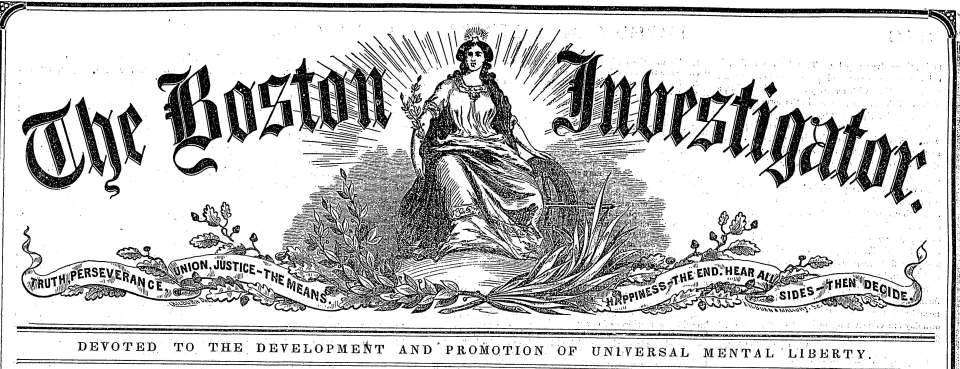
The Boston Investigator
Truth, Perseverance, Union, Justice - The Means.  Happiness - The End.  Hear All Sides - then decide.
Devoted to the development and promotion of universal mental liberty


Did you see “Freethinker” describing one of your ancestors in a biographical sketch? Newspaper article? In a flowery Victorian era obituary?
   Did you think it was just an interesting personality trait? A poetic description of your eccentric ancestor? It is time to learn more about the Freethinker Movement, and the entire history of this interesting society!

I had seen my ancestor Romanus Emerson (1782 – 1852) described as a freethinker (or sometimes capitalized as Freethinker) in a compiled genealogy.  I knew he was an atheist and an abolitionist, so I thought that perhaps the author was trying to cover up his controversial, progressive beliefs with a bit of affectation.  But it turns out that this was EXACTLY the proper identification of his beliefs. 

The Freethinkers emerged as a movement in the United States in the early nineteenth century. They took up the cause of Thomas Paine and other earlier deists and atheists at a time when it was still considered blasphemous and sometimes illegal.

In Boston, The Boston Investigator emerged as a Freethinking newspaper, which was founded in 1831 by Abner Kneeland.  Several famous New Englanders such as Ralph Waldo Emerson, William Lloyd Garrison and Bronson Alcott all defended Kneeand when he spent 60 days in jail for blasphemy.  My ancestor Romanus Emerson was a friend of Kneeland, and he often wrote for The Investigator. While Kneeland was jailed, the compositor for the newspaper, Horace Seaver, took over as editor, and Seaver eventually ran the newspaper when Kneeland left Boston to establish a utopian community in the mid-West. 

Horace Seaver ran The Investigator for over fifty-one years, and was a best friend to my 4th great grandfather, Romanus Emerson.  It seems that Freethinking ran in families.  My ancestor Romanus Emerson began his career in theology school to prepare for the ministry, just like his famous cousin Ralph Waldo Emerson, but both set aside these plans for more progressive beliefs like Freethinking and philosophy.  Horace Holley Seaver was named for a famous Unitarian minister, and began his career as a minister, too, but turned to journalism to spread his new views through his Freethought newspaper. 

When Horace Seaver’s wife, Celinda Griffin, died in 1858, he held a “social funeral” that was published in The Investigator. It was the pre-cursor to today’s secular memorial services held in funeral homes.  Romanus Emerson had previously died in 1852, and his final wish was to have his friend Seaver read his self-written eulogy instead of having a Christian service and funeral sermon.  These wishes were not kept by Emerson’s family and friends, and so Seaver instead published the eulogy in The Investigator.  Perhaps this cemented his belief in a secular funeral for his freethinking wife.  Today, this is not considered unusual at all. 

In 1836 the Free Thinkers were founded at a national convention in Saratoga Springs, New York.  At the convention of 1845 Seaver brought up the word Infidel to be adopted as a title for all atheists. Seaver and Emerson founded The Infidel Relief Society of Boston.  Seaver even built the Paine Memorial Hall in Boston for the infidels, with offices for his newspaper upstairs, because infidel meetings were not welcome at other theaters.  The Paine Hall became popular with progressive orators of the time, especially with abolitionists like Garrison, and for meetings for woman suffrage. The Infidel Relief Society even hosted dances and social events such as picnics, and met regularly until the Civil War.  From atheist to infidel to Freethinkers, their beliefs were the same, and they continue today. 

Freethinkers definition:  Freethinkers are often defined by their rejection of religion, or at least of any organized form of religion.  The Freedom from Religion Foundation describes a freethinker as someone “who forms opinions about religion on the basis of reason, independently of tradition, authority, or established belief”.  Today, freethinking is intricately linked with secularism, atheism, agnosticism, and humanism.

The Cambridge English dictionary: “Someone who forms their own opinions and beliefs, especially about religion or politics, rather than just accepting what is officially or commonly believed or taught”.

The Oxford English dictionary: “…the free exercise of reason in matters of religious belief, unrestrained by deference to authority; the adoption of the principles of a free-thinker”. 

Trivia:  Freethinkers Day is commemorated every year on the birthday of Thomas Paine, January 19th as a day to challenge arbitrary authority and question the status quo.

Famous Freethinkers:

Thomas Paine

Robert Frost

Frederick Douglass

Elizabeth Cady Stanton

Benjamin Franklin

Robert Green Ingersoll (famous orator)

Thomas Jefferson

Emma Lazarus

Abraham Lincoln

Albert Einstein


For the Truly Curious:

Freethinkers: A History of American Secularism by Susan Jacoby, 2005

Black Freethinkers: A History African American Secularism, by Christopher Cameron, 2019

Annie Laurie Gaylor, “Horace Seaver”, Freedom From Religion Foundation website, (  https://ffrf.org/news/day/dayitems/item/14517-horace-seaver  accessed 13 March, 2021)

A webpage from Boston's West End Museum about Abner Kneeland:

https://thewestendmuseum.org/wordpress/wp-content/uploads/2015/04/06_Frame-Abner-the-Blasphemer-2-9-15.pdf?   


My blog post about Romanus Emerson’s self written eulogy (that was no read at his funeral) all about his Freethinking beliefs: 

https://nutfieldgenealogy.blogspot.com/2021/02/romanus-emersons-self-written-eulogy.html 


------------------------------

To Cite/Link to this post:  Heather Wilkinson Rojo, "Was your ancestor a Freethinker?", Nutfield Genealogy, posted March 23, 2021, ( https://nutfieldgenealogy.blogspot.com/2021/03/was-your-ancestor-freethinker.html: accessed [access date]).