Tuesday, July 26, 2022

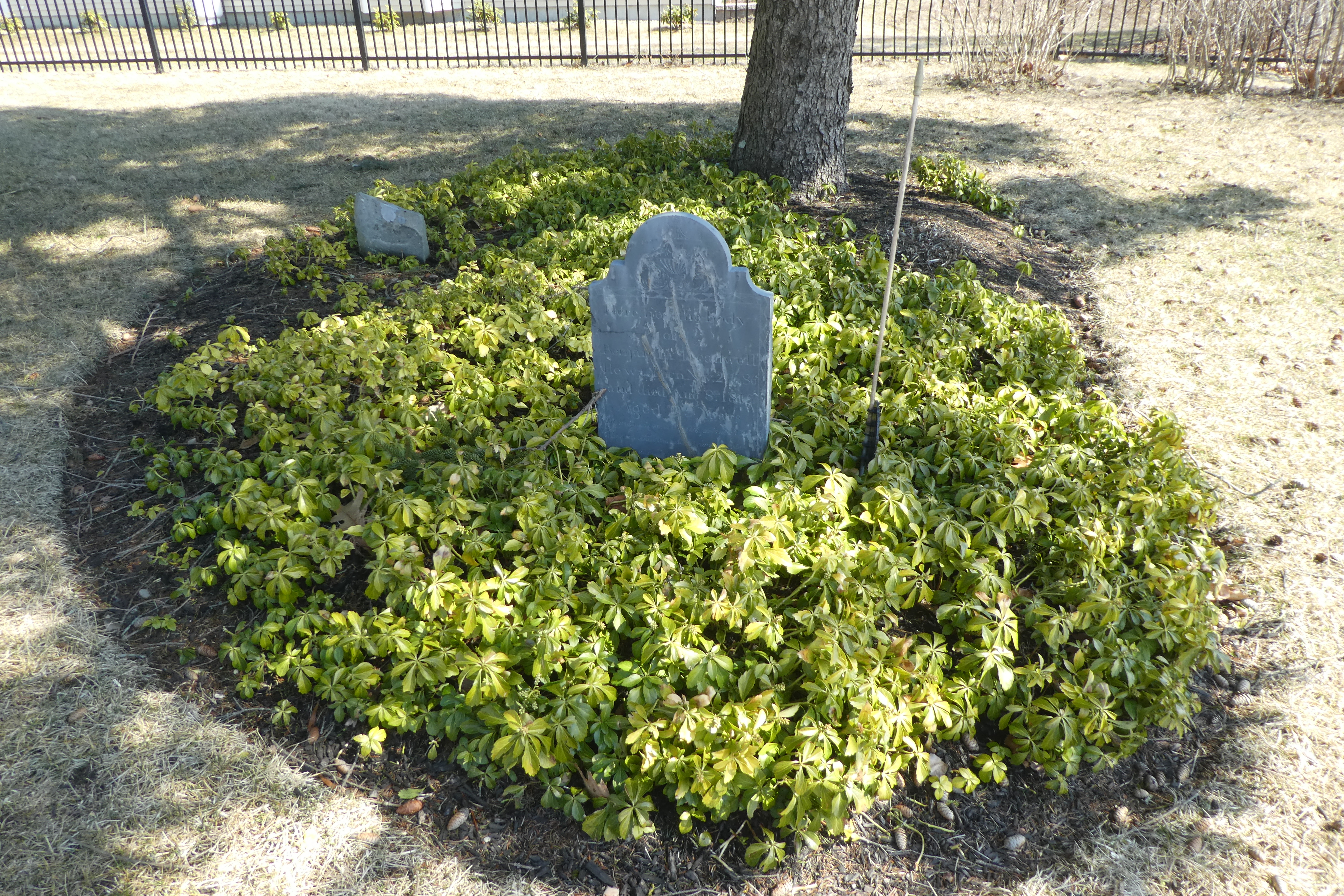
Benjamin Treadwell, died 1815, Wells (now Kennebunk), Maine

 This tombstone was photographed at the Webhannet Burial Ground in Wells, Maine. 


Here lies the body
of
Benjamin Treadwell
He was born Nov. 2, 1786
and died Aug. 8th 1815
Aged 29 Years
Beneath this stone death's prisoner lies
The stone shall move, the prisoner rise
(the rest of the epitaph is below the vegetation) 

As I was wandering this little burial ground in Wells, Maine, to photograph my ancestor Josiah Littlefield, I found this gravestone to Benjamin Treadwell.  I am a descendant of Thomas Treadwell of Ipswich, Massachusetts, so I thought that perhaps there might be a cousin connection.  So we snapped this photograph.  It turns out that Benjamin Treadwell is my third cousin, six generations removed. 

Benjamin Treadwell was born 2 November 1786 in Wells, Maine, the son of Captain James Treadwell and Shuah Littlefield (another cousin connection!).  Captain Treadwell was a veteran of the Revolutionary War.  Benjamin died very young at age 29, but I could find no clues in the vital records or town history to his early demise.  He married Eleanor Kimball (another cousin connection!) on 30 November 1809 in Wells.  

Benjamin's descent is from James Treadwell (1749 - 1811), Samuel Treadwell (1720 - 1803), Samuel Treadwell (b. 1687 in Ipswich), Nathaniel (1637 - 1726 - also my 8th great grandfather), and Thomas Treadwell (about 1603 - 1671 - the immigrant from England to Ipswich and also my 9th great grandfather).  


For the truly curious:

My TREADWELL lineage: 

https://nutfieldgenealogy.blogspot.com/2012/02/surname-saturday-treadwell-of-ipswich.html   

My LITTLEFIELD lineage:

https://nutfieldgenealogy.blogspot.com/2019/01/surname-saturday-littlefield-of-wells.html  

A recent blog post about Josiah Littlefield, buried in this same cemetery:

https://nutfieldgenealogy.blogspot.com/2022/07/josiah-littlefield-d-1713-wells-maine.html   

---------------------

To cite/link to this blog post: Heather Wilkinson Rojo, "Benjamin Treadwell, died 1815, Wells (now Kennebunk), Maine", Nutfield Genealogy, posted July 26, 2022, ( https://nutfieldgenealogy.blogspot.com/2022/07/benjamin-treadwell-died-1815-wells-now.html: accessed [access date]). 

Monday, July 25, 2022

Day Three of the "Path of the Pilgrims" Tour by the GSMD

 Click here to see Day One of the tour:  https://nutfieldgenealogy.blogspot.com/2022/07/on-path-of-pilgrims-tour-from-general.html   

Click here to see Day Two of the tour:  https://nutfieldgenealogy.blogspot.com/2022/07/day-two-on-path-of-pilgrims-tour-by-gsmd.html  

Day Three - The Aptuxet Trading Post in Bourne, Massachusetts, Provincetown, Corn Hill, First Encounter Beach, Cove Cemetery in Eastham, and the Forefathers Monument in Plymouth, Massachusetts - see below

Day Four  https://nutfieldgenealogy.blogspot.com/2022/07/day-four-on-path-of-pilgrims-tour-by.html  

Day Five   https://nutfieldgenealogy.blogspot.com/2022/07/day-five-of-path-of-pilgrims-tour-by.html  

Aptucxet Trading Post, Bourne, Massachusetts
Wampum was the currency of choice at Aptucxet
in the 17th century


Interior of the Aptucxet Trading Post

The Aprucxet Trading Post is a replica of the building erected in 1627 by Plymouth Colony in what is now the town of Bourne.  It was built for trade with the native Wampanoag people and with traders from the Dutch colony in what is now New York state.  The building was contructed according to descriptions in journals and archaeological digs in the area.  The building is situated on the Cape Cod Canal, but in the 1600s this was the banks of the Manomet River.  

The interior of this two room structure replicates the trading post.  There are also displays about the Wampanoag people from this area, and information about wampum, which was the trade item of choice between the Dutch, English and Wampanoag.  They also traded items for corn, beans, fur, and other items for survival and to repay debts to the English companies that financed the Plymouth Colony.  The colonists also operated the Cushnoc Trading Post in what is now the town of Augusta, Maine.  Several of my Mayflower ancestors were instrumental in establishing this trading post - Myles Standish, Isaac Allerton, and John Howland.  
Provincetown, Massachusetts


We ate lunch here, of course!

A Mayflower window over the door of the Mayflower Cafe

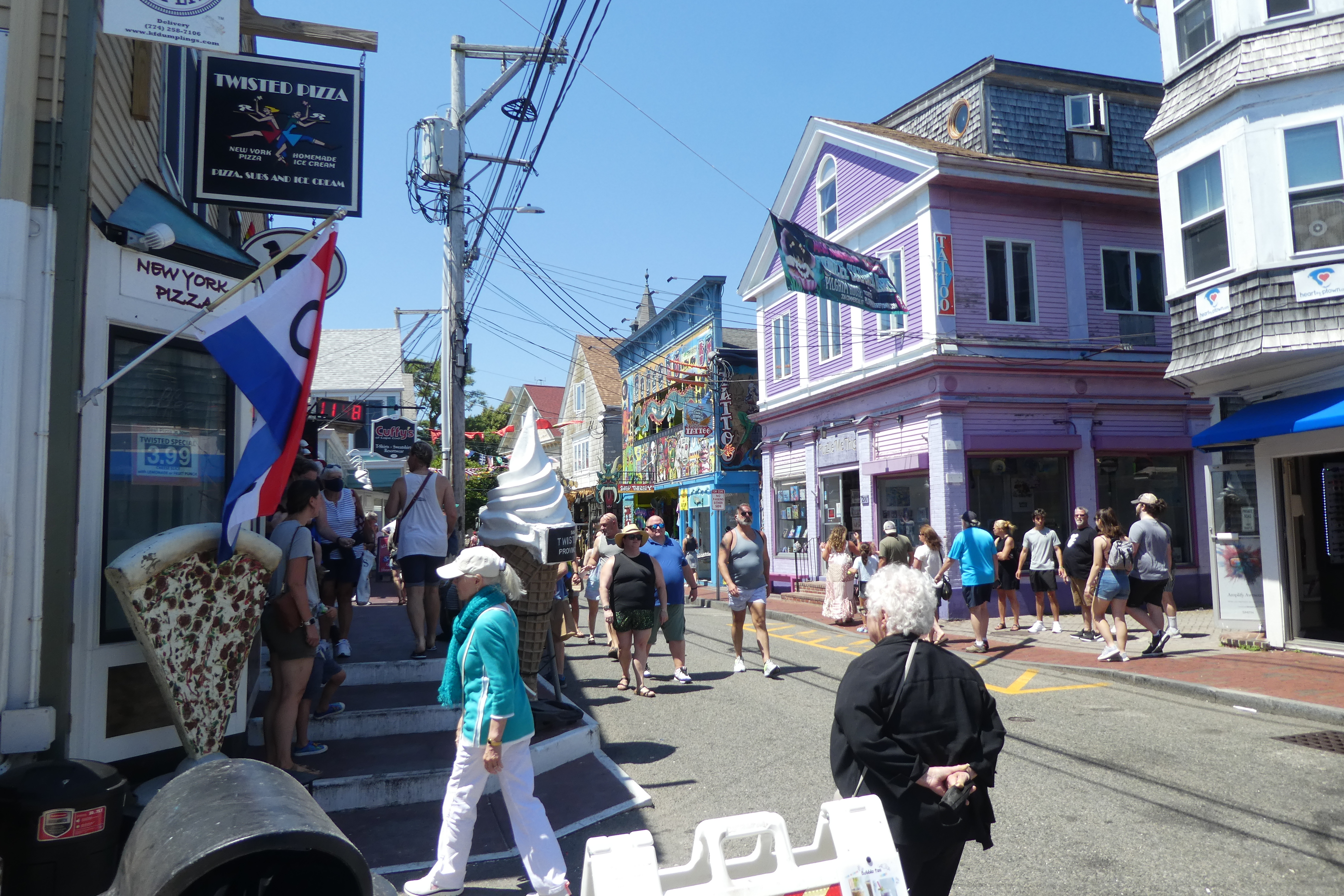
Next our tour took us to the tip of Cape Cod, the town of Provincetown, Massachusetts.  This is where the Mayflower made landfall after 66 days at sea.  The ship moored in Provincetown Harbor after failing to navigate the shoals off Cape Cod.  The passengers wrote and signed the Mayflower Compact here, establishing a New England settlement and forming a civil union while they waited for a new patent (permission to settle outside of the original plan near the Hudson River).  

We had time to explore Provincetown and have lunch, before boarding a trolley for a short tour.  The tour gave us a great history of the town, and some of the neighborhoods built over the last 400 years.  I especially liked learning about the fishermens' homes that were floated off the sandbars to line the streets near the harbor.  We had a chance to view the harbor with its breakwater and lighthouse.  Except for a few buildings, it probably looked like it did back in 1620.  

Our tour took us to view the Pilgrim Monument.  This 252 foot tower was dedicated in 1910 to honor the Pilgrims' landing in Provincetown.  It is visible from Plymouth (on a clear day) and from all over Cape Cod.  Years ago Vincent and I climbed to the top, all 116 steps and 60 ramps.  This time we did not climb!  Trivia fact:  President Teddy Roosevelt laid the cornerstone in 1907, and President Taft led the dedication ceremony three years later. There is a museum at the base of the tower, too.  When you are in Provincetown, just look behind the town hall for the funicular to the top of the hill where the tower is lcated. 

The Mayflower Compact was signed here in Provincetown Harbor

The Pilgrim Monument in Provincetown

Corn Hill Monument, at Corn Hill Beach
in Truro, Massachusetts

The inscription at Corn Hill monument

After visiting Provincetown, we went to Corn Hill Beach in Truro, Massachusetts.  This is a lovely beach, considered one of the nicest beaches on Cape Cod.  At the public parking lot you will find this little fenced in enclosure with a marker acknowledging the place where the Pilgrim explorers found a cache of Indian corn in November 1620.  According to Bradford's journal, they did not know if they should steal the corn, but decided to take it because they were starving after the long voyage from England.  This is a controversial part of the Pilgrim story.  Not only because of the theft of the seed corn, but also because the corn was NOT FOUND IN THIS SPOT!

The actual spot where the corn was found is up the hill on private property.  The road to this hill is a private road.  So the first monument (photograph above) is as close as possible to the real spot.  However there is a very small marker on the actual spot, owned by the General Society of Mayflower Descendants who maintain a right of way.  Since we were all members, we took tools to clear out, weed, and visit the monument! 

Tools for maintaining the "real"
Corn Hill marker

Yours truly at the site of the actual corn cache found
on Corn Hill.  It is hidden behind overgrown vegetation. 

The small Corn Hill Marker before clearing the vegetation

The stone is now visible due to everyone helping
to clear the weeds, branches and vegetation. 


Vincent and I hard at work clearing Corn Hill


The monument at the very windy
First Encounter Beach, Eastham, MA

The First Encounter marker

First Encounter Beach

After Corn Hill we went to see First Encounter Beach.  This is the site of another controversial event between the Nauset people and the Mayflower passengers.  The Nauset members of the Wampanoag nation were very wary of the new English men who had arrived in 1620 because several years earlier some of their tribe members had been kidnapped and taken as slaves to Europe (including Tisquantum "Squanto").  When the Pilgrims and the native people met on this beach, arrows and bullets flew but no one was hurt.  The Nauset retreated and the English went back to the Mayflower.  Fortunately, by the spring of 1621 the relations between the two groups improved. 

We were here at First Encounter Beach on a very windy day.  The tide was low, and there were few visitors even though this beach, like Corn Hill Beach, is a very popular site for swimming and boating. It was easy to imagine how it looked in 1620.  

Cove Burying Ground, Eastham, Massachusetts 

The gravesite of Mayflower passenger Constance Hopkins Snow
died 1677 Eastham, Massachusetts

The gravesite of Giles Hopkins, Mayflower passenger,
died 1690 Eastham, Massachusetts 

The gravesite of Joseph Rogers, Mayflower passenger,
died 1673 in Eastham, Massachusetts

While we were in Eastham, we also stopped at the Cove Burying Ground, where three Mayflower passengers are buried.  This cemetery dates to 1646.  There are no 17th century markers surviving, but descendants of the passenger interred here have placed memorials.  See the link below for a listing of burials here, including the Mayflower passengers Constance Hopkins Snow, Giles Hopkins, and Joseph Rogers.  

The National Monument to the Forefathers
Plymouth, Massachusetts


A detail on the monument showing the Mayflower Compact

One of the panels on the monument lists the Mayflower passengers

Our last stop for the day was the National Monument to the Forefathers, on Allerton Street in Plymouth, Massachusetts.  This is a solid granite monument standing 81 feet tall.  It was erected by the Pilgrim Society, and dedicated in 1889.  It was deeded to the Massachusetts government, and the monument and Plymouth Rock are both part of Pilgrim Memorial State Park.  It is not a federal or national park. 

It was nice to visit this monument near sunset.  The most popular part of the monument with our tour group was the panel listing the Mayflower passengers.  Everyone wanted to find the name of their ancestor or ancestors!


For the truly curious:

The Aptucxet Trading Post:   https://www.bournehistoricalsociety.org/aptucxet-museum/   

Provincetown, Massachusett Tourism:  https://ptowntourism.com/   

The Pilgrim Monument in Provincetown:   https://www.pilgrim-monument.org/   

Corn Hill Beach, Truro, Massachusetts:  https://www.truro-ma.gov/beach-office/pages/corn-hill-beach  


First Encounter Beach, Eastham, Massachusetts:   http://www.capecodgravestones.com/easthampixweb/firenccove.html  

Cove Burying Ground, Eastham, Massachusetts:  https://en.wikipedia.org/wiki/Cove_Burying_Ground  

A listing of burials at the Cove Burying Ground:   http://www.capecodgravestones.com/easthamcove.html  

National Monument to the Forefathers:   https://en.wikipedia.org/wiki/National_Monument_to_the_Forefathers  


---------------------------

To cite/link to this blog post: Heather Wilkinson Rojo, "Day Three of the "Path of the Pilgrims" Tour by the GSMD", Nutfield Genealogy, posted July 25, 2022, ( https://nutfieldgenealogy.blogspot.com/2022/07/day-three-of-path-of-pilgrims-tour-by.html: accessed [access date]).  

Thursday, July 21, 2022

Day Two "On The Path of the Pilgrims" Tour by the GSMD

 Day One  https://nutfieldgenealogy.blogspot.com/2022/07/on-path-of-pilgrims-tour-from-general.html  

Day Two  https://nutfieldgenealogy.blogspot.com/2022/07/day-two-on-path-of-pilgrims-tour-by-gsmd.html  

Day Three  https://nutfieldgenealogy.blogspot.com/2022/07/day-three-of-path-of-pilgrims-tour-by.html  

Day Four   https://nutfieldgenealogy.blogspot.com/2022/07/day-four-on-path-of-pilgrims-tour-by.html 

Day Five   https://nutfieldgenealogy.blogspot.com/2022/07/day-five-of-path-of-pilgrims-tour-by.html   

The Plimoth Patuxet Museum, Plymouth, Massachusetts

The second day of our tour "On the Path of the Pilgrims" took us to the Plimoth Patuxet museum (formerly known as Plimoth Plantation).  This was a highlight of the tour for the members who had never visited Plymouth, Massachusetts before this trip.  It is an open air museum where the re-enactors in the English village represent actual villagers in 1627, and portray life in the colony.  In the Wampanoag homestead the staff represents life in a traditional setting, with wetus, mishoons, a cooking area, gardens, and artifacts. There is also a visitor center with exhibits and a film, and a craft center with artisans doing pottery, woodwork, baking, and making herbal remedies. 

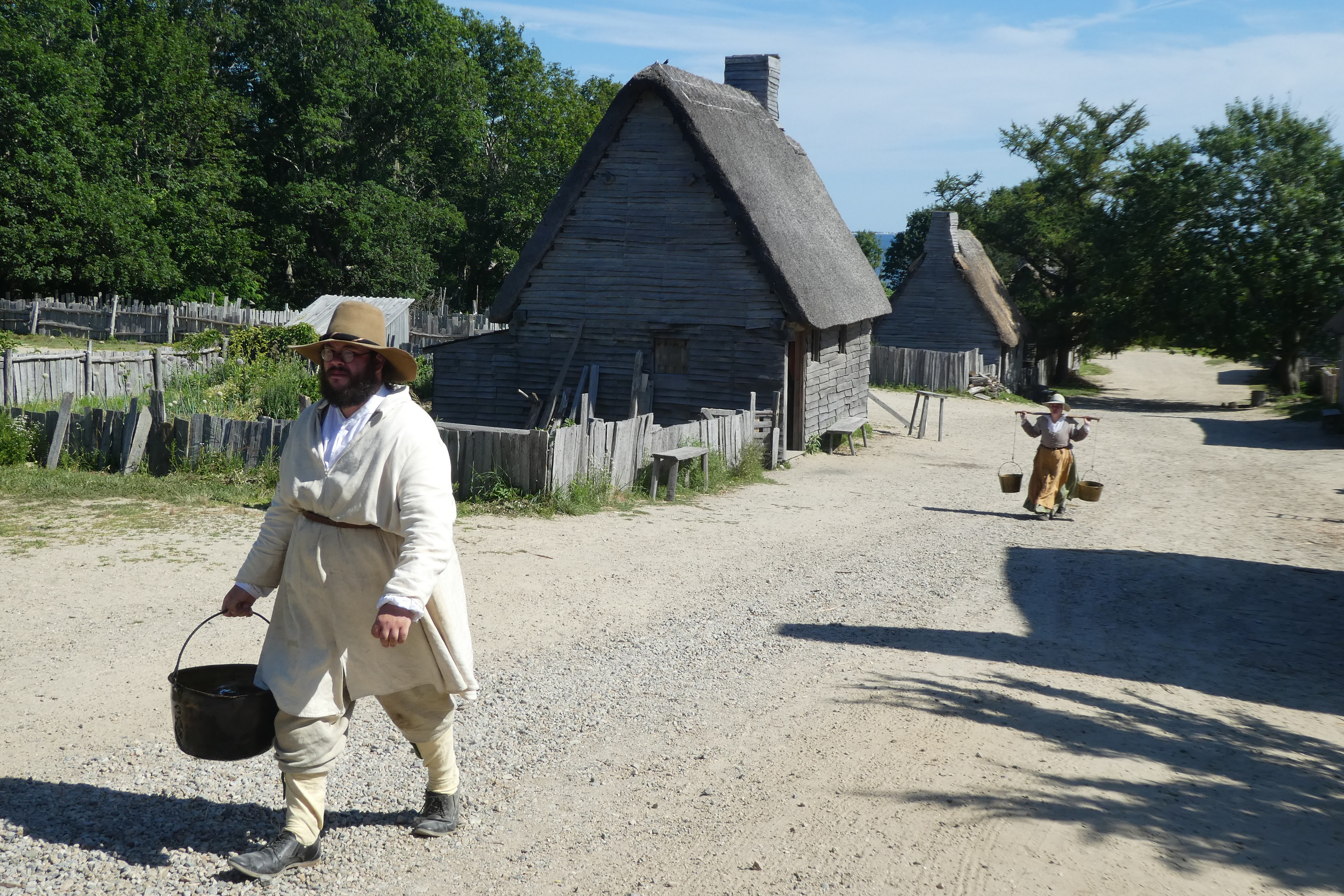
Vincent and I went directly to the English village, and then to the craft center, and then to the visitor center to visit the bookshop.  We didn't have a lot of time to see the museum, but we are life members and visit at least once or twice a year so we knew exactly what we wanted to see.  The last time we visited the re-enactors all wore masks and the interiors of the houses in the English village were closed to visitors.  This time we were able to go inside the homes and interact more with the staff, which was delightful. Mayflower descendants have a lot of fun visiting with their ancestors, and on this visit we were able to interact with ancestors John Howland, Elizabeth Tilley (John's wife), and Mary Beckett (wife of Mayflower passenger George Soule).  

My "ancestors", John Howland and Elizabeth Tilley,
carrying water to their house 

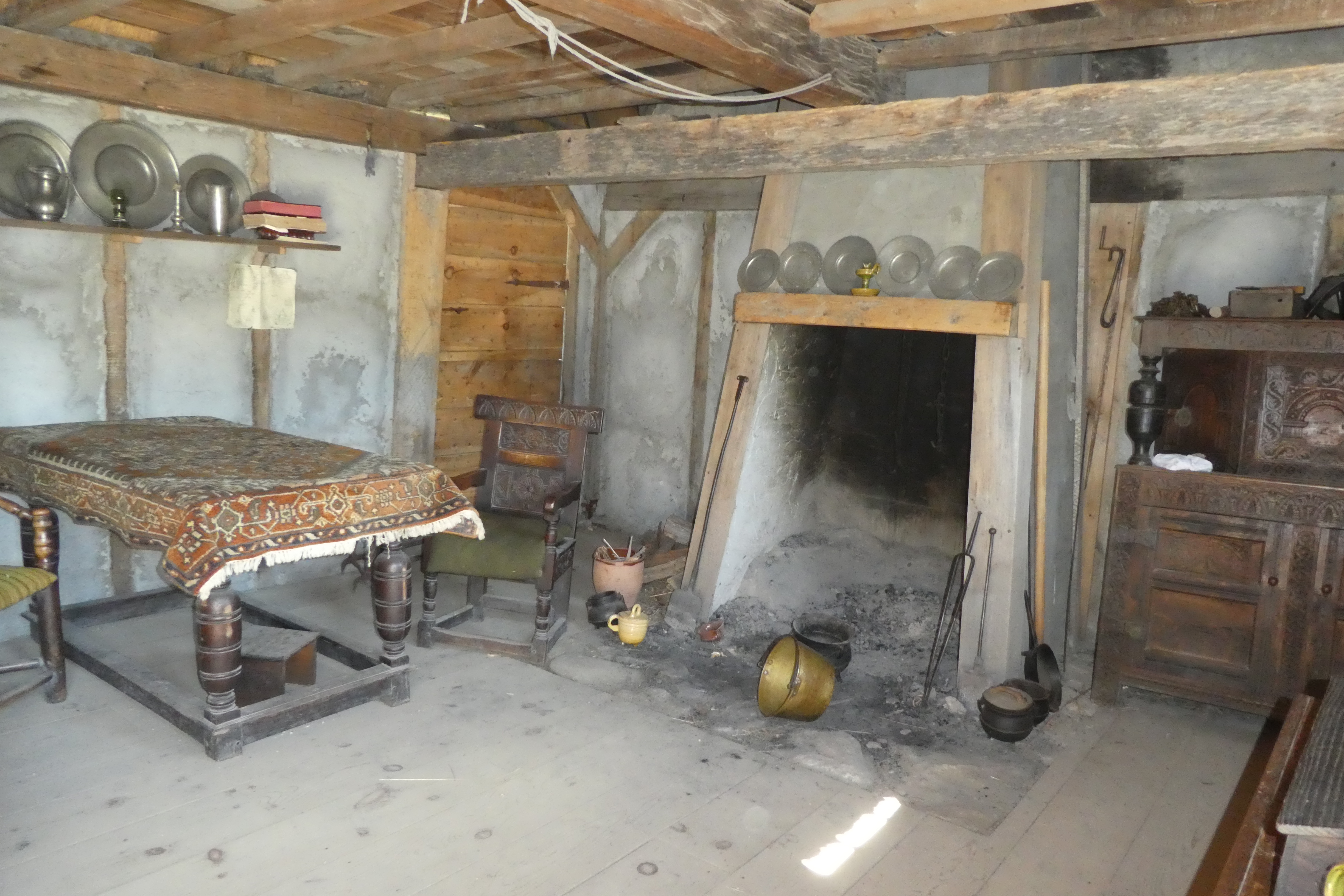
The interior of a house at Plimoth Patuxet

The fort and meetinghouse at Plimoth Patuxet (a replica)

The current Meetinghouse
at Plymouth, Massachusetts

After the museum our tour went to the Plymouth Meetinghouse, which is now operated by the General Society of Mayflower Descendants as a museum, while still being used for services twice a year by the original Unitarian congregation that built the church in 1894, on the site of the original meetinghouses built earlier by the Separatists and Congregationalists.  It is also a museum and will be used by the town as a meetinghouse and event center after the renovations are complete.  The exterior has been cleaned and restored, and now the interior restoration is planned.  The structure will be strengthened to accomodate an elevator, and a new entrance will be built. The santuary stenciling and walls will be cleaned and repaired, as well as other plans.  It is a multi million dollar renovation that will take many years to complete. 

Our group in front of the Plymouth Meetinghouse


The sanctuary inside the Plymouth Meetinghouse

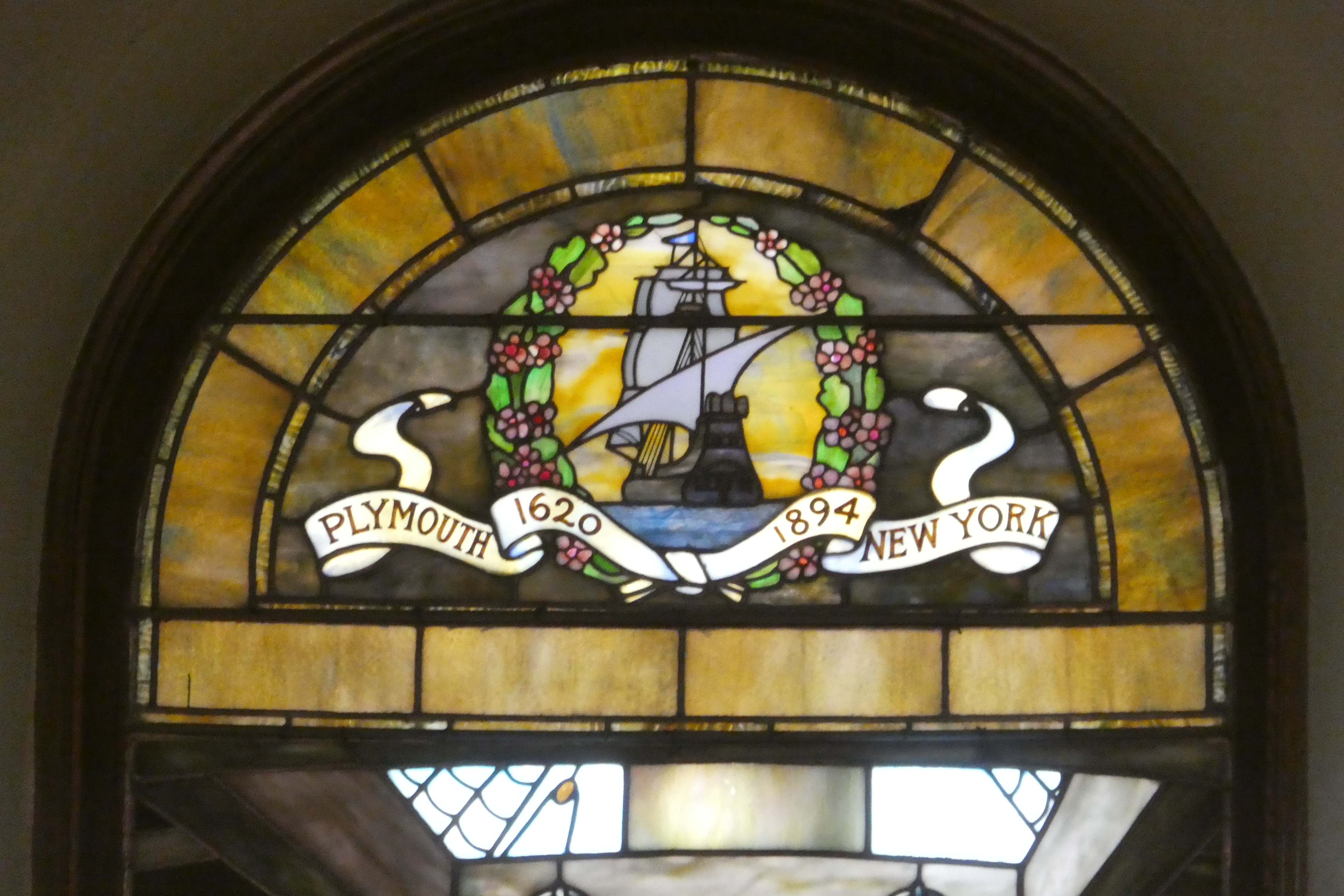
Tiffany stained glass windows show my ancestor 
Rev. John Robinson giving a farewell to the Pilgrims
leaving Delftshaven, Holland for the New World

The extravagant windows were donated by the
New York Mayflower Society 


Yours Truly boarding our Lobster Roll Cruise boat 
at the harbor in Dennis, Massachusetts (Cape Cod)

Mayflower Beach in Dennis, Massachusetts

After touring the meetinghouse, we boarded the bus for a drive to Dennis for a very nice cruise on Cape Cod bay called the Lobster Roll Cruise.  We traveled along the coast as far as Mayflower Beach while enjoying a scrumptious lunch where we were served 8 ounce lobster rolls and salads.  I've had a few lobster rolls this summer, but this was by far the best one yet!  And it was fun watching the coast and imagining how it must have looked 400 years ago to our Mayflower ancestors.  

The Jabez Howland House in Plymouth, Massachusetts

Interior of the Jabez Howland House

Some of these panes of glass are original 17th century

After the tour we returned to Plymouth for a tour of the Jabez Howland House.  This historic house is the oldest house in Plymouth (1667), and the only house in Plymouth where a Mayflower passenger (John Howland) lived.  Jabez was the son of passengers John Howland and Elizabeth Tilley.  The house is operated as a museum by The Pilgrim John Howland Society.  The same society also maintains the historic sites at Rocky Nook in Kingston, Massachusetts where John and Elizabeth Howland had a homestead.  

The house is full of artifacts from the 17th century, including many owned by the Howland family.  There is a small gift shop, too.  

The Mayflower II at her berth in Plymouth Harbor

The Mayflower Women fountain

After the Jabez Howland house we were dropped off at Plymouth harbor for dinner on our own, and time to walk around the waterfront.  Vincent and I wandered along and saw the Mayflower II, Plymouth Rock, the Mayflower Women fountain and Brewster Gardens.  It was a lovely day, and we had fine weather for all the walking and sightseeing.

Stay tuned for Day Three coming soon!

For the truly curious:

Part One "On the Path of the Pilgrims Tour"   https://nutfieldgenealogy.blogspot.com/2022/07/on-path-of-pilgrims-tour-from-general.html   

The Plimoth Patuxet Museums website:   https://plimoth.org/  

The Mayflower Meetinghouse webpage:   https://themayflowersociety.org/visit/mayflower-meetinghouse/   

The Lobster Roll Cruise website:   https://capecodlobstercruise.com/  

The Jabez Howland House:   https://pilgrimjohnhowlandsociety.org/The_Jabez_Howland_House  

-------------------------------

To cite/link to this blog post:  Heather Wilkinson Rojo, "Day Two "On The Path of the Pilgrims" Tour by the GSMD", Nutfield Genealogy, posted July 21, 2022, ( https://nutfieldgenealogy.blogspot.com/2022/07/day-two-on-path-of-pilgrims-tour-by-gsmd.html: accessed [access date]). 

Wednesday, July 20, 2022

A Forgotten Fish - Weathervane Wednesday

 This weathervane was photographed on the grounds of the Shelburne Museum in Shelburne, Vermont.


This weathervane was spotted above a maintenance shed in the rear of the grounds of the Shelburne Museum.  We were walking on the path between the Merry-Go-Round and the Railroad Station, when we saw this shed on the other side of the boundary fence, next to the train tracks.  I had previously taken lots of photos of the weathervanes in the collections of the Dorset House and on top of the out buildings (barns, churches, etc.) and written up lots of blog posts (see below), but we had missed this little weathervane on previous trips to the Shelburne Museum.

This three dimensional weathervane of a fish has a nice green patina.  It is probably copper, and knowing the Shelburne Museum, it was probably moved from another location or it might be a newly commissioned piece of art. The Shelburne Museum has a nice little book on their weathervane collection entitled Silhouettes in the Sky: The Art of the Weathervane, by Jean M. Burks, 2006.  This fish doesn't appear in the book. 

For the truly curious:

A blog post about the Shelburne Museum, 2013:  https://nutfieldgenealogy.blogspot.com/2013/07/the-shelburne-museum-and-shelburne-farms.html  

"Three on one Barn!"  2014:    https://nutfieldgenealogy.blogspot.com/2014/02/weathervane-wednesday-three-on-one-barn.html   

"Five Weathervane Stamps"  2014:   https://nutfieldgenealogy.blogspot.com/2014/04/weathervane-wednesday-five-weathervane.html   

"A Circus Performer" 2014:   https://nutfieldgenealogy.blogspot.com/2014/03/weathervane-wednesday-circus-performer.html   

"Another Centaur?"  2014:    https://nutfieldgenealogy.blogspot.com/2014/09/weathervane-wednesday-another-centaur.html   

"The Lion Killer"  2014:   https://nutfieldgenealogy.blogspot.com/2014/04/weathervane-wednesday-lion-killer.html   

"Seen at the Shelburne Museum"  2014:    https://nutfieldgenealogy.blogspot.com/2014/02/weathervane-wednesday-seen-at-shelburne.html   

"My Favorite Eagle"  2014:   https://nutfieldgenealogy.blogspot.com/2014/03/weathervane-wednesday-my-favorite-eagle.html   

"A Fox and Hound"  2014:  https://nutfieldgenealogy.blogspot.com/2014/03/weathervane-wednesday-my-favorite-eagle.html 

"A Familiar Mermaid"  2014:   https://nutfieldgenealogy.blogspot.com/2014/03/weathervane-wednesday-familiar-mermaid.html   

Click here to see over 460 other weathervane posts: 

https://nutfieldgenealogy.blogspot.com/search/label/Weathervane%20Wednesday   

---------------------------

To cite/link to this blog post: Heather Wilkinson Rojo, "A Forgotten Fish - Weathervane Wednesday", Nutfield Genealogy, posted July 20, 2022, ( https://nutfieldgenealogy.blogspot.com/2022/07/a-forgotten-fish-weathervane-wednesday.html: accessed [access date]). 

Tuesday, July 19, 2022

"On The Path Of The Pilgrims" Tour from the General Society of Mayflower Descendants - Day One

The Massachusetts, State House, Boston, Massachusetts
Undergoing an extensive exterior restoration project

 For the 400th Anniversary commemoration of the voyage of the ship Mayflower, the General Society of Mayflower Descendants planned several tours.  After rescheduling due to the COVID pandemic, these tours finally took place this summer.  Earlier, a tour took place in England and the Netherlands, and since Vincent and I had already taken that tour in 2017 we opted for the New England tour.  Although we live within two hours of Plymouth we know there are many historic sites we have not experienced.  What fun to do it with Mayflower cousins! 

Our tour started by meeting up with our 44 fellow travelers at a hotel at Boston's Logan airport.  We had a welcome dinner and meeting, which included playing an ice breaker game where we had to find someone who matched the Mayflower passengers on cards passed out before dinner.  The person I had to find shared Mayflower passenger George Soule in her family tree, just like me! In our group there were Society members from as far away as California, Montana, and Texas - and there were some from New England including Maine and also a pair from New Hampshire.  

We started our tour the next day by walking the Freedom Trail from the State House to the North End.  This was rather like herding cats!  Having 45 tourists following a guide through Boston's narrow streets and traffic crossing was not easy, but we didn't lose anyone! We were back at the State House on the last day of our tour for a special Mayflower Pilgrim surprise, so stay tuned for the blog post Day Five of this tour. 

The Robert Gould Shaw Memorial on the Boston Common


Our group at the Granary Burying Ground


Our tour guide, Lisa,
with her ancestor's tombstone


We walked past the Robert Gould Shaw Memorial, the memorial to William Blackstone (Boston's first English resident), the Park Street Church, the Tremont Temple and over to the Granary Burial Ground.  There are no Mayflower passengers buried here, but several members of our group had ancestors buried here.  Our tour guide found her ancestor's gravesite - a Captain Thomas Andrews buried in 1690 (he died of small pox returning from an expedition to Canada.  

A marker for the graves of John Winslow and his wife,
Mary Chilton, a Mayflower passenger

Not far from the Granary Burying Ground is the King's Chapel burying ground.  This is where Mary Chilton, a Mayflower passenger is buried.  Mary was about fourteen years old in 1620 when the Mayflower landed in Plymouth, and a common myth is that she was first European woman to step on Plymouth Rock.  She was orphaned the first winter in Plymouth.  She married John Winslow, who was the brother of another Mayflower passenger, Edward Winslow.  They lived on Spring Lane in Boston, where John Winslow was a prosperous merchant. The Chilton Club in Boston is named in her honor. 

Spring Lane, off Washington Street, 
the oldest street in Boston


This marker to Mary Chilton is located on Spring Lane,
near the Commonwealth Book Shop (a pedestrian street)

Next we walked past the Old State House, the site of the Boston Massacre, and had a short stop at Faneuil Hall and Quincy Market.  Our tour continued past the Holocaust Memorial and we had a lunch break at the new Boston Public Market (new to me!).  We regrouped in front of the Union Oyster House and followed the guide across the Greenway to the North End.  We passed Paul Revere's House and followed the Paul Revere Mall up to the Old North Church.  

The state of Paul Revere in front
of the Old North Church


We had a tour of the Old North Church, and the docent knew we were all Mayflower descendants, so she made point of showing us two stone plaques in the entrance of the church. One is a gift from the Guildhall in Boston, England where the Pilgrims were thrown into prison for illegally attempting to leave England.  The other is a plaque from the Boston Stump parishoners to the city of Boston, commemorating the Winthrop fleet.  The picture of the plaque from the Guildhall was difficult to photograph since the bright summer sun from the front door was shining on the glass cover. 

After a brief tour of the Copp's Hill Burial Ground, we boarded our bus again and headed to Quincy, Massachusetts for the Adams National Historical Park.  Did you know that President John Adams was a descendant of John Alden and Priscilla Mullins?  And so was his son, President John Quincy Adams.  

Church of the Presidents
United First Parish Church, Quincy

Presidents John Adams and John Quincy Adams
and their First Ladies lie in this crypt under the church

This plaque is in the church sanctuary.
There is a similar plaque for John Quincy Adams
and his wife, Louisa Catherine Johnson

John Quincy Adams was born in this modest house in 1767

John Adams was born in this little house in 1735

Our tour first went to the Church of the Presidents, where a docent gave a wonderful lecture on both Presidents Adams.  He then took us (in small groups of course) into the crypt where both presidents and their first ladies are interred.  The church was built in 1828 with granite donated by John Adams.  The bell in the steeple was cast by Paul Revere. 

Our next stop was at the farm where both John Adams and John Quincy Adams were born in side by side homes.  Then we went to see Peacefield, where John Adams lived in retirement, and his son John Quincy Adams built a library.  Generations of the Adams family lived here until it was donated to the United States in 1946.  The Stone Library houses the 14,000 volumes owned by John Quincy Adams.  Once a year, on John Quincy Adams' birthday (July 11th) the library is open to the public.  We were there on this special day to see inside the library, and to view the Mendi Bible on display on his library table.  The Mendi Bible was given to him in 1841 by the group of freed Mendi captives from the ship La Amistad.  This bible was stolen from the library in 1996, but the FBI recovered it in 1997 from a locker at a gym in Portsmouth, New Hampshire!  The first black governor of Massachusetts, Deval Patrick, took his oath of office with the Mendi Bible in both 2007 and 2011.   

Next I will post on this blog about Day Two, in Plymouth, Massachusetts! 

The Stone Libary, next to Peacefield


The Mendi Bible on display inside the Stone Library

For the truly curious:

My 2017 blog posts of "Along the Pilgrim Trail" tour of England and the Netherlands start with this post in Babworth, Nottinghamshire, England:   https://nutfieldgenealogy.blogspot.com/2017/10/along-pilgrim-trail-babworth.html  


The General Society of Mayflower Descendants   https://themayflowersociety.org/   

Boston Freedom Trail    https://www.thefreedomtrail.org/  

Old North Church  https://www.oldnorth.com/   

Wikipedia article on Mary Chilton   https://en.wikipedia.org/wiki/Mary_Chilton  

The Adams National Historic Park   https://www.nps.gov/adam/index.htm   

Wikipedia article on The Mendi Bible https://en.wikipedia.org/wiki/Mendi_Bible   

---------------------------

To cite/link to this blog post: Heather Wilkinson Rojo, ""On The Path Of The Pilgrims" Tour from the General Society of Mayflower Descendants - Day One", Nutfield Genealogy, posted July 19, 2022, ( https://nutfieldgenealogy.blogspot.com/2022/07/on-path-of-pilgrims-tour-from-general.html: accessed [access date]).