Showing posts with label 20th Century Americana. Show all posts

Tuesday, September 16, 2025

Dari Joy, Bellows Falls, Vermont

This is another post in my series of stories about 20th Century Americana, which I use as story starters and for helping with oral histories.  Most of these subjects bring back great memories to the people who lived through the 20th century, maybe even YOU!

The Dari-Joy is a small ice cream restaurant at 140 Rockingham Road in Bellows Falls, Vermont, across the street from the Connecticut River.  This is another installment of the 20th Century Americana series at this blog, where I feature unique places and things across New England that were established or made in the 20th century. Maybe you, your parents, your grandparents, or even your great-grandparents remember visiting a place like this for snacks and ice cream. 


The Dari-Joy restaurant was established in 1953 by the DeMuzio family.  For decades we had driven by this little ice cream stand on our way to the Vermont Country Store in Rockingham, Vermont.  Recently we finally decided to stop by and have lunch.  We each had a fine plate of fish and chips, and were tempted by the ice cream menu.  The interior of the restaurant was decorated with photos from the last 50 years of the restaurant, which started as a walk up window and now has expanded to indoor dining.  It was so cute that I decided to include Dari-Joy in my 20th Century Americana series.

There is a statue of "Big Boy" on the roof, and lots of colorful booths and juke boxes inside. Dining here is like stepping back into the 1950s.  They serve burgers, fried seafood, sandwiches, hot dogs, and of course ice cream both hard and soft serve. Wednesdays are prime rib specials.  It's cash only, with and ATM in the dining room. 

The Dari-Joy is open seasonally April to October.  I hope you can visit soon!  

1953 newsclipping about Dari-Joy opening


For the truly curious: 

Dari-Joy at Facebook:   https://www.facebook.com/Darijoyrestaurant  

The Rutland Herald, "50 Years of (Dari) Joy", 17 October 2018   https://www.rutlandherald.com/news/50-years-of-dari-joy/article_76f9a927-738a-5c5f-891f-e40d463fc5b5.html   

Click here to see more 20th Century Americana at the Nutfield Genealogy blog:   https://nutfieldgenealogy.blogspot.com/search/label/20th%20Century%20Americana  

----------------------

To cite/link to this blog post: Heather Wilkinson Rojo, "Dari Joy, Bellows Falls, Vermont", Nutfield Genealogy, posted September 16, 2025, ( https://nutfieldgenealogy.blogspot.com/2025/09/dari-joy-bellows-falls-vermont.html:  accessed [access date]). 

Tuesday, January 30, 2024

A Flamingo in Leominster, Massachusetts for Weathervane Wednesday

 This weathervane was photographed in Leominster, Massachusetts. 


While traveling on Route 2 in central Massachusetts we stopped at a visitor center and found this delightful flamingo weathervane.  I knew immediately that we were in the town of Leominster because of this weathervane.  Growing up in central Massachusetts in the 1960s and 1970s, every kid knew that those plastic, pink lawn flamingos were made in Leominster!  

Leominster was known as the Plastic City.  Many plastic products were produced there, not just pink flamingos!  The artist Don Featherstone created the first pink flamingo in 1957, and had his design manufactured by Union Products in Leominster.  It immediately became a pop culture hit.  In 1996 Featherstone won an Ig Nobel Prize for Art. Union Products closed in 2006, and the molds were purchased by a factory in New York who still sells them.  Factories in Leominster manufactured Foster Grant sunglasses, Tupperware, toys, and other plastic items. 

Plastic, pink flamingos were despised and also beloved by homeowners. Some believed that if a neighbor put out a pink flamingo then their own home would lose value. Others embraced the kitsch, and put out flocks of flamingos.  Leominster has made the pink flamingo part of it's local history, just like Johnny Appleseed, who was born in Leominster in 1774. Every June 23rd "Pink Flamingo Day" is celebrated in Leominster at Monument Square, by proclamation from the city hall.   

It's too bad that this two dimensional weathervane is gilded in gold instead of painted pink.  


For the truly curious:

Wikipedia "Plastic Flamingo":   https://en.wikipedia.org/wiki/Plastic_flamingo   

Yankee Magazine "Last of the Leominster Pink Flamingos":   https://newengland.com/yankee/flamingos/  

Smithsonian Magazine "The Tacky History of the Pink Flamingo"  https://www.smithsonianmag.com/arts-culture/the-tacky-history-of-the-pink-flamingo-18191304/    

A previous blog post about Leominster's Johnny Appleseed:  https://nutfieldgenealogy.blogspot.com/2013/08/on-trail-of-johnny-appleseed.html   

Click here to see over 500 more Weathervane Wednesday posts!     https://nutfieldgenealogy.blogspot.com/search/label/Weathervane%20Wednesday 

----------------------------

To cite/link to this blog post:  Heather Wilkinson Rojo, "A Flamingo in Leominster, Massachusetts for Weathervane Wednesday", Nutfield Genealogy, posted January 30, 2024, ( https://nutfieldgenealogy.blogspot.com/2024/01/a-flamingo-in-leominster-massachusetts.html: accessed [access date]). 

Thursday, April 16, 2020

The American Classic Arcade Museum, Laconia, New Hampshire - 20th Century Americana


Museums are fun and interesting, but usually they are strictly hands off experiences.  The best part of the American Classic Arcade Museum is that it is all hands on!  You can play every arcade game on display.  This includes hundreds of coin operated games - from the pre-electricity era, to video games, pinball games, simulators, and more.  

This museum explores the early history of pinball games, which were demonized during the Great Depression as gambling machines.  You can play these early games, as well as the electronic versions of pinball that were invented in the 1950s.  You can see the early video coin operated games such as Pong and Space Invaders, and the video games that evolved from vector graphics to high resolution. It is a trip down memory lane to play or watch other people play these games you might have known in high school or college. 

This is a completely FREE museum, open to the public.  The money collected from the coin operated games goes right back into restoring and maintaining these vintage machines, and the operating expenses like spare parts, a curator, electricity, and other costs. There are also educational display boards, cut-away models, guest lectures, and a large collection of vintage advertising materials and catalogs. 

The American Classic Arcade Museum is located on the top floor of The Fun Spot, the world's largest arcade and entertainment center. This arcade has over 600 games, including the 300 classic arcade and pinball machines in the museum, a 20 lane ten pin and candlepin bowling center, cash bingo, kiddie bumper cars, and indoor mini-golf.  Tokens purchased work at all games inside the Fun Spot and the museum. 


"COMPUTER
SPACE
Nutting Associates 1971
Computer Space was the first ever coin-operated video game.
It is a basic space-war type game where the player controls a
rocket ship and faces off against flying saucers. Created by
Nolan Bushnell, it cast the mold for all arcade video games
that would follow.  This design trend included a logic board to
run that particular game only, as opposed to a multi-purpose
computer, a video display, hand controls, coin acceptor and
separate power supply.  The coin-box in this game was made
from a paint-thinner can.  The monitor used in this game is a
converted video tube-type television."

The classic Space Invaders

A two person tabletop Ms. Pac Man game console. 
This type of game was popular in bars and pizza joints in the 1980s.

A wall full of classic pinball machines.


This console had the classic Pong. the world's first computer video game, invented by New Hampshire's Ralph Baer. You can read more about the inventor Baer at this post: 


There were plenty of classic pinball games from the past on display,
 including this massive wooden game. 

A display of early home computer game controllers.

This tiny little video game machine for toddlers was too cute to not take a photo! 

For the truly curious:

The American Classic Arcade Museum website:   https://www.classicarcademuseum.org/
579 Endicott Street North
Laconia, New Hampshire
603-393-7903
Open daily 10am to 10pm, closed Thanksgiving and Christmas.  Temporarily closed now.

Click here to read other 20th Century Americana blog posts:
https://nutfieldgenealogy.blogspot.com/search/label/20th%20Century%20Americana 

-----------------------------

To cite/link to this blog post:  Heather Wilkinson Rojo, "The American Classic Arcade Museum, Laconia, New Hampshire - 20th Century Americana", Nutfield Genealogy, posted April 16, 2020, ( https://nutfieldgenealogy.blogspot.com/2020/04/the-american-classic-arcade-museum.html: accessed [access date]).

Saturday, June 15, 2019

Ralph Baer Statue in Manchester, New Hampshire - 20th Century Americana


Earlier in May a new statue was unveiled in Manchester's Arms Park, on the banks of the Merrimack River.  It honors the inventor, Ralph Baer, who is considered the Father of all computer gaming. This statue is a friendly nod to Mr. Baer, and seems to invite you to sit down next to him to see what he is holding in his lap.  Which is just the kind of thing that Mr. Baer would have loved in life, since he enjoyed sharing his invention with everyone, especially children.

Ralph Baer was a former Sanders Associate employee (now BAE Systems) from 1956 to 1987 with a rags to riches story.  He was an immigrant who escaped the horrors of fascism and terror in Europe as a child, and became an engineer and hero to millions of computer gamers and technology users across the globe.  He held over 150 patents and created the first version of "Pong" and the game "Simon", as well as the first home video game console. While working at Sanders (BAE) he developed "The Brown Box", which was sold by Magnavox in the 1970s.

Born in Germany as Rudolf Heinrich Baer (1922 - 2014) his Jewish family fled in 1938 just two months before Kristallnacht.  He became a naturalized United States citizen and worked in a factory.  He later graduated from the National Radio Institute, and fought in World War II where he was assigned to military intelligence in London.  Through the G.I. Bill he earned a Bachelor of Science in Television Engineering.  After several other jobs he joined Sanders Associates (BAE Systems) in 1956. His projects included military applications, but through this technology he developed the concept of home video game consoles.  The rest is history!  His Brown Box was patented in 1973, jointly held by Baer and Sanders Associates.


Ralph Baer married Dena Whinston and they had three children.  He died in Manchester at his home in the North End on 6 December 2014.  He was awarded the National Medal of Technology in 2006 by President George W. Bush. He was inducted to the National Inventors Hall of Fame in 2010. Posthumously he was awarded the Pioneer Award by the Academy of Interactive Arts and Sciences at the 2015 Game Developers Conference. Ralph Baer's lab was recreated at the Smithsonian in Washington, DC, where he donated his papers and other artifacts. Baer was an Institute of Electrical and Electronics Engineers Life Fellow.

A local grassroots effort held an online Kickstarter campaign with support from BAE Systems and the Orbit Group to collect about $65,000 for the statue of Ralph Baer holding his "Brown Box", and for the statue's upkeep.  Names of donors are on the bricks below the statue.  Also, the Baer family has established a scholarship "The Ralph H. and Dena W. Baer Scholarship Fund" at the New Hampshire Charitable Foundation for Manchester Central High School students planning to study a technology related field.  Gifts may be made to the New Hampshire Charitable Foundation.

This is another post in my series of stories about 20th Century Americana, local history which I use as story starters and for helping with oral histories.  Most of these subjects bring back great memories to the people who lived through the 20th century, maybe even YOU!

-------------------------

To cite/link to this blog post:  Heather Wilkinson Rojo, "Ralph Baer Statue in Manchester, New Hampshire - 20th Century Americana", Nutfield Genealogy, posted June 15, 2019, ( https://nutfieldgenealogy.blogspot.com/2019/06/ralph-baer-statue-in-manchester-new.html: accessed [access date]).

Monday, May 7, 2018

20th Century Americana ~ The Wine and Cheese Shop Mouse

This is another post in my series of stories about 20th Century Americana, which I use as story starters and for helping with oral histories.  Most of these subjects bring back great memories to the people who lived through the 20th century, maybe even YOU!


In the early 20th century, before the Maine turnpike was constructed, the main north-south route along the Maine coast was Route 1.  As the tourists traveled Route 1 from Massachusetts and New Hampshire they passed many motels, restaurants, attractions, beaches and souvenir shops all competing for their attention.  Just like my blog post HERE about the advertising art that has survived along Route 1 in Saugus, Massachusetts, this is a blog post about an example of advertising art that has survived the decades in Wells, Maine.

This wooden mouse and his wheel of yellow cheese have been here on Route 1 since I was a little girl.  The mouse used to be taller, and he held a slice of yellow cheese in the past.  Every time I see it I smile to think the mouse has survived another year.  Although some people might describe this as "tacky" and "old fashioned", I think it is charming, even if the wheel of cheese badly needs a new coat of paint.

Do you remember this mouse and wheel of cheese, too?

The Wine and Cheese Shop is located at 259 Post Road, Route 1, Wells, Maine.
https://www.facebook.com/skinsscoopmaine/?rf=149700325098300

Click here to view all the 20th Century American blog posts:
https://nutfieldgenealogy.blogspot.com/search/label/20th%20Century%20Americana

-----------------------------------

To cite/link to this blog post:  Heather Wilkinson Rojo, "20th Century Americana ~  The Wine and Cheese Shop Mouse", Nutfield Genealogy, posted May 7, 2018, ( https://nutfieldgenealogy.blogspot.com/2018/05/20th-century-americana-wine-and-cheese.html: accessed [access date]).

Monday, September 18, 2017

20th Century Americana ~ The New England Telephone Museum in Warner, New Hampshire

This is another post in my series of stories about 20th Century Americana, which I use as story starters and for helping with oral histories.  Most of these subjects bring back great memories to the people who lived through the 20th century, maybe even YOU!


Since we spend many weekends driving around New England in the little red convertible in search of cemeteries, churches and repositories of family history, we often run across many quirky, small museums, too.   New England seems to be full of small yet fascinating small museums and historical societies with great collections.  In Warner, New Hampshire, just off Route 89, we found the New England Telephone Museum.


This great little museum holds phones from the very earliest versions to modern cell phones.  You can't walk around this museum without saying "I remember that one!" or "We had that phone!" or "Remember that?".   Everyone has owned at least one or two or more of the phones in this collection, or your friends and neighbors or workplace had a few more. 

The New England Telephone Museum started as the personal collections of two families who worked in the telephone industry.  Then the collection grew to over 1000 artifacts with donations and gifts.  You can see this museum in about an hour if you are just peeking, or spend hours oohing and ahhhing and asking questions of the very knowledgeable docents.  There is a great movie about the history of the telephone, and also a downloadable app with a mobile tour of the museum. Check the website for special events, too. 


One of the highlights of this museum was a demonstration of how a switchboard worked.  If you ever lived on a party line, or had one in your office, or remember calling a business with a switchboard, this demonstration was fascinating.  In the days before digital computer, the use of mechanical wires in switchboards was the latest in "high technology".  It was actually quite clever to learn how they worked.  The docent also had some funny and true stories about the operators who used to run these devices.   Was there a telephone operator or switchboard operator in your family tree? 


Do you remember any of these telephones?

The Telephone Museum also has a small library with a large collection of telephone books.  This collection might be useful to anyone researching family members in New England. I also believe that this would be a great place to bring older, and even younger, family members and then listen to the stories that come pouring out as they tour the museum.  We brought Vincent's Mom here, and she had fun recognizing some of the older phones and telling stories about some of the office phones she recognized, and about switchboard operators and party lines at home.  This could be some great oral history for your family history files!  


In the basement of the same building you can find the Warner Fire Fighters Museum.  This is one large exhibit hall filled with historic objects and memorabilia from the Warner Fire Department.   There are three vintage fire engines and lots of photographs of the fire department which was founded in 1830.  It is open by appointment and admission is FREE!  Call the phone number 603-456-2222 to schedule a visit to coincide with your next trip to the Telephone Museum.  

1927 Chevrolet Fire Engine


The New England Telephone Museum:  http://www.nhtelephonemuseum.org/ 

The Warner Fire Fighters Museum:
http://www.nhtelephonemuseum.org/warner-firefighters-museum.html


-----------------------------

To cite/link to this blog post: Heather Wilkinson Rojo, "20th Century Americana ~ The New England Telephone Museum in Warner, New Hampshire", Nutfield Genealogy, posted September 18, 2017, (https://nutfieldgenealogy.blogspot.com/2017/09/20th-century-americana-new-england.html: accessed [access date]).

Thursday, October 22, 2015

Chop Suey Sandwiches ~ Unique New England Foods

Yours Truly enjoying a Chop Suey Sandwich
at Salem Willows, Salem, Massachusetts

From time to time I write about unique New England food for this blog.  When doing oral history, food comes up often, and sometimes the food mentioned has disappeared or almost disappeared from today’s menus.  The chop suey sandwich is one of those foods.  Your parents or your grandparents might have enjoyed them all over New England in the 1920 until about the 1960s. Now they are available in just a few spots.

This is such a unique food that many New Englanders have never had it.  If you lived near Salem or Fall River, Massachusetts you probably grew up with it and have fond memories.  My mother has such great memories of chop suey sandwiches that she can’t visit Salem without mentioning dropping by Salem Willows to get one.  Salem Willows used to an amusement park more than 100 years ago.  It is now a seaside public park, and there is still a merry-go-round and picnic grounds.  In the 1900s through the Great Depression, this was a very popular area, and it was even busy in the 1950s when my parents were dating. My grandmother, born in 1905, loved chop suey sandwiches from Salem Willows, so they have been around a long, long time.  
Salem Lowe, where you can still
buy a chop suey sandwich in Salem, Massachusetts
The most famous place to buy a chop suey sandwich is a Chinese restaurant called Salem Lowe, at 197 Fort Avenue, at the Salem Willows Park.  This area is known as “Restaurant Row” and is made up of small establishments selling takeout food such as burgers, ice cream, candy, popcorn and fried seafood. Salem Lowe is famous locally, and has been featured on food blogs, TV, in the novel The Lace Reader by Brunonia Barry and the non-fiction book The Fortune Cookie Chronicles by Jennifer 8. Lee.  A second restaurant, Ghengis, located at 177 Fort Avenue, still sells chop suey sandwiches, too.

Apparently the chop suey sandwich was the first international “fusion” food to become popular in New England.  This was back in the early 20th century when chop suey was an adventurous new food for New England Yankees.  It is a mixture of Chinese chop suey on a burger bun.  It is served with the bread rolled into a cone, filled with the chop suey and wrapped in wax paper. This makes it easier to walk around Salem Willows while eating your sandwich with a fork.  Yes, it is both delicious and messy!  And only $2.10 last July, too, at Salem Lowe.  If you want it served more sandwich style, you can get it in a Styrofoam box with the chop suey inside the bun. 

A closeup view of the chop suey sandwich

Emerill Lagasse, the celebrity chef with roots in New Bedford, published a recipe for it on the Food Network website, except that on the South Shore they call this “Chow Mein Sandwich”.  It appears to be similar, but served with crispy fried noodles on top of the hamburger bun instead of rolled in a cone. You can see that recipe   http://www.foodnetwork.com/recipes/emeril-lagasse/chow-mein-sandwich-recipe.html   I found a video of him making a fancy version of a chow mein sandwich on Martha Stewart’s website  http://www.marthastewart.com/934608/emerils-faul-river-chow-mein-sandwich-recipe    (fast forward to the second half of the video). 

The Hoo-Mee Chow Mein company, from Fall River that sells packaged kits of Chow Mein mix with crispy fried noodles.  Some New England grocery stores carry Hoo-Mee chow mein.  Don’t you love the name? People who move away from Salem or New Bedford have been known to beg their relatives to mail them kits from Hoo-Mee.  Moms send them to college kids as care packages. These kits are also available on Amazon.com or directly from the company:
Hoo-Mee Chow Mein Company
42 8th Street
Fall River, Massachusetts 02720
(508) 675-7711

I understand that at one time chow mein sandwiches were popular in New York, too, especially at Coney Island, which is a sea side park like Salem Willows.  I also understand that since Hurricane Sandy, these chow mein sandwiches are no longer served at Nathan’s at  Coney Island.  The end of an era!

For the truly curious:

Wikipedia “Chow Mein Sandwich” https://en.wikipedia.org/wiki/Chow_mein_sandwich  (Believe it or not, Wikipedia did not have an entry for Chop Suey Sandwiches!)

PDF “The Chow Mein Sandwich: American as Apple Pie” by Imogen L. Lin, https://web.viu.ca/limi/pdf_files/CMS1.pdf  , accessed October 13,  2015

Here is a school menu PDF from Dartmouth High School, November 2014 (near Fall River).  Check out what the kids ate on Thursday, November 6th!   Did they serve this at your school?

---------------------------------------------------

Other unique New England Foods from my blog:

Indian Pudding: 

Fourth of July Peas and Salmon


-------------------------------------------------

To cite/link to this blog post:  Heather Wilkinson Rojo, "Chop Suey Sandwiches ~ Unique New England Foods", Nutfield Genealogy, posted October 22, 2015 (  http://nutfieldgenealogy.blogspot.com/2015/10/chop-suey-sandwiches-unique-new-england.html:  accessed [access date]). 

Monday, June 1, 2015

Shirley Temple ~ more 20th Century Americana

This is another post in my series of stories about 20th Century Americana, which I use as story starters and for helping with oral histories.  Most of these subjects bring back great memories to the people who lived through the 20th century, maybe even YOU!


Shirley Temple (23 April 1928 - 10 February 2014) was more than just a child star.  She helped to lift the spirits of Americans during the Great Depression.  She starred in films starting at age 3 and retired at age 22.  She was the top box office draw from 1935 to 1938, at the height of the Depression.  After her retirement from acting she sat on boards several companies including Walt Disney, and was a diplomat for the United Nations and as an ambassador from the United States to Ghana and Czechoslovakia.

Shirley Temple's personal autograph book, signed by famous 1930s personalities
Franklin Roosevelt, Orson Wells, Ethel Merman, Jimmy Durante, etc. 

Costumes from many Shirley Temple movies
including my personal favorites "Heidi" and "A Little Princess"

I took my mother to see the Shirley Temple exhibit at the Wenham Museum on Mother's Day.  We had a lot of fun, and my mother was not the only one reminiscing.  I remember watching many of Shirley's movies as a child in the 1960s and 1970s.  There were lots of multi-generation families at the exhibit having fun examining all the objects, including many small children who were discovering Shirley's movies, costumes and toys for the first time.

It was a lot of fun seeing this exhibit with Mom.  She was born during the depression, and she remembered all of Shirley Temple's movies.  I listened to Mom tell stories about her memories of seeing the movies, and the different dolls on exhibit (she never had a Shirley Temple doll, but she had a Sonja Henie doll!), the outfits, the autographs of the other movie stars and radio stars and about the era in general.  This is the kind of exhibit that draws a lot of oral history from the older generations!

Shirley Temple and Bill Robinson

This miniature automobile (with a real engine) was a gift to Shirley from
Bill "Bojangles" Robinson.  He had co-starred in several of her movies.
Just look at the face of that envious little boy in the upper left corner! 

Shirley's mother saved and preserved all of the clothing, tap shoes, letters, dolls and things from Shirley's childhood.  According to the brochure distributed at this exhibit "...the private archives of the Shirley Temple childhood is an astounding and virtually unprecedented find in the world today in that a star, not just any star, but the biggest star of the 1930s, preserved so much from her most significant years in the public eye."

Shirley's personal autograph book signed by Disney staff members

Do you recognize this little dress?  Five year old Shirley Temple
wore this dress in "Stand up and Cheer".  Many Shirley dolls wore this dress.
Shirley's childhood hankies!  She always had a purse that carried
a hanky, a slingshot, and her police badge. 

A number of pieces from this private family archive are traveling the country on exhibit.  Over 500 costumes, dolls, toys, and memorabilia will be auctioned by the Shirley Temple Family on July 14th at the Little Theatre in Kansas City.

Shirley Temple's tap shoes, the plaque reads "To Shirley from Uncle Bill"
another gift from Bill "Bojangles" Robinson.
They were the first inter-racial couple to dance together on the silver screen. 

June 4 - 10, Santa Monica History Museum, Santa Monica, California
June 12 - 14, Stanford Theatre,  Palo Alto, California
June 20 - 27, Fort Worth Community Arts Center, Fort Worth, Texas
July 3 - 8, Frazier History Museum, Louisville, Kentucky
The Auction will be July 14th at the Little Theatre, Kansas City, Missouri


"Love, Shirley Temple"  Events and Auction
website https://www.theriaults.com/love-shirley-temple-events-auction-schedule 

Wenham Museum, 132 Main Street, Wenham, Massachusetts
http://www.wenhammuseum.org/   


-------------------------------

To cite/link to this blog post:  Heather Wilkinson Rojo, "Shirley Temple ~ more 20th Century Americana", Nutfield Genealogy, posted June 1, 2015, ( http://nutfieldgenealogy.blogspot.com/2015/06/shirley-temple-more-20th-century.html: accessed [access date]). 
Copyright (c) 2015, Heather Wilkinson Rojo

Thursday, October 9, 2014

Hooksett, New Hampshire ~ 20th Century Americana

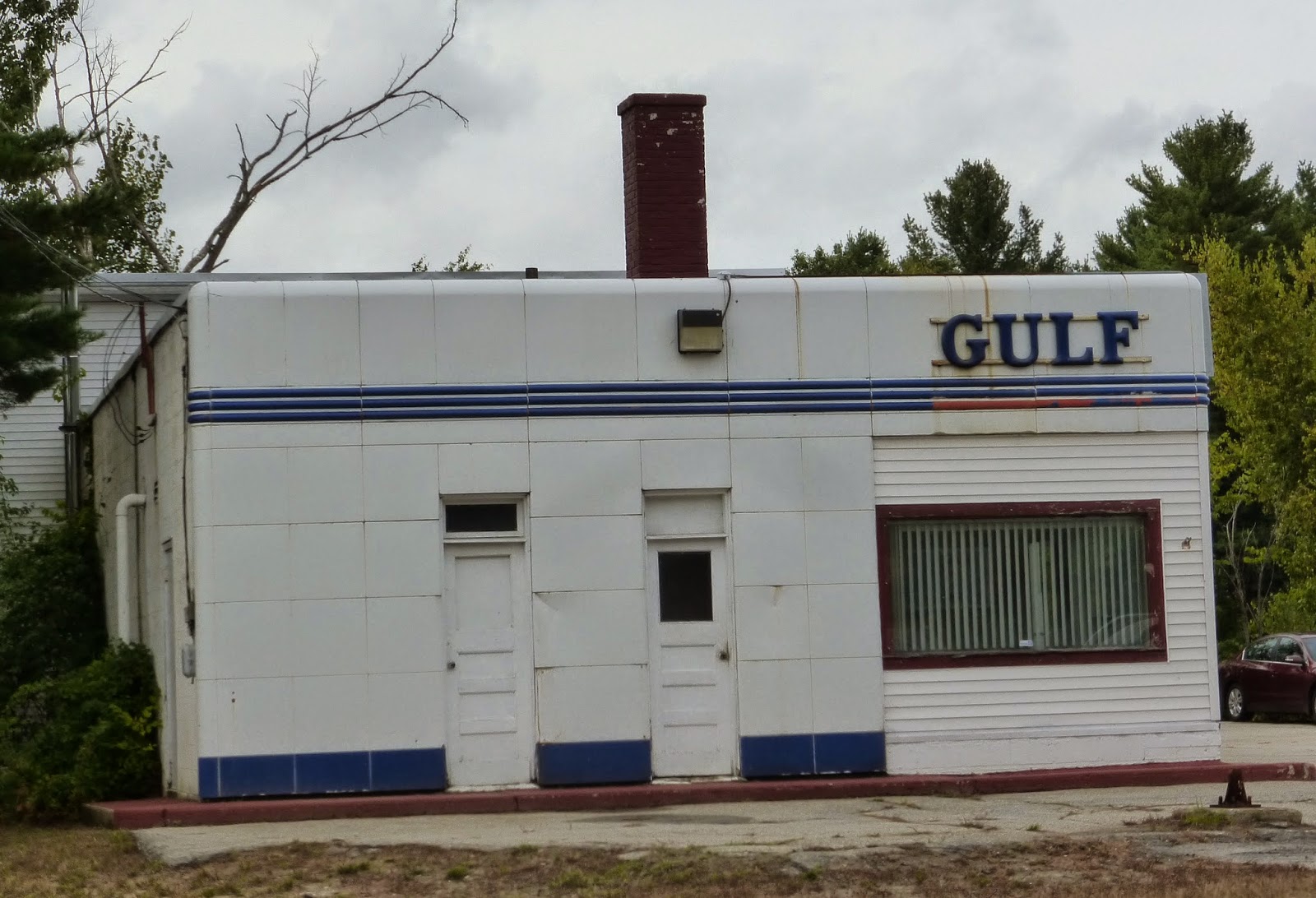
Old Gulf gas station, Route 28, Hooksett, New Hampshire

Eyesores or historical buildings?

This question has been posed in several of my "20th Century Americana" blog posts. It's my belief that since the recent past history is not treasured like the buildings of the 1600s and 1700s, we let some of these landmarks become eyesores.  The 1800s mill buildings of New England are left to decay, and their industrial history becomes a despised part of local lore.  Do we loathe these buildings because of the pollution and immigrant hardship associated with them? Or do we restore them to their former glory and celebrate the history of labor, technology, and the interesting architecture?

These empty buildings in Hooksett, New Hampshire can be seen along Route 3A and Route 28.  Both roads were busy north-south routes from Massachusetts to the great north woods and lakes regions before Interstate Highway 93 was built in the 1960s.  After the highway, some of these businesses languished and closed when the tourists no longer came through town, but drove around it without stopping.

Lately I've noticed that TV shows like "American Pickers" and PBS's "Antique Roadshow" have featured items from old gas stations and service stations.  Oil cans, signs, advertising art and automobile parts in their original boxes are selling for big money to collectors and to decorators.  I wonder if any of these collectors would like an original building to house their stuff?


This old Gulf gas station (also see above at the top of this post) has a porcelain enamel tile exterior and a curved front, which help establish it's date of origins to the 1940s or 1950s.  The National Park Service has a wonderful webpage HERE that describes how some of these old gas stations can be re-purposed for office space, coffee or ice cream shops, and small retail stores.


This old Quonset hut is next door to the old Gulf gas station.  I might have been used by the same business as a service bay or for storage.  Quonset huts have a legendary history from World War II, when they were used as quickly assembled pre-fabricated buildings. The first place of their manufacture was Quonset Point, Rhode Island.  According to Wikipedia, between 150,000 to 170,000 Quonset huts were manufactured and sent all around the globe to U.S. military installations to be used as housing, storage, administration buildings, latrines, hospitals and many other uses.  These corrugated galvanized steel buildings have been adapted to many other uses since World War II.  However, we are losing these structures at a fast pace as they are demolished for more modern buildings.


Old Texaco gas station, Route 3A, Hooksett, New Hampshire


For the truly curious:

Wikipedia - Quonset Huts
http://en.wikipedia.org/wiki/Quonset_hut

Preservation Brief 46 "The Preservation and Re-use of Historic Gas Stations"
http://www.nps.gov/tps/how-to-preserve/briefs/46-gas-stations.htm 

Texas Department of Transportation
PDF of "The Field Guide to Gas Stations in Texas"
includes how to examine old gas stations to determine their age and style
http://ftp.dot.state.tx.us/pub/txdot-info/env/toolkit/420-05-gui.pdf

A Flickr album of photographs of old gas stations, by "citizenkerr"
https://www.flickr.com/photos/citizenkerr/sets/72157623308569800/detail/?page=14

---------------------

To cite/link to this blog post:  Heather Wilkinson Rojo, "Hooksett, New Hampshire ~ 20th Century Americana", Nutfield Genealogy, posted October 9, 2014, ( http://nutfieldgenealogy.blogspot.com/2014/10/hooksett-new-hampshire-20th-century.html: accessed [access date]). 

Copyright (c) 2014, Heather Wilkinson Rojo

Wednesday, August 13, 2014

Weathervane Wednesday ~ An Old Familiar Sign

Weathervane Wednesday is an on-going series of photographs I post weekly.  I started by publishing weather vanes from the Londonderry area, but now I've been finding interesting weather vanes all across New England.  Sometimes my weather vanes are whimsical, or historical, but all are interesting. Often, my readers tip me off to some very unique and unusual weather vanes, too! Today's weather vane was spotted in West Boylston, Massachusetts.

Do you know the location of weather vane #169? Scroll down to the bottom to see the answer!


Today's weather vane was seen along Route 12 in West Boylston, Massachusetts.  It's a "blast from the past" for anyone who remembers the New England countryside dotted with Howard Johnson motels and restaurants.  This two dimensional scene of a child and a lamplighter was sometimes seen atop the orange roofs as a "Simple Simon met a Pie Man" scene from the nursery rhyme.

This orange roofed HoJo motel is now the Classic Suites and Inns.  They have kept the orange roofed building as a reception area, and kept the original weather vane.  It's a true piece of 20th Century Americana, dating back to the days when American first hit the road for vacations with their automobiles.  Most rest areas on the Massachusetts Turnpike and other major highways had Howard Johnson's restaurants in the mid 20th century.

An old Howard Johnson's postcard 
The first Howard Johnson restaurant was established in 1925 as a soda fountain in Quincy, Massachusetts.  During the 20th century the chain grew to over 1,000 restaurants, spurred on by the incredible post World War II boom in highways and automobile sales.  But in the 1970s a combination of events led to the chain being sold off- the gas crisis, the death of the original Howard Deering Johnson in 1972, fast food drive through chains like McDonalds, and the sale of the chain to Marriot in 1985 (who had no interest in the restaurants and closed them).  There are only two Howard Johnson's still operating in locations at  Bangor Maine and Lake Placid, New York.

There is a book about the history of this restaurant chain, with a photo of this weathervane on the cover!  A History of Howard Johnson's: How a Massachusetts Soda Fountain Became an American Icon by Anthony Mitchell Sammarco, The History Press, 2013 (also available on Kindle)

Click here to hear an interview with Anthony Sammarco about his book on Howard Johnson's from the Fieldstone Common website:
http://www.fieldstonecommon.com/history-howard-johnsons-anthony-sammarco/

Classic Suites and Inns website http://www.classicsuites-inns.com/

Click here to see the entire collection of Weathervane Wednesday posts!


--------------------

To cite/link to this blog post:  Heather Wilkinson Rojo, "Weathervane Wednesday ~ An Old Familiar Sign", Nutfield Genealogy, posted August 13, 2014, ( http://nutfieldgenealogy.blogspot.com/2014/08/weathervane-wednesday-old-familiar-sign.html: accessed [access date]).