Showing posts with label Quebec. Show all posts

Wednesday, July 17, 2024

Notre-Dame de Québec Basilica-Cathedral for Weathervane Wednesday

This weathervane was photographed in the Old Quebec City, Canada.


Last week I featured a weathercock above the Quebec City church Notre Dame des Victoires, and today I'm featuring another weathercock from Quebec City also from a church named Notre Dame.  This building is the basilica catheral of Notre Dame de Quebec.  This Roman Catholic church was originally built at the site of a chapel built by Samuel de Champlain in 1633. The tower with the weathercock was built in 1744, and you can see in the plans below, the weathercock was included.  

This church building was destroyed twice, first during the Siege of Quebec in 1759 during the French and Indian War, and then in 1922 it was destroyed by fire.  At first the Ku Klux Klan was blamed for the destruction, but the American thief Ray Marsden confessed to the crime, to cover his burglary. In 1874 it was the first church in North America to be elevated to a basilica.  It is the oldest parish in Canada and celebrated it's 350th anniversary in 2014.  Quebec's first bishop, Francois de Laval, is buried in the crypt. 

The weathercock is an important Christian symbol, often found on Roman Catholic churches.  This one is particularly fancy and detailed, in three dimensions with an elaborate cross.  


These are the plans for the cathedral from 1744, used to reconstruct the church in 1759.
The weathercock was included in the original plans.

By Gaspard-Joseph Chaussegros de Léry - Élévation de la basilique de Québec, Chaussegros de Léry, 1744, BAC, FR CAOM 3DFC 424A. - facebook.com, Public Domain, https://commons.wikimedia.org/w/index.php?curid=45830176

For the truly curious:

Cathedral Basilica of Notre Dame de Quebec at Wikipedia -  https://en.wikipedia.org/wiki/Cathedral-Basilica_of_Notre-Dame_de_Qu%C3%A9bec   

The parish website for Notre Dame de Quebec  -  https://www.notre-dame-de-quebec.org/copie-de-basilique-cathedrale   

Click here to read over 500 more Weathervane Wednesday posts:

----------------------------------------

To cite/link to this blog post: Heather Wilkinson Rojo, "Notre-Dame de Québec Basilica-Cathedral for Weathervane Wednesday", Nutfield Genealogy, posted July 17, 2024, ( https://nutfieldgenealogy.blogspot.com/2024/07/notre-dame-de-quebec-basilica-cathedral.html: accessed [access date]). 

Wednesday, June 26, 2024

The Chateau Frontenac Hotel in Quebec City for Weathervane Wednesday

 This weathervane was photographed in Old Quebec City, Canada. 


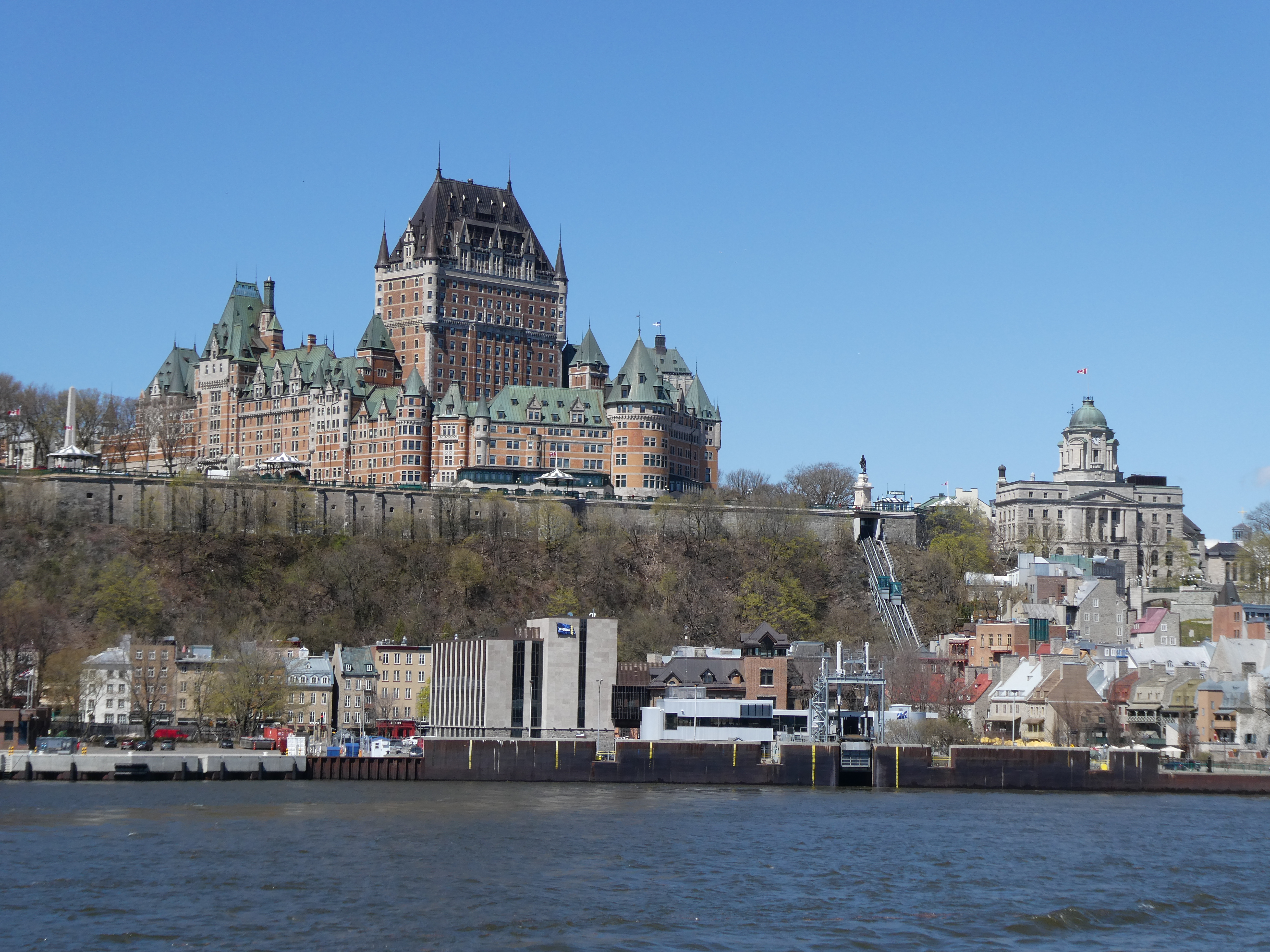
A view of the Chateau Frontenac
from the ferry across the St. Lawrence River to Levis

In May we drove to Quebec City and stayed at the Chateau Frontenac hotel, recreating our honeymoon 40 years ago.  This massive hotel has 610 guest rooms, 18 floors, and many towers and turrets.  Even though it resembles a castle with many towers, this is the only weathervane I could see on the hotel.  The weathervane resembles a banner, which is appropriate for the castle theming.  The very first weathervanes are considered to be banners flying on buildings like castles and forts. 

The Chateau Frontenac sits above the Terrasse Dufferin overlooking the Saint Lawrence River.  It is considered to be the most photographed hotel in the world. It was designated as a National Historic Site of Canada in 1981.  It has been featured in movies, including the Alfred Hitchcock film I Confess. Many celebrities and political figures have stayed here, such as FDR, Sir Winston Churchill, Celine Dion, Queen Elizabeth II, and many Canadian prime ministers.  

For the truly curious: 

Chateau Frontenac at Wikipedia:    https://en.wikipedia.org/wiki/Ch%C3%A2teau_Frontenac  

Fairmont Chateau Frontenac website   https://www.fairmont.com/frontenac-quebec/   

Click here to see over 500 more Weathervane Wednesday posts:   https://nutfieldgenealogy.blogspot.com/search/label/Weathervane%20Wednesday  

-------------------------

To cite/link to this blog post:  Heather Wilkinson Rojo, "The Chateau Frontenac Hotel in Quebec City for Weathervane Wednesday", Nutfield Genealogy, posted June 26, 2024, ( https://nutfieldgenealogy.blogspot.com/2024/06/the-chateau-frontenac-hotel-in-quebec.html: accessed [access date]). 

Wednesday, June 19, 2024

Chalmers Wesley United Church in Quebec City for Weathervane Wednesday

 This weathervane was photographed in Quebec City, Canada.


The Chalmers Wesley United Church is located on 78 Rue Sainte-Ursule, in Old Quebec City, Canada.  It is between Porte Saint Louis and the citadel.  This protestant, English language church was built between 1851 and 1853, and in 1925 became part of the United Church of Canada. 

Like most protestant churches, their weathervane is very simple.  It is a an arrow with no cardinal points. It was very difficult to photograph the church because of the narrow streets, but we did get some nice photos of the weathervane from many blocks away.  Most of the Roman Catholic churches in Quebec City featured weathercocks or more elaborate weathervanes. Click HERE to see the weathercock from Notre Dame des Victoires in Quebec, my June 12th Weathervane Wednesday subject.  


For the truly curious:

The website for Chalmers Wesley United -  https://chalmerswesley.org/   

The Facebook group for the Chalmers Wesley United Church    https://www.facebook.com/groups/chalmer 

To see over 500 more Weathervane Wednesday posts, click here:   https://nutfieldgenealogy.blogspot.com/search/label/Weathervane%20Wednesday  

--------------------

To cite/link to this blog post:  Heather Wilkinson Rojo, "Chalmers Wesley United Methodist Church in Quebec City for Weathervane Wednesday", Nutfield Genealogy, posted June 19, 2024, ( https://nutfieldgenealogy.blogspot.com/2024/06/chalmers-wesley-united-methodist-church.html: accessed [access date]).

Wednesday, June 12, 2024

Notre Dame des Victoires, Quebec City for Weathervane Wednesday

 Today's weathercock was photographed in Quebec City, Canada.


The narrow streets and tiny square, Place Royale, in front of the Notre Dame des Victoires church in Lower Quebec City made this weathercock very difficult to photograph!  I had first visited this church during our honeymoon in Quebec over 40 years ago.  But now the church is closed except on Sundays and special days for mass only.  We could not visit the inside of this historic church when we were there in May this year.

This church is very old, and it was erected between 1687 and 1723.  According to Wikipedia "The church is one of the oldest in North America."  In September 1759 the church was bombarded by the British before the Battle of the Plains of Abraham.  It was restored and reopened in 1816. There is a model of a ship hanging from the ceiling of the church - it is a model of the Brézé which was commanded by the Marquis of Tracy. 

The weathervane above the steeple is a three dimensional weathercock above a pointer and some very fancy cardinal points marking the directions in French. The weathercock is a very common weathervane for Roman Catholic churches.  Weathercocks are weathervanes with roosters. There was a papal edict in medieval times that cockerels should be displayed on each church in memory of Peter's betrayal of Jesus "I tell thee, Peter, the cock shall not crow this day, before that thou shalt thrice deny that thou knowest me." Luke 22:34.  Many of the cocks or roosters ended up on top of steeples as weathervanes.


We took this interior photo in 1983
on our honeymoon in Quebec City

For the truly curious:

Notre Dame des Victoires at Wikipedia:    https://en.wikipedia.org/wiki/Notre-Dame-des-Victoires_Church  

The parish of Notre Dame des Victoires:  https://www.notre-dame-de-quebec.org/notre-dame-des-victoires-church  

Click here to see over 500 more Weathervane Wednesday posts:  https://nutfieldgenealogy.blogspot.com/search/label/Weathervane%20Wednesday   

-----------------------

To cite/link to this blog post:  Heather Wilkinson Rojo, "Notre Dame des Victoires, Quebec City for Weathervane Wednesday", Nutfield Genealogy, posted June 12, 2024, ( https://nutfieldgenealogy.blogspot.com/2024/06/notre-dame-des-victoires-quebec-city.html:  accessed [access date]). 

Thursday, February 7, 2019

Throwback Thursday ~ Honeymoon in Quebec City 1983

This is part two of a blog post I posted two weeks ago about scanning the photo slides of our honeymoon trip in 1983.  We hadn't looked at these slides in many years, and they are yellowing and deteriorating.  It's a good thing we are digitizing them before they disintegrate! You can see part one at this link:
https://nutfieldgenealogy.blogspot.com/2019/01/throwback-thursday-honeymoon-in-vermont.html

After an overnight at the Hanover Inn in Vermont, we drove on to Quebec City.  These are the only photos we have of our honeymoon trip, and you can see that they have faded and yellowed in just 35 years.

We stayed in a tower room of the Chateau Frontenac.
I remember the room was round and overlooked the boardwalk

Yours truly on the boardwalk "Terrasse Dufferin"

At the changing of the guard,
the mascot was a goat

Changing of the guard at the Citadelle


Yes, it rained on our wedding, and on our honeymoon.
This is the Jeanne D'Arc (Joan of Arc) garden in Quebec.

Vincent on the walls of Quebec City

-------------------------------

Heather Wilkinson Rojo, "Throwback Thursday ~ Honeymoon in Quebec City 1983", Nutfield Genealogy, posted February 7, 2019, ( https://nutfieldgenealogy.blogspot.com/2019/02/throwback-thursday-honeymoon-in-quebec.html: accessed [access date]). 

Monday, May 18, 2015

Cochecho Massacre, 27 June 1689, Dover, New Hampshire


The Damm Garrison House in Dover, New Hampshire
is located inside this pavilion at the Woodman Institute

This map is located inside the Damm Garrison at the Woodman Institute in Dover, New Hampshire
It explains the events of Cochecho Massacre, and maps out the locations of the garrisons

The first recorded captives carried to Quebec, Canada to be sold to settlers and native Indians occurred at the Raid on Dover, also known as the Cochecho Massacre, in Dover, New Hampshire on 27 June 1689.  This makes this raid very interesting to genealogists, since some of the women and children who were taken north converted to the Catholic religion.  These same English people later married French spouses and left descendants in Canada.  Some of the captives were redeemed and came home, and some of the redeemed refused to return because they preferred life in Canada!

At the beginning of King William’s War (1688- 1697) there were many raids on New England settlements by the French, and the English raided French villages in Penobscot Bay and Chedabouctou (Guysborough, Nova Scotia).   In June 1689 several hundred Abenaki and Pennacook Indians raided Dover and killed more than 20 and took 29 captives.  This was one quarter of the Dover population. The raid was quite a blow to the English settlements in New Hampshire.

The Dover Raid was revenge on Major Richard Waldron who had  tricked and captured many Abenaki and Wampanoag in 1676 during King Phillip’s War.  These Indians he captured were taken to Boston where some were executed and some were sold into slavery in the Caribbean.  Twelve years later the Abenaki retaliated with the help of the French in Canada.


Waldron's garrison was attacked with a vengeance.  The Major was singled out for a particularly horrendous torture and execution.  His nose and ears were removed and stuffed in his throat.  Each Indian slashed his chest, and he was forced to fall on his own sword.  Waldron had been well known as a cheat at trade with the Indians and he had been a particularly cruel leader to the English settlers (especially to Quakers).  You can read more about Waldron at this blog post:

There were five garrison houses in town at Dover, and others in outlying areas.  Five Indian women came into town and asked to shelter at the garrisons, one at each.  In the middle of the night, each woman opened the gates of the garrison to the attackers.  The rest was history…

According to the book New England Captives Carried to Canada, pages 142 -  these are some of  the identified captives, all traced to French records in Quebec:

John Church (sometimes misspelled Chase)
John Evans
Sarah Gerrish,  7 year old granddaughter of Major Waldron,
Mrs. Elizabeth Hanson, wife of Tobias
----- Heard “a young woman of Cochecho”
Esther Lee, daughter of Richard Waldron, along with her child
Grizel Otis, wife of Richard, daughter of James Warren
Margaret Otis, rebaptized Christine in Quebec
Rose Otis
John Otis
Stephen (rebaptized Joseph Marie)
Nathaniel (rebaptized Paul), son of Stephen Otis and Mary Pitman
Joseph Buss
William Buss

Here is a list of some members of my family tree who were victims of the Cochecho Massacre:

I'm forced to admit that I'm closely related to Major Richard Waldron (1615 – 1689).  He was married to my 9th great aunt, Ann Scammon.  I descend from Ann’s sister, Elizabeth (about 1625 – abut 1680) who married Thomas Atkins.   Major Waldron, as I described above, was killed, along with most of his family, and his garrison was burned to the ground, along with his grist mills and trading post.

I'm proud to tell you about Elizabeth Hull Heard (about 1628 – 1706),  my 8th great grandmother.  According to stories in Cotton Mather’s Magnalia Christi Americana and Belknap’s History of New Hampshire and other books, she was a witness to Waldron’s deceit in 1676, and sheltered a young native Abenaki boy from death.   On the night of the Cochecho Massacre she was hiding In the woods when an Indian pointed his weapon at her, but suddenly spared her life and ran away.  The Heard garrison house was one of the few homes that were successfully defended that night by William Wentworth because Elizabeth's husband had died a few months before the attack.  It is suggested that the Indian who spared her life was the young Abenaki boy in 1675.   Elizabeth's children survived, too, including her daughter Mary (1650 - 1706), my 7th great grandmother, and her husband John Ham and children. 

[You can see that I am related to both the villain and the heroine of this massacre]

For more information:

New England Captives Carried to Canada Between 1677 and 1760 During the French and Indian Wars, by Emma Lewis Coleman, published in 1925, reprinted by the New England Historic Genealogical Society, 2012.

From the Dover, New Hampshire Public Library website

An online article from Portsmouth, New Hampshire historian J. Dennis Robinson

Magnalia Christi Americana, or "The Ecclesiastical History of New-England, from its First Planting in the year 1620 Unto the Year of Our Lord, 1698", Cotton Mather, in seven books (reprint), New Haven, CT,1820

The Hull Family in America, Compiled by Col. Weggant, Hull Family Association 

"A Genealogical Memoir of the Family of Richard Otis" -- 1851 -- by Horatio N. Otis. NEHGR for July 1848 & April 1850 has the Genealogy of the Otis Family Descending from John Otis, who immigrated to New England & settled in Hingham, Mass. about 1635.

Click here for blog post about the DAMM family garrison, which survived the Cochecho massacre in 1689.  The DAMM garrison was built in 1675, and is the oldest surviving garrison house still standing in New Hampshire. 

UPDATE -  3 June 2015
Roger W. Lawrence has written a new book "English Captives and Prisoners Remaining in New France" (for those with ancestors who were carried to Canada from New England in the colonial period). You can pre-order this book from the American Canadian Genealogical Society at this link www.acgs.org 


-----------------------------------

To cite/link to this blog post: Heather Wilkinson Rojo, "Cochecho Massacre, 27 June 1689, Dover, New Hampshire", Nutfield Genealogy, posted May 18, 2015, (http://nutfieldgenealogy.blogspot.com/2015/05/cochecho-massacre-27-june-1689-dover.html: accessed [access date]). 

Friday, April 20, 2012

Friday Funny ~ A Garden Fountain

1983
A fountain at the Jeanne d'Arc Garden in Quebec City
We were on our honeymoon
Notice the statue of Joan of Arc in the back of both of these photographs?

1994
Our daughter at the same fountain
We were in Quebec for the 225th Anniversary
of the Battle on the Plains of Abraham

----------------------
Copyright 2012, Heather Wilkinson Rojo

Friday, April 13, 2012

Friday Funny ~ Watch out!

1983, Quebec City

This is my husband, sticking his head into a cannon on the walls of Quebec City overlooking the St. Lawrence River.  We were on our honeymoon at the Chateau Frontenac in 1983.  I think he would still do this today if he had a chance!

1994, Quebec City
Our daughter in 1994, on another cannon overlooking the St. Lawrence River in Quebec, with the Chateau Frontenac in the background.  I think it runs in the family!  

-------------------------
Copyright 2012, Heather Wilkinson Rojo

Wednesday, October 20, 2010

Not so Wordless Wednesday - Hebridean Scots in Quebec

The Six MacDermid Sisters of Marsboro, Quebec
photographed in Massachusetts in the 1920s
My grandmother's brother, Uncle Horace Warren Roberts, married Katherine Bella MacDermid on 23 June 1920 in Beverly, Massachusetts. My grandmother's family had only arrived in America from Leeds, Yorkshire in 1915, and this must have been a jolly wedding. Great Aunt Katie was well loved, and just mentioning her name to my family brings lots of comments about what a nice, wonderful person she had been. My earliest memory of her was her wonderful Scots accent, and how much I wanted to name my daughter Katie!

The MacDermid/MacDearmid family had originated in Scotland, and the first to arrive in the New World was Auntie Katie's great grandfather Donald MacDearmid. He made his new home in Marsboro, Frontenac County, Quebec, which was a very Hebridean Scots settlement. Most of the original settlers came from the Isle of Lewis. They were unprepared for the harsh life in Quebec, and within a few generations most of the Hebridean settlers had removed to New England or Montreal for a better life. But for a few generations they kept their culture, language, and music alive in Marsboro.

Generation 1. Donald MacDearmid, born about 1802 in Grimsay (Griomasaigh), North Uist, Scotland; married Marion Smith, Born aoubt 1811 in Tarbert, Isle of Harris, Scotland. Five children. He arrived in Quebec about 1865.

Generation 2. Neil MacDearmid, born about 1838 in North Uist, died 17 January 1903 in Marsboro; married Catherine MacDonald. Five children.

Generation 3. Charles Colt MacDearmid, born 19 November 1863 in Scotland, died 30 August 1939 in Marsboro; married in Marsboro on 30 May 1894 to Mary Ross, born 8 February 1873 at Geocrab, Isle of Harris, Scotland. Eleven children, including the six daughters in the photograph above, all born in Marsboro:

1. John MacDermid, born 17 March 1895; married Mary Morrison
2. Katherine Bella MacDermid, born 23 March 1896, died 30 December 1978 in Beverly, Massachusetts; married Horace Warren Roberts (my great aunt and uncle)
3. Neil MacDermid, born 30 January 1898, died 18 May 1904 in Marsboro
4. Mary MacDermid, born 10 July 1900, died January 1900 in Beverly; married Alexander D. Stewart
5. Marion MacDermid, born 4 August 1902, died 28 December 1980 in Salem, Massachusetts; married Louis V. Maglio.
6. Neil A. MacDermid, born 19 June 1904, died 11 December 1974 in Brookline, Massachusetts; married Jeanette (maiden name unknown)
7. Annabelle MacDermid, born 28 July 1906, died 7 September 1999; married Bertram A. Russell*
8. Dolena MacDermid, born 20 December 1908, married Crosby Gray Grant
9. Annie MacDermid, born 21 January 1911, died 1 January 1997 in Beverly, married Walter Akerson
10. Samuel MacDermid, born 9 June 1913, died 18 March 1999 in Beverly; married Alice M. Pitman
11. Alexander C. MacDermid, born 9 August 1915, died 13 November 1992; married Mary K. Baginski

*Auntie Katie (MacDermid) Roberts is my father's aunt. Bertram A. Russell and Annabelle MacDermid had a son, Bertram A. Russell, Jr. who married Priscilla Allen, my mother's first cousin!

For more information:

Oatmeal and the Catechism: Scottish Gaelic Settlers in Quebec, by Margaret Bennett, Birlinn Ltd, Edinborough, Scotland, 2003 (available to view in its entirety on Google Books)

http://hebridscots.com/contents.htm The website for the Hebridean Scots of the Province of Quebec (history and genealogy- including a large database of people from the years 1800-1910)

http://www.interment.net/data/canada/qc/frontenac/echo/index.htm The Echo Vale Cemetery in Marsboro, with a listing of the Scots settlers buried there. Many MacDermid/MacDearmid internments.

--------------------
Copyright 2010, Heather Wilkinson Rojo