Showing posts with label French and Indian War. Show all posts

Monday, April 12, 2021

General John Stark Day, 12 April 2021


Stark Day ceremonies at the Stark family gravesite
at Stark Park in Manchester, New Hampshire 2016

John Stark Day, honoring our beloved New Hampshire Revolutionary War hero, was celebrated formerly on the fourth Monday in April by state statute.  However, in 2017 the students at the Founders Academy Public Charter School in Manchester lobbied for changing John Stark Day to be held on the second Monday in April, a school day instead of in the middle of school vacation.  New Hampshire Governor Chris Sununu signed bill HB91 into law on 13 April 2017.  According to the new statute “The governor shall annually proclaim the second Monday in April as General John Stark Day in Commemoration of General Stark’s gallant and illustrious service to New Hampshire and his country.  Schools are encouraged to commemorate the day with appropriate educational activities.”  [See statute 4:13-1 General John Stark Day  http://www.gencourt.state.nh.us/rsa/html/i/4/4-13-l.htm ]  

Manchester traditionally honors General John Stark with a ceremony at the Stark Park, usually performed in Revolutionary era garb by DAR and SAR members, and then the group moves on to Dunbarton to gather at the Caleb Stark statue (son of General Stark) for a second ceremony.   I’ve tried to be at as many of these ceremonies as possible since moving to Manchester in 2014.  Last year, there was no ceremony, and this year there will be a “virtual ceremony” hosted by the Founders Academy (see the link below).

John Stark was born in Londonderry (now Derry) to his parents Archibald Stark and Eleanor Nichols.  Archibald was born in Glasgow, Scotland in 1697, and grew up in Londonderry, Northern Ireland with his family.  He married Eleanor, whose father was also Scottish.  They came to Nutfield, New Hampshire (now Londonderry, Derry and Windham) and their children died on the voyage, which was plagued with small pox.  More children were born in New Hampshire, and they eventually settled in Derryfield, which is now the city of Manchester.  Three Stark brothers – William, John, and Archibald all served under the British during the French and Indian War.

John Stark was born on 28 August 1728, and married Elizabeth “Molly” Page on 20 August 1758 in Dunbarton, New Hampshire.  They had eleven children.  He lived 94 years and died on 8 May 1822 in Derryfield (Manchester). 

Major Caleb Stark (son of General Stark)
statue in Dunbarton, New Hampshire

For the truly curious:

John Stark Day information from the Founders Academy:  http://www.thefoundersacademy.org/giving/john_stark_day 

From the Cow Hampshire blog “The Many Faces of General John Stark of Manchester, New Hampshire” by Janice Webster Brown: https://www.cowhampshireblog.com/2017/04/01/the-many-faces-of-general-john-stark-of-manchester-new-hampshire/

Click here to see the 2018 Proclamation by Gov. Sununu for John Stark Day:  http://www.gencourt.state.nh.us/rsa/html/i/4/4-13-l.htm  

The website for Stark Park in Manchester, New Hampshire:   http://www.starkpark.com/ 

Other Nutfield Genealogy blog posts about General John Stark: 

The General John Stark House in Manchester, NH:  https://nutfieldgenealogy.blogspot.com/2016/04/the-general-john-stark-house-manchester.html  

The Stark Family Plot:   https://nutfieldgenealogy.blogspot.com/2015/04/tombstone-tuesday-stark-family-plot.html   

General John Stark (including more genealogy information):   https://nutfieldgenealogy.blogspot.com/2010/06/general-john-stark-live-free-or-die.html   

The Stark Homestead Site:  https://nutfieldgenealogy.blogspot.com/2019/06/the-stark-homestead-site-manchester-new.html  

Images of John Stark Day ceremonies 2016:   https://nutfieldgenealogy.blogspot.com/2016/04/john-stark-day-manchester-new-hampshire.html  

Autumn Visit to Dunbarton, New Hampshire (the Caleb Stark statue and the Molly Stark House):   https://nutfieldgenealogy.blogspot.com/2014/10/an-autumn-visit-to-dunbarton-new.html   

-------------------------

To Cite/Link to this post:  Heather Wilkinson Rojo, "General John Stark Day, 12 April 2021", Nutfield Genealogy, posted April 12, 2021 ( https://nutfieldgenealogy.blogspot.com/2021/04/general-john-stark-day-12-april-2021.html: accessed [access date]). 

Tuesday, July 7, 2020

Hannah (Choate) Burnham, died 1805, Dunbarton, New Hampshire

It's Tombstone Tuesday!  This tombstone was photographed at the Center Cemetery in Dunbarton, New Hampshire.


Mrs. Hannah Burnham
died March 1805
AEtat. 81
Relict of Lieut. Nathan Burnham
of Ipswich (Massachusetts)
who fell at the defeat of the British Army
at Ticonderoga, A.D. 1758

The name BURNHAM caught my eye as I wandered through this cemetery recently, and then I saw that this family was from Ipswich.  I have eight BURNHAM lineages from the original Burnham brothers who settled in Ipswich during the great migration!  I knew that this was a cousin connection!

From The History of Dunbarton, by Caleb Stark, page 234 to page 237, "From an examination of several papers now in the possession of John Burnham, Esq., of this town, we infer that his great-grandfather, Nathan Burnham, was an independent husbandman, a man of intelligence and capacity, who possessed the confidence of his fellow-citizens, as also that of the provincial government.  By the former he was intrusted with the management of important transactions, and by the latter appointed to a military office, upon equal rank with officers of the same grade in the line of the English army.  His wife was Hannah Choate of Ipswich.
     On the thirteenth day of March 1758 he was commissioned by Governor Pownell first lieutenant of a company of foot, commanded by Captain Stephen Whipple, in the regiment of Col. Stephen Bagley, which constituted a portion of the force furnished by Massachusetts for the expedition against Canada.  Lieutenants Burnham and Low, of the same company, fell in the fatal attack upon Ticonderoga, July 8, 1758, where an army of sixteen thousand British and Provincial troops were shamefully repulsed by one fourth of their number of French and Indians, through the incapacity of their general. Sixteen hundred and eight regulars and three hundred and thirty four provincials, killed and wounded, was a cruel penalty for General Abercrombie's rash attempt to carry by assault a strong position, without bringing up his artillery, of which he had a good supply. 
      Among the papers in Mr. John Burnham's possession are Governor Pownell's proclamation calling for volunteers from the provincial regiments, Lieut. Burnham's commission, beating orders, forms of enlistment, orders to muster, words of command for the musket drill, order for the march, power-of-attorney to Lieut. B.'s wife to manage affairs during his absence on duty, a kind letter to her while on the march, and lastly, the letter of a friendly comrade from the battle-field, narrating the melancholy fate of her dearest friend - a fate which it has been the sad fortune of widows to hear since the time when man became the murderer of his brother man."

----------------

Hadley, June 7, 1758
To My Dearly Beloved Wife:
I hope through Divine goodness, you are in health, as I am at this time, and I pray God be with you, and preserve you and our dear children from all evil.  My duty to mother Choate.  My love to all my friends. We came into town last Sabbath day, about two o'clock, and billeted the company at private houses, and we are very kindly entertained at the widow Porter's.  Her husband was a member of the General Court about thirty years.  Yesterday the Captain, I, and Lieut. Low, went over Connecticut river to Northampton, to see about the affair, and returned at night. We expect to go over to Northampton to-morrow, to make seven days' provisions, to march near to Albany.
I remain your loving husband,
Nathan Burnham
PS - I should be glad to hear from you.  I have had blisters on one foot, but they are better. Col. Bagley came to town yesterday. Col. Dooty's regiment is coming in, and it supposed both regiments are to march together.  We have twelve of our own guns, and had twenty-two at Worcester, and other companies are much so.  It is supposed there is no great danger. The arms are at Albany.

.... Mrs. Burnham:  I send you these lines to let you know the heavy news that you have to hear from the camp, and I pray God give you grace and strength to hold up under such heavy tidings.  The truth is, your husband, our lieutenant, Nathan Burnham, Being in the fight at the narrows of Ticonderoga, July the 8th, 1758, received a ball in the bowels, which proved mortal. He came to me and told me that he was wounded, and that he should soon be in eternity.  I desired him to retreat down the hill.  I followed him,and found some help to carry him off the ground, namely, James Andrews, John Foster, and Jeremiah Burnham.  We carried him that night four miles to our boats.  The doctor did what he could, but vain was the help of man.  Next Day, being the ninth day upon our passage upon the lake, about eleven o'clock, after many heavenly expressions and prayers, he departed this life, and I believe, made a good exchange.  Please tell Mrs. Low the same heavy news.  Stephen Low, being in the same fight, was, without doubt, shot dead on the spot.  We had not the opportunity to bring off our dead.
Nehemiah Burnham" 

------------------------

Genealogy information:

Lieutenant Nathan Burnham, who died at Fort Ticonderoga, is my 7th great uncle.  I descend from his brother Stephen Burnham, born about 1715 in Ipswich and died 1790 in Milford, New Hampshire.      Nathan Burnham, Jr. was with his father's unit as a waterboy, and was about 11 years old.  He was with his father when he was killed. According to the published Burnham Genealogy book by Roderick H. Burnham, 1879 "Tradition has it that before leaving for the war he took his sword on his hand to try the metal and it broke.  Turning to his wife he said "I shall never come back".  He went on but returned to pray with is family before taking final leave.

Hannah was the daughter of Samuel Choate and Mary Brown.  She was born in Ipswich about 1727 and died 1 March 1805 in Dunbarton, where she is buried. Hannah Choate is my first cousin 10 generations removed.  Her great grandfather, John Choate (born about 1624 and died 4 December 1695 in Ipswich) is my 9th great grandfather.  

For the truly curious:

A blog post about Fort Ticonderoga:

My Surname Saturday blog post about the Burnham family:

My Surname Saturday blog post about the Choate family:


-------------------------------------

Cite/Link to this post:  Heather Wilkinson Rojo, "Hannah (Choate) Burnham, died 1805, Dunbarton, New Hampshire", Nutfield Genealogy, posted July 7, 2020, ( https://nutfieldgenealogy.blogspot.com/2020/07/hannah-choate-burnham-died-1805.html: accessed [access date]).

Tuesday, August 14, 2018

Tombstone Tuesday ~ Samuel Rogers, died 1802, Bow, New Hampshire

This Tombstone was photographed at the East Dunbarton Cemetery, in Dunbarton, New Hampshire.


SAMUEL ROGERS
one of the first
settlers of Bow, N.H.
DIED
March 17, 1802
AE. 77


Samuel Rogers was the brother of Major Robert Rogers (1731 – 1795), the famous Ranger of the French and Indian War.  He was the son of James Rogers (1706 – 1753) and Mary MacPartridge ( 1705 – 1763).  Samuel Rogers was born in 1725 in Ireland and died 17 March 1802 in Bow, New Hampshire. 

He married Anna Caldwell, daughter of Charles Caldwell and Anna Ruggles about 1750.  She was born 28 February 1729 in Goffstown, New Hampshire, and died on 25 Aril 1800.  They had two children:  William born in 1750, and Betsy, born in 1756.

For more information see the book 100 Acres or Less: The History of the Land and People of Bow, New Hampshire,  by David A. Bundy, 1975, or the book Memoir and Official Correspondence of General John Stark, by Caleb Stark. 

---------------------

Heather Wilkinson Rojo, "Tombstone Tuesday ~ Samuel Rogers, died 1802, Bow, New Hampshire", Nutfield Genealogy, posted August 14, 2018, (  https://nutfieldgenealogy.blogspot.com/2018/08/tombstone-tuesday-samuel-rogers-died.html: accessed [access date]). 

Saturday, August 20, 2016

Surname Saturday ~ SAWTELL of Watertown and Groton, Massachusetts


SAWTELL  SARTELL  SATELLE  SATELL  SATLE

There are several good sources of information on the SATELL family of New England.  The first is an article in the NEHGS Register “Richard Sawtell of Watertown, MA”, Volume 126 (1972), pages 3 – 17. One of the authors of this early article was John Brooks Threlfall who wrote a book Fifty Great Migration Colonists to New England and Their Origins in 2008 which updated a lot of the information on the SATELL family. 

Richard Sawtell, my 10th great grandfather, was baptized on April 7, 1611 at Aller, Somerset, England, the son of John Sawtell and Agnes Pittard.  There are many records in Somersetshire of the SAWTELL family.

The first record of Richard Sawtell in New England was on July 25, 1636 on the list of proprietors of Watertown, Massachusetts when he received Lot 8 in the 4th division as a single man.  His brother, Thomas Sawtell, was made a freeman in Boston in 1649, where he died childless in 1651 and named his brother Richard and a sister Ann Kendrick of Muddy River (Suffolk County Probate #111).

Richard Sawtell removed from Watertown to the new settlement of Groton in 1655, where he again received a large grant of land as one of the first, original proprietors.  He was made the first town clerk, and the records show that he was highly educated.  Richard’s homestead was one of five garrison houses in Groton.   There were several raids and massacres in Groton during King Philip’s War, so the family removed back to Watertown.   Two of his sons went back to resettle the town of Groton.  He was chosen to be a selectman in Watertown in 1689.

Richard Sawtell adopted the illegitimate son of Zechariah Smith in 1670.  In 1672 he sued Thomas, John and Joseph Smith for the child’s estate.  They were charged with illegally administering the estate.

In his will, dated May 16, 1692, Richard Sawtell left his lands in Groton and Watertown to his wife, with instructions to his son Obadiah to work the land in Groton, and instructions to his son Enoch to work the land in Watertown. 
Richard Sawtell is the ancestor of presidents Herbert Hoover and Richard Nixon.

My SATELL genealogy:

Generation 1:  Richard Sawtell,  son of John Sawtell and Agnes Pittard, was baptized on 4 April 1611 in Aller, Somersetshire, England, died on 21 August 1694 in Watertown, Massachusetts; married first on 5 February 1627 in High Ham, Somersetshire to Elizabeth Pople, daughter of William Pople.  Married second in 1637 to Elizabeth Waite, daughter of Phineas Waite and Mary Hubbard.  Eleven children with Elizabeth Waite, all born in Watertown.

Generation 2:  Hannah Satell, born on 10 December 1642 in Watertown, died 18 February  1723 in Woburn, Massachusetts; married on 13 July 1665 in Woburn to Increase Winn, son of Edward Winn and Joanna Unknown.  He was born 5 December 1641 in Woburn and died 14 December 1690 in Woburn.  Nine children.

Generation 3: Mary Winn m. Nathaniel Wyman
Generation 4: Increase Wyman m. Deborah Pierce
Generation 5: Increase Wyman m. Catherine Unknown
Generation 6: Jemima Wyman m. Colonel Joshua Burnham
Generation 7: Jemima Burnham m. Romanus Emerson
Generation 8: George Emerson m. Mary Esther Younger
Generation 9: Mary Katharine Emerson m. George E. Batchelder
Generation 10: Carrie Maude Batchelder m. Joseph Elmer Allen
Generation 11: Stanley Elmer Allen m. Gertrude Matilda Hitchings (my grandparents)

----------------------------------------------


Heather Wilkinson Rojo, "Surname Saturday ~ SAWTELL of Watertown and Groton, Massachusetts", Nutfield Genealogy, posted August 20, 2016, (http://nutfieldgenealogy.blogspot.com/2016/08/surname-saturday-sawtell-of-watertown.html:  accessed [access date]). 

Tuesday, August 16, 2016

Tombstone Tuesday ~ John and Mary (Hogg) Stinson, buried in Derry, New Hampshire

This tombstone was photographed at the Forest Hill Cemetery in Derry, New Hampshire.


MEMENTO MORI
ERECTED                       LIKEWISE
In Memory of                 In memory of
  Mr. John Stinson            Mrs. Mary Stinson
who departed                  relict of     
          this Life                   Mr. John Stinson
Febry ye 6th AD        who died Octr.
1785                        4th 1793
      In the 89th                  In the 90th year
Year of his                   of her age
age                                 

John Stinson was born about 1695 and died 5 February 1785 in Londonderry, New Hampshire.  He immigrated to Portsmouth in 1727 and married Mary Hogg.  She was born about 1703 and died 4 October 1793.  Mary Stinson was enumerated in the first federal census in 1790 in Londonderry.

John and Mary Stinson had ten children.  Several sons went on to settle in Starkstown (now Dunbarton, New Hampshire).   Another son, David, was killed by the Indians when captured along with the Stark brothers (John and William) on 28 April 1752 along the Pemigewasset River in Northern New Hampshire.  One of the Stinson daughters, Mary, married Captain William Stark.  Another daughter, Betsey (Jane),  married Stephen Holland, the British Spy around 1751.  You can read all about this Loyalist spy at this link:  


---------------------------

Heather Wilkinson Rojo, "Tombstone Tuesday ~ John and Mary (Hogg) Stinson, buried in Derry, New Hampshire", Nutfield Genealogy, posted August 16, 2016, (   http://nutfieldgenealogy.blogspot.com/2016/08/tombstone-tuesday-john-and-mary-hogg.html:  accessed [access date]).

Friday, June 12, 2015

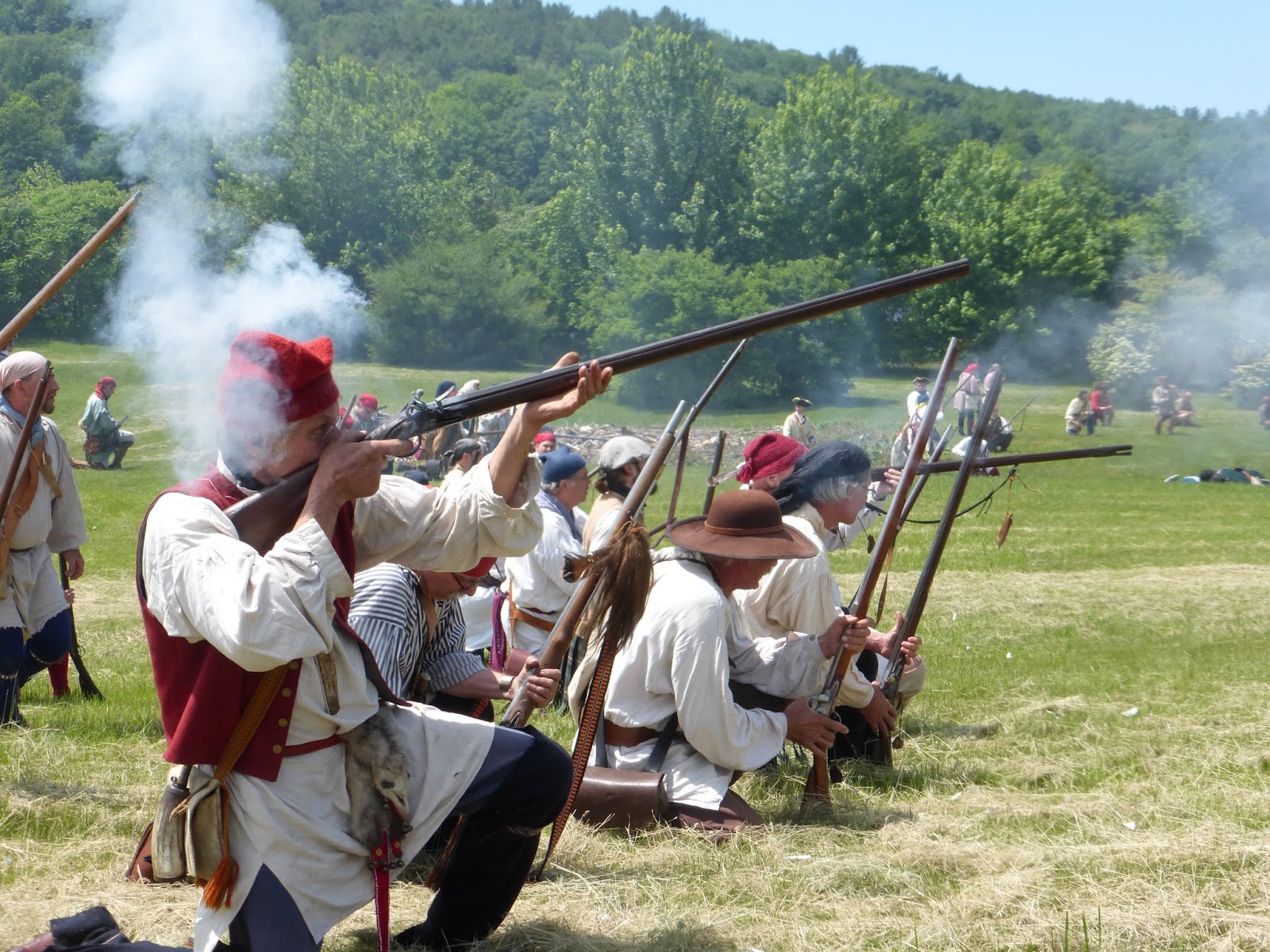
How we spent a day back in the French and Indian War


The Fort at No. 4, Charlestown, New Hampshire
Not many re-enactments offer a view of life during the French and Indian War (1754 - 1765).  Most of the battle and living history museums show life during the American Revolution, or the War of 1812, or the Civil War.  The French and Indian War (known in Europe as the Seven Year's War) is very close in time to the American Revolution, but very different in the details the re-enactors portray.

Entering the Garrison
Inside the Garrison are fortified homes, a great hall, stores and other
buildings to explore, with many demonstrations of colonial crafts, cooking,
defense, and everyday life.  

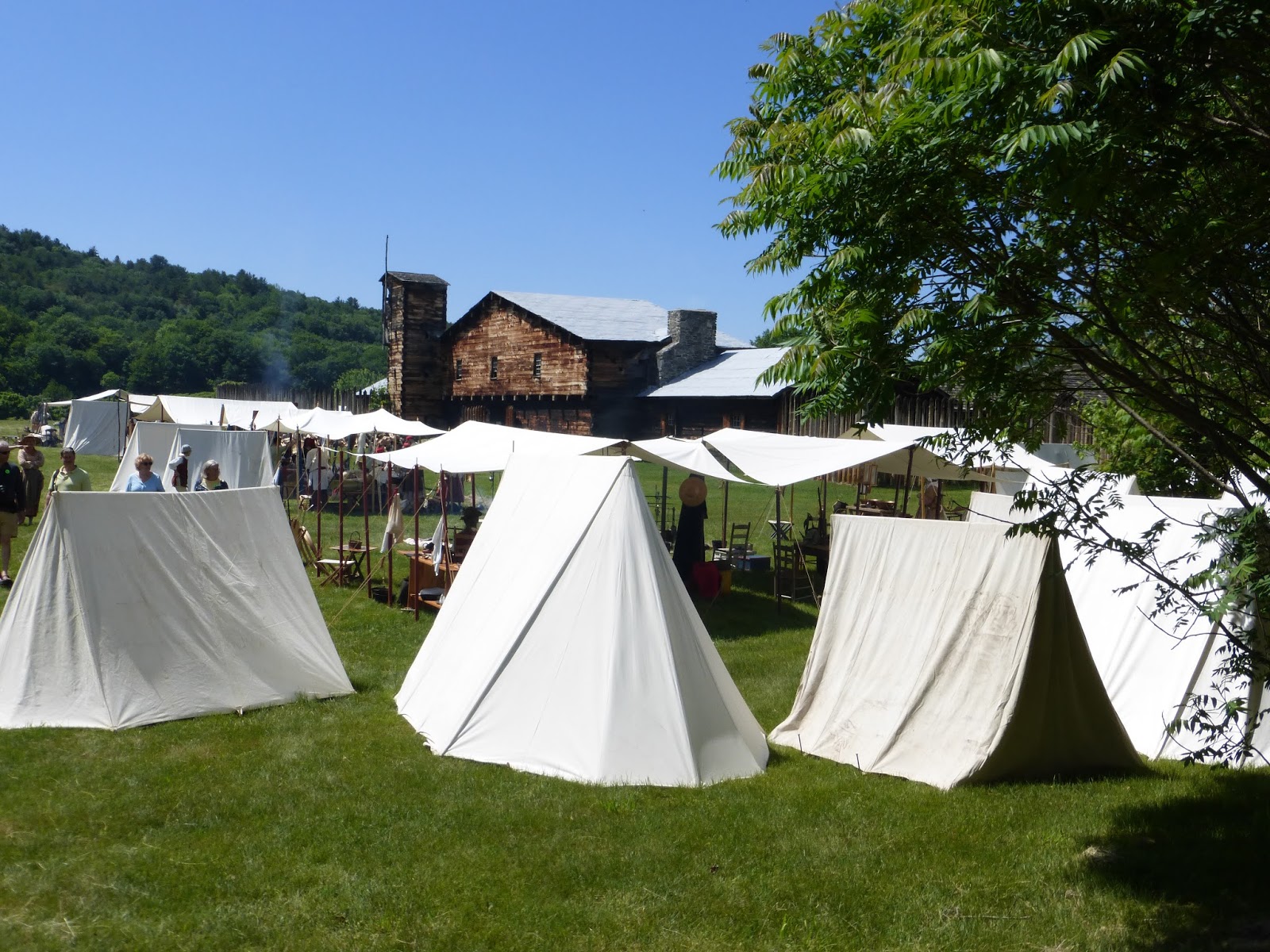
The Fort at No. 4 in Charlestown, New Hampshire was an important defense against the French from Canada during this war.  It was the northernmost garrisoned town on the Connecticut River.  Many of the soldiers who defended the Fort at No. 4, like John Stark, went on to become officers during the American Revolution. This garrisoned village has been preserved for educational purposes, and several battle re-enactments are played out here every summer.  Only one of the re-enactments is set during the French and Indian War.

Blacksmith

Carving horns into powderhorns, hornbooks, cups, shoehorns, etc.

There are many sutlers at these weekend events.  Sutlers or victualers
sold provisions to military camps, and traveled with them to remote outposts

The sutlers provide authentic reproduction wares for re-enactors
and also sell to the general public. You can buy clothing, household
objects, muskets and weapons, and a wide variety of 18th century things.
These photos were taken last weekend.  There is another re-enactment this September set in the Revolution.  There is a special event nearly every weekend, so check out the calendar at the link below. Some of the events are just encampments or militia drills and musters, and some portray Native American life.

Check the schedule for the battle re-enactment times, and set up your blanket or chair early to get a good spot

This re-enactment had actors portraying settlers, British troops, French troops, rangers, Native Americans
and these French Canadian militia known as "milice". This makes the battle very colorful!  

At this re-enactment there was a troop of highlanders with kilts and bagpipes
This group from New York portrayed Rogers Rangers

After the mock battle we wandered through the camps.  The re-enactors were getting ready for their
mid-day meals.  This is one of the French Canadian groups. 

Here in the Native American camp, the men were getting ready to "parlay" with the other groups. 

This is one of the British units roasting a leg of lamb for dinner. It is fun to ask questions and
to join in with the re-enactors for crafts and demonstrations of colonial life.
They will often invite children (and adults) to sit with them and join in on 18th century games.

Another view of the Fort at No. 4 with the French encampment all around it.
The re-enactors stayed all weekend and participated in two mock battles. 


The Fort at No. 4    http://fortat4.org/   
267 Springfield Road
Charlestown, New Hampshire

------------------------------

Heather Wilkinson Rojo, "How we spent a day back in the French and Indian War", Nutfield Genealogy, posted June 12, 2015 ( http://nutfieldgenealogy.blogspot.com/2015/06/how-we-spent-day-back-in-french-and.html : accessed [access date]). 


Monday, January 19, 2015

Who was Jenkins? What happened to his Ear? How did the War of Jenkins’ Ear affect the migration of my ancestors?


There really was a War of Jenkins’ Ear (1739 – 1748) It was a conflict between Spain and England, part of the bigger war known as the War of Austrian Succession.   This war didn’t involve France or England until they were also drawn in as allies of Austria.   To make this more confusing, this whole war was part of King George’s War, which was the third of four French and Indian Wars.  I’ll bet you didn’t know that there were four separate French and Indian Wars, did you?

King George’s War (1744 – 1748) involved New England, New York and the French in Nova Scotia.  It all wasn’t resolved until the fourth French and Indian War (just to be more confusing, this was known as the Seven Year’s War), when Wolfe defeated Montcalm and France at the Battle of the Plains of Abraham in Quebec, and France lost their claim to most of Canada.

What is important to know is that since King Phillip’s War (1675 – 1678) until the Seven Year’s War (1754 – 1763) there was almost continual fighting for the borders and territory between the French, English and Spanish which also involved the native Indian tribes and settlers trying to carve out homesteads.   In New England you can see this especially in the settlement of Maine, New Hampshire and Vermont.  Anyone who thinks that the first war in the colonies was the Revolutionary War is missing six or seven major international conflicts fought in North America and elsewhere.   This doesn’t include smaller wars like Father Rale’s War (1722 – 1725) fought only in New England.  See?  Another war that I bet you haven’t heard of, either, have you?

In tracing my family tree I often find someone born in 18th century  Maine has disappeared from the records.  Or someone suddenly appearing in Marblehead or Salem, Massachusetts in the early 1700s, but not born in England.  I’m always wary of making a leap in migration from one state to another, because most of my ancestors didn’t move around New England very much.  But there was a reason why some of these families fled Maine, came to Massachusetts, and then returned to Maine.

Maine was first settled by the French on St. Croix island in 1604, who called the area Acadia.  The first English settlement at Popham was in 1607, which was abandoned in less than a year. This was the beginning of constant conflict between the two nations.   In 1622 the land that is now roughly the state of Maine was divided into plantations between Sir Ferdinando Gorges and John Mason.  These plantations failed, and were abandoned.  After the four different French and Indian Wars, settlements were again abandoned, and then retried. Over and over.

During the 1692 witch trials, many of the accusing girls and women were refugees from the conflict north of Massachusetts. They had seen massacres, towns burnt, and other atrocities. There is an ongoing theory that their post-traumatic stress syndrome caused them to start the first witch accusations, which snowballed out of control.  After reading some of the first-hand accounts of these conflicts, kidnappings, scalpings, fighting and torture (by both sides, English and Indian) I can believe this theory much more than other theories I have heard (mass hypnosis, ergot poisoning, and jealousy). 

Don’t just look at the vital records for your ancestors’ names.  Read the town and regional histories.  Examine the records of conflicts to see who was involved, names of victims and aggressors.  Who fled?  Who returned? Who was kidnapped? Who was redeemed?  Who died?

---------------------

So who was Jenkins? And what happened to his ear?   In 1731 the English ship Rebecca, captained by Robert Jenkins, was captured by the Spanish off the coast of Florida.  They accused Jenkins of smuggling, and cut off Jenkins’ left ear.  Jenkins testified in 1738 before Parliament about this incident, and supposedly displayed his severed ear.   The conflict over confiscated cargoes, strained relations, and anti-Spanish sentiment spilled over in the West Indies, Florida and Georgia.  

And who was the Father Rale I mentioned above?   The conflict known as Father Rales’ War (1722 -1725) was also known by at least five or six other names such as Lovewell’s War or Governor Dummer’s War (see the Wikipedia article below).  Sebastian Rale was a French Jesuit priest who lived along the Kennebec River in Maine with the Wabanaki people.  Massachusetts Governor Shute demanded he leave In 1717.  Rale remained, and so Shute sent an expedition in 1722 to capture Rale. There were ongoing retaliations and sieges of settlements as far away as Vermont, Nova Scotia and Deerfield, Massachusetts until peace was negotiated in 1726.

So you see- these conflicts affected human migration and immigration all over the 13 colonies, not just in New England and the northern states.

Keep that in mind if your ancestors seem to disappear from the records in one colony and reappear in another.  It could, and did, happen. 

For the truly curious:

Father Rale’s War from Wikipedia http://en.wikipedia.org/wiki/Father_Rale%27s_War

War of Jenkins’ Ear from Wikipedia http://en.wikipedia.org/wiki/War_of_Jenkins%27_Ear  

"Salem Witch Trials Still cast Haunting Shadow" by Deborah McDermott, 18 January 2015,  from seacoastonline.com, Author Emerson Baker on video and an article about the ongoing war and the beginning of the Salem Witch Trials.
http://www.seacoastonline.com/article/20150118/NEWS/150119292/101098/NEWS 

New England Captives Carried to Canada Between 1677 and 1760 During the French and Indian Wars, by Emma Lewis Coleman, first published 1925, reprinted 2012 by the New England Historic Genealogical Society, Boston, Massachusetts.

In the Devil’s Snare: The Salem Witchcraft Crisis of 1692, by Mary Beth Norton, Alfred A. Knopf Publishers, New York, 2002.

“Maine, Indian Land Speculation, and the Essex County Witchcraft Outbreak of 1692” by Emerson Baker and James Kences, from Maine History, Volume 40, Number 3, pages 159 – 189, available to read online at http://www.hawthorneinsalem.org/ScholarsForum/MMD1705.html

“The Refugee’s Revenge”, by Mary Beth Norton, from Common-Place, Volume 2, Number 3, April 2002 oniline at http://www.common-place.org/vol-02/no-03/norton/norton-2.shtml

The image above is from Wikimedia Commons, "Conference Between the French and Indian Leaders Around a Ceremonial Fire", by Emile Louis Vernier (1829 - 1887)

-----------------------------------

To cite/link to this blog post:  Heather Wilkinson Rojo, "Who was Jenkins?  What happened to his Ear? How did the War of Jenkins’ Ear affect the migration of my ancestors", Nutfield Genealogy, posted January 19, 2015, ( http://nutfieldgenealogy.blogspot.com/2015/01/who-was-jenkins-what-happened-to-his.html: accessed [access date]).  

Tuesday, November 11, 2014

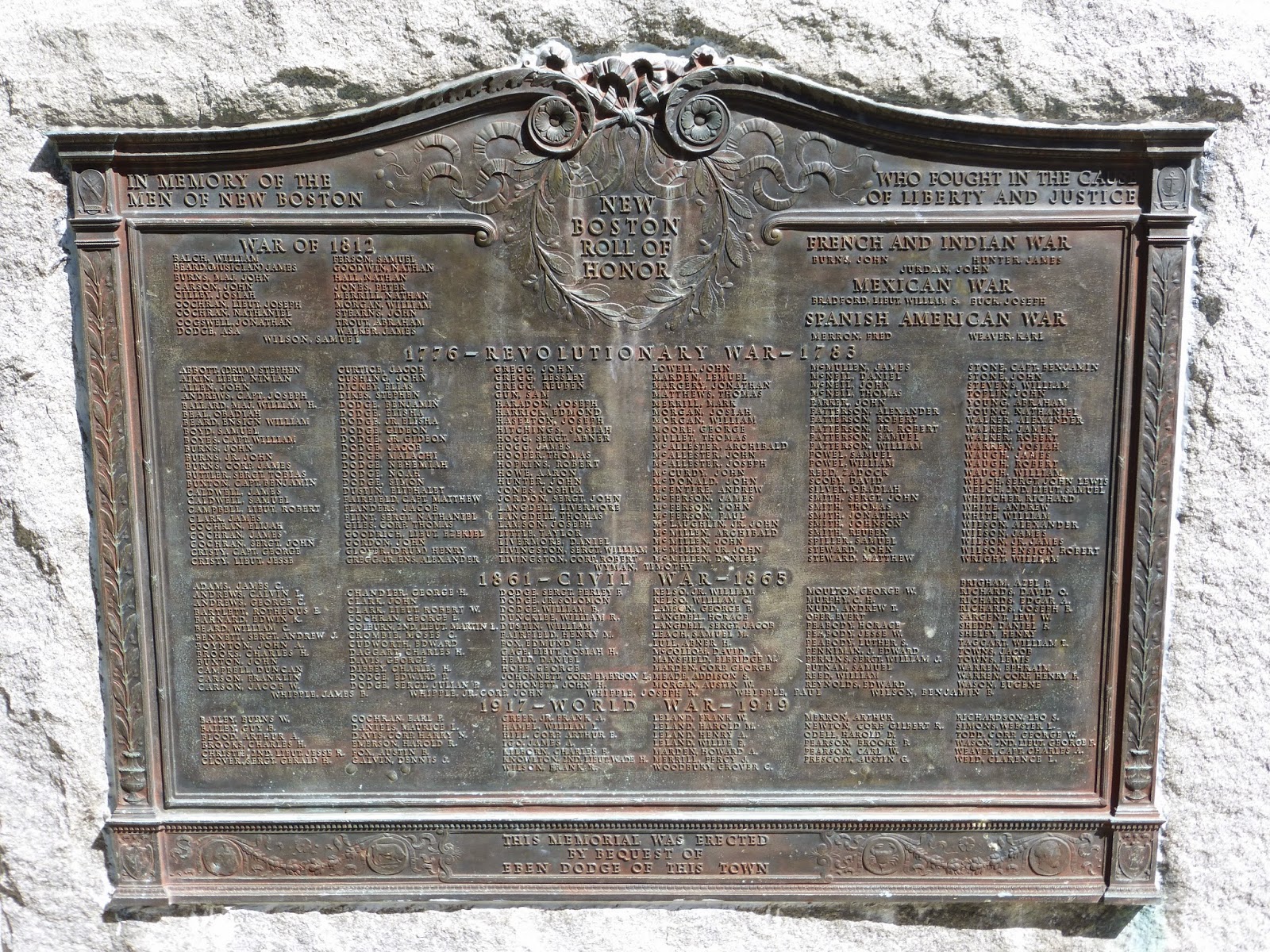
New Boston, New Hampshire Military Honor Roll


New Boston Roll of Honor

In Memory of the Men of New Boston
Who fought in the cause of Liberty and Justice

French and Indian War
Burns, John
Hunter, James
Jurdan, John

1776 Revolutionary War
Abbott, (Drum) Stephen
Aikin, Lieut, Ninian
Allen, John
Andrews, Capt, Joseph
Ballard, Maj, William H.
Beal, Obadiah
Beard, Ensign William
Boyd, Samuel
Boyes, Capt, William
Burns, John
Burns, Jr., John
Burns, Corp, James
Butler, Sergt., Tobias
Buxton, Capt. Benjamin
Caldwell, James
Caldwell, Samuel
Campbell, Lieut. Robert
Clark, James
Cochran, Elijah
Cochran, James
Cochran, Sergt. John
Cristy, Capt. George
Cristy, Lieut. Jesse
Curtice, Jacob
Cushing, John
Dickey, Elias
Dikes, Stephen
Dodge, Benjamin
Dodge, Elisha
Dodge, Jr. Elisha
Dodge, Gideon
Dodge, Jr. Gideon
Dodge, Jacob
Dodge, Malachi
Dodge, Nehemiah
Dodge, Noah
Dodge, Simon
Dustin, Eliphalet
Fairfield, Capt. Matthew
Flanders, Jacob
Flint, Sergt. Nathaniel
Giles, Corp. Thomas
Goodrich, Lieut. Ezekiel
Gordon, John
Glover, (drum) Henry
Gregg, Jr. Ens. Alexander
Gregg, John
Gregg, Lessley
Gregg, Reuben
Gun, Sam
Hardon, Joseph
Harrick, Edmond
Haselton, Joseph
Hitchings, Joseph
Hogg, Sergt. Abner
Hogg, James
Hooper, Thomas
Hopkins, Robert
Howe, Aaron
Hunter, John
Jones, Joshua
Jordon, Sergt. John
Langdell, Livermore
Langdell, Thomas
Lamson, Joseph
Little, Taylor
Livermore, Daniel
Livingston, Sergt. William
Livingston, Corp. Robert
 Lowell, John
Marden, Lemuel
Margery, Jonathan
Matthews, Thomas
Merrill, Mark
Morgan, Josiah
Morgan, William
Moore, George
Mullet, Thomas
McAllester, Archibald
McAllester, John
McAllester, Joseph
McCurdy, John
McDonald, John
McEntire, Andrew
McFerson, James
McFerson, John
McFerson, Paul
McLaughlin, Jr. John
McMillen, Archibald
McMillen, John
McMillen, Jr. John
McMillen, Daniel
McMullen, James
McNeil, Dnaiel
McNeil, John
McNeil, Thomas
Parker, John
Patterson, Alexander
Patterson, Robert
Patterson, Jr. Robert
Patterson, Samuel
Patterson, William
Powel, Samuel
Powel, William
Reed, Zadock
Scoby, David
Silver, Obadiah
Smith, Sergt. John
Smith, Thomas
Smith, Jonathan
Smith, Johnson
Smith, Reuben
Spiller, Samuel
Steward, John
Steward, Matthew
Stone, Capt. Benjamin
Stone, John
Stevens, William
Toplin, John
Young, Abraham
Young, Nathaniel
Walker, Alexander
Walker, James
Walker, Robert
Warren, Josiah
Waugh, James
Waugh, Robert
Waugh, William
Wlech, Sergt. John Lewis
Welch, 2nd Lieut. Samuel
Whitcher, Richard
White, Anderew
White, Wiliam
Wilson, Alexander
Wilson, James
Wilson, Jr. James
Wilson, Ensign, Robert
Wright, William
Wyman, Timothy

War of 1812
Balch, Willliam
Beard, (musician) James
Burns, Maj. John
Carson, John
Cilley, Josiah
Cochran, Lieut, Joseph
Cochran, Nathaniel
Cogswell, Jonathan
Dodge, Asa
Ferson, Samuel
Goodwin, Nathan
Hall, Nathan
Jones, Peter
Merrill, Nathan
Morgan, William
Stearns, John
Trout, Abraham
Walker, James
Wilson, Samuel

Mexican War
Bradford, Lieut. William S.
Buck, Joseph

1861 Civil War  1865
Adams, James C.
Andrews, Calvin L.
Andrews, George C.
Bartlett, Rotheous E.
Barnard, Edwin K.
Beard, William C.
Bennett, Sergt. Andrew J.
Bonton, John A.
Brooks, Charles H.
Buxton, John
Campbell, Duncan
Carson, Franklin
Carson, Jacob W.
Chandler, George H.
Clark, John
Clark, Lieut. Robert W.
Cochran, George E.
Colburn, 2nd Lieut.  Martin L.
Crombie, Moses C.
Cudworth, Edward
Daggart, Charles H.
Davis, George
Dibbey, Charles H.
Dodge, Edward F.
Dodge, Sergt. Julian R.
Dodge, Sergt. Perley F.
Dodge, Jr. Solomon
Dodge, William B.
Duncklee, William R.
Dustin, William
Fairfield, Henry M.
Fox, Edmund R.
Gage, Lieut. Josiah H.
Heald, Daniel
Hofe, George
Johonnett, Corp. Emerson L.
Johonett, John H.
Kelso,  Jr. William
Kelso, Wiliam C.
Lamson, George F.
Langdell, Horace
Langdell, Sergt. Jacob
Leach, Samuel M.
Lull, Abner H.
McCollom, David A.
Mansfield, Elbridge M.
Marden, Corp. George
Meade, Addison S.
Morgan, Austin W.
Moulton, George
Murphy, C. H.
Nudd, Andrew T.
Ober, Evert
Peabody, Horace
Peabody, Jesse W.
Peabody, Luther S.
Penniman, J. Edward
Perkins, Sergt. William
Putnam, Samuel
Reed, William
Reynolds, Edward
Brigham, Azel P.
Richards, David O.
Richards, Edgar A.
Richards, Joseph B.
Sargent, Levi W.
Shedd, Daniel F.
Shelby, Henry
Taggart, William F.
Towns, Jacob
Towns, Lewis
Warren, Ephraim
Warren, Corp. Henry F.
Wason, Eugene
Whipple, Jr. Corp. John
Whipple, Joseph R.
Whipple, Paul
Wilson, Benjamin B.
  
Spanish American War
Merron, Fred
Weaver, Karl

1917- World War I - 1919
Bailey, Burns W.
Bailey, Guy B.
Blood, Arthur A.
Brooks, Charles H.
Christie, 2nd Lieut. Jesse R.
Clover, Sergt. Gerald H.
Cochran, Earl P.
Daniels, Maurice L.
Davis, Corp. Harry N.
Emerson, Harold R.
Fox, Austin B.
Galvin, Dennis J.
Greer, Jr. Frank A.
Hamel, William L.
Hill, Corp. Arthur E.
Igo, James A.
Kilborn, Charles F.
Knowlton, 2nd Lieut. Wade H.
Wilson, Frank R.
Leleand, Frank W.
Leland, Harold M.
Leland, Henry A.
Leland, Willie E.
Marden, Howard A.
Merrill, Percy J.
Woodbury, Grover C.
Merron, Arthur
Nelson, Corp. Gilman
Odell, Harold D.
Pearson, Brooks R.
Pearson, Carl W.
Prescott, Austin G.
Richardson, Leo S.
Simons, Webster L.
Todd, Corp. George W.
Wason, 2nd Lieut. George F.
Weaver, Capt. Charles A.
Weld, Clarence L.
Wilson, Frank R.
Woodbury, Grover C.

This Memorial was erected
By request of
Eben Dodge of this town

[Back side]
 Dedicated to these Patriotic Veterans of New Boston

World War II  12/7/41 – 12/31/46
Audette, Ernest
Bailey, Muriel
Bailey, Oliver
Bartlett, Fred
Berry, Albert
Blaisdell, Clinton
Bose, Robert, Sr.
Boston, Robert
Boudreau, James
Boulter, Marion
Boulter, Pauline
Boulter, Robert
Boulter, Warren
Brown, Harland
Campbell, Douglas
Chauncey, Forrest
Chauncey, Gordon
Christian, Arthur
Christian, Louis
Christian, Walter
Cleveland, Walter
Colburn, Charles
Colburn, John
Colburn, Martin
Colburn, Robert
Colburn, William
Conley, John

Corliss, Woodybell
Corthell, John
Dane, James
Daniels, John Jr.
Daniels, Winston
Emerson, Charles
Fraser, Harold
Gagnon, Arthur
Gagnon, Howard
Gosselin, Ferdinand
Hardy, Roger
Heath, Elroy
Hooper, Bartlett
Humphrey, Ralph
Kane, Bernard
Lewis, Richard
Lindstrom, Edgar
Lovejoy, Winfield
Lovell, Clayton
Lovell, John
Lyon, Clement, Jr.
Mansfield, George H.
McQuillen, Robert
Merron, William
Osborne, Gordon
Paquette, John
Paquette, Raymond
Pelchat, Renaud
Perkins, Leslie
Prince, George
Prince, Paul
Proctor, Warren
Robinson, Calvin
Rogers, Frank Milton
Sandford, Leonard
Sarette, Albert E.
Savoy, Paul Clayton
Savoy, Robert
Skofield, Herman
Smith, Clinton
Stearns, Frank*
Stearns, John
Stier, Arthur
Stiles, Lincoln
Todd, Charles
Todd, Frederick
Todd, Merrill
Towne, Howard
Welch, William
Wilson, Leon
Wilson, Paul
Woodbury, Howard

Korea  6/25/50 – 1/31/55
Allen, Francis
Boulter, James
Card, Robert
Corliss, Moodybell
Friedrich, Henry Jr.
Gagnon, Howard
Hooper, Bartlett
Houghton, Raymond
Hoyt, G. Lester, Jr.
Hunter, Robert
Lavallee, Philip
Lovell, John
Moss, Frederick
Pierce, Emerson
Rogers, Paul
Savoy, Paul Clayton
Strong, Harold
Strong, George
Towne, Howard
Wentworth, Rodney

Vietnam  12/22/61 – 5/7/75
Berger, Glenn
Berger, Rodney
Bose, Larry
Bose, Robert Jr.
Bowen, David
Brusseau, Frederick
Brusseau, Gary
Brusseau, Richard
Buxton, Leon
Card, Dean
Card, Richard
Card, Robert
Caswell, Scott
Chancey, Carl
Colbert, Michael
Colburn, Dale
Colburn, Edward
Dane, Samuel
Daniels, Wayne
Davis, Ronald*
Dodge, Homer G.
Donaher, Michael
Follansbee, Alan
Gagnon, James
Gomes, August, Jr.
Gomes, Russell
Hamel, Dennis
Haskell, G. Douglas
Herbert, Harry
Herbert, Peter
Hooper, Dennis
Hooper, William
Johnston, Arhtur
Johnston, John
Kennedy, Jeremiah
Kennedy, Stephen
Lamarch, Roland
Leach, Sue
Lebaron, Gardner
Leedham, William
Locke, John
Lovejoy, Dwight
Mason, William Jr.
Miller, Richard
Morris, Edward
Morrison, Michael
Murdough, Philip
Olson, Theodore
Paige, Richard
Parker, Glenn
Pelchat, Maurice
Perkins, Russell
Prince, Richard
Pringle, Hugh
Reno, David
Savoy, William
Smith, Newton
Speck, Gerald
Speck, Thomas
Speck, William
Strong, Richard
Towne, Daniel
Trimbury, David
Walker, Chester
Walker, George
Weadick, Edward
Whipple, George
Whipple, James
Wilson, George
Wilson, Paul
Yost, Lary

*Killed in Action
Erected in 1984

[Addendum]

World War II
Clark, John

Korea
Bailey, Raymond
Perkins, Russell
Sarett, John
Sarett, Richard
Sarett, Robert

Vietnam
Bose, Thomas
Savoy, Clayton

Persian Gulf
Gilman, Timothy
Grosso, David
Harvesson, Lauren
Rollins, Byron
Strong, Nathan


See all the other military honor rolls from across the US and Canada that have been listed, photographed and transcribed by volunteers at this link:
http://nutfieldgenealogy.blogspot.com/p/honor-roll-project.html

----------------------------
The URL for this post is
http://nutfieldgenealogy.blogspot.com/2014/11/new-boston-new-hampshire-military-honor.html
Copyright (c) 2014, Heather Wilkinson Rojo