Showing posts with label Wilson. Show all posts

Tuesday, June 2, 2026

My Revolutionary War Patriots - Robert Wilson of Danvers, Massachusetts


At the Wilson Family Burial Ground, Peabody, Massachusetts
ROBERT WILSON
Died
Jan. 4, 1797
Aged 51
[epitaph illegible]

This is Patriot #10 I have written about for this series on my Revolutionary War ancestors.  

Robert Wilson is my 5th great grandfather.  He was born in Salem Village (after 1775 it was known as the town of Danvers), Massachusetts around 1746, the son of Robert Wilson (1724 - 1782) and Elizabeth Southwick of Danvers.  

Robert Wilson's father was a potter, and so was his grandfather, Isaac Wilson, and so were his sons.  According to the book Early New England Potters and Their Wares, by Lura Woodside Watkins, pages 65 - 66 "The Wilsons also were a prominent family of artisans.  Their homestead included the land near 141 Andover Street and eastward where Route 128 now crosses it.  The first two potting Wilsons were sons of Robert, a farmer.  They were Robert, known as Robert Jr., who remained in Danvers, and Joseph, who went to Dedham and thence to Providence, Rhode Island.  When Robert, Jr. died in 1782, he left property worth 627 pounds, including six lots of land, his house, barn, potter's shop, and corn house, a riding chair, and a large personal estate.  He seems to have done well in his trade.  His son Robert, known as Robert 3d, and a younger son Job were potters.  By an order of the court, Robert 3d, as administrator of his father's estate, was obliged to sell a large part of the elder Robert's property to pay certain debts.  This was not done until April 9, 1793, when two-thirds of the land and buildings, and an interest in the business was aquired by Isaac Wilson 3d.  He, too, was a craftsman in clay.  The threee Wilsons ran the shop together for a time, but Robert 3d. and Job both passed away before 1800, while Robert's son Robert, who had worked but a short time as a potter, died three years later at the age of twenty-seven.  Upon Isaac's decease in 1809, this early pottery must have come to an end."

Robert Wilson married Sarah Felton on 23 March 1775 in Danvers. She was the daughter of Malachi Felton and Abigail Jacobs (the great granddaughter of the George Jacobs hanged as a witch during the 1692 witch hysteria). She was probably the first child born in the Nathaniel Felton, Jr. house, which is still standing in the town of Peabody, Massachusetts.  Robert and Sarah had nine children, of whom seven grew up to adulthood and married.  I descend from the eldest child, Robert Wilson (1776 - 1803), mentioned above, who married Mary Southwick, his second cousin. This Robert died at age 27, leaving his widow with two babies.  She never remarried. 

The Wilsons produced an unsual kind of black pottery, which had an almost black glaze. There was a large clay deposit near Andover Street (now Route 114).  Some of this black pottery is on display inside the Nathaniel Felton houses (one is mentioned above) which are still standing on Felton Hill, owned by the Peabody Historical Society.  The Wilsons and their relatives lived on what is now the Danvers/Peabody line, near Route 114 and the Northshore Mall. Nearby is Wilson Square.  Several Wilsons were buried under the parking lot near Macy's at the Mall, but their graves were relocated. Across from the Mall, behind the Kappy's liquor store, there is a Wilson Family Burial Ground. 

At the start of the Revolutionary War there were over 50 small potteries in Danvers, all in the same neighborhood near the clay deposit.  The Wilsons lived and worked at the pottery business, along with other local families such as the Osborns, Paiges, Porters, and Southwicks. The last pottery in Peabody (which broke off from Danvers in 1855) closed due to a fire in the 1950s.  At one time some of these families also produced bricks. 

Robert Wilson served in the Revolutionary War as a Private in Captain Samuel Epe's Company under Colonel Pickering's Regiment of Danvers.  He marched on the alarm of 19 April 1775 for two days of service and is listed in the DAR Patriot's Index. There were six Wilsons from the area of Danvers and Peabody who marched on the Lexington Alarm.  

Robert Wilson died on 4 June 1797 in Danvers, and his son, my 4th great grandfather, Robert Wilson, was the administrator of his father's estate in 1782.  His will (Essex County Probate #30142) mentions his widow Sarah and all the children except for Mercy and Samuel in 1796. He was buried in the Wilson Family Burial Ground, and when Sarah died on 20 November 1836 she was buried nearby in the Felton Family Burial Ground. I cannot find a record of her applying for a widow's pension, and she never remarried. 

I'm curious to find out if the black and redware pottery produced in Danvers and Peabody contained a lead glaze. Both Robert Wilsons mentioned above (the Revolutionary War veteran and his son) died very young.  Perhaps it was lead poisoning? Perhaps we will never know? 


For the truly curious:

Massachusetts Soldiers and Sailors of the Revolution

Essex County, Massachusetts Probate

Early New England Potters and Their Wares,  by Lura Woodside Watkins,  Cambridge: Harvard University Press, 1950, pages 65-66. 

Sophia Richter, "Peabody: Pottery City, 1730 - 1940", Peabody Historical Society and Museum, posted 1 August 2025, ( https://peabodyhistorical.org/2025/08/peabody-pottery-city-1730-1940/: accessed 22 March 2026). 

#1 in this series,  Colonel Joshua Burnham of Milford, New Hampshire:    https://nutfieldgenealogy.blogspot.com/2026/02/my-revolutionary-war-patriots-colonel.html  

#2 in this series,  Andrew Munroe of Lexington, Massachusetts:   https://nutfieldgenealogy.blogspot.com/2026/03/my-revolutionary-war-patriots-major.html  

#3 Jonathan Flint of Reading, Massachusetts:    https://nutfieldgenealogy.blogspot.com/2026/03/my-revolutionary-war-patriots-jonathan.html   

#4 Daniel Glover of Marblehead, Massachusetts:    https://nutfieldgenealogy.blogspot.com/2026/04/my-revolutionary-war-patriots-daniel.html  

#5 Levi Younger of Gloucester, Massachusetts:    https://nutfieldgenealogy.blogspot.com/2026/04/my-revolutionary-war-patriots-levi.html  

#6 Nathaniel Treadwell of Ipswich, Massachusetts:    https://nutfieldgenealogy.blogspot.com/2026/04/my-revolutionary-war-patriots-nathaniel.html 

#7 Captain Westley Burnham of Essex, Massachusetts:   https://nutfieldgenealogy.blogspot.com/2026/04/my-revolutionary-war-patriots-captain.html  

#8 Abner Poland, Sr. of Essex, Massachusetts:    https://nutfieldgenealogy.blogspot.com/2026/05/my-revolutionary-war-patriots-abner_02014071889.html   

#9 Abner Poland, Jr. Of Essex, Massachusetts and Enfield, New Hampshire:    https://nutfieldgenealogy.blogspot.com/2026/05/my-revolutionary-war-patriots-abner_02014071889.html  

-------------------------

To cite/link to this blog post: Heather Wilkinson Rojo, "My Revolutionary War Patriots - Robert Wilson of Danvers, Massachusetts", Nutfield Genealogy, posted June 2, 2026, ( https://nutfieldgenealogy.blogspot.com/2026/06/my-revolutionary-war-patriots-robert.html: accessed [access date]). 

Tuesday, May 21, 2024

Clarissa Goldsmith Wilson, d. 1874, Peabody, Massachusetts for Tombstone Tuesday

 This tombstone was photographed at the Wilson Burial Ground in Peabody, Massachusetts.  This little cemetery is located behind Kappy's Liquor Store off Route 114, near the North Shore Mall.  All the land around the mall was the Wilson Farm in the 1700s and 1800s.  Route 114 was "The Andover Road".  


Clarissa Goldsmith, daughter of Jeremiah Goldsmith and Sarah Converse, was born 11 April 1797 in Andover, Massachusetts.  She married John Wilson, son of Robert Wilson and Sarah Felton (my 5th great grandparents) on 1 June 1831 in Andover.  John was born 18 January 1778 in Danvers and died 26 June 1863, leaving Clarissa a widow.  She died on 1 January 1874. 

When I photographed this cemetery about 10 years ago it was in the fall and there was not good sunlight.  Since the cemetery is located next to a highway cloverleaf, and behind a mall, it was in bad shape.  Clarissa's gravestone was precariously tipped to one side.  If you look up Clarissa's gravestone on Find A Grave you will see that it is now lying flat on the ground, and it is no longer standing.  

The Wilson Cemetery in Peabody, Massachusetts


John and Clarissa Wilson had two boys:

1.  John Wilson, Jr., born 13 October 1832 in Danvers, died 17 July 1867, and married Elizabeth Abbott Waldo in 1856.

2. Edward Hooker Wilson, born 14 March 1835 in Danvers. 

1870 Federal Census, Peabody, Essex County, Massachusetts
Post Office: Peabody Roll: M593_612 Page: 342 Image: 184
Wilson, Clarissa, age 73, keeping house, real estate $6500, personal $5000, b. Mass.
          Edmund H. age 33, farmer, real estate $4000, personal $2500, b. Mass.
          John B., age 10, attending school, b. Mass.
Peabody, Abigail, age 60, domestic servant, b. New Hampshire
McPherson, Jason, age 20, farm laborer, b. Nova Scotia

On the page for the 1870 census Clarissa Wilson, the widow, was living a few houses down from my 3x great grandfather Aaron Wilkinson, and only two houses away from Aaron's son William Prescott Wilkinson (my 3x great uncle) and many other Wilson families.   

For the truly curious:

Another blog post from 2009 about the Wilson Cemetery:   https://nutfieldgenealogy.blogspot.com/2009/09/buried-at-mall.html   

My WILSON Surname Saturday post:  https://nutfieldgenealogy.blogspot.com/2012/01/surname-saturday-wilson.html   

Clarissa Wilson's memorial at Find A Grave:   https://www.findagrave.com/memorial/141545305/clarissa-wilson    

-----------------------------

To cite/link to this blog post:  Heather Wilkinson Rojo, "Clarissa Goldsmith Wilson, d. 1874, Peabody, Massachusetts for Tombstone Tuesday", Nutfield Genealogy, posted May 21, 2024, ( https://nutfieldgenealogy.blogspot.com/2024/05/clarissa-goldsmith-wilson-d-1874.html: accessed [access date]). 

Friday, August 10, 2018

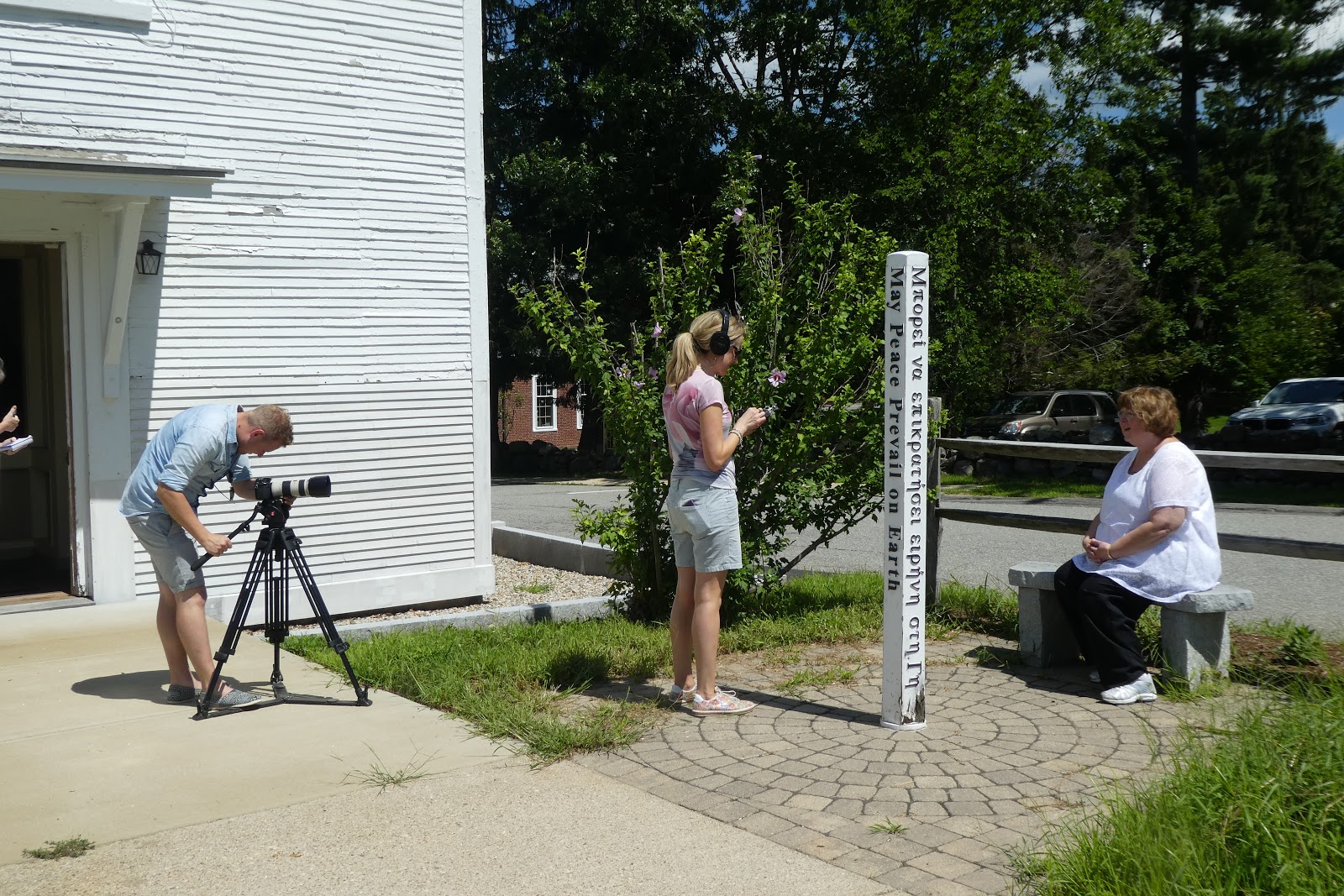
Documentary Filming in Nutfield

Earlier today in East Derry, New Hampshire
At the peace pole behind the First Parish Meeting House

A crew from McMillan Media from the United Kingdom came over to "Nutfield" this week to film scenes for a documentary about the Scots Irish migration to America.  They sent Jan Veitch to interview some of the people in Londonderry and Derry who are helping to plan the 300th anniversary celebrations of the arrival of the first settlers to Nutfield.  I was included in the interviews and filming, along with Paul Lindemann from the First Parish Meetinghouse, Mark Mastromario and Karen Blandford Anderson of the Derry History Museum, Ann Chiampa from the Londonderry Historical Society, TJ Cullinane did a tour of the Forest Hill Cemetery, Nutfield descendant James Scammon, and the Reverend Doctor Deborah Roof from the First Parish, the current pastor of Rev. James MacGregor's 1719 church. 


The film crew was originally sent to the United States to capture scenes at the upcoming Ulster Scots Migration conference happening next week August 14 - 16 at Bowdoin College in Brunswick, Maine.  They heard about Nutfield via social media and changed their plans to take a side trip here to New Hampshire.  Included on their itinerary with the interviews were also plans to film lots of scenery, historic sites, and even do some drone photography.  They will also visit Belfast, Maine.  I hope to see Jane Veitch next week at the conference, along with other Scots Irish descendants, historians and genealogists, and other researchers of the Ulster migration in 1718. 


Karen Blandford Anderson of the Derry History Museum

James Scammon, interviewed by Jane Veitch
James is a WILSON descendant


Paul Lindemann and I watch the interviews
next to the First Parish Meetinghouse
(under renovation, the steeple was removed
for repair work, along with the bell and
the weathervane)


McMillian Media   https://www.macmillanmedia.co.uk/video 

Ulster Scots Migration Conference August 14 - 16, 2018
https://www.maineulsterscots.com/register-your-interest 

The Maine Ulster Scots Project (hosting next week's conference)  https://www.maineulsterscots.com/

The Nutfield 300th Anniversary website   https://www.nutfieldhistory.org/nutfield300th/

Are you a descendant of a Nutfield Scots Irish Family?
Are you interested in attending the 300th celebration?
Please register your contact information here at this link:
https://www.nutfieldhistory.org/family-outreach


---------------------------

Heather Wilkinson Rojo, "Documentary Filming in Nutfield", Nutfield Genealogy, posted August 10, 2018, ( https://nutfieldgenealogy.blogspot.com/2018/08/documentary-filming-in-nutfield.html: accessed [access date]).

Thursday, May 10, 2018

200th Anniversary of Nutfield, from a 1919 Boston Newspaper


Transcribed from The Boston Herald, Sunday, August 17, 1919; Boston, Massachusetts, page 45

“HISTORIC NEW HAMPSHIRE TOWN TO CELEBRATE 2D CENTURY
Londonderry’s Anniversary “Meeting” of 1869 is to Reassemble After an “Adjournment” of 50
Years – But the Cider Provided for in the Will of Dr. Sylvanus Brown Will Not Be Available
By Hobart Pillsbury
Londonderry, Aug. 16

Just 50 years ago one of the greatest celebrations ever held in New Hampshire took place at Derry in commemoration of the 150th anniversary of the organization of the historic town of Londonderry, a town that originally included a part of the city of Manchester, and the present towns of Londonderry, Derry and Windham.  In the official record of that celebration, which has been preserved in the archives of both town and state, the last minute reads thus:
It was now announced by the president of the day that the regular program had been carried out, and it was moved and seconded that the meeting be adjourned for 50 years.

On Aug. 24 that same “meeting” is to reassemble.  Some of the same men and women, although not many, who voted to “adjourn for 50 years” will be present at the reassembling.  There will be others present, United States senators and members of Congress, governors, ex-governors and distinguished men, who were not heard of and perhaps not alive when the former festivities took place, who will join in what will be the most elaborate of the many Old Home week reunions of New Hampshire.

But Time’s speeding onward:
How soon in its flight
Will it bear us afar and away out of sight?
How few, on another centennial day,
Will return and talk over the years sped away?

This verse closed a poem read 50 years ago to the celebrators.  New Hampshire towns, which boast a records of 200 years of uninterrupted organization, take especial interest in the preservation of the old home spirit and the observance of Old Home week.  It is just 20 years since the late Frank W. Rollins, the Boston banker, at that time Governor of New Hampshire, conceived the idea of promoting an annual reunion of those natives of New Hampshire who had moved away.

Horace Greeley’s Dedication

Horace Greeley said, in an oration at the 150th Londonderry anniversary, that “we shall cordially agree to devote this festival to the memory of that Scotch-Irish race who first settled this town.”  The Scotch-Irish blood survives in Londonderry today, to a greater extent probably than in any town in the United States.  What Greeley said 50 years ago is true:
The old township has been cut up into several:  old landmarks have disappeared; old fashions have changed; new institutions have changed old habits and softened rugged peculiarities; but the Scotch-Irish people remain; their genius lights up most of the faces now looking into mine.

One of the participants in the celebration of 1869 was Dr. Sylvanus Brown, a physician of Derry, who died with a few years and left the town a legacy which should be allowed to draw interest until 1919, when the entire fund was to expended in the purchase of cider and distributed among the multitude present at the 200th anniversary exercises.  Whether by providential provision or otherwise, the fund got lost in the financial meanderings of the town in the course of 40 years and no money exists today with which to buy cider.  Furthermore, no cider exists, under the bone dry laws, which could be used for celebrating, and that would be of sufficient caliber faithfully to carry out the provision in the will of Dr. Brown.

E. H. Derby, a prominent Boston lawyer of two generations ago, speaking at the Derry celebration of 1869 referred to the five great anniversaries that were that year observed and that might fittingly be noted in 1919 – the birth of Napoleon, the Pacific railroad, the Suez canal, the invention of the steam engine and the settlement of the Scotch-Irish in America.  The last, according to Bancroft, is as important to America as the landing of the Puritans, and it is held by many that the Scotch-Irish did more for civil and religious liberty, more to sever the ties that bound the colonies to England, and more to establish American independence than did the Pilgrim Fathers.  New Hampshire people are sometimes inclined to weary of the frequent praise of  Massachusetts and the Pilgrim Fathers and the Puritans as the only settlers of New England who came with high courage and firm religious convictions.  The five shiploads of Scotch Irish that arrived in Boston include men who, in the words of Parson Macgregor, “wished to worship God according to the dictates of their conscience and the rules of His inspired word.”

The Story of Londonderry

The story of Londonderry is one of the heroic memoirs of American colonization.  Londonderry was settled by Scotchmen as a result of British oppression.  The English Parliament passed laws which were oppressively felt in Scotland by the Scotch Presbyterians.  Thousands of these Scotchmen early in the 17th century passed over into Ulster in Ireland and resettled that community under favorable terms of the King of England.  These Scotch became Irish, but were not of the Irish.  They did not intermarry with the Irish or agree with them on matters of government and religion.  There was strife which culminated in the memorable siege of Londonderry, the chief city of Ulster, in 1688 – 89.  The Scotch Protestants and the Irish Catholics strove for supremacy with such bitterness that at length the bolder souls among the Scotch, failing of that measure of freedom which they had been led to expect, decided to emigrate to the new world.

Some of the immigrants went from Boston to Worcester, and the Londonderry colonists originally started for Casco Bay, Me, with a view to exploring the territory there.  They spent the winter of 1718-19 at Portland, and suffered many hardships from cold and scarcity of food.  In the spring they sailed down the coaset and up the Merrimack river to Haverhill, from which they explored by land into the desirable tract at Londonderry, to which they originally gave the name of Nutfield.

On April 11, 1719, there arrived in what is now Derry 16 families of Scotchmen from Londonderry, Ireland.  The Rev. James Macgregor delivered under a spreading oak at a place called Horse Hill, the first sermon ever preached in town. The colony was a great success.  Soon there were 70 families, and the first settlers made their “home lots” of gorund only 30 rods wide and one mile long, in order to protect themselves against the Indians.

The settlers purchased the territory from John Wheelwright by a deed that was drawn up at Boston on Oct. 20, 1719.  This John Wheelwright was a grandson of a minister of the same name who had bought the land from the Indians in 1629.  One June 21, 1722 they got a charter from the King of England confirming their titlte to the town on condition that once a year they should pay the King a quit rent of one peck of potatoes forever and should reserve for the royal navy all the trees grown in the town suitable for masts for ships.

Church Well Finished, but Homes of Logs

The early settlers built their homes of logs, but in two years they had a church edifice built of good timber and well finished at what is now East Derry, on the sight of the present Congregational Church.  Able-bodied men attended divine worship fully armed against the raids of the Indians, and there is still preserved the musket which the minister, Mr. Macgregor, habitually carried into the pulpit.

In 1723 a log schoolhouse was built.  It was 75 years before anybody in town had a first-class vehicle to ride in, John Prentice having the first, and he drove a chaise which was considered highly extravagant at the time.

They were loyal to the government.  In the old French war, in 1745, Dr. Matthew Thornton, who afterwards signed the Declaration of Independence, served as surgeon in a campaign of great hardship against Cape Breton.  In 1756, when attempt against Crown Point was made, the town raised three companies of troops which served under the command of three Londonderry soldiers, Robert Rogers, William Stark and his brother, the celebrated John Stark, who afterwards became New Hampshire’s most celebrated general in the revolutionary army.

The spirit of these men was the spirit which identified their sympathies with the cause of independence from the start.  Even before the battle of Lexington and Concord four Londonderry boys deserted from the British army because of their revolutionary principles, and were recaptured at Haverhill, Mass.  A company of Londonderry men under the command of Capt. Aiken proceeded to Haverhill and rescued them.

Londonderry at Bunker Hill

When the news reached New Hampshire that Gen. Gage was marching at the head of British troops from Boston into the interior, the Granite state dispatched at force of 1200 men to Cambridge and Charlestown.  The “History of Londonderry” related that “men dropped their implements and in a few hours all who could bear arms were assembled on the Common at the meeting house.”  They were Minute Men, indeed, and a Londonderry contingent fought at Bunker Hill, where New Hampshire troops were conspicuous for gallantry.

The ancient records show that on Dec. 17, 1776, the town meeting voted
that the remainder of the powder shall be divided to every one that hath not already received of the same, as far as it will go; provided he produces a gun of his own, in good order, and is willing to go against the enemy, and promises not to waste any of the powder, only in self-defense; and provided, also, that he show twenty good bullets to suit his gun, and six good flints.”

When the revolutionary war was over it was proposed to reinstate the Tories as citizens of the town. To this proposal the town sent a memorial to the New Hampshire Legislature, saying:
We expect that you will use your best endeavor that nothing may ever be done for those infernal wretches by the state, further than to provide a gallows, halter and hangman for every one that dare show their vile countenances amongst us.”

It was during this period that sharpers and hawkers took advantage of the depreciation of government money.  The town took official cognizance of the high cost of living, particularly as regarded professional fees and money-changers’ commissions.  A vote was passed to reduce the fees of lawyers 50 per cent on the ground that “they would not then be so fond of business, and people would have time to breathe.”

Large families grew up among the early settlers of Londonderry.  It was the rule rather than the exception to have 8, 10 or 12 children, and there appeared to be no difficulty in supporting families of this size out of the product of the farms.  The settlers introduced the Irish potato into this country and they learned from the Indians how to catch salmon at Amoskeag in what is now the centre of the city of Manchester.  Salmon abounded near the falls at Amoskeag.

Londonderry also developed the linen industry in America, and years ago every house in town had its weaving loom at which the women were particularly adept.  The Londonderry weavers had almost a national reputation for quality of product.  Their frugality and industry enabled them to maintain their large families, and from the original 70 families in the town, it was stated by Charles H. Bell, the former United States senator, at the last celebration in Derry, that “as near as he could figure out, upward of 50,000 descendants of these Scotch-Irishmen were then living in the United States”.

Some Amusing Incidents

The Londonderry men were always religious and maintained the church with considerable dignity.  The minister of Londonderry received a larger salary than the chief executive of New Hampshire.  They were men of plain speech.  The minister one day made many parochial visits, and toward evening rode a horse up to the home of one of his elders. He had, as a matter of course, been pressed at every dwelling to partake of the liquid refreshments which are now taboo, but were then considered indispensable, and between fatigue and overhospitality on the part of his parishioners, found it hard to keep himself upright in the saddle.

The elder’s keen eye took in the situation.

“Wont’ ye light doun, parson,” said he, “and come in and get something do eat, for I perceive ye’ve had enough to drink, already.”

To show how obstinate these men were, the story is related of the representative from Londonderry to the New Hampshire Legislature who differed decidedly from the speaker in matters of religion and politics and had also expressed doubts as to the speaker’s honesty.  At the close of the session it was customary, and as today, to offer resolutions of felicitations to the presiding officer and present him with a substantial gift.

In this particular session the managers of the Legislature feared to encounter the public opposition of the outspoken “gentleman from Londonderry” to their resolution, and thought it prudent to confer with him in private as to their plans.  They showed him the resolution, which was in the ordinary form, presenting “the thanks of the Legislature to the presiding officer for the dignity, ability, and integrity with which he has discharged his duties.”

The gentleman from Londonderry perused the resolution carefully and said:
“There is only one word I object to; strike out “integrity’ and I will vote for the resolution.”

Which was done, and the records of the Legislature stand in that way today for that particular session.
It was the ancient practice in the town to sit at the table in the celebration of the Lord’s Supper.  In other towns it was found more convenient for the communicants to remain in the pews.  Londonderry stuck to its practice for many years, until finally the minister announced that parishioners would remain in their pews during the service, but seats at the table would still be provided for such as might object to the change.  Most of the members adopted the prevailing fashion; but quite a few would not change and sat at the table.  The latter faction dwindled in numbers until there was but one old gentleman who would not yield his assent.  Year after year, until he went down to his grave, each day of communion, in sunshine and in storm, found him sitting at the table, solitary and conspicuous, in mute but faithful protest against an innovation for which he found no warrant in Scripture.

The first display of musical instruments in church ever made in New Hampshire took place in Londonderry, and the incident is somewhat peculiar.  It appears that the minister had formerly been a chaplain in the British army and had learned to play the violin.  He brought his stringed instrument to America, no doubt hidden in the bottom of his chest, and late one night one of the elders, passing the parson’s log cabin, heard the “linked sweetness long drawn out” peeped through the window and discovered the man of God in the very act of drawing the bow.  Of course the elder reported what he saw to the session, and a decree was made that the minister should “hang up the fiddle and the bow” for three successive Sundays in front of the pulpit.

Londonderry got its charter as a town in 1722 and the name was then changed to Nutfield.  One provision of the charter was that fairs should be held in May and November and for over 50 years these were great events.  Merchants came from Boston and Salem to exhibit their wares. Toward the last, however, these fairs became mere riotous gatherings and were abolished.

The town prospered so that 100 years ago it was the first in importance in New Hampshire.  Two famous academies were founded, Pinkerton Academy for boys and the Adams Female Seminary for girls.  In the later one of the faculty was Mary Lyon, who founded Mt. Holyoke College.

The first marriage in Londonderry was that of John Wallace to Annie Barnet, in 1721.  The first funeral was that of John Clark, in 1720.  The first birth was that of Jonathan Morrison, and it was an occasion of much anxiety which mother’s son should obtain the prize of a lot of land which was assigned to the first son born in Londonderry.  This first born was an uncle to one Jeremiah Smith, who was later well known as a “millwright, blacksmith, carpenter, house-joiner, stone-cutter and gunmaker,” being evidently a gentleman of some versatility. 

One of the athletic exercises in the early days of this town was to see who could soonest load a wagon with barrels of cider.  Young men about town, when meeting on the road, would frequently unload and load again just for this purpose.

The New Hampshire Legislature used to have sermons preached before it by distinguished clergymen.  On one occasion the Rev. Dr. Morrison of Londonderry delivered the sermon and the customary motion was made to print the same as a public document.  An amendment was offered “provided they would print the brogue” and solemnly carried.

John Montgomery, one of the early Londonderry weavers, wove the linen for George Washington and other officers of the army and received from Congress for this service 40 pounds in money and a diamond ring as a premium.

Colonists of Londonderry went out from that town to settle many other towns in New Hampshire and Massachusetts.  An expedition went to Bedford in 1737, Peterboro in 1741, Acworth in 1766, Antrim, Henniker, and Deering in 1767, and New Boston in 1774.  The town of Windham was carved out of Londonderry in 1741 and Derry in 1827.  Other towns settled principally by men of this town were Londonderry, N. S., Londonderry, Vt., Windham, Vt., Truro, N.S., and Cherry Valley, N.Y.

Romance of “Ocean Mary”

The most charming of the many stories that are connected with Londonderry is that of “Ocean Mary” and it is said that there is every reason to believe it true.  In July, 1720, a ship, whose name has not been preserved, set sail from Londonderry in Ireland for Boston with a number of well-to-do families on board bound for the Scotch-Irish settlement in New Hampshire.  Among the passengers were James Wilson and the young wife whom he had married a year before on their way to take up the land of which Wilson was one of the original grantees.

Concerning the first few days of the voyage of this immigrant ship little is known, except that there was a protracted calm, followed by a storm of unusual violence, by which the ship was driven from her course.  The passage across the Atlantic was about one-third accomplished when events transpired that mad the trip memorable in the lives of all on board.

One evening the lookout saw on the horizon a sail silhouetted against the rising moon.  The strange craft came nearer and nearer, and by morning her low hull could be seen like a black shadow under her full set of canvas.

The pirate ship came within gunshot of the emigrant ship. There was nothing to do.  The emigrants had nothing but a few muskets for arms, and she was too slow to run away.

Boats were soon alongside and the ocean robbers fell to work, swarming over the decks as men accustomed to plunder and kill and with plenty of knowledge as to both.  Crew and passengers were seized, searched, robbed and bound, and either rolled into heaps or left where they lay.  Valuables were gathered into parcels and made ready to be transferred to the marauder’s vessel.

The robber chief went below, found the officer’s quarters, threw open the aftercabin door with a rough hand, and came upon a young woman lying in the berth.

“What are you doing here?” demanded the ruffian.
The terrified woman uncovered an infant’s face.
“See.”
The pirate drew near to her.
“Is it a boy or a girl?”
“A girl,” said the mother.
“Have you named her?”
“No.”
The pirate went to the cabin door and ordered no man to stir until further orders.  His followers ceased their pillaging and their chief returned to the berth where the woman lay.
“If I may name that baby,” he said to her with quiet voice, “I will unbind your men and leave your ship unharmed.”  May I name the girl?”
“Yes”
Then the robber bent over and took up the hand of the tiny baby.
“Mary” was the name the woman heard his speak.

When the child drew its hand away from his, the mother saw a tear on the pink fingers.
The pirate ordered all captives unbound and goods and valuables restored to the places from which they had been taken.  Then, with his crew, he left the emigrant ship and pulled to his own vessel.  But the emigrant ship had scarcely got underway than a new alarm came. The pirate was returning.

If the passengers were dismayed by his reappearance they were surprised to see him come on board alone and go directly below to the cabin.  There he took from a parcel a piece of brocaded silk of fine texture and beautiful design. It was of a plaid pattern, combining many hues of red and green, wonderfully harmonized and softened with lines of white.

“Let Mary wear this on her wedding day” the pirate said.

He left the ship and was seen no more.

The ship reached Boston and no further incident disturbed the passage.  James Wilson died soon after landing and the mother went with “Ocean Mary” to live in Londonderry, where friends awaited them.  The mother married at Londonderry some months afterward James Clark, the great-great grandfather of Horace Greeley.

In 1738 one Thomas Walker emigrated to America, settled in Londonderry, and married on Dec. 18 of the same year the girl “Ocean Mary”.  The wedding dress was the pirates’ silk.  Four sons were born to her, one of whom, Robert Walker, built the finest house in Henniker, N. H., still standing.  “Ocean Mary” lived in this house, on a sightly hill, until 1814, when she died at the age of 94 years.

She was tall, graceful, with light hair, blue eyes, and a florid complexion.  She had an aristocratic nature, her manner was fine and her ways kindly. Her granddaughter and great granddaughter have worn the pirate’s silk at their weddings, and although mellowed with age, its richness is still preserved.

Many of the older buildings of the town are still standing.  One is the homestead of Matthew Thornton, the first New Hampshire signer of the Declaration of Independence.  Another is the Col. Lane house in which Gen. Derby resided and where the Marquis de Lafayette on his visit to America lodged over night.  The Parker homestead with its beautiful cedar trees in front is the old parsonage of the original Presbyterian church.

The original Pinkerton Academy through whose doors have passed hundreds of men and women who later achieved prominence in all parts of the country, is standing on its original site, within a stone’s throw of the present large and stately academy.  The old academy was used from 1814 to 1887 as the headquarters of the institution.

The Hood farm, where originated the H. P. Hood & Sons milk business, is a place pointed out by natives, not so much because it was Mr. Hood’s first farm, but because before that it was the old Redfield tavern where Lafayette dined.  The birthplace of Gen. George Reid may be seen today, an extremely old style frame house.  Gen. Reid was really one of the great generals of the revolutionary army, although history does not give him that prominence.  To New Hampshire’s people the figure of Gen. Stark overshadows that of Gen. Reid, but there is at the present time a disposition to give Gen. Reid his due and accord him something of the honor to which his services under Washington entitle his memory.  The next session of the Legislature will be asked to place a portrait of Gen. Reid in the State House.

The Adams Female Academy is standing, and the building that was originally used a s boarding house for pupils at that institution is lately used as a boarding house for summer boarders, for whom New Hampshire is a mecca.  It is called “The Elms”.

One of the features of the 200th anniversary celebration will be the historical pageant on the grounds of Pinkerton Academy on Monday, the 25th.  This pageant has been written by Mrs. J. G. McMurphy of one of the old families and it pictures scenes in Londonderry, Ireland, the parting of old friends, the embarkation for America, and the settlement of the town.  The central theme of the pageant is education with freedom to think and to act according to the dictates of conscience.

Among the speakers will be Gov. John H. Bartlett, Senator George H. Moses, Representative Sherman E. Burroughs and Chief Justice Frank N. Parsons of the state supreme court, himself a native of the town.  The presidents of the days of celebration include six distinguished sons of the town.  They are George I. McAllister, an eminent lawyer at Manchester; Charles M. Floyd, former Governor of New Hampshire; Chief Justice Parsons, Robert Lincoln O’Brien, editor of the Herald; Charles H. Hood, present head of the Hood milk concern, and Rosecrans W. Pillsbury, publisher of the Manchester Mirror.  The committee on the celebration is headed by Perley L. Horne, principal of Pinkerton Academy.”


-------------------------

Heather Wilkinson Rojo, "200th Anniversary of Nutfield, from a 1919 Boston Newspaper", Nutfield Genealogy, posted May 10, 2018, ( https://nutfieldgenealogy.blogspot.com/2018/05/200th-anniversary-of-nutfield-from-1919.html: accessed [access date]).

Tuesday, January 30, 2018

Tombstone Tuesday ~ George Wilson, 1747, and Jenit Wilson, 1777, Londonderry, New Hampshire

This tombstone was photographed at the Forest Hill Cemetery in Derry, New Hampshire.  In 1747 this was the town of Londonderry, New Hampshire.


HERE LYES THE BODY OF MR
GEORGE WILSON SON TO MR
JAMES AND JENIT WILSON
HE DIED MAY 29, 1747 AGED 17
YEARS.  ALSO THE BODY OF MRs
JENIT WILSON DAUGHTER OF
MR AND Mrs JENIT WILSON
SHE DIED APRIL 13, 1777 AGED 36

These two siblings are the children of  James Wilson (1680 - 1772) and Jennet Taggart (1703 - 1800), early Nutfield settlers.  This gravestone was cleaned by the Friends of Forest Hill Cemetery on 7 August 2009.  It is decorated with the typical geometric style carvings typical of the early Scots Irish tombstones in Londonderry, similar to those attributed to the Scots Irish carver John Wright "The Hieroglyphic Carver".  According to the History of Londonderry by Rev. Parker, there were four Wilson siblings (Jenit, Alexander, Annis and Margaret). 

----------------------------------

To Cite/Link to this blog post: Heather Wilkinson Rojo, "Tombstone Tuesday ~ George  Wilson, 1747, and Jenit Wilson, 1777, Londonderry, New Hampshire", Nutfield Genealogy, posted January 30, 2018, (  https://nutfieldgenealogy.blogspot.com/2018/01/tombstone-tuesday-george-wilson-1747.html: accessed [access date]).

Saturday, December 10, 2016

Surname Saturday ~ KNIGHT of Charlestown, Massachusetts


John Knight (1601 – 1674), my 11th great grandfather, was a Watertown proprietor in 1636.  He sold his land in Watertown on 5 June 1640 and removed to Salisbury where he was a proprietor.  He removed to Charlestown.  His will is dated 14 December 1672 and was probated 10 June 1674.  The will mentions his son-in-law, Robert Pierce of Woburn, my 10th great grandfather.

My ancestor John Knight was a cousin to the John Knight who came to New England in 1635 aboard the ship James with his brother Richard Knight.  They both settled in Newbury, Massachusetts, and their genealogies are often tangled with John Knight of Charlestown.  In fact, both Johns were considered to be one person in some compiled genealogies.

Recent genealogists have discovered John Knight’s English origins.  He was born in Romsey, Hampshire, England, the son of Nicholas Knight and Jane Hewatt.  His paternal grandparents were William Knight and Elizabeth Wild of Romsey.  His maternal grandfather was John Hewete of Romsey.

On 8 September 1649 John Knight of Charlestown bought 80 acres in Woburn, Massachusetts.  Then on 9 October 1654 John Knight, inhabitant of Woburn, bought 18 acres back in Charlestown.  On 29 Dec 1671 John Knight, malster, sold his home in Woburn to William Johnson. 

Robert Pierce of Woburn gave all his land to his son Benjamin in return for maintenance for the rest of his life, and his wife Mary’s life on 3 July 1693.  This document refers to the 20 acres of land in Woburn he bought from his father-in-law, John Knight, of Charlestown, deceased.   My 9th great grandmother was Elizabeth Pierce (1659 – 1690) the daughter of Robert Pierce and Mary Knight. 

KNIGHT resources:

Stand By My Servant Joseph: The Story of the Joseph Knight Family and the Restoration, by William G. Hartley, 2003.  Available in paperback at Deseret Books 801-517-3315.

A manuscript at the New England Historic Genealogical Society “The Knight Family” call number SG KNI 21, part 1 is the family of John Knight of Newbury, and part 2 is the John Knight of Charlestown, Massachusetts. 

Our Knight line: from John Knight (ca. 1600 – 1674) of Watertown, Woburn, and Charlestown, Massachusetts, to Mary (Knight) Near (1848 – 1923) of Racine, Wisconsin, by Virginia S. Hooper, 1971. 


My KNIGHT genealogy:

Generation 1:  John Knight, son of Nicholas Knight and Jane Hewatt, born 1601 in Romsey, South Hampton, England, died 22 May 1663 in Charlestown, Massachusetts;  married Mary Pickering about 1619 in Romsey.   Mary was born about 1598 in Romsey, and died 16 May 1676 in Charlestown. 
Children: 
a.) Mary  born 14 July 1620 in Romsey, died 18 March 1701 in Woburn, Massachusetts. 
b.) Joseph (1624 – 1687) married Hannah Lamb
c.) John, Jr.  (1630 – 1714) married Ruhamah Johnson, married second to Abigail Stowers, married third to Mary Bridge, married fourth to Mary (Rocke) Clemments, the widow of William Clemments, married fifth to Sarah (Rowlins) Holsworth, widow of Joshua Holsworth. 
And perhaps a fourth child, Samuel 

Generation 2:  Mary Knight, born 14 July 1620 in Romsey, died 18 March 1701 in Woburn, married to Robert Pierce before 1646. He was the son of John Pierce and Elizabeth Hart.  Seven children.

Generation 3:  Elizabeth Pierce m. Samuel Wilson
Generation 4: Mary Wilson m. Ebenezer Pierce
Generation 5: Deborah Pierce m. Increase Wyman
Generation 6: Increase Wyman, Jr. m. Catherine Unknown (see the blog post HERE)
Generation 7: Jemima Wyman m. Joshua Burnham
Generation 8: Jemima Burnham m. Romanus Emerson
Generation 9: George Emerson m. Mary Esther Younger
Generation 10: Mary Katharine Emerson m. George E. Batchelder
Generation 11: Carrie Maude Batchelder m. Joseph Elmer Allen
Generation 12:  Stanley Elmer Allen m. Gertrude Matilda Hitchings (my grandparents)

------------------------------------------------

Heather Wilkinson Rojo, "Surname Saturday ~ KNIGHT of Charlestown, Massachusetts", Nutfield Genealogy, posted December 10, 2016, (http://nutfieldgenealogy.blogspot.com/2016/12/surname-saturday-knight-of-charlestown.html: accessed [access date]). 

Saturday, September 17, 2016

Surname Saturday ~ WILSON of Woburn, Massachusetts


WILSON, WILLSON

John Wilson (about 1626 – 1687), my 10th great grandfather is not my only WILSON ancestor.  I am also a descendant of Robert Wilson (about 1630 – 1675) of Salem Village.  Both these immigrant WILSONS were studied by genealogist Ken Stevens, who did surname studies of all the WILSON families in New England.  If you have a WILSON from New England you can search his book The New England Wilson Index, 1995 for more information. [call number CS71. W75 1995 at the NEHGS library]  His manuscripts and papers are also at NEHGS under the call number Mss 678.  The books on the Wilsons from New England: A Genealogical Record of Some Descendants From Our Colonial Ancestors are under the call numbers CS71 .W75 1988 v.1, v.2, v.3 on the 7th floor of the NEHGS library.

John Wilson’s origins are unknown.  He first settled in Salem, Massachusetts with his wife, Hannah, some time before they bought 2 acres of land on 2 March 1652/3.   They sold this land in 1657, and the first record of them in Woburn was December 1658 when their son Samuel was born.  Samuel Wilson (1658 – 1729) is my 9th great grandfather.  The Proprietors records record John was granted four acres of land in 1661, near the Billerica border today.   Samuel inherited the homestead and provided for his aged mother, and his siblings all removed to other towns in Massachusetts and Connecticut.   Samuel and two of his siblings all married PIERCE children of Robert Pierce of Woburn.

John and Hannah were Anabaptists.  In 1677 they were fined for not attending regular meetings - the Puritan religious services (Middlesex Court Records).  Their son, Samuel, my 9th great grandfather, was listed as an Anabaptist, too. 

John Wilson’s will is not recorded.  The Suffolk County Probate recorded an administrator’s bond and an estate inventory by the administrix, Hannah, and sons John, Jr. and Francis.  Hannah remarried to Thomas Fuller.

My WILSON genealogy:

Generation 1: John Wilson, born about 1626 in England, died 2 July 1687 in Woburn; married about 1650 in England to Hannah James.  She was born about 1628 in England and died after 1697. Twelve children.

Generation 2: Samuel Wilson, born 29 December 1658 in Woburn, died 21 November 1729 in Woburn; married on 24 February 1682 in Woburn to Elizabeth Pierce, daughter of Robert Pierce and Mary Knight.  She was born 6 March 1659 in Woburn, and died 22 December 1690 in Woburn. Three children.

Generation 3:  Mary Wilson,  born 10 April 1685 in Woburn, died 17 January 1747 in Woburn; married Ebenezer Pierce (not a cousin), son of John Pierce and Deborah Converse.  He died before 16 May 1766 in Wilmington, Massachusetts.

Generation 4: Deborah Pierce m. Increase Wyman
Generation 5: Increase Wyman m. Catherine Unknown
Generation 6: Jemima Wyman m. Joshua Burnham
Generation 7: Jemima Burnham m. Romanus Emerson
Generation 8: George Emerson m. Mary Esther Younger
Generation 9: Mary Katharine Emerson m. George E. Batchelder
Generation 10: Carrie Maud Batchelder m. Joseph Elmer Allen
Generation 11: Stanley Elmer Allen m. Gertrude Matilda Hitchings (my grandparents)

------------------------------------------

Heather Wilkinson Rojo, "Surname Saturday ~ WILSON of Woburn, Massachusetts", Nutfield Genealogy, posted September 17, 2016,  ( http://nutfieldgenealogy.blogspot.com/2016/09/surname-saturday-wilson-of-woburn.html: accessed [access date]).

Tuesday, August 30, 2016

Tombstone Tuesday ~ William Wilson, buried 1773 in Derry, New Hampshire

This tombstone was photographed at the Forest Hill Cemetery in Derry, New Hampshire. At the time of burial, 1773, this was the town of Londonderry.


HERE LYES THE BODY OF
MR. WILLIAM WILSON  HE
DIED JULY 30 1773 IN THE
22d  YEAR OF HIS AGE.

This little tombstone is a great example of the early Scots Irish carving often seen in this cemetery in Derry, and in some of the early cemeteries in Londonderry, New Hampshire.  The simple symbols at the top and sides of the tombstone are very typical.   I've seen celtic knots, geometric shapes, and here is the heart and coffin.   Does anyone know the symbolism of the upside-down heart?   Is this gravestone attributable to stone carver John Wight? 


---------------------------

Heather Wilkinson Rojo, "Tombstone Tuesday ~ William Wilson, buried 1773 in Derry, New Hampshire", Nutfield Genealogy, posted August 30, 2016,  (http://nutfieldgenealogy.blogspot.com/2016/08/tombstone-tuesday-william-wilson-buried.html: accessed [access date]).

Tuesday, December 16, 2014

Tombstone Tuesday ~ Agnes Fisher, died 1747, Londonderry, New Hampshire

This tombstone was photographed at the Forest Hill Cemetery in East Derry, New Hampshire.  It had been cleaned by the Friends of Forest Hill in 2009.  If you would like to see a before and after photograph, please click on this link to the entry at the Find A Grave website.


HERE LIES BURIED
THE BODY   OF
MRS AGNES THE
WIFE OF MR SAMUEL
FISHER,  WHO
DEPARTED THIS 
LIFE APRIL 17th
1747 IN THE 21st
YEAR OF HER AGE

Agnes Taylor was born 6 March 1725 in Londonderry, New Hampshire, the daughter of Janet Wilson and Matthew Taylor.   She married Deacon Samuel Fisher, who was born in Ireland on 29 July 1722 and died 10 April 1806 in Londonderry.  Samuel was married three times, and Agnes was his first wife.  He also married Agnes Wilson  and Sarah Barber (both buried at the Old Hill Cemetery in Londonderry with Samuel).  He had a total of 12 children, 76 grandchildren and 53 great grandchildren according to an obituary posted at his memorial at Find a Grave.  Click here to read his memorial and obituary. 

Agnes died 17 April 1747 in Londonderry.  She was only 21 years old, and she died in childbirth.  Her daughter Nancy Fisher was born the same day as her mother's death, and she grew up to married David Ela.  Nancy lived to be 90 years old, and died on 19 February 1837 and is buried at the Forest Hill Cemetery, too, not far from her mother's grave.

-------------------------
The URL for this post is
http://nutfieldgenealogy.blogspot.com/2014/12/tombstone-tuesday-agnes-fisher-died.html
Copyright (c) 2014, Heather Wilkinson Rojo

Thursday, October 10, 2013

Ocean Born Mary ~ born on her way to Londonderry, New Hampshire

Starting today you will be able to listen on line to the internet radio show Fieldstone Common, and Marian Pierre Louis will interview the author Jeremy D'Entremont about his new book Ocean Born Mary:  The Truth behind a New Hampshire Legend.   You can find the recording at this link HERE

This story has a special place in the hearts of Londonderry residents, since Ocean Born Mary Wilson lived in Londonderry after arriving in New England.  According to the legend, a ship full of Ulster Scots was way to New England was laid by pirates.  The head pirate changed his mind about killing and looting the passengers when he saw the newborn baby in her mother's arms.  He asked the mother, Elizabeth Wilson, to name the babe "Mary" after his own mother.  In return the pirate gave the child a bolt of green Chinese silk to make her wedding dress. The rest is history, or myth, take your pick.

I'm currently the president of the Londonderry Historical Society.  This organization was started when the Ocean Born Mary house was removed from Londonderry to Little Compton, Rhode Island in the 1930s. A group of concerned citizens was worried about preserving the remainder of the history of Londonderry, and started the Historical Society.  Again, the rest is history!  

You can now see a bit of the famous silk wedding dress in our Morrison House Museum on Pillsbury Road in Londonderry, and also other snippets at the Derry History Museum, the New Hampshire Historical Society Museum in Concord, New Hampshire, the Henniker Historical Society, the Tucker Free Library in Henniker, New Hampshire, and the DAR Museum in Washington, DC.  Mary's dress appears to have been cut up into many, many pieces for museums and descendants.  

A bit of Ocean Born Mary's silk wedding dress
at the New Hampshire Historical Society Museum in Concord.
The stocking was knit by Mary (Wilson) Wallace for
her son-in-law, Thomas Patterson, to wear on his wedding day.  

The Wilson House, Wilson's Corner, Londonderry before it was moved
(intersection of Auburn Road and Wilson Road)
from Willey's Book of Nutfield

For the truly curious: 

You can read all about Ocean Born Mary and her genealogy at a previous blog post, at this link:
http://nutfieldgenealogy.blogspot.com/2009/10/ocean-born-mary-londonderry-character.html

The Fieldstone Common episode of Ocean Born Mary at this link:
http://www.fieldstonecommon.com/ocean-born-mary-dentremont/

Ocean Born Mary: The Truth Behind a New Hampshire Legend, by Jeremy D'Entremont, Charleston, South Carolina: The History Press, 2011

Jeremy D'Entremont mentions Horace Greeley in the recorded interview. Click this link to read one of my earlier blog posts about Horace Greeley's family tree, and a genealogical connection between Greeley and Ocean Born Mary:
http://nutfieldgenealogy.blogspot.com/2010/03/horace-greeley-remembers-londonderry.html

------------------------------

To Cite/Link to this blog post:  Heather Wilkinson Rojo, "Ocean Born Mary ~ born on her way to Londonderry, New Hampshire", Nutfield Genealogy, posted October 10, 2010, ( http://nutfieldgenealogy.blogspot.com/2013/10/ocean-born-mary-born-on-her-way-to.html, accessed [access date]).  

Tuesday, February 5, 2013

Tombstone Tuesday ~ Rev. and Mrs. John Wilson, Chester, New Hampshire

These tombstones were photographed at the Chester Village Cemetery, Chester, New Hampshire


HERE LIES the Body of
Mrs. JEAN WILSON
Spouse of the Rev. John Wilson
who departed this Life April 1st AD 
1759 Aged 36 Years.
She was a Gentlewoman of Piety
and a good Oeconamist
Likewise the Revd. JOHN WILSON
who departed this Life Febr. ye 1st AD
1779 Aged 69 Years
He was a Servant of Christ in the most
Peculiar & Sacred Relation, both in Doctrine &
Life.  It was his great Delight to prich a crucefied
Christ as our widsom Righteousness Sanctification &
Redemption.  He did not Entertain his hear-
ers with Curiosities, but with Real Spritual
good his Sermons were Clear, Solid
affictionate a Spirit of Vital Christianity
Ran through them, his Life was sutable to 
his holy profession.  he was a steady friend a
Loving, Husband a tender parent, his Inward
grace was visable in a convercastion
becoming the gosple.
Sed Omnes una manet Nox,
Et Calcanda Semdui
Lethi Hor

The Latin phrase is from Horace, and it translates to "But one night waits for all, and the road of death is to tread only once"


The Reverend John Wilson was born in Ulster County, Northern Ireland in 1709.  He was at the University of Edinburgh in 1726, and came to New England in 1729.  He was ordained at the Presbyterian Church in Chester in 1734, where he stayed until his death in 1779.  According to the history of Chester, he had only one daughter, Ann, who married William Mills.

Jean was the daughter of James and Mary Wilson of Chester.  He married first to Thomas Glenn of Ireland, who died on 18 March 1744.  She married second to Reverend John Wilson.  I don't know if the two Wilson families were related.   I love the epitaph that states "She was a Gentlewoman of Piety and a good Oeconamist [Economist]"    I suppose she was a frugal housewife?

Rev. John Wilson's tombstone is completely weather worn.  No inscription can be seen, but the crude carvings along the edges are similar to some of the geometric type carving I've seen in Londonderry and at Forest Hill Cemetery in Derry.  Mrs. Wilson's stone is in very good condition, and is still quite easy to read.

--------------------------------
Copyright 2013, Heather Wilkinson Rojo

Tuesday, November 6, 2012

Tombstone Tuesday ~ Nesmith, Derry, New Hampshire

This tombstone was photographed at the Forest Hill Cemetery, Derry, New Hampshire.
It has the entire genealogy of the Nesmith family! 


Side One

JAMES NESMITH
emigrated from the North of Ireland
in 1718 and with 15 other families
were the original settlers of Londonderry,
N.H. in 1719; died 1767; aged 75, his wife
ELIZABETH, dau'r of Rev. J's McKeen
died in 1763; aged 67, their child'n
were ARTHUR, set'd in S. part of L.D.
afterwards removed to State of
Me.  JAMES, set'd in N. part of L.D.
JOHN, set'd in S. part of L.D. mar'd to
Elizabeth Reid.  THOMAS, set'd in S. part
of L.D. mar'd Annis Wilson
ELIZABETH
JOHN NESMITH, died 1815, aged 87.
Elizabeth, his wife, died 1793, aged 64.
Their child'n were JAMES
mar'd Elizabeth Brewster. ARTHUR 
mar'd Mary Duncan.  JOHN, mar'd 
Susan Hildreth, 2d wife Lydia Sargent.
EBENEZER mar'd Jane Troler.
THOMAS, not mar'd
died at L.D. 1815, aged 40
ELIZABETH, mar'd James Pinkerton
MARY, mar'd John Miltemore
JANE mar'd Hugh Anderson
BENJAMIN NESMITH, youngest son of the
emigrant (mar'd Agnes Gilmore)
Died in Belfast, Me. Sept 1800 aged 66


Side Two

THOMAS NESMITH
died Nov. 30 1789 aged 58
Annis Wilson his wife died Jan. 1, 1821
aged 82, then children were
JOHN mar'd Lucy Martin
ELIZABETH mar'd Jon'a Wallace, she died
at Essex, NY
THOMAS died in infancy

Side Three

JOHN NESMITH
died Feb 4, 1806, aged 44
Lucy Martin, 1st husband John Nesmith
2nd husband, Dan'l McKeen, she died Feb 2,
1837' aged 72, children of first marriage were
JACOB M. died Jan. 19, 1863; aged 77
THOMAS, died July 31, 1870; aged 82
ELIZABETH, mar'd Alexander Park, died
at Windham, Jan. 18, 1836; aged 44
JOHN, died Oct. 15, 1869; aged 76
JAMES W. died Apr. 29, 1881; aged 85
LUCY mar'd John Patten; died Apr. 22
1848; aged 49
ANNIS, mar'd Wm. Davidson, 1801 - 1877
GEORGE R. died, Aug. 21, 1882; aged 79
JONATHAN W. died at Somerville Nov. 2, 
1847, aged 42
ELIZA wife of James W. Nesmith
died Aug. 28, 1865; aged 58 yrs
and dear family
JAMES AUGUSTUS died Sept. 28
1845, aged 11 yrs
MARY ANN wife of Benjamin Parsons
died Apr. 25, 1913; aged 80 yrs, 9 ms

Side Four

JOHN NESMITH
died Nov. 9, 1844; aged 78, mar'd
Susan Hildreth who died 1813; aged ??
2d wife Lydia Sargent. child'n of the
Died April 19, 1856
marriage were 
JOHN P.
ISABELLA A.
SUSAN H.            SAMUEL H.
JAMES P. died at Matanzas April 21, 1844
aged 27
MARY NESMITH Died Feb. 21, 1869
THOMAS, died Nov. 17, 1888
ELIZABETH
child'n of the 2d marriage were
ALBERT S. died Apr. 1, 1860. aged 44
CHARLES E.


--------------------
Copyright 2012, Heather Wilkinson Rojo