Showing posts with label newspapers. Show all posts

Thursday, January 1, 2026

Happy New Year from Salem, Massachusetts 1848


From the Salem Observer, Salem, Massachusetts, January 1, 1848

"THE NEW YEAR

We have once more, as the stereotyped phrase goes, "arrived safely at the commencement of another year."  The planet to which it is our fortune to appertain, has again wheeled its course around the Sun without accident or incident of any kind.  -  We have neither joggled against the vagrant comets which have been seen wandering about in space, nor have fallen out with any of those fixed and respectable bodies which are addicted to more "steady habits."  Hence we have the satisfaction of believing, as we greet the New Year, that "Old Mother Earth" is still a welcome visitant of the starry Host.

While we have gone on thus smoothly with our celestial neighbors, things amongst ourselves have been less unruffled.  The past year has been signalized by many events which have "shed disastrous eclipse upon the nations."  The great famine in Ireland and on the Continent is an event which will be remembered with grief for ages. The commercial distress abroad, the many wars and much bloodshed, and especially our own war with Mexico, can never be forgotten.  Add to these and other public evils, the countless private sorrows, from which, unhappily, no year is free, and we have a picture of the Old Year mournful to look upon. But the picture is false unless it presents cheerful lights also.  The past year has not been without its happy events.  Amongst these may be mentioned the accession to the papal throne of a liberal Pope, (the discovery of Chloroform?), the abolition of Slavery in Algiers, and the spread of generous ideas, liberal principles, and the spirit of humanity, which we cannot but beieve has taken place.  Take it all in all, the past year has doubless afford its full share of blessings.  We cannot expect "Heaven to weep rubies in a crimson shower," but must be satisfied with a fair sprinkling of precious experiences.  

Retrospections are apt to be dull, but anticipations are hopeful and cheering.  We have henceforth to do with the New Year - "the young spark who came of age this morning."  The Old Year may be decrepid and morose but the New Year is sprightly and happy.  He, at least, is no lugubrous old fellow, cutting and slashing on every side with his lean and hungry scythe, but rather a "tentie seesman," scattering the germs of hope and promise with liberal hand.  That many of these seeds may fall upon your lands, dear reader, and find no barren but a fruitful soil, is our earnest desire. In what more hearty way could we wish you a Happy New Year? " 

------------------

To cite/link to this blog post:  Heather Wilkinson Rojo, "Happy New Year from Salem, Massachusetts 1848", Nutfield Genealogy, posted January 1, 2026, ( https://nutfieldgenealogy.blogspot.com/2026/01/happy-new-year-from-salem-massachusetts.html: accessed [access date]). 

Tuesday, December 23, 2025

A Christmas Wedding in 1890


From the Beverly Citizen newspaper
27 December 1890 

On a recent snowy day my 3rd cousin, on my maternal side, a Hitchings descendant like me, sent me this lovely news clipping from the Beverly Citizen.  It shows our common ancestor, Abijah Franklin Hitchings (1841 - 1910), and my great grandfather, Arthur Treadwell Hitching's wedding to my great grandmother Florence Etta Hoogerzeil on 25 December 1890 at 8 Bentley Street in Beverly, Massachusetts.  They were married on Christmas, which was very common in New England at the time.  Thanksgiving was also a very popular time for weddings in New England. If the family was already gathered together, then it was a perfect time for a wedding.  Early Puritan settlers eschewed Christmas as a holiday in New England, but perhaps they were side stepping religion for fun when they held weddings on or around Christmas Day? 

It made me think "What other ancestors were married on Christmas Day?".  This is what I had in my files: 

Phoebe Munroe (my 4th great aunt) and William Cross, 25 December 1828 in Danvers, Massachusetts. 

Elizabeth Sparks and Jacob Perkins (my 8th great grandparents), 25 December 1634 in Ipswich, Massachusetts.  I descend from two of their three children, Elizabeth (who married David Burnham on my wedding day 2 July in 1711) and Jacob Perkins (who removed to Wells, Maine and married Anna Littlefield). 

Close to Christmas - 

21 December

Abijah Hitchings and Mary Cloutman, my 4th great grandparents, were married on 21 December 1795 in Salem, Massachusetts.  

Phebe Lilley and Noah Eaton (my 6th great grandparents), were married on 21 December 1726 in Woburn, Massachusetts. 

Hannah Munroe (my 7th great aunt) and Joseph Pierce, were married on 21 December 1692 in Watertown or Cambridge, Massachusetts. 

22 December

Mary Barber and Benjamin Tarr (my first cousin 7 generations removed), were married on 22 December 1748 in Gloucester, Massachusetts.  Our common ancestor was James Wallis (about 1668 - 1744) who was born in Maine and died in Gloucester, Massachusetts. 

Hannah Dennison and John Wallis (another first cousin 7 generations removed), were married on 22 December 1782 in Gloucester.  They were first cousins to each other.  Was this a double wedding? 

23 December

Sally Flint (my fifth great aunt) and Levi Nichols were married on 23 December 1778 in North Reading, Massachusetts.  

Sally Flint (my fourth great aunt) and Nathaniel Upton, were married on 23 December 1802 probably in North Reading.  

24 December - Christmas Eve

Polly Bray and Asa Burnham, my 5th great grandparents, were married on 24 December 1801 in Ipswich, Massachusetts.  

Emily Burnham (my 5th great aunt) and John Rollins, were married on 24 December 1836 in Essex, Massachusetts. 

26 December (The day after Christmas)

Elizabeth Peach and Harvey Allen (my 3rd great uncle), were married on 26 December 1887 in Beverly, Massachusetts.  

Susanna Dutch (2nd cousin ten generations removed) and Benjamin Knowlton were married on 26 December 1705 in Beverly, Massachusetts. 

New Years Day Weddings:

Tabitha Damon and John Townsend (my 7th great uncle) were married on 1 January 1722 in Reading (now the part that is Wakefield), Massachusetts. 

Sarah Andrews and Charles Treadwell (my 8th great uncle) were married on 1 January 1723 in Hampton Falls, New Hampshire. 

Hannah Flint (my 5th great aunt) and William Whittredge were married on 1 January 1795 probably in North Reading, Massachusetts.  

Thanksgiving weddings (just a few mentioned here, but the last week or ten days in November was extremely popular among my ancestors for weddings):

My grandparents, Bertha Louise Roberts and Donald Munroe Wilkinson  26 November 1926 at 7 Dearborn Avenue in Beverly, Massachusetts. This was Bertha's home, and where my Dad grew up, and where I grew up, too!  I know they were married on Thanksgiving from an audio tape made by Bertha telling the story of her life.  

My 2nd great grandparents, Robert Wilson Wilkinson and Phebe Cross Munroe were married on 24 November 1853 in Danvers, Massachusetts.  This date was confirmed to be Thanksgiving from family tradition. 

My 4th great grandparents Romanus Emerson and Jemima Burnham were married on 22 November 1810 in Milford, New Hampshire.  I had to search online for the date of Thanksgiving in 1810, and this was the result, but I'm not sure that Thanksgiving had a set date this early. 

Mark Burnham (first cousin 7 generations removed) and Hannah Goodhue were married on Thanksgiving day 26 November 1767 in Ipswich, Massachusetts. 

Sarah Rue and John Beckett (my 6th great grandfather, I decend from his first wife, Rebecca Beadle) were married on Thanksgiving Day 25 November 1762 in Salem, Massachusetts (if Thanksgiving was celebrated on the fourth Thursday in November back then).  Sarah Phipps married my 6th great uncle George Munroe on that same day in Lexington, Massachusetts.  

If Thanksgiving were held on 24 November 1763 in Ipswich, Massachusetts, then my 5th great grandparents Isaac Allen and Abigail Burnham also had a Thanksgiving wedding date. 

I'd have to calculate the date of Thanksgiving for each year in the past, which is a floating holiday, and would become a truly huge proposal!  But it is a good future project.  Thanksgiving was not set as a national holiday until Abraham Lincoln proclaimed it in 1863.  He was persuaded to make it a national holiday by New Hampshire resident Sarah Josepha Hale, because of her fond memories of celebrating Thanksgiving as a child in New England.  It was not until 1941 that FDR set the holiday as the fourth Thursday in November, which was previously a tradition in New England that was loosely followed.  

1915 Salem Gazette

-----------------------

To cite/link to this blog post:  Heather Wilkinson Rojo, "A Christmas Wedding in 1890", Nutfield Genealogy, posted 23 December 2025, ( https://nutfieldgenealogy.blogspot.com/2025/12/a-christmas-wedding-in-1890.html: accessed [access date]).

Tuesday, July 9, 2024

Missing Vessel in the Pacific Ocean, 1846


Newsclipping from The New Bedford Mercury, New Bedford, Massachusetts, Friday, May 21, 1847, Volume XL, page 3. 


transcription:

"MISSING VESSEL - On the 5th of August last, the Brig Wm. Neilson, of this port, Capt. Weston, sailed from Honolulu, Sandwich Islands, for Manilla and Canton, since which nothing has been heard of her, although there are dates from Manilla to Feb. 11.  As this run is usually made in about 30 days, it is feared that she foundered in a typhoon, and all on board perished.  The dates from the Sandwich Islands are to Dec. 26, and if she had been lost at any point between the two places, it is altogether improbabable that accounts should not have been received from her at one or the other.

The Hon. Geo. Brown of Beverly, late US Commissioner to the Sandwich Islands, was a passenger, with his son.  Capt. John Dominis, formerly a highly repectable shipmaster of this city, but more recently a merchant of Honolulu, was also a passenger.

When the Wm. Neilson sailed from this port, Nov 5, 1845, her roll of equipage contained the names of the following persons, who, it is believed, were all in her at the time she left Honolulu; they were mostly young and enterprizing New England men: Church Weston, of Duxbury, master; Ovander M. Hammett, of Chilmark, 1st officer; Joseph M. Bryant, of Nobleboro', Me, 2d do.; Amherst Peterson, of Marshfield; Seth F. Peterson, of do; David J. Mann, of Hanover, Walter S. Tribou, of do; Joseph Gilbert, of Salem; John Pitts, of Bell Haven (supposed a foreigner) seamen; Alfred Dorsey, of Baltimore, colored man, cook; Moses H. Ganges, of Philadelphia, colored boy, steward.

The Wm. Neilson was a fine clipper brig, built, we believe, in Baltimore.  She had some cargo on board, and a considerable amount of specie belonging to the owners of the vessel and others.  There is insurance in this city for $8000 on the vessel, $2000 on freight money, and $17,850 on cargo, specie, &c, amounting in all to $27,850. - [Boston Daily Advertiser]"  

Captain John Dominis

Who was Captain John Dominis?  According to the world famous genealogist Donald Lines Jacobus, he was an Italian who married a woman from Boston (and Jacobus could not find her ancestry). I'm happy to say that I have solved this mystery that Jacobus could not. [See The American Genealogist, New Haven, CT: D.L. Jacobus, Volume 32 (1956), page 70.]

John Dominis was probably born in Trieste, in what is now Slovenia.  On 5 October 1824 he married my 5th great aunt, Mary Lambert Jones, in Boston. Mary was the daughter of  Owen Jones (about 1768 - 1850) and Elizabeth Lambert ( about 1775 - 1834).  Mary had 7 siblings, including Catherine Plummer Jones (abt 1799 - 1828), my 4x great grandmother.  Mary was born on 3 August 1803 in Boston, and died 25 April 1889 in Honolulu, Hawaii. Her father Owen Jones, was born in Wales, and was the son of a Boston customs collector, another Owen Jones (1735 - 1798). Elizabeth Lambert's ancestry is still a mystery to me. 

Captain John Dominis first appears in Boston records on 1 February 1823 when he declared his intention to become a US citizen at the US District Court. This record states "that he came from said Trieste to Boston AD 1819 ".  On 19 May 1825 he applied for his citizenship in Boston, and there was a statement signed by Josiah Marshall and Daniel C. Bacon "that the said John Dominis has resided with the US five years at least and within the State of Massachusetts during the five years last past except being absent occasionally on voyages at sea; and during the time he behaved as a man of good moral charcter, attached to the principles of the constitution of the US and well diposed to the good order and happenings of the same." 

John Dominis also obtained a Seaman's Protection Certificate that was issued in Boston on 28 October 1825.  This record lists him as being 28 years old, 5 feet 9 inches tall, and of dark complexion.  It states that he was from Trieste, Italy, and was a naturalized US citizen. 

Professor Samuel Eliot Morison, who wrote about maritime history including the Mayflower, wrote about Captain John Dominis, who became the master of the ship Owhyhee owned by Josiah Marshall of Boston. The Owhyee (the old spelling for Hawaii) explored the Pacific northwest, the Columbia River, and Willamette Valley.   Dominis also was the master of the brig Bolivar, the Nye, and the Joseph Peabody, which sailed to the Sandwich Islands from New York City in 1839.  

Captain John Dominis brought his wife, Mary, and his little son, John Owen Dominis, from Boston to live in Hawaii aboard the Joseph Peabody in 1839.  He left two small daughters at a boarding school in Schenectady, New York.  The captain and his wife began to build an impressive house in Honolulu. Mary sent to Boston for the windows, doors, and other parts for her new home.  Her brother in law, Enoch Snelling, designed the front entrance to this house. 

In 1846 Captain John Dominis set sail again for China to buy furniture for his new mansion in Honolulu.  He was never heard from again, and there were many newspaper accounts, like the one above, presuming he was lost at sea.  Mary was forced to take in boarders in her new house, to keep up the appearances of her status in society.  One of these boarders, Anthony Ten Eyck, consul to the United States, nicknamed her house "Washington Place" because it was similar to George Washington's mansion at Mount Vernon.  Many of these boarders were Americans and some foreign consuls. 

In 1862  John Owen Dominis married Lydia Kamakaeha Paki, the future Queen Liliuokalani. The married couple lived in Washington Place.  Mary Dominis died in 1889.  After the Queen was desposed in the illegal takeover of Hawaii, she spent her retirement years at Washington Place.  This home served as the governor's mansion for the governor of Hawaii for many years, and is now a museum. 

-----------------

For the truly curious:

Hawaii's Story by Hawaii's Queen, Liliuokalani, by Liliuokalani (Queen of Hawaii), 1898, Lee and Shepard of Boston, reprinted by Kessinger Publishing, LLC, 2007. 

My very first blog post on July 27, 2009:    https://nutfieldgenealogy.blogspot.com/2009/07/hawaii-boston-connection-to-royal.html  

I have written many blog posts about Washington Place.  You can scroll through these stories by clicking at this link:   https://nutfieldgenealogy.blogspot.com/search?q=washington+place   

-------------------

To cite/link to this blog post: Heather Wilkinson Rojo, "Missing Vessel in the Pacific Ocean, 1846", Nutfield Genealogy, posted July 9, 2024, ( https://nutfieldgenealogy.blogspot.com/2024/07/missing-vessel-in-pacific-ocean-1846.html: accessed [access date]). 

Tuesday, May 7, 2024

Peter Hoogerzeil Patents a Stove in 1891


Beverly Citizen, Saturday, November 28, 1891, page 2

"Ancient and Curious Stoves
Peter Hoogerzeil made application, last week, for his third patent on a rolling oven grate. His first patent was issued about two years ago and the second about one year later. The improved grate is automatic, and emerges and receds as the door, to which it is attached, is opened or closed.
     He also has a Franklin stove, a portable iron fireplace, with open front and swinging crane, which was named after Dr. Franklin, who invented it, and bears a bust of its inventor.
     Another curious possession is one of the old James stoves, the word "Salem", which appears on its face, indicating the place of its manufacture, though there is nothing that suggests its age. It is in an admirable state of preservation, stands about 28 inches from the floor, is of about the same width, and is not over 15 inches in depth. The fire is kindled at the bottom, and overhead is the oven, with a door opeing in front and one at the back.  The heat also passes through a funnel on either side of the oven, and an iron handle forms a part of the stove-covers. Mr. Hoogerzeil believes this to be the oldest stove in existence, and is desirous of obtaining information of the period when it was manufactured in Salem.  Particular interest attaches to it from the fact that a Detroit stove company has offered $100 in gold for the oldest stove to be placed on exhibition at the World's fair.  Mr. Hoogerzeil obtained the stove through James M. Woodbury, who purchased it from the estate of Miss Susan Forniss, by whom it was used until her decease." 

My great great grandfather Peter Hoogerzeil was a tinkerer and an inventor.  I have found at least a dozen patents he produced, including several for stoves, stove parts, and other cooking devices. He was born 24 June 1841 in Beverly, Massachusetts, the son of Peter Hoogerzeil (an immigrant from Holland) and Eunice Stone.  Peter married Mary Etta Healey on 14 March 1870 in Salem.  She was the daughter of Joseph Edwin Healy and Matilda Weston, natives of Nova Scotia.  

Peter had many occupations over the years.  In the 1860 census he was a fisherman.  In the 1870 census he was listed as a quartermaster and expressman (made deliveries).  He was listed as a teamster (truck or delivery driver) on his 1908 death certificate.  In 1867 he founded the Hoogerzeil Express Company, which he ran for many years and eventually passed it on this his brother-in-law, John E. Healey. He ran his express business from his home in Beverly, and had a large workshop behind the house.  The 1884 Beverly City Directory lists "Peter Hoogerzeil, Jr., job wagon, house 43 Bartlett St."   My mother remembers this house, where her aunt, Isabel Hoogerziel Sorenson, Peter's daughter, lived. 

Among Peter's US patents were the following that were all related to stoves or cooking:

        #403,938 Patented May 28, 1889 Stove Oven

#418,721 Patented January 7, 1890 Stove Oven

#467,292 Patented January 19, 1892 Stove Oven

#486,469 Patented November 22, 1892 Wheelbarrow

#512,615 Patented January 9, 1894 Steam or Baking Pan


For the truly curious:

My Surname Saturday post of my HOOGERZEIL lineage:   https://nutfieldgenealogy.blogspot.com/2018/03/surname-saturday-hoogerzeil-of-holland.html

Blog post "Peter Hoogerzeil's House in Beverly, Massachusetts":     https://nutfieldgenealogy.blogspot.com/2010/08/not-so-wordless-wednesday-peter.html

Tombstone Tuesday - Peter Hoogerzeil's gravestone:    https://nutfieldgenealogy.blogspot.com/2010/08/tombstone-tuesday-peter-hoogerzeil.html 

-------------------------

To cite/link to this blog post: Heather Wilkinson Rojo, "Peter Hoogerzeil Patents a Stove in 1891", Nutfield Genealogy, posted May 7, 2024, ( https://nutfieldgenealogy.blogspot.com/2024/05/peter-hoogerzeil-patents-stove-in-1891.html: accessed [access date]). 

Tuesday, April 23, 2024

Abijah Hitchings' Cow in 1799 - But which Abijah Hitching was it?


The Salem Gazette, Tuesday, 16 July 1799; Salem, Massachusetts; Volume XIII; Issue 829; page 4

This notice of a lost cow (above) appeared in the Salem newspaper in 1799.  I knew immediately that it was one of my ancestors because of the unusual name of Abijah Hitchings.  But which Abijah?  Can you believe that there are five Abijah Hitchings in my family tree, all living in Salem, Massachusetts between 1753 and 1910?  There may have been more that I don't know about, too! 

The first clue is Salem.  The advertisement is from the Salem newspaper, and it includes the wording "Salem, July 5".  Unfortunately, all my Abijah Hitchings lived in Salem, so that was not very helpful.

Next is the date of 1799.  I used the date to eliminate some of the Abijah's in my tree. 

My 5th great grandfather, Abijah Hitchings, lived between 1753 and 1826 

My 4th great grandfather, Abijah Hitchings, lived between 1775 and 1868

My 3rd great grandfather, Abijah Hitchings, lived between 1809 and 1864

My 2nd great grandfather, Abijah Franklin Hitchings, lived between 1841 and 1910. 

From these dates, I can guess that it was either of the two first Abijah Hitchings who lost the cow, since the rest were not born by 1799.  And my 4th great grandfather, Abijah Hitchings was just 24 years old in 1799, and had been married just three years, with one young child living at home (you guessed it - that child was Abijah Hitchings (1798 - 1803)).  His father, my 5th great grandfather, was 46 years old, married since 1775, with four children by two different wives still living at home.  Either one of these could have owned the lost cow.

I know from The Diary of William Bentley, Volume 2, page 468, that Rev. Bentley visited the elder Abijah Hitchings (my 5th great grandfather) often, and in March 1799 he mentioned the "small house on the Hitchens lot on Beckett Street".  This Abijah was veteran of the Revolutionary War, and a housewright in Salem. 

But, just two doors down (according to the 1810 census) Abijah, Jr. lived with his family.  He was a carpenter and a shipwright, and only married once. His first child was named Abijah Hitchings III, but he died young and they named their seventh child (out of eleven!) Abijah Hitchings in 1809 (my 3rd great grandfather).  Rev. Bentley also visited this family very often, and mentioned the visits in his diaries. When he died in 1868 he was the oldest man in Salem. 

Any guesses on who owned the lost cow?

For the truly curious:

Surname Saturday - My HITCHINGS lineage:    https://nutfieldgenealogy.blogspot.com/2014/10/surname-saturday-hitchings-of-lynn.html   

A blog post about Rev. Bentley's diary and the Hitchings family in Salem:    https://nutfieldgenealogy.blogspot.com/2010/09/amanuensis-monday-excepts-from-rev.html  

Click here to read all my blog posts that mention COWS!  LOL!    https://nutfieldgenealogy.blogspot.com/search/label/cows

-----------------------------

To cite/link to this blog post: Heather Wilkinson Rojo, "Abijah Hitchings' Cow in 1799 - But which Abijah Hitching was it?", Nutfield Genealogy, posted April 23, 2024, ( https://nutfieldgenealogy.blogspot.com/2024/04/abijah-hitchings-cow-in-1799-but-which.html: accessed [access date]). 

Monday, March 11, 2024

Albert Hoogerzeil (1845 - 1920) rescues a drowning man - 1896 Newsclipping


Boston Globe, Boston, Massachusetts, 14 January 1896, page 7. 

BEVERLY MAN'S BRAVE ACT

--------------

Albert Hoogerzeil Risks His Own Life to 

Rescue a drowning Neighbor.

Beverly, January 14- A narrow escape from drowning of a Beverly man and a heroic rescue by another is reported this morning.

It seems that William Bennett, while spearing for eels through the ice in the harbor, broke through and was in great danger of drowning, as, on account of his heavy clothes, he was unable to swim. His cries for assistance were heard by Albert Hoogerzeil, who was fishing from a dory about a half a mile away from the drowning man.  Mr. Hoogerzeil rowed with all possible speed to the scene.  At the risk of his own life, he forced his boat through the broken ice and reached Bennett, just as he was sinking for the last time.

He dragged him into the boat and devoted some little time in resuscitating him.  Mr. Bennett was thoroughly chilled and was in great danger of succumbing, but Mr. Hoogerzeil took the clothing off his own back to aid in restoring warmth to the chilled man until he reached the shore and secured assistance.

It is understood that steps will be taken to bring the brave rescue to the attention of the Humane Society with a view that a medal may be secured for Mr. Hoogerzeil in recognition of his courageous act.

-----------------

One of my ancestral family names is Hoogerzeil.  I'm lucky because my 7th great grandfather, Ocker Bruins Hoogerseijl (1663 - 1749) of Krimpen aan de Lek, near Rotterdam in the Netherlands, made up his own surname when patronyms started going out of fashion in his home country.  He was a commander of a whaling ship, and his name "Hoogerzeil" translates to "High Sails".  Every person ever named Hoogerzeil or Hogerzeil has turned out to be one of his descendants.  

Ocker Bruins Hoogersijl's great great grandson, Peter Hoogerzil (1803 - 1889) was a stowawy from Rotterdam to Salem, Massachusetts in the 1820s.  He settled in Beverly, across the harbor from Salem, where he married Eunice Stone in 1828.  She was supposedly the daughter of the sea captain of the ship in which Peter was a stowawy.  I know that Eunice's father, Josiah Stone (1763 - 1848) was a commander of ships in Salem, so there may be some truth to this family myth!

Peter Hoogerzeil and Eunice Stone had six children: Lucy Ann, born 1832; Simeon, born 1839; Peter, born 1841; William, born 1843; Albert Stone, born 1845; and Edmund, born 1847.  Peter, Jr, is my great great grandfather.  Albert, his brother, and the hero of the story in the 1896 Boston Globe article, is my 3rd great uncle.  

Albert Hoogerzeil was a mariner in the United States Navy 1862 through 1864 during the Civil War.  He served aboard the USS Vermont, the USS Western World, and with the Potomac Flotilla.  Back home in Beverly he was a shoemaker and a fisherman.  At age 53 he married Mary Gaffney, born about 1859 in Ireland, on 15 December 1898 in Beverly.  It was his first and only marriage.  They had no children. 

For the truly curious:

A 2014 blog post about the Hoogerzeil Family plot in the Central Cemetery in Beverly:    https://nutfieldgenealogy.blogspot.com/2014/11/tombstone-tuesday-hoogerzeil-in-beverly.html  

A 2018 blog post for Surname Saturday on my Hoogerzeil lineage:   https://nutfieldgenealogy.blogspot.com/2018/03/surname-saturday-hoogerzeil-of-holland.html  

-------------------------

To cite/link to this blog post: Heather Wilkinson Rojo, "Albert Hoogerzeil (1845 - 1920) rescues a drowning man - 1896 Newsclipping", Nutfield Genealogy, posted March 11, 2024, ( https://nutfieldgenealogy.blogspot.com/2024/03/albert-hoogerzeil-1845-1920-rescues.html: accessed [access date]).  

Tuesday, April 12, 2022

Dominic Ianetta "The Hurdy Gurdy Czar" of Boston, 1900

 In March I started a series of blog posts on my son-in-law's musical ancestors, including Dominic Ianetta (1865 - 1952), his great-great grandfather.  Dominic and his wife, Maria Carmella Grosse, were musicians and performers at the turn of the 20th century.  Maria was especially famous as a dancer - but I'll be blogging more about her in the future.

In the past few blog posts I transcribed some interesting news articles about the semi-annual inspection of street musicians in Boston.  Anyone who played an instrument on the street (violins, hurdy-gurdies, street pianos, tambourines, etc.) needed a license.  These inspections were regularly featured by reporters in the Boston newspapers.  Dominic was hired by the city to assist the police inspectors. 

This article below tells an interesting history of Dominic Ianetta's immigration to Boston from Italy, and how he met his future wife.  It also describes how he acquired his position as an inspector of street musicians. 


"HURDY GURDY CZAR

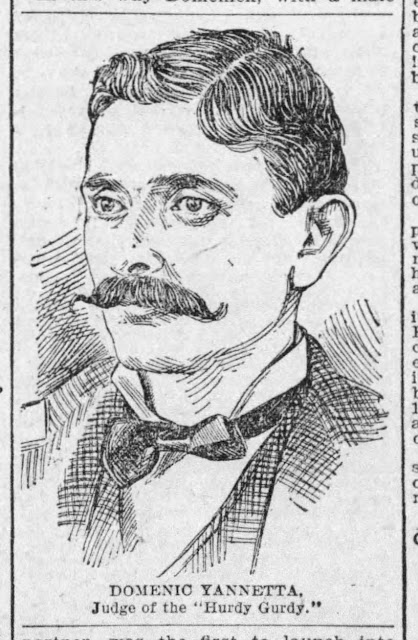
Domenic Yanetta

Keeps Hand Organs in Tune

Husband of Marie Grosse,  Whose Playing

is a Jolly Boston Feature

-------------

His Compensation is the Fee Received

For Repairing Wheezy Machines

------------

Do you know Domenic Yanetta?

Domenick is the English of his name, and, though a great deal depends upon his word, his name as a city official of Boston is now published for the first time.

Probably when you were a child you met Domenick and had the one wish of your babyhood days granted by him, to turn the crank of a hand organ.  But, as is well known, children forget names, even though they never forget their first attempt at hand organ playing.

If you do not know Domenick you ought to, for if your hand organ man, and most everybody has some favorite in this line, has not had his machine inspected within three months, it is to Domenick that you must look to for redress.

There are hand organs without number, but there is only one to whom you can complain with any degree of satisfaction, and he is Domenick, and his headquarters is not at city hall, but 213 Hanover st.

When a lad of about 16 years Domenick came to Boston from sunny Italy.  Soon after his arrival in this city another Italian family by the name of Grosse came here, and the elder Grosse, seeing that money could be made by introducing the hand organ into this country, became the first importer of that instrument.  

In this way Domenick, with a male partner, was the first to launch in to hand-organ playing on the streets of America, and since then he has traveled all over the United States and Europe.

When the "hurdy-gurdy" was first introduced it was the talk of the town.  Money was made as fast as could be expected, and the result was that the elder Grosse, whose place of business was on Battery st., North end, increased the number of machines in use.  At that time all machines had to be imported, and this fact led Domenick to learn the art of tuning, which might be called a business in itself.

After enjoying a year of prosperity in the hand-organ business people began to tire of its then few tunes.  It was hard to get new music, and to make the business a success for any length of time, Domenick says, a person had to keep moving from one city to another.  This ate up a great deal of the profit, and soon the business was abandoned.

A few months after he had given up hand-organ playing, Domenick was being consulted by the elder Grosse as to the best means of disposing of the organs he had in stock.  As it were, they were deadwood on his hands, and as the young player had much experience in traveling, Mr. Grosse was willing to allow him a stated sum for the disposal of the organs.

Among those interested in the consultation was one of the younger daughters of Mr. Grosse, then attending school in the North end.  In a joking way she suggested to her father that now that the men had given up the business as a nonpaying one, why not hire girls to play.

This was a startling suggestion to her father, but it was just what was running in Domenick's mind, for since his becoming a player he learned to look with favor on Marie.  In reply to her father's remark that none could be found who would be willing to undertake the job she offered herself as the first volunteer.

Of course Domenick overcame whatever opposition the father offered, and later, to show his appreciation, "he married the girl", and today is the father of a large American family, while he himself is taking care that those who pay for the music that comes from the hand organ will get what is coming to them without a discordant not.

The appearance of "Happy Marie," as Marie Grosse was styled, was a success, both "financially and socially" and today both man and wife can be seen at parties just as they were seen when they were boy and girl.

About one year ago, when it was legislated that hand organs must be licensed, officer Patterson of station 1 was assigned to look after those desiring to let people hear them play on the streets.  the selection was a good one, but what is an every-day policeman to do when it comes to deciding upon what is what in a hand organ.

If he did not like the way the pipes responded to the popular air he said so, but it is very hard to make a member of the hand-organ fraternity understand anything but complimentary remarks upon the ability of his or her machine.

His advice "to get it tuned" was met with a statement that it had been tuned that morning, and if he happed to contradict this, where was his proof?

Then again a man with any degree of sympathy in his makeup and who is unfamiliar with every fiber of hand organ and language of the player, has no need of passing judgement upon a hand organ.  This Mr. Patterson soon found out, and in order that everybody concerned would be given all that belonged to them, a side partner for himself was looked for.

Domenick all this time was grinding out the latest music, which by the way, had improved considerably since his joining hands with his "Sweet Marie," and his long residence in the North end made him known to everybody in station 1.

One fact well known to all is that there is not a more honest man in the North end than is Domenick.

Church fairs, benefits for disabled persons, and concerts for other charitable purposes have time and again received the use of his instruments free of charge, and only the fact that he realized that the new position would place him where he could be of benefit to many of his poorer but honest countrymen and women, was the reason why he accepted the position, which is not a paying one, when it was offered him.

According to the agreement made he must inspect all machines when required to do so by the music commissioner.

When a machine is found defective and its box is considered sound, he is authorized to charge not more than $1.50 for repairing it.

This is the only compensation coming to him.

What does this mean?  It means that every hand organ and street piano must be inspected by him at least four times a year. It also means that every applicant for a license must have his or her instrument examined and passed upon before the papers are granted.

Besides this it means that the inspector must be a man always ready to assist a person in distress, while at the same time doing his duty, for those under whom he is serving.  he can repair machines free of charge if he so desires, and it is needless to state that often he does so without a murmur.

Then there are those who wish to impose on the public.  There are persons who can afford to hire better instruments.  But in Mr. Patterson Domenick has a man who needs no second word as to the condition of a machine. 

People may try to give pointers to the inspector, but "Come now" from Mr. Patterson is sufficient.  The officer has confidence in Domenick, an so has everybody with honest intentions.  Of late it was found necessary to hire the building at 213 Hanover st., near station 1, to accommodate the large number of applicants seeking permission to play on the streets.

Here everybody desiring to do so can see the transformation of old played-out music boxes into machines whose music would make a shovel dance."
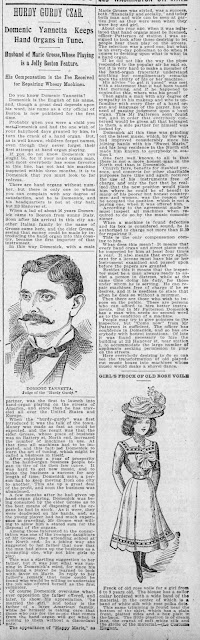

The Boston Globe
12 August 1900
page 25


For the truly curious:

Links to past IANETTA family blog posts:

"Little Musical Performers in Boston 1905"    

https://nutfieldgenealogy.blogspot.com/2022/03/little-musical-performers-in-boston-1905.html   

"Street Organs, Hurdy Gurdies, and Dominic Ianetta of Boston 1900"

https://nutfieldgenealogy.blogspot.com/2022/03/street-organs-hurdy-gurdies-and-dominic.html   

"Boston Police Give a Hurdy Gurdy Party 14 September 1900"

https://nutfieldgenealogy.blogspot.com/2022/03/boston-police-give-hurdy-gurdy-party-14.html  


-----------------------

To Cite/Link to this blog post: Heather Wilkinson Rojo, "Dominic Ianetta "The Hurdy Gurdy Czar" of Boston, 1900", Nutfield Genealogy, posted April 12, 2022, ( https://nutfieldgenealogy.blogspot.com/2022/04/dominic-ianetta-hurdy-gurdy-czar-of.html: accessed [access date]). 

Tuesday, March 29, 2022

Street Organs, Hurdy Gurdies, and Dominic Ianetta of Boston 1900


The Boston Globe, September 9, 1900

My son-in-law's 2nd great grandfather, Dominic Ianetta (1865 - 1952) was a well known musician in Boston's Italian North End.  He lived on Hanover Street, and was listed in various census records and city directories as a piano tuner, musician, and "hurdy gurdy man".  He must have been one of the more talented and famous organ grinders in Boston because the city set up a semi-annual inspection process for street performers, including street organs, and Dominis Ianetta was part of the team.  

Several Boston police officers along with some city musicians were part of the inspections for street organs.  This process must have been intriguing to the public because I was able to find newspaper stories about the inspections every year in the early 1900s.  This one digitized below is one of the earliest.  WARNING:  this article contains language that would not be considered politically correct today, but absolutely racist and offensive. 


"STREET MELODY VENDORS UP FOR INSPECTION

They Play for Prof. Patterson and Mr. Yannetta With Their

Organs and Pianos and Receive Certificates

Prof. Patterson, Mus. D. (doctor of music), left police headquarters in Pemberton square yesterday morning and went down to the North end.  He was neatly clad in a suit of blue, shirt with broad pink stripes and brown derby hat.  His path was strewn with the solemn salutes of the piccolo soloist, the aged violinist, and the picker of a harp who had not yet joined the angel, all of the school Italian.

The professor had advertised a musicale by his pupils, to be held at 213A Hanover st, up over a cigar store, and the inhabitants of the neighborhood were anxiously waiting for the first strains of a fuge to strike their listening ears.

The writer, with a lithograph ticket for the show, arrived at the opera house on time, but failed momentarily in locating the entrance to the auditorium.  The alley was chock full of hurdy gurdies, but not an artist in the whole lot was able to direct the inquirer either to the family circle or the office of the manager.  At station 1, next door, the man behind the rail could give no information concerning the concert, notwithstanding that it was to given under the auspices of the city of Boston.  He referred the reporter to the tobacconist.

The trail finally led to the upper floor at 213A, where Mr. Patterson was found sitting at a small table, a pen in hand and a bottle of red ink within reach.  He was engaged in filling out official blanks with figures which made them look like this:

CITY OF BOSTON

(seal)

POLICE DEPARTMENT

Approved 9 -7.       Approved __________________

When Mr. Patterson is not busy with instrumental music as a teacher and critic, his duties as a special policeman attached to headquarters cause him to ........ pality on the lookout for gentlemen and ladies who beg for a living.  He is equally successful in both lines of his profession, detecting an unworthy solicitor for alms, even more quickly than a false note emanating from a barrel organ.

Inspection Semiannually

Twice a year the street musicians are compelled by the police department to line up for an inspection of the instruments of melody that grind out classics and ragtime from door to door.  June and September are the months in which their machines are put to the strenuous test, and this is September.

"We do not expect symphonic strains," remarked the professor, "but we do insist that the tunes that are played shall not cause distress to the public because of lack of real harmony.  Technique is not necessary.  But monkeys are barred."

Mr. Patterson was joined by Mr. Yanetta, a musical inspector, who has an expert knowledge of the vitals of a hurdy-gurdy, and together they descended to the alley where itinerant musicians and their decorated boxes on wheels were gathered for the first grand musicale of the fall of 1900. 

"Numero!" shouted the professor to one of the Italian artists. Or perhaps he exclaimed "Numera!".  The pronunciation either was not quite distinct, or else the writer, being unacquainted with foreign languages, did not catch the sound correctly as uttered.

Absolute silence - and a wide opening of eyes.

Mr. Patterson, so it seems, is a linguist in addition to his other qualifications as a valuable servant of the municipality.  But he had to admit that he couldn't just follow all the dialects that are in vogue around station 1.

At last Antonio Somebody got it into his head that the doctor of music from headquarters desired to know the number of his old license, and furnished the information that it was 206.

"Play away", ordered the professor.

The French organ, worked by an Italian, threw out into the air a concerto in F that would have sent a thrill of exquisite delight through every fiber of Philip Hale.  In the windows of the station house, facing the alley, just as the bejeweled ladies sit in the boxes at the grand opera, sat the gold-laced officers of the force, drinking in every note as it rose toward the roof and fell back with a thud on the pavement.  It was all free to them.  What the night patrolmen, who were trying to sleep upstairs, thought of the musicale, would probably not be fit to print.

"That will do," said the professor.

Mr. Yannetta repeated the phrase in a foreign tongue.

"Get out of the alley," added the professor, and out went the man and machine without any translation of those words.

"You're Flat"

An Italian with a street piano took off the cover which hid the works, being extremely careful not to mar the picture of a fight between the Chinks and allies which adorned its surface. 

"Play away," said Mr. Patterson, as he dropped on one knee beside an empty fruit box, and with his pen and red ink proceeded to fill out the certificate for the French organ that had passed muster and was licensed to make music for another six months in Boston.

Sousa's march was rattling around in the alley.

"Out of tune," exclaimed Mr. Yanetta.

"You're flat!" broke in Mr. Patterson with energy.

The artist at the handle of the crank simply stared in amazement.

"Tell him he wants to get some new wires," added Mr. Patterson.

Mr. Yannetta explained in Italian to the man, who temporarily failed to secure his card, that the piano would be all right when tuned a bit.

"Get out of the alley," said the professor.

Thus a dozen or more pianos and organs were critically examined, and the new certificates numbered, were pasted on the instruments, where they can be seen day or night, on the streets, for purpose of identification.

Mr. Patterson, special office, M. D. hunter of hoboes and linguist of no mean ability, declared that he must hurry up and get to court, and the musicale in the alley came to an abrupt close with his sudden departure.

There are some 500 hurdy gurdies in the city which are inspected semi-annually.  The inspection of street bands, fiddlers, harpists, and piccolo players, takes place in the office of the professor, up at headquarters, in Pemberton sq." 


Photograph of a street organ by Andrzej Barabasz (Chepry) - Own work, CC BY-SA 3.0, https://commons.wikimedia.org/w/index.php?curid=80060  

For more information on Dominic Ianetta and his family, see this blog post from earlier this month:

https://nutfieldgenealogy.blogspot.com/2022/03/little-musical-performers-in-boston-1905.html   

-----------------

To Cite/Link to this blog post: Heather Wilkinson Rojo, "Street Organs, Hurdy Gurdies, and Dominic Ianetta of Boston 1900", Nutfield Genealogy, posted March 29, 2022, ( https://nutfieldgenealogy.blogspot.com/2022/03/street-organs-hurdy-gurdies-and-dominic.html: accessed [access date]).  

Monday, March 29, 2021

Horace Seaver, Boston News Editor ( 1810 - 1889)


In my last blog post about the Boston Freethinkers and The Boston Investigator newspaper, I noted how my ancestor, Romanus Emerson (1782 - 1852) was a great friend of Horace Seaver, the editor of The Boston Investigator. Both men were Freethinkers, progressives, and abolitionists.  I decided to research a little more about Horace Seaver, to perhaps shed a little more light on how my ancestor came to become a Freethinker, too.  I enlisted a little help from genealogist Randy Seaver, who is a distant cousin to Horace Seaver, the news editor (see below for the genealogies of both men). 

Horace Holly Seaver was named for the famous Unitarian preacher Horace Holly.  His parents wanted him to go to theology school and emulate his namesake, but his faith was put to the test when he joined a debating club and had to argue in support of Christianity.  He listened to a speech by Freethinker, Robert Dale Owen, and this changed his mind about the ministry.  This was very similar to my ancestor, Romanus Emerson's life change.  He wanted to be a minister like his three older brothers, but also ended up a famous atheist in Boston. 

Seaver joined the staff of The Boston Investigator as a typesetter, but assumed control of editing when the regular editor Abner Kneeland was arrested for blasphemy in 1839.  Many famous freethinkers of the day, such as Ralph Waldo Emerson (a cousin to Romanus Emerson), William Lloyd Garrison and Bronson Alcott tried to defend Kneeland's freedom of speech, but he remained in prison for 60 days. After his release he left Boston and started a utopian community out west.  Horace Seaver then became the editor of The Boston Investigator for over 50 years, until his death in 1889.  

When Horace Seaver was still a young editor he joined a meeting of the Freethinkers in New York City on 4 May 1845 where he proposed that the title infidel be used for atheists. He returned to Boston and founded The Boston Infidel Relief Society with my ancestor, Romanus Emerson. Eventually this became a very large, progressive group in Boston.  They built Paine Hall at 490 Washington Street in Boston for meetings, and the offices of The Boston Investigator moved upstairs.  This building was named after Thomas Paine, the famous freethinker. 

The obituary notice for Horace Seaver was published in The New York Times, 22 August 1889:  "Horace Seaver, editor of the Investigator, died yesterday in Boston.  He was born in Boston in 1810, and his connection with the Investigator dates from 1837, when he contributed to that paper a series of articles that attracted wide attention. In 1838 he became editor of the paper and Josiah P. Mendum proprietor, a partnership which had existed uninterruptedly for fifty-one years.  Mr. Seaver devoted a great deal of time to lecturing, his chief theme being "Free Thought".  He was a great anti-slavery man, and was a warm friend of Wendell Phillips, Parker Pillsbury, and William Lloyd Garrison."

The Boston Investigator continued publishing until 1904 when it merged with another Boston newspaper, The Truth Seeker.  Horace Seaver's book was published before his death as Occasional Thoughts of Horace Seaver from Fifty Years of Free Thinking, in 1888.  This book is available to read online through the Google book search.  You can also hear one of the eulogies given at his funeral read aloud at Youtube https://www.youtube.com/watch?v=RpO8EKWSrL0    This "Tribute to Horace Seaver" was originally written and read by the famous Freethinker Robert Green Ingersoll.  

Genealogy:

Below you can see the lineages of both Horace Holly Seaver and the genealogist Randy Seaver.  It is also interesting to note that my 4th great grandfather, Romanus Emerson (1782 - 1852) had a daughter named Emily, who married Melzar Stetson, a 2nd cousin to Horace Seaver.   I am also related to Horace Seaver through his grandmother, Mary May (b. 1657) who is related to me through her own grandmother, Hannah Morrill (my own first cousin 11 generations removed).  

Generation 1:  Robert Seaver born about 1608 in England, and died 5 June 1683 in Roxbury, Massachusetts. He married Elizabeth Ballard about 1634 probably in Roxbury, Massachusetts. 

Generation 2:  Joshua Sever born 30 August 1641 in Roxbury, and died 27 March 1730 in Roxbury.  He married Mary May on 28 February 1677 in Roxbury.

Generation 3: Lt. Joshua Sever born 18 February 1677 in Roxbury, and died 24 September in Dorchester, Massachusetts. On 27 February 1706 he married Mercy Cooke at Dorchester.

Generation 4:  William Sever born 2 September 1721 in Dorchester, and died 4 March 1782 in Dorchester.  On 1 February 1742 in Dorchester he married Patience Trescott, daughter of John Trescott and Sarah Topliff.  She was born 20 March 1722 in Dorchester and died 15 March 1799.

Generation 5:  William Sever, born 8 May 1743 in Dorchester, died 28 July 1815 in Taunton, Massachusetts.  he married first on 15 October 1767 to Mary Foster, and married second on 21 January 1771 to Thankful Stetson.  She was the daughter of Amos Stetson and Margaret Thayer.  

Generation 6: Nathaniel Seaver was born 7 February 1773 in Taunton, and died 17 October 1827 in Boston.  He marry Hannah Loker, daughter of Henry Loker and Hannah Barber on 29 September 1799 in Boston.  

Generation 7:  Horace Holly Seaver was born 25 August 1810 in Boston, and died 20 August 1889 in Boston at 2727 Washington Street.  He was married on 24 September in Providence, Rhode Island to Celinda Griffin, the daughter of James Griffin.  She was born about 1817 in Pelham, New Hampshire and died 9 April 1858 in Somerville, Massachusetts.  No children. 

Genealogy blogger Randy Seaver's lineage:

Generation 1:  Robert Seaver  (1608 – 1683)m. Elizabeth Ballard

Generation 2: Shubael Seaver (1640 – 1730) m. Hannah Wilson

Generation 3: Joseph Seaver (1672 – 1754) m. Mary Read

Generation 4: Robert Seaver (1702 – 1752) m. Eunice Rayment

Generation 5: Norman Seaver (1734 – 1787) m. Sarah Read

Generation 6: Benjamin Seaver (1757 – 1816) m. Martha Whitney

Generation 7: Benjamin Beaver (1791 – 1825) m. Abigail Gates

Generation 8: Isaac Seaver (1823 – 1901) m. Lucretia Townsend Smith

Generation 9: Frank Walton Seaver (1852 – 1922) m. Harriet Louise Hildreth

Generation 10: Fred Walton Seaver (1876 – 1942) m. Alma Bessie Richmond

Generation 11: Fedrick Walton Seaver (1911 – 1983) m. Betty Carringer

Generation 12: Randy Seaver


My blog post on Romanus Emerson "Was Your Ancestor A Freethinker?":

https://nutfieldgenealogy.blogspot.com/2021/03/was-your-ancestor-freethinker.html   

Randy Seaver's genealogy blog Genea-Musings:  https://www.geneamusings.com/


------------------

To Cite/Link to this post:  Heather Wilkinson Rojo, "Horace Seaver,  Boston News Editor ( 1810 - 1889)", Nutfield Genealogy, posted March 30, 2021, ( https://nutfieldgenealogy.blogspot.com/2021/03/horace-seaver-boston-news-editor-1810.html: accessed [access date]). 

Monday, March 22, 2021

Was your ancestor a Freethinker?

The Boston Investigator
Truth, Perseverance, Union, Justice - The Means.  Happiness - The End.  Hear All Sides - then decide.
Devoted to the development and promotion of universal mental liberty


Did you see “Freethinker” describing one of your ancestors in a biographical sketch? Newspaper article? In a flowery Victorian era obituary?
   Did you think it was just an interesting personality trait? A poetic description of your eccentric ancestor? It is time to learn more about the Freethinker Movement, and the entire history of this interesting society!

I had seen my ancestor Romanus Emerson (1782 – 1852) described as a freethinker (or sometimes capitalized as Freethinker) in a compiled genealogy.  I knew he was an atheist and an abolitionist, so I thought that perhaps the author was trying to cover up his controversial, progressive beliefs with a bit of affectation.  But it turns out that this was EXACTLY the proper identification of his beliefs. 

The Freethinkers emerged as a movement in the United States in the early nineteenth century. They took up the cause of Thomas Paine and other earlier deists and atheists at a time when it was still considered blasphemous and sometimes illegal.

In Boston, The Boston Investigator emerged as a Freethinking newspaper, which was founded in 1831 by Abner Kneeland.  Several famous New Englanders such as Ralph Waldo Emerson, William Lloyd Garrison and Bronson Alcott all defended Kneeand when he spent 60 days in jail for blasphemy.  My ancestor Romanus Emerson was a friend of Kneeland, and he often wrote for The Investigator. While Kneeland was jailed, the compositor for the newspaper, Horace Seaver, took over as editor, and Seaver eventually ran the newspaper when Kneeland left Boston to establish a utopian community in the mid-West. 

Horace Seaver ran The Investigator for over fifty-one years, and was a best friend to my 4th great grandfather, Romanus Emerson.  It seems that Freethinking ran in families.  My ancestor Romanus Emerson began his career in theology school to prepare for the ministry, just like his famous cousin Ralph Waldo Emerson, but both set aside these plans for more progressive beliefs like Freethinking and philosophy.  Horace Holley Seaver was named for a famous Unitarian minister, and began his career as a minister, too, but turned to journalism to spread his new views through his Freethought newspaper. 

When Horace Seaver’s wife, Celinda Griffin, died in 1858, he held a “social funeral” that was published in The Investigator. It was the pre-cursor to today’s secular memorial services held in funeral homes.  Romanus Emerson had previously died in 1852, and his final wish was to have his friend Seaver read his self-written eulogy instead of having a Christian service and funeral sermon.  These wishes were not kept by Emerson’s family and friends, and so Seaver instead published the eulogy in The Investigator.  Perhaps this cemented his belief in a secular funeral for his freethinking wife.  Today, this is not considered unusual at all. 

In 1836 the Free Thinkers were founded at a national convention in Saratoga Springs, New York.  At the convention of 1845 Seaver brought up the word Infidel to be adopted as a title for all atheists. Seaver and Emerson founded The Infidel Relief Society of Boston.  Seaver even built the Paine Memorial Hall in Boston for the infidels, with offices for his newspaper upstairs, because infidel meetings were not welcome at other theaters.  The Paine Hall became popular with progressive orators of the time, especially with abolitionists like Garrison, and for meetings for woman suffrage. The Infidel Relief Society even hosted dances and social events such as picnics, and met regularly until the Civil War.  From atheist to infidel to Freethinkers, their beliefs were the same, and they continue today. 

Freethinkers definition:  Freethinkers are often defined by their rejection of religion, or at least of any organized form of religion.  The Freedom from Religion Foundation describes a freethinker as someone “who forms opinions about religion on the basis of reason, independently of tradition, authority, or established belief”.  Today, freethinking is intricately linked with secularism, atheism, agnosticism, and humanism.

The Cambridge English dictionary: “Someone who forms their own opinions and beliefs, especially about religion or politics, rather than just accepting what is officially or commonly believed or taught”.

The Oxford English dictionary: “…the free exercise of reason in matters of religious belief, unrestrained by deference to authority; the adoption of the principles of a free-thinker”. 

Trivia:  Freethinkers Day is commemorated every year on the birthday of Thomas Paine, January 19th as a day to challenge arbitrary authority and question the status quo.

Famous Freethinkers:

Thomas Paine

Robert Frost

Frederick Douglass

Elizabeth Cady Stanton

Benjamin Franklin

Robert Green Ingersoll (famous orator)

Thomas Jefferson

Emma Lazarus

Abraham Lincoln

Albert Einstein


For the Truly Curious:

Freethinkers: A History of American Secularism by Susan Jacoby, 2005

Black Freethinkers: A History African American Secularism, by Christopher Cameron, 2019

Annie Laurie Gaylor, “Horace Seaver”, Freedom From Religion Foundation website, (  https://ffrf.org/news/day/dayitems/item/14517-horace-seaver  accessed 13 March, 2021)

A webpage from Boston's West End Museum about Abner Kneeland:

https://thewestendmuseum.org/wordpress/wp-content/uploads/2015/04/06_Frame-Abner-the-Blasphemer-2-9-15.pdf?   


My blog post about Romanus Emerson’s self written eulogy (that was no read at his funeral) all about his Freethinking beliefs: 

https://nutfieldgenealogy.blogspot.com/2021/02/romanus-emersons-self-written-eulogy.html 


------------------------------

To Cite/Link to this post:  Heather Wilkinson Rojo, "Was your ancestor a Freethinker?", Nutfield Genealogy, posted March 23, 2021, ( https://nutfieldgenealogy.blogspot.com/2021/03/was-your-ancestor-freethinker.html: accessed [access date]).