Showing posts with label Ianetta. Show all posts

Tuesday, April 12, 2022

Dominic Ianetta "The Hurdy Gurdy Czar" of Boston, 1900

 In March I started a series of blog posts on my son-in-law's musical ancestors, including Dominic Ianetta (1865 - 1952), his great-great grandfather.  Dominic and his wife, Maria Carmella Grosse, were musicians and performers at the turn of the 20th century.  Maria was especially famous as a dancer - but I'll be blogging more about her in the future.

In the past few blog posts I transcribed some interesting news articles about the semi-annual inspection of street musicians in Boston.  Anyone who played an instrument on the street (violins, hurdy-gurdies, street pianos, tambourines, etc.) needed a license.  These inspections were regularly featured by reporters in the Boston newspapers.  Dominic was hired by the city to assist the police inspectors. 

This article below tells an interesting history of Dominic Ianetta's immigration to Boston from Italy, and how he met his future wife.  It also describes how he acquired his position as an inspector of street musicians. 

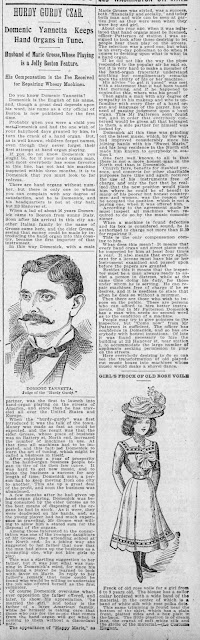
"HURDY GURDY CZAR

Domenic Yanetta

Keeps Hand Organs in Tune

Husband of Marie Grosse,  Whose Playing

is a Jolly Boston Feature

-------------

His Compensation is the Fee Received

For Repairing Wheezy Machines

------------

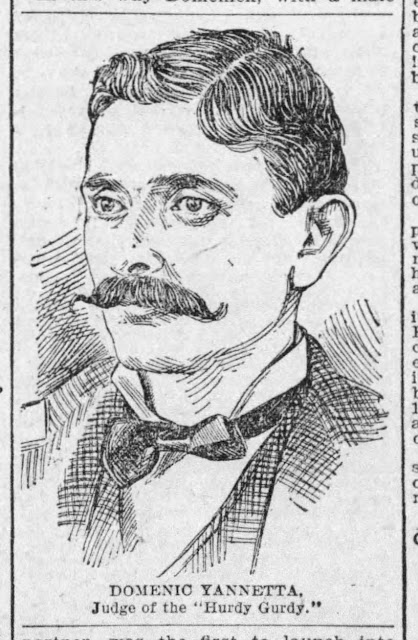
Do you know Domenic Yanetta?

Domenick is the English of his name, and, though a great deal depends upon his word, his name as a city official of Boston is now published for the first time.

Probably when you were a child you met Domenick and had the one wish of your babyhood days granted by him, to turn the crank of a hand organ.  But, as is well known, children forget names, even though they never forget their first attempt at hand organ playing.

If you do not know Domenick you ought to, for if your hand organ man, and most everybody has some favorite in this line, has not had his machine inspected within three months, it is to Domenick that you must look to for redress.

There are hand organs without number, but there is only one to whom you can complain with any degree of satisfaction, and he is Domenick, and his headquarters is not at city hall, but 213 Hanover st.

When a lad of about 16 years Domenick came to Boston from sunny Italy.  Soon after his arrival in this city another Italian family by the name of Grosse came here, and the elder Grosse, seeing that money could be made by introducing the hand organ into this country, became the first importer of that instrument.  

In this way Domenick, with a male partner, was the first to launch in to hand-organ playing on the streets of America, and since then he has traveled all over the United States and Europe.

When the "hurdy-gurdy" was first introduced it was the talk of the town.  Money was made as fast as could be expected, and the result was that the elder Grosse, whose place of business was on Battery st., North end, increased the number of machines in use.  At that time all machines had to be imported, and this fact led Domenick to learn the art of tuning, which might be called a business in itself.

After enjoying a year of prosperity in the hand-organ business people began to tire of its then few tunes.  It was hard to get new music, and to make the business a success for any length of time, Domenick says, a person had to keep moving from one city to another.  This ate up a great deal of the profit, and soon the business was abandoned.

A few months after he had given up hand-organ playing, Domenick was being consulted by the elder Grosse as to the best means of disposing of the organs he had in stock.  As it were, they were deadwood on his hands, and as the young player had much experience in traveling, Mr. Grosse was willing to allow him a stated sum for the disposal of the organs.

Among those interested in the consultation was one of the younger daughters of Mr. Grosse, then attending school in the North end.  In a joking way she suggested to her father that now that the men had given up the business as a nonpaying one, why not hire girls to play.

This was a startling suggestion to her father, but it was just what was running in Domenick's mind, for since his becoming a player he learned to look with favor on Marie.  In reply to her father's remark that none could be found who would be willing to undertake the job she offered herself as the first volunteer.

Of course Domenick overcame whatever opposition the father offered, and later, to show his appreciation, "he married the girl", and today is the father of a large American family, while he himself is taking care that those who pay for the music that comes from the hand organ will get what is coming to them without a discordant not.

The appearance of "Happy Marie," as Marie Grosse was styled, was a success, both "financially and socially" and today both man and wife can be seen at parties just as they were seen when they were boy and girl.

About one year ago, when it was legislated that hand organs must be licensed, officer Patterson of station 1 was assigned to look after those desiring to let people hear them play on the streets.  the selection was a good one, but what is an every-day policeman to do when it comes to deciding upon what is what in a hand organ.

If he did not like the way the pipes responded to the popular air he said so, but it is very hard to make a member of the hand-organ fraternity understand anything but complimentary remarks upon the ability of his or her machine.

His advice "to get it tuned" was met with a statement that it had been tuned that morning, and if he happed to contradict this, where was his proof?

Then again a man with any degree of sympathy in his makeup and who is unfamiliar with every fiber of hand organ and language of the player, has no need of passing judgement upon a hand organ.  This Mr. Patterson soon found out, and in order that everybody concerned would be given all that belonged to them, a side partner for himself was looked for.

Domenick all this time was grinding out the latest music, which by the way, had improved considerably since his joining hands with his "Sweet Marie," and his long residence in the North end made him known to everybody in station 1.

One fact well known to all is that there is not a more honest man in the North end than is Domenick.

Church fairs, benefits for disabled persons, and concerts for other charitable purposes have time and again received the use of his instruments free of charge, and only the fact that he realized that the new position would place him where he could be of benefit to many of his poorer but honest countrymen and women, was the reason why he accepted the position, which is not a paying one, when it was offered him.

According to the agreement made he must inspect all machines when required to do so by the music commissioner.

When a machine is found defective and its box is considered sound, he is authorized to charge not more than $1.50 for repairing it.

This is the only compensation coming to him.

What does this mean?  It means that every hand organ and street piano must be inspected by him at least four times a year. It also means that every applicant for a license must have his or her instrument examined and passed upon before the papers are granted.

Besides this it means that the inspector must be a man always ready to assist a person in distress, while at the same time doing his duty, for those under whom he is serving.  he can repair machines free of charge if he so desires, and it is needless to state that often he does so without a murmur.

Then there are those who wish to impose on the public.  There are persons who can afford to hire better instruments.  But in Mr. Patterson Domenick has a man who needs no second word as to the condition of a machine. 

People may try to give pointers to the inspector, but "Come now" from Mr. Patterson is sufficient.  The officer has confidence in Domenick, an so has everybody with honest intentions.  Of late it was found necessary to hire the building at 213 Hanover st., near station 1, to accommodate the large number of applicants seeking permission to play on the streets.

Here everybody desiring to do so can see the transformation of old played-out music boxes into machines whose music would make a shovel dance."

The Boston Globe
12 August 1900
page 25


For the truly curious:

Links to past IANETTA family blog posts:

"Little Musical Performers in Boston 1905"    

https://nutfieldgenealogy.blogspot.com/2022/03/little-musical-performers-in-boston-1905.html   

"Street Organs, Hurdy Gurdies, and Dominic Ianetta of Boston 1900"

https://nutfieldgenealogy.blogspot.com/2022/03/street-organs-hurdy-gurdies-and-dominic.html   

"Boston Police Give a Hurdy Gurdy Party 14 September 1900"

https://nutfieldgenealogy.blogspot.com/2022/03/boston-police-give-hurdy-gurdy-party-14.html  


-----------------------

To Cite/Link to this blog post: Heather Wilkinson Rojo, "Dominic Ianetta "The Hurdy Gurdy Czar" of Boston, 1900", Nutfield Genealogy, posted April 12, 2022, ( https://nutfieldgenealogy.blogspot.com/2022/04/dominic-ianetta-hurdy-gurdy-czar-of.html: accessed [access date]). 

Thursday, March 31, 2022

Boston Police Give a Hurdy Gurdy Party 14 September 1900

September 14, 1900
Boston Evening Transcript
page 4


Yesterday I posted a story from the September 1900 Boston Globe which had a colorful description of the Boston police department and my son-in-law's great-great grandfather, Dominic Ianetta (1865 - 1952), doing the semi-annual (March and September) inspection of street musicians in the Italian North End of Boston.  Dominic Ianetta (also known as YANNETTA)  was known as "The Hurdy Gurdy Man" of Boston, and he was helpful to the police inspectors during their examinations of the street musicians because he was born in Italy and spoke Italian.  The Boston Globe article was very colorful in it's descriptions, and had a sketch of the street organs and their musicians being examined.  It was also racist in tone.  This article from the Boston Evening Transcript is a bit more level headed.

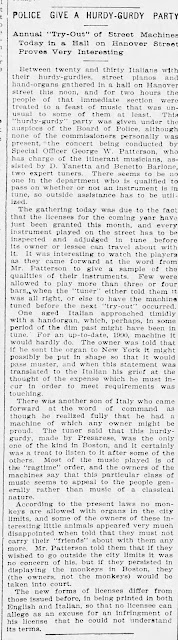
"POLICE GIVE A HURDY-GURDY PARTY

Annual "Try-Out" of Street Machines

Today in a Hall on Hanover Street

Proves Very Interesting

Between twenty and thirty Italians with their hurdy-gurdies, street pianos and hand-organs gathered in a hall on Hanover street this noon, and for two hours the people of that immediate section were treated to a feast of music that was unusual to some of them at least.  This "hurdy-gurdy" party was given under the auspices of the Board of Police, although none of the commissioners personally was present, the concert being conducted by Special Officer George W. Patterson, who has charge of the itinerant musicians, assisted by D. Yanetta and Benetto Barlone, two expert tuners.  there seems to be no one in the department who is qualified to pass on whether or not an instrument is in tune, so outside assistance has to be utilized.

The gathering today was due to the fact that the licenses for the coming year have just been granted this month, and every instrument played on the street has to be inspected and adjudged in tune before its owner or lessee can travel about with it.  It was interesting to watch the players as they came forward at the word from Mr. Patterson to give a sample of the qualities of their instruments.  Few were allowe dto play more than three or four bars, when the "tuner" either told them it was all right, or else to have the machine tuned before the next "try-out" occurred.

One aged Italian approached timidly with a handorgan, which, perhaps, in some period of the dim past might have been in tune.  For an up-to-date, 1900, machine it would hardly do.  The owner was told that if he sent the organ to New York it might possibly be put in shape so that it would pass muster, and when this statement was translated to the Italian his grief at the thought of the expense which he must incur in order to meet requirements was touching.

There was another son of Italy who came forward at the word of command as though he realized fully that he had a machine of which any owner might be proud.  The tuner said that this hurdy-gury, made by Presarese, was the only one of the kind in Boston, and it certainly was a treat to listen to it after some of the others.  Most of the music played is of the "ragtime" order, and the owners of the machines say that this particular class of music seems to appeal to the people generally rather than the music of a classical nature. 

According to the present laws no monkeys are allowed with organs in the city limits, and some of the owners of these interesting little animals appeared very much disappointed when told that they must no carry their "friends" about with them any more.  Mr. Patterson told them that if they wished to go outside the city limits it was no concern of his, but if they persisted in displaying the monkeys in boston, they (the owners, not the monkeys) would be taken into court.

The new forms of licenses differ from those issued before, in being printed in both English and Italian, so that no licensee can allege as an excuse for an infringement of his license that he could not understand its terms."

For the truly curious:

Previous blog posts about Dominic Ianetta, the "Hurdy Gurdy Man" of Boston:

"Street Organs, Hurdy Gurdies, and Dominic Ianetta of Boston 1900"  March 29, 2022  https://nutfieldgenealogy.blogspot.com/2022/03/street-organs-hurdy-gurdies-and-dominic.html   

"Little Musical Performers in Boston 1905"  March 16, 2022

https://nutfieldgenealogy.blogspot.com/2022/03/little-musical-performers-in-boston-1905.html  

--------------------

To Cite/Link to this blog post:  Heather Wilkinson Rojo, "Boston Police Give a Hurdy Gurdy Party 14 September 1900", Nutfield Genealogy, posted 31 March 2022, ( https://nutfieldgenealogy.blogspot.com/2022/03/boston-police-give-hurdy-gurdy-party-14.html: accessed [access date]). 

Tuesday, March 29, 2022

Street Organs, Hurdy Gurdies, and Dominic Ianetta of Boston 1900


The Boston Globe, September 9, 1900

My son-in-law's 2nd great grandfather, Dominic Ianetta (1865 - 1952) was a well known musician in Boston's Italian North End.  He lived on Hanover Street, and was listed in various census records and city directories as a piano tuner, musician, and "hurdy gurdy man".  He must have been one of the more talented and famous organ grinders in Boston because the city set up a semi-annual inspection process for street performers, including street organs, and Dominis Ianetta was part of the team.  

Several Boston police officers along with some city musicians were part of the inspections for street organs.  This process must have been intriguing to the public because I was able to find newspaper stories about the inspections every year in the early 1900s.  This one digitized below is one of the earliest.  WARNING:  this article contains language that would not be considered politically correct today, but absolutely racist and offensive. 


"STREET MELODY VENDORS UP FOR INSPECTION

They Play for Prof. Patterson and Mr. Yannetta With Their

Organs and Pianos and Receive Certificates

Prof. Patterson, Mus. D. (doctor of music), left police headquarters in Pemberton square yesterday morning and went down to the North end.  He was neatly clad in a suit of blue, shirt with broad pink stripes and brown derby hat.  His path was strewn with the solemn salutes of the piccolo soloist, the aged violinist, and the picker of a harp who had not yet joined the angel, all of the school Italian.

The professor had advertised a musicale by his pupils, to be held at 213A Hanover st, up over a cigar store, and the inhabitants of the neighborhood were anxiously waiting for the first strains of a fuge to strike their listening ears.

The writer, with a lithograph ticket for the show, arrived at the opera house on time, but failed momentarily in locating the entrance to the auditorium.  The alley was chock full of hurdy gurdies, but not an artist in the whole lot was able to direct the inquirer either to the family circle or the office of the manager.  At station 1, next door, the man behind the rail could give no information concerning the concert, notwithstanding that it was to given under the auspices of the city of Boston.  He referred the reporter to the tobacconist.

The trail finally led to the upper floor at 213A, where Mr. Patterson was found sitting at a small table, a pen in hand and a bottle of red ink within reach.  He was engaged in filling out official blanks with figures which made them look like this:

CITY OF BOSTON

(seal)

POLICE DEPARTMENT

Approved 9 -7.       Approved __________________

When Mr. Patterson is not busy with instrumental music as a teacher and critic, his duties as a special policeman attached to headquarters cause him to ........ pality on the lookout for gentlemen and ladies who beg for a living.  He is equally successful in both lines of his profession, detecting an unworthy solicitor for alms, even more quickly than a false note emanating from a barrel organ.

Inspection Semiannually

Twice a year the street musicians are compelled by the police department to line up for an inspection of the instruments of melody that grind out classics and ragtime from door to door.  June and September are the months in which their machines are put to the strenuous test, and this is September.

"We do not expect symphonic strains," remarked the professor, "but we do insist that the tunes that are played shall not cause distress to the public because of lack of real harmony.  Technique is not necessary.  But monkeys are barred."

Mr. Patterson was joined by Mr. Yanetta, a musical inspector, who has an expert knowledge of the vitals of a hurdy-gurdy, and together they descended to the alley where itinerant musicians and their decorated boxes on wheels were gathered for the first grand musicale of the fall of 1900. 

"Numero!" shouted the professor to one of the Italian artists. Or perhaps he exclaimed "Numera!".  The pronunciation either was not quite distinct, or else the writer, being unacquainted with foreign languages, did not catch the sound correctly as uttered.

Absolute silence - and a wide opening of eyes.

Mr. Patterson, so it seems, is a linguist in addition to his other qualifications as a valuable servant of the municipality.  But he had to admit that he couldn't just follow all the dialects that are in vogue around station 1.

At last Antonio Somebody got it into his head that the doctor of music from headquarters desired to know the number of his old license, and furnished the information that it was 206.

"Play away", ordered the professor.

The French organ, worked by an Italian, threw out into the air a concerto in F that would have sent a thrill of exquisite delight through every fiber of Philip Hale.  In the windows of the station house, facing the alley, just as the bejeweled ladies sit in the boxes at the grand opera, sat the gold-laced officers of the force, drinking in every note as it rose toward the roof and fell back with a thud on the pavement.  It was all free to them.  What the night patrolmen, who were trying to sleep upstairs, thought of the musicale, would probably not be fit to print.

"That will do," said the professor.

Mr. Yannetta repeated the phrase in a foreign tongue.

"Get out of the alley," added the professor, and out went the man and machine without any translation of those words.

"You're Flat"

An Italian with a street piano took off the cover which hid the works, being extremely careful not to mar the picture of a fight between the Chinks and allies which adorned its surface. 

"Play away," said Mr. Patterson, as he dropped on one knee beside an empty fruit box, and with his pen and red ink proceeded to fill out the certificate for the French organ that had passed muster and was licensed to make music for another six months in Boston.

Sousa's march was rattling around in the alley.

"Out of tune," exclaimed Mr. Yanetta.

"You're flat!" broke in Mr. Patterson with energy.

The artist at the handle of the crank simply stared in amazement.

"Tell him he wants to get some new wires," added Mr. Patterson.

Mr. Yannetta explained in Italian to the man, who temporarily failed to secure his card, that the piano would be all right when tuned a bit.

"Get out of the alley," said the professor.

Thus a dozen or more pianos and organs were critically examined, and the new certificates numbered, were pasted on the instruments, where they can be seen day or night, on the streets, for purpose of identification.

Mr. Patterson, special office, M. D. hunter of hoboes and linguist of no mean ability, declared that he must hurry up and get to court, and the musicale in the alley came to an abrupt close with his sudden departure.

There are some 500 hurdy gurdies in the city which are inspected semi-annually.  The inspection of street bands, fiddlers, harpists, and piccolo players, takes place in the office of the professor, up at headquarters, in Pemberton sq." 


Photograph of a street organ by Andrzej Barabasz (Chepry) - Own work, CC BY-SA 3.0, https://commons.wikimedia.org/w/index.php?curid=80060  

For more information on Dominic Ianetta and his family, see this blog post from earlier this month:

https://nutfieldgenealogy.blogspot.com/2022/03/little-musical-performers-in-boston-1905.html   

-----------------

To Cite/Link to this blog post: Heather Wilkinson Rojo, "Street Organs, Hurdy Gurdies, and Dominic Ianetta of Boston 1900", Nutfield Genealogy, posted March 29, 2022, ( https://nutfieldgenealogy.blogspot.com/2022/03/street-organs-hurdy-gurdies-and-dominic.html: accessed [access date]).  

Wednesday, March 16, 2022

Little Musical Performers in Boston 1905


from The Boston Globe (Boston, Massachusetts), 22 March 1905, Wednesday, page 7

 "BRIGHT LITTLE ARTISTS

Give Marked Evidence of the Instruction They Have Received

    The pupils of Miss Isabel Florence gave an excellent entertainment for their friends last evening in the Children's theatre, Huntington chambers.  Many of the little artists have had only a limited number of lessons, yet their first public appearance on the stage gave evidence of much careful training, and brought forth much well deserved applause.

The program was varied, including character sketches, instrumental music and fancy dances.  Without exception all contributing to the program proved to be possessed of an artistic spirit.

The opening number was a merry circle of little artists, that gave the admiring parents and friends that comprised the audience, an inkling of the instruction the children were receiving.  Those who appeared were Baby Helena, Dorothy Nolan, Helen Jolly, Celia Deutschmann and Marjorie Boyd, the Jarvis sisters, Estelle Seeley, Helen Sylvester and Little Gladys and Helen, as Sambo and Dinah, the hit of "Humpty Dumpty."

Josephine Kirkland gave a dance, and Matilda Yannetta, 10 years old, executed two difficult harp solos.  Bonnie and Hazen Jarvis danced the minuet in a delightfully graceful manner. Eva Lee, aged 8 years, played two piano solos, and then Hermia DeLisle danced a hornpipe, followed by Stella Rothwell in a lively Irish jig.

Matilda and Adelaide Yannetta gave a skirt dance, and Gladys Gilbert executed a jocky toe dance that won much praise. The program closed with an amusing little sketch, which served to introduce Baby Goldie, a 4-year old pupil."

----------------

I found this article online recently during a recent, free weekend of access to Newspapers.com.  My son-in-law has some interesting ancestors from French Canada, Ireland, colonial New England and Italy.  His Italian ancestors were particularly musical, and included his great-great grandparents Dominic Ianetta and Maria Carmella Grosse.  I have not done much Italian genealogy research, but the first thing I learned about the Ianetta family was that there are dozens of spellings of this surname.  This little article appeared in my search at Newspapers.com only after I tried every variation I could think of, and then a few more! 

Dominic Ianetta (1865 - 1952) of Caserta, Campania, Italy married Maria Carmella Grosse (1871 - 1921) of Belmonte Castello, Frosinone, Lazio, Italy on 10 December 1893 in Boston, Massachusetts.  They had eleven children, all born in Boston's North End:

1.  Matilda Angela, born 7 March 1894, died 1993, married Vincent DiPersio

2.  Adelina Laura, born 21 March 1895, died 1977, married Albert Don Safallo

3.  Salvino Angelo "Jimmy", born 29 November 1897, died 1991, married Teresa Marie Galiano

4. Marie, born 28 March 1899, died young 28 August 1899

5. Florence Rose, born 17 November 1900, died 1939, unmarried

6. Alfred Raffaele, born 10 October 1902, died 1947, married Mildred Nuzzolo

7. Lawrence Blasio, born 3 February 1904, died 1981, married Marian Stowe Harris

8. George, born 22 February 1907, died 1934, married Helen 

9. Stella Marie, born 3 February 1910, died 1997, married Anthony Debenedictis

10. Pietro Michael, born 29 Sept 1912, died young 17 October 1912

11. Margharita Louise, born 4 June 1915, died 1976, died unmarried

For the past few years the New England Historic Genealogical society has been conducting a digitization project for the Catholic records of churches in the Boston Diocese. These documents show the records of the seven sacraments (including baptism, marriage and burials) for hundreds of parishes across New England. These are handwritten records with over 10 million names, browsable, searchable (members only) and downloadable.  Best of all, these records are available FREE, even to non-members.

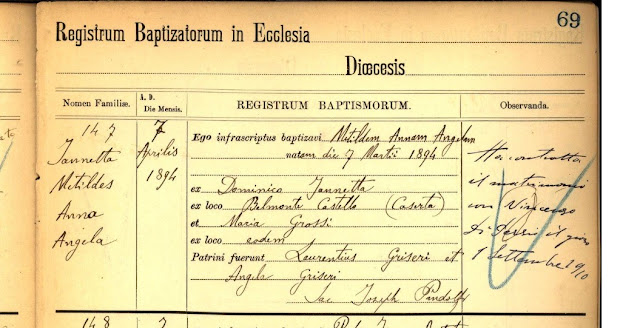
By searching these records for all the variations of the Ianetta name (Janetta, Jannetta, Iannetta, Iannetti, Iannetto, etc). I was able to construct the family you see listed above.  Here is a sample record, showing the baptism of Matilda Ianetta, our little harpist and dancer.  It is recorded entirely in Latin, including her name Matildes Annam Angeles Jannetta, daughter of Dominico Jannetta and Maria Grossi.  Her marriage in 1910 to Vincenzo Di Persio is in the right margin. You can see that the Catholic records give lots of genealogical information, including the birthplace of the parents and the names of the witnesses (who might be kin?). 


I'll be doing some future blog posts about the Ianetta family, and will include some very interesting stories about Dominic, the immigrant ancestor, who was known as the "Hurdy Gurdy Czar" of Boston, and Marie Grosse, who was a famous dancer who performed for Queen Victoria, for Boston theaters, and society events such as soirees at Isabella Stewart Gardner's palace in the Fenway. 

For the truly curious:

Catholic Records at the New England Historic Genealogical Society:   https://catholicrecords.americanancestors.org/  

Newspapers.com    https://www.newspapers.com/    

The New England Historic Genealogical Society  https://americanancestors.org/  

----------------------

To Cite/Link to this blog post: Heather Wilkinson Rojo, "Little Musical Performers in Boston 1905", Nutfield Genealogy, posted March 16, 2022, ( https://nutfieldgenealogy.blogspot.com/2022/03/little-musical-performers-in-boston-1905.html: accessed [access date]).