Showing posts with label Masons. Show all posts

Tuesday, September 20, 2022

John Beahan, died 1816 Portsmouth, New Hampshire

This tombstone was photographed at the Old North Cemetery in Portsmouth, New Hampshire.


HTWSSTKS
Washington 
Chapter

Here rests in peace
the Body of
John Beahan
A native of Ireland
who emigrated to this happy land
AD 1809 died July 31, 1816,
AEt 31
Stranger; Brother; Companions Gone
To join the Royal Arch above,
Where the Great High priest will sure reward
His acts of Kindness, Charity & Love.


 In researching the life of John Beahan I found the website for the St. John's Lodge of Freemasons from Portsmouth, New Hampshire, with an explanation of the symbols on this tombstone.  The initial letters HTWSSTKS are for Royal Arch Masons.  The letters are "Hiram, Tyrian, Widow's Son, Sent to King Solomon", which is a reference to the mason and architect of the Temple of King Solomon.  John Beahan was a member of the Washington Chapter, No. 3, Royal Arch Masons in Portsmouth.  He became a master mason on July 7, 1813.  

John Beahan was a hatter.  He learned this trade in Ireland and he continued with this occupation here in New Hampshire. According to the Portsmouth Freemason website, his gravestone was carved by Samuel Treat. 

For the truly curious:

"John Beahan" by Alan Robinson, Historian for the St. John's Lodge, Portsmouth Freemasons, accessed June 24, 2022:  https://portsmouthfreemasons.org/wp-content/uploads/2011/03/JanuaryTrestle_Board_for_Email.pdf   

North Cemetery Epitaphs:    https://files.cityofportsmouth.com/files/library/North%20Cemetery%20Epitaphs.pdf  

John Beahan's entry at the Find A Grave website:   https://www.findagrave.com/memorial/8091086/john-beahan   

An explanation of HTWSSTKS: 

https://tuisnider.com/2015/08/18/historic-cemetery-symbols-the-acronym-htwsstks-its-meaning/  

-------------------

To cite/link to this blog post:  Heather Wilkinson Rojo, "John Beahan, died 1816 Portsmouth, New Hampshire", Nutfield Genealogy, posted September 20, 2022, ( https://nutfieldgenealogy.blogspot.com/2022/09/john-beahan-died-1816-portsmouth-new.html: accessed [access date]). 

Thursday, July 6, 2017

Historic Valley Cemetery, Manchester, New Hampshire

Valley Cemetery, photo from the Manchester Historic Association Archives

Can you believe that there is a local cemetery I have NOT yet explored in Manchester, New Hampshire?  Well, I was avoiding the Valley Cemetery for years, but just last week I jumped at the chance to go on an informal tour. Why was I avoiding it?  What changed my mind?

Valley Cemetery covers 20 acres and 10 city blocks in downtown Manchester. It is located only one block east of Elm Street, and near the SNHU arena. This large piece of land was donated in 1841 to the city by the Amoskeag Manufacturing Corporation.  It was considered a “garden cemetery” and a public park for pedestrians and picnicking.   The first person buried here was Mary J. Baldwin in 1841.  Members of the Stark family (brother, sister-in-law and niece of Revolutionary War hero General John Stark) had their old fashioned headstones removed to Valley cemetery when the Christian’s Brook Cemetery was bought for redevelopment in the 1850s.

Valley Cemetery’s most interesting feature is a long valley running diagonally through the area.  This valley used to have a water feature, but the creek is now diverted under Elm Street through a culvert. This water feature had a carriage road, with two foot bridges for visitors. There were once benches and two gazebos located along the creek.  Impressive mausoleums and artistic monuments of all sizes could be seen from the bottom of the valley.  Stone staircases led from the lawns above down to the valley.

Valley Cemetery contains the grave sites of mill workers and also the mausoleums of the families who owned the mills and industries that made Manchester a great city in the 1800s.  Among the wealthy gravesites are also the mass graves from two cholera epidemics in the 1800s.  People from all races and ethnicities are buried here including Samanta Plantin (d. 1899) an African American washerwoman who left a large bequest to Tuskegee Institute.
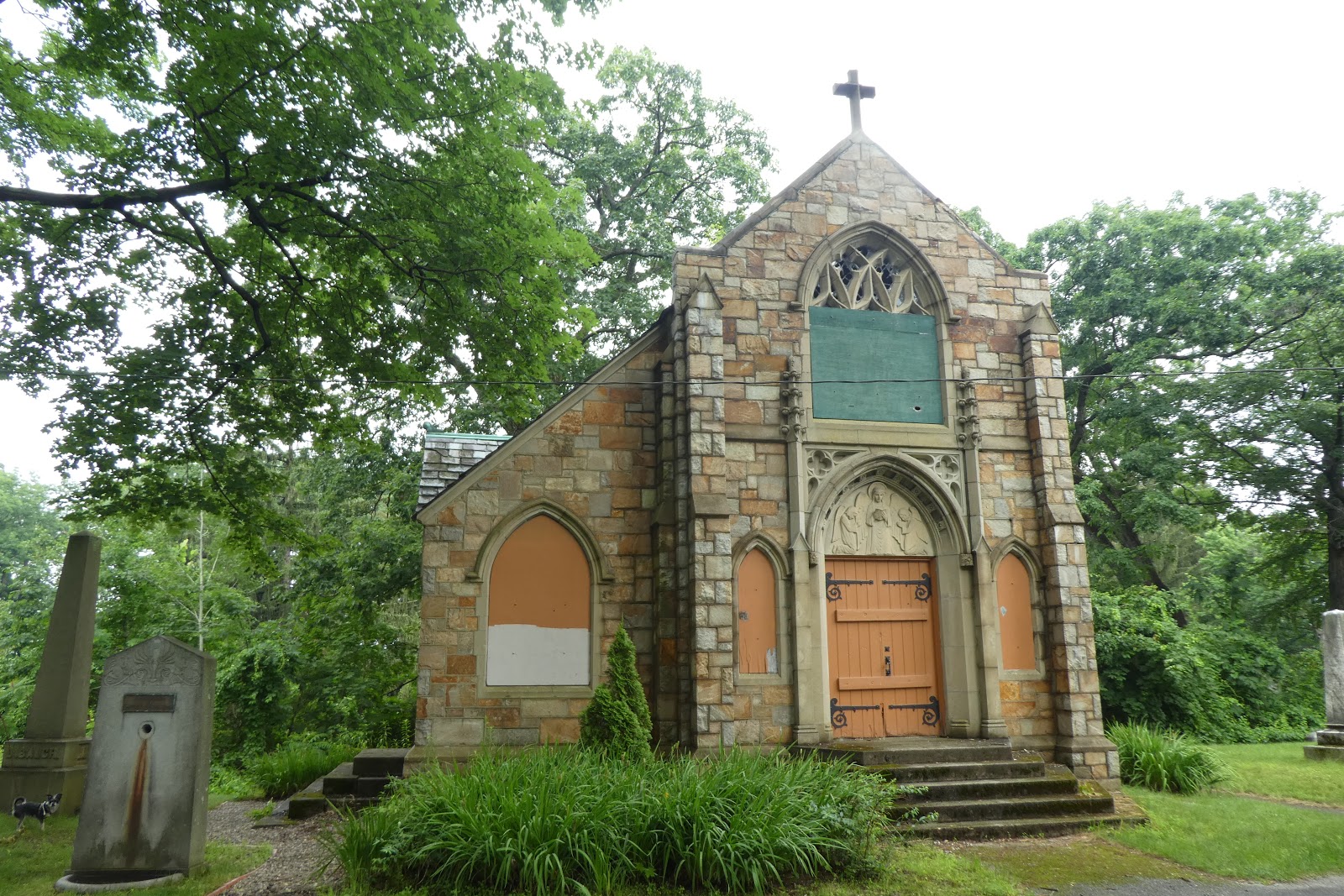
Valley Cemetery Chapel - now boarded up
The cemetery chapel was built in 1932 by Manchester architect and MIT graduate, Chase R. Whitcher for $12,000. There is a receiving tomb built in 1888 for $4,000, and it can hold 75 coffins during the winter. There are 13 mausoleums, the most impressive is the Blood mausoleum near the Pine Street gate, which was built in 1897 for $40,000.  The Frederick Smyth Mausoleum was built in 1885 of white marble and can be seen on the edge of the valley above a steep precipice.

There is one known Revolutionary War veteran buried here – Archibald Gamble who died in 1844.  There are 65 Civil War veterans including 12 officers including Medal of Honor recipient Lt. Henry F. W. Little, Brevet Brigadier General Joseph Carter Abbott, and Captain John M. Caswell.   I saw several graves of veterans from other wars on my tour, but I have no idea how many are buried here.

[UPDATE July 6, 2017 11:30am - Manchester Historian Pat Van Den Berghe says there are 120 Civil War veterans buried here.]

Martha Bouton Cilley Clarke was buried here in 1926.  She was the founder of the Molly Stark DAR (Daughters of the American Revolution) chapter here in Manchester.  In 1932 the DAR placed a bronze plaque in her honor near her gravesite.   Another famous Manchester resident, Samuel Blodgett, died in 1807 and was buried at Christian Brook Cemetery, and reinterred at Valley.  He was the original engineer of the Amoskeag Falls canal, and Derryfield was renamed Manchester, New Hampshire in his honor in 1810.

Valley Cemetery survived the devastating Hurricane of 1938 which uprooted many trees.  By 1953 the cemetery brook was diverted to a culvert and the gazebos were removed.  Since that time the cemetery has been overgrown and forgotten, a place of vandalism and a residence for the homeless.  In 2001 a group called “Friends of Valley Cemetery” was formed to restore the cemetery, but this effort seems to have been abandoned.  The “Friends” was instrumental in getting the Valley Cemetery listed on the National Register of Historic Places, and the cast iron fence around the perimeter was restored, but not much else was renovated or cleaned up.

Valley Cemetery volunteers Mike Drelick and Michelle Caron

Recently, via social media, a new group of volunteers has formed to clean up the Valley Cemetery.  Headed by Manchester resident Mike Drelick and Michelle Caron, this group meets up at Valley several times a week to cut brush, pull weeds, and pick up trash.  They have done an amazing job this summer of uncovering long lost family plots, and clearing paths long forgotten.  They also meet up to just walk the cemetery, hoping that their presence will drive out the unwanted elements of vandals and drug dealers. 

Griffin Family Plot, nearly completely obscured by brush

According to Mike Drelick, he hopes that these volunteer efforts will spur the city into taking more care of this property so that people will return to Valley Cemetery for walking, bird watching and visiting.  The cemetery has a resident flock of turkeys, wildlife, and lots of birds to watch from songbirds to birds of prey.  Art lovers can enjoy the layout of the artistic paths, mausoleums and historic monuments and tombstones. Nature lovers can enjoy the specimen trees (all labeled) and plantings.  Please join Mike one day for a tour, or check out the amazing photos on his Facebook page “Save Valley Cemetery”.

More graves covered by brush and rendered inaccessible
right next to the stone steps going down to the valley

I think Mike’s plan is already showing progress.  Since he has started organizing the cleanup days, the city has come by daily to pick up the dozens of trash bags and brush collected by the volunteers.  A wood chipper was seen yesterday in the cemetery, with two city workers chopping branches and brush.  Carol Robidoux from Manchester Ink Link website has written up a feature article on Mike’s volunteer effort, and this has caused more people to volunteer.

Compare the condition of these stone steps in 2017 to the
antique photo of the valley at the top of this blog post

Mike grew up nearby the cemetery. He’s seen it through its worst phase and has confidence that Valley Cemetery can again become an asset to Manchester, instead of an eyesore.  He described to me how he could envision people visiting the site again for cookouts and concerts, walking tours and picnics. He wants to work together with the parks department to remove brush.  He describes the cemetery as “beautiful” and wonders why the DAR doesn’t place flags on the graves of veterans, and why no one comes to place flowers on the graves here.

I’m hoping that some genealogists, descendants and family members will see the overgrown family plots and be moved to complain to the city, or turn out for volunteer cleanups.  The graves decorated with Masonic symbols and veteran’s gravestones should be adopted by their fraternity and military brothers as community service.  The DAR should turn out to restore the home of their founder’s grave, like they did with Stark Park several years ago.  I also believe that the Manchester mounted police should patrol the paths and old carriage roads here.  The only police presence I saw during my tour was a cruiser who entered at the Pine Street gate, parked by the chapel for 2 minutes, and left.  People walking would feel safer knowing the mounted police were including the cemetery as part of their beat, and it would drive out the troublemakers.

Obvious and deliberate vandalism,
there are many toppled stones here, and graffiti 
I hope these are not your ancestors


If you are at all curious about saving this historic garden cemetery, look at the facts and links below:

Nine Manchester mayors are buried here:
Jacob F. James
Warren L. Lane
Frederick Smyth
Alonzo Smith
David A. Bunton
Darwin J. Daniels
Joseph B. Clark
David B. Varney
William C. Clarke

Two US Senators:
James Underwood Parker
Daniel Clark

Three New Hampshire Governors:
Frederick Smyth
Moody Currier
Ezekiel Straw

There are 13 private mausoleums:
Aretas Blood
E. W. Harrington
Frederick Smyth
Amos and Mary (Ayer) Gale
Nathan Parker
R. H. Ayer
J. W. Fellows and J. A. Moore
Josiah Crosby
Charles A. Gillis
F. Tenny & J. A. Chamberlain
R. J. Parker
George W. Bailey
W. D. Buck

The Artemas Blood mausoleum, now behind
a chain link fence barrier
The Smyth mausoleum 2017 (volunteers cut back the brush)
The Smyth mausoleum (white marble above the valley)
can be seen in this vintage photo courtesy of the
Manchester Historic Association


Photos of Phase I of the Valley Cemetery Restoration Project sign, which has the names of several men who are still aldermen or mayor of Manchester.  What happened to this project? Was there a Phase II in the planning?


Save Valley Cemetery Facebook page:

Carol Robidoux, “Saving Valley Cemetery”, Manchester Ink Link, June 23, 2017

City of Manchester, New Hampshire Valley Cemetery Page:

United States Department of the Interior, National Park Service
National Register of Historic Places Registration Form for Valley Cemetery dated 2004:

Another volunteer effort “Taking Back Valley Cemetery”  headed up by Tanya Frazier, with website and online volunteer registration page at this link:

Other sources of information on Valley Cemetery:

The History of Manchester, by C. E. Potter, 1856

Manchester on the Merrimack, by Grace Holbrook Blood, Manchester Historic Association, 1975

“A Walking Tour of Valley Cemetery”, by the Manchester Historic Association, 2016:  https://www.youtube.com/watch?v=G9h0p6oTORE&feature=youtu.be 

“Autumn Foliage Manchester New Hampshire Cemetery Park”, by 67kneil, 2013:  https://www.youtube.com/watch?v=e1i3SD3xhaQ 

“Historic Places Manchester NH USA Valley St Cemetery”, by 67kneil, 2010:  https://www.youtube.com/watch?v=8halNa9gqTw 


Are your ancestors buried here?  The FindAGrave website has photographed about 65% of the graves at Valley Cemetery.  There are still several outstanding photo requests.  With the volunteers uncovering plots under brush hopefully more will be uploaded to FindAGrave soon.  Here is the link for a list of Valley Cemetery graves listed at FindAGrave:  https://www.findagrave.com/cgi-bin/fg.cgi?page=cr&CRid=103162&CScn=valley&CScntry=4&CSst=32&CScnty=1902&


---------------------------

Heather Wilkinson Rojo, "Historic Valley Cemetery, Manchester, New Hampshire", Nutfield Genealogy, posted Jul 6, 2017, (https://nutfieldgenealogy.blogspot.com/2017/07/historic-valley-cemetery-manchester-new.html: accessed [access date])/

Wednesday, July 29, 2015

Weathervane Wednesday ~ A Fraternal Organization

Weathervane Wednesday is an on-going series of photographs I post weekly.  The first weathervanes I published were from the Nutfield (Londonderry) area, but now I've found interesting weather vanes from all over New England.  Some weathervanes are historical, some are whimsical, but all are interesting.  Often, my readers have sent me photographs of unique and unusual weather vanes from all across the USA and around the world.  If you know a historical or interesting weather vane, please let me know!

Today's weathervane is from New Hampshire.

Do you know the location of weather vane #219?  Scroll down to see the answer!


Today's weather vane was photographed in Hampton, New Hampshire.  You can see this weathervane from the causeway leaving Hampton Beach going west on Route 101.  The Saint James Masonic Lodge is located on a parallel street, at 77 Tide Mill Road. 

This weathervane is the typical mason's square and compass you see used everywhere in Masonic symbology.  These are the tools of the stone mason.  The letter "G" inside the square and compass stands for both "God" and "Geometry".  I've seen this symbol on Masonic halls, on Masonic insignia and jewelry, and on gravestones.  I'm sure you've seen it, too, but this is the first time I've seen it on a weathervane!

Saint James Masonic Lodge 102 -  http://www.stjames102nh.org/  

Click here to see the entire series of Weathervane Wednesday posts!

Click here to read an old 2012 blog post "Was Your Ancestor a Mason"

-------------------------------

Heather Wilkinson Rojo, "Weathervane Wednesday ~  A Fraternal Organization", Nutfield Genealogy, posted July 29, 2015, ( http://nutfieldgenealogy.blogspot.com/2015/07/weathervane-wednesday-fraternal.html: accessed [access date]). 

Tuesday, November 5, 2013

Tombstone Tuesday ~ Henry Moor, M. A., d. 1798 Londonderry, New Hampshire

This tombstone was photographed at the Valley Cemetery in Londonderry, New Hampshire


Henry Moor, M. A. 
departed this life Feb 14, 1798 
AEtat 34

A lecture silent, but of sovereign power
To vice, confusion; and to virtue, peace
Virtue alone has majesty in death

Henry Moor was the son of William Moor and Martha Mack of Londonderry.  He graduated from Phillips Andover Academy in 1787, and from Dartmouth College in 1793.  He was the first preceptor of Groton Academy (now known as the Lawrence Academy at Groton) from 1793 – 1796 for a salary of $745.83.   Following his brief teaching career Henry Moor was a merchant in Londonderry, and died unmarried at age 34. Obviously, he must have been a Freemason.

The St. Marks Lodge of the Free and Accepted Masons is located at 58 Broadway in Derry, New Hampshire. According to their website, they were granted their charter in 1826, and met above James Thom’s grocery store in East Derry, which at that time was still Londonderry.  This is too late to have been the lodge where Henry Moor belonged. I wondered where he became a Freemason?

The New England Historic Genealogical Society’s subscription website www.americanancestors.org has a data base of Massachusetts membership cards from 1733 – 1990.  I didn't find Henry Moor listed there.

According to the website of the Grand Lodge of New Hampshire, the first meeting of New Hampshire Freemasons was on 8 July 1789 in Portsmouth, New Hampshire to create a Grand Lodge for the state.  Many local lodges were involved in this decision, so I’m sure that there must have been a lodge near Londonderry, or perhaps near Dartmouth College, where he became a member.   For example, St. John’s Lodge, No. 1 in Portsmouth was gathered in 1736, one of the oldest Masonic Lodges in the USA.
 
 ---------------------------
The URL for this post is
http://nutfieldgenealogy.blogspot.com/2013/11/tombstone-tuesday-henry-moor-m-d-1798.html
 
Copyright 2013, Heather Wilkinson Rojo

Tuesday, January 8, 2013

Tombstone Tuesday ~ Dr. Phillip Godfrid Kast, Derry, NH

This tombstone was photographed at Forest Hill Cemetery, Derry, New Hampshire


Virtue & silence

ERECTED IN MEMORY OF Dr. PHILLIP
GODRID ~ KAST
He was a gentleman of extensive
aquaintance & his benevolence was no
less Confined.  His hospitality was without
Ostentation - In a word he was a benefactor
to mankind.  In his last sickness hi pain
was xtream which he endured with a 
truly philosophick spirit without y lest
repining almost beyond Example.  He has
Left an inconsolable widow and five Small
Children join'd by the multitude to 
the loss of a tender husband, an indulgent parent, & valuable friend
He departed this life Sept. 6th 17

[the rest of the year was left blank] 

A close up look at the symbols,
a coffin, a shoe, a book, three candles, etc. 

This unusual tombstone is different from most of the engravings at Forest Hill not only because of the odd symbols on top, but for the sentimental wording.  The slate stone was been encased in concrete for preservation by the Derry Masons in the 1920s.  The year of death was not carved into the epitaph, but Dr. Kast died in Londonderry in 1781 after a fall from his horse while visiting a patient.

Phillip Godfrid Kast, son of Dr. Phillip Godfried Kast of Germany and Jane Gowdy, was born about 1743 and died on 6 September 1781.  He was a member of the fraternal order of Masons, and a pharmacist at Salem, Massachusetts. He married Sarah McHard, daughter of Haverhill distiller James McHard,  on 22 January in Haverhill, Massachusetts.  She died 17 May 1835 in Hopkinton, New Hampshire.

For more information on Dr. Phillip Godfrid Kast, see a story by Richard Holmes, the former Derry Town Historian, at this link: http://www.derrynews.com/opinion/x1232766507/Rick-Holmes-A-Loyalists-grave

UPDATE - 9 January 2013

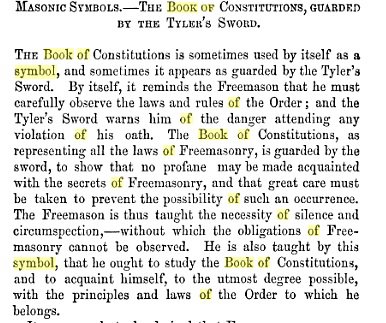
I posted a link to this blog post on Facebook, and several genealogists and historian friends left helpful comments there.  The best was from my friend and fellow member of the Londonderry Historical Society who sent me these three images from the book "Freemasonry, Its Symbolism, Religious Nature and Law of Perfection" by Chalmers Izett Paton, 1873.  Thanks, Penny!  You can find this book at www.archive.org

Three Candles

The Book

The Shoe


------------------------

To Cite/Link to this Blog Post:  Heather Wilkinson Rojo, "Tombstone Tuesday ~ Dr. Phillip Godfrid Kast, Derry, NH", Nutfield Genealogy, posted January 8, 2013, ( https://nutfieldgenealogy.blogspot.com/2013/01/tombstone-tuesday-dr-phillip-godfrid.html: accessed [access date]). 

Friday, December 14, 2012

Boston Tea Party ~ 16 December 1773


The newly re-opened Boston Tea Party Museum

The Boston Tea Party took place on 16 December 1773, and was an act of violence and treason. There is no official list of participants, especially since the men who threw the tea into the harbor were committing a crime. There is a list at the Boston Tea Party Museum website that contains the names of men “documented” to have been at the event. http://www.bostonteapartyship.com/. There is a list of participants at this link, too:  https://familypedia.fandom.com/wiki/Boston_Tea_Party_participants   

In various records I've found several members of my family tree who claimed to have been at the Boston Tea Party. Who knows for sure? What do you think?

Robert Hichborn was the brother in law to my 6x great grandfather Daniel Glover (1735 – abt 1790). He had several famous military brothers in law, including General John Glover (1732 – 1797). Robert Hichborn was a sailmaker and shipbuilder who lived on Anne Street in Boston’s North End, near the site of the Boston Tea Party. He was a member of the Sons of Liberty and was also an officer in the American Revolution. In the Massachusetts Historical Society Proceedings Volume 20, page 11, he was listed along with 25 men, including Paul Revere, to guard the tea (guard?). This is the same bunch accused of tossing it into the harbor.

Nathaniel Frothingham (1746 – 1825) is a 2nd cousin seven generations removed, grandson of my 7x great aunt Hannah (Rand) Frothingham (1672 – 1760), great grandson of my ancestors Thomas Rand and Sarah Edenden. He was a Boston coachmaker or “chaisemaker”and is listed on the Tea Party Museum website, as well as on the SAR list.

Major Robert Davis (1747 – 1798) was a descendant of my ancestors John Gore and Rhoda Gardner. He was an officer in the American Revolution, and a member of the Ancient and Honorable Artillery Company. He was said to have been a member of the Boston Tea Party in compiled genealogies, and was also a Freemason. He is on the museum list, and the SAR list has him as an “importer of groceries and liquors”. I wonder if he was involved with importing tea?

John Holyoke (1743 – 1807) was married to Elizabeth Treat (1747 – 1830) my 2nd cousin 8 generations removed. He served in the American Revolution and claimed to have participated in the Boston Tea Party. “Mr. HOLYOKE never, never confirmed the tale; the whole party was pledged to secrecy” [ Holyoke, A North American Family 1637 - 1992, John Gibbs Holyoke, Gateway Press, Inc. (Baltimore, 1993)] He is not on the lists at the museum or SAR. I’m inclined to think he was telling his grandchildren a tall tale.

Serendipity! Last year I was pleased to find out that fellow genealogy blogger, Deb Ruth, had made a “cousin connection” with me when she was researching her husband’s ancestor James Starr. She was excited to find out that James was a member of the Sons of Liberty, and he had participated in the Boston Tea Party. Starr is listed on the museum website. She wrote about our cousin connection at this link: http://deb-adventuresingenealogy.blogspot.com/2011/11/surprise-connection-hello-cousin.html

There was a Josiah Snelling listed on the page of participants from the Boston Tea Party museum, but there are no details about him. My 4x great grandmother, Catherine Plummer (Jones) Dominis, had a sister, Sarah Dargue Jones (1794 – 1875) who married Enoch Howes Snelling in Boston. Enoch had three cousins named Josiah Snelling, born in 1735, 1741 and 1757. The last one would have been only 16 years old in 1773. All these Snellings lived along the waterfront in Boston, mostly in the North End, where Paul Revere lived, too. I’m pretty sure that the Josiah Snelling on the list is one of these cousins, or maybe even one I don’t have in my Snelling database.

------------

The list of participants from the Boston Tea Party Museum can be seen at this link:
http://www.bostonteapartyship.com/participants-in-the-boston-tea-party

A list of participants from the Old South Meetinghouse website:
https://www.osmh.org/boston-tea-party/who-dumped-the-tea 

There is also a running theme at J.L. Bell's Blog "Boston 1775" about the participants at the Boston Tea Party. He writes posts every December about the possible men who were documented to be at the event, believe it or not. You can find his blog at this link http://boston1775.blogspot.com/

From my Christmas Ornament collection

This blog post was orginally published 16 December 2011 at this link:
http://nutfieldgenealogy.blogspot.com/2011/12/boston-tea-party-16-december-1773.html

-------------

To Cite/Link to this blog post: Heather Wilkinson Rojo, "Boston Tea Party ~ 16 December 1773", Nutfield Genealogy, posted December 14, 2012, ( https://nutfieldgenealogy.blogspot.com/2012/12/boston-tea-party-16-december-1773.html: accessed [access date]). 

Thursday, September 20, 2012

Was Your Ancestor A Mason?


Juniper Hall, Shrewsbury, Massachusetts

Juniper Hall was built by Matthew John Whitall, who manufactured carpets in nearby Worcester. He was a 33rd degree Mason.   His home was built in 1912 on 100 acres of land on top of Meetinghouse Hill, the highest point in Shrewsbury.  Calvin Coolidge visited in 1922 the year Mr. Whitall died.  In 1927 the home was deeded to the Masons of Massachusetts.  Mrs. Whitall wished it to be used for a hospital.  It was used as a Masonic home from 1928 until 1975.  The estate was bought by the town in 1976 and the building was razed. The property is now Prospect Park.

My great grandfather, Joseph Elmer Allen, died at the Shrewsbury Masonic Hospital in 1932.  I wrote to the current Massachusetts Masonic Hospital, which is located in Charlton, for his records.  They sent me a copy of his admittance card, which was about the size of a 5”x7” card.  It stated that he was a 7th degree Mason and was admitted on 4 March 1932.  He died on 12 March 1932 at 10:40 PM.  It was a very short record because he was there such a short time.  He was a member of the Joseph Webb Lodge in Cambridge, Massachusetts.


The Shrewsbury, Massachusetts Masonic Hospital

Recently my mother showed me some on line photos of the old Shrewsbury Masonic home, and I was very impressed with the former residence.  It must have been a wonderful home for the retired and sick Masons.  The postcards I saw on line of Juniper Hall were beautiful, and I’m sure it was still beautiful in 1932.  Perhaps by 1975 it was quite run down, because the town of Shrewsbury tore it down so quickly after acquiring the property.


The Allen Family Plot at the Spring Street Cemetery in Essex, Massachusetts
The top of the large letter A is marked with Masonic symbols, as are
the individual stones of the Allen men who were also members.


Frank Gilman Allen was the brother of my great grandfather, Joseph Elmer Allen


If your ancestors or family members were members of a Masonic lodge, the first clue might be a masonic symbol on a gravestone. The records of the Massachusetts Masons are online at the New England Historic Genealogical Society at www.americanancestors.org   There you will find what lodge your ancestor belonged to, and when they were admitted as members.  You can write to the lodge for more information.   In Massachusetts there is also a Scottish Rite masonic library at the National Heritage Museum in Lexington, and you can see if there are any records on your family members.  www.nationalheritagemuseum.org  The museum often has genealogy classes, too.


For more information:

Massachusetts Mason Membership Cards are available for searching at the New England Historic Genealogical Society website www.americanancestors.org and at this link at Ancestry.com http://search.ancestry.com/search/db.aspx?dbid=5061

The History of Prospect Park, Shrewsbury, Massachusetts:  http://www.prospectfriends.org/History.html

This webpage has photos of the Shrewsbury Masonic Home in its heyday in an article in the Shrewsbury Lantern for a talk by the Shrewsbury Historical Society about Juniper Hall, the Masonic Home and Prospect Park http://shrewsbury.net/?p=2053

An article from Community Advocate, “Shrewsbury Property Rich in History” by Sue Wambolt, contributing writer, dated 8 August 2012, http://www.communityadvocate.com/2012/08/08/shrewsbury-property-rich-in-history/

The Genealogy of Matthew John Whittall http://www.my-family-research.info/?page_id=228

--------------------------

Heather Wilkinson Rojo, "Was Your Ancestor a Mason?", Nutfield Genealogy, posted September 20, 2012, ( https://nutfieldgenealogy.blogspot.com/2012/09/was-your-ancestor-mason.html: accessed [access date]). 

Friday, December 16, 2011

The Boston Tea Party ~ 16 December 1773


On my Christmas Tree, 2011


The Boston Tea Party took place on 16 December 1773, and was an act of violence and treason.  There is no official list of participants, especially since the men who threw the tea into the harbor were committing a crime.  There is a list at the Boston Tea Party Museum website that contains the names of men “documented” to have been at the event. http://www.bostonteapartyship.com/.   The “Sons of Liberty” chapter of the SAR has a list of 58 men at this link http://www.revolutionarywararchives.org/tealist.html

In various records, I’ve found several members of my family tree who claimed to have been at the Boston Tea Party.   Who knows for sure?  What do you think?

Robert Hichborn was the brother in law to my 6x great grandfather Daniel Glover (1735 – abt 1790).  He had several famous military brothers, including General John Glover (1732 – 1797).   Robert Hichborn was a sailmaker and shipbuilder who lived on Anne Street in Boston’s North End, near the site of the Boston Tea Party.  He was a member of the Sons of Liberty and was also an officer in the American Revolution.   In the Massachusetts Historical Society Proceedings Volume 20, page 11, he was listed along with 25 men, including Paul Revere, to guard the tea (guard?).  This is the same bunch accused of tossing it into the harbor.   

Nathaniel Frothingham (1746 – 1825) is a 2nd cousin seven generations removed, grandson of my 7x great aunt Hannah (Rand) Frothingham (1672 – 1760), great grandson of my ancestors Thomas Rand and Sarah Edenden.  He was a Boston coachmaker or “chaisemaker” and is listed on the Tea Party Museum website, as well as on the SAR list.

Major Robert Davis (1747 – 1798) was a descendant of my ancestors John Gore and Rhoda Gardner.  He was an officer in the American Revolution, and a member of the Ancient and Honorable Artillery Company.  He was said to have been a member of the Boston Tea Party in compiled genealogies, and was also a Freemason.  He is on the museum list, and the SAR list has him as an “importer of groceries and liquors”.  I wonder if he was involved with importing tea?

John Holyoke (1743 – 1807) was married to Elizabeth Treat (1747 – 1830) my 2nd cousin 8 generations removed.  He served in the American Revolution and claimed to have participated in the Boston Tea Party.  “Mr. HOLYOKE never, never confirmed the tale; the whole party was pledged to secrecy” [ Holyoke, A North American Family 1637 - 1992, John Gibbs Holyoke, Gateway Press, Inc. (Baltimore, 1993)]  He is not on the lists at the museum or SAR.  I’m inclined to think he was telling his grandchildren a tall tale.

Serendipity! Last month I was pleased to find out that fellow genealogy blogger, Deb Ruth, had made a “cousin connection” with me when she was researching her husband’s ancestor James Starr.  She was excited to find out that James was a member of the Sons of Liberty, and he had participated in the Boston Tea Party.  Starr is listed on the museum website.  She wrote about our cousin connection at this link: http://deb-adventuresingenealogy.blogspot.com/2011/11/surprise-connection-hello-cousin.html

There was a Josiah Snelling listed on the page of participants from the Boston Tea Party museum, but there are no details about him.   My 4x great grandmother, Catherine Plummer (Jones) Dominis, had a sister, Sarah Dargue Jones (1794 – 1875) who married Enoch Howes Snelling in Boston.  Enoch had three cousins named Josiah Snelling, born in 1735, 1741 and 1757.  The last one would have been only 16 years old in 1773.  All these Snellings lived along the waterfront in Boston, mostly in the North End, where Paul Revere lived, too.  I’m pretty sure that the Josiah Snelling on the list is one of these cousins, or maybe even one I don’t have in my Snelling database.

------------

The list of participants from the Boston Tea Party Museum can be seen at this link:
http://www.bostonteapartyship.com/participants-in-the-boston-tea-party

There is also a running theme at J.L. Bell's Blog "Boston 1775" about the participants at the Boston Tea Party.  He writes posts every December about the possible men who were documented to be at the event, believe it or not.  You can find his blog at this link http://boston1775.blogspot.com/

-------------
Copyright 2011, Heather Wilkinson Rojo

Thursday, August 26, 2010

Treasure Chest Thursday - The Imprisonment Quilt

The Imprisonment Quilt

Perhaps the most historic quilt ever made in American History is the quilt made by a queen. A queen in American history? Well, once upon a time there was a Kingdom of Hawaii, with a beautiful palace more high tech than any in Europe or America. There were Kings and Princesses. They had a beautiful, peaceful island nation and political ties with the crowned heads of Asia and Europe. Queen Lili’uokalani of the Kingdom of Hawaii was its last sovereign, and she was deposed and arrested and held as a prisoner at Iolani Palace for six months. During this time she made a famous Victorian style crazy quilt known as the “Imprisonment Quilt”

In 1893, when the ex-queen was implicated in the attempted counter revolution they imprisoned her in a corner room. She was unjustly arrested. Although the other rooms at Iolani Palace are opulent and well appointed, this one room contains only a bare metal bed and a chair. The windows are still furnished with the frosted glass installed to prevent her from looking out the window. It is spartan and definitely "not royal". The one wonderful feature of this room is the display of the famous quilt.

Queen Lili’uokalani was allowed to have one lady in waiting during her imprisonment, but she was not allowed to choose her companion. A woman was chosen every day to sit with her, and to help her pass the time the ladies would sew. She started with four small pieces of scrap material, and the other ladies would ask if they could add to the quilt. Over time hundreds of pieces of ribbons and cloth were put together in the quilt. It is covered with silk embroidery, of symbols of the Hawaiian Kingdom, names of supporters, the Queen’s biography and even a family tree.

Queen Lili'uokalani

As a palace treasure, the quilt is displayed in the Imprisonment Room at Iolani Palace under Plexiglas. We were not allowed to photograph it during our tour of the palace, but I have a photograph of a poster that was on display in the Royal Barracks behind the palace. I was lucky enough to be on the tour with a distant cousin, who pointed out her great grandfather’s name, Ernest Renkin, on one of the quilt squares. Her great grandmother was one of the ladies chosen to be a companion to the Queen during her imprisonment.

There are mysterious symbols embroidered in silk all over the quilt. These include a clock with its hands set at 8:27, a fork and knife, a turtle, a Chinese gentleman with a parasol, a key, a pair of pliers, symbols of Freemasonry, etc. Her brother, King Kalakua, and her husband, John Owen Dominis, my first cousin 4x removed, was a 33rd degree Mason. A small book, The Queen’s Quilt, describes each square on the quilt, many of the names and symbols. This book is available through the Palace gift shop at http://www.iolanipalace.org/ or through bookstores and on-line at Amazon.com.

Note:

There is a second type of famous quilt in Hawaiian history. In 1893 when the monarchy was overthrown, the flag of the Kingdom was outlawed. Women began to sew quilts incorporating the old flag and other symbols of royalty. Scraps of the old flags were often used. Today they are valuable possessions known as “My Beloved Flag”.
A Hawaiian woman displays her flag quilt

Quilting is a very popular hobby in Hawaii. The missionaries who arrived from New England in the 1820s taught quilting to the local women, and it spread in popularity. There are many quilt shops, exhibits, galleries and museums. The women of Hawaii have developed their own style of quilting, which is often using just one or two colors on a white background, usually stylized flowers and leaves. It is very distinctive and popular with tourists as locally made souvenirs; in full sized quilts, pot holders, bags and other smaller gifts.

For more information:

The Queen’s Quilt, by Rhoda E. A. Hackler and Loretta G. H. Woodard, 2004, Friends of Iolani Palace.

http://www.youtube.com/watch?v=4dl3boyzSsM A Hawaiian TV news story on the Imprisonment Quilt, and the story of one of the names on the quilt.


Note:  Queen Lilioukalani married, my first cousin five generations removed, John Owen Dominis (1832 - 1891).  His mother, Mary Lambert (Jones) (1803 - 1889) and my 4th great grandmother, Catherine Plummer (Jones) Younger (about 1799 - 1828) were sisters.

---------------------

To cite/link to this blog post: Heather Wilkinson Rojo, "Treasure Chest Thursday - The Imprisonment Quilt", Nutfield Genealogy, posted August 26, 2010, ( https://nutfieldgenealogy.blogspot.com/2010/08/treasure-chest-thursday-imprisonment.html: accessed [access date]).

Thursday, May 6, 2010

Fort No. 4- at Charlestown, New Hampshire


Old Fort No. 4 has been a living history museum since 1960. It presents a slice of life from the early 1700s, including the French and Indian War. The fort is located along the banks of the Connecticut River, the natural border between New Hampshire and Vermont. It protected English settlers from Indian attacks and French invasions coming down from Canada. Fort No. 4 was built in 1744 to protect Land Grant Number Four.

The Fort No. 4 museum has been closed due to the economy, and the lack of school children’s field trips. I guess field trips were first victims to budget cuts, and nearly every school child in New Hampshire used to take a fourth grade tour of the beloved fort. It is a wooden garrison enclosure, complete with stockade fence, blacksmith shops, powder house and other military buildings. More than fifteen years ago we enjoyed a full blown re-enactment of a battle there, complete with French troops, cavalry, colonial rangers, and an armada of Native Americans advancing down the Connecticut River in dugout canoes.

This past week the Olive Branch Lodge #64 of Freemasons in Chester, Vermont sent out a press release that they will step in to help reopen the closed museum. “The Board intends to host events at the Fort this summer while preparing for a full reopening of the Fort at No. 4 in the spring of 2011.” The Chester Freemasons are also hoping other Freemason Lodges will join them in the re-opening effort.

Here are some photos from last year when we drove out to visit Fort No. 4, only to find out it was closed.

---------------
For more information:

http://www.blogger.com/www.fortat4.org The website of the Museum at Fort No. 4, Charlestown, New Hampshire

http://www.vpr.net/news_detail/87950/ Vermont Public Radio news story about the re-opening of the Fort No. 4 Museum.

Saturday, April 10, 2010

Masonic Genealogy Workshop

The National Heritage Museum, 33 Marrett Road, Lexington, Massachusetts

We were at the National Heritage Museum today for the wonderful exhibit "Jim Henson's Fantastic World" (it runs through June 27th, 2010, and it's FREE!) When the staff pointed out to me this genealogy workshop

The Van Gorden-William Library and Archives stafff (at the National Heritage Museum) will be sponsoring a workshop on Masonic Genealogy, Saturday, May 15, 2010, 1:00 - 3:00 PM. The workshop will include information on the types of Masonic records that exist, where they are located, and how they may be useful to genealogical research as it relates to Freemasonry.

For more information, contact (781) 457-4109 or library@monh.org

Pre-registration is required, call (781) 861-6559, ext. 4101
$15 for NHM members and Freemasons, $20 for others
Registration limited to 10

The National Heritage Museum is supported by the Scottish Rite of Freemasonry
www.nationalheritagemuseum.org

Wednesday, February 17, 2010

Black History Month – Part 2


Yesterday I listed bits of trivia in my genealogy notes related to slaves. Today I’ll write about more tidbits in the genealogy data base related to African American History or slavery, but not directly related to black slaves owned by the family. There were a plethora of abolitionists and social reformers in my family, and their stories are below...

--------------

Romanus Emerson (1782 – 1852) was my 4x great grandfather, and also a cousin to Ralph Waldo Emerson, the sage of Concord. He was a reformer, and also a quite interesting Boston character. From "History of South Boston (It's Past and Present) and Prospects for the Future with Sketches of Prominent Men" by John J. Toomey and Edward P. B. Rankin, Boston, Massachusetts, 1901, pages 224 -225

"Romanus Emerson was one of the residents of "The Village" on Emerson Street, near K Street. He lived in South Boston more than forty years, arriving in 1808, and kept a small grocery store in addition to following his trade of carpenter. During his time he witnessed changes and improvements in the district. He, himself, was forward in every movement for social reform, and took a deep interest in the moral progress of society. In the closing clays of his life he was zealously engaged in the temperance and anti-slavery movements. He was of an easy, quiet disposition, and his temper was not quickly ruffled. He was especially peculiar in his views of religion. Toward the close of his life he renounced all religious opinions whatever, deliberatively holding to his speculative belief. He died October 10, 1852, at the age of 70. "

Romanus’s wife, Jemima Burnham, was the daughter of Colonel Joshua Burnham, the dear friend of the famous Hutchinson singers I wrote about in my blog on January 8, 2010 in “The Hutchinson Family Singers of Milford, New Hampshire.” The Hutchinsons were friends of Frederick Douglass. They traveled with him on his lecture tours and lived near his Lynn, Massachusetts home. I hope that some of the Emerson and Burnham family members had a chance to meet or talk with this great man.
---------------

Dr. Andrew Nichols (1785- 1853) was a resident of Salem, Massachusetts. From the Newhall’s home in East Saugus, Dr. Nichols received and cared for escaping slaves. Andrew Nichols was the head of the Free Soil Party in South Danvers (now Peabody) and a graduate of Harvard Medical School. In addition to helping escaped slaves, he befriended abolitionist lecturers. His tombstone in Peabody bears the words “Erected by the Friends of Humanity to Humanity’s Friend.”

Dr. Andrews Nichols was a cousin through the Ward Family (his wife was Mary Holyoke Ward). After him, there were four generations of Dr. Andrews Nichols in succession, and each Andrew was tied to my Wilkinson ancestors in Salem, up until the early 20th century when my uncle, Bob Wilkinson, worked as for Dr. Nichols (1890 -1978) at the Danvers State Hospital. This Dr. Nichols’ mother (Mary Ann Bill) was sister to my great grandmother Isabella Lyons Bill. This last Dr. Nichols was a reformer in the world of mental health, and advocated humane care in the Massachusetts state institutions at Danvers and Tewksbury.

-----------

Noah Martin Eaton (1832 – 1909) was a South Reading, Massachusetts abolitionist who removed to Lawrence, Kansas, a center of anti-slavery sentiment. His two oldest children out of six were born there in 1861 and 1862. On August 21, 1863, during the Civil War, Confederate guerillas led by William Quantrill burned most of the houses and killed 150 to 200 of the men they found in Lawrence. Noah removed his family back to Wakefield, Massachusetts, where he spent the rest of his life. They were lucky to escape Kansas safely during this violent part of history! Noah’s grandmother was another Emerson cousin of mine, and his wife, Eliza Ruth Walton (1837 – 1856) is a descendant of my Flint ancestral family.
------------

A reversed role….
Dr. Daniel Mason (1647-1698) is a cousin through the Fiske family. He graduated from Harvard College in 1666. He was a physician and in served as a ships surgeon and sailed from Charlestown, Massachusetts in n 1679. He was captured by a Barbary Corsair and carried to Algiers and is supposed to have died in slavery, 1698. These are the Barbary pirates made famous in the Navy hymn “from the shores of Montezuma to the shores of Tripoli” -Tripoli being the capital where they operated during the First Barbary War in 1784 (which was triggered by tributes paid to the pirates – sound familiar?). Thousands of American, Europeans (and Africans) were captured and sold into slavery in North Africa during this episode of history.
--------------

James Putnam King (1817- 1894) was a successful farmer, politician and abolitionist in Peabody, Massachusetts. He became a member of the Massachusetts legislature in 1854, overseer of the poor for the town of Peabody, and was quite well known as a large land owner. Mr. King was not famous, nor produced any noteworthy abolitionist literature, but is typical of the family sentiment in the 1800s. As a reformer, he was well known in Peabody. Mr. King’s brother-in-law married into my Wilkinson family from New Hampshire, and he shared Southwick, Jacobs, Waters, and Trask ancestors with me. Most of these Peabody families were originally Quaker, which may explain their abolitionist beliefs.

Food for thought:

I wonder how many of these Massachusetts abolitionists and reformers knew that certain ancestors owned slaves?

For Part One Click Here

For Part Three Click Here


------------

Copyright 2010, Heather Wilkinson Rojo
-
-