Showing posts with label Rogers. Show all posts

Monday, July 25, 2022

Day Three of the "Path of the Pilgrims" Tour by the GSMD

 Click here to see Day One of the tour:  https://nutfieldgenealogy.blogspot.com/2022/07/on-path-of-pilgrims-tour-from-general.html   

Click here to see Day Two of the tour:  https://nutfieldgenealogy.blogspot.com/2022/07/day-two-on-path-of-pilgrims-tour-by-gsmd.html  

Day Three - The Aptuxet Trading Post in Bourne, Massachusetts, Provincetown, Corn Hill, First Encounter Beach, Cove Cemetery in Eastham, and the Forefathers Monument in Plymouth, Massachusetts - see below

Day Four  https://nutfieldgenealogy.blogspot.com/2022/07/day-four-on-path-of-pilgrims-tour-by.html  

Day Five   https://nutfieldgenealogy.blogspot.com/2022/07/day-five-of-path-of-pilgrims-tour-by.html  

Aptucxet Trading Post, Bourne, Massachusetts
Wampum was the currency of choice at Aptucxet
in the 17th century


Interior of the Aptucxet Trading Post

The Aprucxet Trading Post is a replica of the building erected in 1627 by Plymouth Colony in what is now the town of Bourne.  It was built for trade with the native Wampanoag people and with traders from the Dutch colony in what is now New York state.  The building was contructed according to descriptions in journals and archaeological digs in the area.  The building is situated on the Cape Cod Canal, but in the 1600s this was the banks of the Manomet River.  

The interior of this two room structure replicates the trading post.  There are also displays about the Wampanoag people from this area, and information about wampum, which was the trade item of choice between the Dutch, English and Wampanoag.  They also traded items for corn, beans, fur, and other items for survival and to repay debts to the English companies that financed the Plymouth Colony.  The colonists also operated the Cushnoc Trading Post in what is now the town of Augusta, Maine.  Several of my Mayflower ancestors were instrumental in establishing this trading post - Myles Standish, Isaac Allerton, and John Howland.  
Provincetown, Massachusetts


We ate lunch here, of course!

A Mayflower window over the door of the Mayflower Cafe

Next our tour took us to the tip of Cape Cod, the town of Provincetown, Massachusetts.  This is where the Mayflower made landfall after 66 days at sea.  The ship moored in Provincetown Harbor after failing to navigate the shoals off Cape Cod.  The passengers wrote and signed the Mayflower Compact here, establishing a New England settlement and forming a civil union while they waited for a new patent (permission to settle outside of the original plan near the Hudson River).  

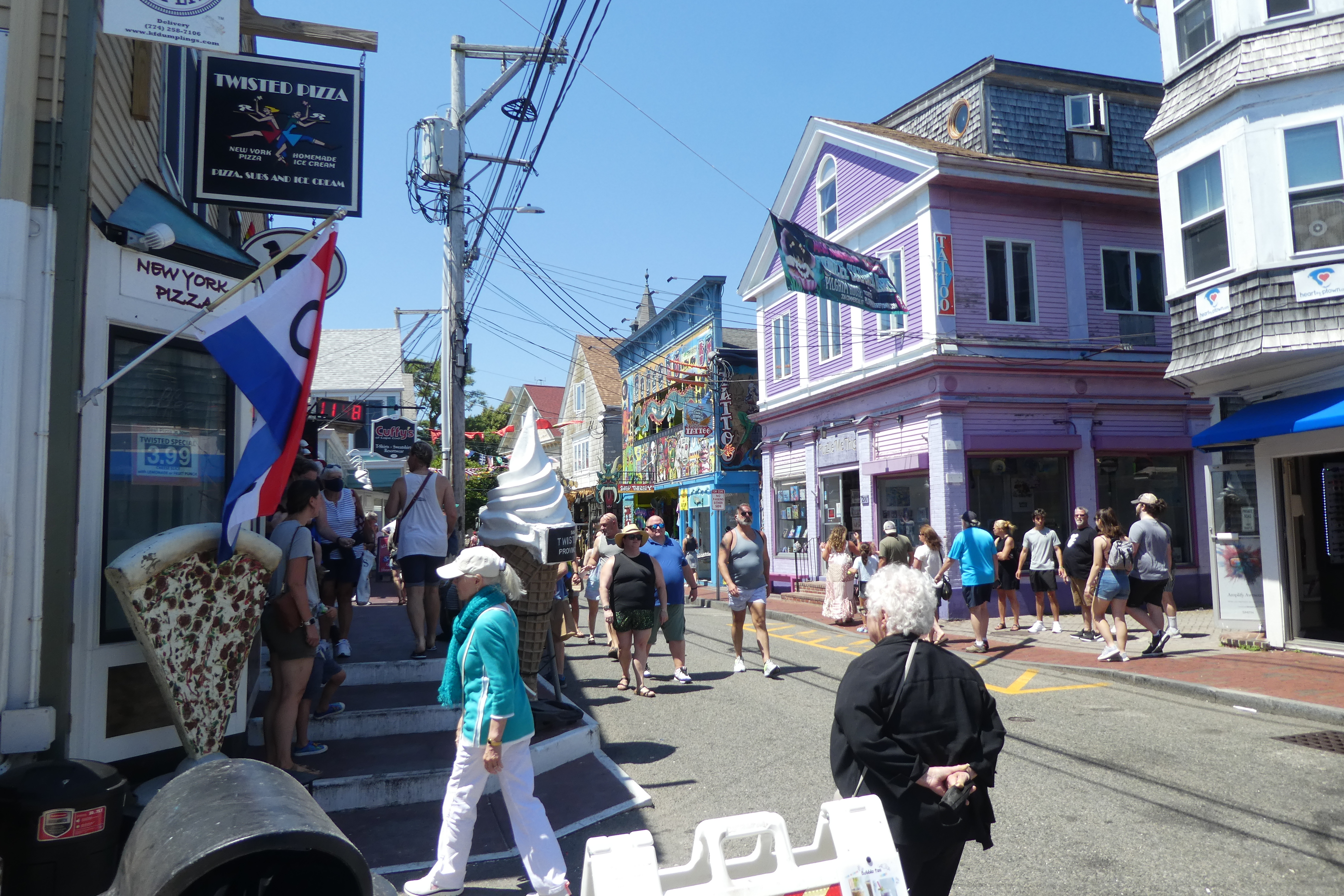
We had time to explore Provincetown and have lunch, before boarding a trolley for a short tour.  The tour gave us a great history of the town, and some of the neighborhoods built over the last 400 years.  I especially liked learning about the fishermens' homes that were floated off the sandbars to line the streets near the harbor.  We had a chance to view the harbor with its breakwater and lighthouse.  Except for a few buildings, it probably looked like it did back in 1620.  

Our tour took us to view the Pilgrim Monument.  This 252 foot tower was dedicated in 1910 to honor the Pilgrims' landing in Provincetown.  It is visible from Plymouth (on a clear day) and from all over Cape Cod.  Years ago Vincent and I climbed to the top, all 116 steps and 60 ramps.  This time we did not climb!  Trivia fact:  President Teddy Roosevelt laid the cornerstone in 1907, and President Taft led the dedication ceremony three years later. There is a museum at the base of the tower, too.  When you are in Provincetown, just look behind the town hall for the funicular to the top of the hill where the tower is lcated. 

The Mayflower Compact was signed here in Provincetown Harbor

The Pilgrim Monument in Provincetown

Corn Hill Monument, at Corn Hill Beach
in Truro, Massachusetts

The inscription at Corn Hill monument

After visiting Provincetown, we went to Corn Hill Beach in Truro, Massachusetts.  This is a lovely beach, considered one of the nicest beaches on Cape Cod.  At the public parking lot you will find this little fenced in enclosure with a marker acknowledging the place where the Pilgrim explorers found a cache of Indian corn in November 1620.  According to Bradford's journal, they did not know if they should steal the corn, but decided to take it because they were starving after the long voyage from England.  This is a controversial part of the Pilgrim story.  Not only because of the theft of the seed corn, but also because the corn was NOT FOUND IN THIS SPOT!

The actual spot where the corn was found is up the hill on private property.  The road to this hill is a private road.  So the first monument (photograph above) is as close as possible to the real spot.  However there is a very small marker on the actual spot, owned by the General Society of Mayflower Descendants who maintain a right of way.  Since we were all members, we took tools to clear out, weed, and visit the monument! 

Tools for maintaining the "real"
Corn Hill marker

Yours truly at the site of the actual corn cache found
on Corn Hill.  It is hidden behind overgrown vegetation. 

The small Corn Hill Marker before clearing the vegetation

The stone is now visible due to everyone helping
to clear the weeds, branches and vegetation. 


Vincent and I hard at work clearing Corn Hill


The monument at the very windy
First Encounter Beach, Eastham, MA

The First Encounter marker

First Encounter Beach

After Corn Hill we went to see First Encounter Beach.  This is the site of another controversial event between the Nauset people and the Mayflower passengers.  The Nauset members of the Wampanoag nation were very wary of the new English men who had arrived in 1620 because several years earlier some of their tribe members had been kidnapped and taken as slaves to Europe (including Tisquantum "Squanto").  When the Pilgrims and the native people met on this beach, arrows and bullets flew but no one was hurt.  The Nauset retreated and the English went back to the Mayflower.  Fortunately, by the spring of 1621 the relations between the two groups improved. 

We were here at First Encounter Beach on a very windy day.  The tide was low, and there were few visitors even though this beach, like Corn Hill Beach, is a very popular site for swimming and boating. It was easy to imagine how it looked in 1620.  

Cove Burying Ground, Eastham, Massachusetts 

The gravesite of Mayflower passenger Constance Hopkins Snow
died 1677 Eastham, Massachusetts

The gravesite of Giles Hopkins, Mayflower passenger,
died 1690 Eastham, Massachusetts 

The gravesite of Joseph Rogers, Mayflower passenger,
died 1673 in Eastham, Massachusetts

While we were in Eastham, we also stopped at the Cove Burying Ground, where three Mayflower passengers are buried.  This cemetery dates to 1646.  There are no 17th century markers surviving, but descendants of the passenger interred here have placed memorials.  See the link below for a listing of burials here, including the Mayflower passengers Constance Hopkins Snow, Giles Hopkins, and Joseph Rogers.  

The National Monument to the Forefathers
Plymouth, Massachusetts


A detail on the monument showing the Mayflower Compact

One of the panels on the monument lists the Mayflower passengers

Our last stop for the day was the National Monument to the Forefathers, on Allerton Street in Plymouth, Massachusetts.  This is a solid granite monument standing 81 feet tall.  It was erected by the Pilgrim Society, and dedicated in 1889.  It was deeded to the Massachusetts government, and the monument and Plymouth Rock are both part of Pilgrim Memorial State Park.  It is not a federal or national park. 

It was nice to visit this monument near sunset.  The most popular part of the monument with our tour group was the panel listing the Mayflower passengers.  Everyone wanted to find the name of their ancestor or ancestors!


For the truly curious:

The Aptucxet Trading Post:   https://www.bournehistoricalsociety.org/aptucxet-museum/   

Provincetown, Massachusett Tourism:  https://ptowntourism.com/   

The Pilgrim Monument in Provincetown:   https://www.pilgrim-monument.org/   

Corn Hill Beach, Truro, Massachusetts:  https://www.truro-ma.gov/beach-office/pages/corn-hill-beach  


First Encounter Beach, Eastham, Massachusetts:   http://www.capecodgravestones.com/easthampixweb/firenccove.html  

Cove Burying Ground, Eastham, Massachusetts:  https://en.wikipedia.org/wiki/Cove_Burying_Ground  

A listing of burials at the Cove Burying Ground:   http://www.capecodgravestones.com/easthamcove.html  

National Monument to the Forefathers:   https://en.wikipedia.org/wiki/National_Monument_to_the_Forefathers  


---------------------------

To cite/link to this blog post: Heather Wilkinson Rojo, "Day Three of the "Path of the Pilgrims" Tour by the GSMD", Nutfield Genealogy, posted July 25, 2022, ( https://nutfieldgenealogy.blogspot.com/2022/07/day-three-of-path-of-pilgrims-tour-by.html: accessed [access date]).  

Tuesday, August 14, 2018

Tombstone Tuesday ~ Samuel Rogers, died 1802, Bow, New Hampshire

This Tombstone was photographed at the East Dunbarton Cemetery, in Dunbarton, New Hampshire.


SAMUEL ROGERS
one of the first
settlers of Bow, N.H.
DIED
March 17, 1802
AE. 77


Samuel Rogers was the brother of Major Robert Rogers (1731 – 1795), the famous Ranger of the French and Indian War.  He was the son of James Rogers (1706 – 1753) and Mary MacPartridge ( 1705 – 1763).  Samuel Rogers was born in 1725 in Ireland and died 17 March 1802 in Bow, New Hampshire. 

He married Anna Caldwell, daughter of Charles Caldwell and Anna Ruggles about 1750.  She was born 28 February 1729 in Goffstown, New Hampshire, and died on 25 Aril 1800.  They had two children:  William born in 1750, and Betsy, born in 1756.

For more information see the book 100 Acres or Less: The History of the Land and People of Bow, New Hampshire,  by David A. Bundy, 1975, or the book Memoir and Official Correspondence of General John Stark, by Caleb Stark. 

---------------------

Heather Wilkinson Rojo, "Tombstone Tuesday ~ Samuel Rogers, died 1802, Bow, New Hampshire", Nutfield Genealogy, posted August 14, 2018, (  https://nutfieldgenealogy.blogspot.com/2018/08/tombstone-tuesday-samuel-rogers-died.html: accessed [access date]). 

Monday, October 13, 2014

A Rogers Group Poem by Robert Frost


A Rogers Group
by Robert Frost

How young and unassuming
They waited in the street,
With babies in their arms
And baggage at their feet.

A trolley car they hailed
Went by with clanging gong,
Before they guessed the corner
They waited on was wrong.

And no one told them so
By way of traveler's aid,
No one was so far touched
By the Rogers Group they made.


I last blogged about Rogers Groups and the sculptor John Rogers more than a year ago at this link:  http://nutfieldgenealogy.blogspot.com/2013/09/have-you-ever-seen-rogers-group.html   These large statuettes were popular during the Victorian period, and were very sentimental and patriotic.   They were immensely popular not just in New England, where they were designed and manufactured, but all over the United States.  Each figurine featured groups of several people posed in scenes from American history, literature or popular culture.

As you read this poem by Robert Frost, can't you just imagine the street scene?  A young family, or perhaps a group of immigrants, waiting on a street corner with all their trunks and children.  After looking at photos of many, many Rogers Groups I'm surprised it wasn't the subject of one of his statuettes.  This Rogers Group sculpture was actually found in the Robert Frost house, and is now on display in the museum in the barn at the Robert Frost farm in Derry, New Hampshire.   The figurine is called "Coming to the Parson", dates from 1870, and it shows a young couple approaching a minister to discuss their upcoming wedding plans.

Robert Frost Farm
122 Rockingham Road
Derry, New Hampshire
603-432-3091
website: http://www.robertfrostfarm.org/


-------------------
The URL for this post is
http://nutfieldgenealogy.blogspot.com/2014/10/a-rogers-group-poem-by-robert-frost.html

Copyright (c) 2014, Heather Wilkinson Rojo

Thursday, September 18, 2014

Are you a descendant of Thomas Rogers of the Mayflower?

Sometimes I get interesting email I just have to share with everyone.  This is one of those occasions!  Please check the links, because they have some of the best local history and genealogy of a Mayflower family I have ever seen.  There is a great sketch of Thomas Rogers (about 1571 - 1620), who died that first winter in Plymouth but his sons Joseph (1602/3 - 1677/8)  and John (1606 - abt 1691) went on to have descendants in the Plymouth Colony. 

St. Peter and St. Paul Church, Watford, Northamptonshire
Where members of the Rogers family were baptized and married
(photo from the website mentioned below)

Dear Mayflower Society Representative,
I hope you don't mind me contacting you by email. My name is Dee Solomon and I live in the small village of Watford in the County of Northamptonshire in England UK.
As I am certain you are already aware, our village is the birthplace of the Pilgrim Father Thomas Rogers, his wife; Alice Cosford and their children.
My reason for contacting you is to bring to your attention our village's history website - which tells the story of Watford from Roman times to modern day. We do have one webpage which is dedicated to the story (as far as we know it) of the Rogers family.
Since we started the website we have had a number of descendants of the Rogers family (now living in the United States of America) contact us for information or photos of Watford - of which we have been happy to assist wherever possible. One person even asked us to send them a leaf from a tree in our churchyard!
Whilst few buildings now exist in the village that were around in Thomas Rogers time, our parish church was built in the 1300s and was, with certainty, where the Rogers family once attended services. Indeed, his father; William Rogers, his sister; Elizabeth and his infant brother; John Rogers were all buried in the churchyard here. Likewise, Thomas and Alice's children were all baptised here too. We still have the 15th Century font in the church that was almost certainly used for the baptisms.
One thing we have noticed is that when descendants are tracing their ancestry they often get our village confused with the much larger town of Watford in the county of Hertfordshire, England UK. Watford in Hertfordshire is only about 60 miles to the south of us and has no connection with the Rogers family. However, we understand how easily people can make this mistake and we try to correct this if we ever see it used on genealogy sites.
We just wanted you to be made aware of our existence here and, if we can ever be of assistance to you and your society or to individual members who are descendants of the Rogers family, please do not hesitate to contact us.
Kindest and best wishes.
Dee Solomon


UPDATE!  5 September 2025 
The three links above to www.watfordvillage.weebly.com no longer are working 

-------------------------

For more information on Thomas Rogers

The Thomas Rogers Society in America http://www.thomasrogerssociety.com/    

The General Society of Mayflower Descendants https://www.themayflowersociety.org/   

The Pilgrim Fathers UK Origins Association and Community Interest Company http://www.pilgrimfathersorigins.org/   

Mayflower Families Through Five Generations: Descendants of the Pilgrims who landed at Plymouth, Massachusetts December 1620: Family of Thomas Rogers, by Ann T. Reeves (Plymouth, Massachusetts: General Society of Mayflower Descendants, 2000) 

"English Ancestry of the Pilgrim Thomas Rogers and his Wife Alice (Cosford) Rogers" by Clifford L. Stott, The Genealogist, No.2 (1989).


Friday, March 7, 2014

America’s First Military Dog? Sgt. Beaubien

"Sergeant Beaubien" by historical artist John Buxton
depicts Rangers on patrol overlooking Lake George.
On the right is William Stark with his famous dog "Beaubien"

Captain William Stark was a member of Roger’s Rangers, and elder brother to General John Stark who was so famous during the American Revolution.  (Gen. Stark coined the famous phrase “Live Free or Die” which became the New Hampshire state motto).   Both Stark brothers were born at the Stark homestead on Stark Road in Derry, New Hampshire (then known as Londonderry).  Each brother took a different side during the American Revolutionary War, but served together in the French and Indian War.  

William Stark adopted a wolf hybrid dog from a French Canadian officer, and he named him Sergeant Beau de Bien.  He entered the dog into the muster roll of the Rangers, and he earned Sergeant’s pay as a scout.  The men called the dog “Beaubien”.  This famous dog was beloved by the Rangers and his story is now part of New Hampshire history.

“He [Beaubien]lived to a ripe old age and though he never boasted of his deeds he was considered a hero.”   History of Rogers Rangers, by Burt G. Loescher, Volume 1, pages 90-91.

A hearing was held recently in Concord at the statehouse to create a canine veteran’s day to honor service dogs.  Twelve other states have such a holiday.  Richard Holmes, the Derry Town historian recently announced at the Londonderry Historical Society meeting on 25 February 2014 that the first military dog in America was Londonderry’s own Beaubien.  His story could be the symbol of the service dogs from New Hampshire for this new holiday. 

For more information:

“Dogs could be honored with Canine Veteran’s Day”, WMUR TV, 20 February 2014 http://www.wmur.com/news/dogs-could-be-honored-with-canine-veterans-day/24587696

“Sgt. Beaubien was another Nutfield First" by Rick Holmes, Derry News, March 13, 2014  https://www.derrynews.com/opinion/column-sgt-beaubien-was-another-nutfield-first/article_bb803e17-8cf0-5a59-bc2a-9bf2248386af.html   

Sergeant Beaubien, original artwork by John Buxton http://www.lordnelsons.com/gallery/frontier/buxton/15.htm

My Londonderry friend just wrote a children's book about a military dog, see this link:
http://www.amazon.ca/The-Adventures-Jethro-Fritz-Feinstein/dp/1457524570 


------------------------------

To cite/link to this blog post:  Heather Wilkinson Rojo, "America’s First Military Dog? Sgt. Beaubien", Nutfield Genealogy, posted March 17, 2023, ( https://nutfieldgenealogy.blogspot.com/2014/03/americas-first-military-dog-sgt-beaubien.html: accessed [access date]). 

Tuesday, February 4, 2014

Tombstone Tuesday ~ Grandmother and Granddaughter, died in a fire, 1704, Portsmouth, New Hampshire

This tombstone was photographed at the Point of Graves in Portsmouth, New Hampshire.  I saw that both the woman and the infant died at nearly the same time, but had different names.  I knew there must be a good story behind this carving...


HERE LYES                                      ELIZABETH
YE BODY OF MRS                     DAUR TO YE
ELIZABETH                                   REVEREND MR
ELATSON                               NATHANIEL &
                                                  SARAH ROGERS
AGED 45 YEARS                       AGED 17 MONTHS
DIED IANRY                           DIED OCTBR ye
1704                                               30  1704

According to the book Historic Burial Grounds of the New Hampshire Seacoast by Glenn A. Knoblock, "Elizabeth Elatson and Sarah Rogers, 1704, Point of Graves, Portsmouth.  Likely the work of William Muford [A Boston Quaker stonecarver], this gravestone has a sad tale to tell. On October 30, 1704, Rev. Nathaniel Roger's house caught fire in the middle of the night.  Mrs. Roger's mother, Elizabeth Elatson, tried to save her granddaughter, Sarah.  But it was not to be.  Little Sarah died that night.  Mrs. Elatson survived the fire, but died of her injuries in January."

If you are wondering how the fire could be in October 1704, and Mrs. Elatson died just a few months later in January 1704, you have to remember the Julian calendar was still being used in the British colonies at this time.  The new year did not take place until March.  Grandmother Elizabeth Elatson died in January 1704/05 using double dating.

----------------------------------
The URL for this post is
http://nutfieldgenealogy.blogspot.com/2013/10/tombstone-tuesday-grandmother-and.html 

Copyright (c) 2014, Heather Wilkinson Rojo

Monday, September 30, 2013

Have you ever seen a "Rogers Group"?

The Millyard Museum, Manchester, New Hampshire
display of "Rogers Groups" and biographical information
on the sculptor John Rogers 

When I was in high school, I worked as a page at the Gale Free Public Library in Holden, Massachusetts.  This was an old stone building with two floors, and the children’s room was in the basement.  I had to run up and down the huge staircases to run errands for the librarians.  Halfway up the grand staircase to the upstairs reference room, there was a landing with a large window and several sculptures on the ledge.  I didn't know it at the time, but they were plaster statues known as “Rogers Groups”. 

One of these sculptural groups was a statue of the figures of John Alden and Priscilla Mullins, two Mayflower passengers.  It always made me pause to stop and look at the details.  John stood with his tall Puritan hat in his hands, looking nervous, as he asked Priscilla if she would marry Myles Standish.  She looked coy as she worked on a spinning wheel.  The words “Why don’t you speak for yourself, John?” were on the base.  Over the years since then, I have seen many copies of this same sculpture in other places, and many others called “Rogers Groups”.
"Why Don't You Speak For Yourself, John?"
photo from the New York Historical Society
Museum and Library website

I recently found out more about the artist John Rogers.  He was born in Salem, Massachusetts and at age 20, in 1850, he started working in the Amoskeag Millyard in Manchester, New Hampshire.  He dreamt of becoming an artist, and would mold small models in his boarding house dining room.   He finally went to Europe to study art and in 1863 started his own company in New York City to produce inexpensive plaster versions of his sculptures. 

Rogers Groups are usually formed out of two or three or more human figures, telling a story from popular literature, popular culture or history.  They were mass produced by the thousands for over thirty years.  You can find them on eBay, in antique stores, or maybe in your attic.  There are about 85 different patented groups.  They originally sold for about $14 each. Your ancestors may have had one in their parlor, or you might even have one in your attic.

My favorite place to see Rogers Groups is at the Vermont Country Store in Rockingham, Vermont. There are a few dozen on display, up above the store shelving, near the ceiling level.  Not many shoppers spend time looking at them, but I certainly do every time I am there!  Vrest Orton, who established the Vermont Country Store, wrote a book about his collection and the statues in 1968. 


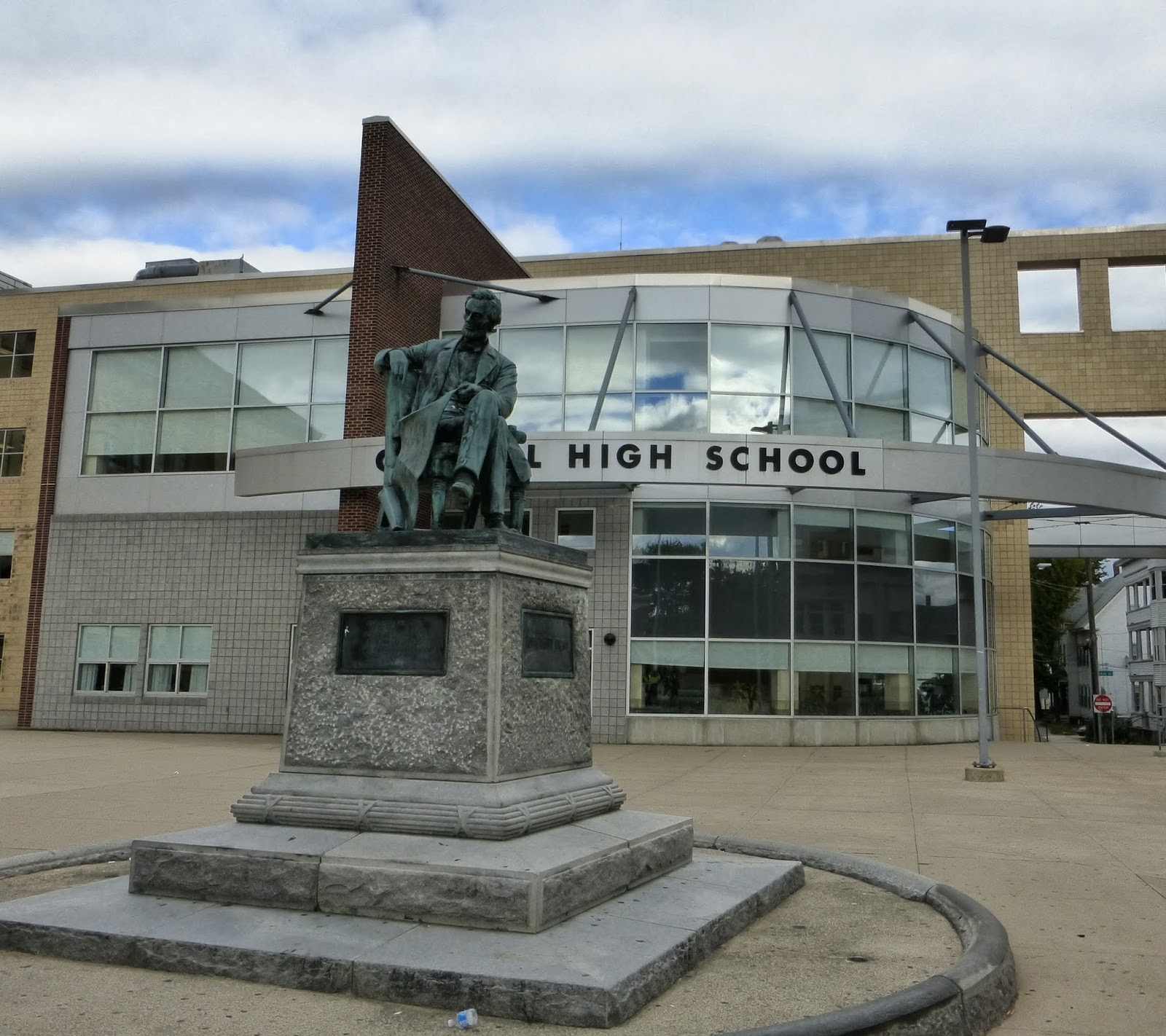
There is a large bronze statue of Abraham Lincoln by John Rogers in the courtyard at Manchester Central High School in Manchester, New Hampshire.  It is one of only a few monumental sculptures by John Rogers, and it was erected in 1876. It was placed on a pedestal in 1910.  The small plaster version mass produced by the Rogers factory is one of the few “groups” with only one figure.  The school was established in 1846, and is New Hampshire’s oldest public high school.


For more information:

The Rogers Family Papers, 1614 – 1950 (bulk 1831 – 1950) are kept at the New York Historical Society Museum and Library, under MS 523   You can find a nice link to the story of John Rogers at this URL  www.johnrogers-history.org by the New York Historical Society.   

This website www.johnrogers.info has a photo with information on every John Rogers Group of statuary ever published.

The Famous Rogers Groups, by Vrest Orton, published by the Vermont Country Store, Rockingham, VT, 1968.  Available for sale at Abebooks.com  and it is also available to read online at Archive.org  at this link: http://archive.org/stream/staturlinc/staturlinc_djvu.txt (no illustrations for the online version) This book is a chronological checklist of over 80 popular sculptures.

John Rogers Statuary by Paul and Meta Bleier, Schiffer Publishers, 2nd edition, 2001.  This book chronicles every group with photographs, size, patent number or design date and stories.

John Rogers, The People’s Sculptor, by David H. Wallace, Wesleyan University Press, 1967.

Genealogy:
(I noticed his mother was a Derby, which led me to look up at his Salem ancestry)

Generation 1: Roger Derby, b. 1643 in Chard, Somersetshire, England, d. 26 September 1698 Salem, m. 23 August 1668 in Topsham, Devonshire, England to Lucretia Hilman

Generation 2: Richard Derby, b. 25 July 1679 Ipswich, d. 25 July 1715 Salem, m. 25 Feb 1702 in Salem to Martha Haskett

Generation 3: Richard Derby b. 16 September 1712 Salem, d. 1783 Salem, m. 3 Feb 1734 in Salem to Mary Hodges

Generation 4: Elias Haskett Derby b. 16 August 1739 Salem, d. 8 September 1799 m. 23 April 1761 in Salem to Elizabeth Crowninshield b. 1736 Salem

Generation 5: John Derby b. 9 May 1767 Salem, Massachusetts, d. 25 November 1831 Salem, m 12 December 1801 in Salem to Eleanor Coffin b. 22 July 1779 in Portland, Maine.

Generation 6: Sarah Ellen Derby b. 6 May 1805, Salem, Massachusetts m. 5 June 1827 in Boston to John Rogers b. about 1802, d. 15 June 1884 in Boston

Generation 7:  John Rogers, born 30 October 1829 in Salem, Massachusetts, died 26 July  1904 at New Canaan, Connecticut  m. 28 April 1865 in New York City to Harriet Moore Francis b. 18 August 1841 in New York City, New York, died 1927.

UPDATE 30 September 2013 2:45pm
The Epsom, New Hampshire Historical Society Blog has a nice post about John Roger's "The Council of War" statuette at their museum:
http://epsomhistory.blogspot.com/2013/06/john-rogers-council-of-war-at-museum.html

--------------------------

The URL for this post is:
http://nutfieldgenealogy.blogspot.com/2013/09/have-you-ever-seen-rogers-group.html 

Copyright (c) 2013, Heather Wilkinson Rojo

Wednesday, April 24, 2013

A 1779 Slave Petition finally passes in the New Hampshire Legislature, 233 years late


Prince Whipple, an enslaved officer in the Continental Army, and 19 other enslaved men from New Hampshire drew up a petition in 1779.  They wanted to be emancipated.  The New Hampshire legislature tabled the petition, saying that it wasn't a good time to vote (it was the middle of the Revolutionary War).  They effectively ignored the black men’s document.   Five of the men and Prince Whipple were eventually freed, and the other 14 died as slaves.

Thirty years ago historian Valerie Cunningham found the petition on the front page of the New Hampshire Gazette and wrote about it in her book Black Portsmouth.   To raise awareness for the Portsmouth Black Heritage Trail and the fundraising effort to erect a memorial on the site of the African Burying Ground, the committee asked Senator Martha Fuller Clark to revive the petition.  She introduced it to the Senate in January 2013. 

Now 233 years later, New Hampshire is changing history.  In March 2013 the New Hampshire Senate unanimously passed the bill.  Today, on 24 April 2013 the New Hampshire House voted on the bill to free the 14 slaves.  The vote passed (344 yeas and 2 nays, then after a revote it was unanimous).

Although only about 1% of New Hampshire’s population is of African American descent, this action rights a wrong that has been long overdue.  The small number of blacks in New Hampshire makes them less likely to be heard in political matters.  This vote freed those 14 enslaved men posthumously. Their fate had languished in limbo for 233 years.

To go along with the celebration, just yesterday, the National Endowment for the Arts gave a $20,000 grant to the African Burying Ground Memorial Park.  This brings the total raised to $720,000.  The African Burying Ground Committee is looking to raise $1.2 million.  This recognition from the NEA helps to bring the project into the national spotlight.

Judy G. Russell, the “Legal Genealogist” asked me to photograph this petition at the New Hampshire State Archives, for one of her lectures at the National Genealogy Society conference.  If you are attending the conference in Las Vegas, Nevada 8 – 11 May 2013, you can hear all the details from Judy, an expert lawyer and genealogist (a terrific combination).  My photographs were donated to the State Archives, and are on file at the State Archives office for anyone who would like to see a copy of the petition.  Here is page one above.

These are the names of the enslaved men who signed the petition. Do you recognize any of these surnames from your New Hampshire family tree?

Nero Brewster
Will Clarkson
Garrett Colton
Peter Frost
Zebulon Gardner
Cesar Gerrish
Seneca Hall
Cipio Hubbard
Winsor Moffat
Cato Newmarch
Jack Odiorne
Romeo Rindge
Pharaoh Rogers
Quam Sherburne
Pharaoh Shores
Kittindge Tuckerman
Cato Warner
Peter Warner
Samuel Wentworth
Prince Whipple (owned by William Whipple, signer of the Declaration of Independence)

For the truly curious:

Click this link to see the 1779 Freedom Petition as published in the New Hampshire Gazette, 15 July 1780:  http://www.trinityhistory.org/AmH/SlavesNH1779.pdf

Black Portsmouth by Mark J. Sammons and Valerie Cunningham, University of New Hampshire Prss, Published by University Press of New England, Lebanon, NH, 2004

Seacoastonline announces the vote today at this link:
http://www.seacoastonline.com/articles/20130424-NEWS-130429868

The Portsmouth African Burying Ground http://www.africanburyinggroundnh.org/

The Portsmouth Black Heritage Trail http://pbhtrail.org/web/

The New Hampshire State Archives  http://sos.nh.gov/arch_rec_mgmt.aspx

A lesson plan from the New Hampshire Historical Society about the 1779 Slave Petition:

The NGS 2013 Family History Conference http://www.ngsgenealogy.org/cs/conference_info

------------------------------

Heather Wilkinson Rojo, "A 1779 Slave Petition finally passes in the New Hampshire Legislature, 233 years late", Nutfield Genealogy, posted April 24, 2013, ( http://nutfieldgenealogy.blogspot.com/2013/04/a-1779-slave-petition-finally-passes-in.html: accessed [access date]). 

Monday, November 26, 2012

Roger's Rangers


Robert Rogers, 1727 – 1795

In New England, one of the most interesting roles to play in battles re-enactments is to be a member of Rogers Rangers.  This is a maverick group, and the actors don’t wear colonial uniforms, but buckskins and moccasins like Daniel Boone.   The Rangers became famous fighting in the French and Indian war, chasing the enemy up and down the Connecticut and Merrimack River valleys, which were the major highways of the time.

Robert Rogers was raised in Londonderry, when it was a frontier to the wilderness.  Beyond Londonderry was disputed territory belonging to Indian tribes and the French.   There were no formal schools in Londonderry at the time, and we can imagine when he learned to read and write, it was at home.  He learned to hunt with his Scots Irish neighbors, and to be comfortable in the wilderness.   In 1739 his family removed from Londonderry to near present day Concord, New Hampshire.   His father called his land Munterloney, after a place in Derry, Ireland.  It was later called Dunbarton, New Hampshire.

Rogers became a scout for Captain Ladd in 1746, and when he was a teenage boy.  In 1753 he was mustered into Captain John Goffe’s company.   At the expedition against Crown Point Robert Rogers was named Captain and the Second Lieutenant was John Stark.  Rogers kept journals at this time, which are an interesting view of the war from the frontier.   His troop was now known as “Rogers Rangers” and in 1757 they reconnoitered Lake George by snowshoes, and attacked a wagon train supplying the French.   This was known as the “Battle of the Snowshoes.”  He was wounded at this battle, but highly commended by General Abercrombie. 

Rogers later took his Rangers to the siege of Louisburg, missing the siege of Fort William Henry whilst he was in Nova Scotia.  He returned to Lake George, New York, in 1758 where he lost 114 out of about 200 men.  After many other skirmishes along the New York border, he was at the siege of Detroit in 1763.  He was to be tried for high treason and court-martialed in 1768 due to his mismanagement of Fort Michilimackinac.   However, he sailed for England to escape the trial.  He was feted by the nobility in England, probably because of the wild tales he could tell of life in the wilderness fighting the Indians.

By now he was known as Major Rogers, and earned a large estate in Concord, New Hampshire.  He married the daughter of a Portsmouth minister.  The marriage didn't last, and his wife petitioned for a divorce in 1778, on the grounds of desertion.   She lived with her second husband on the estate in Concord.

He appeared again in America in July 1775 on behalf of the British Army.   The people of the colonies regarded him as a spy, and he was arrested in Pennsylvania.   He appeared in Hanover, New Hampshire where he paid a visit to President Wheelock of Dartmouth College.  He proposed a deal to Wheelock to obtain a grant of land for Dartmouth from the Crown in exchange for aiding him, yet Rogers disappeared the next morning.   He was finally arrested again in New York, and he fought his last battle at Mamaroneck and was defeated by the colonists.   He returned to England and died there in 1795.

Rogers had a romanticized life, portrayed by writers and actors as an adventurer, yet his life ended in disgrace according to the Americans.  The British probably have a different point of view!

---------

For more information:

An American edition of Roger’s Journals was first edited by Dr. Franklin Benjamin Hough and published in 1883 and a new edition The Annotated and Illustrated Journals of Major Robert Rogers was edited by Timothy J. Todish, Purple Mountain Press, 2002

Rising Above Circumstances: The Rogers Family in Colonial America by Robert J. Rogers, Sheltus & Picard, 1998

Parker’s History of Londonderry, page 180 and 238

The Bay State Monthly, Volume 2, Issue 4, pages 211-   (January 1885), "Robert Rogers, The Ranger", by Joseph B. Walker

War on the Run: The Epic Story of Robert Rogers and the Conquest of America's First Frontier by John F. Ross, Bantam Publishing, 2009

See the website http://www.montalona.com/ for more genealogical information on the Rogers family

-----------------------
Rogers Family Tree:

Gen. 1.  James Rogers, born 30 June 1706 in Ireland, died in 1753 in Bow, New Hampshire, buried in the Forest Hill Cemetery, Derry, New Hampshire;  married  December 1725 in Ireland to Mary McFatridge, born about August 1705 in Ireland, died before 1772 in Dunbarton, New Hampshire.  Ten children.

Gen. 2. Robert Rogers, born 7 November 1731 in Methuen, Massachusetts (a staging point for Ulster Scots headed to New Hampshire), died on 18 May 1795 at Borough, England;  married about 1760 to  Elizabeth Browne, daughter of Reverend Arthur Browne of Portsmouth, divorced in 1778.  One child.

Gen. 3.  Arthur Rogers, Esquire,  born 12 February 1769 in Portsmouth, New Hampshire, died 1841 in Concord, New Hampshire.   He was a lawyer.  He married about 1795 in Concord to Margaret Furness, daughter of Robert Furness.   She was born 2 July 1770 in Portsmouth and died in 1848.  They had nine children.

For a related story see "Scots Irish at Concord, NH" by my guest blogger, Tom Tufts 
------------------------------
Copyright 2012, Heather Wilkinson Rojo

Monday, August 13, 2012

Scots Irish at Concord, NH, and the "Irish Fort"

Scots Irish Early Settlers at Concord, New Hampshire and the "Irish Fort"
By Guest Blogger Tom Tufts  ttuftsy@comcast.net

The Advanced Guard, June 21, 1759 *
The Scots-Irish went many places after landing in Nutfield. They were considered squatters at Concord and built what may have been the first fort in the interior of New Hampshire. Previous forts were in place at the Seacoast to protect from foreign invasions and every community had garrison houses built for defense, but theirs seems to be the first called a fort.  The only fort before this was built for an injured soldier on the way to Lovewell’s fight in Pigwacket (Fryeburg Maine) in 1725 and was merely a “palisaded log cabin”. (This is quoted from one of the best books on the conflict; A Half-Century of Conflict by Francis Parkman. The injured soldier of Lovewell’s was Benjamin Kidder of Nutfield.) The Fort at #4 in Charlestown, NH was built later.

We know the Scots-Irish were in Nutfield as early as 1719 and apparently some moved on to Concord by 1721-1722. This is mentioned in The military history of the state of New-Hampshire, from its settlement, in 1623, to the rebellion, in 1861: comprising an account of the stirring events connected therewith; biographical notices of many of the officers distinguished therein: and notes explanatory of the text by C. E. Potter. That reference states in the same chapter that the fort at Penacook (Concord) was there in 1722 when Massachusetts sent soldiers there to take command of it and drive off the Irish. How successful they were is open to debate and further research. They could be the families that settled in Dunbarton and surrounding towns like Bow. The History of Concord…by The Historic Commission and Lyford states that surveyors in 1722 found the Irish there and reported it to the authorities, claiming they had a grant from New Hampshire to make a settlement there. 

The Massachusetts government thought enough of this report to send a troop there to investigate. They did indeed find the Scots-Irish settled there and in the discussion of who had the power to hold or grant the land, the Scots-Irish spokesman, (a Mr. Houston) told Lt. Frie (or Frye) and his troop to remove themselves or they would drive them off. No one was removed and the Lieutenant sent back to Massachusetts for advice but it appears they stayed and surveyed the settlement on the west side of the river and the Irish maintained their homes in what is now East Concord. By 1724 they had erected a fort within 80 rods of Sewall’s farm “upon the interval on the east side of the river with a view to permanent occupation”. This was the “Irish Fort” and in 1725 the Indian hunter, Col. Tyng rested there on his way to scout for Indians in the Winnipesauke area. Since then this area has been know as the fort and encompasses East Concord which is near to New Hampshire’s current “Fort”, the National Guard base.

It seems though, that the Irish settlers were to be caught up in the fight between Massachusetts and New Hampshire for the rights to settle the land. They had long fought over the boundary between the two states and this was miles to the north but they both claimed it as their own. Even to the point where each sent surveyors to lay out the land and enticed settlers with money to settle there. Each state also granted lands and lots and in 1725, families from Andover, Haverhill and other Essex County towns started to settle on the west side of the river. Nothing more is said of the Irish in that publication. In Bouton’s History of Concord the Irish of Nutfield are mentioned as having a fort there prior to the grant by Massachusetts. One of the petitions even states that “as in the case of Nutfield, it would be a thing attended with too much difficulty to pretend to root them out, if they should get a foothold there”.

Robert Rogers at the Battle on Snowshoes
from http://www.lakegeorgemirrormagazine.com/tag/rogers-rangers/ 
The Indian danger was present from the first settlements right up until the Revolutionary period. Some historians have called this Americas bloodiest conflict as it was deadlier per capita compared to the Civil War or the World Wars. At times referred to as the French and Indian wars, they can be defined by monarch and time period and relation to the European conflict they accompanied. No matter what you call it the period from first settlement to late Eighteenth Century was a warring time. Each village had to muster and drill and numerous lists of these soldiers are available. The Scots-Irish were not unaccustomed to this as they had endured the same fate before coming to America. Their history there is full of war stories. A full chapter of History of Londonderry is devoted to their turbulent times in the British Isles. Their names are scattered throughout the early rosters of Militia. It is no surprise that on settling at “Penacook” they built a fort for protection from the Indians. Robert Rogers the famous Indian hunter and first leader of “Rangers” in the military was said to be Scots-Irish but there was debate over whether he was from Londonderry or Massachusetts.

Next time….more on the Scots in the local militias and offensive attacks on Louisburg Nova Scotia and Canada.

-----------------------------

The histories mentioned in this article are:

History of Concord, New Hampshire: From the Original Grant in Seventeen Hundred and Twenty-five to the Opening of the Twentieth Century, by Concord (N.H.). City History Commission, Amos Hadley, Will B. Howe

The History of Concord: From Its First Grant in 1725, to the Organization of the City Government in 1853, with a History of the Ancient Penacooks ; the Whole Interspersed with Numerous Interesting Incidents and Anecdotes, Down to the Present Period, 1885 ; Embellished with Maps ; with Portraits of Distinguished Citizens, and Views of Ancient and Modern Residences by Nathaniel Bouton

The History of Londonderry, Comprising the Towns of Derry and Londonderry, N. H. by Edward Lutwyche Parker


*  Based on primary source descriptions of the campaign, this painting depicts Major Robert Rogers and “Captain Jacobs” (an Indian) as they scout the forest ahead of General Jeffrey Amherst’s army on their way to capture Fort Carillon (Ticonderoga) and other French posts on Lake Champlain. In the left background is the front of the Ranger column and on the right, in brown, is General Thomas Gage’s Light Infantry. In between, behind the flag is a British Regular officer and a lieutenant colonel of a Provincial regiment. Two of the Ranger companies are made up of Stockbridge Indians, captained by Jacob Cheeksaunkum (Captain Jacobs) and his son. (From Gary Zaboly and www.fortat4.org)  (Copyright © 2008 Fort at No. 4, All Rights Reserved)
--------------------
Copyright 2012 Heather Wilkinson Rojo and Tom Tufts