Showing posts with label Howland. Show all posts

Tuesday, February 21, 2023

John Howland, Mayflower Passenger, died 1673 - Tombstone Tuesday

 This tombstone was photographed at Burial Hill, Plymouth, Massachusetts. 


Here ended the Pilgrimage of
JOHN HOWLAND
who died February 23, 1672/3
aged above 80 years.
He married Elizabeth daughter of
JOHN TILLEY
who came with him in the 
Mayflower Dec. 1620.
From them are descended a 
numerous posterity.
~~~~~~~~~~
"Hee was a godly man and an ancient
professor in the wayes of Christ.  Hee was
one of the first comers into this land and
was the last man that was left of those
that came over in the Shipp called the
Mayflower that lived in Plyouth."
                      Plymouth Records.


John Howland is my 10th great grandfather, and was a Mayflower passenger.  His wife, Elizabeth Tilley, was also a young passenger on board the Mayflower, along with her parents, brother, aunt and uncle.  She was left an orphan when they all died that first winter, and married John Howland three years later in the new Plymouth Colony.  They had ten children.  You can read all about my lineage from John Howland and Elizabeth Tilley HERE.  Elizabeth Tilley was buried in Swansea, Massachusetts, where she went to live with her daughter Lydia when she was widowed. NOTE: This burial ground in what was once Swansea, Massachusetts is now East Providence, Rhode Island [thank you to reader Andrew Whipple for this edit!] 

This is the second known tombstone for John Howland.  It is unknown if any type of marker, stone or wooden, was place on his grave site in 1673.  Around 1844 a simple marker was erected, and then replaced with this current, more elaborate memorial stone in 1897.  

For the truly curious:

Surname Saturday - Howland -   https://nutfieldgenealogy.blogspot.com/2017/08/surname-saturday-howland-mayflower.html  

A blog post about Rocky Nook, the homesite of John Howland and Elizabeth Tilley in Duxbury, Massachusetts   https://nutfieldgenealogy.blogspot.com/2018/03/rocky-nook-site-of-mayflower-passenger.html   

Find A Grave, John Howland -  https://www.findagrave.com/memorial/6613808/john-howland  

A story about the two known grave markers for John Howland at Burial Hill in Plymouth -   https://pilgrimjohnhowlandsociety.org/The_history_of_John__Elizabeth_and_Yet_Mercy__s_Headstones    

---------------------

To cite/link to this blog post:  Heather Wilkinson Rojo, "John Howland, Mayflower Passenger, died 1673  - Tombstone Tuesday", Nutfield Genealogy, posted February 21, 2023, ( https://nutfieldgenealogy.blogspot.com/2023/02/john-howland-mayflower-passenger-died.html: accessed [access date]). 

Monday, July 25, 2022

Day Three of the "Path of the Pilgrims" Tour by the GSMD

 Click here to see Day One of the tour:  https://nutfieldgenealogy.blogspot.com/2022/07/on-path-of-pilgrims-tour-from-general.html   

Click here to see Day Two of the tour:  https://nutfieldgenealogy.blogspot.com/2022/07/day-two-on-path-of-pilgrims-tour-by-gsmd.html  

Day Three - The Aptuxet Trading Post in Bourne, Massachusetts, Provincetown, Corn Hill, First Encounter Beach, Cove Cemetery in Eastham, and the Forefathers Monument in Plymouth, Massachusetts - see below

Day Four  https://nutfieldgenealogy.blogspot.com/2022/07/day-four-on-path-of-pilgrims-tour-by.html  

Day Five   https://nutfieldgenealogy.blogspot.com/2022/07/day-five-of-path-of-pilgrims-tour-by.html  

Aptucxet Trading Post, Bourne, Massachusetts
Wampum was the currency of choice at Aptucxet
in the 17th century


Interior of the Aptucxet Trading Post

The Aprucxet Trading Post is a replica of the building erected in 1627 by Plymouth Colony in what is now the town of Bourne.  It was built for trade with the native Wampanoag people and with traders from the Dutch colony in what is now New York state.  The building was contructed according to descriptions in journals and archaeological digs in the area.  The building is situated on the Cape Cod Canal, but in the 1600s this was the banks of the Manomet River.  

The interior of this two room structure replicates the trading post.  There are also displays about the Wampanoag people from this area, and information about wampum, which was the trade item of choice between the Dutch, English and Wampanoag.  They also traded items for corn, beans, fur, and other items for survival and to repay debts to the English companies that financed the Plymouth Colony.  The colonists also operated the Cushnoc Trading Post in what is now the town of Augusta, Maine.  Several of my Mayflower ancestors were instrumental in establishing this trading post - Myles Standish, Isaac Allerton, and John Howland.  
Provincetown, Massachusetts


We ate lunch here, of course!

A Mayflower window over the door of the Mayflower Cafe

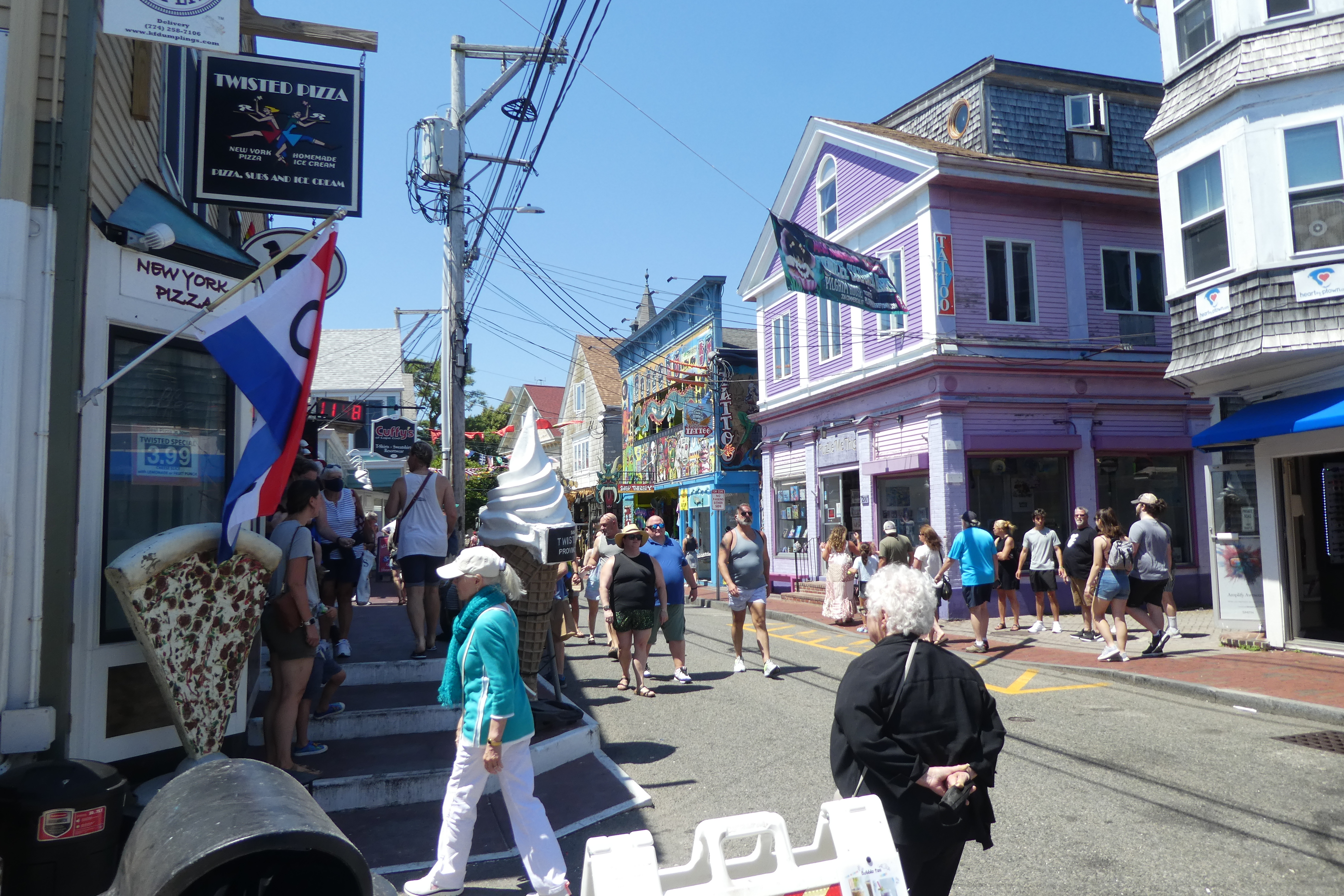
Next our tour took us to the tip of Cape Cod, the town of Provincetown, Massachusetts.  This is where the Mayflower made landfall after 66 days at sea.  The ship moored in Provincetown Harbor after failing to navigate the shoals off Cape Cod.  The passengers wrote and signed the Mayflower Compact here, establishing a New England settlement and forming a civil union while they waited for a new patent (permission to settle outside of the original plan near the Hudson River).  

We had time to explore Provincetown and have lunch, before boarding a trolley for a short tour.  The tour gave us a great history of the town, and some of the neighborhoods built over the last 400 years.  I especially liked learning about the fishermens' homes that were floated off the sandbars to line the streets near the harbor.  We had a chance to view the harbor with its breakwater and lighthouse.  Except for a few buildings, it probably looked like it did back in 1620.  

Our tour took us to view the Pilgrim Monument.  This 252 foot tower was dedicated in 1910 to honor the Pilgrims' landing in Provincetown.  It is visible from Plymouth (on a clear day) and from all over Cape Cod.  Years ago Vincent and I climbed to the top, all 116 steps and 60 ramps.  This time we did not climb!  Trivia fact:  President Teddy Roosevelt laid the cornerstone in 1907, and President Taft led the dedication ceremony three years later. There is a museum at the base of the tower, too.  When you are in Provincetown, just look behind the town hall for the funicular to the top of the hill where the tower is lcated. 

The Mayflower Compact was signed here in Provincetown Harbor

The Pilgrim Monument in Provincetown

Corn Hill Monument, at Corn Hill Beach
in Truro, Massachusetts

The inscription at Corn Hill monument

After visiting Provincetown, we went to Corn Hill Beach in Truro, Massachusetts.  This is a lovely beach, considered one of the nicest beaches on Cape Cod.  At the public parking lot you will find this little fenced in enclosure with a marker acknowledging the place where the Pilgrim explorers found a cache of Indian corn in November 1620.  According to Bradford's journal, they did not know if they should steal the corn, but decided to take it because they were starving after the long voyage from England.  This is a controversial part of the Pilgrim story.  Not only because of the theft of the seed corn, but also because the corn was NOT FOUND IN THIS SPOT!

The actual spot where the corn was found is up the hill on private property.  The road to this hill is a private road.  So the first monument (photograph above) is as close as possible to the real spot.  However there is a very small marker on the actual spot, owned by the General Society of Mayflower Descendants who maintain a right of way.  Since we were all members, we took tools to clear out, weed, and visit the monument! 

Tools for maintaining the "real"
Corn Hill marker

Yours truly at the site of the actual corn cache found
on Corn Hill.  It is hidden behind overgrown vegetation. 

The small Corn Hill Marker before clearing the vegetation

The stone is now visible due to everyone helping
to clear the weeds, branches and vegetation. 


Vincent and I hard at work clearing Corn Hill


The monument at the very windy
First Encounter Beach, Eastham, MA

The First Encounter marker

First Encounter Beach

After Corn Hill we went to see First Encounter Beach.  This is the site of another controversial event between the Nauset people and the Mayflower passengers.  The Nauset members of the Wampanoag nation were very wary of the new English men who had arrived in 1620 because several years earlier some of their tribe members had been kidnapped and taken as slaves to Europe (including Tisquantum "Squanto").  When the Pilgrims and the native people met on this beach, arrows and bullets flew but no one was hurt.  The Nauset retreated and the English went back to the Mayflower.  Fortunately, by the spring of 1621 the relations between the two groups improved. 

We were here at First Encounter Beach on a very windy day.  The tide was low, and there were few visitors even though this beach, like Corn Hill Beach, is a very popular site for swimming and boating. It was easy to imagine how it looked in 1620.  

Cove Burying Ground, Eastham, Massachusetts 

The gravesite of Mayflower passenger Constance Hopkins Snow
died 1677 Eastham, Massachusetts

The gravesite of Giles Hopkins, Mayflower passenger,
died 1690 Eastham, Massachusetts 

The gravesite of Joseph Rogers, Mayflower passenger,
died 1673 in Eastham, Massachusetts

While we were in Eastham, we also stopped at the Cove Burying Ground, where three Mayflower passengers are buried.  This cemetery dates to 1646.  There are no 17th century markers surviving, but descendants of the passenger interred here have placed memorials.  See the link below for a listing of burials here, including the Mayflower passengers Constance Hopkins Snow, Giles Hopkins, and Joseph Rogers.  

The National Monument to the Forefathers
Plymouth, Massachusetts


A detail on the monument showing the Mayflower Compact

One of the panels on the monument lists the Mayflower passengers

Our last stop for the day was the National Monument to the Forefathers, on Allerton Street in Plymouth, Massachusetts.  This is a solid granite monument standing 81 feet tall.  It was erected by the Pilgrim Society, and dedicated in 1889.  It was deeded to the Massachusetts government, and the monument and Plymouth Rock are both part of Pilgrim Memorial State Park.  It is not a federal or national park. 

It was nice to visit this monument near sunset.  The most popular part of the monument with our tour group was the panel listing the Mayflower passengers.  Everyone wanted to find the name of their ancestor or ancestors!


For the truly curious:

The Aptucxet Trading Post:   https://www.bournehistoricalsociety.org/aptucxet-museum/   

Provincetown, Massachusett Tourism:  https://ptowntourism.com/   

The Pilgrim Monument in Provincetown:   https://www.pilgrim-monument.org/   

Corn Hill Beach, Truro, Massachusetts:  https://www.truro-ma.gov/beach-office/pages/corn-hill-beach  


First Encounter Beach, Eastham, Massachusetts:   http://www.capecodgravestones.com/easthampixweb/firenccove.html  

Cove Burying Ground, Eastham, Massachusetts:  https://en.wikipedia.org/wiki/Cove_Burying_Ground  

A listing of burials at the Cove Burying Ground:   http://www.capecodgravestones.com/easthamcove.html  

National Monument to the Forefathers:   https://en.wikipedia.org/wiki/National_Monument_to_the_Forefathers  


---------------------------

To cite/link to this blog post: Heather Wilkinson Rojo, "Day Three of the "Path of the Pilgrims" Tour by the GSMD", Nutfield Genealogy, posted July 25, 2022, ( https://nutfieldgenealogy.blogspot.com/2022/07/day-three-of-path-of-pilgrims-tour-by.html: accessed [access date]).  

Tuesday, January 18, 2022

Just for Fun! Pilgrim Names Seen Around Plymouth, Massachusetts

 These fun images were photographed around the town of Plymouth last fall during the General Society of Mayflower Descendants Board of Assistants meeting.


--------------------

To Cite/Link to this blog post:  Heather Wilkinson Rojo, "Just for Fun!  Pilgrim Names Seen Around Plymouth, Massachusetts", Nutfield Genealogy, posted January 18, 2022, ( https://nutfieldgenealogy.blogspot.com/2022/01/just-for-fun-pilgrim-names-seen-around.html

Tuesday, July 6, 2021

Hannah Chipman Huckins, died 1696, Barnstable, Massachusetts - Tombstone Tuesday

 This tombstone was photographed at the Lothrop Hill Cemetery, Barnstable, Massachusetts


HERE LYETH INTERRED
Ye BODY OF
HANNAH HUCKINS
Ye WIFE OF
THOMAS HUCKINS
DEC'D NOVEMBER Ye 4
IN Ye 37 YEAR OF HER
AGE 1696


Hannah Chipman Huckins, my 8th great grandmother, is buried next to her mother, my 9th great grandmother, Hope Howland Chipman.  Hannah was born 14 January 1659 in Plymouth, Massachusetts.  Her grandparents were John Howland and Elizabeth Tilley, the Mayflower passengers.  Hannah married Thomas Huckins on 1 May 1680 in Barnstable, Massachusetts.  She had nine children with Thomas, and then she died young on 4 November 1696.  I descend from their daughter Hope Huckins (1689 - 1730) who married Benjamin Hamblin.  

Hannah's husband, Thomas Huckins has no known tombstone.  He remarried to Sarah Pope, the widow of Samuel Hinckley.  Thomas died before 15 October 1714. 

A previous blog post about my HUCKINS lineage:

A previous blog post with Hope Howland Chipman's tombstone:

-------------------------------------

To Cite/Link to this post:  Heather Wilkinson Rojo, "Hannah Chipman Huckins, died 1696, Barnstable, Massachusetts - Tombstone Tuesday", Nutfield Genealogy, posted July 6, 2021, ( https://nutfieldgenealogy.blogspot.com/2021/07/hannah-chipman-huckins-died-1696.html: accessed [access date]). 

Tuesday, June 29, 2021

Hope Howland Chipman, died 1683, Barnstable, Massachusetts - Tombstone Tuesday

 This tombstone was photographed at the Lothrop Hill Cemetery, Barnstable, Massachusetts


HERE LYETH
INTERRED Ye BODY OF
MRS. HOPE CHIPMAN Ye
WIFE OF ELDER JOHN
CHIPMAN AGED 54
YEARS WHO CHANGED
THIS LIFE A BETER
Ye 8 OF JANUARY
1683


The back and sides of this tombstone were encased in lead,
which was an old fashioned way of preserving the slate stone from the weather


Hope Howland Chipman is my 9th great grandmother, born 30 August 1629 in Plymouth, Massachusetts, the daughter of Mayflower passengers John Howland and Elizabeth Tilley.  She married John Chipman on 13 September 1646 in Plymouth, and they removed to Barnstable on Cape Cod.  They had twelve children, and I descend from her fifth daughter, Hannah (1659 - 1696) who married Thomas Huckins.  Hannah Huckins, my 8th great grandmother, is buried next to her mother - I'll post her tombstone in a future blog post.  

You can see my HOWLAND lineage at this link: 

Last week I featured Hope's husband's tombstone.  Elder John Chipman is buried in Sandwich:

This tombstone and the Lothrop Hill Cemetery were recently featured in the Summer 2021 issue of The Mayflower Quarterly magazine by the General Society of Mayflower Descendants.  


------------------------

To Cite/Link to this post:  Heather Wilkinson Rojo, "Hope Howland Chipman, died 1683, Barnstable, Massachusetts - Tombstone Tuesday", Nutfield Genealogy, posted June 29, 2021, ( https://nutfieldgenealogy.blogspot.com/2021/06/hope-howland-chipman-died-1683.html: accessed [access date]). 

Tuesday, June 22, 2021

Elder John Chipman, died 1709 Sandwich, Massachusetts - Tombstone Tuesday

This tombstone was photographed at the Old Town Cemetery in Sandwich, Massachusetts.  


HERE LYES BURIED
Ye BODY OF ELDER
JOHN CHIPMAN
AGED 88 YEARS
DIED APRIL Ye 7th
1709


The tiny tombstone to the right is Elder John Chipman, and the larger stone to the left is his second wife,  Ruth Sargent, who died in 1711.  I descend from his first wife, Hope Howland Chipman, daughter of Mayflower passengers John Howland and Elizabeth Tilley, who died on 8 January 1684 in Barnstable, Massachusetts.  

John Chipman was born about 1620 in Bryant's Puddle, Dorset, England, and died 8 January 1709 in Sandwich, Massachusetts.  He married Hope Howland on 13 September 1646 in Plymouth, Massachusetts.  He became a member of the church in Barnstable on 30 June 1653, and his wife was a member on 7 August 1650.  He removed to Sandwich after his second marriage, where he died and was buried. 

John Chipman and Hope Howland had twelve children.  I descend from their fifth child, Hannah Chipman (1659 - 1696), who married Thomas Huckins and lived in Barnstable.  

Please see my blog post on my Chipman lineage here:   https://nutfieldgenealogy.blogspot.com/2017/09/surname-saturday-chipman-of-cape-cod.html   

-----------------------------

To Cite/Link to this post:  Heather Wilkinson Rojo, "Elder John Chipman, died 1709 Sandwich, Massachusetts - Tombstone Tuesday", Nutfield Genealogy, posted June 22, 2021, ( https://nutfieldgenealogy.blogspot.com/2021/06/elder-john-chipman-died-1709-sandwich.html: accessed [access date]). 

Tuesday, April 28, 2020

Little Martha Chase Allen, buried 1867 in West Tisbury, Massachusetts - Tombstone Tuesday

This tombstone was photographed at the West Tisbury Burial Ground on Martha's Vineyard.


MATTIE
Dau. of
Joseph C. or Ann
C. ALLEN
Died Sept. 13, 1867
Aged 3 yrs. 1 Mo.

Martha "Mattie" Chase Allen was the daughter of Joseph Chase Allen and Ann Howland, born 16 August 1864 in West Tisbury, Massachusetts, and died 13 September 1867.  Her mother Ann Howland was the daughter of Elijah Howland and Sophronia Tilton.  She was a descendant of Mayflower passengers John Howland and Elizabeth Tilley.  

I'm a cousin to little Mattie on the Allen, Howland and Robinson lineages.

Allen of Braintree, Massachusetts: 

Howland of the Mayflower: 

Robinson of England, Leyden, Holland, and Massachusetts:

-------------------------------------

Heather Wilkinson Rojo, "Little Martha Chase Allen, buried 1867 in West Tisbury, Massachusetts - Tombstone Tuesday", Nutfield Genealogy, posted April 28, 2020, ( https://nutfieldgenealogy.blogspot.com/2020/04/little-martha-chase-allen-buried-1867.html: accessed [access date]). 

Friday, March 20, 2020

Eber Bunker's Hill in Australia, a Mayflower Descendant

The text on this plaque is below

Bunkers Hill

"Bunkers Hill was named after Captain Eber Bunker, father of Australian whaling, who had his house and store not far from here in the early 1800s.  This high ground, as outlined on the map below, was commonly called Bunkers Hill until the 1830s, but only received official recognition, at the request of the Sydney Cove Redevelopment Authority, in 1977.

Captain Eber Bunker was born to a Puritan whaling family in Plymouth, Massachusetts on 7th March 1761.  He moved to England after the American Revolution where he married Margrett Thompson, second cousin to Admiral Collingwood, in 1786 and took his first command, the whaler “Spencer”, in 1788.  He first arrived in Sydney in 1791 as master of the “William and Ann”, a transport in the Third Fleet, and there upon engaged in the first whaling expedition in Australian waters in the company of the “Britannia”. 

He returned to Australia in 1799 with the new ship “Albion” and spent two winters whaling of the Australian and New Zealand coasts.  At the request of Governor King, he took presents to King Pomere of Tahiti in exchange for hogs, howls and fruits for the colony. On a second voyage from England in 1803 he discovered the Bunker Islands off Queensland.  The “Albion” accompanied the “Lady Nelson” from Sydney with stores and cattle, to found the new settlement of Hobart on the River Derwent, in Tasmania.

He was well rewarded for his services being given several land grants around Liverpool and the Hunter Valley and, after his last whaling voyage in 1824-25, he retired to his properties, dying at Collingwood (now part of Liverpool) on 27th September 1836, aged 74.

You are standing on the high bluff that gave The Rocks its name and which marks the eastern edge of Bunkers Hill.  In front of you are the brickyards of Sgt. Major Row (1881), the stone buildings of the Counting House (1848), and Union Bond (1841) and below are the terraces of Atherton Place (1880 – 81).  Behind you, in Cumberland Street are under approaches to the Sydney Harbour Bridge, where Princes Street once lay, was the site of the solid mansions of worthy and well-to-do citizens of the 1850s.  Handsome homes of two or three storeys, with thick walls of squared stone and wide verandahs with graceful iron columns rose in grounds dotted with tall Norfolk Pines and Moreton Bay figs.

The Plague of 1900 led to a massive clean up of The Rocks and many of the old houses were torn down by the government of the day.  Work on the Harbour Bridge swept away much of what remained.

The walkway and lookout on which this plaque stands were put by the Sydney Cove Redevelopment Authority in 17979 – 80, transforming Gloucester Street to Gloucester Walk.

This Plaque was unveiled by the Minister for Planning & Environment the Hon. Eric Bedford BA MP on Wednesday 22nd October 1980."

------------------------------

These three photos were sent to me by a young genealogist friend in Australia. He is applying for membership to the Mayflower Society under the passengers John Howland and Elizabeth Tilley.  The new Australian Mayflower Society just formed a few months ago, and I wish him luck!  He is also a descendant of Eber Bunker.  Here is the lineage from John Howland and Elizabeth Tilley down to Eber Bunker.

Generation 1:  John Howland, Mayflower passenger, son of Henry Howland and Margaret Aires, was born 1592 in Fenstanton, England, died 23 February 1672 at Rocky Nook, Plymouth, Massachusetts; married on 25 March 1623 in Plymouth, Massachusetts to Elizabeth Tilley, Mayflower passenger, daughter of John Tilley and Joan Hurst.  She was born 30 August 1607 in Henlow, Bedfordshire, England and died 21 December 1687 in Swansea, Massachusetts. They had ten children.

Generation 2:  Desire Howland, born 13 October 1623 in Plymouth, Massachusetts, and died 13 October 1683 in Barnstable, Massachusetts; married on 6 November 1644 in Barnstable to John Gorham, son of Ralph Gorham and Margaret Stephenson.  He was born 28 January 1620 in Benefield, Northamptonshire, England and died 5 February 1675 in Swansea. They had eleven children.

Generation 3:  Shubael Gorham, born 21 October 1667 in Barnstable, died 7 August 1750; married on May 1695 on the island of Nantucket to Puella Hussey, daughter of Stephen Hussey (grandson of Rev. Stephen Batchelder) and Martha Bunker (daughter of George Bunker and Elizabeth Godfrey).  She was born 10th 10 mo. 1677 on Nantucket, and died in Barnstable before 23 September 1748. They had ten children.

Generation 4:  Desire Gorham, born 26 September 1710 in Barnstable, died 5 November 1801; married Zachariah Bunker on 2 September 1728 on Nantucket island. He was the son of Jonathan Bunker and Elizabeth Coffin.  Zachariah Bunker died on Nantucket 16 August 1757.  They had nine children all born on Nantucket island.

Generation 5: James Bunker, born 21 August 1733 on Nantucket island, was lost at sea in 1768; married Hannah Shurtleff in Plymouth, Massachusetts on 26 January 1757.  She was the daughter of James Shurtleff and Faith Jackson.  They had five children.

Generation 6: Eber Bunker, son of James Bunker and Hannah Shurtleff, was born on 7 March 1761 in Plymouth, Massachusetts and died on 27 September 1836 at Collingwood, now Liverpool, New South Wales. He married first on 16 November 1786 in England to Margrett Thompson, daughter of Henry Thompson and Isabella Collingwood, who died March 1808. They had children:  Isabella, Mary Ann, Charlotte, Charles Harris, Henry Edmund, Ernest, James Eber, and Henry Thompson.  He married second to Margaret Macfarlane.  He married third to Ann Howey, widow of William Minchin on 28 April 1823.

You might be wondering if Eber Bunker of Bunkers Hill in Australia is related to the same family of Bunker Hill in Boston (Charlestown).  The answer is “Probably!”. 

 The Bunker Hill in Massachusetts was named for George Bunker, who had a farm there in Charlestown.  The Bunker family lived on this land before the battle, and for generations afterwards.  George left the area a few years before the Revolutionary War, which was fortunate since the town of Charlestown was destroyed by the British during the battle.  The famous “Bunker Hill Monument” is on the top of Breed’s Hill in Boston, not Bunker Hill.  

George Bunker was born about 1600 at Bengeo, Hertfordshire, England and died about 1664 in Malden, Massachusetts; married Judith Major on 8 September 1624 at Odell, Bedfordshire, England.  He owned the land known as Bunker Hill in Charlestown and is buried at the Phipps Street Buring Ground in Charlestown.  His five children were baptized in Odell, Bedfordshire which is very close to Tingrith (see below for the lineage of Eber Bunker).  However George Bunker’s parents are unknown, so we cannot prove that these two Bunker branches were kin.  George Bunker’s last two children (he had seven children) were baptized at Charlestown, Massachusetts. 

Eber Bunker (1761 - 1836)


Eber Bunker’s Bunker Genealogy:

Generation 1: Tymothie Bunker and Elizabeth Hawkins, resided in Tingrith, Bedfordshire, England

Generation 2: George Bunker and Elizabeth Godfrey, 5 May 1644 in Maulden, Bedfordshire, England

Generation 3: William Bunker and Mary Macy

Generation 4: Jonathan Bunker and Elizabeth Coffin

Generation 5: Zachariah Bunker and Desire Gorham

Generation 6: James Bunker and Hannah Shurtleff

Generation 7: Eber Bunker of Australia

Isabella, daughter of Eber Bunker


For the truly curious:

Australian Dictionary of Biography website, a sketch about Eber Bunker:  http://adb.anu.edu.au/biography/bunker-eber-1849

The Bunker Blog – Website of the Bunker Family Association - https://www.bunkerfamilyassn.org/

Bunker Family History by Henry L. Bunker III, 1984.  [Information on Bunker Hill in Massachusetts is on pages 69 – 70, 72, and 99 – 100].

Australian Mayflower Society became official on 26 January 2020:
 https://www.themayflowersociety.org/blog/item/443-welcoming-the-australia-society

Australian Society of Mayflower Descendants Facebook group:   https://www.facebook.com/groups/736882643392129/

-----------------------------

Heather Wilkinson Rojo, "Eber Bunker's Hill in Australia, a Mayflower Descendant", Nutfield Genealogy, posted March 20, 2020, ( https://nutfieldgenealogy.blogspot.com/2020/03/eber-bunkers-hill-in-australia.html: accessed [access date]).