ROBINSON
The painting "Embarkation of the Pilgrims"
by Robert W. Weir, 1836
which shows Rev. John Robinson blessing the
passengers of the Mayflower in 1620
Reverend
John Robinson (1576 – 1626) is one of my favorite ancestors. I descend from him on my maternal and
paternal lineages. He was most famous as
pastor to the Separatist Pilgrims who
left on the Mayflower, even though he himself never came to America. He left a legacy that is remembered by
Mayflower descendants, members of the churches that evolved from the Separtists
(the Congregational and Unitarian Churches), and lovers of New England history.
Rev.
John Robinson went to Cambridge University in 1592, but disagreed with the
church and resigned on 10 February 1603/4.
He joined the Separtists who gathered around William Brewster in
Scrooby, England. He became their pastor
and the group went to Amsterdam, and then Leyden to set up a church. By 1617 he thought of bringing his
congregation to America. When they
finally made plans to come on the Mayflower
and Speedwell in 1620, Rev. Robinson
decided to stay with the majority of his congregation in Holland. He planned to join the group as soon as
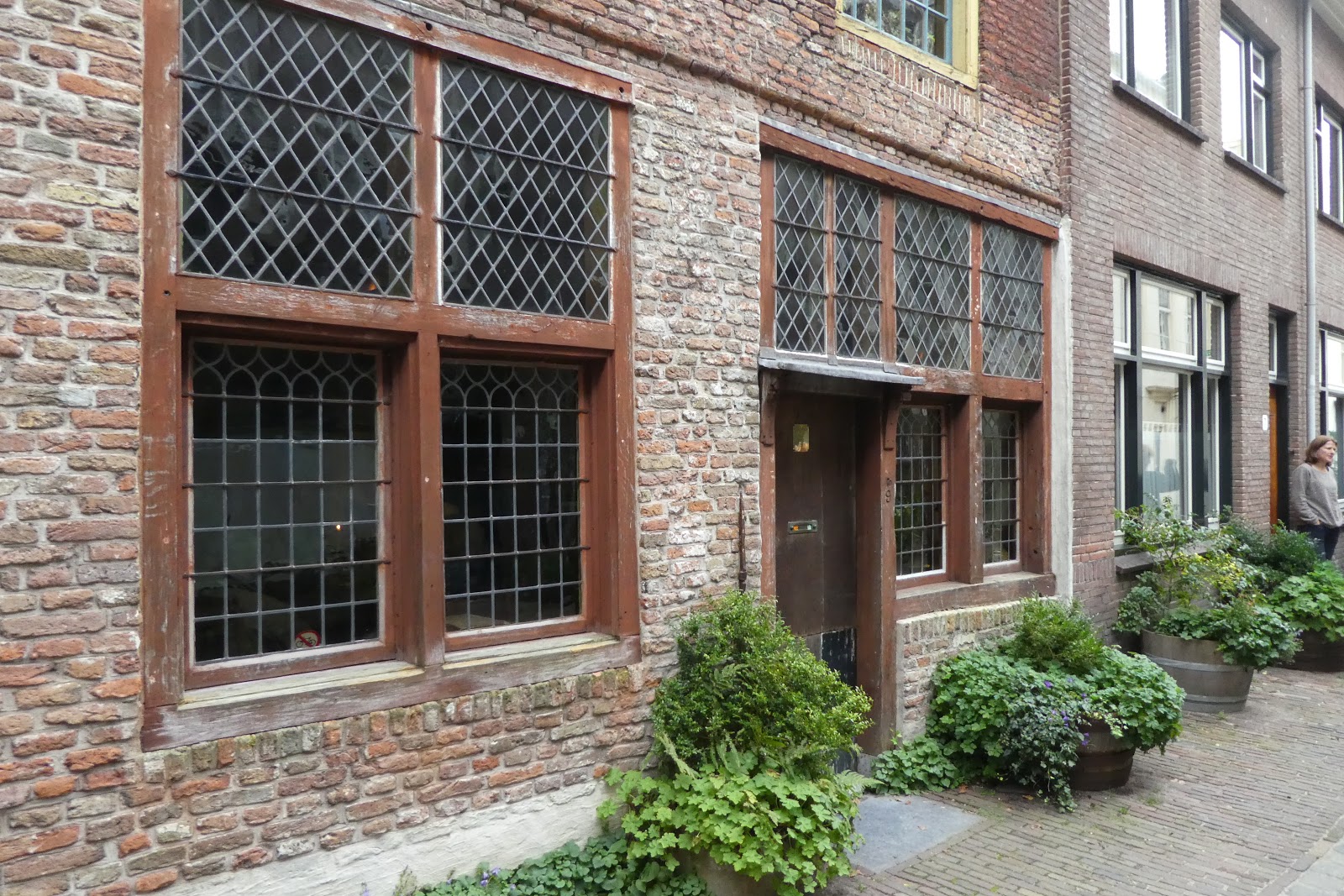
possible, but he died in 1626. He is buried under the floor of St. Pieterskerk
in Leyden, along with about 30 other Pilgrims who remained in Holland. This church is a spot that is popular with
American tourists.
The
letter that Rev. John Robinson wrote as a farewell to the Pilgrims was read by
John Carver (a relative of his wife, Bridget) on board the Mayflower prior to
their first attempt to depart on 5 August 1620.
You can see that some of his ideas in this letter were written into the
Mayflower Compact. This letter is often
read (in part) at Mayflower Society meetings and at the opening services of the
Triennial Mayflower Congresses in Plymouth, Massachusetts.
Loving and
Christian Friends,
I do heartily and
in the Lord salute you all as being they with whom I am present in my best
affection, and most earnest longings after you. Though I be constrained for a
while to be bodily absent from you. I say constrained, God knowing how
willingly and much rather than otherwise, I would have borne my part with you
in this first brunt, where I not by strong necessity held back for the present.
Make account of me in the meanwhile as of a man divided in myself with great
pain, and as (natural bonds set aside) having my better part with you. And
though I doubt not but in your godly wisdoms you both foresee and resolve upon
that which concerneth your present state and condition, both severally and
jointly, yet have I thought it but my duty to add some further spur of
provocation unto them who run already; if not because you need it, yet because
I owe it in love and duty. And first, as we are daily to renew our repentance
with our God, especially for our sins known, and generally for our unknown
trespasses; so doth the Lord call us in a singular manner upon occasions of
such difficulty and danger sa lieth upon you, to a both more narrow search and
careful reformation of your ways in His sight; let He, calling to remembrance
our sins forgotten by us or unrepented of, take advantage against us, and in
judgment leave us for the same to be swallowed up in one danger or other.
Whereas, on the contrary, sin being taken away by earnest repentance and the
pardon thereof from the Lord, sealed up unto a man's conscience by His Spirit,
great shall be his security and peace in all dangers, sweet his comforts in all
distresses, with happy deliverance from all evil, whether in live or in death.
Now, next after
this heavenly peace with God and our own consciences, we are carefully to
provide for peace with all men what in us lieth, especially with our
associates. And for that, watchfulness must be had that we neither at all in
ourselves do give, no, nor easily take offense being given by others. Woe be
unto the world for offenses, for though it be necessary (considering the malice
of Satan and man's corruption) that offenses come, yet woe unto the man, or
woman either, by whom the offense cometh, saith Christ, Matthew 18:7. And if
offenses in the unseasonable use of things, in themselves indifferent, be more
to the feared than death itself (as the Apostle teacheth, 1 Corinthians 9:15)
how much more in things simply evil, in which neither honor of God nor love of
man is thought worthy to be regarded. Neither yet is it sufficient that we keep
ourselves by the grace of God from giving offense, except withal we be armed
against the taking of them when they be given by others. For how unperfect and
lame is the work of grace in that person who wants charity to cover a multitude
of offenses, as the Scriptures speak!
Neither are you to
be exhorted to this grace only upon the common grounds of Christianity, which
are, that persons ready to take offense either want charity to cover offenses,
or wisdom duly to weigh human frailty; or lastly, are gross, though close
hypocrites as Christ our Lord teacheth (Matthew 7:1,2,3), as indeed in my own
experience few or none have been found which sooner give offense than such as
easily take it. Neither have they ever proved sound and profitable members in
societies, which have nourished this touchy humor.
But besides these,
there are divers motives provoking you above others to great care and
conscience this way: As first, you are many of you strangers, as to the persons
so to the infirmities one of another, and so stand in need of more watchfulness
this way, lest when such things fall out in men and women as you suspected not,
you be inordinately affected with them; which doth require at your hands much
wisdom and charity for the covering and preventing of incident offenses that
way. And, lastly, your intended course of civil community will minister
continual occasion of offense, and will be as fuel for that fire, except you
diligently quench it with brotherly forbearance. And if taking of offense causelessly
or easily at men's doings be so carefully to be avoided, how much more heed is
to be taken that we take not offense at God Himself, which yet we certainly do
so oft as we do murmur at His providence in our crosses, or bear impatiently
such afflictions as wherewith He pleaseth to visit us. Store up, therefore,
patience against that evil day, without which we take offense at the Lord
Himself in His holy and just works.
A fourth thing
there is carefully to be provided for, to wit, that with your common
employments you join common affections truly bent upon the general good,
avoiding deadly plague of your both common and special comfort all retiredness
of mind for proper advantage, and all singularly affected any manner of way.
Let ever man repress in himself and the whole body in each person, as so many
rebels against the common good, all private respects of men's selves, not
sorting with the general conveniency. And as men are careful not to have a new
house shaken with any violence before it be well settled and the parts firmly
knit, so be you, I beseech you, brethren, much more careful that the house of
God, which you are and are to be, be not shaken with unnecessary novelties or
other oppositions at the first settling thereof.
Lastly, whereas you
are become a body politic, using amongst yourselves civil government, and are
not furnished with any persons of special eminency above the rest, to be chosen
by you into office of government; let your wisdom and godliness appear, not
only in choosing such persons as do entirely love and will promote the common
good, but also in yielding unto them all due honor and obedience in their
lawful administrations, not beholding in them the ordinariness of their
persons, but God's ordinance for your good; not being like the foolish
multitude who more honor the gay coat than either the virtuous mind of the man,
or glorious ordinance of the Lord. But you know better things, and that the
image of the Lord's power and authority which the magistrate beareth, is
honorable, in how means persons soever. And this duty you both may the more
willingly and ought the more conscionably to perform, because you are at least
for the present to have only them for your ordinary governors, which yourselves
shall make choice of for that work.
Sundry other things
of importance I could put you in mind of, and of those before mentioned in more
words, but I will not so far wrong your godly minds as to think you heedless of
these things, there being also divers among you so well able to admonish both
themselves and others of what concerneth them. These few things therefore, and
the same in few words I do earnestly commend unto your care and conscience,
joining therewith my daily incessant prayers unto the Lord, that He who hath
made the heavens and the earth, the sea and all rivers of water, and whose
providence is over all His works, espeically over all His dear children for
good, would so guide and guard you in your ways, as inwardly by His Spirit, so
outwardly by the hand of His power, as that both you and we also, for and with
you, may have after matter of praising His name all the days of your and our
lives. Fare you well in Him in whom you trust, and in whom I rest.
An unfeigned
wellwiller of your happy success in this hopeful voyage,
John Robinson
Descendants of Reverend John Robinson are not
eligible for membership in the Mayflower Society. There is no Robinson Society,
nor any compiled genealogies. His son
Isaac Robinson is not mentioned in the book, New Englanders in the 1600s
by Martin Hollick. Isaac arrived in
Massachusetts aboard the ship Lion
and was made a freeman in Scituate in 1636. He was the only one of his siblings to come to
America. Isaac Robinson followed Quaker ideas, and was forced to leave
Barnstable and go to Falmouth.
You can read about Isaac Robinson and his family in
Banks’ History of Martha’s Vineyard
and in Anderson’s The Great Migration Begins.
I received a great deal of help on my
two lineages from Rev. John Robinson and his son Isaac from the website www.revjohnrobinson.com administered by
Donald L. Robinson. His email is blinkybill158@revjohnrobinson.com
. This website maintains a message board
and a list of ROBINSON researchers. There
are also many photographs of sites in England and Holland where Rev. Robinson
lived and preached, including St. Pieterskerk.
My Robinson
genealogy:
Generation
1: John Robinson, son of John Robinson
and Anne Unknown, was born in 1576 and died on 1 March 1626 in Leyden, South
Holland (the Netherlands); married on 15 February 1603 at St. Mary’s Greasley,
Nottinghamshire, England to Bridget White.
She was the daughter of Alexander White and Eleanor Smith, born about
1581 in Sturton, Nottinghamshire, and died after 28 October 1643 in Leyden.
Nine children.
Generation
2: Isaac Robinson, born 1610 in Leyden, died 1704 in Barnstable, Massachusetts;
married first on 26 September 1636 in Scituate, Massachusetts to Margaret
Hanford, daughter of Theophilus Hanford and Eglin Hatherly. She was born about 1619 in England and died
13 June 1649 in Barnstable. Six children.
Isaac married second about 1651 to Mary Unknown and had four more
children.
Generation
3: John Robinson, born about 1640 and died after 1714 in Connecticut; married 1
May 1667 in Barnstable to Elizabeth Weeks, daughter of William Weeks and Mary
Butler. She was born about 1648 on the
island of Martha’s Vineyard. Ten children.
Generation
4: Mary Robinson, born 12 December 1683
in Falmouth, Massachusetts, and died in November 1721; married on 22 November
1704 in Falmouth to Benjamin Davis, son of John Davis, Jr. and Ruth
Goodspeed. He was born 8 September 1679
in Barnstable, and died in 1754. Nine children.
Generation
5: Ruth Davis m. John Mayhew
Generation
6: Mary Mayhew m. Caleb Rand
Generation
7: Mary Rand m. Asahel Bill
Generation
8: Reverend Ingraham Ebenezer Bill m.
Isabella Lyons
Generation
9: Caleb Rand Bill m. Anna Margareta Bollman
Generation
10: Isabella Lyons Bill m. Albert Munroe
Wilkinson
Generation
11: Donald Munroe Wilkinson m. Bertha Louise Roberts (my paternal grandparents)
Lineage
B:
Generation
4: Isaac Robinson, son of John Robinson and Elizabeth Weeks, born 30 January
1670; married first to Hannah Harper on 1 March 1690 in Barnstable. She was the daughter of Robert Harper and
Prudence Butler, born May 1670 in Sandwich, Massachusetts. Eight children.
Generation
5: Peter Robinson, born 15 December 1701 in Falmouth, died after 1772; married
on 18 July 1724 in Falmouth to Martha Green, daughter of Isaac Greene and Sarah
Unknown. She was born 28 October 1705 in
Falmouth. Seven children.
Generation
6: Jabez Robinson, born 9 June 1726 in Falmouth; married on 7 January 1748 to
Tabitha Green, daughter of William Green and Joanna Mendall. She was born 18 December 1726 in Falmouth.
Five children.
Generation
7: Elizabeth Robinson, born 17 June 1750 in Falmouth, died 27 June 1837;
married on 8 September 1774 to Ebenezer Crosby, son of Jonathan Crosby and
Hannah Hamblin. He was born 26 August
1747 in Mansfield, Connecticut, and died 26 February 1826 in Yarmouth, Nova
Scotia. Eleven children.
Generation
8. Rebecca Crosby m. Comfort Haley
Generation
9: Joseph Edwin Healy m. Matilda Weston
Generation
10: Mary Etta Healey m. Peter Hoogerzeil
Generation
11: Florence Etta Hoogerzeil m. Arthur Treadwell Hitchings
Generation
12: Gertrude Matilda Hitchings m. Stanley Elmer Allen (my maternal
grandparents)
------------------------------
To Cite/Link to this blog post: Heather Wilkinson Rojo, "Surname Saturday ~ Robinson of England and Leyden, Holland and Massachusetts", Nutfield Genealogy, posted 3 August 2013, ( https://nutfieldgenealogy.blogspot.com/2013/08/surname-saturday-robinson-of-england.html: accessed [access date]).