Showing posts with label Guest blogger Tom Tufts. Show all posts

Friday, July 18, 2014

Blogger Meetup at Exeter, NH's Revolutionary War Festival

Genealogy Blogger Tom Tufts and Yours Truly

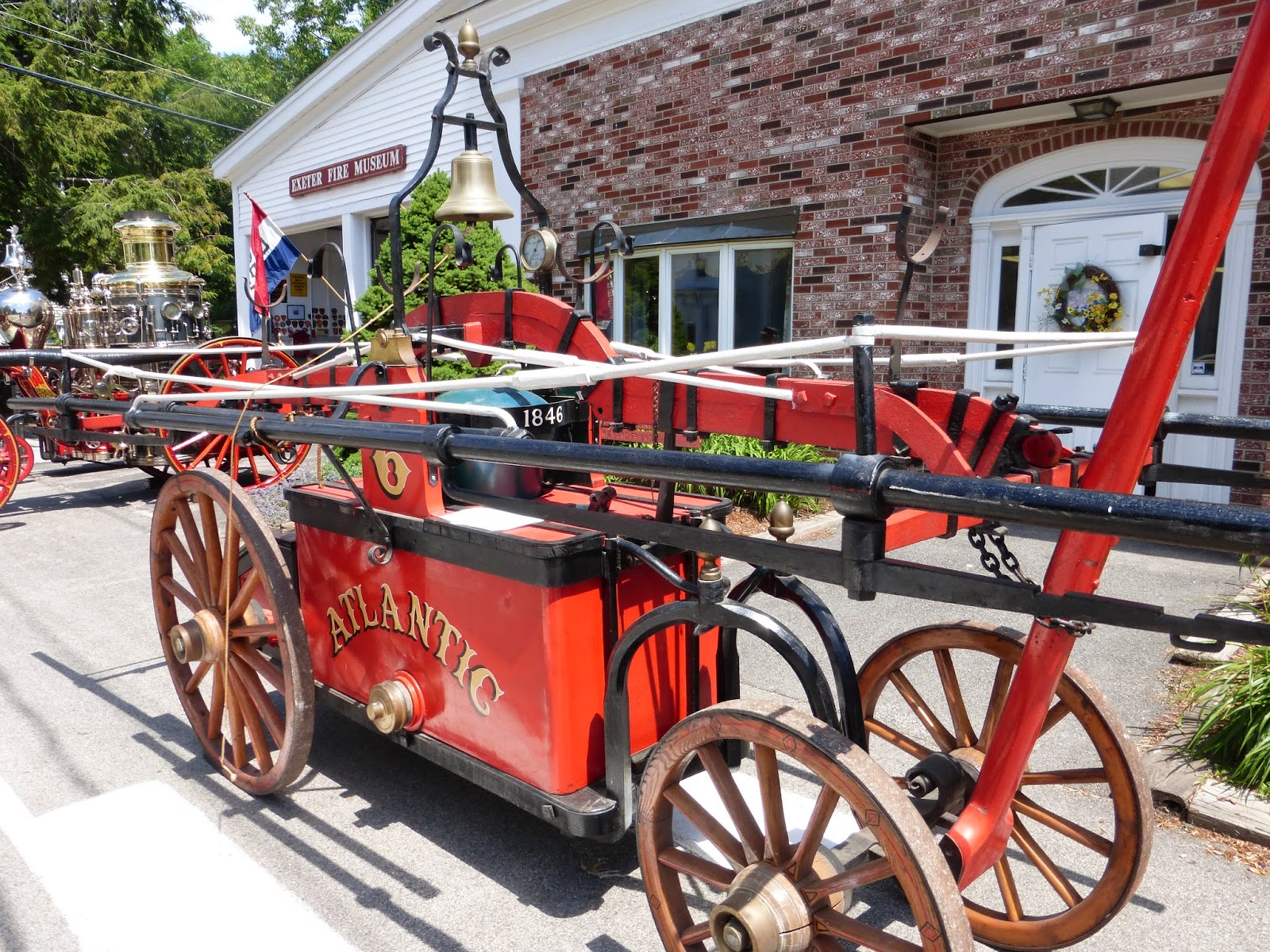
Tom Tufts is the author of the Tufts Family Genealogy blog.  We share the ancestor, Peter Tufts (1616- 1700) who settled in Malden, Massachusetts.  He is my 9th great grandfather.  Tom started by guest blogging on my blog, and then started the Tufts Family Genealogy blog in 2012.  We have met up a few times.  I knew that Tom was a long time volunteer at the Exeter, New Hampshire Fire Museum, and he told me that the museum was going to be open during the Exeter Revolutionary War Festival last weekend. It was time for my first visit to this extraordinary little museum.


This little museum used to be the old fire station.  There are two hand pumpers from 1835 and 1846, and a steam pump from 1873 build in Manchester, NH. The fire engines date from the 1920s and 1940s. The bays of the old fire station are full of memorabilia like fire extinguishers, air tanks, axes, patches, tools and lots of photos of firemen from the years past.  Many of the old photos have names on them, which is a great genealogy resource. 

If you are a regular reader of Tom's blog, you may not know that he is a retired fireman with 20 years of service in Manchester and five years of service in Exeter.  His grandfather was an Exeter fireman, and there are photos of him in the museum. Tom even showed me a group photo that includes his grandfather, and two other family members.  I'll let Tom post that on a future blog post, because the story behind the people in the group photo is a bit of genealogical serendipity.  


The museum is located on 30 Court Street in Exeter, New Hampshire.  It is open the first and third Saturday of the month from noon to 4pm.

The Tufts Family Genealogy blog
http://tuftsgenealogy.blogspot.com/  

Read Thomas Tufts guest blog posts at Nutfield Genealogy
http://nutfieldgenealogy.blogspot.com/search/label/Guest%20blogger%20Tom%20Tufts

----------------------------
The URL for this post is
http://nutfieldgenealogy.blogspot.com/2014/07/blogger-meetup-at-exeter-nhs.html 

Copyright (c) 2014, Heather Wilkinson Rojo

Friday, October 26, 2012

Follow Friday ~ Tufts Family Genealogy

Over the past few months I've had a few guest bloggers try out writing their genealogy and local history stories on my blog.  Several of them have gone on to start their own blogs, and this week Tom Tufts debuted his own genealogy blog "Tufts Family Genealogy" at http://tuftsgenealogy.blogspot.com/
This book was the inspiration for one of Tom's guest posts

Tom wrote three stories this year at my blog, the first was "John Tufts: A Shipwreck Story of Londonderry Immigrants" at the link http://nutfieldgenealogy.blogspot.com/2012/03/john-tufts-shipwreck-story-of.html   He had originally written to me to see if I had more information on this great story about some Tufts from Northern Ireland immigrating to the New World.  I hadn't heard this story of the shipwreck before, and so he wrote up the blog post and it received a lot of comments. His second story was "Scots Irish at Concord, NH and the 'Irish Fort'" http://nutfieldgenealogy.blogspot.com/2012/08/scots-irish-at-concord-nh-and-irish-fort.html which was another local history story that was new to me.

Tom's last story on my blog was "Henry Tufts, Black Sheep of an Otherwise Respectable Family" at http://nutfieldgenealogy.blogspot.com/2012/09/henry-tufts-black-sheep-of-otherwise.html    This story grew out of our meeting in person at the Derry Library's New Hampshire Room for some collaborative research, and a discussion about our common Tufts ancestors.  After the story of Henry Tufts was posted, I urged Tom to think about starting his own blog.  His stories are too interesting, and his knowledge of local history and families is vast enough to fill his own blog.

And so, Tom started posting stories.  He didn't want to advertise his blog until he had a few posts up on the website.  When he finally put up a post on Facebook to share his blog, I figured it was safe to now publicize his URL and time for him to get a few followers!

Tom Tufts is a resident of nearby Raymond, New Hampshire.  He is a volunteer at the Exeter Fire Museum located on Court Street in Exeter, New Hampshire https://www.facebook.com/pages/Exeter-Fire-Museum/106340866082047 .   Tom is seriously considering starting a new career as a professional genealogist, and is off to a good start with his new blog!  I hope you will read his posts and consider becoming a follower, too!

Also by one of my past guest bloggers: The Pye Plate by Bette Pye http://thepyeplate.blogspot.com/


--------------------------
Copyright 2012, Heather Wilkinson Rojo

Friday, September 14, 2012

Henry Tufts, Black Sheep of an Otherwise Respectable Family

by guest blogger, Tom Tufts

I hope my Great-Grandfather forgives me. James Arthur Tufts I was a professor of English at Phillips Exeter Academy for 50 years and on local library boards to prevent Henry Tufts's book from being bought for the public to read. Henry was not an ancestor of mine and his book is what I call barely historical fiction. It tells the tale of his life of criminal activities and “sufferings”. Titled; A Narrative of the Life, Adventures, Travels and Sufferings of Henry Tufts, Now Residing at Lemington, in the District of Maine, in Substance, as Compiled from His Own Mouth. The printing shop that originally printed it was burned down on account of it but later it was edited and released by Edmund Lester Pearson in 1930 and in 1993 with an extensive introduction by Neal Keating.  It is available occasionally today from online sources. Some stated it was really written with Thomas Tash, a revolutionary hero and neighbor of Henry’s in Lee NH.

                                The story contains narrative of his first exploits stealing fruit from a neighbor’s orchard as a child and continues stealing whenever he needed throughout his life. He seemed proud of it, stole from his own family and found fault with those who would not lock things up. He fathered children with several women, even marrying them without leaving his previous wife. He joined the army and deserted when he got bored. After a time this all caught up with him and he often was jailed but prided himself with his ability to escape jails including Exeter, Dover, and in Maine and Massachusetts. He even was committed to death for offenses in Massachusetts and only was reprieved at the last moment and sent to the Castle prison in Boston. He later was moved to Salem where he escaped the last time fleeing to Maine where his wife and their children had established homes. He had spent time living with the Abenaki Indians to recover from an illness and learned the Indian method of medicine from Molly Ockett which he later performed for many others, perhaps making up for his many disgraces.

That is the short version. It barely details the full story. A quick internet search will bring up results for many books and articles where the book is mentioned. It is not bad if you look at it as entertainment or for a look into what life was like in the colonial era. The book Landmarks in Ancient Dover, New Hampshire by Mary Thompson describes him in her description of the Lee/Durham boundary line which ran through their farm. Notable Events in the History of Dover New Hampshire From the First Settlement in 1623 to 1865 by George Wadleigh is another. The full review of his book which I prefer appears in Harper's new monthly magazine Volume 76, Issues 451-456. This review by Thomas Wentworth Higginson really describes it better than I could. He details many of his exploits stealing horses and travelling the continent.

I would rather tell the story of the true Tufts family that is filled with leaders in many fields. They were teachers, preachers, soldiers, and farmers, and all respectable members of society. The book itself describes the family as Boston “Brahmin”. Most of us can trace our roots to Henry’s great-great- grandfather Peter Tufts who came to Charlestown Massachusetts from Norfolk County England around 1638. Henry’s grandfather was a respected Harvard educated preacher and his cousin Lieutenant Thomas Tufts of Greenland NH was one of the New Hampshire Militia in the siege of Louisburg Nova Scotia in 1745 and died from illness acquired there. Colonel Henry Tufts, no direct relation, and of a much later date was the first head of the US Army Criminal Investigation Division. Descendents of his family and his father’s family were early settlers of the Farmington NH area and Limington ME. I expect to greet many of them at the annual reunion in Middleton NH this month. There are many patriots and civic leaders in the families even today. A Dennis Robinson of seacoastnh.com recently reviewed the book with no reference to respectable Tufts. The best reference for this family is Tufts Kinsmen by Herbert Adams and the Tufts Kinsmen Association (2010 and earlier editions). It can be obtained by e-mailing tuftskinsmenbook@gmail.com

For more information: 

J. Dennis Robinson "Henry Tufts wrote First American Criminal Biography" http://www.seacoastnh.com/History/History_Matters/Henry_Tufts_Wrote_First_American_Criminal_Autobiography/

A Narrative of the Life, Adventures, Travels and Sufferings of Henry Tufts, now residing at Lemington, in the District of Maine, by Henry Tufts, printed by Samuel Bragg, 1807 (the original book can be seen at the Essex Institute, Salem, Massachusetts and at the New York Public Library) 1993 reprint available.

Genealogy:

Generation 1) Peter Tufts (1617 - 1700) m. Mary Pierce
Generation 2) Thomas Tufts (1883 - 1733) m. Mary Lynde
Generation 3) Henry Tufts (1716 - 1780) m. Mary Wedgewood
Generation 4) Henry Tufts was born 24 June 1748 in Newmarket, New Hamphsire, and died 31 January 1831 in Limerick, Maine.  He was married about 1770 in Durham, New Hampshire to Lydia Bickford, daughter of Joseph Bickford and Margery Unknown. In the Tufts Kinsman he is listed as "vagabond, soldier AR, Indian doctor".  


--------------------------
Copyright 2012 Heather Wilkinson Rojo and Tom Tufts

Monday, August 13, 2012

Scots Irish at Concord, NH, and the "Irish Fort"

Scots Irish Early Settlers at Concord, New Hampshire and the "Irish Fort"
By Guest Blogger Tom Tufts  ttuftsy@comcast.net

The Advanced Guard, June 21, 1759 *
The Scots-Irish went many places after landing in Nutfield. They were considered squatters at Concord and built what may have been the first fort in the interior of New Hampshire. Previous forts were in place at the Seacoast to protect from foreign invasions and every community had garrison houses built for defense, but theirs seems to be the first called a fort.  The only fort before this was built for an injured soldier on the way to Lovewell’s fight in Pigwacket (Fryeburg Maine) in 1725 and was merely a “palisaded log cabin”. (This is quoted from one of the best books on the conflict; A Half-Century of Conflict by Francis Parkman. The injured soldier of Lovewell’s was Benjamin Kidder of Nutfield.) The Fort at #4 in Charlestown, NH was built later.

We know the Scots-Irish were in Nutfield as early as 1719 and apparently some moved on to Concord by 1721-1722. This is mentioned in The military history of the state of New-Hampshire, from its settlement, in 1623, to the rebellion, in 1861: comprising an account of the stirring events connected therewith; biographical notices of many of the officers distinguished therein: and notes explanatory of the text by C. E. Potter. That reference states in the same chapter that the fort at Penacook (Concord) was there in 1722 when Massachusetts sent soldiers there to take command of it and drive off the Irish. How successful they were is open to debate and further research. They could be the families that settled in Dunbarton and surrounding towns like Bow. The History of Concord…by The Historic Commission and Lyford states that surveyors in 1722 found the Irish there and reported it to the authorities, claiming they had a grant from New Hampshire to make a settlement there. 

The Massachusetts government thought enough of this report to send a troop there to investigate. They did indeed find the Scots-Irish settled there and in the discussion of who had the power to hold or grant the land, the Scots-Irish spokesman, (a Mr. Houston) told Lt. Frie (or Frye) and his troop to remove themselves or they would drive them off. No one was removed and the Lieutenant sent back to Massachusetts for advice but it appears they stayed and surveyed the settlement on the west side of the river and the Irish maintained their homes in what is now East Concord. By 1724 they had erected a fort within 80 rods of Sewall’s farm “upon the interval on the east side of the river with a view to permanent occupation”. This was the “Irish Fort” and in 1725 the Indian hunter, Col. Tyng rested there on his way to scout for Indians in the Winnipesauke area. Since then this area has been know as the fort and encompasses East Concord which is near to New Hampshire’s current “Fort”, the National Guard base.

It seems though, that the Irish settlers were to be caught up in the fight between Massachusetts and New Hampshire for the rights to settle the land. They had long fought over the boundary between the two states and this was miles to the north but they both claimed it as their own. Even to the point where each sent surveyors to lay out the land and enticed settlers with money to settle there. Each state also granted lands and lots and in 1725, families from Andover, Haverhill and other Essex County towns started to settle on the west side of the river. Nothing more is said of the Irish in that publication. In Bouton’s History of Concord the Irish of Nutfield are mentioned as having a fort there prior to the grant by Massachusetts. One of the petitions even states that “as in the case of Nutfield, it would be a thing attended with too much difficulty to pretend to root them out, if they should get a foothold there”.

Robert Rogers at the Battle on Snowshoes
from http://www.lakegeorgemirrormagazine.com/tag/rogers-rangers/ 
The Indian danger was present from the first settlements right up until the Revolutionary period. Some historians have called this Americas bloodiest conflict as it was deadlier per capita compared to the Civil War or the World Wars. At times referred to as the French and Indian wars, they can be defined by monarch and time period and relation to the European conflict they accompanied. No matter what you call it the period from first settlement to late Eighteenth Century was a warring time. Each village had to muster and drill and numerous lists of these soldiers are available. The Scots-Irish were not unaccustomed to this as they had endured the same fate before coming to America. Their history there is full of war stories. A full chapter of History of Londonderry is devoted to their turbulent times in the British Isles. Their names are scattered throughout the early rosters of Militia. It is no surprise that on settling at “Penacook” they built a fort for protection from the Indians. Robert Rogers the famous Indian hunter and first leader of “Rangers” in the military was said to be Scots-Irish but there was debate over whether he was from Londonderry or Massachusetts.

Next time….more on the Scots in the local militias and offensive attacks on Louisburg Nova Scotia and Canada.

-----------------------------

The histories mentioned in this article are:

History of Concord, New Hampshire: From the Original Grant in Seventeen Hundred and Twenty-five to the Opening of the Twentieth Century, by Concord (N.H.). City History Commission, Amos Hadley, Will B. Howe

The History of Concord: From Its First Grant in 1725, to the Organization of the City Government in 1853, with a History of the Ancient Penacooks ; the Whole Interspersed with Numerous Interesting Incidents and Anecdotes, Down to the Present Period, 1885 ; Embellished with Maps ; with Portraits of Distinguished Citizens, and Views of Ancient and Modern Residences by Nathaniel Bouton

The History of Londonderry, Comprising the Towns of Derry and Londonderry, N. H. by Edward Lutwyche Parker


*  Based on primary source descriptions of the campaign, this painting depicts Major Robert Rogers and “Captain Jacobs” (an Indian) as they scout the forest ahead of General Jeffrey Amherst’s army on their way to capture Fort Carillon (Ticonderoga) and other French posts on Lake Champlain. In the left background is the front of the Ranger column and on the right, in brown, is General Thomas Gage’s Light Infantry. In between, behind the flag is a British Regular officer and a lieutenant colonel of a Provincial regiment. Two of the Ranger companies are made up of Stockbridge Indians, captained by Jacob Cheeksaunkum (Captain Jacobs) and his son. (From Gary Zaboly and www.fortat4.org)  (Copyright © 2008 Fort at No. 4, All Rights Reserved)
--------------------
Copyright 2012 Heather Wilkinson Rojo and Tom Tufts

Thursday, March 22, 2012

John Tufts: A Shipwreck Story of Londonderry Immigrants


John Tufts: A Shipwreck Story of Londonderry Immigrants

By Tom Tufts, Guest Blogger for Nutfield Genealogy 
from the Boston Evening Post  22 June 1737

Has anyone ever heard of Londonderry or Windham immigrants from Ireland in 1737 being shipwrecked off Nova Scotia or Maine?

Sometimes it’s really not clear what records to believe. I have been researching Tufts families for a few years and come across a lot of great stories and records but often the stories are conflicting or unclear. I always tell people to seek out the actual records and cherish those as accurate, but are they really? We have all seen errors in census and written histories.

 John Tuffts or Tufts was clearly in Windham by 1748 when he married and then bought a farm in 1752 from John Morison (whose wife was Ann (Tufts) Morison-his second cousin). He married (first) Catherine Moore had a family in Windham and a second family with Mary Campbell in Belfast Maine. His history from then is quite clear as he was a miller, selectman and led the families that removed to settle what is now Belfast Maine. They were all clearly of Scots-Irish descent and their stories are in several town histories.

The Tufts historians have differed over John’s ancestry. The latest was Herbert Adams who worked for 50 years on Tufts history and his result was recently published by the Tufts Kinsmen Association as Tufts Kinsmen. He shows that this John came from Medford as most of our Tufts descended from Peter Tufts who came from England around 1638.  He even mentions the bible of Peter Tufts was handed down through John’s family.

Recently a genealogist sent me a note questioning this connection. She has a transcript of a story handed down through a branch of this family that he was actually from Ireland (Scots-Irish) and shipwrecked as a boy when coming to this country and orphaned. This reminded me I had seen a similar story in; Tufts Family History 1963 by Jay Franklin Tufts. That story is from a third branch of John’s family and very similar to the transcript.

The genealogist also sent a news article from the Boston Evening Post in 1737 which details the wreck of the Catherine off sable Island near Nova Scotia. It was from Portrush, Ireland and headed for Boston with many families and said to be the “most richly laden that ever crossed the ocean”. Many perished but some were rescued and brought to “Piscataqua” (Portsmouth) and “thence to Londonderry”.

So my quandary is who to believe. The shipwreck stories can’t be denied. While there are differences, there are too many similarities, and the story comes from 2 different branches of John’s descendents. The bible story, if accurate, would prove he was related to Peter Tufts but where’s the bible?  There are other details in Tufts Kinsmen which relate him as well, including estate benefits from relatives wills. The other note in Kinsmen that is interesting is under another John who was said to be Irish, not from Peter, who settled in West Brookfield MA. There he states a John Tufts did try to come from Ireland but perished in the wreck of the Catherine! He quotes the ships manifest and has the notation (NEJ) which is not in the bibliography.

I really wonder why this story isn’t written about in more local or family histories. If anyone has heard of a similar shipwreck story please share. It was quite dramatic as nearly half perished. John’s mother threw him her purse to him as she slipped below the waves and this haunted him for years. Three others who perished were “Messr.s Archibald, Charles Mcneal (Macneal?) and Mrs. Margaret Snell”. They could have been coming to join others of their family already in Nutfield.  John’s survival was said to be with a brother and sister. What happened to them? Would some family have taken them in? The mystery remains to be discovered.
part two of the above newsclipping
part three
part 4
click to enlarge the images

----------------------

My guest blogger is Thomas Tufts, of Raymond, New Hampshire, who is a descendant of John Tufts of Windham.  He contacted me a few weeks ago about this story, and I also received an email query from him through the Londonderry Historical Society.  I couldn't find any information for him in the papers in the Londonderry Leach Library, and he has been searching the files in many local archives, including the New Hampshire Historical Society Library.  I thought that maybe by putting his information on my blog someone out there might know more information about the wreck of the Catherine or this group of Scots-Irish immigrants, including John Tufts.  If anyone knows more, please leave a comment here or contact Tom at ttuftsy@comcast.net  Thanks!

UPDATE -  see additional information about the shipwreck from Christine Sharbrough at the Accessible Archives blog at this link: http://www.accessible-archives.com/2012/07/tories-in-new-hampshire/
----------------------


Heather Wilkinson Rojo and Thomas Tufts, "John Tufts: A Shipwreck Story of Londonderry Immigrants", Nutfield Genealogy, posted March 22, 2012, ( https://nutfieldgenealogy.blogspot.com/2012/03/john-tufts-shipwreck-story-of.html: accessed [access date]).