Showing posts with label myths. Show all posts

Monday, November 23, 2020

The Five Kernels of Corn Myth at Thanksgiving


I originally blogged about the Thanksgiving Five Kernels of Corn in 2011, but since that time I’ve learned a lot about this quaint tradition.  I decided to repost a new update on this myth.

For generations New Englanders, and some Mayflower families that moved south and west, practiced a quaint little tradition at their Thanksgiving table.  Each place setting was given five kernels of parched corn, often along with a card that had this little poem, or a similar one:

Five Kernels
(author unknown)

The first winter in Plymouth was very cold
And hunger abounded as the the year unrolled.
Some days each only had five kernels of corn.
Their lives were becoming sad and forlorn.

But then spring came and their harvest grew.
The pilgrims began to thrive and their spirits did, too.
But they never forgot the bleak times they did abate
So on Thanksgiving they’d put five kernels on each plate.

The first kernel  reminded them of the autumn beauty.
The second one of the freedom that they held dearly.
The third reminded of their love and care for each other
And the fourth was for dear friends like the Indian brother.

The fifth kernel reminded of God’s love and care for all.
So as you prepare and celebrate Thanksgiving this fall,
Remember to put five little kernels on each dinner plate
To honor the pilgrims and give thanks for our good fate.

Families that follow this tradition don’t use popcorn (you would break your teeth), but they purchase roasted sweet corn (one brand name is "Corn Nuts") .  You can make this yourself or search for it online or in your local market.  Or open up a can of corn and count out the kernels onto the plates. Some Mayflower Societies pass out candy corn.  This tradition was passed on for many, many years, and is mentioned in books, such as the Little House books by Laura Ingalls Wilder (which makes sense because I have Ingalls ancestors from Lynn, Massachusetts, just like the author).  

It’s very true that the Mayflower passengers suffered greatly during their first winter here in 1620 until the spring of 1621.  Half of their company, fifty out of 102 passengers died of sickness and exposure.  It is also true that the following spring they planted a crop with help from several native members of the Wampanoag nation, which was followed by a successful first harvest.  They celebrated a traditional English “Harvest Home” celebration that fall, just like they always did at home in Europe, and were joined by many members of the local Wampanoag tribe.

You can learn more about how the myth of the Five Kernels started in a pamphlet published by the General Society of Mayflower Descendants in the 1950s.  Jim Baker, a former research at the Plimoth Plantation Museum, wrote this in 1998.

From Jim Baker:

"However, this never happened. There is no mention of the supposed division in any of the contemporary sources, nor is there any reason to believe that the colonial leaders would actually issue a daily corn ration of five kernels, which was not enough to be of any nutritional benefit. Instead, they simply ran out at the end of the spring season in April when they planted what they had put aside as seed." As J. A. Goodwin (1888) observed concerning the tradition, "the story rests on no foundation, and is opposed to common-sense." 1

Similarly, the effect of the suffering may be exaggerated. Bradford simply notes they were very badly supplied and lacked corn entirely for two or three months, being reduced to living on water, fish, shellfish, ground nuts and a few water fowl, and "now and then a deer." 2 As this was a healthy if highly unsatisfactory diet to the colonists, no one died or "succombed." Winslow does mention that he had seen "... some seasons at noon I have seen men stagger by reason of faintness for want of food", yet he does not give a specific date for this. As he then continues "...yet ere night, by the good providence and blessing of God, we have enjoyed such plenty as though the windows of heaven had been opened unto us.” 3 the use of the phrase may be more a general comment that a specific description. 

Just as Plymouth Rock came to symbolize the heroic and providential nature of the Mayflower voyage, some icon was required to celebrate the Plymouth colonists’ courageous perseverance through their suffering and deprivation. The five kernals were adopted to point this moral at some point after the American Revolution. Their appearance is first recorded at the 1820 Forefathers’ Day dinner when the five symbolic parched corns was placed on each plate to remind the diners of "the time in 1623, when that was the proportion allowed to each individual on account of scarcity." 4

The story was related by subsequent writers such as Frances Baylies (1866) 5 and Joseph Banvard (1851)6 , but after the Bradford manuscript had been found and published and no evidence for the tradition was discovered, the Five Kernels myth gradually faded from public memory, and is seldom referred to today.

Another reference to five kernels of corn occurs in quite a different context. The Harlow Old Fort House (ca. 1677) Museum in Plymouth has been holding an annual juvenile pageant called "The Corn Planting" each May since before 1928. 7 A group of costumed school children enact a short re-enactment of the planting of corn by Squanto and the colonists which is witnessed by other students from local schools. 

As part of this tradition, the hills of corn are each supplied with five kernels of corn, and the following rhyme is recited: 
Five kernels of corn in a row
One for the blackbird, one for the crow,
One for the cutworm and two to grow. 8"      
JWB 12/14/98


1. Godwin, John A. The Pilgrim Republic. Boston: Ticknor & Co., 1888, p. 242.
2. Bradford, William. Of Plymouth Plantation. S.E. Morison, ed. NY: Knopf, 1970, p. 123
3. Winslow, Edward. "Good Newes from New England" in Alexander Young. Chronicles of the Pilgrim Fathers. Boston: Charles C. Little and James Brown, 1844, pp. 354-554. Thacher, James. History of Plymouth. Boston: Marsh, Capon & Lyon, 1832, p. 248.
5. Frances Baylies. An Historical Memoir of the Colony of New Plymouth Boston: Wiggin & Lunt 1866, p. 121
6. Joseph Banvard. Plymouth and the Pilgrims, Boston: Gould and Lincoln, 1851, p. 136
7. Barker, Amy H. A History of the Plymouth Antiquarian Society. Plymouth: Plymouth Antiquarian Society, 1959.
8. Plimoth Colony Cook Book . Sally Erath, ed. Plymouth: Plymouth: Antiquarian Society, 1981, p. 41

There are many myths surrounding the Pilgrims.  Plymouth Rock is definitely a myth.  Who would land a boat on a rock? But now it is a National Historic Site.  Myles Standish did not court Priscilla Mullins, but Longfellow's poem is one of the most famous he ever wrote.  Although the myth of the Five Kernels was debunked in the 1950s, many families continue this tradition.  Americans love to count their blessings at Thanksgiving, and this little story and poem is part of that custom.   I know that we still do it at our Thanksgiving table, but I usually follow up with “Here’s what really happened” 30 second explanation.  Perhaps it is time for someone to write up a new, more accurate poem? 


My original blog post “Five Kernels of Corn for Thanksgiving” from 20 November 2011 is at this link:   http://nutfieldgenealogy.blogspot.com/2011/11/five-kernels-of-corn-for-thanksgiving.html   


Within a few hours of publishing this post I had volumes of email and comments that made me publish a second update at this link:
http://nutfieldgenealogy.blogspot.com/2011/11/five-kernel-of-corn-update.html

-----------------------------

To Cite/Link to this blog post:  Heather Wilkinson Rojo, "The Five Kernels of Corn Myth at Thanksgiving", Nutfield Genealogy, posted November 24, 2020, ( https://nutfieldgenealogy.blogspot.com/2020/11/the-five-kernels-of-corn-myth-at.html: accessed [access date]). 

Friday, June 1, 2018

Why do we say “Rabbit, Rabbit, Rabbit” on the 1st of each month?


"Even Mr. Roosevelt, the President of the United States, has confessed to a friend that he says 'Rabbits' on the first of every month—and, what is more, he would not think of omitting the utterance on any account." – Newspaper article, The Nottingham Evening Post, 27 November, 1935.


I always say “Rabbit” three times on the first day of the month.  I try to make it the first thing I say that morning.  It goes back to my childhood. When I was a little girl, I never knew what the day of the month it was until I got to school.  But on the first of the month it would be a contest to see who would remember first.  Usually some other kid would shout it out while walking to school, and we’d all repeat it to the next kid we saw. And so it would travel through the neighborhood.

Now I post it every month on Facebook. If you are a Facebook friend, you know I also put up a picture of a rabbit, too.  Or three rabbits. I didn’t know why we say it three times. I didn’t know why we say it in the first place.  Finally, fellow genealogist Dan Young asked me, “Do you have a blog post on the history of why we say Rabbit?”

So here it is- the reason why we say “Rabbit, rabbit, rabbit”!

It turns out to be a British custom that was carried to North America.  Over there people say “Rabbits” or “White Rabbits” or repeat “Rabbit” some number of times for good luck in the new month.  According to Wikipedia, northern New England is where this custom is most prevalent in the USA.  In Britain, It is more common in Scotland than in England.

Rabbits are considered lucky in the British Isles- think of the lucky rabbit’s foot. Rabbits are a tradition sign of fertility (remember the Playboy symbol?). White rabbits are especially lucky or magical, and we all know this from the color of most magician’s rabbits. One of the articles I linked below said that FDR not only said Rabbits on the first of the month, but he carried a rabbit’s foot in his pocket for good luck.  Maybe he was just super superstitious?

What is the symbolism of the “Three Hares” often seen carved on churches in England or medieval manuscripts? Well, according to Wikipedia again, it is also seen all over Europe and the Middle East. Is it a symbol of the trinity?  Is it from the pagan Celts? This symbol appears to be a puzzle, just like the fact that although each of the three rabbits appears to have two ears, there are only a total of three ears.  Check out the website for the Three Hare Project, which has published a new book on this subject:


The Three Hares: A Curiosity Worth Regarding, by Tom Greeves, Sue Andrew and Chris Chapman, Skerryvore Productions,UK, 2016


Variations on this theme:

Be the first to say “Rabbit” for good luck
It must be the first words spoken aloud that morning
If you repeat the word “Rabbit” the rabbit will run away with your problems
If you forget to say rabbit first thing, reverse your bad luck by saying “Tibbar” before bed.
Drink a Rabbit Rabbit beer from New England’s Lamplighter Brewing Co. (Cambridge, MA)
Buy a dress from the fashion company Rabbit Rabbit Rabbit  Designs (Google it!)
Gilda Radner used the “Bunny Bunny” version every month

For the truly curious:

From NPR’s “A Way with Words”

Mother Nature - 


Bangor, Maine Bangor Daily News –

Rabbit Rabbit Day on Facebook - https://www.facebook.com/RabbitRabbitDay/  


The Three Hares from Wikipedia- https://en.wikipedia.org/wiki/Three_hares 

 ------------------------------

Heather Wilkinson Rojo, "Why do we say “Rabbit, Rabbit, Rabbit” on the 1st of each month?", Nutfield Genealogy, posted June 1, 2018, ( https://nutfieldgenealogy.blogspot.com/2018/06/why-do-we-say-rabbit-rabbit-rabbit-on.html: accessed [access date]). 

Friday, November 18, 2016

The Five Kernels of Corn Myth at Thanksgiving


I originally blogged about the Thanksgiving Five Kernels of Corn in 2011, but since that time I’ve learned a lot about this quaint tradition.  I decided to repost a new update on this myth.

For generations New Englanders, and some Mayflower families that moved south and west, practiced a quaint little tradition at their Thanksgiving table.  Each place setting was given five kernels of parched corn, often along with a card that had this little poem, or a similar one:

Five Kernels
(author unknown)

The first winter in Plymouth was very cold
And hunger abounded as the the year unrolled.
Some days each only had five kernels of corn.
Their lives were becoming sad and forlorn.

But then spring came and their harvest grew.
The pilgrims began to thrive and their spirits did, too.
But they never forgot the bleak times they did abate
So on Thanksgiving they’d put five kernels on each plate.

The first kernel  reminded them of the autumn beauty.
The second one of the freedom that they held dearly.
The third reminded of their love and care for each other
And the fourth was for dear friends like the Indian brother.

The fifth kernel reminded of God’s love and care for all.
So as you prepare and celebrate Thanksgiving this fall,
Remember to put five little kernels on each dinner plate
To honor the pilgrims and give thanks for our good fate.

Families that follow this tradition don’t use popcorn (you would break your teeth), but they purchase roasted sweet corn (one brand name is "Corn Nuts") .  You can make this yourself or search for it online or in your local market.  Or open up a can of corn and count out the kernels onto the plates. Some Mayflower Societies pass out candy corn.  This tradition was passed on for many, many years, and is mentioned in books, such as the Little House books by Laura Ingalls Wilder (which makes sense because I have Ingalls ancestors from Lynn, Massachusetts, just like the author).  

It’s very true that the Mayflower passengers suffered greatly during their first winter here in 1620 until the spring of 1621.  Half of their company, fifty out of 102 passengers died of sickness and exposure.  It is also true that the following spring they planted a crop with help from several native members of the Wampanoag nation, which was followed by a successful first harvest.  They celebrated a traditional English “Harvest Home” celebration that fall, just like they always did at home in Europe, and were joined by many members of the local Wampanoag tribe.

You can learn more about how the myth of the Five Kernels started in a pamphlet published by the General Society of Mayflower Descendants in the 1950s.  Jim Baker, a former research at the Plimoth Plantation Museum, wrote this in 1998.

From Jim Baker:

"However, this never happened. There is no mention of the supposed division in any of the contemporary sources, nor is there any reason to believe that the colonial leaders would actually issue a daily corn ration of five kernals, which was not enough to be of any nutritional benefit. Instead, they simply ran out at the end of the spring season in April when they planted what they had put aside as seed." As J. A. Goodwin (1888) observed concerning the tradition, "the story rests on no foundation, and is opposed to common-sense." 1

Similarly, the effect of the suffering may be exaggerated. Bradford simply notes they were very badly supplied and lacked corn entirely for two or three months, being reduced to living on water, fish, shellfish, ground nuts and a few water fowl, and "now and then a deer." 2 As this was a healthy if highly unsatisfactory diet to the colonists, no one died or "succombed." Winslow does mention that he had seen "... some seasons at noon I have seen men stagger by reason of faintness for want of food", yet he does not give a specific date for this. As he then continues "...yet ere night, by the good providence and blessing of God, we have enjoyed such plenty as though the windows of heaven had been opened unto us.” 3 the use of the phrase may be more a general comment that a specific description. 

Just as Plymouth Rock came to symbolize the heroic and providential nature of the Mayflower voyage, some icon was required to celebrate the Plymouth colonists’ courageous perseverance through their suffering and deprivation. The five kernals were adopted to point this moral at some point after the American Revolution. Their appearance is first recorded at the 1820 Forefathers’ Day dinner when the five symbolic parched corns was placed on each plate to remind the diners of "the time in 1623, when that was the proportion allowed to each individual on account of scarcity." 4

The story was related by subsequent writers such as Frances Baylies (1866) 5 and Joseph Banvard (1851)6 , but after the Bradford manuscript had been found and published and no evidence for the tradition was discovered, the Five Kernels myth gradually faded from public memory, and is seldom referred to today.

Another reference to five kernels of corn occurs in quite a different context. The Harlow Old Fort House (ca. 1677) Museum in Plymouth has been holding an annual juvenile pageant called "The Corn Planting" each May since before 1928. 7 A group of costumed school children enact a short re-enactment of the planting of corn by Squanto and the colonists which is witnessed by other students from local schools. 

As part of this tradition, the hills of corn are each supplied with five kernels of corn, and the following rhyme is recited: 
Five kernels of corn in a row
One for the blackbird, one for the crow,
One for the cutworm and two to grow. 8"
                                                                      JWB 12/14/98


1. Godwin, John A. The Pilgrim Republic. Boston: Ticknor & Co., 1888, p. 242.
2. Bradford, William. Of Plymouth Plantation. S.E. Morison, ed. NY: Knopf, 1970, p. 123
3. Winslow, Edward. "Good Newes from New England" in Alexander Young. Chronicles of the Pilgrim Fathers. Boston: Charles C. Little and James Brown, 1844, pp. 354-554. Thacher, James. History of Plymouth. Boston: Marsh, Capon & Lyon, 1832, p. 248.
5. Frances Baylies. An Historical Memoir of the Colony of New Plymouth Boston: Wiggin & Lunt 1866, p. 121
6. Joseph Banvard. Plymouth and the Pilgrims, Boston: Gould and Lincoln, 1851, p. 136
7. Barker, Amy H. A History of the Plymouth Antiquarian Society. Plymouth: Plymouth Antiquarian Society, 1959.
8. Plimoth Colony Cook Book . Sally Erath, ed. Plymouth: Plymouth: Antiquarian Society, 1981, p. 41

There are many myths surrounding the Pilgrims.  Plymouth Rock is definitely a myth.  Who would land a boat on a rock? But now it is a National Historic Site.  Myles Standish did not court Priscilla Mullins, but Longfellow's poem is one of the most famous he ever wrote.  Although the myth of the Five Kernels was debunked in the 1950s, many families continue this tradition.  Americans love to count their blessings at Thanksgiving, and this little story and poem is part of that custom.   I know that we still do it at our Thanksgiving table, but I usually follow up with “Here’s what really happened” 30 second explanation.  Perhaps it is time for someone to write up a new, more accurate poem? 


My original blog post “Five Kernels of Corn for Thanksgiving” from 20 November 2011 is at this link: http://nutfieldgenealogy.blogspot.com/2011/11/five-kernels-of-corn-for-thanksgiving.html   

Within a few hours of publishing this post I had volumes of email and comments that made me publish a second update at this link:
http://nutfieldgenealogy.blogspot.com/2011/11/five-kernel-of-corn-update.html


-----------------------------

To Cite/Link to this blog post: Heather Wilkinson Rojo, "The Five Kernels of Corn Myth at Thanksgiving", Nutfield Genealogy, posted November 18, 2016, (http://nutfieldgenealogy.blogspot.com/2016/11/the-five-kernels-of-corn-myth-at.html: accessed [access date]).

Friday, May 1, 2015

Corrections to the Story of Hilton Point. Or “Why Historians should listen to Genealogists”


On Friday, 1 May 2015 I posted a “Photo Friday” story about Hilton Point in Dover, New Hampshire, with photos of the two memorials built there to the memory of Edward Hilton.  Both memorials state that New Hampshire’s first permanent settlement was when Edward Hilton arrived in 1623 to fish. 

I checked the official government website for the state of New Hampshire, https://www.nh.gov/   The page with the history of our state reads “… in 1623, under the authority of an English land-grant, Captain John Mason, in conjunction with several others, sent David Thomson, A Scotsman, And Edward and Thomas [sic] Hilton, fish merchants of London, with a number of other people in two divisions to establish a fishing colony in what is now New Hampshire, at the mouth of the Piscataqua River…. the Hilton brothers set up their fishing stages on a neck of land eight miles above, which they called Northam, afterwards named Dover.”

My blog post used the information on the historical markers, and from several books on the History of New Hampshire.  Were they wrong? 

I didn't use Robert Charles Anderson’s Great Migration series for this blog post, because I was just doing a quick local history post, not a genealogy story.  But I should have.  As fellow blogger Jeanie Roberts pointed out to me in a comment on my blog post, “Edward did not migrate until 1628” according to Anderson.  

I couldn't wait to run to my copy of the Great Migration to see what it said.  I used to teach fourth grade, the year that New Hampshire students learned all about state and local history.  We always taught them that 1623 was THE YEAR.   I was imagining fourth graders being assigned homework, googling the story and reading my blog post. Was it full of wrong information?

Anderson made a good case in Great Migration Begins, Vol. II, page 950. He quoted The Genealogical Dictionary of Maine and New Hampshire, page 331 (a sketch of Edward Hilton) “He likely made a voyage to Piscataqua with trading goods and began a plantation, unrecorded, in 1628”  and on page 334 (a sketch of his brother William (not Thomas as stated on the New Hampshire state website) “The historian Hubbard cared little about the eastern country and his paragraph about the founding of N.H. (N. E. Reg. 31.179) is mostly false, Hilton did not come to the Piscataqua with David Thomson in 1623 and Chr. Levett’s book proves that no settlement had been made up the river in the spring of 1624”

GDMNH was published in 1939.  The Great Migration Begins was published in 1995.  This is 2015.  Why are we all still saying that New Hampshire’s first permanent settlement was 1623?  Don’t the historians communicate with our great genealogists?

Instead of just updating my first blog post from Friday, I’m also publishing this one, and linking the two posts.  I can’t wait to see if a fourth grader challenges his teacher with this information!

Sources mentioned  (all three are traditional genealogy sources):

The Genealogical Dictionary of Maine and New Hampshire, by Sibyl Noyes, Charles Thornton Libby and Walter Goodwin Davis, published by the New England Historic Genealogical Society, 2012 (originally 1939 in five volumes) 

The Great Migration Begins: Immigrants to New England 1620 – 1633, by Robert Charles Anderson, published by the New England Historic Genealogical Society, three volumes, 1995.

The New England Historical and Genealogical Register, Volume 31 (1877), page 179 “Some of the Descendants of William Hilton” by John Hassam.

Jeanie Robert's blog The Family Connection blog post 5 January 2013, "Thomas Roberts of Dover, New Hampshire"
http://www.jeaniesgenealogy.com/2013/01/thomas-roberts-of-dover-new-hampshire.html   

Of course, we have to add an article by Portsmouth historian, J. Dennis Robinson, too!
http://www.seacoastnh.com/History/History-Matters/portsmouth-and-dover-still-feuding-over-1623-nh-founding-date/   

-------------------------
The URL for this post is
http://nutfieldgenealogy.blogspot.com/2015/05/corrections-to-story-of-hilton-point-or.html 
Copyright © 2015, Heather Wilkinson Rojo


Thursday, January 29, 2015

… Read how a family history fib spread in 1889, and is still spreading today!


The Munroe Tavern, Lexington, Massachusetts

Genealogy fibs spread on the internet, but this is nothing new… Read how a family history fib spread in 1889, and is still spreading today!

Several years ago I wrote a blog post about a fake letter written in 1889.  This “letter” was written by James Phinney Munroe, a recent MIT graduate and the new president of the Lexington Historical Society.  The Munroe family had a long history in Lexington, including being involved in the Battle of Lexington and their family tavern being used on the day of the battle as a field hospital by the British Troops.  When George Washington decided to visit all the states (all 13 of them) in 1789 one of his stops was in Lexington, where he had dinner at the Munroe Tavern.

The visit to the Munroe’s was fact.  You can visit the tavern in Lexington today and see the china dishes used by Washington for his dinner.  The dinner was served by Sarah Munroe and her sister, the daughters of the innkeeper, William Munroe.  The dishes were carefully preserved by the Munroe family, and donated to the Historical Society along with the entire tavern.  And so, when James Phinney Munroe, a descendant of this family, was celebrating the 100th anniversary of Washington’s famous dinner at the Munroe tavern he decided to have a bit of fun and produced a delightful letter written by “Sarah Munroe”, along with a story about finding it in the attic.  This was published in the Proceedings of the Lexington Historical Society 1889.

Ha Ha!  The joke was on him.  The “letter” was reproduced all over New England, and all over America, but not with the accompanying explanation of how it was a joke for the anniversary celebration.  J. P. Munroe spent years writing to magazines and newspapers explaining the provenance of the “letter” but to no avail.  The story kept cropping up all over, even after his death in 1929.  And it spreads today, faster than wildfire because of the internet.

Just last week, J. L. Bell of the blog Boston 1775, questioned the fake letter by Sarah Munroe.  Of course it was fake!  A reader left him a comment, and she turned out to be a staff member of a Lexington museum.  He was set straight, and produced a second blog post for Boston 1775, see below for all the links.

I have seen the fake “letter” produced in genealogies online, even though the same James Phinney Munroe wrote the definitive genealogy on the Munroe family A Sketch of the Munro Clan: Also of William Munro who Deported from Scotland, Settled in Lexington, Massachusetts and some of his Posterity in 1900 and explained the provenance of the letter.  But I guess people would rather copy what they see online instead of checking with the Historical Society or books. 

Excerpts from “the letter” (How much would you like to bet that someone will copy this part of my blog post and ignore the above explanation?):

My ever deare Mary:-
I crave your patience in this Episle, as I must finish it to go by the Sunday Coach, and therefore indight it by a bad candle, dip’d I warrant, by Brother Jonas, who is ever slack in all except his play.  We have had great doings here.  Our Loved President has journied here to Lex. & has took dinner at our very House. I suppose you, in the great city of New York can have little interest in the small haps of a Country Town, but remember it is the birth-place of you, and of American Freedom!...
…Betimes Mr. Washington appered, bestriding a most handsome White horse.  He wore a military Habit, much like that of my Worthy Father, only gayer and with fine things, I mind not what they call ‘em, on the showlders.  His Hat he wore under his arm, and he bent himself to one side and the other as he Passed.  I promise you we huzzared stoutly, but he bowed not, only leaned, as one shd say, towards us… Then followed some Speech which I heard not, daring to venture no nearer than I was, being that I had an old Frock, and compeled to hold back Lucindy.  Soon the whole Troupe betook themselves to the Spot where the Blood was spilled…
…When we come to the house there stood my Father and step-mother at the tap-room Door, Anna and the naybors skulking in the parlour.  My Father looked grandly in his rejimentels and proud indeed I was of him as he led the way to the Dinner-room prepar’d for Mr. Washington in the upper room, looking toward your house.  ‘Twas arrang’d that my Step-mother dish the vittles in the kitch’n, yours should bring them to the stares the short way, thou knows’t, thro’ the shop & the Tap-room) and then my Father shod serve them to the gests.  ‘Twas permited me to stand in the corner betwixt the windos, to give what help was needed.  We had right fine feast, I can tell you…
…not just then arose a great cracking and howling.  We rushed to the Window and there in the butt’nwood Tree was Jonas, clinging to the frill of Lucindy’s skirt, and she dangeling in mid-air.  Before we could get out of the room one of the Black-men had climed the tree and caught Lucindy by the Neck like a Cat, and carried her down. The silly child had led Jonas into climing the Tree with her to look in at the dinner-room Window, and a limb having snapped she wod, but for Jonas, have broke her neck…
… I have burned 3 Dips, which is sinfull, & have set up long beyond Bell-ringing to send you this, so now I must stop.
Your ever affectionate
Sally

The genealogy of the Munroe family members in this story:

Generation 1:  William Munroe (1625 – 1718) m. Martha George (my 7th great grandparents)

Generation 2:  William Munroe (1669 – 1759) m. Mary Cutler

Generation 3:  William Munroe (1703 – 1747) m. Sarah Mason

Generation 4:  William Munroe (1742 – 1827) m. 1. Anna Smith,  m.2.  Polly Rogers
Children: William, Anna, Sarah, Lucinda, Jonas, Edward

Generation 5: Jonas Munroe (1778 – 1860) m. Abigail C. Smith

Generation 6: James Smith Munroe (1824 – 1910) m. Alice Bridge Phinney  (“bequeathed to the Lexington Historical Society, on behalf of his brother William and himself, that part of the real estate known as “Munroe Tavern” and a parcel of land surrounding it, to be kept forever as a token of Colonial and Revolutionary Lexington”  from page 217 of The Genealogy of the Lexington Munroes, compiled by Richard S. Munroe, Florence, Massachusetts, 1986)

Generation 7: James Phinney Munroe, born 3 June 1862, the author of “the letter” to the Lexington Historical Society, supposedly written by his great aunt, Sarah Munroe, sister of his grandfather, Jonas (the one who didn’t make very good candles).

Links:

My blog post from Monday, November 5, 2012 “5 November 1789, George Washington Dined Here!”, where I mention James Phinney Munroe’s fake letter http://nutfieldgenealogy.blogspot.com/2012/11/5-november-1789-george-washington-dined.html  

J. L. Bell’s Boston 1775 blog post “President Washington in Sickness and in Lexington”, Friday, January 16, 2015 (where the author suspects the Sarah Munroe letter is fake) http://boston1775.blogspot.com/2015/01/president-washington-in-sickness-and-in.html

J.L. Bell’s blog post “The Real Story of the Fake Sarah Munroe Letter”, Wednesday, 21 January 2015 (more details about James Phinney Munroe’s fake letter by his dead great aunt, Sarah Munroe)  http://boston1775.blogspot.com/2015/01/the-real-story-of-fake-sarah-munroe.html

The Proceedings of the Lexington Historical Society (online version)  and James Phinney Munroe’s entry with "the letter", pages xxxvi - xxxvii  https://books.google.com/books?id=-fhk1Y1enZEC&pg=PR36#v=onepage&q&f=false

-------------------------
The URL for this post is
http://nutfieldgenealogy.blogspot.com/2015/01/read-how-family-history-fib-spread-in.html
Copyright © 2015, Heather Wilkinson Rojo

Friday, November 7, 2014

Researching Your Mayflower Ancestors

Celebrating our Mayflower ancestors!
This blog post was published simultaneously here at Nutfield Genealogy and also at the Worldwide Genealogy blog www.worldwidegenealogy.blogspot.com 

-------------------------------

Every year, just before Thanksgiving, some folks  want to know if they have a ancestor from the 1620 ship Mayflower.  My first advice is that it will probably take you more than a few weeks to prove a lineage back to someone born in the late 1500s, who might qualify as a passenger on this ship.  After all, it has been about thirteen or fourteen generations since those passengers were born.  But, if you work hard at it, you might be able to introduce your Mayflower passenger ancestor to your friends and family around the 2015 Thanksgiving table.

Mayflower descendants live all over the globe.  There are active Mayflower Societies in all 50 states, Washington DC, and Canada.  Societies are being considered for the United Kingdom and Australia because there are descendants living there, too.  Many descendants live in the Netherlands, because the Pilgrim families left siblings and married children behind in Leiden.  There are good numbers of other descendants scattered across the map.  Are you one of them?

1.   Start with yourself and work backwards in time.  It is impossible to start with a passenger and try to work forward to yourself along a lineage.  Besides, there were 102 passengers.  Even if grandma swears you descend from William Bradford, you just might be a descendant of Myles Standish or Priscilla Mullins. You will never know unless you follow proper genealogical practices of starting now and working back through the generations.

2.  Become familiar with the surnames of the 102 passengers, their descendants and where they lived.  Yes, BREWSTER is one of the Mayflower names, but there was also an early Brewster family in New Hampshire.  They were not related. Some of the passengers had common names like BROWN and WHITE.  However, if your BROWNS lived in southeastern Massachusetts in the 1600s and 1700s, this is worth researching.   You can find a complete list of passengers with known descendants are at these links:


Scroll down to “Mayflower Research” on this page to read sketches on each Pilgrim family from early Plymouth, Massachusetts: http://www.americanancestors.org/articles-topics/

3.  If you can work your family tree back to about the mid 1700s your next step is to review the Silver Books published by the General Society of Mayflower Descendants.  These are books produced by the “Five Generations Project” to document the first five generations of each Mayflower passenger. Some of the finest colonial genealogists have been part of this project.  Most of these lineages have been published, and the project is now called “Mayflower Families in Progress” as they continue researching the sixth and seventh generations.  You can find these books in good genealogy libraries, book stores, and for sale online at this link: https://www.themayflowersociety.org/membership-info16   For a good listing of all the books, see this link: http://mayflowerhistory.com/mayflower5g 

4. Use primary source documents (birth, marriage and death records) if you are planning to submit your research to a lineage society.  Deeds, probate (wills), gravestones, diaries and family bibles have also been used to establish lineage.  Some of this is available on the internet, and are acceptible if they are scanned images of original documents such as censuses and birth records.  Note all records with proper citations (page numbers, microfilm numbers, etc.).   User submitted trees on www.familysearch.org and www.ancestry.com  are not acceptable because they lack documentation, but you can use them as clues to help you find primary source materials.  Don’t forget to make photocopies of everything you find.  Click this link to read about “The Best Records to Prove your Case” by Mayflower genealogist Alicia Crane Williams:

5.  In rare cases, you might want to consider DNA testing.  Many of the Pilgrim family associations have DNA projects.  However, for acceptance into a lineage society such as the General Society of Mayflower Descendants, DNA testing must be backed up with a paper trail.  DNA can help establish that two men descend from a common ancestor.   Several DNA tests have been used in the lineage application process for GSMD. 

Let’s say you find a link to one of the Mayflower families.  What happens next?

1.  Congratulations!  You are connected to some of the most well researched group of immigrants on the planet earth.  There are endless books, articles, blog posts and all sorts of stories, documents and things to learn about your ancestor to keep you busy for quite some time. New research is being published every year.

2.  You've earned your bragging rights.  Not just that you have a famous ancestor, but you have done an impressive job at researching thirteen or fourteen generations.  You can now take those documents and research papers and apply to family associations (more than half the Mayflower families have family associations), to the General Society of Mayflower Descendants, Colonial Dames, or any number of other lineage societies.  Here is a link to the “Join GSMD” webpage: https://www.themayflowersociety.org/membership-info16

3.  Double check your research against these links to common Mayflower genealogy hoaxes:


4.  If the historian of a lineage society questions your lineage application papers, don’t worry.  They are just asking you to clarify a point with additional documentation.  They usually can help point you where to look for that additional piece of information.  Remember that lineage societies are actively recruiting for new members, they don’t want to keep you out of the club!

---------------------------

Some good links for online information on the Mayflower Passengers:

The General Society of Mayflower Descendants  https://www.themayflowersociety.org/

Leiden, Netherlands Pilgrim Archives  http://www.pilgrimarchives.nl/

Leiden American Pilgrim Museum Foundation  http://www.leidenamericanpilgrimmuseum.org/

The Pilgrim Hall Museum, Plymouth, Massachusetts   http://www.pilgrimhallmuseum.org/  

Plimoth Plantation Museum, Plymouth, Massachusetts  www.plimoth.org

The New England Historic Genealogical Society  www.americanancestors.org 

Caleb Johnson’s Mayflower History website   http://mayflowerhistory.com/

Sail 1620 (Pilgrim Biographies)  http://sail1620.org/


Thru the Looking Glass:  Mayflower Families   http://mayflowerfamilies.com/

------------------------------------------

Good Books (there are many, but here’s a good place to start):

The Great Migration Series, The Great Migration Begins (3 volumes)  and The Great Migration (7 volumes) by Robert Anderson published by the New England Historic Genealogical Society

The Pilgrim Migration: Immigrants to Plymouth Colony, 1620 – 1633  by Robert Anderson, NEHGS, 2007

William Bradford’s Of Plymouth Plantation, edited by Caleb Johnson, 2006

The Mayflower: A Story of Courage, Community and War, by Nathaniel Philbrick, 2007

Strangers and Pilgrims, Travellers and Sojourners: Leiden and the Foundations of Plymouth Plantation, by Jeremy Dupertuis Bangs, 2009

Making Haste from Babylon: The Mayflower Pilgrims and Their World: A New History, by Nick Bunker, 2010

---------------------------------

Heather Wilkinson Rojo, "Researching Your Mayflower Ancestors", Nutfield Genealogy, posted November 7, 2014, ( http://nutfieldgenealogy.blogspot.com/2014/11/researching-your-mayflower-ancestors.html: accessed [access date]). 

Friday, January 10, 2014

More Johnny Appleseed photos from Cincinnati, Ohio

My blogger friend Pam Seavey Schaffner read my Johnny Appleseed post from August and she send me some photos of this beautiful monument to him from Cincinnati, Ohio.  Pam's blog is called "Digging Down East", and we share a few New England ancestors.  And then blogger Carol Bowen Stevens from "Reflections from the Fence" sent me some photos of Johnny's burial spot in Fort Wayne, Indiana.  Thank you so much, ladies!

John Chapman AKA "Johnny Appleseed" is a distant cousin to me.  He left his hometown of Leominster, Massachusetts and went to the Ohio and Indiana territories as a missionary.   These photos are of the memorial to Johnny at the Spring Grove Cemetery in Cincinnati, Ohio.  He is not buried here, but was buried in Fort Wayne, Indiana. 


JOHNNY APPLESEED
JOHN CHAPMAN SEPTEMBER 26, 1774 - MARCH 18, 1845
JOHNNY APPLESEED, FIGURE OF LEGEND, WAS A SWEDENBORGIAN
MISSIONARY TO THE OHIO AN DINDIAN FRONTIER.  SAINTLY
IN HIS DAILY LIFE, HE LOVED LIFE IN ALL ITS FORMS AND
HAD A JOYOUS WILL TO HELP THE EARTH YIELD ITS FRUITS.
BIBLE IN HAND AND SACK OF SEEDS SWINGING FROM HIS SHOULDER
HE PLANTED MANY APPLE ORCHARDS THAT LIVE TODAY IN THIS
NATION.  MAY HE BE REMEMBERED IN FACT AS WELL AS IN
LEGEND FOR HIS GODLINESS AND GOODNESS.


These next photos are from Fort Wayne, and are of the supposed burial spot for John Chapman "Johnny Appleseed". 


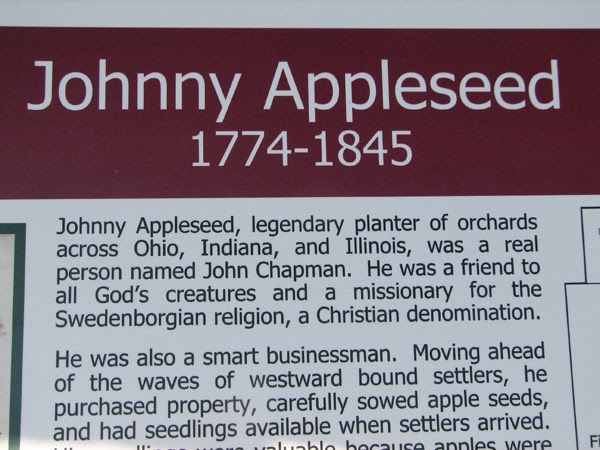
Johnny Appleseed
1774 - 1845

Johnny Appleseed, legendary planter of orchards
across Ohio, Indiana and Illinois, was a real
person named John Chapman.  He was a friend to
all God's creatures and a missionary for the 
Swedenborgian religion, a Christian denomination.

He was also a smart businessman.  Moving ahead
of the waves of westward bound settlers, he
purchased property, carefully sowed appleseeds,
and had seedlings available when settlers arrived.
His seedlings were valuable because apples were
highly nutritious and orchards were a symbol of 
permanency.  He sold trees for 3 cents if you
planted them and 6.5 cents if he planted them for 
you.  Johnny was also very generous, often saying
"pay me when you can."  

The amber water flask Johnny gave to a little girl on her birthday
gives us a clue to his success and fame.  Material things meant
little to Johnny except when they could make a child smile, give
a pioneer family the means to improve their diet or increase 
their cash income from apples or apple jack.  Cider and apple
jack were pioneer currancy.

Documents like this receipt
indicate that Johnny lived
and worked here from the 
1830s until his death in 1845.

Johnny lived a life of service in harmony with nature that impressed Native Americans, as
well as his fellow Americans.  He was a proud patriot.  His thoughts were of God and the
afterlife and his greeting was often, "I have good news from heaven!"  He must have been a
good salesman.  People loved him.

The water flask is on display at The History Center, 302 East Berry Street. 


JOHN CHAPMAN
"JOHNNY APPLESEED"
DIED 1845
----------
ERECTED BY
INDIANA
HORTICULTURAL SOCIETY


"JOHNY
APPLESEED"
JOHN CHAPMAN
HE LIVED FOR OTHERS
HOLY BIBLE
1774 - 1845


IN FOND MEMORY OF
JOHN CHAPMAN, ENDEARINGLY KNOWN AS "JOHNNY APPLESEED"
THESE GRAVESITE IMPROVEMENTS WERE PROVIDED BY
THE MEN'S GARDEN CLUBS OF AMERICA
AND
THE JOHNNY APPLESEED NATIONAL MEMORIAL FOUNDATION, INC.
SEPTEMBER 25, 1965


My blog post about Johnny Appleseed's birthplace in Leominster, Massachusetts

Pam Seavey Schaffner's blog   http://www.diggingdowneast.blogspot.com/

Carol A. Bowen Steven's blog http://reflectionsfromthefence.blogspot.com/

----------------------------
The URL for this post is
http://nutfieldgenealogy.blogspot.com/2014/01/more-johnny-appleseed-photos-from.html 

Copyright (c) 2014, Heather Wilkinson Rojo

Thursday, November 28, 2013

The Five Kernels of Corn Myth at Thanksgiving


NOTE - This blog post was updated in 2020, see this link:
https://nutfieldgenealogy.blogspot.com/2020/11/the-five-kernels-of-corn-myth-at.html   


I originally blogged about the Thanksgiving Five Kernels of Corn in 2011, but I’ve learned a lot about this quaint tradition since then.  I decided to repost a new update on this myth (see the 2020 link above for the latest blog post on the Five Kernels of Corn).

For generations New Englanders, and some Mayflower families that moved south and west, practiced a quaint little tradition at their Thanksgiving table.  Each place setting was given five kernels of parched corn, often along with a card that had this little poem, or a similar one:

Five Kernels

The first winter in Plymouth was very cold
And hunger abounded as the the year unrolled.
Some days each only had five kernels of corn.
Their lives were becoming sad and forlorn.

But then spring came and their harvest grew.
The pilgrims began to thrive and their spirits did, too.
But they never forgot the bleak times they did abate
So on Thanksgiving they’d put five kernels on each plate.

The first kernel  reminded them of the autumn beauty.
The second one of the freedom that they held dearly.
The third reminded of their love and care for each other
And the fourth was for dear friends like the Indian brother.

The fifth kernel reminded of God’s love and care for all.
So as you prepare and celebrate Thanksgiving this fall,
Remember to put five little kernels on each dinner plate
To honor the pilgrims and give thanks for our good fate.

Families that follow this tradition don’t use popcorn (you would break your teeth), but they purchase roasted sweet corn.  You can make this yourself or search for it online or in your local market.  Or open up a can of corn and count it out onto the plates. This tradition was passed on for many, many years, and is mentioned in books, such as the Little House books by Laura Ingalls Wilder (which makes sense because I have Ingalls ancestors from Lynn, Massachusetts, just like the author). 

It’s very true that the Mayflower passengers suffered greatly during their first winter here in 1620 until the spring of 1621.  Half of their company, fifty out of 102 passengers died of sickness and exposure.  It is also true that the following spring they planted a crop with help from several native members of the Wampanoag nation, which was followed by a successful first harvest.  They celebrated a traditional English “Harvest Home” celebration that fall, just like they always did at home in Europe, and were joined by many members of the local Wampanoag tribe.

You can learn more about how the myth of the Five Kernels started in a pamphlet published by the General Society of Mayflower Descendants in the 1950s.  Jim Baker, a former research at the Plimoth Plantation Museum, wrote this in 1998.

From Jim Baker:

"However, this never happened. There is no mention of the supposed division in any of the contemporary sources, nor is there any reason to believe that the colonial leaders would actually issue a daily corn ration of five kernals, which was not enough to be of any nutritional benefit. Instead, they simply ran out at the end of the spring season in April when they planted what they had put aside as seed." As J. A. Goodwin (1888) observed concerning the tradition, "the story rests on no foundation, and is opposed to common-sense." 1

Similarly, the effect of the suffering may be exaggerated. Bradford simply notes they were very badly supplied and lacked corn entirely for two or three months, being reduced to living on water, fish, shellfish, ground nuts and a few water fowl, and "now and then a deer." 2 As this was a healthy if highly unsatisfactory diet to the colonists, no one died or "succombed." Winslow does mention that he had seen "... some seasons at noon I have seen men stagger by reason of faintness for want of food", yet he does not give a specific date for this. As he then continues "...yet ere night, by the good providence and blessing of God, we have enjoyed such plenty as though the windows of heaven had been opened unto us.” 3 the use of the phrase may be more a general comment that a specific description.

Just as Plymouth Rock came to symbolize the heroic and providential nature of the Mayflower voyage, some icon was required to celebrate the Plymouth colonists’ courageous perseverance through their suffering and deprivation. The five kernals were adopted to point this moral at some point after the American Revolution. Their appearance is first recorded at the 1820 Forefathers’ Day dinner when the five symbolic parched corns was placed on each plate to remind the diners of "the time in 1623, when that was the proportion allowed to each individual on account of scarcity." 4

The story was related by subsequent writers such as Frances Baylies (1866) 5 and Joseph Banvard (1851)6 , but after the Bradford manuscript had been found and published and no evidence for the tradition was discovered, the Five Kernals myth gradually faded from public memory, and is seldom referred to today.

Another reference to five kernals of corn occurs in quite a different context. The Harlow Old Fort House (ca. 1677) Museum in Plymouth has been holding an annual juvenile pageant called "The Corn Planting" each May since before 1928. 7 A group of costumed school children enact a short re-enactment of the planting of corn by Squanto and the colonists which is witnessed by other students from local schools.

As part of this tradition, the hills of corn are each supplied with five kernals of corn, and the following rhyme is recited:
Five kernals of corn in a row
One for the blackbird, one for the crow,
One for the cutworm and two to grow. 8"
JWB 12/14/98

1. Godwin, John A. The Pilgrim Republic. Boston: Ticknor & Co., 1888, p. 242.
2. Bradford, William. Of Plymouth Plantation. S.E. Morison, ed. NY: Knopf, 1970, p. 123
3. Winslow, Edward. "Good Newes from New England" in Alexander Young. Chronicles of the Pilgrim Fathers. Boston: Charles C. Little and James Brown, 1844, pp. 354-554. Thacher, James. History of Plymouth. Boston: Marsh, Capon & Lyon, 1832, p. 248.
5. Frances Baylies. An Historical Memoir of the Colony of New Plymouth Boston: Wiggin & Lunt 1866, p. 121
6. Joseph Banvard. Plymouth and the Pilgrims, Boston: Gould and Lincoln, 1851, p. 136
7. Barker, Amy H. A History of the Plymouth Antiquarian Society. Plymouth: Plymouth Antiquarian Society, 1959.
8. Plimoth Colony Cook Book . Sally Erath, ed. Plymouth: Plymouth: Antiquarian Society, 1981, p. 41


There are many myths surrounding the Pilgrims.  Plymouth Rock is definitely a myth.  Who would land a boat on a rock? But now it is a National Historic Site.  Myles Standish did not court Priscilla Mullins, but Longfellow's poem is one of the most famous he ever wrote.  Although the myth of the Five Kernels was debunked in the 1950s, many families continue this tradition.  Americans love to count their blessings at Thanksgiving, and this little story and poem is part of that custom.   I know that we still do it at our Thanksgiving table, but I usually follow up with “Here’s what really happened” 30 second explanation.  Perhaps it is time for someone to write up a new, more accurate poem?

My original blog post “Five Kernels of Corn for Thanksgiving” from 20 November 2011 is at this link: http://nutfieldgenealogy.blogspot.com/2011/11/five-kernels-of-corn-for-thanksgiving.html   Within a few hours of publishing this post I had volumes of email and comments that made me publish a second update at this link:
http://nutfieldgenealogy.blogspot.com/2011/11/five-kernel-of-corn-update.html


----------------------------------------

 Heather Wilkinson Rojo, "The Five Kernels of Corn Myth at Thanksgiving", Nutfield Genealogy, posted November 28, 2013, ( https://nutfieldgenealogy.blogspot.com/2013/11/the-five-kernels-of-corn-myth-at.html: accessed [access date]).