Showing posts with label Womens History. Show all posts

Wednesday, March 18, 2026

America's Tapestry Project in New Hampshire


The New Hampshire team is working with this rendering
to create their panel for the America's Tapestry Project

This year will mark the 250th anniversary since July 4th, 1776, when the Declaration of Independence was signed, usually recognized as the birthday of the United States of America.  The America's Tapestry project is a collaboration of the 13 states representing the original 13 colonies who signed the Declaration of Independence, creating 13 embroidered panels.  Each tapestry illustrates stories and images from the colonies during the Revolutionary War. 

According to the website, over 1,000 volunteers are participating to embroider the panels, from ages 5 to 96, from New Hampshire to Georgia. Here in New Hampshire, the volunteers have been meeting every Friday and Saturday at the Millyard Museum in Manchester, New Hampshire.  I recently visited to see what was happening.  The embroiderers were busy completing scenes of an Abenaki village, Fort William and Mary in Portsmouth, and the Pine Tree Riot which took place in Weare, New Hampshire. The volunteers were kind enough to describe the project and even let me place a few stitches into the tapestry. 

The New Hampshire panel is scheduled to be completed in April 2026, and then it travels out of state to be prepared for display.  If you want to see these talented embroiderers at work, hurry over before the end of April!  You can follow the progress of this beautiful tapestry with their very active Facebook page, which posts photos every week.  See the link below. 

All thirteen panels will be displayed together as part of a moving exhibit in each of the original 13 states.  The New Hampshire display of the America's Tapestry Project will be January 2027 to April 2027 at the Millyard Museum, 200 Bedford Street, in Manchester, New Hampshire.  Save the dates!  If you live in another state, please check the website link below for dates and places.  


I was honored to be asked to add a few stitches in the stone wall! 
Volunteer Carol Tewes Ganse showed me how to include my stitchwork. 


A close up view reveals textures, 3 dimensions, and interesting
materials such as moose hairs, and various other fibers


A close up of the stone wall under Fort William and Mary
reveals some Easter Eggs (stones shaped like the 13 original colonies)


This pattern for the seawall includes another Easter Egg
(the profile of the Old Man of the Mountain at the far left) 


This detail includes native Abenaki beadwork and porcupine quills.
An embroidered depiction of an Abenaki canoe full of fur bundles was made of
milkweed fibers, rabbit and bison fur, and other natural materials. 


Busy volunteers on a Saturday morning at the Millyard Museum


My two tiny stitches in the stone wall


My friend Sherry Gould showed me some of her needlework
on the New Hampshire tapestry

For the truly curious:

America's Tapestry:     https://www.americastapestry.com/  

America's Tapestry New Hampshire Facebook group:   https://www.facebook.com/groups/770145248992414/  

The Millyard Museum:  https://manchesterhistoric.org/millyard-museum-2/   

----------------------

To cite/link to this blog post: Heather Wilkinson Rojo, "America's Tapestry Project in New Hampshire", Nutfield Genealogy, posted March 18, 2026, ( https://nutfieldgenealogy.blogspot.com/2026/03/americas-tapestry-project-in-new.html: accessed [access date]). 

Monday, March 25, 2024

Millie the Mill Girl of Manchester, New Hampshire - An Update

More than a year ago I reported that the city of Manchester, New Hampshire was rennovating "Millie", the statue that honors generations of mill girls who toiled in the textile mills along the Merrimack River.  You can read that blog story HERE.   I'm happy to report that the restoration project finished several months ago, but I never had a chance over the winter to take new photographs.  You can see the finished project now below!


THE MILL GIRL
She stands here for thousands
of 19th century working women

Industrial Revolutionaries who broke
with the past to earn their living,
making history and creating the future.

In 1880 one third of Manchester's population,
3385 women, worked in the textile mills of
the Amoskeag Manufacturing Company, situated
below along the banks of the Merrimack River.

Sculptress:
Antoinette Schultze

Funding for this public art project
was made possible by gifts from

Norwin S. and Elizabeth N. Bean Foundation
and 
Samuel P. Hunt Foundation

Dedicated September 9, 1988

Presented by the City of Manchester Parks and Recreation Commission
and
Manchester Art Commission


For the truly curious:

My blog post from August 2022 about the rennovation of Millie:   https://nutfieldgenealogy.blogspot.com/2022/08/millie-in-millyard-manchester-new.html   

A blog post from 2012 about Millie the statue:    https://nutfieldgenealogy.blogspot.com/2012/02/millie-mill-girl-of-manchester-new.html     

The Amoskeag Manufacturing Company Wikipedia:   https://en.wikipedia.org/wiki/Amoskeag_Manufacturing_Company  

"Mill Girl makeover: New accessible surroundings for historic city landmark", Manchester Ink Link, July 26, 2023   https://manchesterinklink.com/mill-girl-makeover-new-accessible-surroundings-for-historic-city-landmark/  

"Mill Girl Plaza in Manchester unveils accessibility additions", WMUR TV, July 26, 2023  https://www.wmur.com/article/mill-girl-plaza-manchester-accessibility-additions/44655616        

--------------------

To cite/link to this blog post: Heather Wilkinson Rojo, "Millie the Mill Girl of Manchester, New Hampshire - An Update", Nutfield Genealogy, posted March 25, 2024, ( https://nutfieldgenealogy.blogspot.com/2024/03/millie-mill-girl-of-manchester-new.html: accessed [access date]). 

Monday, March 18, 2024

Votes for Women! The White Farm in Concord, New Hampshire


National Votes for Women Trail
Road to the 19th Amendment
Home of Armenia S. and 
Nathaniel White, social
reformers and founders
of New Hampshire Woman
Suffrage Association 1868.
William C. Pomeroy Foundation 2022
                                            Learn more at
                                    nvwt.org

View of the entrance to White Farm

We recently visited the White Farm in Concord, New Hampshire for the New Hampshire Surplus store, which is open on Mondays. This is a fun place to find all sorts of office equipment and government supplies, and to also find bins full of items confiscated by the TSA agents at airports (pocket knives, electronics, snow globes, baseball bats, tools, etc.) as well as things abandoned at airports (books, water bottles, wheelchairs, leg braces, glasses, and other oddities).  I noticed a new sign in front of the entrance, or rather a new sign to me since the pandemic.  I was excited to read about the family that once lived here, but I also wanted to learn more about the sign.  Who was the NVWT?  What was this "National Votes for Women Trail"? What is the William C. Pomeroy Foundation? 

First I tackled the White family.  I googled and searched for more information on Armeia S. and Nathaniel White.  This property on Clinton Street was their dairy farm, but they also had a fine mansion downtown, and White Park is named for them. 

Armenia Smith Aldrich (November 1, 1817 - May 7, 1916) was born in Mendon, Massachusetts to John Aldrich and Harriet Smith.  If you are interested in her ancestry, read the "Cow Hampshire" or the Wikipedia articles listed below. She was descended from many colonial families, including Edward Doty, Francis Cooke, and Stephen Hopkins of the Mayflower.  She married Nathaniel White and lived in Concord, where Nathaniel had a stage coach business.  Armenia was very interested in reform and progressive movements, including abolition, sufferage, and temperance.  She was elected the first president of the NH Woman's Christian Temperance Union and the first president of the NH Woman Suffrage Association. 

Nathaniel White (February 7, 1811 - October 2, 1880) owned a stage coach business, and later a railroad entrepreneur.  He was also interested in progressive ideas and was instrumental in the NH Asylum for the Insane (just down the road from his farm), the NH State Reform School, the Orphanage in Franklin, and the Home for the Aged in Concord.  His farm was originally over 400 acres. He served in the NH state legislature, and ran for governor in 1875 for the Prohibition Party. 

Children of Armeia and Nathaniel White:
1. John A (1838 - 1899)
2. Armenia E. (b. 1847 and married Horatio Hobbs)
3. Lizzie H. (b. 1849 and married Charles H. Newhall)
4. Annie F. (1852 - 1865)
5. Nathaniel, Jr. (1855 - 1904)
6. Selden F. (b. 1857 and died young)
7. Benjamin C. (b. 1861)

In researching this signpost, I learned about the National Votes for Women Trail, which is part of the National Collaborative for Women's History Sites.  The link below has an interactive map with over two thousand sites.  Many of these sites are in New England, and many of those are in New Hampshire!  Who knew? 

The signpost also mentions the William C. Pomeroy Foundation, which helps "communities celebrate and preserve their history" according to their website (see the link below).  Their signage program began in 2006 to place historical markers in NY state. Then the foundation expanded across the country with grants for historical markers in 48 states.  


For the truly curious:

"Cow Hampshire" blog article on Armenia White:  https://www.cowhampshireblog.com/2015/03/24/new-hampshires-leading-suffragist-civil-leader-and-philanthropist-armenia-s-aldrich-white-1817-1916/  

Armeia S. White Wikipedia article:  https://en.wikipedia.org/wiki/Armenia_S._White  

Nathaniel White Wikipedia article:  https://en.wikipedia.org/wiki/Nathaniel_White_(businessman)  

NH Historical Society on Armenia White  https://www.nhhistory.org/object/313471/white-armenia-s-1817-1916   

NH Surplus - White Farm, 144 Clinton Street, Concord, NH     https://www.das.nh.gov/purchasing/white-farm.aspx   

NH Women's Foundation article on this historical marker:   https://nhwomensfoundation.org/2022/08/11/armenia-white-marker-added-to-the-new-hampshire-womens-heritage-trail/  

The National Votes for Women Trail: https://ncwhs.org/votes-for-women-trail/   

The William C. Pomeroy Foundation:  https://www.wgpfoundation.org/    

-----------------------

To cite/link to this blog post:  Heather Wilkinson Rojo, "Votes for Women!  The White Farm in Concord, New Hampshire", Nutfield Genealogy, posted March 18, 2024, ( https://nutfieldgenealogy.blogspot.com/2024/03/votes-for-women-white-farm-in-concord.html: accessed [access date]). 

Tuesday, March 7, 2023

A photo of Mary Munroe Sanderson (1748 - 1852) who witnessed the Battle of Lexington, Massachusetts

This is an amazing old photo of Mary Munroe Sanderson (1748 - 1852) from the collections of the Boston Public Library.  Thank you to my sister's friend, who shared a copy to her from Facebook (see the link below).  We all share Munroe ancestry!


Mary Munroe was born 10 October 1748 in Lexington, Massachusetts.  She married Samuel Sanderson of Woburn on 27 Ocotber 1772 and had six children.  On 23 September 1852 the women in Lexington had a fundraising party for Mary Munroe Sanderson, who was more than 100 years old and suffering from severe arthritis.  The party raised $300, and she died a month later, aged 104. She died on 15 October 1842 in East Lexington, and is buried at the Old Burying Ground.   Her epitaph reads:

Mary Munroe relict of Samuel Sanderson
Born in Lexington Oct 10, 1748
Died in East Lexington Oct 15, 1852
Age 104 years 5 days
A witness of the first revolutionary conflict, she recounted its trying scenes to the last. The vitality of her Christian faith was envinced by cheerfulness under severy bodily infirmity for more than twenty years.

Mary is the daughter of William Munroe and Rebecca Locke.  William Munroe is the brother of my 6th great grandfather, Andrew Munroe (1718 - 1766).  These are the generations that lived through the Battles of Lexington and Concord, and the American Revolutionary War.  The Sanderson House still stands next to the Munroe Tavern in Lexington, Massachusetts.  

Mary's husband, Corporal Samuel Sanderson [from the Hudson History of Lexington, Volume II Genealogies]: He was sergeant in a detachment from Lexington militia company commanded by Capt. John Bridge, service 5 days; detachment reported on command at Cambridge from 11 May to 15 May 1775, by order of Committee of Safety; also corporal, pay-roll of a detachment from Lexington militia company commanded by Capt. John Parker, service 2 days; detachment reported on command at Cambridge from 17 June to 18 June 1775, by order of Committee of Safety; also private, Capt. John Briges company, Col. Eleazer Brook’s regiment, service from 4 March to 8 March 1776, 5 days; company stationed in Roxbury.

From Canavan Papers Vol I:  To the east of Munroe Tavern is the Sanderson place, in 1775 this long low house was occupied by Samuel Sanderson and his wife Mary Munroe Sanderson, to whom he was married in 1772. With them was his brother Elijah. These two Sandersons were cabinetmakers. At a later period Elijah lived in Salem and from time to time sent venture of cabinet to France and Spain where they sold well, for the old New England joiner was an artist and made all kinds of woodwork from Pine coffins to the most beautiful desks and sideboards.

(Mary) …She was the daughter of one of the Munroe’s in that part of Lexington known as Scotland, and was born in 1748. She married Sanderson in 1772, he worked at his trade as a “Jiner” in the basement of the house, and his wife often held a candle as he made a coffin. When he heard that the British were coming he piloted his wife over to her father’s carrying his babe, and accompanied by a little girl who was at their house. Over at Scotland they found the mother getting breakfast and the brothers at first did not believe the report. After the British retreated Mary returned home and found a good many things had been stolen. Her cow (which was a good part of her marriage portion) had been killed; and a wounded British soldier was stowed away in her bed. She cried out “ I wont hae him there. Why didn’t you knock him on the head?” But the town authorities insisted he be taken care of. Those who lived on that part of Lexington called Scotland had a little of the Scottish accent and Mrs. Sanderson kept it all her life. The soldier begged for Tea but she refused. “what for should I gae him tae for? He shall hae none.” The wounded man refused to eat or drink unless the food was tasted by some of the family.

The Sandersons moved to Lancaster in 1776 but after her husbands death she returned ot Lexington and died there in 1852 at the age of 104.

I don't know the year this photo was taken, but she looks like she was very elderly at the time.  

For the truly curious:

The Facebook link with the photo of Mary Munroe Sanderson:   https://www.facebook.com/HistoricPhotographs/posts/pfbid031uXGDheW6iDLa5tvAN1ZT1xg5PxffwdrF7bpyfrkcKHq3wgK8Xk8iEfqQt1QFPhxl   

The Sanderson House:   https://www.lexingtonma.gov/DocumentCenter/View/3514/Area-AD---Sanderson-House---Munroe-Tavern  


This sketch of Mrs. Mary Sanderson is from the Locke Family Association website:  www.lockegenealogy.org  It is from the book Book of the Lockes: A genealocial and historical record of the descendants of William Locke, of Woburn, Massachusetts, by John Goodwin Locke.  

------------------------------

To cite/link to this blog post:  Heather Wilkinson Rojo, "A photo of Mary Munroe Sanderson (1748 - 1852) who witnessed the Battle of Lexington, Massachusetts", Nutfield Genealogy, posted March 7, 2023, ( https://nutfieldgenealogy.blogspot.com/2023/03/a-photo-of-mary-munroe-sanderson-1748.html: accessed [access date]). 

Tuesday, August 10, 2021

The Mary Baker Eddy Birthplace


BIRTHPLACE
OF
MARY BAKER EDDY
DISCOVERER AND FOUNDER
OF
CHRISTIAN SCIENCE

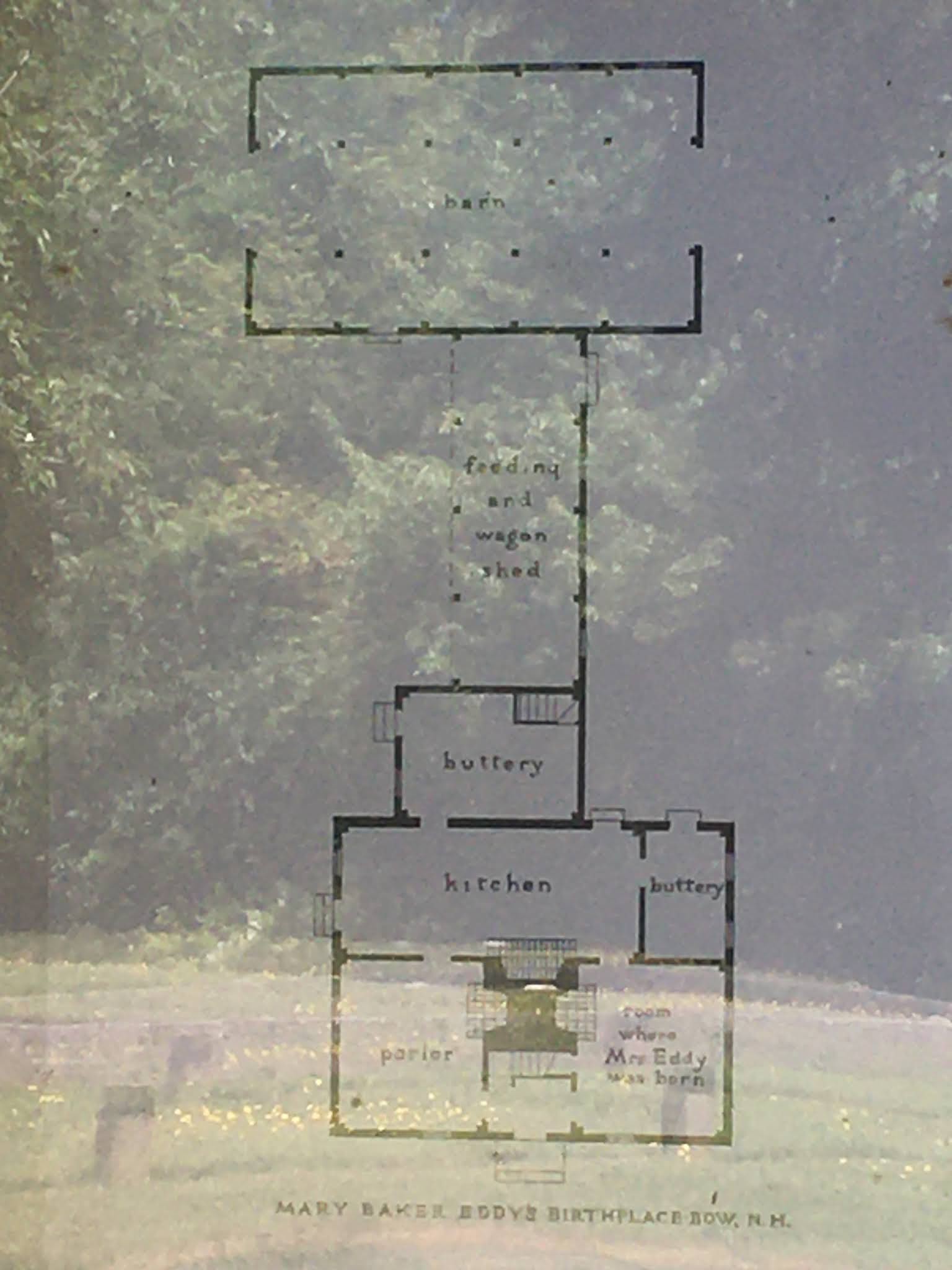
Nearby our home in Manchester, New Hampshire off Route 3A and the Merrimack River is a historic site we never visited until just a few weeks ago.  We drive by it all the time on our way to Concord, passing through the small town of Bow.  There is a small wooden sign "The Birthplace of Mary Baker Eddy", but usually we are too busy to stop, or it is winter and the entrance is snowed in, or the gate is closed, or some other mundane reason.  Finally, we stopped by to see this spot.

The entrance is on Baker Road, up a steep hill from busy Route 3A. The trees form a tunnel, which is lush and quiet.  By the time you reach the top of the hill it is silent except for the distant sounds of traffic on Route 93 nearby.  This little wooded park is squeezed in between routes 3A and 93.  At the time of Mary Baker Eddy's birth in 1821 the area was heavily deforested farm land.  It is hard to imagine her family farm now, since the buildings no longer exist and the landscape has changed so much.

Mary Morse Baker was born on July 16, 1821 to her parents Mark Baker and Abigail Barnard Ambrose.  The family removed from Bow to Sanbornton Bridge (now the town of Tilton) in 1836.  She married George Washington Glover in 1843, but he died of Yellow Fever after only six months. She remarried in 1853 to Daniel Patterson, a local dentist, but divorced him in 1872.  In 1875 she published her book Science and Health, which was her guide to her new movement which became known as Christian Science.  Today there are over 1,500 Christian Science churches in over 70 countries. 

In 1877 she married Asa Gilbert Eddy, and became Mary Baker Eddy.  In 1882 the couple removed to Boston, and Gilbert Eddy died the same year.  She established her own church in Boston, and in 1888 opened a reading room which sold her books and bibles.  The founded the Christian Science Monitor newspaper in 1908.  She died at age 89 on 3 December 1910 at 400 Beacon Street in Newton, Massachusetts, and was buried at the Mount Auburn Cemetery in Cambridge, Massachusetts.  

In 1921 a granite pyramid weighing 100 ton was installed at her birthplace in Bow.  It was blown up (dynamite) in 1962, and her former home in Concord was destroyed, too, because the Christian Science church believed they would become pilgrimage spots.  Her homes in Swampscott, Amesbury, Stoughton, Lynn and Newton (all in Massachusetts) are owned by the Longyear Museum and open to visitors. 


Signs at the birthplace parking area show how the farm and dwelling would have looked in 1821


This engraving was made in 1898 by Mary Baker Eddy's cousin, Rufus H. Baker

--------------------------

For the truly curious:

"The Dearest Spot On Earth: The Birthplace of Mary Baker Eddy", a blog post from the Mary Baker Eddy Library   https://www.marybakereddylibrary.org/research/the-dearest-spot-on-earth-the-birthplace-of-mary-baker-eddy/  

The Longyear Museum and the Mary Baker Eddy Historic Houses:  https://www.longyear.org/   

Wikipedia article on Mary Baker Eddy:  https://en.wikipedia.org/wiki/Mary_Baker_Eddy   

The Ancestry of Mary Baker Eddy, edited by William Montgomery Clemens, 1924, published by the University of Wisconsin - Madison.  Available to read or download for free online at Google Books at this link:  https://www.google.com/books/edition/The_Ancestry_of_Mary_Baker_Eddy/SIZIAAAAMAAJ?hl=en     

--------------------------

To Cite/Link to this post:  Heather Wilkinson Rojo, "The Mary Baker Eddy Birthplace", Nutfield Genealogy, posted August 10, 2021, ( https://nutfieldgenealogy.blogspot.com/2021/08/the-mary-baker-eddy-birthplace.html: accessed [access date]). 

Tuesday, June 15, 2021

Molly Reid Memorial, Londonderry, New Hampshire


BIRTHPLACE OF

MARY WOODBURN

WIFE OF

GEN. GEO. REID

1735 - 1823

----------

GEN. STARK SAID OF HER

"IF THERE IS A WOMAN IN

NEW HAMPSHIRE FIT FOR

GOVERNOR, IT IS

             MOLLY REID."

ERECTED BY MOLLY REID

CHAPTER D.A.R.

1899


This monument to Molly Reid is located on High Range Road in Londonderry, New Hampshire, on private property (but visible by the roadside) between Parmenter Road and MacIntosh Road.  She was the wife of General George Reid, who lived in Londonderry (now the part that is Derry) and who fought the American Revolution in Lexington, Concord, Bunker Hill, Trenton, Saratoga, Monmouth,  and with George Washington in Yorktown.  

George Reid was a farmer, who married Mary Woodburn in 1765.  They had five children, Mary Boyd Reid Dinsmoor (d. 1834), James Reid (1767 - 1827), John Reid (1771 - 1834), George Reid (1774 - 1848), and Elizabeth Reid McGregor (1776 - 1847).  The Reid family is buried at Forest Hill Cemetery, and follow the link below to see a blog post with photographs of the Reid family plot.  

Mary Woodburn was the daughter of John Woodburn, an Irish immigrant, and Mary Boyd of Londonderry.  Their farm and homestead was located near the memorial on High Range Road. Their home was a garrison, which was never needed because Londonderry was never attacked by the French or the native people of the area.  Mary (Molly) was born 7 April 1734/5 and died on her birthday in 1823, aged 88 years.   John Woodburn is also buried at Forest Hill in Derry. 


For the truly curious:

The Molly Reid Chapter DAR website:   http://mollyreid.nhsodar.org/    

A 2012 blog post with the gravestone of General George Reid and Mary Reid, buried at Forest Hill Cemetery in Derry, New Hampshire:   https://nutfieldgenealogy.blogspot.com/2012/04/tombstone-tuesday-revolutionary-war.html    


-------------------

To Cite/Link to this post:  Heather Wilkinson Rojo, "Molly Reid Memorial, Londonderry, New Hampshire", Nutfield Genealogy, posted June 15, 2021, ( https://nutfieldgenealogy.blogspot.com/2021/06/molly-reid-memorial-londonderry-new.html: accessed [access date]). 

Tuesday, March 9, 2021

The Peabody Essex Museum's Special Exhibit on the Salem Witch Trials 1692


Last week Vincent and I carefully planned our first museum visit in almost a year.  The Peabody Essex Museum in Salem, Massachusetts had their special exhibit The Salem Witch Trials 1692 open since September 26, 2020.  I was thinking I would miss this exhibit due to the pandemic.  We have been very careful about not going into many indoor places, including picking up groceries, staying home, and social distancing.  But this exhibit is closing on April 4, 2021 and we decided to try it as our first indoor excursion.

First of all, we did all the recommendations I heard from Dr. Fauci and the CDC to stay safe.  We double masked, including an N95 mask with a cloth mask over it.  We brought hand sanitizer and used it often, even though I didn't really touch anything in the museum (they had self opening doors in most places - just wave your hand! And tissues inside the elevators for touching the buttons, and hand sanitizer everywhere).   We both had received our first vaccines more than two weeks ago. 

On top of this, we thought carefully about planning a day and time for our trip.  Usually I book a medical appointment for the first opening of the day, and we go mid week if I have to go into a store to avoid crowds. So we planned to go on a Thursday morning to the Peabody Essex.  I discussed this with a staff member after we saw the Salem Witch Trial exhibit, and they said that Thursdays and Fridays were very slow (the museum is open Thursdays to Sundays 11am to 5pm).  And March is a good time to visit Salem if you want to avoid people.  It's too blustery and chilly to attract a lot of tourists.  And the exhibit is winding down.  If you want to go, go soon but plan the day and time carefully. 

As you can see from the photo below, the museum was almost empty, except for staff wandering here and there.  We were the only people inside the exhibit hall for almost 30 minutes, when another two people entered.  The photo below is the two of us in the main lobby, with no one else in sight!  It was very easy to social distance.  Tickets are timed to ensure that occupancy levels remain low, both for museum entry and the tickets to the special exhibits. 


The Salem Witch Trials 1692 is divided into many galleries, with a great introduction in the beginning about the history of witch trials in Europe, and included many famous old books I had only read about in accounts of Salem history. There were some fine original copies of Malleus Maleficarum and Cotton Mather's Wonders of the Invisible World.  The map below includes Salem, Salem Village and nearby towns, and I found the locations of three homes of ancestors who were hanged in 1692 - Bridget Bishop, George Jacobs, and John Proctor.  Also highlighted on this map was Beadle's Tavern, where some of the examinations for the trials took place, owned by another ancestor, Samuel Beadle (1643 - 1706). 


One gallery blew me away, with some artifacts I didn't know existed at all!  And every artifact had been owned by an ancestor.  There was a window from the Towne family home (Edmund Towne, my 8th great grandfather was also the brother of three accused witches).  There was an account book from Joshua Buffum (8th great uncle).  A brass sundial owned by John Proctor, hanged in 1692 (my 9th great grandfather).  A valuables chest owned by accusers Joseph and Bathsheba Pope (my 7th great grandparents) I previously blogged about HERE  along with the actually testimony of Joseph Pope against John Proctor.  Every article on display in this little niche touched one of my ancestral families. 


This sundial was owned by John Proctor, and was a valuable item
for it's time in 17th century Salem. 

The next gallery in this exhibit had many documents, including accounts submitted by the jailkeeper Wiliam Dounton (my 8th great grandfather) and items from the jail.  Dounton was a cruel man, and the descriptions of the jail are hair raising.  There was an actual bill for the board and food for prisoners, and a census of prisoners which included many family members.  The wall planks from the jail have been preserved and are on display here.  Prisoners accused of being witches were chained to these walls, including small children. 

I could go on describing items, but that would fill a book!  I enjoyed seeing George Jacobs's two walking sticks on display here.  They used to be in an exhibit on the first floor of the Phillips library when it was located across the street.  I hadn't seen them in a long, long time.  George Jacobs was my 9th great grandfather, hanged as a witch on 19 August 1692 along with John Proctor (described above with the sundial).  They also had the famous painting of Jacobs's trail done by Tompkins Harrison Matteson in 1859 and featured in almost every account of the witch trials.  This was displayed next to the document showing the examination of Jacobs by the magistrates which describe his two canes. 


One of the most moving items to me was the document with the red wax seal below.  It is the warrant for the execution of Bridget Bishop (my 9th great grandmother).  The bottom of the document has a note by the sheriff George Corwin who reported that he did his appointed job "I have taken the body of the within named Bishop... to the place for her Execution and Caused to be [hanged] by the neck until She was dead."   This gave me shivers to read the actual document. 


The last room of the exhibit hall names and remembers 25 victims of the Salem Witch Trials on the wall, and it also includes a wall called "Reckoning and Reflection".   The last part of the exhibit is called "Reaction and Impact" with documents and books written after 1692.  I liked especially a quote from Thomas Maule, 1695, on the wall that read "For it were better that one hundred Witches should live, than that one person be put to death for a Witch, which is not a Witch."   Maule was an outspoken critic of the trials.  His book, on display here, was the first condemnation of the trails published under its author's own name.  

If you don't want to visit in person, or if you can't visit the museum because of the pandemic or if you live at a distance, try this link from the PEM website and watch the 360 degree tour of The Salem Witch Trials 1692.  You can zoom in and out and move through the space using your mouse or finger.  https://www.pem.org/exhibitions/the-salem-witch-trials-1692  There is a second video on this page, with a tour of the galleries in the exhibit.  At the bottom of this page are links to related articles about the exhibit.  

There are two other exhibits currently at the PEM - Stories of Salem, From A to Z, and Made It: The Women Who Revolutionized Fashion.  We had tickets to the Stories of Salem, and I enjoyed it very much. There are many items, documents and ephemera from Salem history from pre-colonization to the present representing history, famous residents, art, design, industry, and pop culture.  If your family lived in Salem recently or long ago, you'll find lots of interesting items in this exhibit! 


This dollhouse belonged to a wealthy Salem Family over 100 years ago

Do you remember when Parker Brothers made their board games in Salem?

An exhibit of witches in pop culture in Salem contained this
weathered old weathervane!  I loved it! 

For the truly curious:

The Peabody Essex Museum:   https://www.pem.org/   

The museum is located at East India Square, 161 Essex Street, Salem, Massachusetts

Admission to the museum is $20 (seniors $18, students with ID $12, youths 16 and under and Salem residents are free)  The Salem Witch Trials 1692 is FREE but requires a timed entry ticket.  

Two links to blog posts about the Pope Valuables Chest:

https://nutfieldgenealogy.blogspot.com/2009/09/treasure-chest-thursday-at.html  

https://nutfieldgenealogy.blogspot.com/2014/11/surname-saturday-pope-of-salem.html  

My lineage from Bridget Bishop:

https://nutfieldgenealogy.blogspot.com/2017/06/bridget-playfer-wasselbee-oliver-bishop.html  

My lineage from George Jacobs:

https://nutfieldgenealogy.blogspot.com/2012/04/surname-saturday-jacobs-of-salem.html    

My lineage from John Proctor:

https://nutfieldgenealogy.blogspot.com/2012/05/surname-saturday-proctor-of-salem.html  


------------------------

To Cite/Link to this post:  Heather Wilkinson Rojo, "The Peabody Essex Museum's Special Exhibit on the Salem Witch Trials 1692", Nutfield Genealogy, posted March 9, 2021, ( https://nutfieldgenealogy.blogspot.com/2021/03/the-peabody-essex-museums-special.html: accessed [access date]). 

Tuesday, February 23, 2021

The Obituary of Jemima (Burnham) Emerson, 1868 - The Christian Wife of an Infidel

The Col. Joshua Burnham Tavern, photo 2001
where Jemima Burnham grew up, Milford, New Hampshire

My 4th great grandmother was born as Jemima Burnham.  Her name is listed as Jemima Wyman Burnham on an SAR application dated 20 August 1957 for Emerson Francis Thayer McLean, a distant cousin.  I've never seen her listed with a middle name on any other vital record or documentation.  Her mother's name was Jemima Wyman, so it could be possible.  Jemima was born 9 May 1783 in Milford, New Hampshire.  It is often difficult to learn about the lives of our women ancestors, but bits and pieces of Jemima's life have become revealed to me over 40 years of searching for clues.

Her father was Colonel Joshua Burnham.  He was a local character, a veteran of the Revolutionary War, a local hero who was present at the Battle of Bunker Hill and served in New York, Philadelphia and Canada.  The history of Milford states that he was an eyewitness when George Washington took command of the Continental Army.  He built a large farm and tavern near the banks of the Souhegan River, which is still standing on River Road.  He later sold his tavern and property to Jesse and Polly Hutchinson, who raised their thirteen children there in Milford.  These children were famous as the Hutchinson Family singers who sang songs of temperance, abolition, women's suffrage, and other progressive movements all over the USA and even in Europe.  

Although Col. Burnham sold his farm to the Hutchinson family, he remained in Milford, and remained a good friend to Jesse Hutchinson.  He must have agreed with all the progressive beliefs, and discussed them with the Hutchinson's various friends who included P. T. Barnum, William Lloyd Garrison and Frederick Douglass.  These famous singers gave their very first concert at the Baptist church in Milford.  The Hutchinson Singers toured England with Douglass in 1845, and some moved to Lynn, Massachusetts to live next door to him.  

Local history and various Hutchinson journals and books remember Col. Burnham as an old veteran who would wander the property, often stuffing his pockets with apples from the orchard.  The Burnham family and the Hutchinson family lie side by side in a small burial ground, the North Yard Cemetery,  within site of the Col. Burnham tavern on River Road.  Joshua Hutchinson wrote the epitaph for Joshua Burnham "Soldier of the revolution zealous in his country's cause, Faithful to the constitution and obedient to its laws"

These stories are what I know of Jemima's life in Milford.  Of course, she had married by 1810 to Romanus Emerson and removed to South Boston where her children were born.  Her family had been members of the Baptist Church in Milford, listed on the records.  The same Baptist church that held the first concerts for the Hutchinson family who sang about abolition before the Civil War.  Although the Baptist church is considered conservative today, they supported very progressive ideas in the early nineteenth century. 

I was not surprised that she married Romanus Emerson.  He came from a family of ministers.  They were Congregationalists going back to Puritan times.  The Emerson family included early ministers such as Rev. Joseph Emerson, born in England about 1620, who married Elizabeth Bulkely, the daughter of Rev. Edward Bulkely (1614 - 1696) the first minister of Concord, Massachusetts.  Even Ralph Waldo Emerson (1803 - 1882), son of a Concord minister, also studied for the ministry at Harvard.  Romanus Emerson had three brothers who became ministers, and he himself studied for the ministry but gave up due to a speech impediment.  

It was during his time studying theology that Romanus Emerson had a change of heart.  He became an atheist.  He said that "Freethinking" without the constraints of religion and other social mores opened his mind to progressive thoughts and more independent beliefs.  He joined the Free Soil movement, the abolitionists, and the Infidel Society.  He called himself an "Infidel" for the rest of his life, and wrote his own eulogy describing his "Infidel" beliefs. 

I have no idea what Jemima thought of all this during her married life with Romanus, the atheist.  I believe that she agreed with his progressive thoughts and politics.  But to be an atheist, or an "Infidel", at this time was considered quite shocking.  As a Baptist all her life, this was probably somewhat of a problem at home. Or was it? Women were considered to be obedient and quiet in those days. But we know that was not always the case.  

Romanus died in 1852.  He was a famous Bostonian, with his obituaries carried in newspapers across the country.  His last wish was to not have a Christian funeral, but to be buried in South Boston "At the point" and for his best friend, Horace Seaver, to read his self written eulogy.  However, his family (Jemima?) did not follow his final wishes, and gave him a funeral officiated by the Rev. Capen of the Hawes Place Church (next door to their house) and he was laid to rest in the Hawes Burying Ground.  Was it out of spite that she ignored her husband's final wishes? or did Jemima truly love her husband and worry about his immortal soul? 

As a widow, Jemima Emerson was enumerated in the 1855 Massachusetts State Census and the1860 Federal Census living in the Boston home of Melzar Stetson, her son-in-law, husband to her daughter Emily.  Her death certificate lists her place of death as 88 Emerson Street, her home address on the street in South Boston named after her Infidel husband, Romanus. 

Jemima died in 1868. Unlike her famous husband, I found only one mention of Jemima's death (other than short death notices in Boston newspapers) in The Christian Watchman (a Boston Baptist journal), dated Thursday, 27 August 1868, on page 7. See the obituary transcribed below.  She was laid to rest at the Mount Hope Cemetery in the Mattapan section of Boston, and Romanus was reinterred from the Hawes Burial Ground to lie next to her.  I like to think that perhaps it was out of love that she had him moved to be next to her for eternity.

"Obituary

Mrs. Jemima Emerson

In South Boston, August 5, Mrs. Jemima Emerson, at the advanced age of 86 years, widow of the late Romanus Emerson.  When 18 years of age she was converted, and baptized in Milford, N. H.  Afterwards united with the Dudley Street Church, Roxbury, and then with the South Baptist Church, and finally became a constituent member of the Fourth Street Baptist Church.  Her early Christian experience began with deep conviction of sin, from which, after long struggles, she was delivered by the power of Christ.  This, together with the opposition she encountered in following the Lord in baptism, determined, in great measure, the marked features of her subsequent life.  She loved the doctrines of grace, and clung with ever increasing tenacity to the great pillars of eternal truth.  She loved the assembly of God's people, and even until within a few weeks of her death her voice was frequently heard in the prayer meeting, as she bore cheerful testimony to the faithfulness of God.  Her children have lost a faithful, godly mother, whose prayers for their spiritual welfare ended only with her life.  The church she honored has lost a firm friend.  The community, which for forty years has been growing around her, has lost a beacon of light.  She now enjoys the rest which for many years she has anticipated, and she "being dead yet speaketh."  "Those that be planted in the house of the Lord shall flourish in the courts of our God.  They shall still bring forth fruit in old age." " 

For the truly curious:

"Romanus Emerson's Boston Obituaries 1852", published February 9, 2021: https://nutfieldgenealogy.blogspot.com/2021/02/romanus-emersons-boston-obituaries-1852.html   

"Romanus Emerson's Obituaries 1852" (published across the United States), posted on this blog on October 1st, 2020:  https://nutfieldgenealogy.blogspot.com/2020/10/romanus-emersons-obituaries-1852.html    

My Surname Saturday post on the EMERSON family:   https://nutfieldgenealogy.blogspot.com/2015/01/surname-saturday-emerson-of-ipswich.html    

My Surname Saturday post on the BURNHAM family:     https://nutfieldgenealogy.blogspot.com/2014/05/surname-saturday-burnham-of-chebacco.html  

"Tombstone Tuesday ~ Col. Joshua Burnham, Milford, New Hampshire":     https://nutfieldgenealogy.blogspot.com/2013/10/tombstone-tuesday-col-joshua-burnham.html  

------------------------

To Cite/Link to this post:  Heather Wilkinson Rojo, "The Obituary of Jemima (Burnham) Emerson, 1868 - The Christian Wife of an Infidel", Nutfield Genealogy, posted February 23, 2021, ( https://nutfieldgenealogy.blogspot.com/2021/02/the-obituary-of-jemima-burnham-emerson.html: accessed [access date]).  

Thursday, June 25, 2020

Did Your Ancestor Serve in the Civil Defense During World War II?


Two weeks ago I posted about this wooden crate from my parents' house that was full of World War II ephemera.  The last blog post was about the ration tickets I found inside the box, and this week I've photographed the items related to civil defense. Both of my grandfathers, Donald Munroe Wilkinson ( 1895 - 1977) and Stanley Elmer Allen (1904 - 1982) were both too old to serve or be drafted into the military during World War II.  However both volunteered in the civil defense.

Many civilians served in voluntary positions during the war for air raid drills and coastline drills.  They also learned to fight fires, provide first aid, assist the coast guard, and also to lead recycling, rationing and Liberty bond drives. There were women's auxiliary units, too, for first aid, rolling bandages, and other projects.  Even children played with games that taught them to identify aircraft and other civilian saboteur surveillance. 


I found this certificate in the box, recognizing my maternal grandfather's service in the auxiliary police for the town of Hamilton, Massachusetts.  During World War II many police officers were drafted, leaving towns without their usual police force.  Citizen volunteers were trained to assist the regular police.

My paternal grandfather served as an air ward warden in Beverly, Massachusetts (a contiguous town).  The air raid wardens would patrol their neighborhoods to make sure that homes were darkened with blackout curtains.  Beverly is a coastal town, and blackouts were important along both coasts of the United States.


For the truly curious:

World War II ration tickets blog post:
https://nutfieldgenealogy.blogspot.com/2020/06/world-war-ii-ration-tickets-and-tokens.html 

----------------------

Heather Wilkinson Rojo, "Did Your Ancestor Serve in the Civil Defense During World War II?", Nutfield Genealogy, posted June 25, 2020, ( https://nutfieldgenealogy.blogspot.com/2020/06/did-your-ancestor-serve-in-civil.html: accessed [access date]).