Showing posts with label Quaker. Show all posts

Tuesday, September 21, 2021

Sandwich Quaker Meeting House


The Sandwich Quaker Meeting was first gathered on 13 April 1657 at the home of William Allen on Spring Hill Road in East Sandwich, about 500 yards from the present meeting house.  Among the attendees was Nicholas Upsall who had been expelled from Boston for his heretical beliefs.  By 1658 there were sixteen Quaker families in Sandwich, meeting secretly to avoid punishment.  But in 1694 the town granted the Quakers land on Spring Hill for a burial ground and meetinghouse. This structure was built in 1810.   Today it is considered the home of the oldest continuous Quaker meeting in America.

This building was originally made on the Kennebec River in Maine and shipped to Sandwich.  It was reassembled according to the numbered timbers.  There are original carriage sheds on each side of the meetinghouse, and the privies behind were used until 1992 when the community house was connected to the town water.  The burial ground is behind the meetinghouse, but the earliest burials were unmarked by gravestones.  There is no known record of early burials.

Around this meetinghouse there was a large Quaker village with a Quaker school, the Wing and Hoxie family homesteads (now museum houses open to the public in the summer), and homes of other early Quaker families. Surnames include Bowman, Crocker, Holway, Gifford, Jones, Ewer, West, Russell and others.  The Religious Society of Friends is still continuing services at this meetinghouse, and worship is 10am every Sunday. Visitors are welcome. 


SANDWICH
MEETING of FRIENDS

Sandwich Monthly Meeting of Friends, established in 1657, is the
oldest continuous Quaker meeting in North America.  It consists
of congregations here, in West Falmouth and in Yarmouth.

This meetinghouse, the third on this site, was built in 1810.
Meetings for worship are held here at 10:00am each Sunday.

Meetings for worship are also held each Sunday throughout the
year at 10:00 am at the South Yarmouth Meetinghouse and
10:00am at the West Falmouth Meetinghouse.
-------------0---------------
Visitors are always Welcome


For the truly curious:

East Sandwich Friends Meeting House
6 Quaker Road
East Sandwich, Massachusetts 02537

Sandwich Monthly Meeting history webpage (from the Cape Cod Quakers website):  http://www.capecodquakers.org/smm_history.html 

A listing of burials in Sandwich Quaker Cemetery http://www.capecodgravestones.com/sandquaker.html 

“The Quaker Way of Life”, Cape Cod Times, 20 August 2007, https://www.capecodtimes.com/article/20070820/news/708200318

 ---------------------------

To Cite/Link to this post: Heather Wilkinson Rojo, "Sandwich Quaker Meeting House", Nutfield Genealogy, posted Sept 21, 2021, ( https://nutfieldgenealogy.blogspot.com/2021/09/sandwich-quaker-meeting-house.html: accessed [access date]). 

Tuesday, September 7, 2021

The Wing Fort House, Sandwich, Massachusetts


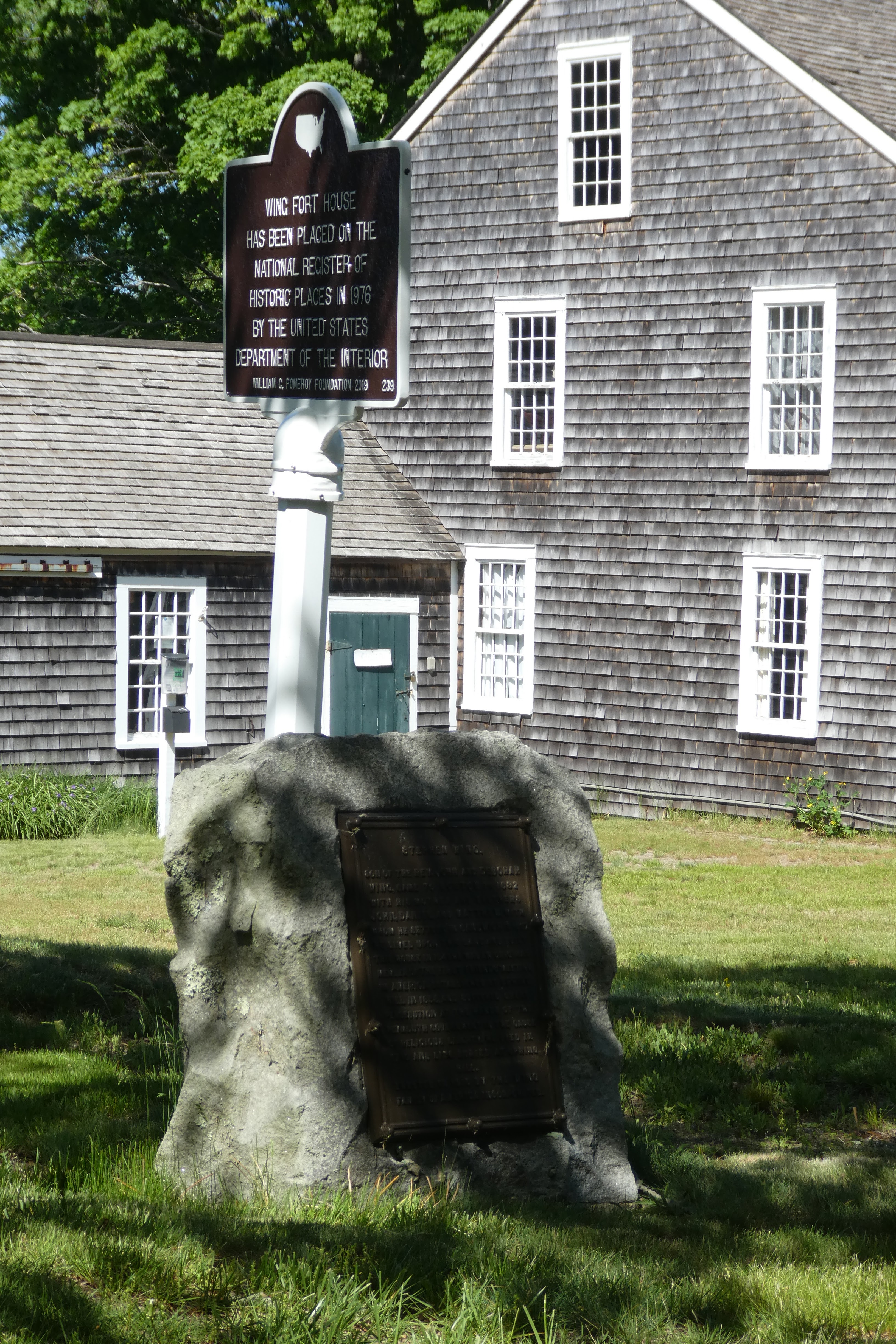
While we were exploring Cape Cod a few months ago we had a serendipitous discovery.  We were lost on a back road, searching for the Quaker cemetery, when we stumbled across this historic home.  It was the Wing Fort House on Spring Hill Road in Sandwich, Massachusetts.  Of course, we stopped to take a few photos before continuing our search. This house was built by an a relative who became a Quaker, so we knew we were very close to our destination!

This garrison home was built in 1641 by Stephen Wing.  (I descend from his grandfather, the Reverend Stephen Batchelder (1561 – 1656) through his two children Nathaniel (1590 – 1630) and Ann (b. about 1603) who married John Sanborn).  It is puzzling why this was built as a garrison, since the native Wampanoags were friendly to the English settlers on Cape Cod.  Stephen Wing lived here with his family and his mother, Deborah Batchelder (my 10th great aunt) who was the wife of the Reverend John Wing.

Stephen Wing was one of the first Quakers in Sandwich, Massachusetts.  The Plymouth Court records have some of the first legal proceedings against the early Quakers in Sandwich.  On March 2, 1657/8 “Lieut. Ellis, Stephen Winge and Thomas Butler, being summoned to answer for tumultuous carriage as aforesaid, [at a Quaker meeting] being examined, and not found so faulty as was supposed, were admonished and cleared.”  He was fined many times for refusal to take the oath of Fidelity because Quakers believed it a sin to take any oath. 

Descendants of the Wing family have lived in this house until 1942 when it was sold to the Wing Family of America (the family association) as a museum house.  Unfortunately, the tours run from June through September, so we missed seeing the inside of the house.  During the rest of the year the house is available by appointment to members of the Wing association.

 There have been several archaeological digs at the site of the Wing Fort House.  Most recently was an archaeological dig at this house in 2010 that revealed a small addition to the north side (a possible milk house?) and many 17th, 18th and 19th century artifacts.  See the link below for a report on what was found. 


WING FORT HOUSE
HAS BEEN PLACED ON THE
NATIONAL REGISTER OF
HISTORIC PLACES IN 1976
BY THE UNITED STATES
DEPARTMENT OF THE INTERIOR
WILLIAM G. POMEROY FOUNDATION 2019     239


STEPHEN WING

SON OF THE REV. JOHN AND DEBORAH
WING, CAME TO BOSTON IN 1632
WITH HIS MOTHER AND BROTHERS
JOHN, DANIEL, AND MATHEW, WITH
WHOM HE SETTLED IN SANDWICH IN 1637.
HE LIVED UPON THIS LAND AND BUILT
THIS HOUSE IN 1641.  HE WAS AN ORGINAL
MEMBER OF THE FIRST FRIENDS MEETING
IN AMERICA, ESTABLISHED AT SPRING
HILL IN 1658, AND SUFFERED GREAT
PERSECUTION AT THE HANDS OF THE
PLYMOUTH GOVERNMENT IN THE CAUSE
OF RELIGIOUS LIBERTY.  HE DIED IN
1710 AND LIES BURIED AT SPRING
HILL.
ERECTED IN 1910 BY THE WING
FAMILY OF AMERICA INCORPORATED.


For the truly curious:

The Wing Family of America website:    https://www.wingfamily.org/ 

“Tour the Wing Fort House from Your Own Home with Caretaker, Dave Wheelock”  (two parts)  via YouTube  https://www.youtube.com/watch?v=5zp8afIPBFk 

Click here to see the reports on the 2010 archaeological dig (report and artifacts)  http://www.plymoutharch.com/wing-fort-house-excavations/  

“Mystery of Missing Family Members Still Unsolved After Archaeological Dig”, The Sandwich Enterprise, July 28, 2017,  https://www.capenews.net/sandwich/news/mystery-of-missing-family-members-still-unsolved-after-archaeological-dig/article_4a4bd723-40c8-5427-ae4e-a539e03fdab6.html 

A slide show of a visit to the Wing Fort House (no narration or captions):  https://vimeo.com/28244835 

---------------

To Cite/Link to this post: Heather Wilkinson Rojo, “The Wing Fort House, East Sandwich, Massachusetts”, Nutfield Genealogy, posted September 7, 2021, ( https://nutfieldgenealogy.blogspot.com/2021/07/the-wing-fort-house-sandwich.html: accessed [access date]). 

Saturday, August 4, 2018

Surname Saturday ~ MENDALL of Marshfield and Rochester, Massachusetts


MENDALL /  MENDELL

John Mendall, my 9th great grandfather, came late to New England, perhaps in the 1650s.  He married the widow of Jeremiah Burroughs.  She came with four small children, and her name is unknown.  Together they had five children with the surname Mendall, one son and four daughters, all born in Marshfield, Massachusetts and listed in the town records.   John Mendall’s birth, origins and exact death date are all unknown.

John Mendall’s will was dated 11 May 1711 and proved 8 February 1720.  His wife was not mentioned in the will, so she must have predeceased him sometime before 1711.  The will mentions his son, John; his grandson-in-law, Francis Crooker; his daughters Mercy Tinkham, Sarah Torry, Hannah Tilden and Ruth Doty; and his son-in-law Thomas Tilden.    This family is of great interest to Mayflower researchers because two of John Mendall’s daughters married grandsons of Mayflower Passengers.  Mercy married Peter Tinkham, grandson of passenger Peter Brown; and daughter Ruth married Theophilus Doty, the grandson of passenger Edward Doty (also my 10th great grandfather). 

The will of John Mendall:

In The Name of God, Amen. The tenth day of May in the year of our Lord 1711, I John Mendall of Marshfield in the county of Plimoth in New England, being aged & weak in body, but of perfect mind and memory thanks be given to God; therefore calling my mortality of my body to mind and knowing that it is appointed for men once to dye Doe make and ordain this my Last Will & Testament, that is to say, principally & first of all I give & recommend my soul into the hands of God that Gave it, & my body to be buried at the discretion of my Executor hereafter named & as touching such worldly Estate wherewith it hath pleased God to bless me in this life, I Give devise & dispose of the same in the following manner & form: That is to say ; First, I will that all those debts & duties as I do owe in Right or Conscience to any manner of person or persons whatsoever, Shall be well & truly contented and paid; or ordained to be paid in Convenient time after my decease, by my Executor hereafter named.
    Item: I give & bequesth to my well beloved son John Mendall, one shilling.
    Item: I give & bequeth to my well loved grandson-in-law, Francis Crooker, all my ropemaking tools that I doe use in or about the makeing of rope, after I have done useing them myself.
    Item: I give & bequeth all the rest of my estate of what kind or nature soever to my well beloved daughters, Mercy Tinckum & Sarah Torry & Hannah Tilden & Ruth Doty. I likewise constitute make and ordain my son-in-law Thomas Tilden to be my only & sole executor of my Last Will & Testament & I do hereby utterly Disalow, Revoke, and disannul all & every other former Testaments, Wills, & Legacies, Bequests & Executors by me before this time in anyways Named, Willed & Bequesthed, Ratifieing & Confirming this & no other to be my Last Will & Testament In Witness whereof I have hereunto sett my hand & seal this day and year above written.
      Signed Sealed Published Pronounced & Declared by the sd John Mendall as his Last Will & Testament in the presence of us the subscribers (viz) the words (my son-in-law Thomas Tilden to be) were Enterlined before the Ensealing & Delivery of these presents between eighteenth & ninteenth lines.
    The Mark of John X Mendall
    John Jones (signed)
    John Little (signed)
    Isaac Little (signed)

I descend from John Mendall, Jr. (1663 – 1743), my 8th great grandfather, who was a Quaker who settled in nearby Rochester, Massachusetts.  He had three children, two boys and one girl, born in Rochester and recorded there.  His death date is unknown, but his will was proven on 14 July 1743.

For more MENDALL information:

Descendants of John Mendall, Sr., of Marshfield, Massachusetts. by Sidney D. Smith, Gateway Press, Baltimore, Md., 1984.  Available online at archive.org 

Records of the Colony of New Plymouth, In New England, Volume 7, page 199.

My MENDALL genealogy:

Generation 1:  John Mendall, born about 1638 probably in England, died about 1720 in Marshfield, Massachusetts; married to Unknown, widow of Jeremiah Burroughs, before 1663. Five children.

Generation 2:  John Mendall,born 15 December 1663 in Marshfield, Massachusetts; died before 14 July 1743 in Rochester, Massachusetts; married about 1687 in Scituate, Massachusetts to Joanna Standlake, daughter of Richard Standlake and Unknown. She was born about 1661 in Scituate, and died 5 June 1738 in Rochester.  Three children.

Generation 3:  Joanna Mendall, born 13 May 1690 in Rochester, died before 3 May 1773 in Falmouth, Massachusetts; married first on 17 July 1707 in Rochester to Daniel Butler (five Butler children); married second on 16 May 1726 in Falmouth to William Green, son of Isaac Green and Unknown.  He was born 20 November 1696 in Malden, Massachusetts and died about 1773 in Falmouth.  Five more Green children.

Generation 4:  Tabitha Green m. Jabez Robinson
Generation 5:  Elizabeth Robinson m. Ebenezer Crosby
Generation 6:  Rebecca Crosby m. Comfort Haley
Generation 7:  Joseph Edwin Healy m. Matilda Weston
Generation 8:  Mary Etta Healey m. Peter Hoogerzeil
Generation 9:  Florence Etta Hoogerzeil m. Arthur Treadwell Hitchings
Generation 10:  Gertrude Matilda Hitchings m. Stanley Elmer Allen (my grandparents)

----------------------------

Heather Wilkinson Rojo, “Surname Saturday ~ MENDALL of Marshfield, Massachusetts”, Nutfield Genealogy, posted August 4, 2018, ( https://nutfieldgenealogy.blogspot.com/2018/08/surname-saturday-mendall-of-marshfield.html: accessed [access date]).

Saturday, July 14, 2018

Surname Saturday ~ HARPER of Sandwich, Massachusetts


HARPER

Robert Harper (about 1630 – about 1704), my 9th great grandfather, was an early Quaker.  His name can be found in the Falmouth, Massachusetts Friend’s Monthly Meeting records.   Because of his faith (not attending church), and he refused to take the oath of Fidelity, he lost much of his personal property and was heavily fined. Perhaps that’s why he left no will or tombstone (Quakers were buried together in unmarked graves). 

As a Quaker, in 1660 Robert Harper was sentenced to be whipped, and he and his wife, Deborah, were sent to the prison in Boston.   In 1661 Harper “stood under the scaffold and caught in his arms the body of his friend William Leddra, the martyr preacher” on Boston Common.  For this act of kindness, Harper and his wife were banished again.

I descend from Robert Harper and his second wife, Prudence Butler, through their daughter Hannah (b. 1670) who married Isaac Robinson.  She is my 8th great grandmother. Isaac was another Quaker who was heavily prosecuted by the Puritan authorities. They had ten children. Isaac Robinson was a great grandson of the Reverend John Robinson, pastor to the Pilgrims.

Some HARPER resources:

MacLean W. McLean, "Robert Harper of Sandwich, Mass., and his Son Stephen of Falmouth." The American Genealogist, Volume 48, page 215, October 1972

History of Cape Cod by Frederick Freeman, 1862

Sandwich and Bourne Town Records

The Genealogical Dictionary of New England, by Savage

The History of the Society of Friends in America, Volume 1

My HARPER genealogy:

Generation 1:  Robert Harper, born about 1630 in England, died about 1704 in Sandwich, Massachusetts; married first to Deborah Perry May 1654; married second to Prudence Butler, daughter of Thomas Butler, 22 June 1666 in Sandwich.  Four children.

Generation 2:  Hannah Harper, born May 1670 in Sandwich; married 1 March 1690 in Barnstable to Isaac Robinson, great grandson of Rev. John Robinson, pastor to the Pilgrims, son of John Robinson and Elizabeth Weeks.  Ten children.

Generation 3:  Peter Robinson m. Martha Green
Generation 4:  Jabez Robinson m. Tabitha Green
Generation 5: Elizabeth Robinson m. Ebenezer Crosby
Generation 6:  Rebecca Crosby m. Comfort Haley
Generation 7:  Joseph Edwin Healy m. Matilda Weston
Generation 8:  Mary Etta Healey m. Peter Hoogerzeil
Generation 9:  Florence Etta Hoogerzeil m. Arthur Treadwell Hitchings
Generation 10:  Gertrude Matilda Hitchings m. Stanley Elmer Allen (my grandparents)

See this interesting blog post by Christy K. Robinson about Robert Harper:

------------------------------------

Heather Wilkinson Rojo, “Surname Saturday ~ HARPER of Sandwich, Massachusetts”, Nutfield Genealogy, posted July 14, 2018, ( https://nutfieldgenealogy.blogspot.com/2018/07/surname-saturday-harper-of-sandwich.html:  accessed [access date]). 

Monday, May 12, 2014

"But for the Bread", an Historical Poem by Jeff Southwick

Shelter Island

Jeff Southwick wrote this poem about our mutual ancestors, the Southwicks.  Lawrence and Cassandra Southwick were persecuted Quakers in Salem, Massachusetts.  In 1659 they were banished, and fled to Shelter Island off Long Island, New York where they died of exposure.  Their minor children, Daniel and Provided, were sold into slavery by the Massachusetts General Court.  

I met Jeff via Google+ when he wrote to me in reply to my post about Shelter Island.  He shared his Southwick ancestry and this poem.  His lineage is 1. Lawrence and Cassandra Southwick, Daniel, Daniel, Jonathan, George, Jonathan, Stephen Wilbur, Jesse, Jesse, Donald and then himself. 

Jeff Southwick wrote " I was wondering what my ancestors where like as people, and so how much different might be the temperament of a person from generation to generation.  With my parents, grandparents and my children I share a basic respect for others and outlook on life, and so I assume that provided that my ancestors married others of similar temperament, then maybe my outlook on life is not that much different from that of L&C, though how would I know.  As I pondered that thought this past week I wrote the following."  He also wrote " My branch came from Daniel, and headed west from NY to Iowa in the mid 1800s. I am in the 11th." 

But for the Bread
by Jeff Southwick
May 2014

But for the bread I might not be here had Daniel’s emptiness not been sated
But for the bread Endicott said a heretic possessing papers would not be fed
But for the bread slipped between jail bars I might be someone else instead
But for the bread Provided at risk we may have gone to darkness convicted
But for the bread the captain contemplated the morality of humanity traded
But for the bread never by Josiah was an unforgiving stone tossed in hatred 
But for the bread in a corner establish family tradition of love demonstrated
But for the bread within privation to hold vision of justice Cassandra waited
But for the bread when Lawrence sought shelter he willed to a nation ahead

For more information on the Southwick family:

A post about a poem by Whittier about the Southwick children being sold into slavery:
http://nutfieldgenealogy.blogspot.com/2009/11/ballad-of-cassandra-southwick.html

A post about Shelter Island (the one that inspired Jeff Southwick to contact me)
http://nutfieldgenealogy.blogspot.com/2012/08/a-visit-to-shelter-island.html

------------------------------
The URL for this post is
http://nutfieldgenealogy.blogspot.com/2014/05/jeff-southwick-wrote-this-poem-about.html

Copyright 2014, Jeff Southwick and Heather Wilkinson Rojo

Saturday, August 11, 2012

The Sylvester Family of Shelter Island

To find the Sylvester Monument and Quaker
Cemetery, look for this historical marker
on Route 114 on Shelter Island

At one time the Sylvester family owned all of Shelter Island, off the coast of Long Island between the North and South Forks.  The first owner was Nathaniel Sylvester, a wealthy Englishman, who was a sugar merchant who paid for the island with sacks of sugar.   His wife, Grissell Brinley was the daughter of the auditor for King Charles of England.  Nathaniel left his plantation to his son, Giles.  Both were monarchists and  friends of Quakers, and sympathized with their plight at the hands of the Puritans. The ruins of his plantation built in 1662 have been the site of archaeological research in recent years by the University of Massachusetts.  There is a current manor house built in 1735 after the earlier home was destroyed by fire.


On the Sylvester Manor grounds there is a Quaker cemetery.  The earliest graves here date from 1729, and there are about ten gravestones here with the surnames HUDSON, BROWN and KNOWLING.  The graves of the Sylvester family members have been removed to another graveyard on Shelter Island.  The marble monument in the middle of the cemetery dates from 1884, and names the persecuted Quakers who sought refuge or were aided and befriended by the Sylvester family.   The marble ledger stones are mostly illegible, as well as the steps with the Quaker history inscribed.   See this blog post for the Quaker history transcribed: ******** 

----------------------- 

Transcription from Friend’s Intelligencer and Journal:

The monument sits in the middle
of the Shelter Island Quaker Cemetery

We had a hard time reading the inscription
until I found this transcription online

To
Nathaniel Sylvester
First resident Proprietor
Of
The Manor of Shelter Island
Under grant of
Charles II, A. D. 1666
[Coat of Arms]
An Englishman
Intrepid
Faithful to friendship,
The soul of integrity and honor,
Hospitable to worth and culture,
Sheltering ever the persecuted for conscience sake
The Daughters of
Mary and Phoebe Gardiner Horsford,
Descendants of
Patience, Daughter of Nathaniel Sylvester,
And Wife of the Huguenot, Benjamin L”Hommedieu
In reverence and affection
For
The good name of their ancestor
In
1885
Set up these stones, for
A Memorial
1610                              1680

The bottom stone was in better
condition and legible

(On the bottom stone)
Descent from Anne Brinley of the Female Side
[Coat of Arms]
Thomas Brinley, King’s auditor, married Anne Wase
Nathaniel Sylvester married Grissell Brinley
Benjamin L’Hommedieu married Patience Sylvester
Benjamin L’Hommedieu married 2nd Martha Bourne
Ezra L’Hommedieu married Mary Catherine Havens
Samuel Smith Gardiner married Mary Catharine L’Hommedieu
Eben Norton Horsford married Mary L’Hommedieu Gardiner

Succession of Proprietors
The Manhannsett Tribe
 The King
The Earl of Sterling
 James Farrett
Stephen Goodyear
Nathaniel Sylvester
 Giles Sylvester
Brinley Sylvester
 Thomas Dering
Sylvester Dering
Mary Catherine L’Hommedieu
 Samuel Smith Gardiner
Eben Norton Horsford

-------------------------

For more information:        

Part 1- A Visit to Shelter Island
http://nutfieldgenealogy.blogspot.com/2012/08/a-visit-to-shelter-island.html

Part 2- The Quaker Memorial at Shelter Island
http://nutfieldgenealogy.blogspot.com/2012/08/the-quaker-monument-on-shelter-island.html
    
Friend’s Intelligencer and Journal,  1895, Volume 52, page 571, “An Interesting Monument on Shelter Island”

Sylvester Manor, a 243 historic plantation and non-profit educational farm on Shelter Island

A website about the archaeological digs at Sylvester Manor:

-------------------------
Copyright 2012, Heather Wilkinson Rojo

Friday, August 10, 2012

The Quaker Monument on Shelter Island

This is the transcription of the now illegible words on the steps of the Quaker Monument, given to me by the Friends on Shelter Island.  The transcription was made some years ago of the monument erected in 1884.  The tablets on the top of the monument are inscribed with a memorial to the Sylvester Family, who sheltered the Quakers and were great allies with many Friends both in England and in the New .  I'll transcribe those in another blog post.

Each step on all four sides of this monument is inscribed
with the following words....
West Top Step – THE PURITAN AND HIS PRIDE
West middle step- OVERCOME BY THE FAITH OF THE QUAKER
West bottom step – GAVE CONCORD AND LEXINGTON AND BUNKER HILL TO HISTORY

South top step – DANIEL GOULD BOUND TO THE GUN CARRIAGE AND LASHED
South middle step – EDWARD WHORTON THE MUCH SCOURGED
South bottom step – CHRISTOPHER HOLDER THE MUTILATED

East top step- LAWRENCE AND CASSANDRA SOUTHWICK
East middle step- DESPOILED IMPRISIONED STARVED WHIPPED BANISHED
East bottom step- WHO FLED HERE TO DIE

North top step – OF THE SUFFERINGS OF CONSCIENCE SAKE OF FRIENDS OF NATHANIEL SYLVESTER MOST OF WHOM SOUGHT SHELTER HERE INCLUDING
North middle step- GEORGE FOX FOUNDER OF THE SOCIETY OF QUAKERS AND OF HIS FOLLOWERS
North bottom step- MARY DYER MARMADUKE STEVENSON AND WILLIAM ROBINSON WILLIAM LEDDRA WHO WERE EXECUTED ON BOSTON COMMON


Named on the Monument, in the order they were listed:

Daniel Gould  - nephew of my 9x great grandmother, Priscilla (Gould) Putnam.  In Boston in 1659 he was sentenced to be whipped 30 times, and told to depart or be imprisoned.

Edward Wharton- arrived with some of the Salem Quakers (including my ancestors the Southwicks, Popes, Trasks and Buffums).  He was whipped for stating that Robinson and Stevenson were unjustly hung.  Before William Leddra was hung in Boston, he attended him in prison and then assisted in giving his body a decent burial.  He was banished from Boston in 1661, went to Rhode Island and then later to Maine as far north as Casco Bay to preach.  He was arrested in New Hampshire in 1663 and sentenced to be scourged in Dover, Hampton and Newbury. In 1664 he was whipped through Boston, Lynn and Salem “By order of Governor Endicott led to the marketplace, bound to the wheels of a great gun, and barbarously whipped with thirty stripes to such a degree, that it was testified that peas might lie in the holes made in his flesh by the knots of the whip.” [Persecutions of Early Quakers in America, Chapter XIV, www.hallvworthington.com/persecutions/part-6.html ] 

Christopher Holder- (about 1631 – after 1676)  Holder arrived in Boston aboard the “Speedwell” on 27 July 1656, but port officials suspected Quakers were on board and searched the vessel.  Governor John Endicott ordered them brought directly to court to be deported back to England.  Holder returned to New England later and went to Sandwich, Massachusetts where he was able to preach his faith for several months.  He went to Salem, to the Congregational Church where Governor Endicott preached and he was captured.  A church member named Samuel Shattuck tried to save him from being arrested, but both were given 30 lashes.  His Salem hosts, Lawrence and Cassandra Southwick were also jailed with him. When Holder returned to Sandwich he was given 33 lashes.  When he tried to go to Boston he was again arrested and his ear was cut off as punishment.  He finally removed to safety in Rhode Island and died there after 1676.

Humphrey Norton- He was imprisoned at New Haven, Connecticut for heresy.  An iron key was place in his mouth during the trial so he could not testify.  His punishment was to be whipped 36 times, branded with the letter H for heresy, fined and banished.  He went to Rhode Island, and then in 1658 tried to go to Plymouth with John Rous where they were arrested upon arrival.  They would not take an oath of allegiance, and so were whipped and banished back to Rhode Island.

John Rous-  Was the son of a wealthy planter in Barbados who joined the Quakers and went to Rhode Island in 1657.  He went to Plymouth in 1658 with Norton, but was treated more leniently because of his father’s influence (he received only 15 lashes to Norton’s 30).  He tried to board a ship in Boston to return to Barbados, but was arrested by Governor Endicott and had his right ear cut off as punishment.  He was released and returned to Barbados and then to England.  He spent his life supporting the Quakers and writing pamphlets.  He used his wealth to influence politics in England in support of the Quakers.

Giles Sylvester- was born at Shelter Island and inherited 4/5ths of his father’s estate.  Perhaps he is labeled “The Champion” on the monument for this statement signed 28 of the 11m, 1659 by Giles Sylvester “Whereas, I am accused to say that all the ministers in New England were worse than witches, I own I said soe, for which I am heartily sorrowful, and owne to bee very inconsiderately spoken and to my folly and wickedness in it, and hope the Lord shall guide my wayes and words to be more circumspent and like to himself.”

Ralph Goldsmith- Captain Goldsmith was paid $300 by the Quakers in England to set sail in 10 days for Boston “good or no goods” with Friends on board, and also a message from King Charles II to stop hanging the Quakers in the Massachusetts colony.  Samuel Shattuck was on board with the “King’s Missive” and the ship arrived in October 1661. 

Samuel Shattuck-  Samuel Shattuck was a Salem resident who went to England to tell the Quakers of the persecutions going on in Boston.  He was given the “King’s Missive” to deliver to Governor John Endicott, to end the hanging of Quakers.  The story goes that he was arrested upon landing in Boston, and sent to Governor Endicott, where a constable knocked off his hat and told him to bare his head before the Governor.  When Shattuck revealed he was the King’s messenger, Endicott had to bare his head to Shattuck!  This incident has been made into a poem by John Greenleaf Whittier (“The King’s Missive”) and a play by Henry Wadsworth Longfellow (“John Endicott”).   Samuel Shattuck is buried in the Charter Street Burying Ground in Salem.   Samuel Shattuck is my 1st cousin 10x removed, his mother was Damaris Sibley (1606 – 1674) sister to Richard Sibley (about 1630 – 1676), my 9x great grandfather.

Lawrence and Cassandra Southwick- My ancestors, who were fined for not attending the Puritan meetings, and arrested when Holder came to Salem.  Their children were sold into slavery for non-payment of the fines.  The elderly couple was banished from Massachusetts, and so they went into exile and removed to the Quaker colony on Shelter Island, off Southold on Long Island.  They arrived in the fall of 1658 and died a few months later in early 1659 of exposure and deprivation.

Nathaniel Sylvester- a royalist, whose wife was the daughter of the accountant for Charles I and Charles II.  He was the first European to settle on Shelter Island in June 1651. Sylvester was a great friend of George Fox, the founder of the Quakers in England.  Fox visited Shelter Island at least once.  Sylvester created a refuge for persecuted Quakers from New England on Shelter Island.

George Fox- (1624-1691) founder of the Religious Society of Friends, or Quakers.  He traveled all over England as a preacher, and went to North America, including Shelter Island.  He was often persecuted by the authorities for heresy and other charges.  His journal was published after his death.

Mary Dyer – (abt 1611 – 1660) One of the four executed Quakers known as the Boston Martyrs. She repeatedly defied the law banning Quakers in Massachusetts, and kept returning to Boston to preach.  She visited Shelter Island at least twice. She was hanged on Boston Common on 1 June 1660.  Mary Dyer is buried on Boston Common in an unmarked grave.  There is a statue of her in front of the Massachusetts State House, facing Boston Common.

Marmaduke Stevenson- see below

William Robinson-  Stevenson and Robinson arrived in Boston just as a new law imposed the death sentence on Quakers.  They were imprisoned upon arrival.  The court released them and banished them upon pain of death for returning to Massachusetts.  They went to Rhode Island, and were hanged on 27 October 1659 when they returned to Boston.

William Leddra-   A Quaker who arrived in Boston from Barbados and was hanged on 14 March 1661, just before the “Kings’s Missive” arrived that fall stopping the hangings.

------------------------------

For more information:

Blog post Part 1, A Visit to Shelter Island:
http://nutfieldgenealogy.blogspot.com/2012/08/a-visit-to-shelter-island.html 

Persecutions of Early Quakers in America, Chapters VI and XIV,   https://www.hallvworthington.com/Persecutions/Part-6.html

Quakers and Baptists in Colonial Massachusetts, by Carla Gardiner Pestana, Cambridge University Press, 1991.

Historical Papers on Shelter Island and It’s Presbyterian Church, by Jacob Edward Mallman, 1899 (see page 24 for the quote by Giles Sylvester)

History of the Society of Friends in America, by James Bowden, London, 1850.

History of Salem by Sidney Perley, in three volumes,  1924.   Available on line at this link: http://etext.lib.virginia.edu/salem/witchcraft/Perley/

Shelter Island Historical Society – www.shelterisland.org

The Mary Barrett Dyer Blog by Christy K. Robinson at www.marybarrettdyer.blogspot.com

------------------------

Heather Wilkinson Rojo, "The Quaker Monument on Shelter Island", Nutfield Genealogy, posted August 10, 2012, (  https://nutfieldgenealogy.blogspot.com/2012/08/the-quaker-monument-on-shelter-island.html: accessed [access date]).

Thursday, August 9, 2012

A Visit to Shelter Island


In the fall of 1658 my 9 x great grandparents, Quakers Lawrence and Cassandra Southwick, were banished from the Massachusetts Bay Colony by the Puritan government.  They sought refuge at the little Quaker settlement of Shelter Island, off of Long Island.  They both died there of deprivation and exposure in May 1659.  You can read the story of their persecution and punishment in this blog post: http://nutfieldgenealogy.blogspot.com/2012/03/surname-saturday-southwick-of-salem.html

In my mind’s eye, I saw Shelter Island as a barren, deserted island.  The sad story of the Southwicks loomed in my imagination, and I wished to explore it and see their final resting spot.  Even though Long Island is close to New England, I had never been there. 

The Quaker Monument in the middle of
the Quaker Cemetery, at the Sylvester Manor
on Shelter Island, off Long Island, New York

Suddenly we had a chance to visit Long Island, and the first place on my list of “things to see” was Shelter Island.  We visited on the first day of our trip.  It was a long drive from New Hampshire, and three ferries later, and we were on a beautiful, green, quiet little resort island. It was nothing like I had imagined. 

We found the Quaker Cemetery after driving right past it a few times.  It is on a dirt road barely visible from the main road, but there is a white sign hanging there that says “Society of Friends”.  The land is private owned by the Sylvester Estate, and the Quakers hold an outdoor Sunday meeting there in the summer months next to the small burying ground.  You must drive down the road carefully to see both.

The Quaker burial ground has less than a dozen gravestones, and a large monument erected by the Sylvester family.  The Sylvesters themselves were removed from the burial ground to another cemetery years ago.  Most of the Quaker graves are unmarked. The large monument is dedicated to the Sylvester family on top, and the steps tell the story of the Quaker settlement.  However it is entirely illegible due to weather and wear.

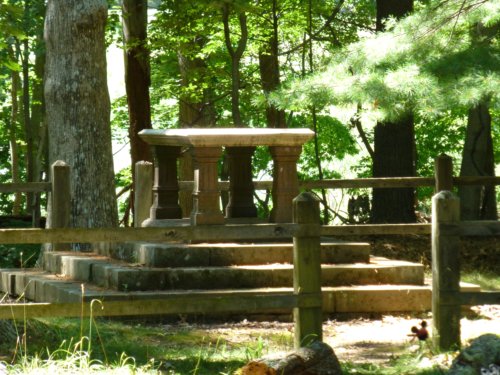
The Quaker Meeting area is simple, with board benches placed in a circle in a wooded area next to the burial ground.  I imagine this is how the first Quakers held their meetings on Shelter Island.  It was beautiful on the day we visited, with the sunlight coming in through the leaves and branches.  On the way out of the site I wrote down the phone number on the sign by the road.  We called right away.  A very nice woman answered the phone, and told me that she had a sheet of paper with a transcription of the monument’s inscription.  We met her at her home in Shelter Island Heights and had a nice conversation about the Quaker history of the island. She told me that many Southwick descendants have come to the Quaker Meetings on Shelter Island in the summers! If we had been staying longer, it would have been nice to attend the meeting.

This simple Quaker Meeting place is next to the cemetery

This sign and phone number led us to the cemetery

You can see our red convertible in the trees, and this road is
easy to miss if you are unfamiliar with the area.  Look for the white
Quaker Meeting sign or this blue marker to Nathaniel Sylvester

I’ll post the inscription tomorrow, with a biography of each of the names listed on the monument.  Stay tuned, because you will be surprised by some of the names listed!
For more information:


Shelter Island Historical Society: http://shelterislandhistory.org/


------------------------

Heather Wilkinson Rojo, "A Visit to Shelter Island", Nutfield Genealogy, posted August 9, 2012,  (  https://nutfieldgenealogy.blogspot.com/2012/08/a-visit-to-shelter-island.html: accessed [access date]).