Showing posts with label Lowell. Show all posts

Tuesday, October 31, 2023

Elizabeth Gerrish Greenleaf, died 1712, Newbury, Massachusetts - Tombstone Tuesday

 This tombstone was photographed at the First Parish Burial Ground in Newbury, Massachusetts. 


HERE LYES INTERRED

Ye BODY OF

ELIZABETH GREENLEAF

WIFE TO CAP. STEPHEN

GREENLEAF DECEr. ye 5th

OF AUGUst 1712 IN Ye 58th

YEAR OF HER AGE.


Elizabeth Gerrish, daughter of William Gerrish and Joanna Lowell, was born 10 September 1654 in Newbury.  She married Stephen Greenleaf, son of Stephen Greenleaf and Elizabeth Coffin, on 23 October 1676 in Newbury. They had ten children born in Newbury. Stephen remarried to Hannah Tristram on 19 September 1713. 

Elizabeth and Stephen Greenleaf are my 9th great grandparents.  I descend from their daughter Elizabeth, born 12 January 1677 in Newbury, who married Henry Clarke on 7 November 1695 in Newbury.  Elizabeth died in 1724. 

For the truly curious:

Click here to see the tombstone of Elizabeth's husband Stephen Greenleaf:

https://nutfieldgenealogy.blogspot.com/2022/11/stephen-greenleaf-died-1743-newbury.html  


----------------

To cite/link to this blog post: Heather Wilkinson Rojo, "Elizabeth Gerrish Greenleaf, died 1712, Newbury, Massachusetts - Tombstone Tuesday", Nutfield Genealogy, posted 31 October 2023, ( https://nutfieldgenealogy.blogspot.com/2023/10/elizabeth-gerrish-greenleaf-died-1712.html: accessed [access date]).

Wednesday, March 1, 2017

Weathervane Wednesday ~ Above a Textile Mill

Huzzah!  Today is the 300th Weathervane Wednesday post!

Weathervane Wednesday is an on-going series of photographs I post weekly.  I started out by publishing only weather vanes from the Londonderry area, but now I've been finding interesting weather vanes from all over New England.  Sometimes these weather vanes are whimsical, or historical, but all are very unique.  Often, my readers tip me off to some very special and unusual weather vanes.  This weathervane photo today was sent in by a reader and a fellow genealogy blogger.

Today's weather vane is from somewhere in Massachusetts.

Do you know the location of weather vane #300?  Scroll down to see the answer...


These very interesting photographs were sent to me by genealogy blogger Barbara Poole from Lowell, Massachusetts.  She often posts photo essays of her home city and the surrounding area, and has published some lovely photos of the Lowell National Historic Park and the textile mills.  This weathervane is located on the cupola above the Boott Mill.

The weathervane is a replica of a flying shuttle from a loom.  I used to weave on a table loom, and I recognized the shuttle right away.  The shuttle is a symbol of Lowell, and can be found on many items in the Lowell National Park giftshop, and on the literature about the park and the city.  The shuttle held the warp yarns and it was passed from side to side across the vertical yarns.  In the mechanized looms in the mills these flying shuttles would fly very fast back and forth.  When you visit the Boott Mill you will see a floor of looms operating, and the shuttles are actually going across the fabric with cotton yarns.  The noise is deafening, and the entire building vibrates with the machinery.  Imagine how the young mill girls felt when every floor of the building was operating with hundreds of looms!

The Boott Mill is part of a large complex that includes demonstration area for the Lowell National Park.  It also includes condos, apartments, office space and other uses.  The Mill girl housing built in 1837 for the original female employees is part of the Boot Mill complex and offers exhibits, too.

Lowell National Historic Park   https://www.nps.gov/lowe/index.htm

Flying Shuttle article at Wikipedia  https://en.wikipedia.org/wiki/Flying_shuttle

Barbara Poole's genealogy blog Life from the Roots:
http://lifefromtheroots.blogspot.com/

I posted a nice weathervane with a spindle in 2015 at this link:
https://nutfieldgenealogy.blogspot.com/2015/09/weathervane-wednesday-over-girl-scout.html  


------------------------------

Heather Wilkinson Rojo, "Weathervane Wednesday ~ Above a Textile Mill", Nutfield Genealogy, posted March 1, 2016, (http://nutfieldgenealogy.blogspot.com/2017/03/weathervane-wednesday-above-textile-mill.html: accessed [access date]).

Thursday, October 24, 2013

The Middlesex Canal


After posting several times about Colonel Loammi Baldwin and Count Rumford AKA Benjamin Thompson of Woburn, Massachusetts, I was incredibly curious to learn more about the Middlesex Canal.  If you remember the post with the photo of Loammi Baldwin, it is located right across the street from the remains of the canal in Woburn.  We went over to look at the canal and to read the signs, and it was not an impressive sight since it looked like a barely visible ditch.  However, the historical markers described a great canal system that ran from the current city of Lowell to downtown Boston.  I wanted to learn more!

After Googling the Middlesex Canal, and reading more about it in the History of Woburn, I learned that there was a Middlesex Canal Museum in North Billerica.  We spent a pleasant afternoon there, and picked the brain of the volunteer on staff.  He told me much information about how Loammi Baldwin was one of the original proprietors of the canal in 1793, and invested in the new transportation system which brought goods and people from the Merrimack River (Northern Middlesex County and New Hampshire) right to Dock Square in downtown Boston. 


The canal was laid out from the Merrimack River in Chelmsford in 1794 and arrived at the Charles River next to Boston in 1803.  It was dug by hand by local workers.  Eventually it went right through downtown Boston to Dock Square near today’s Quincy Market, where goods could be loaded onto seagoing ships, or sold and traded in the city.  Much of the canal is now invisible, especially in the urban areas closer to Boston.  But the canal can still be seen in northern Middlesex County, and is even still navigable in many places.  Stonework bridges, aqueducts and other features such as locks are visible, too.

Loammi Baldwin was also the treasurer of the state of Massachusetts after the
Revolutionary War.  You can see his signature on this $20 bill from 1786
at the Middlesex Canal Museum in North Billerica, Massachusetts
If your ancestors lived in New Hampshire, Middlesex County or Boston during the period between the Revolutionary War and the Civil War, their lives would have been greatly changed by the building of the canal.  It brought great prosperity to the region, and it changed the way people traded and moved goods in New England.  The success of the Middlesex canal influenced other canals in the new United States, including the Erie Canal and the Chesapeake and Ohio (C&O) canal near Washington, DC.

The rise of the age of rail and steam brought an end to the profitability of the Middlesex Canal, but in its short life it made many of the proprietors wealthy men.  Life along the canal was busy, with stations for travelers and goods, taverns, inns and other facilities that are mostly now gone.  The few that are left are often not recognized as part of a great transportation system that once existed in this area.  It takes a map, a keen eye and some research to follow the trail of the canal. 

This mural by Thomas Dahill at the Middlesex Canal Museum
is also an illustration in the book Life on the Middlesex Canal

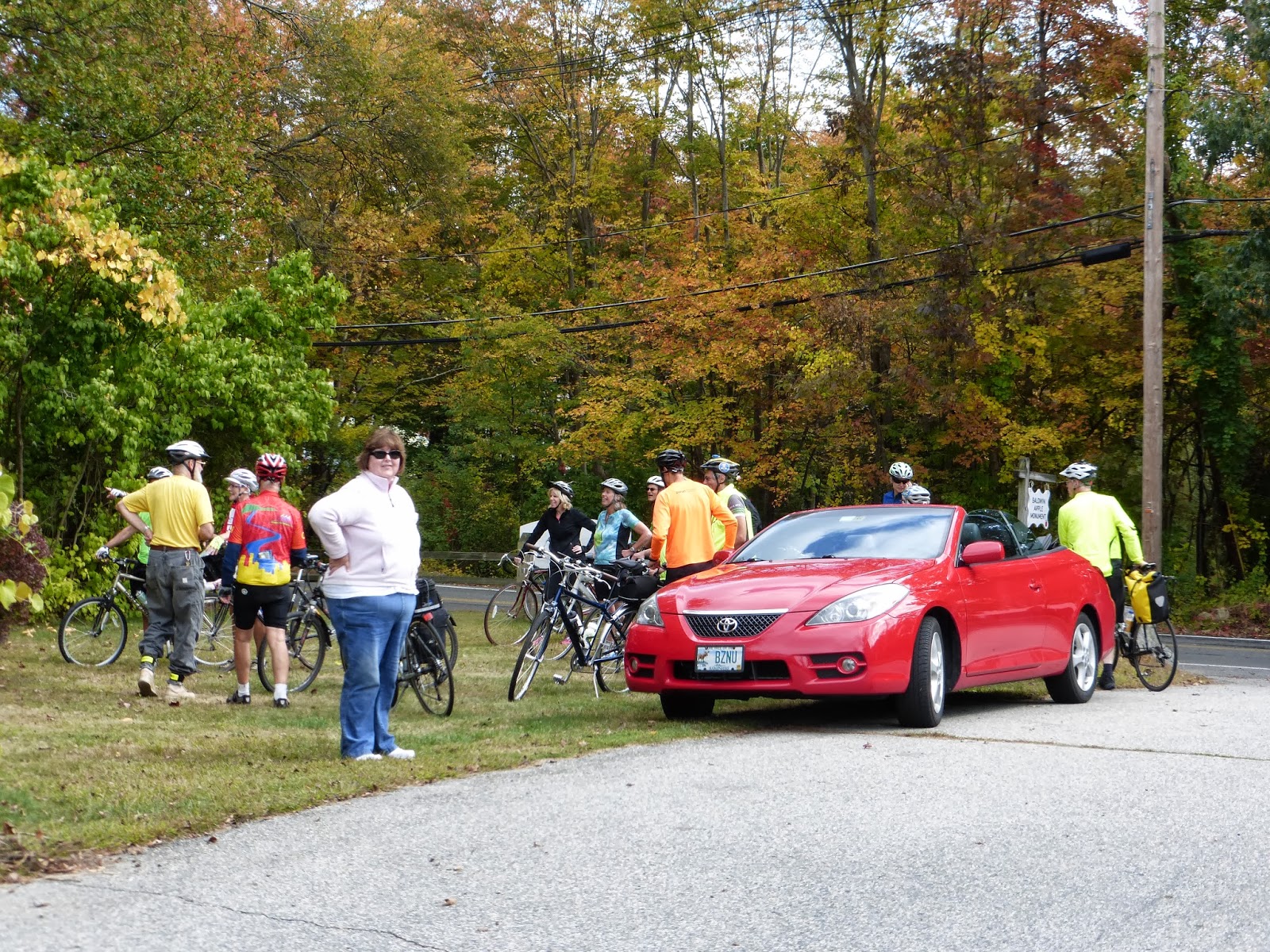
There are bike tours, walking tours and historical tours offered year round of the old Middlesex Canal.  While we were visiting the Baldwin Apple monument, one of the bike trails tours appeared, and the participants were quite enthusiastic about finding the hidden history of a National Treasure right in their own backyards!

Some people bike the canal trail, we rode nearby with the little red convertible!
This photo is at the Baldwin Apple memorial in Wilmington, Massachusetts, not far from the canal

For more information:

Middlesex Canal Association website    www.middlesexcanal.org

Life on the Middlesex Canal by Alan Seaburg, Cambridge, MA: Miniver Press, 2009

The Old Middlesex Canal by Mary Stetson Clarke, Easton, PA:  Center for Canal History and Technology, 1974

The Incredible Ditch: A Bicentennial History of the Middlesex Canal, by Carl Seaburg, Alan Seaburg and Tom Dahill, Cambridge, MA: Miniver Press, 1997

The History of Woburn, Middlesex County, Mass., by Samuel Sewall, Boston, MA: Wiggin and Lunt Publishers, 1868.  (available to read or download online at Google Book Search)

My blog post from 14 October 2013 on "Colonel Loammi Baldwin"

-----------------------------------

To Cite/Link to this post:   Heather Wilkinson Rojo, "The Middlesex Canal", Nutfield Genealogy, posted October 24, 2013, ( http://nutfieldgenealogy.blogspot.com/2013/10/the-middlesex-canal.html: accessed [access date]). 

Monday, January 23, 2012

Monday, January 24, 2011

King Kalakaua in Boston, 1875- Amanuensis Monday


King Kalakua
This statue is located in Waikiki
 I had a surprise the other day when I saw a mention of King Kalakaua visiting Boston on one of his many tours of the United States. I knew he loved travel, and he had a grand trip around the world in 1881. His sister, Queen Lili’uokalani visited Boston twice. The first time was with Queen Kapi’olani on their way to Queen Victoria’s Jubilee in 1887. Her second visit to Boston was when she arrived in January 1896, recently deposed, and on her way to consult with President McKinley about the overthrow of the Hawaiian Kingdom.

I had bought Ralph Kuykendall’s three volume History of The Hawaiian Kingdom in the gift shop at Iolani Palace last summer. It is an enormous work, so I’ve just been using it as a reference. Perhaps I should read the entire thing someday, because there are so many fascinating things I’ve found inside! I was curious. What was Kalakaua doing in Boston? With whom did he visit and socialize? Did he visit with his sister’s family? Members of the “Hawaii Club” of Boston? I'll be looking into this mystery in the next few weeks.


The New York Times, published 4 January 1875, found at Google News Search http://query.nytimes.com

“KING KALAKAUA AT BOSTON

HE ATTENDS CHURCH IN THE MORNING AND
KEEPS QUIET THE REST OF THE DAY-
PROGRAMME FOR THE WEEK.

Special Dispatch to the New-York Times

BOSTON, Dec. 3.- The King of the Sandwiches
spent a quiet Sunday. This forenoon he attended
service at the Park Street Church, at the invitation
of Hon. Alpheus Hardy, who gave him the mis-
sionary reception, and listed to a sermon by
Rev. George L. Walker D.D., who alluded to the
King’s presence in the prayer, wherein he prayed
that the favor of the Lord might be upon
him and his people. In the afternoon and
evening the King lounged about his
apartments, declining all invitations to go
out, and even to take a sleigh ride on the mill-dam,
but Gov. Kapena, Alderman Clark, Col. Shepard and
Lieut. Palmer took a brisk trip over the course.
To-morrow the King will be hurried about at a
lively pace. In the morning he rides withersoever
the city committee choose. In the afternoon he will
receive the officers of the army and navy at present
in this vicinity, and in the evening will attend the
opening of opera bouffe at the Globe Theater. The
next day he visits the public schools, meets the
merchants of the city in the rooms of the Board of
Trade, goes to see Lotta at the Boston Theatre in
the evening, and the next day he goes to Lowell
and St. Johnsbury, Vt. This is the programme
as at present arranged. It may be changed,
the trip to Lowell being set down for Tuesday instead
of Wednesday.”
Did you know that King Kalakaua was the first monarch to attend a state dinner at the White House? See the story at Time Magazine article, January 19, 2011 "King Kalakaua Goes to Washington, 1874" http://www.time.com/time/specials/packages/article/0,28804,2043087_2043088_2043115,00.html

--------------------

Copyright 2011, Heather Wilkinson Rojo

Wednesday, May 5, 2010

Treasure Chest Thursday - Emily Wiley Munroe’s Quilt- 1860


Ten family members in Lowell
On our outing to see Emily (Wiley) Munroe's Quilt

Last November I wrote a posting about a quilt made by a member of my family tree. I didn’t know about this quilt, nor about this branch of the family, until I used Google.com to search a name. I had been searching for my 4x great grandfather Luther Simonds Munroe, but his namesake was his nephew, with the same name, and this second Luther’s wife had made a quilt during the Civil War era. Fortunately for me, Emily (Wiley) Munroe’s quilt had been donated by a descendant to the New England Quilt Museum, and was also the subject of a chapter in a book called “Massachusetts Quilts: Our Common Wealth” edited by Lynne Z. Bassett.


The Cover of "Massachusetts Quilts"

I contacted the New England Quilt Museum last fall, and they told me that the Munroe quilt had been on exhibit earlier in the year, for the publication of the book, but it was currently in storage. Connie Colum Barlow, the executive director kindly invited me to come to the museum to see the quilt up close and personal. I wanted my extended family to see the quilt, too, so we decide on May as the mutually agreeable time for everyone to drive from Maine, New Hampshire, Rhode Island and other parts of Massachusetts to the Lowell Quilt Museum.

A Quilt Museum curator named Laura Lane was very kind to take the quilt out of archival storage for us, and spread it out on a large table so we could see it up close. However, we were unable to take any photographs. Ten cousins, aunts and spouses gathered around and Laura gave us a very delightful explanation of the details in the quilt. It was made of 54 individually bound squares whip stitched together to form a coverlet. The squares were wool, each appliquéd and embroidered with animals, hearts and flowers. The squares were backed with denim or mattress ticking.

It was immediately apparent that browns, greys, blacks and drab colors were the usual clothing scraps used by Emily Munroe for this quilt. Bright red embroidery spiced up the patterns, but I was struck by how drab their clothing must have been. The Munroes were simple farmers in Lynnfield, Massachusetts, selling market vegetables, probably to Boston. The quilt fabrics were probably scraps of jackets, trousers and farm clothing.


Emily Munroe's Quilt
Photo from the Massachusetts Quilts book
The quilt seemed to be in remarkable condition, with the colors bright and dark. However, if you looked closely there were a few moth holes and wear marks. The coverlet must have been well used and well loved. I’m sure it was lovingly displayed, too, but guarded from strong sun over the years. It is in need of some restoration and conservation to prevent any further damage.

The whole family enjoyed the outing to the quilt museum very much, even the husbands who tagged along. The gift shop sold post cards of Emily Munroe’s quilt, and we all bought several. I bought a copy of the “Massachusetts Quilts” book, and we also saw a wonderful display of Amish crib quilts upstairs. Laura Lane told us that next year, for the 150th anniversary of the Civil War, there will be a display at the Quilt Museum of civil war era quilts. Emily Munroe’s quilt will be taken out of storage and displayed again for this exhibit!

If you are interested in the New England Quilt Museum, the website is listed below. It is in Lowell, Massachusetts housed in a building that used to be a bank for the women mill workers in the 1830s and 1840s. We also all enjoyed lunch at a lovely Greek restaurant around the corner, and celebrated my aunt’s 82nd birthday with a cake. Lowell is full of ethnic restaurants, too many to mention here. The Lowell National Park visitor center was at the end of the block, and the Trolley Museum across the street. Around the corner are the Boott Cotton Mill and the Boarding House Museums. Everything is very close and handy, and in the summer you can enjoy a tour with a National Park ranger on the canals, or on the trolleys.

-----------------
For more information:

My blog post about Emily Wiley Munroe’s Quilt in 2009
http://nutfieldgenealogy.blogspot.com/2009/11/google-your-way-to-quilt-sometimes.html

The New England Quilt Museum http://www.nequiltmuseum.org//

Massachusetts Quilts: Our Commonwealth, by Lynne Zacek Bassett, editor, University Press of New England, 2009.
------------------
Copyright 2010, Heather Wilkinson Rojo

Thursday, November 5, 2009

Google Your Way to a Quilt


Google your way to a Quilt

Sometimes after I’ve tried the library, the archives, ancestry.com and NEHGS- I next resort to finding genealogy information by just Googling names to see what comes up. Now, with the addition of Google Books, I’m often surprised at what happens. And sometimes names that didn’t draw any hits six months ago suddenly have interesting results. This is what happened to me last week.

My Munroe lineage was one of the first lines I ever worked on, and it was easy to do when I found the book “The History and Genealogy of the Lexington, Massachusetts Munroes” by Richard S. Munroe. I was only sixteen years old when I started researching my own genealogy, with a night school class under my belt and the American Antiquarian Society within bicycle riding distance of my house in Holden, Massachusetts. I used this book to fill out the obligatory family tree chart, but for thirty years I’ve been filling in the missing stories.

The name I was interested in researching was Luther Simonds Munroe. His father had fought in the American Revolution, and his great, great grandfather had been a prisoner of war under Cromwell in Puritan England, and he had been sentenced to indentured servitude in New England. There were plenty of interesting Munroes, and fascinating stories, but Luther Simonds Munroe had a big blank next to his name in the book. I knew the basics: he died of diabetes at age 46 in 1851; he was listed as a church sexton on his death record; His children were in the Danvers and Salem vital records. Period.

There are three Luther Simonds Munroes in the Massachusetts Vital Records: 1). The sexton Luther Simonds Munroe, 2.) his son, Luther Simonds Munroe, Jr. and 3.) a nephew with the same name. I couldn’t find anything interesting about any of these Luthers. Suddenly, when Googling the name, there were several hits, and all pointed to an exhibit at the Lowell Quilt Museum in 2008. Imagine that, just down the road from here in Londonderry, New Hampshire!

The Massachusetts Quilt Documentation Project was established in 1994, and over time is has recorded 6,000 pre-1950 quilts from this state. A book, “Massachusetts Quilts: Our Common Wealth” edited by Lynne Z. Bassett and others documents the stories of 112 of the most historic quilts, with beautiful photography and detailed histories. One of these featured quilts was sewn by Emily (Wiley) Munroe, the wife of the nephew named Luther Simonds Munroe of Lynnfield, Massachusetts.

Emily Munroe’s quilt was sewn sometime in the civil war era. It is made of 54 woolen blocks from the simple farming clothing of the family. Each block shows country designs of flowers, trees, horses and a central block with a house scene, complete with a dog and horse. The colors are mostly earth tones, brightened up with touches of red wood cloth. Emily passed the quilt down in her own family, and through descendants, until it was ultimately donated to the Lowell Quilt Museum. It is a simple, yet elegant design, and somehow it made its way into the commemorative book. The book contained the story of Emily, her family, the quilt’s provenance and how it was donated.

Well, I was so excited to find this on Google; I immediately emailed the curator at the Quilt Museum. Connie Colom Barlow, the executive Director emailed me back and explained that the exhibit was over, and the quilt was put into permanent storage in the collections area. However, we were welcome to contact the curatorial assistant to find a mutually agreeable time for an appointment to see the quilt up close and personal!

Right now, the plan is for all the cousins, aunties, daughters and me to get together for a family field trip to see the “Munroe Quilt.” We are still in the middle of emailing a flurry of messages back and forth, from Maine to Rhode Island, to find a time. After our quilt field trip, I’ll blog another story, and include some more photos of our generation with the quilt. Stay tuned!
Meanwhile, I’m still searching for more about Luther Simonds Munroe, 1805 – 1851, Danvers.

------------------

The Munroe family Tree:

Gen. 1: William Munroe, born about 1625 in Scotland, died on 27 January 1717/18 in Lexington; married about 1665 to Martha George, daughter of John George and Elizabeth, born about 1636 in Charlestown, Massachusetts, died about 1672 in Lexington. William was married three times and had a total of fourteen children.

Gen 2: George Munroe, born about 1672 in Lexington, died on 17 January 1746/7 in Lexington; married to Sarah Mooer, daughter of Jonathan Mooers and Constance Langthorne, born about 1677 in Newbury, died on 4 December 1752 in Lexington. Nine children.

Gen. 3: Andrew Munroe, born about 4 June 1718 in Lexington, died on 16 September 1766 in Lexington; married on 26 May 1763 to Lucy Mixer, daughter of Joseph Mixer and Mary Ball, born on 21 November 1727 in Shrewsbury, died on 3 September 1783 in Woburn (now Burlington, Massachusetts.) Lucy remarried on 6 December 1774 in Woburn to Caleb Simonds as his second wife- he was married three times.

Gen. 4: Andrew Munroe, born on 31 March 1764 in Lexington, died on 7 August 1836 in Danvers; married to Ruth Simonds, daughter of Caleb Simonds and Susannah Simonds, born on 13 April 1763 in Woburn, died on 29 January 1840. Eleven children, including the Luther Simonds Munroe who is my 4th great grandfather, and Uriah, his brother, see below. Andrew and Ruth were step siblings (see mother Lucy’s remarriage above)

Gen 5: Uriah Munroe, born 27 Oct 1793 in Danvers, died 12 Mar 1841 in Lynnfield; married on 20 October 1819 in Danvers to Esther Eleanor Twiss, daughter of Jonathan Twiss and Esther Bruce, born on 16 July 1803 in Danvers. Three children.

Gen 6: Luther Simonds Munroe, born on 2 May 1823 in Danvers, died 29 Jan 1885 in Lynnfield; married on 10 April 1851 in Boston to Emily Louise Wiley, daughter of Robert Wiley and Rosetta Benton of England, born 25 August 1832 in Boston, Massachusetts, died 16 August 1894 in Lynnfield. Seven children, including Harry Wingate Munroe, born on 20 May 1859, who inherited the quilt.

-------------------

See also:

http://www.massquilts.org/MassQuilts_Book.htm  - for more information on the Book project, and a link to the chapter with the story and photographs of the Munroe Quilt

www.nequiltmuseum.org - the webpage for the New England Quilt Museum in Lowell

http://books.google.com - the search engine that helped me find the quilt and story
“History and Genealogy of the Lexington, Massachusetts Munroes” by Richard S. Munroe, 1966

“Munro: Sketch of the Munro Clan; Also of William Munro who, Deported from Scotland, Settled in Lexington, Massachusetts, and some of his Posterity” by J. P. Munro, 1900, out of print, yet available in a custom bound photoduplicate of the original on acid free paper through the bookstore at the New England Historic Genealogical Society.

UPDATE-  Yes, my family did get to see the quilt!  Click here for the blog post!
http://nutfieldgenealogy.blogspot.com/2010/05/emily-wiley-munroes-quilt-circa-1860.html

---------
Copyright 2009, Heather Wilkinson Rojo

Monday, November 2, 2009

Mill Girls from Derry and Londonderry


Country Girls in the Big City

Eliza Adams and her sisters,
Forest Hill Cemetery, Derry, New Hampshire

The Eliza Adams Exhibit at the
Boarding House Museum, Lowell, Massachusetts
Years ago I took my Londonderry Girl Scout troop to Lowell National Park, to see how the mill girls lived and worked. The girls were about twelve years old, not much younger than some of the mill workers in the 1830s and 40s. We took a canal boat ride, and toured the noisy Boot Mill (a big hit for kids) and finally went into the boarding house. We earned a merit badge with some of our activities in Lowell, but the girls also learned that young ladies from Londonderry and Derry were some of the mill workers.

Inside the boarding house there was an interactive exhibit showing some of the girls who worked in the textile mills, including some personal items, photographs and silhouettes. Of all the exhibits, the one I remember most was Eliza Adams from Derry. Her trunk, letters and photograph were behind glass, but a recorded voice of an actress read her letters aloud. It was poignant, and even the little girls were amazed that a girl from Derry lived and worked in those big factories weaving cloth.

Eliza is one of the most famous of the Lowell mill girls, like Lucy Larcom, because her letters to her mother have survived through time. Tens of thousands of girls served in Lowell and other mill cities, but they remain silent witnesses to history. Very few mill girls ever left letters or journals. Through Eliza we learn her daily routine, her friendships, her homesickness, that she attended a reception held for President Tyler, and witnessed a strike.

At age 42 Eliza bought a farm in South Hadley, Massachusetts, where Mary Lyons had her college, Mount Holyoke, the first college for women in America. Years before, Mary Lyons had been an assistant teacher at the Adams Female Academy in Derry. Eliza had attended school in Derry with Mary Lyons, before going to work in Lowell. Eliza Adams adopted two little girls, and fostered several others, and grew prosperous on her farm as a single, independent woman.

Eliza, and her sisters, attended the Adams Female Academy in Derry, which had been founded by her uncle, Jacob Adams, who left a bequest to the school. Later, after working at the mills in Lowell, she went to Ipswich to work in another mill and also attend the Ipswich Female Seminary founded by Zilpah Grant, another teacher from Derry’s Female Academy. Letters from Eliza to both Zilpah and Mary Lyons survive in the archives at Mount Holyoke College. Zilpah Grant and Mary Lyons are some of the most famous educators mentioned in Feminist History courses.

What is amazing is that Eliza did nothing unusual by today’s standards. She went to school, educated herself with her own earnings, bought property and was a single mother. She did not go off to Lowell to work in the mills with the aim of finding a husband or man to help her in life. However, in the mid 1800s these were rare events, and probably considered quite odd. Letters do survive over time, but most letters we see from this time period are written by men. To read about Eliza’s accomplishments is wonderful, but it is also just as nice to read about her daily work life, and her homey remarks back to her mother back on the farm in Derry.

------------
The Eliza Adams Lineage:

Gen. 1. Robert Adams was born in England in 1602; married to Eleanor Wilmot and resided in Newbury, Massachusetts. Robert Adams first came to Ipswich, Massachusetts in 1635, bringing his wife and his first two children. He resided in Salem and removed to Newbury in 1640. His first wife, Eleanor, died on 12 June 1677 and married second 6 February 1678 to Sarah (Glover) Short, the widow of Henry Short. He died on 12 October 1682, and his widow died on 24 October 1697 in Newbury.

Gen. 2. Sergeant Abraham Adams, born in 1639 in Salem, Massachusetts; married on 10 November 1670 to Mary Pettengill, daughter of Richard Pettengill and Joanna Ingersoll, born on 6 Jul 1652 and died on 19 September 1705. He was a corporal in the militia of 1685 to 1693, and became a sergeant in 1703. They resided in Newbury, Massachusetts. They had fourteen children. He died in August 1714 in Newbury.

Gen. 3. Richard Adams, born in Newbury on 22 November 1693; married on 12 December 1717 to Susannah Pike, daughter of John Pike and Lydia Little, born on 3 April 1697 and died on 17 October 1754. They resided in Newbury and had ten children

Gen. 4. Deacon Edmund Adams, youngest child of Richard, born 24 October 1740 in Newbury; married first on 22 November 1764 to Hannah Thurston, she died on 14 September 1807; he married second about 1811 to Mrs. Betsey Kimball of Hampstead, New Hampshire. Edmund Adams removed to Derry, New Hampshire and settled on the farm belonging to Deacon James Adams, a first comer to Nutfield. Deacon Edmund Adams had ten children by his first wife, and one by his second wife.

Gen. 5. Edmund Adams, eighth child of Deacon Edmund, born in Newbury on 3 April 1777; married in 1808 to Elizabeth Carr. She died on 2 May 1858 and he died on 8 September 1858. They resided in Derry and had eight children.
Edmund’s brother, Jacob Adams, the youngest child, was born 14 Jan 1785 in Newbury, and died unmarried. Jacob was the founder of the Derry Female Academy.

Gen. 6. Eliza Adams, fourth child of Edmund, born on 15 January 1815 in Derry; died unmarried in 12 November 1881. She is buried with her parents in Forest Hills Cemetery, Derry.

--------
Sources:

“A Genealogical History of Robert Adams of Newbury” by Andrew N. Adams, Rutland, VT: Tuttle Publishing Company, 1900

“The Story of an Industrial City: A guide to Lowell National Park” by Thomas Dublin, National Park Service, 1993

“The Belles of New England: The Women of the Textile Mills” by William Moran, St. Martin’s Griffin/ Thomas Dunne Books, 2004

--------
Copyright 2009, Heather Wilkinson Rojo