Showing posts with label Great Depression. Show all posts

Monday, June 1, 2015

Shirley Temple ~ more 20th Century Americana

This is another post in my series of stories about 20th Century Americana, which I use as story starters and for helping with oral histories.  Most of these subjects bring back great memories to the people who lived through the 20th century, maybe even YOU!


Shirley Temple (23 April 1928 - 10 February 2014) was more than just a child star.  She helped to lift the spirits of Americans during the Great Depression.  She starred in films starting at age 3 and retired at age 22.  She was the top box office draw from 1935 to 1938, at the height of the Depression.  After her retirement from acting she sat on boards several companies including Walt Disney, and was a diplomat for the United Nations and as an ambassador from the United States to Ghana and Czechoslovakia.

Shirley Temple's personal autograph book, signed by famous 1930s personalities
Franklin Roosevelt, Orson Wells, Ethel Merman, Jimmy Durante, etc. 

Costumes from many Shirley Temple movies
including my personal favorites "Heidi" and "A Little Princess"

I took my mother to see the Shirley Temple exhibit at the Wenham Museum on Mother's Day.  We had a lot of fun, and my mother was not the only one reminiscing.  I remember watching many of Shirley's movies as a child in the 1960s and 1970s.  There were lots of multi-generation families at the exhibit having fun examining all the objects, including many small children who were discovering Shirley's movies, costumes and toys for the first time.

It was a lot of fun seeing this exhibit with Mom.  She was born during the depression, and she remembered all of Shirley Temple's movies.  I listened to Mom tell stories about her memories of seeing the movies, and the different dolls on exhibit (she never had a Shirley Temple doll, but she had a Sonja Henie doll!), the outfits, the autographs of the other movie stars and radio stars and about the era in general.  This is the kind of exhibit that draws a lot of oral history from the older generations!

Shirley Temple and Bill Robinson

This miniature automobile (with a real engine) was a gift to Shirley from
Bill "Bojangles" Robinson.  He had co-starred in several of her movies.
Just look at the face of that envious little boy in the upper left corner! 

Shirley's mother saved and preserved all of the clothing, tap shoes, letters, dolls and things from Shirley's childhood.  According to the brochure distributed at this exhibit "...the private archives of the Shirley Temple childhood is an astounding and virtually unprecedented find in the world today in that a star, not just any star, but the biggest star of the 1930s, preserved so much from her most significant years in the public eye."

Shirley's personal autograph book signed by Disney staff members

Do you recognize this little dress?  Five year old Shirley Temple
wore this dress in "Stand up and Cheer".  Many Shirley dolls wore this dress.
Shirley's childhood hankies!  She always had a purse that carried
a hanky, a slingshot, and her police badge. 

A number of pieces from this private family archive are traveling the country on exhibit.  Over 500 costumes, dolls, toys, and memorabilia will be auctioned by the Shirley Temple Family on July 14th at the Little Theatre in Kansas City.

Shirley Temple's tap shoes, the plaque reads "To Shirley from Uncle Bill"
another gift from Bill "Bojangles" Robinson.
They were the first inter-racial couple to dance together on the silver screen. 

June 4 - 10, Santa Monica History Museum, Santa Monica, California
June 12 - 14, Stanford Theatre,  Palo Alto, California
June 20 - 27, Fort Worth Community Arts Center, Fort Worth, Texas
July 3 - 8, Frazier History Museum, Louisville, Kentucky
The Auction will be July 14th at the Little Theatre, Kansas City, Missouri


"Love, Shirley Temple"  Events and Auction
website https://www.theriaults.com/love-shirley-temple-events-auction-schedule 

Wenham Museum, 132 Main Street, Wenham, Massachusetts
http://www.wenhammuseum.org/   


-------------------------------

To cite/link to this blog post:  Heather Wilkinson Rojo, "Shirley Temple ~ more 20th Century Americana", Nutfield Genealogy, posted June 1, 2015, ( http://nutfieldgenealogy.blogspot.com/2015/06/shirley-temple-more-20th-century.html: accessed [access date]). 
Copyright (c) 2015, Heather Wilkinson Rojo

Monday, November 18, 2013

Anti-Gravity, History, Rocks, Finance, and Genealogy

HERE AT NEW BOSTON, N.H.
ROGER W. BABSON
AND HIS ASSOCIATES
PIONEERED
IN ACTIVE RESEARCH
FOR ANTI-GRAVITY
AND A PARTIAL GRAVITY
INSULATOR
1959


This traffic island in the middle of New Boston, New Hampshire hides a secret! 
Under the plants and bushes is a monument to anti-gravity.  

I have been a fan of John J. Babson’s book The History of Gloucester, 1876, since it contains much genealogy information and historical stories about my ancestors.   In learning more about the Babson family, one of my favorite members has to be Roger Ward Babson (1875 – 1967).   He went to MIT, and worked for investment companies and invented Babson’s Statistical Organization in 1904.  His interest in business theory led him to found Babson College in Massachusetts, Webber College in Florida and the now gone Utopia College in Kansas.  He is famous for predicting the 1929 Wall Street Crash and the Great Depression.  On September 5, 1929, just a few weeks before the crash he gave a speech “Sooner or later a crashing is coming, and it may be terrific.”

Roger Ward Babson was also an odd character; he founded the Gravity Research Foundation in 1948, convinced that science could learn to harness gravity.  They also experimented with theories on anti-gravity and gravity insulators.  He built a headquarters for this foundation in the little village of New Boston, New Hampshire because he was convinced it was far enough from civilization to survive a nuclear bomb in Boston, Massachusetts. The Gravity Research Foundation still exists, and it gives a prize every year for the best essay about gravity. Don’t laugh because Steven Hawking is one of the prize winners (see, he’s not just a character on The Big Bang Theory).

Another odd interest of Babson’s was the early settlement in Gloucester, Massachusetts known as Dogtown.  He hired stonecutters during the Great Depression to carve inspirational mottos on the boulders throughout Dogtown.  You can still walk through this area today and read the boulders which say things such as “Keep out of Debt”, “Help Mother” and “Prosperity follows service”, as well as marking the location of Dogtown Square and the cellar holes of colonial era homes.

A "Babson Boulder" at Dogtown, Gloucester, Massachusetts

There is a Babson Museum in West Gloucester dedicated to James Babson, the first Babson in Gloucester, Massachusetts who was a cooper.  The museum is a cooperage, built in 1658.   Roger Ward Babson is a distant cousin to me through his ROGERS and WHIPPLE ancestors.


I would love to photograph all these monuments to anti-gravity and gravity research, but as you can see below, someone has already done that.  Here is a list of all the colleges with the Anti-Gravity Monuments (none are the three colleges he founded, nor his Alma Mater the Massachusetts Institute of Technology): 

Colby College in Waterville, Maine
Middlebury College in Middlebury, Vermont
Keene State College in Keen, New Hampshire
Gordon College in Wenham, Massachusetts
Tufts University in Medford, Massachusetts
Eastern Nazarene College in Quincy, Massachusetts


We found this monument at Gordon College, Wenham, Massachusetts

THIS MONUMENT HAS BEEN 
ERECTED 1964 BY THE
GRAVITY RESEARCH FOUNDATION
ROGER W. BABSON FOUNDER
IT IS TO REMIND STUDENTS
OF THE BLESSINGS FORTHCOMING
WHEN SCIENCE DETERMINES
WHAT GRAVITY IS, HOW IT WORKS
AND HOW IT MAY BE CONTROLLED


For the truly curious:

The Babson Historical Association http://babsonhistorical.org/  Museum, genealogy and other Babson information and Images, including the Babson Family Association and Reunion.

http://www.oddthingsiveseen.com/2010/03/anti-gravity-monuments.html      from the Odd Things I've Seen website, this is the post that got me driving around New England looking for these monuments.  There are photos of all the monuments at this page.

http://nutfieldgenealogy.blogspot.com/2012/06/stone-wall-stories-3-dogtown.html   my blog post about looking for the Babson Boulders in Dogtown, Gloucester, Massachusetts

http://cowhampshire.blogharbor.com/blog/_archives/2006/9/3/2208378.html   A blog post about Roger Ward Babson, from Jan Brown’s blog “Cow Hampshire”, it includes a genealogy of the Babson Family.

The Gravity Research Foundation http://www.gravityresearchfoundation.org/
Try your luck at writing a prize winning essay on gravity, or anti-gravity, just like Stephen Hawking

-------------------------------------------

To cite/link to this blog post:   Heather Wilkinson Rojo, "Anti-Gravity, History, Rocks, Finance, and Genealogy", Nutfield Genealogy, posted November 18, 2013, (  http://nutfieldgenealogy.blogspot.com/2013/11/anti-gravity-history-rocks-finance-and.html: accessed [access date]). 


Monday, June 24, 2013

The Civilian Conservation Corps Museum


This weekend we wandered up to Allenstown, New Hampshire to visit Bear Brook State Park. There is a small museum complex there with a CCC museum, a Snow Mobile Museum, and a currently closed Family Camping Museum.  The entire complex used to be a Civilian Conservation Corps Camp between 1935 and 1942.  It is one of the most perfectly preserved CCC camps in the USA, with most of the buildings still standing and in very nice shape. There is also a modern Ameri Corps camp on the other side of Bear Brook State Park, where today's college students performs some of the same duties as their forebears did in the CCC during the Great Depression.

The CCC was developed as a temporary agency to provide work relief.  Over 3 million young men participated in the CCC during the nine years it operated, building roads, state and national parks, reforestation efforts and forest fire fighting in 48 states, Hawaii and Puerto Rico.  The young men received $30 a month, of which $25 was sent home to their families. By 1942 these same young men were being drafted into service for World War II, and work relief was no longer needed, so Congress permanently closed the program.

If you have ancestors or family members who served in the CCC, the records of their service are kept in St. Louis at the National Archives annex.  The Richard Diehl CCC Museum in Allenstown has hundreds of photographs, lists of names of men, artifacts and a small library of books with information on the CCC, the Bear Brook Camp, other camps in New Hampshire and across New England.  The building was once the mess hall, and you can wander around to look at the other buildings, which were mostly barracks. 


BEAR BROOK CCC CAMP
1935- 1942
The Bear Brook Civilian Conservation Corps (CCC)
Camp was one of 28 work camps established in 
N.H. between 1933 and 1942. President Franklin D. 
Roosevelt started the program after the Depression 
to put young unemployed men to work in
conservation.  From 1925 to 1938 the 1123rd Co. CCC
was here; later this was one of four CCC camps in
the state to employ World War I veterans.  bear
Brook was the last active CCC camp in N. H. and was
given to the state in 1943.  It was listed in the 
National Register of Historic Places in 1992 as
one of the country's most intact CCC camps.


A typical bed from a CCC barrack, with a footlocker
owned by CCC alumni, Robert Ellis, of company 2130


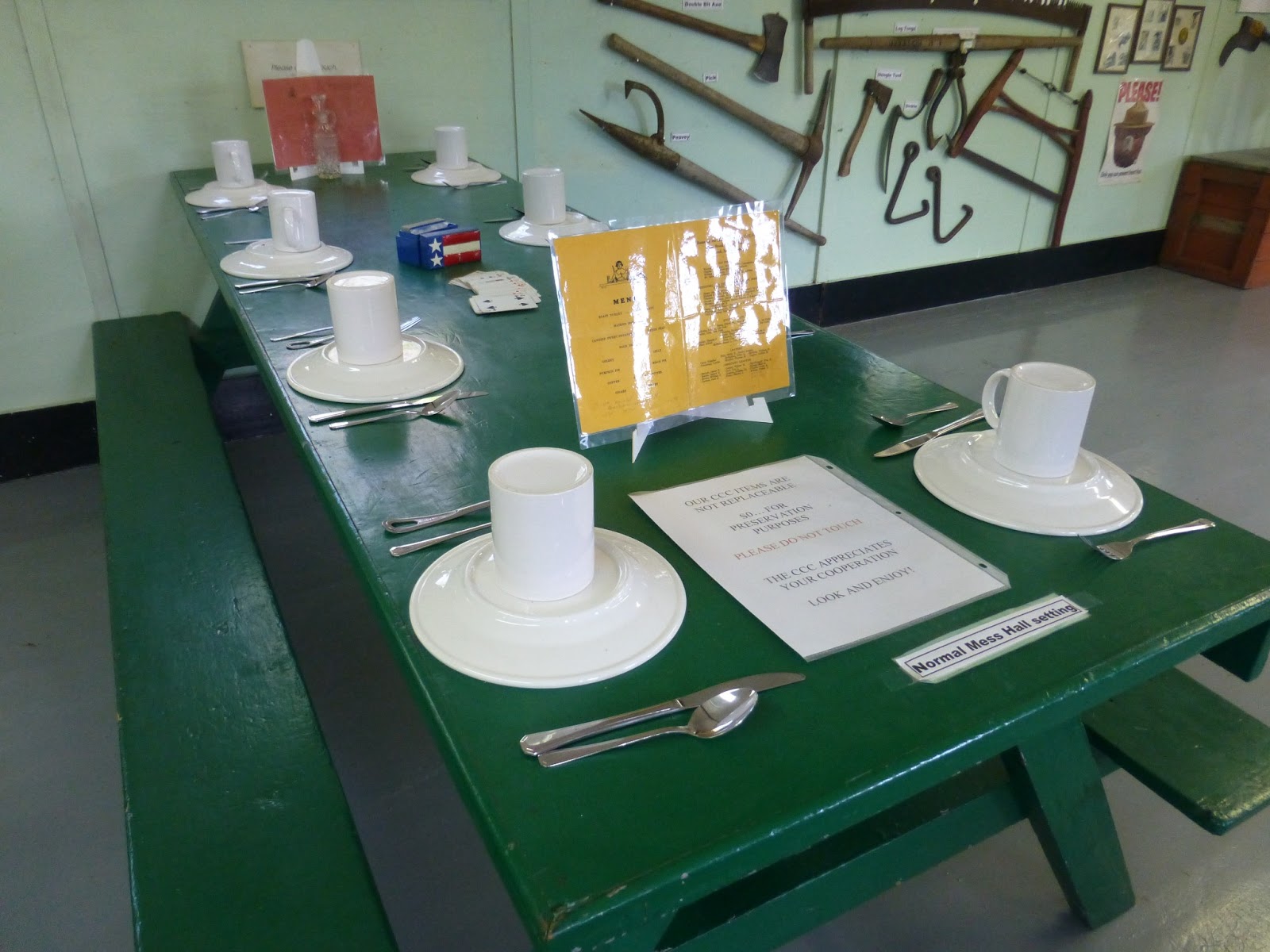
Actual dishes and items from the CCC mess hall


This collage of fading photographs was propped in a window of the CCC Museum.
These photos are curling at the edges, fragile and yet the faces of the young men are still visible.
This museum, and others like it, need some help with archival preservation techniques. 


One of the large fieldstone fireplaces in one of the barrack buildings, 
now being used as the Snow Mobile Museum.  
This was the only heat for the young men during the cold New Hampshire winters. 


At the beach nearby the museum is a statue to the CCC workers


Across from the CCC worker statue is a pavillion overlooking the swimming pond.
In the 1930s the CCC workers dug out a three foot brook,
 built a dam, and developed the pond for recreation.
The fieldstone pavillion is a testament to their workmanship eighty years later! 

My mother's cousin, Waldo Emerson Cooper (1913 - 1976) served in the CCC starting in 1935.  He was born in Westborough, Massachusetts, and died in Los Angeles, California.  I don't know where he served in the CCC, but it might have been in New Hampshire where there were many forestry programs and state parks being built.   He enlisted in the US Army Air Corps in 1944, like so many other young men of his age. The family lost track of him over the years, but I was able to find his death listed in the California Death Index at Ancestry.com   It would be quite a genealogy adventure to write to the National Archives to read more about his service in the CCC.

** This post is the first in a series I think I will call "20th Century Americana".  These are things I find around New England from the recent past, but they are now history since we are now in the 21st century.  Not many of these things are currently being preserved or saved, but they are part of history and family history.  I thought the Civilian Conservation Corps camp in Allenstown was a good place to start.

For more information:

Bear Brook State Park:  http://www.nhstateparks.com/bearbrook.html

A listing of CCC Museums across the USA:   http://ccclegacy.org/CCC_Museums.html

--------------------------
Copyright 2013, Heather Wilkinson Rojo

Friday, November 2, 2012

The 1938 Hurricane in Londonderry and Derry


As we brought in the bird feeders, stocked up on batteries, and prepared for Hurricane Sandy, we remembered past hurricanes and storms.  I’ll never forget my former brother-in-law riding out the “Perfect Storm” of 1991  on board his lobster boat in Menemsha, Massachusetts.  (He survived!) My mother will never forget Hurricane Daisy in 1958 that arrived just before her wedding. My father worked for Traveler’s Insurance, and went to New Orleans in the wake of Hurricane Betsy as a claims adjuster in 1965.  His letters to my mother describe the devastation. According to Wikipedia it was “the first tropical cyclone in the Atlantic Basin to cause $1 billion (1965 USD) in damage.” These stories live on in our family history.

One of my favorite books about
New England after the 1938 storm

The hurricane of 1938 was expected to turn out to sea, but instead it headed directly north into New England.  The storm surge ahead of the storm caused south facing bays such as Buzzard’s Bay in Massachusetts and Providence, Rhode Island to experience unprecedented flooding and loss of life.  Here, further north, the damage was caused by wind that caused entire forests to be flattened as far north as Maine and Nova Scotia.  The wind on top of Mount Washington was measured at 163 mph.  Gusts were measured above 180 mph in Rhode Island.

New Hampshire had been hit by a huge flood in 1936, and then the hurricane in 1938.  In the middle of the Great Depression, this was an unbearable hardship for many New Englanders.  Whole neighborhoods along the coast were washed away forever.  The inland landscape was forever changed when centuries old trees were uprooted, and historic homes, churches and other buildings were destroyed.

The eye of the storm passed up the New Hampshire and Vermont border, along the Connecticut River.  The storm hit Londonderry and Derry at about five in the afternoon, and continued its fury all night.  The next morning townspeople woke to see the devastation.  In Derry the conservative estimate was 450 trees down.  There wasn’t electricity to the area for days, and Broadway in Derry was black for 48 hours.  There was not a single death in Derry or Londonderry.   A woman from Derry, Edna Clark, was vacationing in North Weare, New Hampshire and was swept to her death when a dam gave way.

In his history of Derry Nutfield Rambles, Derry’s former town historian, Richard Holmes, reported that Adams Pond was filled with thousands of logs from the windblown trees, and were turned into boards at the local sawmill.  Two billion feet of usable timber were felled by the hurricane.  60, 000 people in New Hampshire were made homeless, and thirteen lost their lives.  There was about $12 million in storm damage to New Hampshire (1938 dollars).

It is hard to imagine the tree damage, until you learn an entire project that built on the fallen trees from the Hurricane of 1938.  That was the woman’s sawmill at Turkey Pond in Concord, New Hampshire.  In 1942 the US Forest Service built a sawmill on Turkey Pond and hired women (while the men served in WWII) to cut the fallen trees into boards for the war effort.  This is New Hampshire’s version of “Rosy the Riveter”, and was written up into the book They Sawed Up a Storm, by Sarah Shea Smith.

These stories are passed along in our families.  Make sure you record all oral histories, and any other events that affect your family.  Someday your children or grandchildren will ask “Where were you during Hurricane Sandy of 2012?”

For more information:

Nutfield Rambles, by Richard Holmes, Peter Randall Publisher, 2007

They Sawed up a Storm, by Sarah Shea Smith, Peter Randall Publisher, 2011 .  Place an order at http://turkeypond.com/

“Hurricane of 1938: Memories of the Last Big One”, Eagle Tribune, Lawrence, Mass., 30 July 2006 http://www.eagletribune.com/local/x1876247807/Hurricane-of-1938-Memories-of-the-last-big-one/print


---------------------------
Copyright 2012, Heather Wilkinson Rojo

Thursday, June 21, 2012

Stone Wall Stories - #3 Dogtown, Massachusetts


Near Cherry Street in Gloucester, in a large tract of conservation land surrounding the reservoir, you can find the remnants of an early village.   This was the earliest settled place in Gloucester, when the town grew up inland.  After the War of 1812 the people felt safer about living near the harbor, and most left this area to move to the coast.  Only the poorest people stayed behind in what became known as “Dogtown” because of the abandoned dogs who scrounged the cellar holes and shacks.  Widows, vagabonds and the insane were left behind with the dogs.

This Babson boulder marks the spot
of Dogtown Square

During the Great Depression in the 1930s, Gloucester resident Roger Babson hired Italian stonemasons to carve inspirational quotations on 22 boulders in Dogtown.  At the time, the land was clear of trees, and there were numbers marking the cellar holes of colonial residents identified in his grandfather John James Babson’s “History of Gloucester”.  Now, the area is heavily wooded, and hikers have to search for the numbers, cellar holes and Babson boulders.

An antique postcard showing what Dogtown looked like
before it was swallowed up with forest

I had several ancestors and their relatives live in Dogtown.  I previously posted a story “Tammy Younger, the Witch of Dogtown” at this link: http://nutfieldgenealogy.blogspot.com/2010/02/tammy-younger-witch-of-dogtown.html

Today’s post is part of a series of stories I wrote for this week all about stones and stone walls:


One of Roger Babson's inspirational boulders

Wikipedia story on Dogtown, Massachusetts - http://en.wikipedia.org/wiki/Dogtown,_Massachusetts

This Dogtown website http://www.thedacrons.com/eric/dogtown/visiting_dogtown_gloucester.php has maps and history, including the location of most of the Babson boulders.

------------------

Copyright 2012, Heather Wilkinson Rojo

Thursday, August 4, 2011

Draper and Maynard Sports Equipment


In 1881 Jason F. Draper and John Maynard established a glove factory in Plymouth, New Hampshire.  In 1882 they began producing baseball gloves and supplied major league teams.  By the 1920s 90% of the major league teams were using equipment from Draper-Maynard.  The company was bought and sold many times over the years, and it is now the D&M Co. of Tokyo, Japan, which was not aware of its connection with Draper-Maynard “until they did research for their centennial celebration in 2001.”  [see the NH Historical Society webpage http://www.nhhistory.org/baseballquiz/baseball4.html]   There is also a new company named Draper-Maynard producing vintage reproduction baseball jackets and gloves, and it uses the original “Lucky Dog” trademark of Jason Draper’s bird dog, Nick.
At the height of the Great Depression my uncle Robert Wilkinson was just a kid, and the oldest boy in the family.  His uncle invited him up to visit Plymouth, New Hampshire.  This uncle was George Herbert Adams, but he was known by the strange nickname of Cupe Adams, and he was more of a first cousin once removed.  Cupe was married to Inez Perkins, daughter of Elizabeth Bill, my great grandmother’s sister.   Cupe was a graduate of Dartmouth College, and the treasurer at Draper-Maynard Company.

So Robert and my grandmother were picked up by a chauffeur from their home in Beverly, Massachusetts and driven to the Adams summer home on Squam Lake, where they were treated like royalty.  The height of the weekend was a tour of the Draper-Maynard factory where the sports equipment was made in nearby Plymouth.  Uncle Robert, who is not longer alive, was only about ten years old, and thought he had died and gone to heaven.  There were not many  toys in the house where he grew up with my Dad, and the whole neighborhood shared bats, gloves and balls for baseball, football and other sports.   Uncle Cupe took a basket and filled it with bats, balls of all types, gloves, hats, helmets and other goodies for the overawed little cousin.  When Robert returned to Dearborn Avenue in Beverly he was the neighborhood hero, especially to his two little brothers!

1913 Draper & Maynard
Spring and Summer Catalog

Uncle Robert never forgot his benevolent Adams relatives, and they were kind to the whole family over the years.  Inez (Perkins) Adams was a house mother for a girl’s dorm at Plymouth State Normal School, which is now known as Plymouth State University, and she was a favorite cousin.  Everyone remembered her as a particularly nice person.  When my grandmother was a newlywed English bride to my Yankee grandfather, cousin Inez helped her to learn all about her new relatives.   The original Draper-Maynard factory building was bought in 1992 by Plymouth State University and is now the art department. 


Genealogy:

Generation 1.  Caleb Rand Bill, born 30 May 1833 in Nictaux, Nova Scotia, son of Reverend Ingraham Ebenezer Bill and Isabella Lyons, died on 30 December 1902 in Salem, Massachusetts; married on 7 June 1858 in Lunenburg, Nova Scotia to Annie Margaret Bollman, daughter of Bremner Frederick Bollman and Sarah Elizabeth Lennox, born on 11 September 1835 in Lunenburg, died in 1923 in Salem, Massachusetts. Nine children including my Great Grandmother, Isabella Lyons Bill, born January 1863 in Machias, Maine.

Generation 2.  Elizabeth T. Bill, sister to Isabella (above), born September 1866 in Houlton, Maine; married on 26 December 1892 in Salem, Massachusetts to Charles Foster Perkins as his first wife.  Two children.
Generation 3.  Inez Margaret B. Perkins, born 26 April 1893 in Salem, died August 1966 in Houston, Texas; married in 1915 to George Herbert Adams, Jr., born 12 April 1890 in Plymouth, New Hampshire, son of George Herbert Adams and Sarah Katherine Smith, died 4 November 1943.  One son.

Generation 4. George Herbert Adams, III, born 28 July 1916, died on 7 January 1990, married with at least one son also named George Herbert Adams. 
I wonder if the nickname “Cupe” was passed along to all the other George Herbert Adams?

http://draper-maynard.com/  Draper- Maynard website for reproduction vintage sports equipment
http://www.la84foundation.org/SportsLibrary/BBM/1912/bbm96ad.pdf   “The Draper-Maynard Co., Manufacturers of Sporting Goods”    from the sports library archives at La84foundation.org


------------------
To cite/link to this blog post: Heather Wilkinson Rojo, "Draper and Maynard Sports Equipment", Nutfield Genealogy, posted August 8, 2011, ( https://nutfieldgenealogy.blogspot.com/2011/08/draper-and-maynard-sports-equipment.html: accessed [access date]). 

Friday, July 22, 2011

Beat the Heat!

Last night online a genealogist  asked  "How did our ancestors survive heat waves?"  I know that when I was growing up in the 1960s and 1970s no one in my neighborhood had air conditioning, not even in our cars!  How did we survive the occasional heat wave?  What did our ancestors do?


Herbert Robson and Helen Hitchings (my great aunt)
at the beach in 1925, Beverly, Massachusetts


1936 Heat Wave kills thousands, strengthens the Dust Bowl
People sleeping outdoors in St. Paul, Minnesota during the Great Depression
Photo from the St. Paul Daily News, Minnesota Historical Society
Photograph collection 7/1936 Location No. QC1.3r5


Beverly, Massachusetts Misery Island 1948
my Dad on the far left  


My mom on vacation at a pool in Mexico, 1959


Hanging out on the stoop in Beverly,
Three generations of the Allen Family 1967


Holden, Massachusetts Public Pool, 1972
my sister and I with neighbors 


My Dad and a neighbor, during a 1975 heat wave in Holden,
There's nothing like a sprinkler, lawn chair, and a cold beer!

---------------

Heather Wilkinson Rojo, "Beat the Heat!", Nutfield Genealogy, posted July 22, 2011, ( https://nutfieldgenealogy.blogspot.com/2011/07/beat-heat.html: accessed [access date]).

Friday, March 11, 2011

Ice Jams and your Ancestors

The news lately has all been weather and earth related. Frigid temperatures, tsunamis, earthquakes, mud slides, and here in New Hampshire and Maine we’ve had a spate of ice jams. The local TV news shows amazing film of ice crushing against bridges and dams, causing flooding and widespread damage. The rest of the country asks “Ice what?”

The 1936 Flood in Nashua, New Hampshire
was caused by ice jams and spring rains

An ice jam is caused by an accumulation of floating ice, usually in a river, that restricts the water flow and causes flooding upstream. When the ice jam releases, damage is caused downstream from the sudden flow of water and ice. Usually the crush of ice weakens or destroys bridges and dams.

The local Manchester, New Hampshire newspaper ran an article yesterday about the all the flooding since the unseasonal rains. For example, in Keene, the Contoocook River in Peterborough sent water flowing over Route 202.  Last year the Pemigewasset River was a foot over flood level due to ice jams. Closer to home the police were monitoring the streets of Pinardville, in Goffstown, which are prone to flooding.  Even the Charles River, west of Boston, is above flood stage this morning.  This much rain is unusual, causing the ice in the rivers to loosen and the snow pack to melt much faster than through regular thawing.

According to the US Army Corps of Engineers, the earliest ice jam disaster occurred in 1780. They keep an Ice Jam Database on over 12,200 ice jam events, each with a narrative description. The latest ice jam disaster occurred right here in New Hampshire, on 24 January 1999 in the town of Littleton. On that day 40 senior citizens were evacuated when the Ammonoosuc River and its ice and water flooded near their assisted living center.

Many people remember the 1936 Flood in New Hampshire, but few remember that it was caused by both ice dams and open flooding. Industry along the rivers lost $5,000,000 (1936 USD) during the depression, which not only was a huge amount of money for the time, but also many scarce jobs were lost. Total property damage exceeded $100,000,000 (1936 USD). About 150 to 200 people lost their lives. The Millyard Museum in Manchester has many photographs of the flood, and the aftermath. I particularly remember one photo of the water up to the second floor windows of one of the mill yard buildings. That is a lot of water!

If your ancestors or relatives tell stories of lives and property lost during flooding, you might be able to trace it to a flood caused by an ice dam. Using a combination of newspaper accounts and the Ice Jam Database, you can find exactly where the damage occurred, names of victims, estimates on property damage and narratives of the event. Ice jam flooding usually occurs between January and March.

I Googled “ice jams” “New Hampshire” and went to the Google news search. I started reading articles from the 1920’s. The first one was from the “Lewiston Daily Sun” in Maine, dated 13 February 1925. It described a stretch of warm weather and rain that was similar to the conditions here this week. According to the article “…so warm that some have even allowed their furnace fires to go out.” This was followed by descriptions of flooding in sections of Lewiston and serious damage due to ice jams. Boats were floating in the streets of Montpelier, Vermont and two people were injured when the cold water hit a boiler, causing an explosion. The front page articles also covered ice jam flooding stories in New Hampshire and Boston, Massachusetts.

I can imagine that in the future my descendants would be reading articles from the “Nashua Telegraph” and the “Manchester Union Leader” to see what the ice jam events were like in March 2011.

----------

For more information:

The photo above is of Nashua, New Hampshire in the aftermath of the March 1936 flood from the NOAA Easter Regional Headquarters website http://www.erh.noaa.gov/

http://www.crrel.usace.army.mil/ierd/tectran/IERD26.pdf  An article from the US Army Corps of Engineers which lists many references such as newspaper articles on disasters in the state of New Hampshire.

U.S. Army Cold Regions Research and Engineering Laboratory (CRREL) (part of the U.S .Army Corps of Engineers) welcomes inquires about their database. Call 603-646-4361 or write to:
CRREL
ATTN: J. C. Tatinclaux
71 Lyme Road
Hanover, NH 03755-1290

The Manchester Millyard Museum and the Research Center are run by the Manchester Historic Association http://www.manchesterhistoric.org/   There is an online library catalog of the books and most of the photograph collection. There were over 212 records found relating to the word “Flood” and most were related to photographs and scrapbooks pertaining to the 1936 and 1896 floods.

-------------------------
The URL for this post is
http://nutfieldgenealogy.blogspot.com/2011/03/ice-jams-and-your-ancestors.html

Copyright 2011, Heather Wilkinson Rojo

Thursday, July 1, 2010

Fourth of July Peas and Salmon


In New England it has always been common to eat peas and salmon for the 4th of July, harkening back to a time when people ate seasonally. This is the time of the year when the last of the spring peas are harvested, before the summer heat sets in. The salmon are running upstream, too, at this time. My mother remembers having traditional peas and salmon during the Great Depression and World War II, even though both were canned! It was as traditional as turkey for Thanksgiving Dinner.

Last year, at the "Past is Present" website sponsored by the American Antiquarian Society in Worcester, Massachusetts, this post explored the myth of Abigail Adams serving Salmon and Peas on the first July 4th, 1776 at their home in Massachusetts. http://pastispresent.org/2010/cookery/the-question-something-smells-fishy/ The myth was debunked (John Adams was busy at Independence Hall in Philadelphia on that day, not having dinner with Abigail!) but it does confirm that peas and salmon was a popular early summer dinner in New England.

Some people eat their peas and salmon creamed or with egg sauce. Others have the peas steamed and grill their salmon. In Maine there is a comfort food known as “salmon pea wiggle” made of canned salmon, sauce and potatoes. Often the peas and sauce are flavored with dill, which is thriving this time of the year, too. Of course, recently, many people identify any summer holiday with burgers on the grill, as ubiquitous as fireworks, and have never had Independence Day peas and salmon.

There are creative ways to serve peas and salmon. Since modern New Englanders might insist on falling back to "something on the grill", the salmon has become a side dish. I’ve seen pasta salads mixed with peas and salmon (good for a potluck type 4th of July cookout). I’ve seen salmon dips with a pea garnish at holiday barbeques (for those who shudder at the idea of salmon instead of burgers and hot dogs). A few years ago we stuck with tradition and tried a Julia Child recipe with a real salmon poacher one Independence Day, with a fancy hollandaise instead of the traditional egg sauce. A whole salmon.  Cooked outside on the grill, of course, because it is now considered "de rigueur" for the 4th of July.

I’m sure that now our salmon comes from Alaska instead of local waters, and the peas are often frozen instead of fresh. But we still enjoy them with a few new potatoes on the side. And egg sauce. And dill. Yummmmm!

Maine Salmon Pea Wiggle
1 (10 oz.) pkg. frozen baby green peas, cooked by pkg. directions
1 (16 oz.) can pink salmon
2 c. white sauce (any recipe will do)
4-6 boiled eggs, chopped

Mix peas, salmon, chopped eggs and sauce. Heat 3-5 minutes or until heated through. Serve over new potatoes, mashed potatoes, crackers, toast, or puff pastry shells.

Don’t forget to garnish with some dill!

For another salmon story from the Revolutionary War, click here:
https://nutfieldgenealogy.blogspot.com/2010/01/another-cow-salmon-and-sam-adams.html 

--------------------

To cite/link to this blog post: Heather Wilkinson Rojo, "Fourth of July Peas and Salmon", Nutfield Genealogy, posted July 1, 2010, ( https://nutfieldgenealogy.blogspot.com/2010/07/fourth-of-july-peas-and-salmon.html: accessed [access date]).

Thursday, April 8, 2010

Working at “The Shoe” in Beverly, Massachusetts


United Shoe Machinery Corporation was a major employer in Beverly, Massachusetts. The locals called it “The Shoe,” and when it began manufacturing in 1902 it was the largest factory in the world at that time. By World War I it employed over 5,000 workers. Founded in 1899, they produced machines for the shoe industry, and it was one of the first international companies. There were branches in England, Germany, Canada, South America and Asia by 1905. It quickly became a monopoly, receiving royalties on 317 million pairs of shoes by 1932.

During the Great Depression, USM made only 15% less than just before 1931, and workers were sometimes furloughed, but not laid off. By 1960 USM had invented over 800 new machines and held more than 9,000 patents. When the monopoly was broken up, USM tried to diversify but fell into debt and sold many of the new divisions. By the 1970s the USM had its last decade of manufacturing in Beverly. The factory property was bought by Cummings Properties in 1996 and converted into office, laboratory and research space.

The Beverly USM factory was a good employer in its day. Besides employing the majority of blue collar workers in the region, it also established an industrial school, part of Beverly High School, where young men were guaranteed a lifetime job with “The Shoe.” There were also athletic associations, a country club and a chorus. My parents held their wedding reception in the country club, which is now the Beverly municipal golf course. "Inside are a theater, an auditorium, a library, locker rooms, bowling alleys and cozy little rooms for the women who may congregate with their sewing or other pleasant diversions so dear to the feminine heart," New England Magazine reported [from the Cummings Center website].

This is the kind of prosperity that drew immigrants to New England. This is the kind of guaranteed employment that my generation and my daughter's generation will never know. I can't imagine working in one place my entire life, knowing that my children would be guaranteed jobs, too! This just doesn't exist anymore in the United States.

Three generations of my family worked here at “The Shoe” in Beverly, from my two great grandfathers, three of my four grandparents, and my father.

My great grandfather, John Peter Bowden Roberts, immigrated to Beverly in 1915 from Leeds, England to work at “The Shoe.” He was lured by his son-in-law, who also left Leeds to work at General Electric in Lynn, Massachusetts. His other son-in-law, my grandfather, Donald Munroe Wilkinson, worked at “The Shoe” as a shipping inspector. His daughter, Bertha, who married Donald, was a matron at USM during World War II, watching over the many Rosy-the-Riveters. They all lived on Dearborn Avenue, within walking distance of the factory.

On my mother’s side of the family, my great grandfather Arthur Treadwell Hitchings was a draftsman and shoe designer for “The Shoe.” He lived in company housing near the USM company golf course. His son-in-law, my grandfather, Stanley Elmer Allen, was a glazier for 45 years at USM. I can remember his retirement party was a big deal in the 1960s, when thousands of people were still employed by “The Shoe.” My father, John Warren Wilkinson, worked his way through college as a security guard at USM. Various other uncles and cousins all spent some time employed by USM during the mid 20th century. They all had modest jobs, but they were happy with their situations and community.

The Cummings Center in Beverly is now more than 1.5 million square feet of office space. The Cummings Properties worked with the Beverly Historical Society to showcase artifacts from USM throughout the hallways, and in a special gallery. Of special interest are the many photographs of workers, old time clocks and machinery. It is located at 181 Elliott Street, Beverly, Massachusetts, and it is free and open to the public.

The collected archives 1899 to 1972 of the USM have been donated to the Smithsonian Museum, and include 5,000 glass plate and safety negatives of shoe making machines, company catalogs, photographs taken at the Beverly plant, and 16mm motion pictures. A complete description of the collection can be found here: http://siris-archives.si.edu/ipac20/ipac.jsp?session=1267646M588BM.4957&profile=all&uri=link=3100006~!135429~!3100001~!3100002&aspect=Browse&menu=search&ri=2&source=~!siarchives&term=United+Shoe+Machinery+Company%2FCorporation&index=#focus

Essex National Heritage Area, Industrial Trail http://www.essexheritage.org/sites/united_shoe.shtml

The Smithsonian Institution Research Information System - Search over 2.3 million records, with 290,000 images, video and sound files from Smithsonian museums, archives, and libraries http://www.siris.si.edu

---------------------------

Copyright 2010, Heather Wilkinson Rojo
-