Showing posts with label Indians. Show all posts

Wednesday, March 18, 2026

America's Tapestry Project in New Hampshire


The New Hampshire team is working with this rendering
to create their panel for the America's Tapestry Project

This year will mark the 250th anniversary since July 4th, 1776, when the Declaration of Independence was signed, usually recognized as the birthday of the United States of America.  The America's Tapestry project is a collaboration of the 13 states representing the original 13 colonies who signed the Declaration of Independence, creating 13 embroidered panels.  Each tapestry illustrates stories and images from the colonies during the Revolutionary War. 

According to the website, over 1,000 volunteers are participating to embroider the panels, from ages 5 to 96, from New Hampshire to Georgia. Here in New Hampshire, the volunteers have been meeting every Friday and Saturday at the Millyard Museum in Manchester, New Hampshire.  I recently visited to see what was happening.  The embroiderers were busy completing scenes of an Abenaki village, Fort William and Mary in Portsmouth, and the Pine Tree Riot which took place in Weare, New Hampshire. The volunteers were kind enough to describe the project and even let me place a few stitches into the tapestry. 

The New Hampshire panel is scheduled to be completed in April 2026, and then it travels out of state to be prepared for display.  If you want to see these talented embroiderers at work, hurry over before the end of April!  You can follow the progress of this beautiful tapestry with their very active Facebook page, which posts photos every week.  See the link below. 

All thirteen panels will be displayed together as part of a moving exhibit in each of the original 13 states.  The New Hampshire display of the America's Tapestry Project will be January 2027 to April 2027 at the Millyard Museum, 200 Bedford Street, in Manchester, New Hampshire.  Save the dates!  If you live in another state, please check the website link below for dates and places.  


I was honored to be asked to add a few stitches in the stone wall! 
Volunteer Carol Tewes Ganse showed me how to include my stitchwork. 


A close up view reveals textures, 3 dimensions, and interesting
materials such as moose hairs, and various other fibers


A close up of the stone wall under Fort William and Mary
reveals some Easter Eggs (stones shaped like the 13 original colonies)


This pattern for the seawall includes another Easter Egg
(the profile of the Old Man of the Mountain at the far left) 


This detail includes native Abenaki beadwork and porcupine quills.
An embroidered depiction of an Abenaki canoe full of fur bundles was made of
milkweed fibers, rabbit and bison fur, and other natural materials. 


Busy volunteers on a Saturday morning at the Millyard Museum


My two tiny stitches in the stone wall


My friend Sherry Gould showed me some of her needlework
on the New Hampshire tapestry

For the truly curious:

America's Tapestry:     https://www.americastapestry.com/  

America's Tapestry New Hampshire Facebook group:   https://www.facebook.com/groups/770145248992414/  

The Millyard Museum:  https://manchesterhistoric.org/millyard-museum-2/   

----------------------

To cite/link to this blog post: Heather Wilkinson Rojo, "America's Tapestry Project in New Hampshire", Nutfield Genealogy, posted March 18, 2026, ( https://nutfieldgenealogy.blogspot.com/2026/03/americas-tapestry-project-in-new.html: accessed [access date]). 

Wednesday, November 27, 2024

A Photo Tour of Plimoth Patuxet Museum


Happy Thanksgiving! 

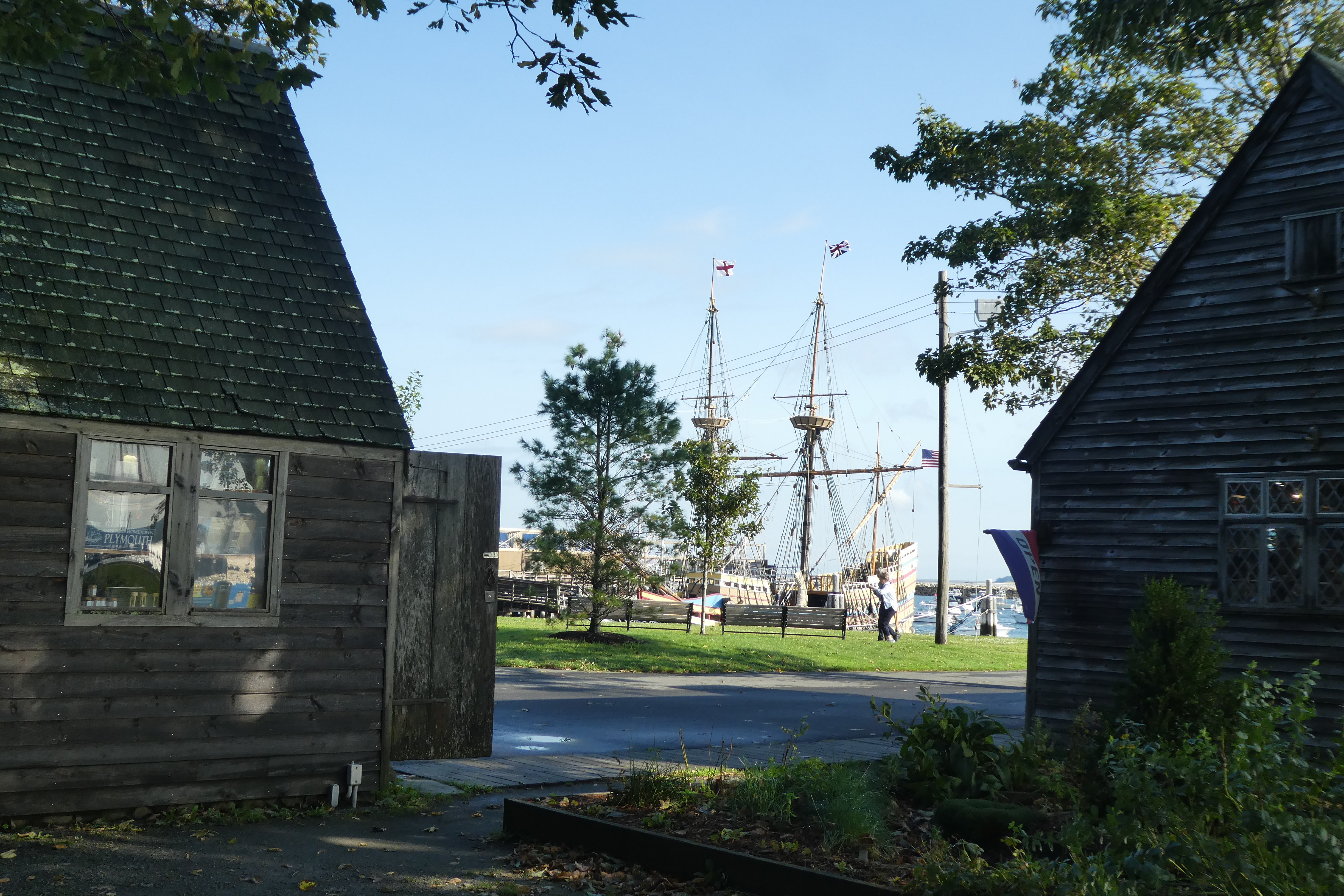
At the Plimoth Patuxet open air museum, this path leads to the English village.  However, due to recent archeaological digs in downtown Plymouth at the site of the original fort, historians have learned that the native Wampanoag people lived very close to the palisade.  Previously they were believed to live nearby, but not this close.  The museum is re-interpreting the palisade and the Wampanoag dwellings.  A grant from Americana Corner helped to fund the new palisade. 

In 1635, the colony contracted Thomas Boreman to build the wall as such: “All the posts are to be 10 inches square, and not to stand above 10 foote asunder, to be done with 3 rails between every post, of fit scantling. The post and rails are all to be sawne. He [Thomas Boreman] is to enclose the whole work with sawne boards. It is to be 9 foote high, and they are to be cut sharp at the top and either listed or shot with a plane…”.


This is the wetu that is now very close to the palisade and the fortress. 


Our cousins from Spain enjoyed the Wampanoag Homesite very much.  The inside of the wetu is a very interesting experience. 


For the truly curious:

Plimoth Patuxet website:  https://plimoth.org/   

Americana Corner web page about Plimoth Patuxet's palisade    https://www.americanacorner.com/preserving-america/plimoth-patuxet-museums

My 2019 blog post about Dr. Langdon from UMass and his archeaological digs at Plymouth   https://nutfieldgenealogy.blogspot.com/2019/11/new-archaeological-finds-at-plymouth.html  

--------------------------

To cite/link to this blog post: Heather Wilkinson Rojo, "A Photo Tour of Plimoth Patuxet Museum", Nutfield Genealogy, posted November 27, 2024, ( https://nutfieldgenealogy.blogspot.com/2024/11/a-photo-tour-of-plimoth-patuxet-museum.html: accessed [access date]). 

Monday, January 2, 2023

What did Genea-Santa Bring? Christmas Books 2022


For many years I have posted the books that Genea-Santa has put under my Christmas tree.  You can see below for a list of links going back to 2014!  This year was a small haul, but enough to keep me very busy reading.  

I hope you find a few books on this list for yourself and your own family history research!


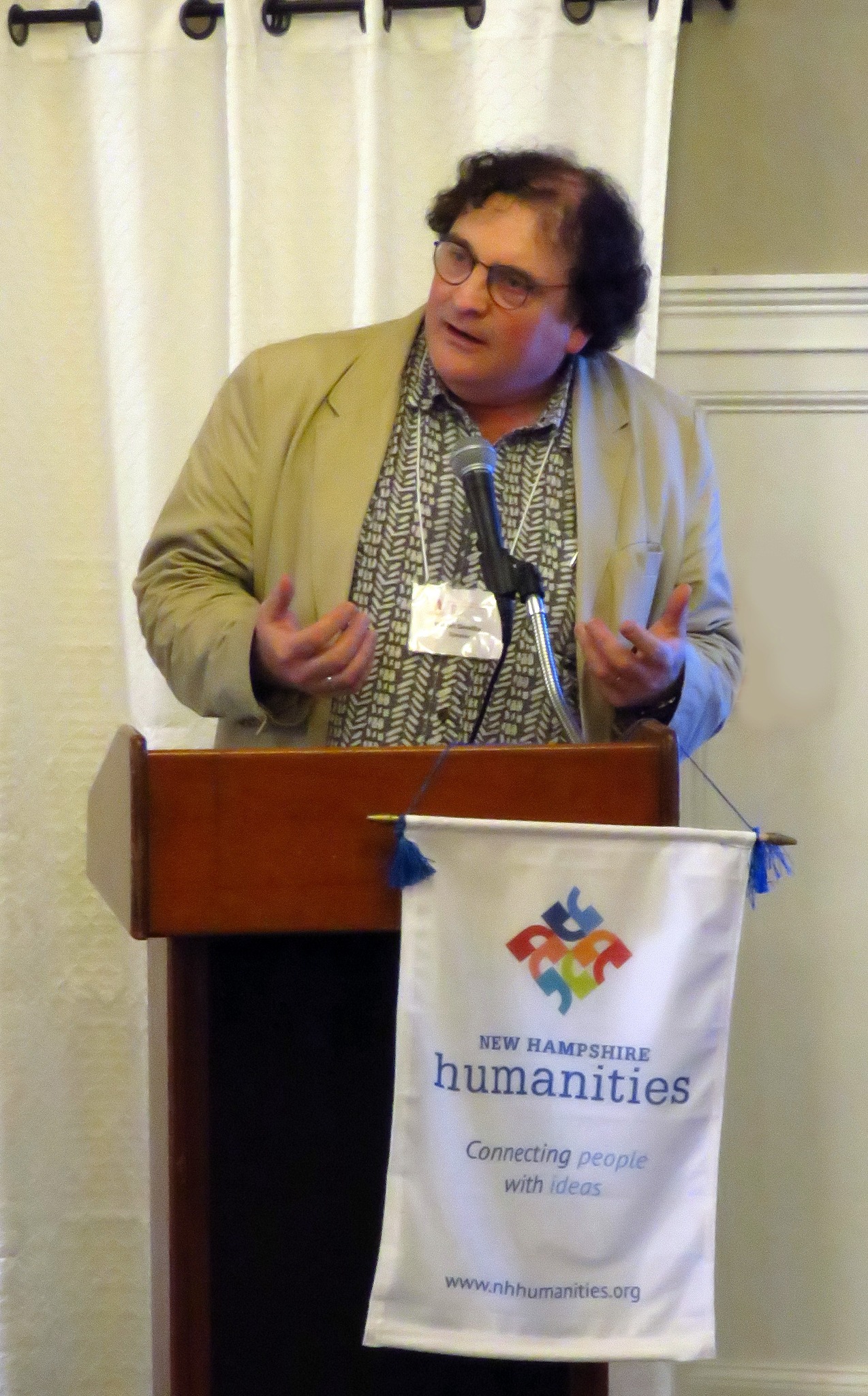
The first book is Robert Goodby's A Deep Presence: 13,000 Years of Native American History. We were very lucky that in November Professor Goodby of Franklin Pierce College was the featured speaker at the Compact Day Luncheon held by the New Hampshire Mayflower Society.  We were able to purchase an autographed copy of his newest book about the Native Abenaki who lived in our part of New England. He was a wonderful speaker, and if you hear about him speaking near you I would recommend you attend.  I can't wait to read this book!


Santa found this book on the history of Eastham, Massachusetts.  I have many ancestors from this town - Crosby, Bangs, Lumpkin, Mayo, Osborn, Mayhew, Davis, Hawes, and more.  It will be fun learning more about their hometown, and perhaps finding additional information on my ancestors.


In 2021 we stayed at a campground on Cape Cod, and this book of essays by Henry David Thoreau was in our little Airstream trailer.  During our weekend on the Cape I read several of these essays about Cape Cod and one about Mount Wachusett (near where I grew up and graduated at Wachusett Regional High School).  I was hooked and hated to leave the book behind.  Thank you, Santa!  Now I can read all the other essays.  (Purchased at the Concord Museum gift shop in Concord, Massachusetts)


This book looks like fun!  New England's Hidden Past: 360 Overlooked, Underappreciated, and Misunderstood Landmarks by husband and wife Dan and Leslie Landrigan is a surprise.  If you are a regular reader of this blog, you know how much I like to post about unsual New England historical sites. This book might send me off on a few local road trips.  Stay tuned!

For the truly curious: 

Christmas Books 2021

https://nutfieldgenealogy.blogspot.com/2022/01/what-did-genea-santa-bring-christmas.html  

Christmas Books 2020

https://nutfieldgenealogy.blogspot.com/2021/01/what-did-genea-santa-bring-christmas.html  

Christmas Books 2019
------------------------

To Cite/Link to this Blog Post:  Heather Wilkinson Rojo, "What did Genea-Santa Bring?  Christmas Books 2022", Nutfield Genealogy, posted January 2, 2023, (  https://nutfieldgenealogy.blogspot.com/2023/01/what-did-genea-santa-bring-christmas.html: accessed [access date]). 

Tuesday, July 12, 2022

Josiah Littlefield, d. 1713 Wells, Maine

The headstone and footstone of Josiah Littlefield
at the Webhannet Burial Ground, on the Post Road in Wells, Maine


HERE LYES Ye BODY OF
Mr. JOSIAH LETTLEFIELD
AGED ABOUT 50 YEARs
DIED APRIL Ye 26th
1731

Josiah Littlefield is my 8th great grandfather.  You can read my post about my Littlefield lineage HERE.

Josiah was the son of John Littlefield and his wife Patience (maiden name unknown).  He was born about 1662 in Wells, York County, Maine.  His paternal grandparents were Edmund Littlefield and Annis Austin, immigrants from Titchfield, Hampshire, England. Josiah inherited his father's sawmill.  There is a marker for this sawmill on the Post Road in Wells, by the Josias River (named in his honor). 

Josiah's life in Maine was marked by terribly sad and violent relations with the native people.  There were frequent raids and massacres on both sides.  On 10 August 1707 his wife (my 8th great grandmother Lydia Masters) and son, John Jr., were killed by the Indians on their way to Boston.  On 22 April 1708 Josiah was captured by the Indians and taken to Canada, and not released until April 1710 as part of a prisoner exchange.  On 18 April 1713 he was killed while working in his fields.  

After his death his eight children (three sons and five daughters) were adopted by Samuel and Elizabeth Cole, and their baptisms were recorded in the records of Wells, Maine.  His second wife, Elizabeth Hilton, carried on a long feud with Joseph Winn, who had been in charge of Josiah Littlefield's estate during his captivity.  She sued Joseph Winn in what was the longest litigation in colonial Maine history (but it left great records about the family! Yay!)  Elizabeth Hilton Littlefield remarried in 1716 to Malachi Edwards, who had been her lawyer during the lawsuit.  

The book The History of Wells and Kennebunk: From the earliest settlement to the year 1820, at which time Kennebunk was set off an incorporated , by Edward Emerson Bourne, 1875, has an account of Josiah Littlefield on pages 267 - 274.  This book also has this letter written from Josiah to his children during his captivity:

"Dear and loving children, my kind love remembered to you all, and my kind love to my brother and sister, and my kind love to all my friends att Wells, and to Mr. Emery in particular, dasiaring of him prayers for me and for my children, hoping in God they are in good health as I am att this present writing, blessed be God for it.

Aprel the 23 I was taken by foer Indans, and may the 3 I arrived att nongonuay (Norridgewock), and from thence to caback (Quebec), and arrived at caback may the 26 and from thence to Moriel (Montreal), and arrived at Moriel June the 2, and now I have liberty granted to me to rite to my friends and to the governor, and for my redemtion and for Wheelrite’s child to be redeemed by two Indena prisoners that are with the English now, and I have been with the governor this morning and hee have promised that if our governor will send them that wee shall be redeemed, for the governor have sent a man to redeem Wheelrites child and do lookes for him in now every day with the child to Moriel where I am, and I would pray whilrite to be very brief in the matter, that we may come home before winter, for we must come by Albany, and I have allso aquainted our Gofnear dedly (Dudley) with the same, no more at present but remain yours to command."


For the truly curious:

LITTLEFIELD Surname Saturday:

---------------------------

To cite/link to this blog post: Heather Wilkinson Rojo, "Josiah Littlefield, d. 1713 Wells, Maine", Nutfield Genealogy, posted July 12, 2022, ( https://nutfieldgenealogy.blogspot.com/2022/07/josiah-littlefield-d-1713-wells-maine.html: accessed [access date]). 

Saturday, October 30, 2021

Commemorating the 400th Anniversary of the First Thanksgiving

Sometime in the fall, 400 years ago the Wampanoag and English Separatists came together for what we now call the "First Thanksgiving".  The native Wampanoag people had suffered tremendous loss from disease, pandemic, and kidnappings.  The Separatists had fled their native England, and their temporary home in Leiden, Holland, and were seeking respite in the New World. Both came together for not just a feast, but to support each other through mutual aid and understanding.  Little did they know that this trust and treaty would last only a few decades. As we commemorate this event, we need to recognize the events leading up to that harvest meal, and what happened in the decades and centuries that followed.

Many people came together to plan the 400th Anniversary - the Wampanoag people, the state of Massachusetts, the General Society of Mayflower Descendants, the National Park Service, the town of Plymouth, the Plymouth 400 organization, Massachusetts Governor Baker, the town of Provincetown, the Pilgrim Hall Museum in Plymouth, the governments of the United Kingdom and the Netherlands, and more.  Little did they know how another pandemic would disrupt life, plans, and events.  And in the aftermath of this disruption, we need to recognize that the events should not end.  We should continue to learn and turn our hearts into new understandings of what happened in Plymouth.  As new archeological evidence is uncovered about how the native people and the Pilgrims lived together, we need to pass on this information to new generations.

I hope that the scholarship, archaeology, publishing of new books, lectures, online and in-person events continue. Events like the Indigenous History Conference should be an annual occurrence.  Across the nation, this 17th century history is being erased from school curriculums and from textbooks, just at a time when understanding cultural differences and the story of the indigenous people of North America is desperately needed! 

For the truly curious:

On YouTube, a video compilation of some the events from Plymouth 400:   https://www.youtube.com/watch?v=8EmOzXPmgxQ  

NBC 10 Boston TV's special "Righting 400 Years of History: Plymouth Then and Now" which originally aired on September 8, 2021 is available online at this link: 

https://www.nbcboston.com/community/plymouth-400/righting-400-years-of-history-plymouth-then-and-now/2486453/   

Some scheduled events for 2021:  https://nutfieldgenealogy.blogspot.com/2021/08/2021-updated-mayflower-400th.html  

Authors and Lecturers: 

Sue Allan   https://mayflowermaid.com/  

Jeremy Dupertuis Bangs    https://leidenamericanpilgrimmuseum.org/en  

Caleb Johnson   http://mayflowerhistory.com/  

Paula Peters  https://en.wikipedia.org/wiki/Paula_Peters  

Nathaniel Philbrick   https://www.nathanielphilbrick.com/ 

Museums (watch for events):

Plimoth Patuxet Museum:  https://plimoth.org/  

The Pilgrim Hall Museum:  https://pilgrimhall.org/  

The Mashpee Wampanoag Museum: https://mashpeewampanoagtribe-nsn.gov/museum  

More:

The General Society of Mayflower Descendants:  https://themayflowersociety.org/  

The Plymouth Archaeological Rediscovery Project:  https://www.plymoutharch.com

SmokeSygnals   https://www.nativeamericancreative.com/  

The Silver Book Project:  https://themayflowersociety.org/genealogy/explore-your-roots/silver-books-project/  

--------------------

To Cite/Link to this blog post:  Heather Wilkinson Rojo, "Commemorating the 400th Anniversary of the First Thanksgiving", Nutfield Genealogy, posted October 30, 2021, ( https://nutfieldgenealogy.blogspot.com/2021/10/commemorating-400th-anniversary-of.html: accessed [access date]).  

Wednesday, October 6, 2021

Seen at Chauncey Creek, Kittery, Maine - Weathervane Wednesday

 This weathervane was spotted while dining at the Chauncey Creek restaurant in Kittery, Maine. 


Whilst enjoying our lobster dinner on the river front deck of the Chauncey Creek restaurant, Vincent looked up and saw this interesting weather vane above a building next door.  It is located above piles of lobster pots, and was turning in the summer breeze.

This two dimensional figure of a Native hunter has a nice patina, although it is probably not particularly old.  Some of these weathervanes of aboriginal people have become controversial in recent years, and some institutions and residences have removed them.  

See the blog post about the controversial weather vane at Dartmouth College, which has been removed due to it's depiction of a native person with a barrel of rum:   https://nutfieldgenealogy.blogspot.com/2018/02/weathervane-wednesday-above-university.html   

---------------------

To Cite/Link to this blog post:  Heather Wilkinson Rojo, "Seen at Chauncey Creek, Kittery, Maine - Weathervane Wednesday",  Nutfield Genealogy, posted October 6, 2021, ( https://nutfieldgenealogy.blogspot.com/2021/10/seen-at-chauncey-creek-kittery-maine.html: accessed [access date]). 

Monday, January 4, 2021

What did Genea-Santa Bring? Christmas Books 2020

I usually post the books my Genea-Santa brings every Christmas.  Again, Santa was very generous and brought me a pile of books to keep me busy while "safe at home" this winter.  One book never made it from the North Pole to our home, and has been stuck in a USPS warehouse in New Jersey for several weeks.  I'll let Santa's friends, the Three Kings (Los Reyes Magos) deliver it from the warehouse to me in a few days.

I hope you find a few good books in this post for your Santa list next year!


Death of an Empire:  The Rise and Murderous Fall of Salem, America's Richest City - I have been looking forward to reading this book ever since my first cousin told me about it last summer.  The author, Robert Booth, is a well known maritime historian, and the founder of the online Salem Historical Society.  The story of how Salem fell from being one of the richest cities in America is one I know only a little about, so I'm looking anxious to read this book.  My ancestors lived through all of this fascinating history! 


Forgotten Wolves of Wilkinaland - I've been fascinated by J. C. (Max) Wilkinson's theory for writing this book ever since following him on the Facebook group "Wilkinson Family Lineage".  In short, his theory is that Wilkinson is surname based on a place, not a diminutive for "Son of Wilkin" or "Son of Will" or "Son of William".  I started this book Christmas night, and it is fascinating!  I highly recommend it for anyone with a variation of the name Wilkinson (Wilkerson, Wilkins, Wilkens, Wilkie, etc.).  


Mayflower Migration: Immigrants to Plymouth, 1620 - Here is yet another book in Robert Charles Anderson's Great Migration series.  I already owned his book The Pilgrim Migration 1620 - 1623, 2004, and this new book was just published this year by NEHGS.  This Mayflower book focuses exclusively on the Mayflower passengers, and no other Plymouth settlers, and includes new research.  Each passenger has a sketch including a biography with comments and notes by Anderson just like in the other Great Migration books. 


This Land is Their Land: The Wampanoag Indians, Plymouth Colony, and the Troubled History of Thanksgiving - In 2020 I vowed to read more books about the Wampanoag and the other native people of New England. This 2019 book by David J. Silverman was one of the top books recommended to me by Plimoth Plantation staff.  I'm looking forward to reading it and learning more from the original people of the land where my ancestors settled and lived with side by side. 


In the Shadow of Men: The Lives of Separatist Women - I heard Sue Allan speak about her research on this book last year, and when it was published this year, 2020, I had a hard time getting a copy.  The NEHGS bookstore ran out several times!  But Genea-Santa came through with a book just in time for Christmas.  I have four female ancestors who were passengers on the Mayflower, and I was a tiny bit disappointed to see that none of them had a chapter in this book.  But I know Sue is always researching more Pilgrims every year, so perhaps there will be a Volume 2?  


Of Plimoth Plantation by William Bradford: The 400th Anniversary Edition - This new 2020 edition of the famous journal by Bradford was edited by a star studded panel: Kenneth P. Minkema, Francis J. Bremer, and Jeremy Bangs, with an introduction by Paula Peters of the Wampanoags.  It was published by the Colonial Society of Massachusetts and NEHGS (The New England Historic Genealogical Society).  Be aware that there is a second 400th Anniversary Edition of Bradford's Journal published by Plimoth Plantation and the Massachusetts State Library also for this year, 2020.  This is the book that Genea-Santa ordered from the museum in Plymouth, Massachusetts that was sent to a warehouse in New Jersey by the USPS and never arrived in Manchester, New Hampshire in time for Christmas.  Why own both editions?  I'll let you know in a later blog post!  


The History and Antiquities of Every Town in Massachusetts - this 2014 book edited by John Warner Barber is a new edition of an 1839 book.  There is a sketch for every town in Massachusetts that existed at the time of the original book (there were 306 towns then minus the four towns drowned by the Quabbin reservoir and the four towns annexed by Boston, and now there are 351 towns).  


The Mayflower Descendant - is the journal from the Massachusetts Mayflower Society published twice a year by the New England Historic Genealogical Society.  Anyone can subscribe to this through the NEHGS website, even if you are not a member of the Massachusetts Mayflower. Thank you for renewing my subscription another year, Santa!


Genea-Santa also added this Delft mug of the Mayflower II from the Plimoth Plantation gift shop! 


For the truly curious - check out the books I received from Genea-Santa in the past years:

Christmas Books 2019

https://nutfieldgenealogy.blogspot.com/2019/12/what-did-genea-santa-bring-christmas.html   

 Christmas Books 2018  

https://nutfieldgenealogy.blogspot.com/2019/01/christmas-books-from-santa-2018.html   

Christmas Books 2017

Christmas Books 2016:

Christmas Books 2015:

Christmas Books 2014:


-------------------------------

To Link/Cite this blog post:  Heather Wilkinson Rojo, "What did Genea-Santa Bring? Christmas Books 2020", Nutfield Genealogy, posted January 4, 2020, ( https://nutfieldgenealogy.blogspot.com/2021/01/what-did-genea-santa-bring-christmas.html: accessed [access date]).