Showing posts with label Salem. Show all posts

Tuesday, September 15, 2026

My Loyalist Ancestors - Benjamin Thompson AKA Count Rumford


The Count Rumford birthplace in Woburn, Massachusetts


This is the second blog post on a Loyalist ancestor I have written this year for the 250th anniversary of the United States.  Benjamin Thompson is my first cousin, six generations removed.  His mother, Ruth Simonds (b. 1730) is the sister of my 5th great grandfather, Caleb Simonds (1720 - 1811).  Benjamin Thompson was born 26 March 1753 in Woburn, Massachusetts in the house of his grandfather, Captain Ebenezer Thompson.  He attended the local schools until he was eleven years old, when he was sent (along with his young friend and neighbor Loammi Baldwin) to Medford to study mathematics, astronomy and science.  

At age 13 he was bound as an apprentice to a Salem merchant, John Appleton.  Thompson went home to Woburn soon after because Appleton lost his business when the relations between the colonies and England became strained. Then he taught school in Wilmington in 1768 and 1769.  Later in 1769 he again studied science (anatomy and physiology) under Dr. John Hay, a doctor in Woburn. In 1770 he studied at Harvard with his friend Loammi Baldwin.  In 1772 he began to teach school in Rumford (now Concord, New Hampshire). 

By 1772 he married Sarah Walker, the widow of Benjamin Rolfe, and daughter of Rev. Timothy Walker of Rumford. She was a very wealthy woman, age 33, and Benjamin Thompson was only 19 years old. He joined the New Hampshire regiment, and had to chose sides to be an American or a Loyalist.  When he was denied a commission to be an officer in the Continental army he joined the British. Benjamin and Sarah had one daughter, Sarah, born 18 October 1774. 

When the British evacuated Boston on 17 March 1776 he fled to England and left his wife in New Hampshire. He was elected to the Royal Society of Science in 1779, returned to America as an officer in 1781 - 1782, and was knighted in 1784.  Then he left England for Germany, where he served the Prince of Bavaria for 18 years, where he was made a count of the Holy Roman Empire. He chose to be named Count Rumford, after the town in New Hampshire.

In 1803 he settled in France where he remarried to the widow of the French chemist Lavoisier.  His new wife was Anne Marie Pierette Paulze. While in France he invented a calorimeter, a photomete, and a drip coffee maker.  His studies of heat lead him to be the first to understand that heat was a form of motion.

He endowed the Rumford Medals at the Royal Society, and the Rumford Medals at the American Academy of Arts and Sciences, and the Rumfor chair of science at Harvard College (now Harvard University). He, along with Sir Joseph Banks, founded the Royal Institution of Great Britain.  He also made some practical inventions such as central heating, the smokeless chimney, the kitchen oven, the first pressure cooker, and other. His name lives on for the invention of the Rumford Fireplace, which reflected more heat back into the room than previous versions of fireplaces. 

As Count Rumford in Europe, he had several love affairs, including a woman Victoire Lafevre (his housekeeper) who bore him a son,  and the Countess Baumgarten with whom he had another daughter named Sophia, born in 1798.  Count Rumford also had an affair with her sister, the Countess Nogarola.  

Benjamin Thompson, AKA Count Rumford, died 21 August 1814 in Auteil, France and is buried there. His epitaph reads "Benjamin Thompson, Conte De Rumford. The celebrated physicist and enlightened philanthropist, whose discoveries on light and heat made his name illustrious and whose work to help the poor will always be dear to the friends of humanity."

President Franklin D. Roosevelt said that Sir Benjamin Thompson, Count Rumford, was "one of the three greatest minds America has produced" (the others were Benjamin Franklin and Thomas Jefferson).  

By Thomas Gainsborough - Corel Photo CD, MASTERS I, Public Domain, https://commons.wikimedia.org/w/index.php?curid=9516763


For the truly curious:

Previous blog posts on Benjamin Thompson, Count Rumford:

"Two Cousins", 17 May 2012:  https://nutfieldgenealogy.blogspot.com/2012/05/two-cousins.html   

"The Count Rumford House", 14 May 2012:   https://nutfieldgenealogy.blogspot.com/2012/05/count-rumford-house.html   

"Colonel Loammi Baldwin", 24 October 2013:   https://nutfieldgenealogy.blogspot.com/2013/10/colonel-loammi-baldwin.html  

Memoir of Sir Benjamin Thompson, Count Rumford, with notices of his daughter, (with an edition of Rumford's complete works) by George E. Ellis, published by the American Academy of Arts and Sciences, Boston, 1875. 

Sir Benjamin Thompson, Count Rumford and the Royal Instituation, by the Royal Society, 1999. 

White Knight, Red Heat: The many lives of Benjamin Thompson, Count Rumford, by John and Mary Gribbin, 20023

Benjamin Thompson at Wikipedia:   https://en.wikipedia.org/wiki/Benjamin_Thompson 

-------------------

To cite/link to this blog post: Heather Wilkinson Rojo, "My Loyalist Ancestors - Benjamin Thompson AKA Count Rumford", Nutfield Genealogy, posted September 15, 2026, ( https://nutfieldgenealogy.blogspot.com/2026/09/my-loyalist-ancestors-benjamin-thompson.html: accessed [access date]). 

Tuesday, July 21, 2026

My Revolutionary War Ancestors - George Fint of Reading, Massachusetts


The George Flint House in North Reading, Mass.

This is the 12th post I have written about a Revolutionary War veteran ancestor.  George Flint, my 5th great grandfather, was the son of George Flint (b. 1686) and Jerusha Pope, born on 16 November 1728 in what is now the town of North Reading, Massachusetts.  His mother, Jerusha, was the daughter of Joseph Pope and Bethshua Folger (the sister to Abiah Folger, Benjamin Franklin's mother).  Joseph and Bethshua Pope were notorious witnesses in the 1692 Salem witch trials, and accused their neighbors John Proctor, Martha Corey, and Rebecca Nurse of witchcraft.  

On 13 November 1753 George Flint married Hannah Phelps in Andover, Massachusetts.  Hannah is a "brickwall ancestor", and I have not been able to identify her parents or her ancestors. Phelps is a very common name in Andover, Massachusetts.  George and Hannah had seven children between 1755 and 1770, including my 4th great grandmother, Phebe Flint, born on 8 March 1763 in North Reading.  Phebe married her cousin, John Flint, who was the son of Jonathan Flint and Lydia Proctor.  Jonathan Flint is the son of Mary Collston, also imprisoned for witchcraft along with her mother and grandmother.  Lydia Proctor is the granddaughter of John Proctor, who was accused by the Pope (see the paragraph above) and hanged as a witch on 19 August 1692.  This family tree is full of people who both survived and also died during the 1692 hysteria.  

George Flint served in the American Revolution as a Sargent.  He first answered the Lexington Alarm under Colonel David Green in the 2nd Middlesex County Regiment. David Green is the great grandson of my ancestor Thomas Green of Malden, Massachusetts.  He later served under Captains Amos Upton and John Flint (a cousin) in the 3rd Reading Company.  

George Flint died on 31 August 1808 in North Reading.  His wife, Hannah, had died three years earlier on 5 May 1805. I have not been able to locate a gravestone or burial site for either George or Hannah Flint. He apparently died intestate. 

For the truly curious:

Genealogical and Personal Memoirs Relating to the Families of Boston and Eastern Massachusetts, by William Richard Cutter, Volume 1, page 267.  

Massachusetts Soldiers and Sailors in the War of the Revolution, Volume 16, page 226. 

Other blog posts about my Revolutionary War Ancestors: 

#1 Colonel Joshua Burnham of Milford, NH:  https://nutfieldgenealogy.blogspot.com/2026/02/my-revolutionary-war-patriots-colonel.html  

#2  Major Andrew Munroe of Lexington, MA:  https://nutfieldgenealogy.blogspot.com/2026/03/my-revolutionary-war-patriots-major.html  

#3 Jonathan Flint of Reading, Massachusetts:    https://nutfieldgenealogy.blogspot.com/2026/03/my-revolutionary-war-patriots-jonathan.html   

#4 Daniel Glover of Marblehead, Massachusetts:    https://nutfieldgenealogy.blogspot.com/2026/04/my-revolutionary-war-patriots-daniel.html  

#5 Levi Younger of Gloucester, Massachusetts:    https://nutfieldgenealogy.blogspot.com/2026/04/my-revolutionary-war-patriots-levi.html  

#6 Nathaniel Treadwell of Ipswich, Massachusetts:    https://nutfieldgenealogy.blogspot.com/2026/04/my-revolutionary-war-patriots-nathaniel.html 

#7 Captain Westley Burnham of Essex, Massachusetts:   https://nutfieldgenealogy.blogspot.com/2026/04/my-revolutionary-war-patriots-captain.html  

#8 Abner Poland, Sr. of Essex, Massachusetts    https://nutfieldgenealogy.blogspot.com/2026/05/my-revolutionary-war-patriots-abner_02014071889.html   

#9 Abner Poland, Jr. of Essex, Massachusetts    https://nutfieldgenealogy.blogspot.com/2026/05/my-revolutionary-war-patriots-abner_02014071889.html  

#10  Robert Wilson of Danvers, Massachusetts    https://nutfieldgenealogy.blogspot.com/2026/03/my-revolutionary-war-patriots-robert.html   

#11  Amos Burnham of Ipswich, Massachusetts   https://nutfieldgenealogy.blogspot.com/2026/06/my-revolutionary-war-ancestors-amos.html   

-------------------------

To cite/link to this blog post: Heather Wilkinson Rojo, "My Revolutionary War Ancestors - George Fint of Reading, Massachusetts", Nutfield Genealogy, posted July 21, 2026, ( https://nutfieldgenealogy.blogspot.com/2026/07/my-revolutionary-war-ancestors-george.html: accessed [access date]). 

Tuesday, April 7, 2026

My Revolutionary War Patriots, Daniel Glover, Marblehead, Massachusetts

 This is #4 in my series of blog posts about my ancestors who served in the American Revolution.

This painting depicts Glover's Regiment
rowing General Washington across the Delaware River

Daniel Glover is my 6th great grandfather, the son of Jonathan Glover, Jr. and Tabitha Bacon, born in January 1734/35 in Salem, Massachusetts.  He married Hannah Jillings on 1 December 1757 in Newbury, Massachusetts and had four children.  She was the daughter of Thomas Jillings and Hannah Mirick of Newbury. 

Daniel's father died when he was very young, about four years old, leaving his mother a widow with four young boys.  Tabitha Bacon Glover was very resourceful, but left destitute.  Her husband left no will so she applied for the guardianship of her sons - twins Jonathan and Samuel, John, and the youngest, Daniel, my ancestor.  John would become the very famous Brigadier General John Glover of the American Revolutionary War, and his brothers all were members of his Marblehead regiment.  Tabitha left Salem with her children to live with her sister in Marblehead, where she raised her family. Twenty years later, when her sons were grown, Tabitha remarried to Daniel's father-in-law, Thomas Jillings. 

Daniel became a blockmaker by trade, who crafted wooden pieces for ship builders, including the "block" or pulleys used in the rigging. He was also the captain of several of his brother's ships.  His two brothers Jonathan (hatmaker) and John (cordwainer or shoemaker) were successful in their businesses and invested in ships sailing out of Salem. He captained the family owned schooner "Three Brothers" according to the Salem Gazette in 1768. Many newspaper accounts in Salem mention a Captain Glover in their shipping news, but not all give a first name or name Daniel. He is known to have commanded the brigantines "Ranger" and "Benjamin".  

During the American Revolution, Daniel's brother John Glover formed the 14th Massachusetts Regiment, which formed up under the new Continental Army in Boston.  General Washington ordered Glover to take his ship "Hannah" (named for his wife Hannah Gale) as a privateer to plunder British shipping off the New England coast. Washington was impressed, and this is considered the birth of the United States Navy.  George Washington asked Glover's regiment to join him as mariners for the Battle of Brooklyn in New York, the Battle of Pell's Point, and for rowing Washington and his troops across the Delaware River for the Battle of Trenton. All the Glover brothers participated in these events of the Revolutionary War. The story of Glover's Regiment was covered recently in Ken Burns new documentary about the Revolutionary War, and in the books I list below. 

Daniel came home from the Revolutionary War to live in Beverly and Marblehead. He had two sons and two daughters - Jonathan, Hannah, Tabitha and John.  I descend from his daughter Tabitha, born in 1765, who married Thomas Homan in Marblehead on 28 November 1782 and had seven children.  

Despite belonging to this famous family of mariners and patriots, there are very few records on Daniel Glover.  He is an enigma.  Daniel died sometime before 1790 when his wife Hannah was listed in the first federal census as a widow. His burial place is unknown.  Hannah, his widow, died in Salem on 4 October 1810. The Salem and Marblehead records do not list his death record. He left no probate records or will.  His house survives in Marblehead at 11 Mechanic Court and is known locally as "The Old Hammond House".  

For the truly curious: 

My other patriot blog posts in this series: 

#1  Colonel Joshua Burnham, Milford, New Hampshire:    https://nutfieldgenealogy.blogspot.com/2026/02/my-revolutionary-war-patriots-colonel.html   

#2  Major Andrew Munroe, Lexington and Danvers (now Peabody), Massachusetts:   https://nutfieldgenealogy.blogspot.com/2026/03/my-revolutionary-war-patriots-major.html  

#3  Jonathan Flint, Reading, Massachusetts:   https://nutfieldgenealogy.blogspot.com/2026/03/my-revolutionary-war-patriots-jonathan.html  

My Glover lineage:   https://nutfieldgenealogy.blogspot.com/2017/09/surname-saturday-glover-of-salem-and.html   

Books about General John Glover and his regiment:

The Indispensables: The Diverse Soldier Mariners who Shaped the Country, Formed the Navy, and Rowed Washington Across the Delaware, by Patrick K. O'Donnell, 2022, Atlantic Monthly Press. 

Saving Washington's Army: The Brilliant Last Stand of Genral John Glover at the Battle of Pell's Point, New York, October 18, 1776, by Phillip Thomas Tucker, 2022, Skyhorse Publishing.  

General John Glover and his Marblehead Mariners, by George A. Brillias, 1960, Henry Holt and Company. 

General John Glover and his Marblehead Regiment in the Revolutionary War: A Paper Read Before the Marblehead Historical Society, May 14, 1903, by Nathan P. Sanborn and C. H. B. Quennell, published in 2021 by Barakaldo Books. 

The image above is the painting Washington Crossing the Delaware by Emanuel Leutze, 1851, now at the Metropolitan Museum of Art in New York City.  

----------------------

To cite/link to this blog post: Heather Wilkinson Rojo, "My Revolutionary War Patriots, Daniel Glover, Marblehead, Massachusetts", Nutfield Genealogy, posted April 7, 2026, ( https://nutfieldgenealogy.blogspot.com/2026/04/my-revolutionary-war-patriots-daniel.html: accessed [access date]). 

Tuesday, March 24, 2026

My Revolutionary War Patriots, Jonathan Flint of Reading, Massachusetts

 This is Patriot #3 in this series of blog posts about my ancestors in the Revolutionary War.


My 5th great grandfather Jonathan Flint was born on 11 August 1730 in Reading, Massachusetts, the son of Jonathan Flint (b. 1689) and Mary Collston Hart.  Mary was the daughter of Elizabeth Collston, who was only 16 when she was accused of being a witch during the 1692 witchcraft hysteria.  She was arrested along with her mother, Mary Duston Collston, and grandmother, Lydia Dustin.  Lydia died in prison in Cambridge, Massachusetts before being exhonorated. Elizabeth escaped twice, once from the Cambridge prison, and a second time while being transported to the courthouse in Charlestown.  

On 1 August 1751 Jonathan Flint married Lydia Proctor in Salem, Massachusetts.  By coincidence, Lydia was the great granddaughter of John Proctor who was hanged as a witch in 1692.  John Proctor was the protagonist in the famous play "The Crucible" written by Arthur Miller. Lydia had several relatives involved with the witch hysteria, including the grandparents William Buckley and Sarah Smith.  Her grandmother Sarah was arrested on 14 May 1692 for witchcraft and imprisoned. Two pastors spoke to her innocence, but she still spent eight months in prison until found not guilty in January 1693.  

Jonathan and Lydia had eight children between 1751 and 1767.  They lived in North Reading, Middlesex County, Massachusetts, not far from Lexington and Concord.  When the alarm rang out for the British regulars attacking Lexington on 19 April 1775 Jonathan was 44 years old.  As a corporal in Captain John Batchelder's Company, his militia responded to the alarm and marched towards Lexington.  The company arrived after the battle, but Jonathan re-enlisted again in 1776.  The musket he used in the American Revolution was supposed to be preserved in the collections of the Rhode Island Historical Society, but they have no record of this artifact. 

Captain John Batchelder's Company was part of Ebenezer Bridge's Regiment, also known as the 11th Massachusetts Regiment. This regiment fought at the Battle of Bunker Hill and served in the Siege of Boston until it was disbanded in December 1775. This regiment had eleven companies, including Batchelder's company.  I don't know if Jonathan Flint saw action at Bunker Hill. 

Jonathan returned to his life as a farmer in the North Precinct, now called North Reading and died around 1800 at about age 70.  The exact date is unknown and I have not found a grave for Jonathan.  I descend from his son, John Flint, who was born in North Reading on 3 April 1761 and died there on 26 August 1836. John married his cousin, Phebe Flint, daughter of George Flint and Hannah Phelps.  Phebe had eight children with John, and died in 1846.  John was also married to Mehitable McIntire, daughter of Archelaus McIntire and Abigail Felton, who had two children with John Flint.  

My 5th great grandmother, Lydia Proctor,  must have died before 1794.  I have found no death record for her, nor a grave site.  On 24 June 1794 Jonathan Flint remarried to Sarah Smith.  They had no children.  I have not found a death record for Sarah, or a grave site. She did not apply for a widow's pension for Jonathan's Revolutionary War service. 

For the truly curious:

A Genealogical Register of the Descendants of Thomas Flint, of Salem, by John Flint and John H. Stone, published by Warren F. Draper, Andover, Massachusetts, 1860, see pages 9 and 14. 

#1 in this series Colonel Joshua Burnham of Milford, New Hampshire:   https://nutfieldgenealogy.blogspot.com/2026/02/my-revolutionary-war-patriots-colonel.html  

#2 in this series Major Andrew Munroe of Lexington, Woburn, and Danvers (now Peabody), Massachusetts:    https://nutfieldgenealogy.blogspot.com/2026/03/my-revolutionary-war-patriots-major.html  

---------------------------

To cite/link to this blog post: Heather Wilkinson Rojo, "My Revolutionary War Patriots, Jonathan Flint of Reading, Massachusetts", Nutfield Genealogy, posted March 24, 2026, ( https://nutfieldgenealogy.blogspot.com/2026/03/my-revolutionary-war-patriots-jonathan.html: accessed [access date]). 

Thursday, January 1, 2026

Happy New Year from Salem, Massachusetts 1848


From the Salem Observer, Salem, Massachusetts, January 1, 1848

"THE NEW YEAR

We have once more, as the stereotyped phrase goes, "arrived safely at the commencement of another year."  The planet to which it is our fortune to appertain, has again wheeled its course around the Sun without accident or incident of any kind.  -  We have neither joggled against the vagrant comets which have been seen wandering about in space, nor have fallen out with any of those fixed and respectable bodies which are addicted to more "steady habits."  Hence we have the satisfaction of believing, as we greet the New Year, that "Old Mother Earth" is still a welcome visitant of the starry Host.

While we have gone on thus smoothly with our celestial neighbors, things amongst ourselves have been less unruffled.  The past year has been signalized by many events which have "shed disastrous eclipse upon the nations."  The great famine in Ireland and on the Continent is an event which will be remembered with grief for ages. The commercial distress abroad, the many wars and much bloodshed, and especially our own war with Mexico, can never be forgotten.  Add to these and other public evils, the countless private sorrows, from which, unhappily, no year is free, and we have a picture of the Old Year mournful to look upon. But the picture is false unless it presents cheerful lights also.  The past year has not been without its happy events.  Amongst these may be mentioned the accession to the papal throne of a liberal Pope, (the discovery of Chloroform?), the abolition of Slavery in Algiers, and the spread of generous ideas, liberal principles, and the spirit of humanity, which we cannot but beieve has taken place.  Take it all in all, the past year has doubless afford its full share of blessings.  We cannot expect "Heaven to weep rubies in a crimson shower," but must be satisfied with a fair sprinkling of precious experiences.  

Retrospections are apt to be dull, but anticipations are hopeful and cheering.  We have henceforth to do with the New Year - "the young spark who came of age this morning."  The Old Year may be decrepid and morose but the New Year is sprightly and happy.  He, at least, is no lugubrous old fellow, cutting and slashing on every side with his lean and hungry scythe, but rather a "tentie seesman," scattering the germs of hope and promise with liberal hand.  That many of these seeds may fall upon your lands, dear reader, and find no barren but a fruitful soil, is our earnest desire. In what more hearty way could we wish you a Happy New Year? " 

------------------

To cite/link to this blog post:  Heather Wilkinson Rojo, "Happy New Year from Salem, Massachusetts 1848", Nutfield Genealogy, posted January 1, 2026, ( https://nutfieldgenealogy.blogspot.com/2026/01/happy-new-year-from-salem-massachusetts.html: accessed [access date]). 

Tuesday, December 23, 2025

A Christmas Wedding in 1890


From the Beverly Citizen newspaper
27 December 1890 

On a recent snowy day my 3rd cousin, on my maternal side, a Hitchings descendant like me, sent me this lovely news clipping from the Beverly Citizen.  It shows our common ancestor, Abijah Franklin Hitchings (1841 - 1910), and my great grandfather, Arthur Treadwell Hitching's wedding to my great grandmother Florence Etta Hoogerzeil on 25 December 1890 at 8 Bentley Street in Beverly, Massachusetts.  They were married on Christmas, which was very common in New England at the time.  Thanksgiving was also a very popular time for weddings in New England. If the family was already gathered together, then it was a perfect time for a wedding.  Early Puritan settlers eschewed Christmas as a holiday in New England, but perhaps they were side stepping religion for fun when they held weddings on or around Christmas Day? 

It made me think "What other ancestors were married on Christmas Day?".  This is what I had in my files: 

Phoebe Munroe (my 4th great aunt) and William Cross, 25 December 1828 in Danvers, Massachusetts. 

Elizabeth Sparks and Jacob Perkins (my 8th great grandparents), 25 December 1634 in Ipswich, Massachusetts.  I descend from two of their three children, Elizabeth (who married David Burnham on my wedding day 2 July in 1711) and Jacob Perkins (who removed to Wells, Maine and married Anna Littlefield). 

Close to Christmas - 

21 December

Abijah Hitchings and Mary Cloutman, my 4th great grandparents, were married on 21 December 1795 in Salem, Massachusetts.  

Phebe Lilley and Noah Eaton (my 6th great grandparents), were married on 21 December 1726 in Woburn, Massachusetts. 

Hannah Munroe (my 7th great aunt) and Joseph Pierce, were married on 21 December 1692 in Watertown or Cambridge, Massachusetts. 

22 December

Mary Barber and Benjamin Tarr (my first cousin 7 generations removed), were married on 22 December 1748 in Gloucester, Massachusetts.  Our common ancestor was James Wallis (about 1668 - 1744) who was born in Maine and died in Gloucester, Massachusetts. 

Hannah Dennison and John Wallis (another first cousin 7 generations removed), were married on 22 December 1782 in Gloucester.  They were first cousins to each other.  Was this a double wedding? 

23 December

Sally Flint (my fifth great aunt) and Levi Nichols were married on 23 December 1778 in North Reading, Massachusetts.  

Sally Flint (my fourth great aunt) and Nathaniel Upton, were married on 23 December 1802 probably in North Reading.  

24 December - Christmas Eve

Polly Bray and Asa Burnham, my 5th great grandparents, were married on 24 December 1801 in Ipswich, Massachusetts.  

Emily Burnham (my 5th great aunt) and John Rollins, were married on 24 December 1836 in Essex, Massachusetts. 

26 December (The day after Christmas)

Elizabeth Peach and Harvey Allen (my 3rd great uncle), were married on 26 December 1887 in Beverly, Massachusetts.  

Susanna Dutch (2nd cousin ten generations removed) and Benjamin Knowlton were married on 26 December 1705 in Beverly, Massachusetts. 

New Years Day Weddings:

Tabitha Damon and John Townsend (my 7th great uncle) were married on 1 January 1722 in Reading (now the part that is Wakefield), Massachusetts. 

Sarah Andrews and Charles Treadwell (my 8th great uncle) were married on 1 January 1723 in Hampton Falls, New Hampshire. 

Hannah Flint (my 5th great aunt) and William Whittredge were married on 1 January 1795 probably in North Reading, Massachusetts.  

Thanksgiving weddings (just a few mentioned here, but the last week or ten days in November was extremely popular among my ancestors for weddings):

My grandparents, Bertha Louise Roberts and Donald Munroe Wilkinson  26 November 1926 at 7 Dearborn Avenue in Beverly, Massachusetts. This was Bertha's home, and where my Dad grew up, and where I grew up, too!  I know they were married on Thanksgiving from an audio tape made by Bertha telling the story of her life.  

My 2nd great grandparents, Robert Wilson Wilkinson and Phebe Cross Munroe were married on 24 November 1853 in Danvers, Massachusetts.  This date was confirmed to be Thanksgiving from family tradition. 

My 4th great grandparents Romanus Emerson and Jemima Burnham were married on 22 November 1810 in Milford, New Hampshire.  I had to search online for the date of Thanksgiving in 1810, and this was the result, but I'm not sure that Thanksgiving had a set date this early. 

Mark Burnham (first cousin 7 generations removed) and Hannah Goodhue were married on Thanksgiving day 26 November 1767 in Ipswich, Massachusetts. 

Sarah Rue and John Beckett (my 6th great grandfather, I decend from his first wife, Rebecca Beadle) were married on Thanksgiving Day 25 November 1762 in Salem, Massachusetts (if Thanksgiving was celebrated on the fourth Thursday in November back then).  Sarah Phipps married my 6th great uncle George Munroe on that same day in Lexington, Massachusetts.  

If Thanksgiving were held on 24 November 1763 in Ipswich, Massachusetts, then my 5th great grandparents Isaac Allen and Abigail Burnham also had a Thanksgiving wedding date. 

I'd have to calculate the date of Thanksgiving for each year in the past, which is a floating holiday, and would become a truly huge proposal!  But it is a good future project.  Thanksgiving was not set as a national holiday until Abraham Lincoln proclaimed it in 1863.  He was persuaded to make it a national holiday by New Hampshire resident Sarah Josepha Hale, because of her fond memories of celebrating Thanksgiving as a child in New England.  It was not until 1941 that FDR set the holiday as the fourth Thursday in November, which was previously a tradition in New England that was loosely followed.  

1915 Salem Gazette

-----------------------

To cite/link to this blog post:  Heather Wilkinson Rojo, "A Christmas Wedding in 1890", Nutfield Genealogy, posted 23 December 2025, ( https://nutfieldgenealogy.blogspot.com/2025/12/a-christmas-wedding-in-1890.html: accessed [access date]).

Monday, April 21, 2025

Troublesome Thomas Tuck of Beverly, Massachusetts


The town seal of Beverly, Massachusetts

I share this ancestor, Thomas Tuck (1611 - 1667) with my fellow genealogy blogger, Bill West, who unfortunately passed away last year.  Bill wrote three interesting blog posts about Thomas Tuck, and you can find the links below at the end of this post.  It was Bill who called our common ancestor "Troublesome Thomas Tuck".  

Thomas Tuck was my 9th great grandfather, born about 1611 probably in England.  He died in Beverly, Massachusetts on 20 March 1667.  Years after he died his ghost became part of the 1692 witch trails, when someone accused him of coming back from the dead to urge her to buy some land!  In my opinion his ghost was mentioned because he was not particularly law abiding during his life.  But we will never know, will we? 

" And for seeing the devill, or any spirit but ones, & that was soon after old Thomas Tuck dyed (w'ch I take to be about ten yeare since) & that shee took it to be the Ghost of Thom: tuck coming to speak w'th her about some land s'd Tuck had told her of before his death. But that shee fled from the Ghost & got away."  Salem Witch Papers No. 68.18 Examination of Dorcas Hoar 2 May 1692 

I'm on a search to learn more about Thomas Tuck's wife.  Or his wives.  I wasn't sure how many times he married, or which wife might have been the mother of my 8th great grandfather, John Tuck, born in 1646 in Beverly and died there in 1722.  There is no mention of Thomas Tuck, unfortunately, in any of the Great Migration Books, so I can assume he came to Massachusetts after 1635 (which is the drop off date for Robert Charles Anderson's research).  He is not found in many other records except for court records, where I can find many, many mentions of his misadventures.

In Sidney Perley's History of Salem, 1924, Volume 1, pages 399 - 401 there is a very short mention of Thomas Tuck.  No, not three pages on him, just three sentences in the footnotes:

"Thomas Tuck, a blacksmith, aged about twenty-five, lived on Cape Ann side in 1636.  In 1643 he was living apart from his wife, and in 1650 he had married the widow of George Harris.  His wife was Joan in 1679.  In 1643 he was complained of for living absent from his wife, but was discharged."

What facts do I learn from this tiny paragraph?  Or what new questions do I have?  How many wives did Thomas Tuck have? Which wife was my ancestress? Where can I find more records? Does he appear anywhere except in court records? Why was he a part of the Salem Witch Hysteria? 

Fortunately, after a lot of digging over many months, I found a terrific resource.  Someone had done a sketch of Thomas Tuck and his children in the 2018 edition of the New England Historic Genealogical Society Register journal, hidden inside an article about George Harris (Yes!  The same George Harris mentioned in that brief little paragraph in the History of Salem.) And this article answered all my questions about Troublesome Thomas Tuck, and even brought up some new questions and further things to investigate.

My question was how many wives did Thomas Tuck have?   Apparently he had two, one before "Joan".  Joan's previous marriage to George Harris left her with three sons.  One of these sons, Samuel Harris (1644-1682) was married to Mary Hoar, the daughter of accused witch Dorcas (Galley) Hoar.  This news explained a lot of the mentions in court records of Thomas Tuck being the "father-in-law" (step-father) to Joseph Harris.  It also explains why the Tuck and Harris children were called to testify at Dorcas Hoar's trial for witchcraft in 1692. 

The article also listed many, many resources in the footnotes for additional deeds, court records, and other information.  Some of the best I found were compiled genealogies done on the Harris family, which helped me to sort out the Tuck family!  

Thomas and Joan Tuck had only one known child, my 8th great grandfather John Tuck (1646 - 1722) who married a Rachel (________) - another brick wall female line to untangle.  But they had six children including my 7th great grandfather John Tuck (1674 - 1717), and his sister Mary Tuck (1682 - 1741/2) who married John Balch the grandson of my 8th great grandparents Benjamin Balch and Sarah Gardner. Another daughter-in-law, Sarah Reith, remarried, when her husband Joseph Tuck died, to Samuel Allen of Manchester, Massachusetts (My mother's maiden name is Allen, a descendant of William Allen (1602 - 1678) of Manchester, so I need to find the kinship connection for this Samuel Allen). I had some notes on these Balch/Tuck/Reith/Allen families already in my files. I'm sure that I can unravel it all now with this new information. 

Don't forget to check journal articles, blog posts, and compiled genealogies of related families when you hit a Brick Wall ancestor!  Especially new articles published in the last five years, which may not be mentioned as much as articles from the 20th century or early 2000s (or show up on online searches).  

For the truly curious:

History of Salem, by Sidney Perley, 1924, Volume 1, pages 399 - 401.

NEHGS Register, 2018, Volume 172, pages 302 - 304  George Harris 1 of Salem, Massachusetts, with Sketch of Thomas 1 Tuck, by Gale Ion Harris https://www.americanancestors.org/DB202/i/55221/304/73267555

The Salem Witchcraft Papers, at salemlib.virginia.edu/texts/transcripts.html, SWP No. 68.4 (deposition of Rachel Tuck and Hannah Cox v. Dorcas Hoar, 14 May 1692)

From Bill West's blog West in New England, more about Thomas Tuck: 


------------------------------

To cite/link to this blog post:  Heather Wilkinson Rojo, "Troublesome Thomas Tuck of Beverly, Massachusetts", Nutfield Genealogy, posted April 22, 2025, ( https://nutfieldgenealogy.blogspot.com/2025/04/troublesome-thomas-tuck-of-beverly.html: accessed [access date]).  


Tuesday, April 23, 2024

Abijah Hitchings' Cow in 1799 - But which Abijah Hitching was it?


The Salem Gazette, Tuesday, 16 July 1799; Salem, Massachusetts; Volume XIII; Issue 829; page 4

This notice of a lost cow (above) appeared in the Salem newspaper in 1799.  I knew immediately that it was one of my ancestors because of the unusual name of Abijah Hitchings.  But which Abijah?  Can you believe that there are five Abijah Hitchings in my family tree, all living in Salem, Massachusetts between 1753 and 1910?  There may have been more that I don't know about, too! 

The first clue is Salem.  The advertisement is from the Salem newspaper, and it includes the wording "Salem, July 5".  Unfortunately, all my Abijah Hitchings lived in Salem, so that was not very helpful.

Next is the date of 1799.  I used the date to eliminate some of the Abijah's in my tree. 

My 5th great grandfather, Abijah Hitchings, lived between 1753 and 1826 

My 4th great grandfather, Abijah Hitchings, lived between 1775 and 1868

My 3rd great grandfather, Abijah Hitchings, lived between 1809 and 1864

My 2nd great grandfather, Abijah Franklin Hitchings, lived between 1841 and 1910. 

From these dates, I can guess that it was either of the two first Abijah Hitchings who lost the cow, since the rest were not born by 1799.  And my 4th great grandfather, Abijah Hitchings was just 24 years old in 1799, and had been married just three years, with one young child living at home (you guessed it - that child was Abijah Hitchings (1798 - 1803)).  His father, my 5th great grandfather, was 46 years old, married since 1775, with four children by two different wives still living at home.  Either one of these could have owned the lost cow.

I know from The Diary of William Bentley, Volume 2, page 468, that Rev. Bentley visited the elder Abijah Hitchings (my 5th great grandfather) often, and in March 1799 he mentioned the "small house on the Hitchens lot on Beckett Street".  This Abijah was veteran of the Revolutionary War, and a housewright in Salem. 

But, just two doors down (according to the 1810 census) Abijah, Jr. lived with his family.  He was a carpenter and a shipwright, and only married once. His first child was named Abijah Hitchings III, but he died young and they named their seventh child (out of eleven!) Abijah Hitchings in 1809 (my 3rd great grandfather).  Rev. Bentley also visited this family very often, and mentioned the visits in his diaries. When he died in 1868 he was the oldest man in Salem. 

Any guesses on who owned the lost cow?

For the truly curious:

Surname Saturday - My HITCHINGS lineage:    https://nutfieldgenealogy.blogspot.com/2014/10/surname-saturday-hitchings-of-lynn.html   

A blog post about Rev. Bentley's diary and the Hitchings family in Salem:    https://nutfieldgenealogy.blogspot.com/2010/09/amanuensis-monday-excepts-from-rev.html  

Click here to read all my blog posts that mention COWS!  LOL!    https://nutfieldgenealogy.blogspot.com/search/label/cows

-----------------------------

To cite/link to this blog post: Heather Wilkinson Rojo, "Abijah Hitchings' Cow in 1799 - But which Abijah Hitching was it?", Nutfield Genealogy, posted April 23, 2024, ( https://nutfieldgenealogy.blogspot.com/2024/04/abijah-hitchings-cow-in-1799-but-which.html: accessed [access date]). 

Monday, March 11, 2024

Albert Hoogerzeil (1845 - 1920) rescues a drowning man - 1896 Newsclipping


Boston Globe, Boston, Massachusetts, 14 January 1896, page 7. 

BEVERLY MAN'S BRAVE ACT

--------------

Albert Hoogerzeil Risks His Own Life to 

Rescue a drowning Neighbor.

Beverly, January 14- A narrow escape from drowning of a Beverly man and a heroic rescue by another is reported this morning.

It seems that William Bennett, while spearing for eels through the ice in the harbor, broke through and was in great danger of drowning, as, on account of his heavy clothes, he was unable to swim. His cries for assistance were heard by Albert Hoogerzeil, who was fishing from a dory about a half a mile away from the drowning man.  Mr. Hoogerzeil rowed with all possible speed to the scene.  At the risk of his own life, he forced his boat through the broken ice and reached Bennett, just as he was sinking for the last time.

He dragged him into the boat and devoted some little time in resuscitating him.  Mr. Bennett was thoroughly chilled and was in great danger of succumbing, but Mr. Hoogerzeil took the clothing off his own back to aid in restoring warmth to the chilled man until he reached the shore and secured assistance.

It is understood that steps will be taken to bring the brave rescue to the attention of the Humane Society with a view that a medal may be secured for Mr. Hoogerzeil in recognition of his courageous act.

-----------------

One of my ancestral family names is Hoogerzeil.  I'm lucky because my 7th great grandfather, Ocker Bruins Hoogerseijl (1663 - 1749) of Krimpen aan de Lek, near Rotterdam in the Netherlands, made up his own surname when patronyms started going out of fashion in his home country.  He was a commander of a whaling ship, and his name "Hoogerzeil" translates to "High Sails".  Every person ever named Hoogerzeil or Hogerzeil has turned out to be one of his descendants.  

Ocker Bruins Hoogersijl's great great grandson, Peter Hoogerzil (1803 - 1889) was a stowawy from Rotterdam to Salem, Massachusetts in the 1820s.  He settled in Beverly, across the harbor from Salem, where he married Eunice Stone in 1828.  She was supposedly the daughter of the sea captain of the ship in which Peter was a stowawy.  I know that Eunice's father, Josiah Stone (1763 - 1848) was a commander of ships in Salem, so there may be some truth to this family myth!

Peter Hoogerzeil and Eunice Stone had six children: Lucy Ann, born 1832; Simeon, born 1839; Peter, born 1841; William, born 1843; Albert Stone, born 1845; and Edmund, born 1847.  Peter, Jr, is my great great grandfather.  Albert, his brother, and the hero of the story in the 1896 Boston Globe article, is my 3rd great uncle.  

Albert Hoogerzeil was a mariner in the United States Navy 1862 through 1864 during the Civil War.  He served aboard the USS Vermont, the USS Western World, and with the Potomac Flotilla.  Back home in Beverly he was a shoemaker and a fisherman.  At age 53 he married Mary Gaffney, born about 1859 in Ireland, on 15 December 1898 in Beverly.  It was his first and only marriage.  They had no children. 

For the truly curious:

A 2014 blog post about the Hoogerzeil Family plot in the Central Cemetery in Beverly:    https://nutfieldgenealogy.blogspot.com/2014/11/tombstone-tuesday-hoogerzeil-in-beverly.html  

A 2018 blog post for Surname Saturday on my Hoogerzeil lineage:   https://nutfieldgenealogy.blogspot.com/2018/03/surname-saturday-hoogerzeil-of-holland.html  

-------------------------

To cite/link to this blog post: Heather Wilkinson Rojo, "Albert Hoogerzeil (1845 - 1920) rescues a drowning man - 1896 Newsclipping", Nutfield Genealogy, posted March 11, 2024, ( https://nutfieldgenealogy.blogspot.com/2024/03/albert-hoogerzeil-1845-1920-rescues.html: accessed [access date]).  

Tuesday, December 5, 2023

Cornelius and Elizabeth Tarbell, Merrimack, New Hampshire - Tombstone Tuesday

 This double tombstone was photographed at the Turky Hill Cemetery in Merrimack, New Hampshire.


In memory of Mr. Cornelious
& Mrs. Elizabeth Tarbell

Mr. Tarbell             Mrs. Tarbell
died Dec. 11             died June 7
1803 in the              1797 in the
82 Year of             77 Year of
his age.               her age.
Erected by Mr. Daniel Ingalls


Cornelius Tarbell was born 29 March 1722 in the part of Salem, Massachusetts that is now the town of Peabody. He was the son of Cornelius Tarbell and Mary Sharp. Cornelius, Jr. married Elizabeth Giles, and their intent to marry was file on 19 October 1745 in the Salem vital records.  Cornelius died 11 December 1803 in Merrimack, New Hampshire.  He is buried with his wife, and his mother Mary is buried nearby. 

Elizabeth Giles was born in Danvers, Massachusetts around 1720, and she died on 7 June 1797 in Merrimack.  She had at least four children, Elizabeth, Mary, Ruth and Cornelius.  The daughter Mary married Daniel Ingalls who paid for this double tombstone.  Daniel and Mary Ingalls are also buried at the Turkey Hill Graveyard. 

Cornelius Tarbell was a veteran of the Revolutionary War. He removed from Danvers to Andover to Merrimack where he served as the town moderator and tythingman.  Cornelius owned three lots of land in Merrimack, one was across from the meetinghouse.  He sold his land to his sons-in-law Daniel Ingalls and Deacon Benjamin Franklin Nourse.  

For more information on this Tarbell family see the book Thomas Tarbell and some of his descendants, by Charles Henry Wight, published in 1907 by the New England Historic Genealogical Society. 

---------------------

To cite/link to this blog post:  Heather Wilkinson Rojo, "Cornelius and Elizabeth Tarbell, Merrimack, New Hampshire - Tombstone Tuesday", Nutfield Genealogy, posted December 5, 2023, ( https://nutfieldgenealogy.blogspot.com/2023/12/cornelius-and-elizabeth-tarbell.html: accessed [access date]).   

Monday, April 10, 2023

My Cousin Found my Great Great Grandfather's Scrapbook (circa 1895 - 1905)


My distant cousin found my great great grandfather's scrapbook listed in the card catalog of the Phillip's Library of the Peabody Essex Museum.  It was listed as "ephemera" and "scrapbook of mounted newspaper clippings, announcements, invitations, tickets, etc.".  This scrapbook belonged to Abijah Franklin Hitchings (1841 - 1910) and on the cover it said "Miscellaneous No. 5" and there was a note that it had been donated by Mrs. Thomas L. Henley on 9 October 1974.  Who was Mrs. Henley.  How did she get the scrapbook?  What happened to scrapbooks 1 to 4?  

My cousin and I had been exchanging Facebook messages for a few years, but we had never met in person. We both descend from Frank Hitchings.  He had two children, a son Arthur Treadwell Hitchings (1868 - 1937) and a daughter Mabelle Cloutman Hitchings (1881 - 1916) who married Moses Stevens Herrick.  We determined that we were 3rd cousins, and planned to meet up at the Phillips Library as soon as possible to view the scrapbook.  What would it contain?  Letters? Family photos? 

Frank Hitchings had been a sail maker in Salem, Massachusetts early in life.  Then he joined the "Minute Men of '61" when the Civil War started, which was a Zoave unit of volunteers from Salem. He re-enlisted and served a second time during the Civil War until he was wounded in his leg at the Battle of Fredericksburg. Frank walked with a limp for the rest of his life.  He married Hannah Eliza "Lottie" Lewis on 22 September 1864, and soon after that he began to work at the Salem Custom House. Eventually he became the Deputy Custom Collector. 

Cousins at the entrance to the 
Phillips Library, Rowley, Massachusetts

The Phillips Library is free to the public, by appointment.  The website includes strict instructions on how to request materials, what is allowed in the reading room, and directions to the archive, which was moved from Salem to Rowley several years ago (see the link below for my blog post about the move).  The instructions for the reading room were familiar to me, but new for my cousin who had never been inside an archive or ever requested a manuscript or old book. It was a lot of fun seeing this scrapbook with her!

The book was quite large, but not quite full of ephemera.  It ended with about a third of the pages blank, but we could see from this that Frank had used some sort of maritime book with lists of ships and cargo for his scrapbook.  The first two thirds of the pages were completely full of clippings and paper items glued down so it was difficult to see that it was a repurposed book.  Frank was a very frugal Yankee!

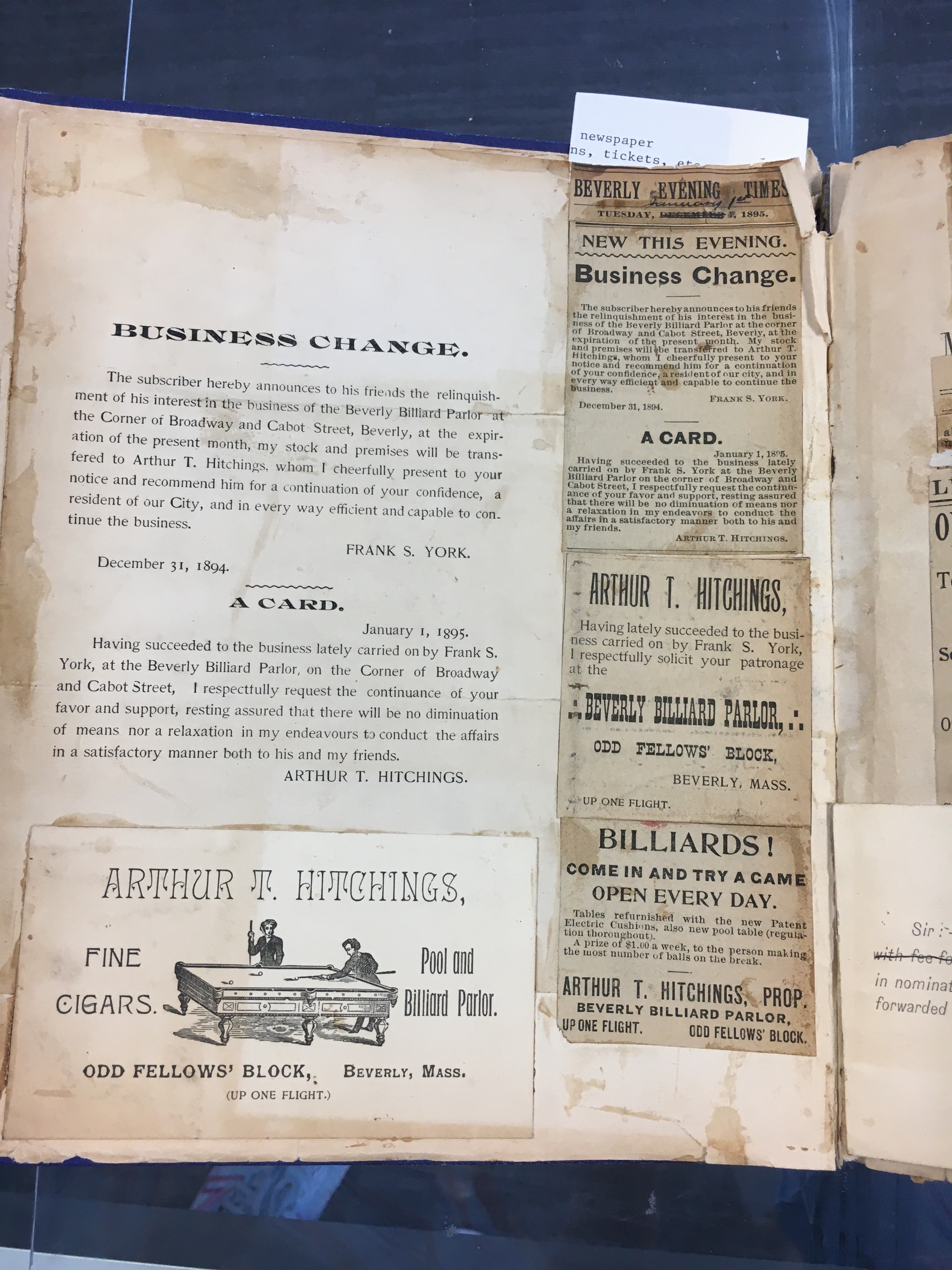
Advertisements and a business card
for Arthur Hitchings Billiard Parlor

We had a great time perusing this scrapbook, although some of the newspaper was very fragile and started to shed pieces as we turned the pages.  One of the first pages had my great grandfather's business cards and some newspaper advertisements for his billiard parlor in Beverly, Massachusetts.  This made us hopeful that we would find more personal family items inside the scrapbook. We didn't find much, except for obituaries.

There were several newsclippings with the death notice for
Frank's mother, Eliza Ann Treadwell, who was born on 27 August 1812
in Salem, and died 31 January 1896 in Salem, Massachusetts

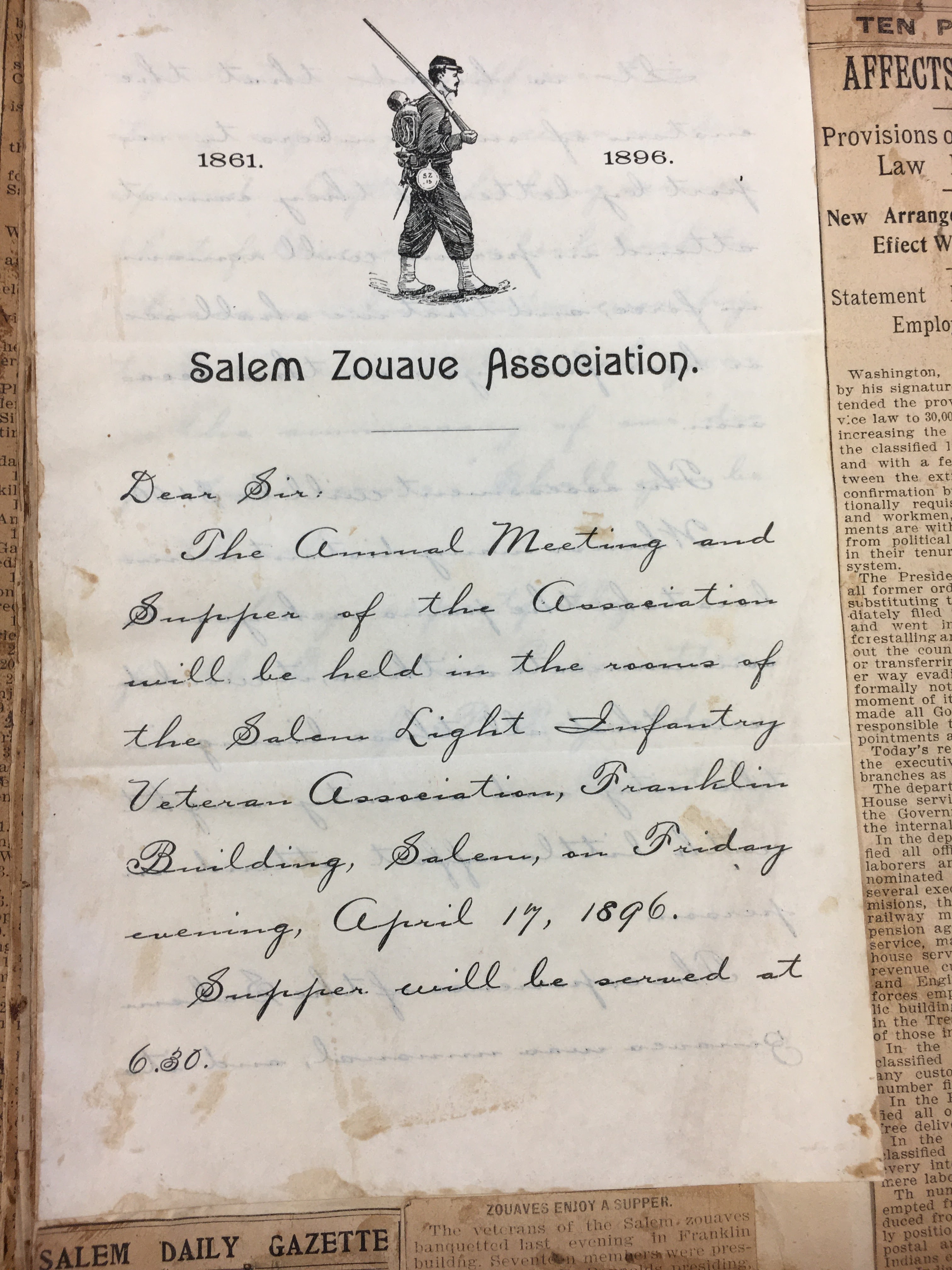
Included in the scrapbook were many, many newsclippings and invitations of the parades and reunions attended by the "Minute Men of '61" and the local Salem GAR unit where Frank was a member.  The Minute Men of '61 were the regiment that rescued the USS Constitution, Old Ironsides, from Annapolis, Maryland during the Civil War and returned her to the North.  They had an annual reunion for many years, and Frank had carefully pasted all the invitations and programs into his scrapbook. 

The 1896 program for the 
"Minute Men of '61" reunion

The handwritten invitation to the 
annual Salem Zouave Association reunion. 


Frank Hitchings had an interest in maritime
history, and included this newsclipping on the 
Arbella, which brought the Winthrop Fleet to Salem

The Custom House was renovated in 1898
and the golden Eagle was restored

A photo of the Custom House eagle 
from my 2015 visit to Salem

Frank Hitchings bought a lot at Salem Willows,
and many of the newsclippings mention
parties at this house on Juniper Point

Apparently, Mabelle Hitchings, my cousin's great grandmother, was a fine dancer and banjo player. Many of the newsclippings mentioned her at dance recitals and concerts. This fancy pamphlet from an 1897 dance recital had Mabelle on the cover.  She was mentioned inside doing several dances.  In 1897 Mabelle would have been about sixteen years old. This is the only photo we have seen of Mabelle, and we knew it was her from a display of photographs at a Hitchings family reunion about 20 years ago, where her daughter Muriel identified her as the dancer on the cover. Frank had carefully pasted this into his scrapbook, too. 

Mabelle Hitchings on the cover
of a Dance Recital program 

Salem News, 2 February 1898

Apparently there had been a huge blizzard on 2 February 1898, and Frank had collected many newsclippings of the storm and saved them in his scrapbook.  This was the "storm of the century" and was similar to when I lived through the "Blizzard of 1978".  Many ships were lost off the coast of Salem and Gloucester, and the town was cut off from the outside world for several days.  The illustrations above show the devastation and wrecked ships. 

I loved the headlines here about the Blizzard of 1898
"Salem As it Used to Be: How People Lived in Days of Grandfathers"

One of the most interesting things in the scrapbook were all the membership cards Frank had for the Essex Institute.  The Peabody Museum (the former Peabody Academy of Science), the East India Marine Society, and the Essex Institute merged together to create one institution.  Members of the societies collected curiosities from their maritime travels and donated collections, along with artwork, books, and manuscripts.  These collections today are valuable for historical and genealogical research.  I wonder if Frank Hitchings knew that someday this collection would include his personal scrapbook, and also the two books he wrote on shipping in Salem. 

Frank Hitchings' 1896 membership card to the Essex Institute
which he probably used for writing his books

We enjoyed viewing Frank Hitching's scrapbook, but it left us wanting to know more.  There were not many personal or family items inside the scrapbook, just items Frank found interesting. We could see that he had many interests in his Civil War service, his career at the custom house, the local weather, and anything related to maritime history.  It gave me a better idea of who Frank was as a person, but I was hoping to learn more about his family, and perhaps see more photographs.

And...

Who was Mrs. Thomas L. Henley who donated this scrapbook? Was she a relative or cousin?  I found a Thomas Henley who married Mildred Florence Hitchings (1909 - 1981). Mildred was my grandmother's sister, my aunt Millie.  Did she donate this scrapbook?  What happened to the other scrapbooks? 

For the truly curious:

Essex Country Ship Registers, by A. Frank Hitchings, 1883, two volumes (Book 1 includes ships registered 1789 to 1828, and Book 2 has ships registered 1828 to 1851)   The call number for this book at the Phillips Library is Mss. 150+  

Also:  Ship Registers of the District Of Salem and Beverly, 1789 - 1900, by A. Frank Hitchings, published Salem, Massachusetts: Essex Institute, 1906 available online at  https://www.google.com/books/edition/Ship_Registers_of_the_District_of_Salem/Z2saAAAAYAAJ?hl=en&gbpv=1&dq=%22benjamin+gardner%22+marblehead+massachusetts&pg=PA107-IA1&printsec=frontcover  

The Peabody Essex Museum's Phillips Library   https://www.pem.org/visit/library   

Previous blog posts:

2009 - about Frank's military career during the Civil War:  https://nutfieldgenealogy.blogspot.com/2009/11/how-to-find-your-american-veteran.html 

2015 - about Frank's career at the Salem Custom House:    https://nutfieldgenealogy.blogspot.com/2015/06/my-great-great-grandfather-deputy.html    

2023 - A recent discovery of a Civil War photo of Frank:    https://nutfieldgenealogy.blogspot.com/2023/01/newly-discovered-civil-war-photos-of-my.html  


Association of the Massachusetts
Minute Men of '61

-------------------------

To cite/link to this blog post: Heather Wilkinson Rojo, "My Cousin Found my Great Great Grandfather's Scrapbook (circa 1895 - 1905)", Nutfield Genealogy, posted April 10, 2023, ( https://nutfieldgenealogy.blogspot.com/2023/04/my-cousin-found-my-great-great.html: accessed [access date]). 


Tuesday, January 10, 2023

Newly discovered Civil War photos of my Great Great Grandfather

 Over Christmas break my distant cousin contacted me with some genealogy questions.  One was a question about a photo she saw on Find A Grave for my great great grandfather Abijah Franklin Hitchings (1841 - 1910).  I had never seen this photo before!


I contacted the gentleman who contributed this photo to Frank Hitchings memorial at Find A Grave https://www.findagrave.com/memorial/15836442/abijah-franklin-hitchings  His name was Peter Maugle, and according to his profile at Find A Grave, he is a staff member at Fredericksburg National Military Park. He has added photos to over one thousand memorials while attempting to establish the identities of the marked graves at Fredericksbury National Cemetery.  Frank Hitchings was wounded at Fredricksburg, but did not die there.  He died in 1910 at his home in Salem, Massachusetts. 

According to Peter Maugle, he found this photo at the Library of Congress digital collection.  You can see the information at this link identifies Frank Hitchings as the soldier seated in the photograph.  https://www.loc.gov/item/2022630776/    This photo was donated to the Library of Congress in September 2020.  It pays to keep looking at those Find A Grave memorials every year to see if new information has been added! 

I have previously blogged about Great great grandpa Hitchings at several blog posts.  I'll add those links to the end of this post, and if you are interested you can read those stories.  He had served twice in the Civil War, first in the "Minute Men of '61" (Co. I, 8th Reg. Mass. Vol. Infantry) which rescued Old Ironsides (the USS Constitution) from Annapolis, and then again in Co. H, 19th Reg. Vol. Infantry, and was in the Battle of Fredericksburg.  Here is the digital version of his carte de viste- the original hangs on my mother's living room wall. This would have been his colorful Zouave uniform from the "Minute Men". 


Frank Hitchings served in the invalid corps during the end of the Civil War.  He had been a sailmaker before his military service, and after the war he began working at the Salem Custom House.  Eventually he became the Deputy Customs Collector.  His office is preserved in the Salem National Historic Park at the old Custom House on the waterfront. 

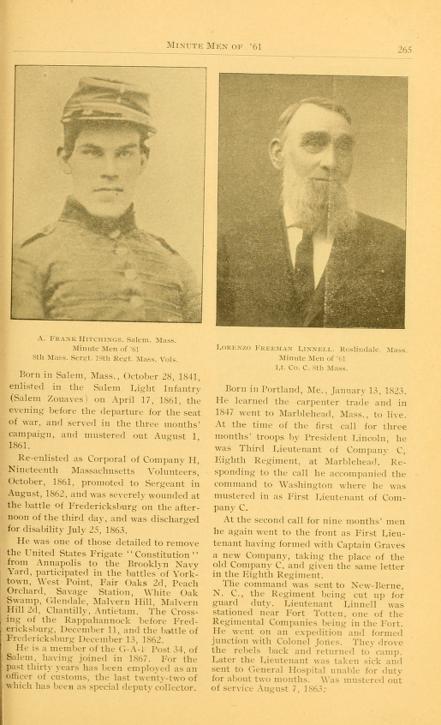
My grandmother was born in 1905. She remembers her "Dada Hitchings" walked with a limp.  He had his leg examined many times by the doctors at the Boston Veterans Hospital in Charlestown, and those records are preserved in his pension file.  His wife Hanna Eliza Lewis Hitchings (1844 - 1921) received a widow's pension when Frank died in 1910.  His obituaries are full of testimonies and information about his military service and his participation in many GAR events.  I wasn't surprised to see at the Library of Congress website many links to mentions of his name including the book History and Complete Roster of the Massachusetts Regiments: Minute Men of '61 who responded to the first call of President Abraham Lincoln, April 15, 1861, to defend the Flag and Constitution of the United States, by George W. Nason, 1910.  

This book at the LOC included this page about A. Frank Hitchings (page 265) 


Just when you think you've found all the existing material (ephemera, photos, information) on an ancestor, something new pops up!  Never stop looking and communicating with your cousins. 

For the Truly Curious:

Abijah Franklin Hitchings Find A Grave Memorial   https://www.findagrave.com/memorial/15836442/abijah-franklin-hitchings  

Photograph at the Library of Congress    https://www.loc.gov/item/2022630776/  

"How to find your American Veteran Ancestors (A. Frank Hitchings" November 10, 2009   https://nutfieldgenealogy.blogspot.com/2009/11/how-to-find-your-american-veteran.html   

"My Great Great Grandfather, the Deputy Customs Collector, June 26, 2015   https://nutfieldgenealogy.blogspot.com/2015/06/my-great-great-grandfather-deputy.html   

My Hitchings Surname Saturday post, October 4, 2014    https://nutfieldgenealogy.blogspot.com/2014/10/surname-saturday-hitchings-of-lynn.html  

------------------------

To Cite/Link to this blog post: Heather Wilkinson Rojo, "Newly discovered Civil War photos of my Great Great Grandfather", Nutfield Genealogy, posted January 10, 2023, ( https://nutfieldgenealogy.blogspot.com/2023/01/newly-discovered-civil-war-photos-of-my.html: accessed [access date]). 

Wednesday, July 6, 2022

An Ode to Rockingham Park Race Track - Weathervane Wednesday

 This weathervane was photographed in Salem, New Hampshire.


You can see this weathervane from Rockingham Park Boulevard, heading east from Exit 1 off Route 93 towards Route 28 in Salem, New Hampshire.  As you pass Mall Road and head towards the new Tuscan Village development, look to your left just as you pass the intersection with Tuscan Boulevard.  Above the Nike "swoosh" is a roof with this small weathervane.  

This weathervane is small in proportion to the large roof and building it sits above, so it is difficult to see this weathervane without looking for it from Rockingham Park Boulevard.  It is more difficult to see from inside the mall looking from the parking area in front of the Nike store or Pottery Barn.  

This three dimensional race horse and jockey are reminiscent of the Rockingham Park Race Track that stood on this parcel of land before the Tuscan Village was built.   The horse racing area was built in 1906, first for gambling, and then for horse racing.  There was a large racetrack, a clubhouse and stands, stables, paddocks, and training areas.  Rockingham Park also hosted automobile racing and aviation events such as the first aviation meet in New England in 1911.  During World War I it was a base for the 14th US Army Corps of Engineers. 

The history of the Rockingham Park goes back to the early 20th century and some famous horse races including the horse "Seabiscuit" who raced there in 1935 and 1936.  The last horserace held at Rockingham was in 2009.  On July 29, 1980 there was a fire in the clubhouse at Rockingham which destroyed the grandstand.  It reopened in 1984 with a smaller facility often referred to as "The New Rock".  Most of the original parking area was developed in the indoor Mall at Rockingham Park in 1991.  After a long decline the racetrack was demolished in 2017 and is being developed into a multi use residential, hotel, business, and retail area by The Tuscan Village. 

I was hoping that the new Tuscan Village would incorporate more art and historical artifacts from the race track into the newly designed development, but this is the only reminder of the horse racing I could find. 

The old Rockingham Park grandstands and oval race track


For the truly curious:

WMUR "After 110 years, Rockingham Park closes its doors", 1 September 2016:   https://www.wmur.com/article/after-110-years-rockingham-park-closes-its-doors-1/5214632#  

The Boston Globe, "Rockingham Park to close its doors for a final time Wednesday", 30 August 2016,   https://www.bostonglobe.com/metro/2016/08/30/rockingham-park-close-its-doors-for-final-time-wednesday/C5IvlMeEy0zyR0r3ffjWqL/story.html   

Click here to see over 475 other weathervanes featured in my blog posts:

https://nutfieldgenealogy.blogspot.com/search/label/Weathervane%20Wednesday    

-------------------

To cite/link to this blog post: Heather Wilkinson Rojo, "An Ode to Rockingham Park Race Track - Weathervane Wednesday", Nutfield Genealogy, posted July 6, 2022, ( https://nutfieldgenealogy.blogspot.com/2022/07/an-ode-to-rockingham-park-race-track.html: accessed [access date]).