Showing posts with label Hawthorne. Show all posts

Tuesday, October 28, 2025

This story will give you the Willeys - literally!


To the memory of the Family
which was at once destroyed by
a slide from the white Mountains
on the night of 28 August 1826.

SAMUEL WILLEY, AE 38
POLLY L. WILLEY, 35
ELIZA A. WILLEY, 12
JEREMIAH WILLEY, 11
MARTHA G. WILLEY, 10
ELBRIDGE G. WILLEY, 7
SALLY WILLEY, 3

Happy Halloween!  In New England we use a lot of words to describe the sensation of getting the shivers - goosebumps, goosepimples, chicken skin, jitters, getting the creeps, and "getting the willies".  Some people say that this word "the willies" dates back to a disaster that happened in the White Mountains of New Hampshire in 1826 when an entire family died during a landslide.  The Willey Family story is sad, but scary enough to have lived on in ghost stories, books (including Nathaniel Hawthorne), and history books.  I previously blogged about the Willey family disaster and their genealogy HERE in 2010.  Seven members of the Willey family, two parents and five children, and two hired hands all died in this landslide. Only the bodies of the parents, two of the three children, and the two hired men were found. The bodies were buried near the homesite originally, and then reburied elsewhere. 

Recently we drove through Crawford Notch, the site of the famous 1826 landslide, and we looked at the monument to the family.  I knew that this was the place where the family house stood, not the burial place for the bodies of the Willey family.  But where were they buried? Somewhere else in Crawford Notch? Nearby in Bartlett or somewhere that is now part of the Crawford Notch State Park or the White Mountain National Forest land? Miles away with family members in southern New Hampshire (the family originated in the Piscataqua Region) or even out of state? Where? 

I made a quick search of the Find A Grave website, and Google with some interesting results. I searched for Samuel Willey born 1788 and died 1826.  Find A Grave said he was buried in the Willey Slide Cemetery located in Intervale, Carroll County, New Hampshire.  There are many places in New Hampshire called "Intervale", which literally means between mountains or between towns.  There is a place called Intervale nearby between the towns of Bartlett and Conway, New Hampshire. On Find A Grave there are no GPS coordinates or directions, which is very odd.  There is no description of the cemetery, and no map.  Very odd indeed.  There is even a misleading entry "Willey Family Cemetery" off Moose Mountain Road in Brookfield, New Hampshire with no photos, no information, nothing. I think it was created as a red herring. 

Since we were in the area, I was determined to find this elusive cemetery.  Google showed me that I was not alone. Many other people have documented this search online. I found one of the hired hands buried nearby in Bartlett.  His name was David Allen, and he is buried at the Garland Ridge Cemetery a short distance from Crawford Notch.  There is a link below to his gravestone. That was easy. But where is the Willey family burial ground, and where is the other hired hand buried? 

Using Google Maps satellite view has helped me in the past to find small, unmarked family cemeteries in New England.  Since we live in a heavily wooded region, satellite views often show small square or irregular openings in the forest canopy that are not visible from the road.  My next ploy was to stop in to the Conway or North Conway Public Library to ask about local cemeteries. 

As we were driving up towards Crawford Notch, through the Kancamaugus Notch and Bear Notch, I read the accounts online of other people searching for the Willey Family.  The story told by Robert Gillis of his teenaged nephew, Colin, searching for the burial ground, was inspirational. I loved reading about young people who become enthralled with local history or genealogy.  Colin used the local library to find the small Willey family burial ground. Then he mysteriously did not give the location.  But, if Colin could find it, I was sure I could find it, too.

As we were driving I also watched a 15 minute video by "Rick and Bill" on Youtube of their search for the Willey Cemetery.  You can find the link below.  Rick and Bill make videos of local history in New Hampshire, and although they also did not give the location of the cemetery either, their video gave me clues in the background as to where it was located. If you are familiar with the Intervale area, you will know what I mean. 

Both Vincent and I searched the Intervale area using the satellite views.  We knew that the Willey burial ground was nearby and easily found it.  You can find it, too.  I'm going to follow the local tradition and not tell you where to find it.  Some things can't be too easy! 

I'm writing this story near Halloween.  I've seen what Halloween mania has done to historic places like Salem, Massachusetts, and to some local burial grounds.  This is why the local people have not published the map, coordinates, or address for the Willey Family cemetery.  If you are truly interested in the history, then like me, Bill, Rick, and Colin, you can do the legwork and find it for yourself.  This is a burial ground which deserves respect.  It is not a tourist attraction for Halloween.  

Visit with respect.  Bring flowers, and leave nothing but footprints. 

Colin, Bill, Rick, and the entire Willey family would agree.  Let me know if you find the Willeys! 

The Willey Family plot

A close up of the tombstone

This stone is marked with a DAR flagholder,
and is reinforced with a metal support

The entrance to the cemetery is on private property.
Ask permission before you enter the cemetery


For the Truly Curious:

A 2010 blog post about the Willey Family:   
https://nutfieldgenealogy.blogspot.com/2010/10/happy-halloween-story-of-willey-family.html     

Wikipedia:   https://en.wikipedia.org/wiki/Willey_House_(New_Hampshire)   

Link to Samuel Willey's memorial at Find A Grave:   https://www.findagrave.com/memorial/231693821/samuel-willey  

Link to David Allen's memorial at Find A Grave:   https://www.findagrave.com/memorial/116456101/david-allen  

Robert Gillis, "An historical quest fulfilled: Finding the Willey Family of Crawford Notch", posted 17 September 2015,  https://www.robertxgillis.com/?p=5761  accessed 18 October 2025. 

Bill Thompson and Rick Davidson, "Visiting the Site of the Famous Willey Landslide and the Willey Cemetery", Youtube, 17 April 2024,   https://www.youtube.com/watch?v=BPlKlczGsBs accessed 18 October 2025. 

------------------------

To cite/link to this blog post:  Heather Wilkinson Rojo, "This story will give you the Willeys - literally!", Nutfield Genealogy, posted 28 October 2025, ( https://nutfieldgenealogy.blogspot.com/2025/10/this-story-will-give-you-willeys.html: accessed [access date]). 

Tuesday, January 12, 2021

The Old Manse in Concord, Massachusetts


Last week we took a walk by the Old Manse in Concord, Massachusetts.  I have never seen the inside of this historic house museum, even though I am related to the Emerson family of Concord.  It was built in 1770 by the Reverend William Emerson, just in time to experience one of the first battles of the American Revolution.  It is located by Concord’s Old North Bridge where the battle of April 19, 1775 was fought between the American patriots and the British.

First, a little family history! The Rev. William Emerson is my 2nd cousin, seven generations removed. We share Joseph Emerson (about 1621 – 1680) and his wife Elizabeth Bulkely (1638 – 1693) as our common ancestor.  My line of Emerson ancestors lived nearby Concord in Reading, Massachusetts until the 1800s when my ancestor Romanus Emerson (1782 – 1852) removed to South Boston.  He was from a family of eleven children, and eight brothers.  Of those eight brothers, four lived to adulthood and became ministers. Romanus studied for the ministry, too, but due to a “speech impediment” (according to a compiled genealogy of the family) he went to Boston and became a famous atheist!

The great writer and philosopher Ralph Waldo Emerson (1803 – 1882) lived in Concord and was the grandson of Rev. Phebe Bliss. Ralph Waldo Emerson was from a line of five out of six generations of minister Emerson ancestors in a row, and he studied to be a minister, too. His brief ministry included being ordained at Boston's Second Church and being the chaplain of the Massachusetts legislature, but it all ended when he began to doubt his faith. He went to Europe and returned to Concord to become a popular lecturer, and later a philosopher and writer.  It was perhaps the influence of this famous writer and his transcendentalist friends, including Nathaniel Hawthorne, that made this house so important and historic. 


From this sign by the Old Manse:

"The Reverend William Emerson (1743 - 1776), grandfather of writer Ralph Waldo Emerson (1803 - 1882), built this house in 1769-70.  On April 19, 1775, family members watched from the house as British soldiers and local militia fought the battle that started the American Revolution.

The Old Manse then played an important role in America's literary and cultural revolutions.  Ralph Waldo Emerson (1803-1882) wrote Nature here in 1834-35, an essay that sparked the Transcendental movement.  Nathaniel Hawthorne (1804 - 64) lived here from 1842 - 45).  His collection of short stories, Mosses from an Old Manse, gave the house its nickname, a Scottish term for 'minister's house." 


Rev. William Emerson became a chaplain to the Continental Army, then died in October 1776 on his way home from Fort Ticonderoga. His widow remarried to his successor, the Rev. Ezra Ripley, and continued living at the Old Manse.  Ralph Waldo Emerson lived here with his step-grandfather in 1834 while writing Nature

Nathaniel Hawthorne and his new bride, Sophia Peabody, moved here in 1842, and Henry David Thoreau dug them a garden.  One famous legacy that Hawthorne and his wife left at the Old Manse was a a short passage they etched in the window of his study with her wedding ring diamond. He also wrote many of his tales here, some which were included in Mosses from an Old Manse (1846), and others published later. New Hampshire's only US president, Franklin Pierce, was a guest of the Hawthorne's while they lived at the Old Manse.  Hawthorne removed to Salem in 1845, and returned to Concord in 1852 to live at the historic house called The Wayside.  

The house was owned by the Ripley family until 1939 when it was donated to the Trustees of Reservations.  It was a National Historic Landmark in 1966.  The house is open for guided tours by the Trustees of Reservations in the summer, see the website (below) for more information. It is located adjacent to the Old North Bridge, the Minuteman Statue, and the battlefield.  There is a restroom across the path to the Old North Bridge, and if you follow across the bridge and up the hill, you will reach the US National Historic Site interpretive center with more restrooms, giftshop, and small museum. It is also within walking distance of the Concord Common and the Sleep Hollow Cemetery with Author's Ridge where Henry David Thoreau, Nathaniel Hawthorne, Ralph Waldo Emerson, William Ellery Channing, Louisa May Alcott and others are buried. 

For the truly curious:

The Old Manse, 269 Monument Street, Concord, Massachusetts

The Old Manse website:   https://thetrustees.org/place/the-old-manse/   

The US National Park Service website:  https://www.nps.gov/places/the-old-manse.htm   

My EMERSON Surname Saturday sketch, with eight generations of Emersons from Thomas Emerson the immigrant to Ipswich, Massachusetts down to my great great grandmother, Mary Katharine Emerson (1847 - 1932):  https://nutfieldgenealogy.blogspot.com/2015/01/surname-saturday-emerson-of-ipswich.html    

------------------------

To Cite/Link to this post: Heather Wilkinson Rojo, "The Old Manse in Concord, Massachusetts", Nutfield Genealogy, posted January 12, 2021, ( https://nutfieldgenealogy.blogspot.com/2021/01/the-old-manse-in-concord-massachusetts.html: accessed [access date]).

Friday, June 26, 2015

My Great Great Grandfather, the Deputy Customs Collector


Salem, Massachusetts is famous for the witch trials and the hysteria of 1692, but it is more important for its role in role as one of the most lucrative ports during the age of clipper ships to the Far East, importing porcelains, tea and spices.  This age of wealth was short lived when the larger ships to Asia and the Pacific no longer fit in Salem harbor.  By the time of the Civil War, most of the trade had moved to larger ports such as Boston and San Francisco.  Nathaniel Hawthorne worked at this custom house as a surveyor from 1846 – 1849, before he removed to Concord, Massachusetts.   The opening paragraphs of his famous book The Scarlet Letter describe the custom house in Salem.

In the 1870s, my 2nd great grandfather, Abijah Franklin Hitchings (1841 – 1910), began to work at the custom house.  He was a Civil War veteran, injured at the Battle of Fredericksburg, and unable to do manual labor.  He walked on crutches for a long time, and used a cane later in life.  He was the deputy customs collector until his death in 1910. 

This is the only photograph I have
of Abijah Franklin Hitchings
in his Salem Zouave uniform from
the Civil War

While he was at the custom house he wrote a book that listed all the ships registered in Salem since 1789.  You can see copies of this book at the Phillips Library in Salem and at the New England Historic Genealogy Society in the rare books collection.  The book lists the ships by name, with their statistics and the names of the captains and owners.  It is a valuable resource for Salem genealogy and maritime history.   His obituary mentioned another book about earlier ships that was unfinished at the time of his death, but I don’t know what happened to that manuscript. (See below for the obituary and genealogical information)

This custom house was built in 1819.  It was the thirteenth custom house on this site since the first one was built by the English in 1649 to collect duties for the British Crown.  This building housed the US Customs officials and their offices, and a warehouse for storing bonded and impounded cargos.  The eagle on the roof was carved by Joseph True in 1826.  The customs service was active here until the 1930s, and in 1938 the building was acquired by the National Park Service as a National Historic Site.
The interior of the Salem Custom House

The park ranger let me hold the key to the
Custom House inside the Deputy Collector's Office.
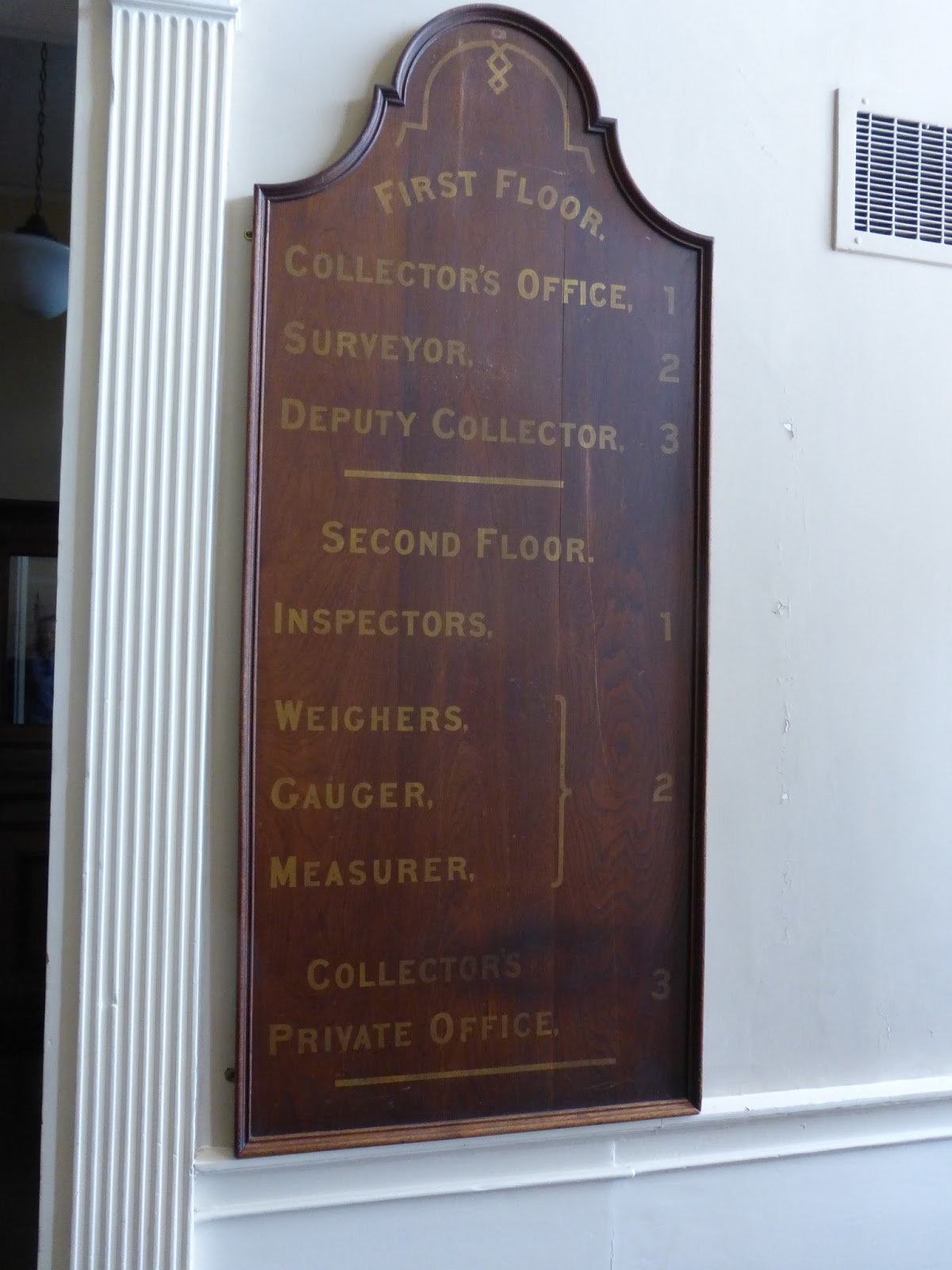
This would have been my 2x great grandfather's office

You can see that room #3 was the
Deputy Collector's Office

This was the collector's office, which was open to the public in its day

The collector's desk, where paperwork was filed and customs duties were levied

Today you can tour the Salem Custom House by appointment.  Only 20 visitors are allowed inside at any one time, accompanied by a park ranger.  On the day we visited, the custom house tour was combined with a tour of the USS Friendship, which is moored in front on Derby Wharf.


A view from the second floor of the Salem Custom House,
from the window of the Custom Collector's private office.
You can see Derby Wharf and the USS Friendship


My great great grandfather’s book:

Ship Registers of the District of Salem and Beverly, Massachusetts, 1789 – 1900, by A. Franklin Hitchings, Salem, Massachusetts:  Essex Institute, 1906.

Salem Custom House links:

The Salem Maritime National Historic Site http://www.nps.gov/sama/learn/historyculture/customhouse.htm

The US Custom House in Salem: Introduction

Salem Maritime National Historic Site at Wikipedia

The Records of the Salem Custom House 1762 – 1901 are held at the Peabody Essex Museum, under the call number MH 261.  They contain 9 boxes and 9.5 linear feet of material.   http://www.pem.org/library/finding_aids/MH261_SalemCustomHouseRecords.pdf

Additional material is held under The Records of The U.S. Customs Service , Record Group 36 at the National Archives and Records Administration in Waltham, Massachusetts.   http://www.archives.gov/boston/exhibits/mount-vernon/various-ships-records.html

A blog post which contains a transcription of a letter written by A. F. Franklin, the Deputy Custom's Collector, in 1902
http://nutfieldgenealogy.blogspot.com/2010/12/amanuensis-monday-salems-deputy-custom.html 

Genealogy Information:

Generation 1:  Daniel Hitchings, born about 1632 in England, died 15 April 1731 in Lynn, Massachusetts (yes, he was nearly 100 years old!); married first to Eleanor Unknown, mother of his children.  She died 10 September 1694 in Lynn.  He married second to Sarah Cushman, widow of John Hawkes, daughter of Thomas Cushman and Mary Allerton (my 10th great aunt in another lineage, daughter of Isaac Allerton, the Mayflower passenger, my 11th great grandfather).   I descend from two of Daniel Hitching’s five children.

Generation 2: Daniel Hitchings, born about 1660 in Lynn, died 15 January 1735 in Lynn; married first to Sarah Boardman (no children), and married second to Susannah Townsend on 19 October 1708 in Lynn.  She was the daughter of Thomas Townsend and Mary Davis, born 5 November 1672 in Boston and died 12 May 1737 in Lynn. Five children.

Generation 3:  Daniel Hitchings, born 19 October 1709 in Lynn, died 25 April 1760 in Lynn; married in June 1735 in Lynn to Hannah Ingalls, daughter of Nathaniel Ingalls and Anne Collins.  She was born about 1713 and died before 15 April 1798.  Twelve children.

Generation 4: Abijah Hitchings, born 18 January 1753 in Lynn, died 27 March 1826 in Salem; married first on 24 June 1775 in Lynn to Mary Gardner, daughter of Benjamin Gardner and Sarah Randall.  She died before 1792.  He married second to her sister, Sarah Gardner.

Generation 5: Abijah Hitchings, son of Abijah and Mary, born about 1775 in Lynn and died 26 July 1868 in Salem; married 21 December 1795 in Salem to Mary Cloutman, daughter of Joseph Cloutman and Hannah Becket.  She was born about 1775 in Salem and died 28 November 1853 in Salem.  Eleven children.

Generation 6: Abijah Hitchings, born 18 January 1809 in Salem, died 18 January 1864 in Salem; married on 4 December 1836 in Salem to Eliza Ann Treadwell, daughter of Jabez Treadwell and Betsey Jillings Homan.  She was born 27 August 1812 in Salem, and died 31 January 1896 in Salem.  Four children.

Generation 7:  Abijah Franklin Hitchings, born 28 October 1841 in Salem, died 19 May 1910 in Salem; married on 22 September 1864 in Salem to Hannah Eliza Lewis, daughter of Thomas Russell Lewis and Hannah Phillips.  She was born about 1844 probably in Salem, and died 15 February 1921 at the Danvers State Hospital, Danvers, Massachusetts.  Two children.

Generation 8: Arthur Treadwell Hitchings, born 10 May 1868 in Salem, died 7 March 1937 in Hamilton, Massachusetts; married on 25 December 1890 in Beverly to Florence Etta Hoogerzeil, daughter of Peter Hoogerzeil and Mary Etta Healey.  She was born 20 August 1871 in Beverly and died 10 February 1941 in Hamilton.  Eight children.

Generation 9:  Gertrude Matilda Hitchings, born 1 August 1905 in Beverly, and died 3 November 2011 in Peabody, Massachusetts; married on 14 February 1925 in Hamilton to Stanley Elmer Allen, son of Joseph Elmer Allen and Carrie Maude Batchelder.  He was born 14 January 1904 in Cambridge, Massachusetts and died 6 March 1982 in Beverly.  Seven children, including my mother.

Obituaries for Abijah Franklin Hitchings:
May 20, 1910
Newspaper unknown (found in a file at Harmony Grove Cemetery, Salem, Massachusetts, where Abijah Franklin Hitchings is buried).

A. F. HITCHINGS DIED LAST NIGHT
Was Deputy Collector of the Port of Beverly and Salem for Many Years
WAS AN ANITQUARIAN

                A. Frank Hitchings, deputy collector of customs for the district of Salem and Beverly, died at his home, 8 Bentley Street, last night.  He was born in Salem, was the son of the late Abijah and Eliza (Treadwell) Hitchings, and was in his 69th year.  He was educated in the Salem public schools, and afterwards worked at shoe making.  He was one of the original minute men, enlisting as a boy of 19 years, in the old Salem Zouaves.  Company J, Eighth regiment, M.V.M., Capt. Arthur F. Devereaux, and serving until discharged August 1, 1861.  He re-enlisted as a sergeant in Company H., 19th Massachusetts regiment, and was discharged July 25, 1863 on account of wounds received at the battle of Fredricksburg.  He joined Post 34, G.A.R., May 17, 1869.
                Nov. 19, 1873 Mr. Hitchings was appointed an inspector in the Salem Custom house and assigned to duty as clerk.  June 3, 1881, he was promoted to deputy collector, succeeding Col. J. Frank Dalton, who resigned May 7, 1881, to become postmaster of Salem.  Mr. Hitchings has held the position of deputy collector ever since.  He was a fine penman, very careful and methodical in everything that he did, and was a valuable government official.  In connection with Stephen W. Phillips he prepared for publication by the Essex Institute the official register of all Salem vessels of which any record could be found in the Salem Custom house, a work which is extremely valuable today.  He was a member of the Essex Institute.  He possessed a fund of valuable information of Salem's early history, gleaned from his long service in the custom house.
                Mr. Hitchings leaves a widow, a son, a daughter, and grandchildren.

Also, from a newspaper clipping (newspaper unknown)

May 24, 1910
In Memoriam
A. Frank Hitchings

                The death of Deputy Collector A. Frank Hitchings removes from Salem one of those characteristic figures we can ill afford to lose.  Since William W. Oliver, the Salem custom house has had no officer so thoroughly imbued with a love of all that was best in the city's commercial past, so absorbed in his allotted work, so thoroughly familiar with the detailed knowledge which makes a functionary of his class invaluable.  He had been identified with the government service long enough to become a part of it.  Enlisting for the Civil war among the youngest, he encountered every peril and bore every hardship with a murmur, and, at the end of the struggle, brought home, like so many more, wounds which have slowly sapped the currents of his life.
                Mr. Hitchings produced, four or five years ago, a complete abstract of all the ships' registers recorded at this port under the Federal constitution.  The aid rendered by George H. Allen and Stephen W. Phillips enabled him to make this monumental work a unique contribution to the antiquarian resources of this region.  It left only one thing to be desired.  The lack of a single feature, an index to the names of owners and masters, was a serious handicap to its practical utility.  Such an index would have been too bulky to be printed with the book, but without an index, curious descendants of the old worthies who made Salem famous could only trace the voyages of their ancestors where they knew before hand the names of their ships.
                This task Mr. Hitchings set himself at once to supply.  He had undertaken a card catalogue, already well advanced, which was to embrace, not only the ship's registers here since 1789, but also such earlier Salem ships as could be traced, besides the added tonnage of Newburyport, Gloucester and Marblehead.  A good deal of material for this work was already to be printed.  But the task awaits for its completion the time, energy, patience and skill of some public spirited deliverer in the hidden things.  The student who takes up the task where Mr. Hitchings has left it, and carried in forward to success, will be able to congratulate himself, not only on providing ready access to the very tonnage owned by each merchant, commanded by each shipmaster, of Salem's palmy days, but also on completing a well earned monument to one of the modest, painstaking, earnest workers in the field of local research.

R.S.R. Salem, May 23

----------------------------

To cite/link to this blog post: Heather Wilkinson Rojo, "My Great Great Grandfather, the Deputy Customs Collector", Nutfield Genealogy, posted June 26, 2015 (  http://nutfieldgenealogy.blogspot.com/2015/06/my-great-great-grandfather-deputy.html :  accessed [access date]). 

Wednesday, June 1, 2011

Nathaniel Hawthorne - Not so Wordless Wednesday


This statue of Nathaniel Hawthorne is located in front of the Hawthorne Hotel, on Washington Square in Salem, Massachusetts.  He was born in Salem on July 4, 1804 and died in Plymouth, New Hampshire on May 19, 1864.  According to my Family Tree Maker software data base he is a 4th cousin 5x removed from me.   However, I feel closer to him because he worked at the Salem Custom House as an inspector just before the Civil War, and my 2x great grandfather (Abijah Franklin Hitchings) was the deputy custom inspector there, too.  His wife, Sophia Amelia Peabody is related to me through her Towne ancestors.

At the beginning of Hawthorne's Scarlet Letter, in the introduction, he describes a custom inspector finding a letter in the archives of the Custom House.  This letter formed the basis for the story of the Scarlet Letter.  I'd like to think perhaps this was a true incident.   Can you imagine, during a quiet moment, two young custom's officials digging through the musty documents looking for something interesting?  Perhaps my ancestor was in on this bit of mischief with Mr. Hawthorne?  It's fun to imagine!

-----------------
Copyright 2011, Heather Wilkinson Rojo

Thursday, October 28, 2010

Happy Halloween! The Story of the Willey Family of Crawford Notch

Crawford Notch State Park October 2010
The Site of the Willey House

Many writers, including Nathaniel Hawthorne, have told the sad story of the Willey Family of Crawford Notch. The tragedy was also included in songs, poems and paintings of the time period. This remote mountain pass was used by Native Americans, who told Timothy Nash its whereabouts. He is generally credited with its discovery in 1771. The first permanent settlers in the notch were the Abel Crawford family in 1792, on land originally granted to Nash.

In 1825 Samuel Willey, Jr. of Bartlett, New Hampshire built a small house in Crawford Notch at the foot of what is now called Mt. Willey. He brought his wife and five children to live there. On 28 August 1826 there was an extended drought, followed by heavy rain. The Saco River, which has its headwaters in Crawford Notch, rose 20 feet overnight. Two days later, friends came to the valley and were horrified to find the house unharmed, but the surrounding slopes littered with landslide and avalanche boulders. A large ledge above the house had divided the landslide, which passed around the house. The bodies of the Willey parents and two children were found, and three other children remained missing.

Poets and writers have dreamed up many versions of scary tales about what happened the day of the tragedy. Did the family flee the house when they heard the landslide? Were they escaping the flood when caught by an avalanche? Were they warned ahead of time? The house stood untouched, with a bible on the table and a dog still inside.

The Willey house stood as an inn to travelers until 1898 when it burned to the ground. Its site is marked by a large boulder with a bronze plaque. As a child we used to camp nearby, and my Dad would tell the story of the Willey family in his best Halloween voice. We would get the shivers standing there looking at the park and historical marker. We were there just two weeks ago to see the Fall foliage and visit the site. I still get the shivers even today!

1971, my sister and I at Crawford Notch
(the hills still bear the marks of the landslide 150 years before)


Willey Family Lineage (Thanks to Sue and Rick Willey, please see below)

Generation 1. Thomas Willey was born 1617 in Lincolnshire or Lancashire, England, died September 1681 in Oyster River (now Durham), New Hampshire; married Margaret Geaffit, born about 1615 in England.

Generation 2. John Willey, born between 1655 and 1656 in Oyster River, died 10 Sept 1770 in Oyster River; married Alice Dorcas about 1688.

Generation 3. Samuel Willey, born 1693 in Dover, New Hampshire; married about 1715 to Sarah Stevenson, daughter of Bartholomew Stevenson and Mary Clark.

Generation 4. Samuel Willey, born before 6 March 1719/20; married 16 June 1749 to Sarah Glazier.

Generation 5. Captain Samuel Willey, born 31 January 1753 in Lee, New Hampshire, died 14 June 1844; married on 23 October 1782 to Betsey Glazier, born 1 January 1761, and died 7 April 1844 in Conway, New Hampshire.

Generation 6. Samuel Willey, born 31 March 1788, died on 28 March 1826 in Crawford Notch Avalanche; married to Polly Lovejoy, born 1791, died on 28 March 1826, daughter of Jeremiah Lovejoy and Elizabeth Spring. (Polly had a royal ancestral lineage from King Edward III of England through her ancestor Edward Carleton of Rowley, Massachusetts, see Ancestral Roots of Sixty Colonists who came to New England between 1623 and 1650, by Frederick Lewis Weis, Genealogical Publishing Co., 1988 ).

For more information:

The story of the Willey Family from the NH State Park’s Website (scroll down under History)
http://www.nhstateparks.com/crawford.html

The Ambitious Guest” a short story from Twice Told Tales, by Nathaniel Hawthorne, 1837

The Story of the Willey Family”, brochure by the New Hampshire State Parks (from Crawford Notch State Park, picked up in October 2010 at the gift shop, free)

This link has a beautiful painting by Thomas Cole of Crawford Notch “A View of the Mountain Pass Called the Notch of the White Mountains”, 1839, an excerpt from Hawthorne’s version of the tale, and also a passage from Cole’s journal, 1828, just two years after the incident.
http://www.nga.gov/education/classroom/19th_century_america/art_crawfordnotch.shtm

The New Hampshire Willey Family Tree, by Sue and Rick Willey
http://whatreallyhappened.com/WRHARTICLES/pearl/www.geocities.com/Pentagon/6315/family/willeynh.pdf

---------------------

To cite/link to this blog post:  Heather Wilkinson Rojo, "Happy Halloween!  The Story of the Willey Family of Crawford Notch", Nutfield Genealogy, posted 28 October 2010, ( https://nutfieldgenealogy.blogspot.com/2010/10/happy-halloween-story-of-willey-family.html: accessed [access date]).