This weekend we wandered up to Allenstown, New Hampshire to visit Bear Brook State Park. There is a small museum complex there with a CCC museum, a Snow Mobile Museum, and a currently closed Family Camping Museum. The entire complex used to be a Civilian Conservation Corps Camp between 1935 and 1942. It is one of the most perfectly preserved CCC camps in the USA, with most of the buildings still standing and in very nice shape. There is also a modern Ameri Corps camp on the other side of Bear Brook State Park, where today's college students performs some of the same duties as their forebears did in the CCC during the Great Depression.
The CCC was developed as a temporary agency to provide work relief. Over 3 million young men participated in the CCC during the nine years it operated, building roads, state and national parks, reforestation efforts and forest fire fighting in 48 states, Hawaii and Puerto Rico. The young men received $30 a month, of which $25 was sent home to their families. By 1942 these same young men were being drafted into service for World War II, and work relief was no longer needed, so Congress permanently closed the program.
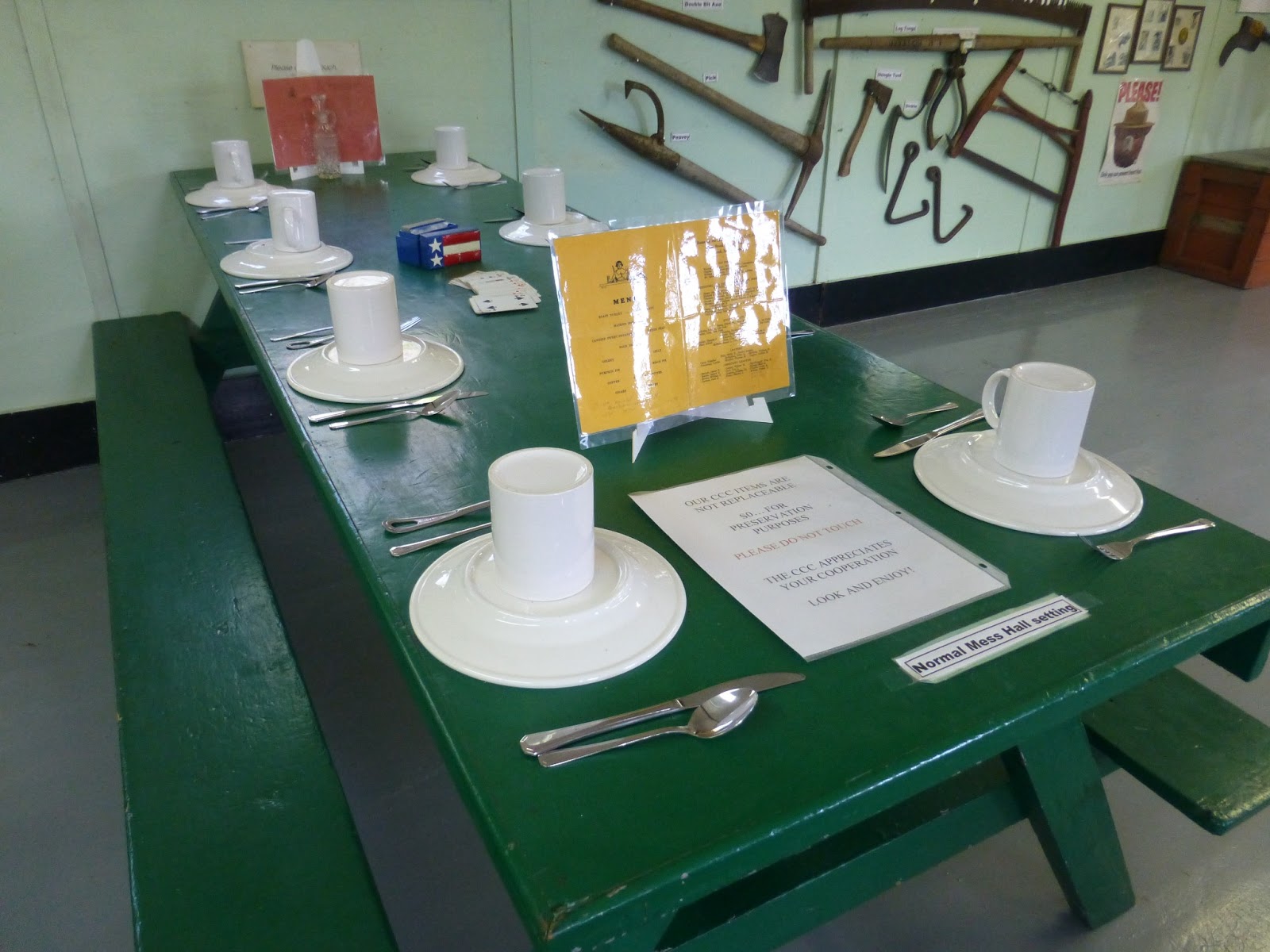
If you have ancestors or family members who served in the CCC, the records of their service are kept in St. Louis at the National Archives annex. The Richard Diehl CCC Museum in Allenstown has hundreds of photographs, lists of names of men, artifacts and a small library of books with information on the CCC, the Bear Brook Camp, other camps in New Hampshire and across New England. The building was once the mess hall, and you can wander around to look at the other buildings, which were mostly barracks.
BEAR BROOK CCC CAMP
1935- 1942
The Bear Brook Civilian Conservation Corps (CCC)
Camp was one of 28 work camps established in
N.H. between 1933 and 1942. President Franklin D.
Roosevelt started the program after the Depression
to put young unemployed men to work in
conservation. From 1925 to 1938 the 1123rd Co. CCC
was here; later this was one of four CCC camps in
the state to employ World War I veterans. bear
Brook was the last active CCC camp in N. H. and was
given to the state in 1943. It was listed in the
National Register of Historic Places in 1992 as
one of the country's most intact CCC camps.
A typical bed from a CCC barrack, with a footlocker
owned by CCC alumni, Robert Ellis, of company 2130
Actual dishes and items from the CCC mess hall
This collage of fading photographs was propped in a window of the CCC Museum.
These photos are curling at the edges, fragile and yet the faces of the young men are still visible.
This museum, and others like it, need some help with archival preservation techniques.
One of the large fieldstone fireplaces in one of the barrack buildings,
now being used as the Snow Mobile Museum.
This was the only heat for the young men during the cold New Hampshire winters.
At the beach nearby the museum is a statue to the CCC workers
Across from the CCC worker statue is a pavillion overlooking the swimming pond.
In the 1930s the CCC workers dug out a three foot brook,
built a dam, and developed the pond for recreation.
The fieldstone pavillion is a testament to their workmanship eighty years later!
My mother's cousin, Waldo Emerson Cooper (1913 - 1976) served in the CCC starting in 1935. He was born in Westborough, Massachusetts, and died in Los Angeles, California. I don't know where he served in the CCC, but it might have been in New Hampshire where there were many forestry programs and state parks being built. He enlisted in the US Army Air Corps in 1944, like so many other young men of his age. The family lost track of him over the years, but I was able to find his death listed in the California Death Index at Ancestry.com It would be quite a genealogy adventure to write to the National Archives to read more about his service in the CCC.
** This post is the first in a series I think I will call "
20th Century Americana". These are things I find around New England from the recent past, but they are now history since we are now in the 21st century. Not many of these things are currently being preserved or saved, but they are part of history and family history. I thought the Civilian Conservation Corps camp in Allenstown was a good place to start.
For more information:
Bear Brook State Park:
http://www.nhstateparks.com/bearbrook.html
A listing of CCC Museums across the USA:
http://ccclegacy.org/CCC_Museums.html
--------------------------
Copyright 2013, Heather Wilkinson Rojo