Showing posts with label Loyalist. Show all posts

Tuesday, September 15, 2026

My Loyalist Ancestors - Benjamin Thompson AKA Count Rumford


The Count Rumford birthplace in Woburn, Massachusetts


This is the second blog post on a Loyalist ancestor I have written this year for the 250th anniversary of the United States.  Benjamin Thompson is my first cousin, six generations removed.  His mother, Ruth Simonds (b. 1730) is the sister of my 5th great grandfather, Caleb Simonds (1720 - 1811).  Benjamin Thompson was born 26 March 1753 in Woburn, Massachusetts in the house of his grandfather, Captain Ebenezer Thompson.  He attended the local schools until he was eleven years old, when he was sent (along with his young friend and neighbor Loammi Baldwin) to Medford to study mathematics, astronomy and science.  

At age 13 he was bound as an apprentice to a Salem merchant, John Appleton.  Thompson went home to Woburn soon after because Appleton lost his business when the relations between the colonies and England became strained. Then he taught school in Wilmington in 1768 and 1769.  Later in 1769 he again studied science (anatomy and physiology) under Dr. John Hay, a doctor in Woburn. In 1770 he studied at Harvard with his friend Loammi Baldwin.  In 1772 he began to teach school in Rumford (now Concord, New Hampshire). 

By 1772 he married Sarah Walker, the widow of Benjamin Rolfe, and daughter of Rev. Timothy Walker of Rumford. She was a very wealthy woman, age 33, and Benjamin Thompson was only 19 years old. He joined the New Hampshire regiment, and had to chose sides to be an American or a Loyalist.  When he was denied a commission to be an officer in the Continental army he joined the British. Benjamin and Sarah had one daughter, Sarah, born 18 October 1774. 

When the British evacuated Boston on 17 March 1776 he fled to England and left his wife in New Hampshire. He was elected to the Royal Society of Science in 1779, returned to America as an officer in 1781 - 1782, and was knighted in 1784.  Then he left England for Germany, where he served the Prince of Bavaria for 18 years, where he was made a count of the Holy Roman Empire. He chose to be named Count Rumford, after the town in New Hampshire.

In 1803 he settled in France where he remarried to the widow of the French chemist Lavoisier.  His new wife was Anne Marie Pierette Paulze. While in France he invented a calorimeter, a photomete, and a drip coffee maker.  His studies of heat lead him to be the first to understand that heat was a form of motion.

He endowed the Rumford Medals at the Royal Society, and the Rumford Medals at the American Academy of Arts and Sciences, and the Rumfor chair of science at Harvard College (now Harvard University). He, along with Sir Joseph Banks, founded the Royal Institution of Great Britain.  He also made some practical inventions such as central heating, the smokeless chimney, the kitchen oven, the first pressure cooker, and other. His name lives on for the invention of the Rumford Fireplace, which reflected more heat back into the room than previous versions of fireplaces. 

As Count Rumford in Europe, he had several love affairs, including a woman Victoire Lafevre (his housekeeper) who bore him a son,  and the Countess Baumgarten with whom he had another daughter named Sophia, born in 1798.  Count Rumford also had an affair with her sister, the Countess Nogarola.  

Benjamin Thompson, AKA Count Rumford, died 21 August 1814 in Auteil, France and is buried there. His epitaph reads "Benjamin Thompson, Conte De Rumford. The celebrated physicist and enlightened philanthropist, whose discoveries on light and heat made his name illustrious and whose work to help the poor will always be dear to the friends of humanity."

President Franklin D. Roosevelt said that Sir Benjamin Thompson, Count Rumford, was "one of the three greatest minds America has produced" (the others were Benjamin Franklin and Thomas Jefferson).  

By Thomas Gainsborough - Corel Photo CD, MASTERS I, Public Domain, https://commons.wikimedia.org/w/index.php?curid=9516763


For the truly curious:

Previous blog posts on Benjamin Thompson, Count Rumford:

"Two Cousins", 17 May 2012:  https://nutfieldgenealogy.blogspot.com/2012/05/two-cousins.html   

"The Count Rumford House", 14 May 2012:   https://nutfieldgenealogy.blogspot.com/2012/05/count-rumford-house.html   

"Colonel Loammi Baldwin", 24 October 2013:   https://nutfieldgenealogy.blogspot.com/2013/10/colonel-loammi-baldwin.html  

Memoir of Sir Benjamin Thompson, Count Rumford, with notices of his daughter, (with an edition of Rumford's complete works) by George E. Ellis, published by the American Academy of Arts and Sciences, Boston, 1875. 

Sir Benjamin Thompson, Count Rumford and the Royal Instituation, by the Royal Society, 1999. 

White Knight, Red Heat: The many lives of Benjamin Thompson, Count Rumford, by John and Mary Gribbin, 20023

Benjamin Thompson at Wikipedia:   https://en.wikipedia.org/wiki/Benjamin_Thompson 

-------------------

To cite/link to this blog post: Heather Wilkinson Rojo, "My Loyalist Ancestors - Benjamin Thompson AKA Count Rumford", Nutfield Genealogy, posted September 15, 2026, ( https://nutfieldgenealogy.blogspot.com/2026/09/my-loyalist-ancestors-benjamin-thompson.html: accessed [access date]). 

Tuesday, September 1, 2026

My Loyalist Ancestors - The Hessian soldier, Dr. Johann Daniel Bollman of Lunenburg, Nova Scotia

An exhibit on the German soldiers
Saratoga National Historical Park visitor center
photographed 16 August 2026

This is the first blog post I've written this year about a Loyalist ancestor, for the 250th anniversary of the United States.  Dr. Johann Daniel Bollman was born at Hammersleben, Magdeburg, about 1751 and came to North America with Baron de Riedesel's Brunswick Regiment in 1776.  Magdeburg is on the Elbe river in Germany, in Saxony-Anhalt.  He was my fourth great grandfather, and would have been about 25 years old in 1776.

In January 1776 King George of England contracted with the Duke of Brunswick to send troops to America. These soldiers left Brunswick in February under the newly promoted Major General Friedrich Adolph Riedesel. Sixteen ships traveled across the North Atlantic in six weeks, reaching Quebec City in June.  The Baron de Riedesel's wife and children followed, and arrived in July. They were part of a British plan under General Burgoyne to cut off New England from the other southern colonies. The first big battle of this campaign was at Bennington, Vermont, in August, and was soon followed by the battles at Saratoga, New York in October. The British forces lost both battles, and surrendered at Saratoga on 17 October 1777.  The defeated army was marched to Cambridge (outside of Boston, Massachusetts), including the de Riedesel family and all the captured prisoners of war - German and English.

Johann Daniel Bollman was the compagnie feldscher (company surgeon) under Captain Julius Poellnitz's company of the Braunschweig Infantry Regiment under Major General Von Riedesel.  This was all under Burgoyne's army in the Northern Campaign of 1777.  He was part of the Battles of Saratoga, including the Battle of Freeman's Farm fought on 19 September 1777. 

Dr. Johann Bollman was taken prisoner at Saratoga when he was wounded. As a prisoner he aided wounded British soldiers, and was part of the field hospital set up along banks of the Hudson River below the battlefields.  He was part of the march to Cambridge, and was included in the prisoner exchange when some British troops were sent to Halifax.  Most of the other prisoners, known as the Convention Army, were marched south to Virginia.  Under the terms of the "Convention of Saratoga" it was agreed by truce that the troops would be sent back to Europe and not fight again in the conflict. It is estimated that about 5,000 to 6,000 soldiers were captured at Saratoga (British, German, Canadian and other loyalists).  In Cambridge about 1,300 escaped. Another 600 men escaped during the march to Charlottesville, Virginia later in 1779. They were held there for about four years. 

We know that Dr. Bollman must have been part of the earlier prisoner exchange to Halifax prior to 1779, since he petitioned for compensation for providing medical services in Nova Scotia for the period of 25 November 1779 to 10 March 1780.  He married, Jane Bremner, the widow of German settler Philip Augustus Knaut, in Lunenburg, Nova Scotia on 14 February 1782.  

The Baron Von Riedesel's wife, Frederika Charlotte, kept a journal of her experiences in America. Her writing includes witnessing the Battle of Freeman's Farm on 19 September 1777 in Saratoga.  She describes the battle, and caring for the wounded in the aftermath.  She witnessed the surrender at Schuylerville on 17 October, and traveled with the defeated army to Boston with her children.  She and her family, including the children, were prisoners for four years as part of the Convention Army.  Her letters and journal were pubished in a book in 1800.  Although she never names Dr. Bollman, he must have worked with the Baroness, and seen the same horrific wounds and sights.  It is a valuable book for understanding the battle and the prisoners of war. 

Later in Nova Scotia, Dr. Bollman became active in politics and served as a member of the House of Assembly representing Lunenburg Township from 1793 to 1809.  He was appointed one of the first Health Officers in Nova Scotia on 14 May 1799.  In the Nova Scotia Archives there is another petition of John Bolman to the House of Assembly requesting reimbursement for vaccinating Mi'kmaq in Mahone Bay for small pox in 1817. 

Dr. Bollman also appeared before the Supreme Court of Nova Scotia in 1793.  He was running for office agains Lewis Morris Wilkins. After Dr. Bollman's election was announced, Wilkins and some followers trashed Dr. Bollman's house and apothecary shop in Lunenburg. They destroyed 150 window panes as well as doors and furniture. In the medicine shop over 100 bottles were destroyed. Bollman's lawyer wrote "His said dwelling house was rendered uninhabitable, his family and himself obliged to fly from the same and his business and trade as a Druggist and Apothecary was totaly prevented, stopeped and put to an end so that the said John Bolman being obliged to ship up his said shop the windows thereof and the Drugs and Medicines as aforesaid and divers other wrongs and outrages then and there committed against the peace of our Lord." According to Dr. Bollman, Wilkins called him "that Hessian Bugger".  (see the book Surgeons, Smallpox and the Poor below) 

Johann Daniel Bollman and his wife, Jane, had eleven children born in Lunenburg:

1. Jane, born 1 Jan 1764, married John Pernette

2. John, born 1785, died 16 May 1811 at the Battle of Albuera in Spain

3. Henry, born 1 August 1787, married to Mary (Unknown)

4. Mary, born 25 Noember 1788, died 9 February 1865 in New Dublin, Nova Scotia (unmarried?)

5. Ann, born 22 December 1790, died 21 March 1872 (unmarried?) 

6. Robert, born 1 April 1793, died 8 August 1817 drowned at sea

7. James Bethel, born 26 May 1795, died before 1833

8. Caroline, born 16 May 1797, married Roger Aitkan

9. Edward Bremner, born 23 October 1799, married Sarah Creighton

10. Bremner Frederick (my 3rd great grandfather), born 25 February 1802, married Sarah Elizabeth Lennox and had three children. I descend from from their daughter, Ann Margaret Bollman (1835 - 1923) who married Professor Caleb Rand Bill of Nictaux, Cornwallis, Nova Scotia and they removed to Salem, Massachusetts (my great, great grandparents). 

11. Charles Morris, born 23 December 1805, married Clara Collins

In the records of the Anglican church in Lunenburg you can find the deaths of Johann Bollman and his wife.  He died on 17 September 1833 and she preceded him on 6 March 1829.  There doesn't seem to be a tombstone for either one of them in the local cemeteries. He served as a doctor in Lunenburg for 54 years. 

For the truly curious:

"Surname Saturday ~ BOLLMAN, my Hessian Ancestor", posted 1 March 2014:    https://nutfieldgenealogy.blogspot.com/2014/03/surname-saturday-bollman-my-hessian.html    

"The Hessian soldier who stayed in the New World", posted 19 November 2009:   https://nutfieldgenealogy.blogspot.com/2009/11/other-mayflowers-part-4.html   

Frederika Charlotte Riedesel,  Letters and Journals relating to the War of the American Revolution, and the Capture of the German Troops at Saratoga, by Mrs. General Riedesel. Translated by  William L. Stone, published at Albany 1867.  Available to read and download at Google Books online. 

The Hessians of Nova Scotia, 1994, compiled by Johannes Helmut Merz.  

The Diary of Adolphus Gaetz, 1965, University of Michigan, see page 111 for references to Dr. Johann Bollman. 

Surgeons, Smallpox, and the Poor: A History of Medicine and Social Conditions in Nova Scotia, 1749-1799,  By Allan Everett Marble, McGill-Queen's University Press, Montreal, pages 160- 161 for references to Dr. Johann Daniel Bollman. 

A Directory of the Members of the Legislative Assembly of Nova Scotia, 1758 - 1958, Public Archives of Nova Scotia, 1958. 

------------------

To cite/link to this blog post:  Heather Wilkinson Rojo, "My Loyalist Ancestors - The Hessian soldier, Dr. Johann Daniel Bollman of Lunenburg, Nova Scotia", Nutfield Genealogy, posted September 1, 2016, ( https://nutfieldgenealogy.blogspot.com/2026/09/my-loyalist-ancestors-hessian-soldier.html: accessed [access date]). 

Thursday, February 22, 2018

A Traitor in my Family Tree?

Boston Massacre

On this date, 22 February, in 1770 a mob had gathered outside of Theophilus Lillie’s shop in Boston to protest his importation of British goods. This was during the “Intolerable Acts” when the folks in Boston decided to stop drinking tea and buying British goods, rather than pay the intolerable taxes on imported goods.  While reading about this incident in history, I was struck by the name of the shopkeeper and (thank you internet!)  I was researching his genealogy to find a link to my LILLIE ancestors of Reading, Massachusetts.  I wasn’t finding any links.

As I read further, I learned that the man who lived next door to the shop in the story was named Ebenezer Richardson.  He tried to disperse the crowd by firing bird shot into the crowd, which was mostly young boys and teenagers.  One teen was injured, and a 10 year old German boy named Christopher Sneider was killed.  Again, being a genealogist, I stopped at the name of Ebenezer Richardson.  I had a long line of Ebenezer Richardsons in my family tree, from the town of Woburn outside of Boston. It only took me a minute to confirm that one of these cousins in my tree was the same Ebenezer Richardson whose shot out his bedroom window foreshadowed the Boston Massacre, which took place soon after on 5 March 1770. 

Who was Ebenezer Richardson?  Well, it turns out that his hot temper which led to this incident was not the first time he had displayed tawdry behavior.   In 1752 his wife’s sister gave birth to his child.  He married his own sister-in-law in Boston in January 1754 (his wife didn’t die until 1782).   

Ebenezer Richardson, upon fleeing Woburn, went to work for the British as an informer in Boston.  When he was found out, the British made him a Boston customs officer. His job was to collect the new  taxes from the hated Stamp Act and Townshend Acts. 

After the little Sneider boy died,  two thousand people attended his funeral.  On 20 April 1770 Richardson was found guilty of murder by a Boston jury. I’m not surprised- he was a very unpopular figure in Boston and rumored to be tarred and feathered.  The British judges thought the sentence unfair and didn’t sentence him to hang, and London sent a pardon.  The British also found him a new job in 1773 in Philadelphia.  But the good folks of Boston “informed” on Richardson and told the people of Philadelphia his story, including the scandal with his second wife.  He fled to London.

No more is known of Ebenezer Richardson.  Did he die in London?  Change his name?

Ebenezer Richardson, son of Timothy Richardson and Abigail Johnson, was born on 31 March 1718 in Woburn, Massachusetts.  He married first to Rebecca Fowle about 1740.  She was the widow of Phineas Richardson (she was the second cousin once removed of Phineas, and the second cousin twice removed of Ebenezer).   He married second to Kezia Fowle, sister to Rebecca and widow of Thomas Henshaw.   I have no further information on Kezia, and Rebecca died on 6 November 1782 in Woburn, long after the scandal.

The two Fowle sisters, Rebecca and Kezia, are my 1st cousins 8 generations removed.  Their parents, John Fowle and Elizabeth Prescott are my 8th great uncle and aunt.  John’s parents, James Fowle (1643 – 1690) and Abigail Carter (1648 – 1718) are my 8th great grandparents.

Ebenezer Richardson is further removed from me.  He is my 3rd cousin, 8 generations removed.  His great grandparents, John Richardson and Elizabeth Bacon, are my 9th great uncle and aunt. His 2x great grandparents, Samuel Richardson (1602 – 1658) and Joanna Thake (1606 – 1666), are my 9th great grandparents.  Interestingly, Elizabeth (Bacon) Richardson’s grandparents, Michael Bacon (1579 – 1648) and Alice Blower (1681 – 1648), are my 11th great grandparents.

For more about this story:

Don't miss Part Two of this blog post:
https://nutfieldgenealogy.blogspot.com/2018/02/a-traitor-in-my-family-tree-yes-part-two.html


The Richardson Memorial: Comprising a Full History and Genealogy of the Posterity of these Three Brothers, Ezekiel, Samuel and Thomas Richardson, by John Adams Vinton, 1876, pages 242-244, page 265.

J.L. Bell, “Ebenezer Richardson Custom’s Informer”, Boston 1775, posted May 22, 2006, (http://boston1775.blogspot.com/2006/05/ebenezer-richardson-customs-informer.html: accessed 22 February 2018).

J. L. Bell, “Ebenezer Richardson as Cause of the American Revolution”, Boston 1775, posted April 9, 2015, (http://boston1775.blogspot.com/2015/04/ebenezer-richardson-as-cause-of.html: accessed 22 February 2018).

My RICHARDSON "Surname Saturday" post:
https://nutfieldgenealogy.blogspot.com/2013/01/surname-saturday-richardson-of-woburn.html

My FOWLE "Surname Saturday" post:
https://nutfieldgenealogy.blogspot.com/2012/12/surname-saturday-fowle-of-charlestown.html


The image above is from Paul Revere of Boston. The print was copied by Revere from a design by Henry Pelham for an engraving eventually published under the title "The Fruits of Arbitrary Power, or the Bloody Massacre," of which only two impressions could be located by Brigham. Revere's print appeared on or about March 28, 1770. - http://hdl.loc.gov/loc.pnp/ppmsc.00174, Public Domain, https://commons.wikimedia.org/w/index.php?curid=4415919

------------------------

To Cite/Link to this post:  Heather Wilkinson Rojo, “A Traitor in my Family Tree?”, Nutfield Genealogy, posted February 22, 2018, (  https://nutfieldgenealogy.blogspot.com/2018/02/a-traitor-in-my-family-tree.html: accessed [access date]). 

Saturday, January 21, 2017

Surname Saturday ~ LAMBERT of Boston


LAMBERT / LOMBARD / LAMPORT / LAMPERT / LUMBARD

Lambert family, probably of Boston, is one of my biggest brickwall mysteries in my family tree.  My 5th great grandmother, Elizabeth Lambert (about 1775 – 1834) was described as a Boston debutante by her grandson, Governor John Owen Dominis of Hawaii.  However, I am unable to find out anything about her LAMBERT family except for one tantalizing clue.  She had a possible sister, Sarah, who married a John DARKE/DARGUE in 1796.   Elizabeth named her eldest daughter, Sarah Dargue Jones (about 1794 – 1875) after this sister. 

Elizabeth and Sarah Lambert would have been born in Boston around the time of the Boston military occupation by British troops prior to 1775. They probably were not even born in Boston at all.  Civilians fled Boston during the occupation.  In 1768 the British had deployed two regiments, or 2,000 soldiers, to restore order.   A fleet of British war ships crowded the harbor, which was closed.  Then, in 1775, the British retreated from the battles of Lexington and Concord to Boston, which was held under Seige by militas and the Continental Army.  Most civilians fled, or at least sent their wives and children out of the city.  Most of those left behind were Loyalists.  If the Lamberts were here before or during the military occupation and the Seige, where did they go during the conflict?  This might be where Elizabeth and Sarah were born, or where their parents married. 

Bostonians reclaimed Boston after “Evacuation Day” on 17 March 1775 when the British fleet departed Boston Harbor with troops and Loyalists aboard.   Citizens returned to Boston to rebuild the city, which had been ransacked.   The population of Boston in 1765 had been about 15,000 people.   The number of people in Boston fell by 2/3 during the 1770s to a low of less than 6,000. 

In 1793 Elizabeth Lambert married Owen Jones, the son of a British customs official.  Were they loyalists? I have no proof one way or another.  They had eight children, six daughters who all married well, and two sons who died young.  One son died as a young child, the other died unmarried at sea.  My Lambert lineage daughters out, and my 4th great grandmother was Catherine Plummer Jones (1799 – 1828) who also died young after giving five children to her mariner husband, Levi Younger, of Gloucester.

The Lamberts and the Joneses lived in Boston’s North End neighborhood.   Owen Jones lived on Ship Street,  Hanover Street, and Tileston Street.   Records were found in the New North North church and at the 2nd Baptist Church. 
Interestingly, Elizabeth (Lambert) Jones’s obituary was carried in the Nantucket Inquirer on 11 February 1834.  Did she have relatives on the island of Nantucket?  

Unfortunately, It is difficult to find vital records or any other type of information on Boston families during and before the Revolutionary War.  And LAMBERT and all its spelling variations were very common.  There were many LAMBERT families in Boston and other parts of Massachusetts.  I have had some luck searching church records, newspapers, and other sources. 

If anyone has a clue as to the identity of this LAMBERT family, please leave a comment or email vrojomit@gmail.com

My LAMBERT genealogy:

Generation 1:   Unknown Lambert; married and had two daughter (probably more children)  1.) Elizabeth 2.) Sarah Lambert born about 1776 and died 3 September 1796, married on 1 Dec 1793 to John Darke/Dargue

Generation 2:  Elizabeth Lambert, born about 1775, died 6 February 1834 in Boston; married on 11 May 1793 at the 2nd Baptist Church, Boston, Massachusetts to Owen Jones, son of Owen Jones and Ann Unknown.  He was born about 1678 in Wales, and died 22 April 2850 in Dorchester, Massachusetts.  Eight children.

Generation 3:  Catherine Plummer Jones, born about 1799, died 2 May 1828; married on 23 October 1816 in Gloucester, Massachusetts to Levi Younger as his first wife.  He also married Jane Unknown, who died 26 November 1845 in Boston;  and Margaret Unknown, who died 21 February 1895. Five chidren.

Generation 4:  Mary Esther Younger, born 17 Feb 1826 and died 7 January 1913 in Boston.  Eight children.

Generation 5:  Mary Katharine Emerson m. George E. Batchelder
Generation 6:  Carrie Maude Batchelder m. Joseph Elmer Allen
Generation 7:  Stanley Elmer Allen m. Gertrude Matilda Hitchings (my grandparents)

-------------------------------------------------------

Heather Wilkinson Rojo, "Surname Saturday ~  LAMBERT of Boston", Nutfield Genealogy, posted January 21, 2017,  ( http://nutfieldgenealogy.blogspot.com/2017/01/surname-saturday-lambert-of-boston.html: accessed [access date]).  
Tuesday, July 26, 2016

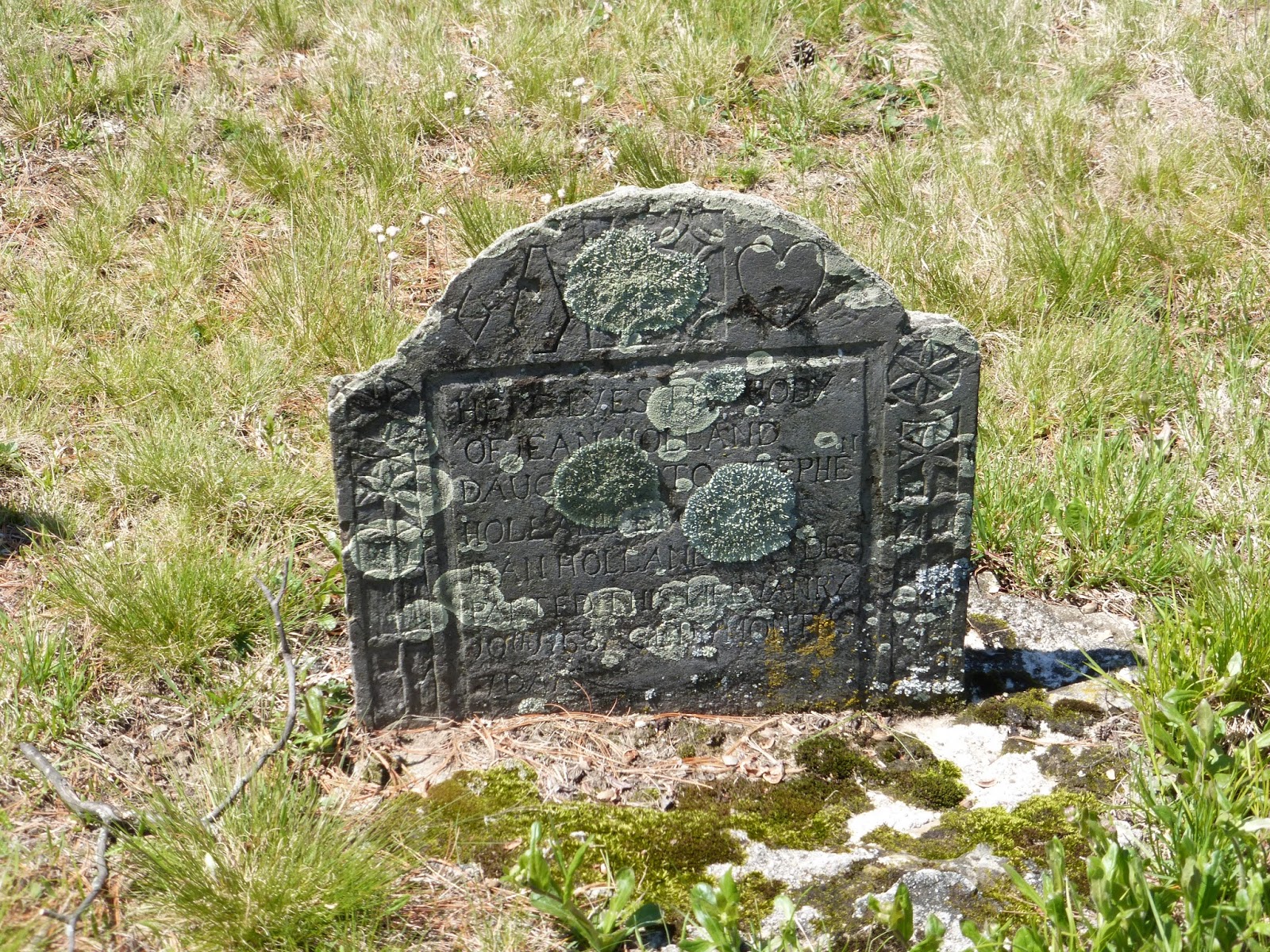
Tombstone Tuesday ~ Jean HOLLAND, died 1768 in Londonderry (now Derry), New Hampshire

This tombstone was photographed at the Forest Hill Cemetery in Derry, New Hampshire.


HERE LYES THE BODY
OF JEAN HOLLAND
DAUGHTER TO STEPH^N
HOLLAND AND
JEAN HOLLAND DE-
PARTED THIS LIFE JANRY
10TH 1768 AGED 7 MONTHS
7 DAYS

Stephen Holland was born about 1733 in Coleraine, Northern Ireland.  He was a member of Roger’s Rangers and was wounded at the battle of Fort William Henry and wounded again at the battle of Quebec.  He received a pension for her service and wounds, and removed to Londonderry and lived on a plot of land in East Derry across from the present day First Parish Church.  Colonel Holland opened a tavern here.

He married Jane/Jean Stinson around 1751 and they had nine children live to adulthood.  Jane/Jean is the only one buried in Derry (then known as Londonderry, New Hampshire). 

In 1773 the town of Londonderry proclaimed allegiance to Governor Wentworth, an appointed Royal Governor during the midst of pre Revolutionary War unrest. Holland was suspected of being the author of this proclamation. When the town of Londonderry called a town meeting to send delegates to the Exeter Congress that same year, Holland, as Justice of the Peace, ordered the meeting closed.  Holland was a very unpopular man while the rest of Londonderry’s inhabitants were patriots. Some suspected that Holland was a British spy.

To save face Holland stood up at a town meeting in 1775 and proclaimed his allegiance to the patriot cause.  The men at the meeting voted they were “satisfactory for his conduct” and a month later they elected him as moderator in place of the usual moderator, Matthew Thornton, who was at the Provincial Congress.  On June 18, 1775 Holland secretly went to the seacoast to recruit a militia of 200 men to assist the British.  He even signed the Association Test in 1776, which swore allegiance to George Washington.  He had fooled the town one more time!

Later, in 1778, he was found out and his property was confiscated and sold by the Committee of Safety.  On the same day the following other men were banished, too:  Richard Holland, John Davidson, James Fulton, Thomas Smith, and Dennis O’Hala.   There was a Captain Stephen Holland in the Prince of Wale’s American Volunteers in 1782.  His final burial place is unknown (and probably not in the Derry or Londonderry area!) 

You can read more about Colonel Stephen Holland “Spy Master” at this link to an article written by Richard Holmes, the Derry Town Historian:  http://www.londonderrynh.net/2014/08/stephen-holland-spy-master/75199


-----------------------------------------

Heather Wilkinson Rojo, "Tombstone Tuesday ~ Jean HOLLAND, died 1768 in Londonderry (now Derry), New Hampshire", Nutfield Genealogy, posted  July 26, 2016, (  http://nutfieldgenealogy.blogspot.com/2016/07/tombstone-tuesday-jean-holland-died.html: accessed [access date]).  

Thursday, October 3, 2013

A Door with History


This door is located at the Museum of Fine Arts, Boston
in the new American Wing


Nathaniel Sparhawk was born about 1717 in Boston and he
married Elizabeth Pepperell on 1 May 1742 in Kittery, Maine.  
His great aunt, Anna Sparhawk (1623 - about 1717) married 
James Convers, my 8th great grandfather, as his second wife. 


"Doorway from the
Sparhawk house
Maine (Kittery), about 1742
Painted wood, glass
This doorway comes from one of the grandest 
eighteenth-century houses in Kittery, Maine, on
the New Hampshire border.  The house was
owned by Nathaniel Sparhawk, whose portrait
by John Singleton Copley is on view in gallery 128"


a close up of the door knocker

This house at Kittery, Maine was known locally as Sparhawk Hall.  It was built in 1742 (one year after Nathaniel Sparhawk's marriage) as a wedding gift from his father-in-law, Sir William Pepperell.  Nathaniel Sparhawk was a wealthy merchant.  His portrait by Copley is one of the artist's few life sized paintings.  In 1758 Sparhawk had to declare bankruptcy, and his property was auctioned, except for this house.  When his wealthy father-in-law died, he was not named in the will.  His wife inherited in her own name.  This was all lost after the American Revolution because the Sparhawks and Pepperells remained loyalists and everything was confiscated by the new government.

The Lady Pepperell House and Sparhawk Hall were famous homes in Kittery, from the same family.  The Sparhawk house was used in movies and hosted politicians during the Portsmouth Treaty in 1905.  Sparhawk Hall was finally demolished in 1967, and the door was donated to Strawberry Banke Museum.  The interior woodwork was sold off and installed in a private home in Winthrop, Maine.  You can still find Sparhawk Lane in Kittery, near where the home once stood.

Click here to see photos of the Sparhawk Mansion before its demolition:
http://www.seacoastnh.com/Places-%26-Events/Historic-Portsmouth/Sparhawk-Mansion-on-Death-Row/


Museum of Fine Arts, Boston  http://www.mfa.org/

-------------------------------

The URL for this post is
http://nutfieldgenealogy.blogspot.com/2013/10/a-door-with-history.html

Copyright 2013, Heather Wilkinson Rojo

Saturday, August 24, 2013

Surname Saturday ~ Lyons, Loyalists from Connecticut to Nova Scotia?


Isabella Lyons (1806 - 1872)
wife of Rev. I. E. Bill

LYONS

This is another brickwall line, and I was reluctant to post it as a Surname Saturday name until I realized that someone out there in cyber space may have the answer to my lineage problems.  So here is the story…

My line begins with David Lyons.   He appears in Nova Scotia records for the first time when he purchased land from Thomas M. Beckwith near the Pereau River on 6 April 1803.   He appears in the 1790 Federal Census of Stratford, Connecticut.   According to an article in Connecticut Ancestry “Connecticut Loyalists Who Went to Canada” 1974, Volume 17, No. 2, a “Daniel Lyon” was granted land in Canning, Nova Scotia.  Is this the same man?

On 25 May 1779 in Cornwallis, Kings County, Nova Scotia David Lyons married Elizabeth Ratchford, the daughter of Thomas Ratchford and Desire Gore, other new Nova Scotia planters from New England.  I know little else about Thomas and Elizabeth. David Lyons and his family are listed in the Cornwallis Township book, which gives the names and some dates for the twelve children’s births.

My line continues through their son, Thomas Ratchford Lyons, who married twice. His first wife, and my 4th great grandmother, was Ann Skinner.  She gave him seven children.  I only know a little about this generation from vital records in the Cornwallis Township Book and from a journal written by a son-in-law.  Their daughter, Isabella Lyons, married the Reverend Ingraham Ebenezer Bill, who wrote extensively about his life, his family and his conversion to the Baptist faith.  There is also some information about the Lyons family in the family sketches chapters of The History of King’s County, Nova Scotia by Arthur Wentworth Hamilton Eaton, 1910 (available to read online at archive.org at this link http://archive.org/details/historykingscou00eatogoog ).

Other LYONS researchers have uncovered information about a Patrick Lyons in Nova Scotia.  This Patrick Lyons lived previously in Connecticut, where he witnessed a will.  Patrick Lyons left a will mentioning his father’s burial in County Monaghan, Ireland, and a brother Edmund in Castleblaney.  Could he be the father, brother or kinsman of David Lyons? Was the family of Irish descent?  Were they Loyalists?

My LYONS lineage:

Generation 1:  Patrick Lyons?

Generation 2: David Lyons, born about 1759 in Connecticut? Died May 1812 in Cornwallis, Nova Scotia; married on 25 May 1779 in Cornwallis to Elizabeth Ratchford, daughter of Thomas Ratchford and Desire Gore.  She was born about 1764 and died on 18 March 1845 in Nova Scotia.

Generation 3: Thomas Ratchford Lyons, born 3 March 1780 in Cornwallis, died 1859 in Sackville, Nova Scotia; married first on 30 September 1802 in Cornwallis to Ann Skinner, daughter of Charles Skinner and Sarah Osborn.  She was born 9 March 1786 in Cornwallis and died 19 October 1815 in Cornwallis.  He married second to Anne Griffin.

Generation 3: Isabella Lyons, born 28 January 1806 in Cornwallis, died April 1872 in Carleton, New Brunswick; she married on 20 April 1826 in Cornwallis to Reverend Ingraham Ebenezer Bill, son of Asahel Bill and Mary Rand.  He was born on 19 February 1805 in Billtown, Cornwallis and died 4 August 1891 in St. Martin’s, New Brunswick.

Generation 4: Caleb Rand Bill m. Ann Margaret Bollman
Generation 5: Isabella Lyons Bill m. Albert Munroe Wilkinson
Generation 6: Donald Munroe Wilkinson m. Bertha Louise Roberts (my grandparents)

------------------------

Copyright 2013, Heather Wilkinson Rojo