Monday, February 12, 2018

An Update on The Meetinghouse at First Parish in Derry

This new 60 foot post was inserted
into the top of the First Parish church
tower by crane and lots of skill!
Lowering the post into position,
very carefully!
A skilled craftsman guiding
the new post into position

Exciting things have happened recently at the renovations of the Meetinghouse at First Parish in East Derry, New Hampshire.  Nearly 300 years ago Rev. James MacGregor brought his flock of Ulster Presbyterians from Northern Ireland to New England. After a cold welcome in Boston, and a rough winter in Maine, they found a home in Nutfield (now the towns of Londonderry, Derry and Windham) when they were granted land for settlement from Governor Shute of Massachusetts.  In April 1719 the first sixteen families arrived here, and on 11 April 1719 Rev. MacGregor gave his first sermon on the shore of Beaver Lake. 

This small congregation eventually built a small meetinghouse, and then second meetinghouse in 1769, which is the building still standing in East Derry. In 1822 this small meeting house was cut into two halves, and enlarged by adding a 24 foot section to the middle. A tower or steeple was added sometime later.  In 1845 a second floor was added, moving the church sanctuary upstairs, and town offices were placed downstairs.  In 1876 a bell and clock were added to the tower.  In 1884 stained glass windows were installed.

In recent years, the tower was repaired in the 1990s on the 275th anniversary of the parish.  These renovations proved to be damaging to the structure, and in 2013 -2014 a structural analysis fund that the tower needed stabilization, the roof slate needed to be removed and replaced, and other safety repairs were needed for the whole structure.  It was decided that a major renovation was needed.  In 2016 the entire building was lifted and the steeple top removed. The building sills were repaired, and a new foundation was poured.  Last year the tower base was reinforced with new beams.  In 2018 it is hoped that the tower will be finished and the steeple top returned to it’s place above the tower.

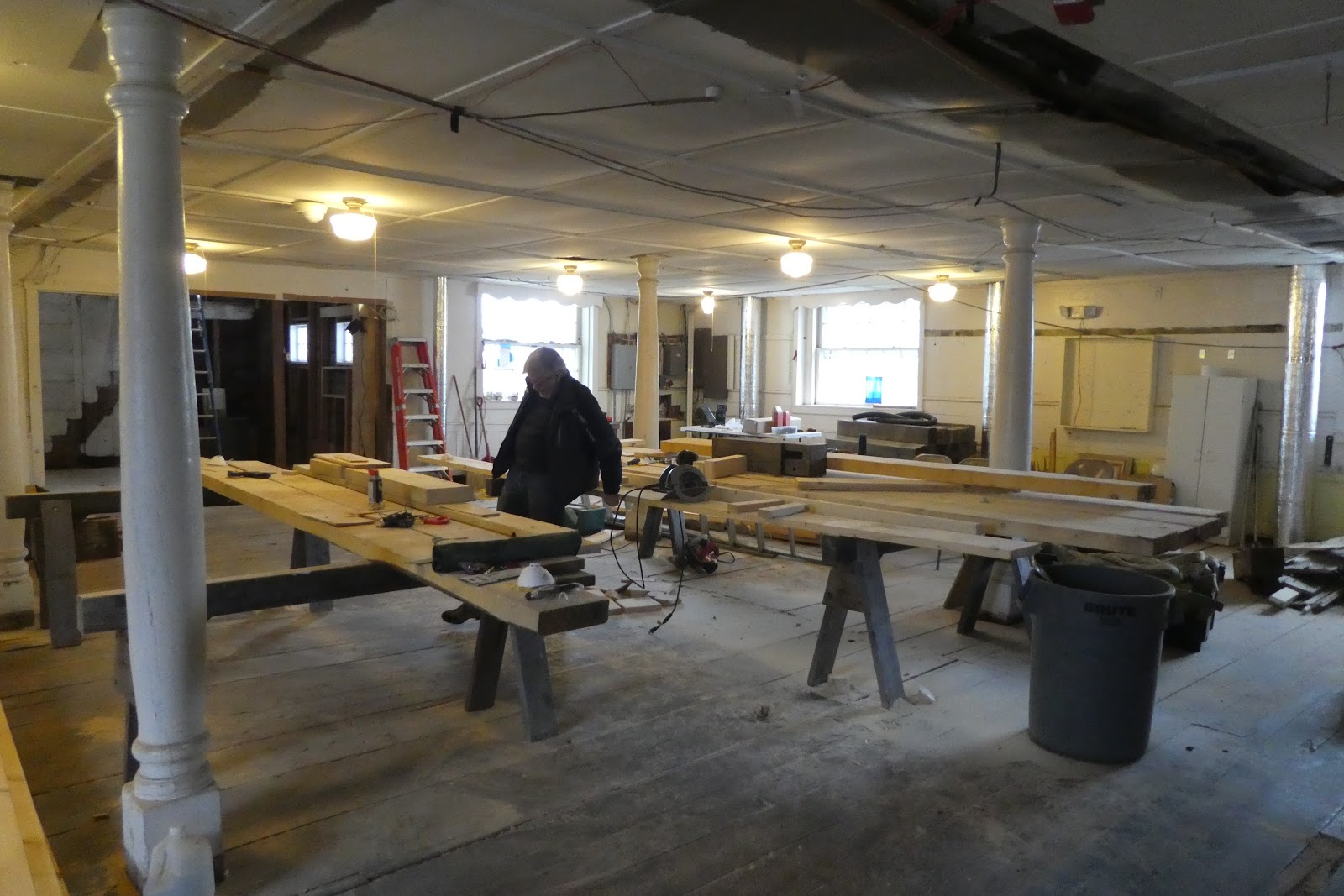
Last week, Paul Lindemann, the media contact for the Friends of The Meetinghouse at First Parish, gave me a tour of the building.  Work was going on while we there, to finish repairs on the tower base and first floor of the meetinghouse. Paul is an expert on the history of the building, and has been following the project for many years. The first three photos above, of the 60 foot new beam going into the tower, are from Paul's collection of photos of the renovation process. 

Inside the tower base, where the long
60 foot beams were lowered from the top
At some point in the past, the original
entrance to the meetinghouse was blocked by
a staircase to the tower.  This door will be
re-opened as part of the renovations, and
the staircase moved to a new location.
The tower base will become a new entry.


It was originally hoped that the entire project would be finished for the 300th anniversary of Nutfield in the year 2019.  However, many more renovation projects were discovered during the current rehabilitation of the building, which has caused a need for more fundraising for the project.   There is asbestos that needs to be removed or re-mediated.  Cracks to the plaster caused by lifting the building need repair.  The ceiling of the sanctuary needs renovation since it cracked and peeled while being unheated during the winter it was lifted.  The roof project has not been started yet.  Interior finishes such as new hallways, stairs, and an elevator to meet ADA codes have yet to be installed. All of this will take more time and money than originally planned. 

Rev. Dr. Deborah Roof holds a timber peg that will be used to hold together the post and beam construction
of the First Church renovations.  For a donation, you can sign this peg and your name will become
part of the permanent structure of the First Parish Meetinghouse!  See below for details. 

Hopefully the local community, Nutfield descendants, and history buffs will support the Friends of the Meetinghouse at First Parish in their project to complete their renovations in a timely manner for the 300th anniversary in 2020.  It is expected that the project will move along enough for the bell to be rung on the anniversary of the first sermon on 11 April, and perhaps tours for the 300th anniversary celebrations even if the sanctuary interior renovations are not complete.

The MacGregor stained glass window
commemorates the first minister
of the First Parish church in 1719

The sanctuary of the First Parish awaits necessary renovations
before it can be used for worship services

When the first floor was built in 1769
pew boxes were installed in the hardwood floor.
You can see where those pew boxes used to exist.
The first floor will be renovated for community
use, which harkens back to the days when it
was used as the town hall or meetinghouse. 

Paul Lindemann, my tour guide, shows the rail from the rotting steeple,
and a piece of wainscotting from the first floor meeting room.
The window behind him used to serve as the East Derry post office.

Paul explained to me how this first floor area used to be the town hall,
and will become community space again after the renovations.

Important links:


Friends of the Meetinghouse at First Parish 501(c ) (3) :  https://fotmh.org/ 

              Timber Peg Donations:   https://fotmh.org/timber-peg-donations/   

Paul Lindemann’s blog  “Nutfield History”   http://www.nutfieldhistory.org/  

                Paul’s recent detailed blog post on the tower rehab project:


My previous blog posts about the renovation process at First Parish:
Sept. 17, 2015


Thank you to Paul Lindemann for the excellent tour of the meetinghouse, and for the first three photos at the top of this blog post (of the new beam being installed into the meetinghouse tower).

----------------------------

Heather Wilkinson Rojo, “An Update on The Meetinghouse at First Parish in Derry”, Nutfield Genealogy, posted February 12, 2018, ( https://nutfieldgenealogy.blogspot.com/2018/02/an-update-on-meetinghouse-at-first.html: accessed [access date]). 

Saturday, February 10, 2018

Surname Saturday ~ LEWIS of Salem, Massachusetts

Gloucester Fisherman's Wife Memorial

My 4th great grandfather, Thomas Lewis, is named as the father of Frederick Augustus Lewis on his 1850 death record, and on Thomas Russell Lewis’s marriage record in 1852.   Frederick Augustus and Thomas Russell were the twin sons of Thomas Lewis. I don’t know my 4th great grandfather’s origins at all.

With this information from the son’s vital records, and their father’s name, I was able to find a death announcement in the Salem Gazette, 24 August 1824, page 3 for “Mr. Thomas Lewis, aged 54”.  There is no corresponding death record in the vital records.  Is this their father?  The birth record for both boys appears in the compiled book of Salem Vital Records with only their mother listed (no father’s name) baptized on 26 June 1825 at the Howard Street or Branch Church in Salem, Massachusetts.  Were the twin babies born posthumously?

In his probate records, Thomas Lewis is described as a ropemaker of Salem.

To throw a monkey wrench into the mix, I don’t know the full name of the mother of these twin boys.  She is listed as “Amelia” in their baptism records.  I cannot find a marriage between a Thomas Lewis and an Amelia in any Massachusetts records.  “Amelia Lewis” remarried again in 1827 to Thomas Johnson in Salem, and then “Amelia Johnson” remarried again in 1843 to John Adams in Topsfield.    John and Amelia Adams were listed in the Wayland, Massachusetts 1860 Federal Census Mortality Schedule as “paupers”.   Such a sad life for my 4th great grandmother, Amelia!

I descend from Capt. Thomas Russell Lewis (1825 – 1853), my 3rd great grandfather.  He married young to Hannah Phillips, my 3rd great grandmother, in 1841, and had three children.  She died in 1851, and he remarried quickly to Lydia Pickering in 1852, probably so his very young children had a stepmother to care for them.  However, two years later, in 1853, Capt. Thomas Russell Lewis died in Surinam, in the West Indies.   The newspaper Salem Register on 6 October 1853, page 2 reads “Mortuary Notice: At Surinam, August 22, of erysipelas, Capt. Thomas R. Lewis of this city, master of the brig Gazelle.”  (Erysipelas is a strep infection of the skin).

Upon Capt. Lewis’s death, the probate record states that Lydia, the step mother, went to court and stated that “She has three small children, & has no means of support for herself & them, that the whole of the estate of said Thomas amounts only to the sum of $120 or appraisal…”  Another generation, another sad story!

My 2nd great grandmother, Hannah Eliza Lewis (about 1844 – 1921), was only seven years old when her mother died, and only nine years old when her father died at sea.  Her stepmother remarried to John Bradbury Hardy of Lynn, Massachusetts.  I don’t know where little Hannah was raised, with her stepmother or some other relatives?  I couldn’t find any guardianship court records.

In 1864 Hannah married my 2nd great grandfather, Abijah Franklin Hitchings.  He was known as “Frank” or “Dada” Hitchings by my grandmother.  Frank was a veteran of the Civil War, and had been injured at the Battle of Fredricksburg.  His leg injury bothered him for the rest of his life, as his pension papers show many, many medical reports from the “Old Soldiers Hospital” in Chelsea, Massachusetts.  Frank had been a sail maker before the war, but after the war he became the Deputy Collector of Customs at the Salem Custom House.  He held this job until his death in 1910.  

Hannah outlived Frank by another eleven years, but she was not well.  She received a Civil War widow’s pension, but in those documents I found many, many letters from her son, Arthur, my great grandfather, who described that she was suffering from dementia and had been committed to the Asylum at Danvers. His letters begged for a raise in her widow’s benefits to cover her care.  Hannah died in the Asylum at Danvers in 1921, and she is buried in the Harmony Grove Cemetery in Salem in the large plot owned by her father, Capt. Lewis, where many Lewis, Hitchings and other relatives are buried. A third generation, and a third sad story!

Some LEWIS resources:

Salem Vital Records,  Essex County Probate Records, Salem Gazette newspapers via GenealogyBank online database, Harmony Grove Cemetery in Salem archives, US Federal Census records, and Civil War pensions documents.  This LEWIS family does not appear to in any compiled genealogy or journal articles. 

My LEWIS genealogy:

Generation 1:  Thomas Lewis, born about 1770, died 31 August 1824 in Salem, Massachusetts; married  to Amelia Unknown.  She was born about 1790 probably in Stoughton, Massachusetts, and died 22 April 1860 in Wayland, Massachusetts.  Two twin sons.

Generation 2:  Captain Thomas Russell Lewis, baptized 26 June 1825 in Salem, died 22 August 1853 in Surinam, West Indies; married on 4 March 1841 in Salem to Hannah Phillips, daughter of James Phillips and Sarah Cree.  She was born about 1821 in Topsfield, Massachusetts and died 17 October 1851 in Salem. Three children.

Generation 3:  Hannah Eliza Lewis, born about 1844 in Salem, died 15 February 1921 in at the Danvers State Hospital, Danvers, Massachusetts; married on 22 September 1864 in Salem to Abijah Franklin Hitchings.  He was the son of Abijah Hitchings and Eliza Ann Treadwell, born 28 October 1841 in Salem, died 19 May 1910 in Salem.  Two children.

Generation 4:  Arthur Treadwell Hitchings m. Florence Etta Hoogerzeil
Generation 5:  Gertrude Matilda Hitchings m. Stanley Elmer Allen (my grandparents)

NOTE:  I have written another Surname Saturday blog post on another LEWIS family, showing my descent from another Thomas Lewis, who lived in Maine in the 17th century: 
https://nutfieldgenealogy.blogspot.com/2016/06/surname-saturday-lewis-of-saco-maine.html


-------------------------------

Heather Wilkinson Rojo, “Surname Saturday ~ LEWIS of Salem, Massachusetts”, Nutfield Genealogy, posted February 10, 2018, (   https://nutfieldgenealogy.blogspot.com/2018/02/surname-saturday-lewis-of-salem.html: accessed [access date]). 

Thursday, February 8, 2018

In the Footsteps of the Ancestors ~ A visit to Dordrecht, The Netherlands

Grote Kerk, Dordrecht, Netherlands


Part 3 of 3

My 3rd great grandfather, Peter Hoogerzeil (1803 – 1889) stated on documents in Massachusetts that he was from “Dort” in the Netherlands.  I never found a city or village named Dort on any map.  I started to research his story in the 1970s, but it was until the 1990s, when I started using the internet for my genealogy, that I solved this little mystery. On a bulletin board for Dutch genealogy I asked about “Dort” and someone told me that this was the nickname for the city of Dordrecht in South Holland.  Solving this mystery led to my finding six generations of Peter Hoogerzeil’s ancestors!

A list of HOOGERZEIL births in the Beverly, Massachusetts Vital Records
Note the "Dort" for Peter Hoogerzeil's place of birth.  Also note all the different
versions of spelling for the Dutch surname HOOGERZEIL! 

I recently blogged about my trip to the Netherlands, and my distant Hogerzeil cousin who led me on a tour of my ancestral origins.  Visiting Dordrecht was a highlight of this trip, because it was the place where my immigrant ancestor was born.  Sometime in the 1820s Peter Hoogerzeil, who was a mariner descended from many generations of whaling sea captains, stowed away in a ship that left Rotterdam, nearby Dordrecht.  This ship was full of hemp from Indonesia, bound for the ropewalk in Salem, Massachusetts.  Peter settled in Beverly, across the harbor from Salem, where he married and left many descendants.  I was born in Beverly, and grew up not far from where he lived on Bartlett Street.

Dordrecht is one of the oldest cities in Holland, and it was built on several rivers that drain into the Rhine.  At one time Dordrecht was considered to be more important than Rotterdam, but that changed in the late 1800s and early 1900s.  I’m guessing that at the time Peter left Dordrecht, it was an important commercial port, which made it easy for him to take the chance at running away to America. 

My distant cousin, Hans Hogerzeil, and Erik Kon, met us in Leiden and brought us to Dordrecht, where our first stop was the part of the harbor called “Kalkhaven” (chalk harbor), where Simon Hoogerzeijl (1743- 1802) lived when he removed from Nieuwpoort.   This little harbor can be seen in this map from 1868 (below).  We also visited the outside of the Grote Kerk (“The Great Church”) where many Hogerzeil ancestors were married, buried or baptized.  It was a Monday on the day of our visit, which is a day many buildings, stores and museums are closed in the Netherlands, so we never saw the inside of this church. 


Kalkhaven "Chalk Harbor", in Dordrecht, the Netherlands
Grote Kerk, the Great Church at Dordrecht

We also took a walk through the medieval center of Dordrecht, and saw the city hall, and the city archive (closed!).  When we return to visit Holland again, we will be sure it won’t be a Monday!


Dordrecht City Hall


We were comparing Hoogerzeil genealogy notes at a Dordrecht cafe!

The streets were a maze, but we had a good tour guide!

The Dordrecht Museum and archive is in this building

Part 1 of this series, where I visit the village Krimpen aan de Lek:
https://nutfieldgenealogy.blogspot.com/2018/02/in-footsteps-of-ancestors-touring.html   

Part 2 of this series, where I visit the tiny town of Nieuwpoort:
https://nutfieldgenealogy.blogspot.com/2018/02/in-footsteps-of-ancestors-touring_5.html 


 ------------------------------

Heather Wilkinson Rojo, “In the Footsteps of the Ancestors ~ A visit to Dordrecht, The Netherlands", Nutfield Genealogy, posted February 8, 2018, (  https://nutfieldgenealogy.blogspot.com/2018/02/in-footsteps-of-ancestors-visit-to.html: accessed [access date]). 

Wednesday, February 7, 2018

Weathervane Wednesday ~ A Unitarian Church

I post another in a series of weather vane photographs every Wednesday.  This started with images of weathervanes from the Londonderry, New Hampshire area, but now I've found interesting weather vanes all across New England and across the globe.  Sometimes my weather vanes are whimsical, or historical, but all are interesting.  Often my readers tip me off to some very unique or unusual weathervanes, too!  If you know a great weather vane near you, let me know if you'd like to have it featured on this blog.

Today's weather vane was photographed in New Hampshire.

Do you know the location of weathervane post #349?  Scroll down to find the answer.


This banner style weathervane has a cut out of the "flaming chalice" symbol.  It is located on the Unitarian Church in Walpole, New Hampshire.  The steeple on this church was recently renovated, according to the church website.  This congregation was gathered in 1761. This building dates from about 1922 when the previous church collapsed under a large snow load after a blizzard on 19 February 1920.

This church has the flaming chalice on their weathervane and their sign out in front of their building.  This is a symbol of the Unitarian Universalist faith tradition.  This symbol for the Unitarians was adopted around the time of World War II.  Although this banner style weathervane looks old, I think that the weathervane might not date back to the 1920s when the church was rebuilt, but it might be newer than that.

Walpole Unitarian Church website:  http://walpoleuuchurch.wixsite.com/walpoleunitarian


Click here to see the entire collection of Weathervane Wednesday posts!

---------------------------

Heather Wilkinson Rojo, "Weathervane Wednesday ~ A Unitarian Church", Nutfield Genealogy, posted February 7, 2018, (https://nutfieldgenealogy.blogspot.com/2018/07/weathervane-wednesday-unitarian-church.html: accessed [access date]).

Tuesday, February 6, 2018

Tombstone Tuesday ~ Joseph and Anna Rolfe, Derry, New Hampshire

This tombstone was photographed at the Forest Hill Cemetery in Derry, New Hampshire.  In 1781 this was located in Londonderry, New Hampshire (before the schism between Londonderry (west) and Derry (east).)


In 
Memory of
JOSEPH ROLFE
Died July 1781,
AEt. 53
ANNA, his wife,
Died Aug. 23, 1826
AEt. 88


B. Day Lowell


I found the marriage of Joseph Rolfe and Ester Rolfe on 24 February 1763 in the Newbury, Massachusetts vital records.  According to the website Rolph Reunion Database at www.rolphreuniondatabase.com  Joseph Rolfe was born on 14 May 1730 in Newubry, son of Samuel Rolfe and Judith Toppan.  He married first to his cousin, Esther Rolfe, the daughter of Henry Rolfe and Elizabeth Toppan.  He married his second wife, Anna, in 1775.  He was a patriot serving in the Revolutionary War as a seaman on the sloop "Tyrranicide".  Around 1780 he came to Londonderry, where he was buried with his second wife.  The first wife, Esther Rolfe, is buried in Newbury, Massachusetts. 

Benjamin Day was a famous stone carver from Lowell, Massachusetts.  This stone is carved in the typical neo classical style famous after the Revolutionary War with a weeping willow and classic Greek columns.  This is quite different from the Scots Irish stones of the early settlers with their geometric designs, and the skulls and winged souls of the Puritan settlers. 

----------------------------------

Heather Wilkinson Rojo, "Tombstone Tuesday ~ Joseph and Anna Rolfe, Derry, New Hampshire", Nutfield Genealogy, posted February 6, 2018, (  https://nutfieldgenealogy.blogspot.com/2018/02/tombstone-tuesday-joseph-and-anna-rolfe.html: accessed [access date]). 

Monday, February 5, 2018

In the Footsteps of the Ancestors ~ Touring Nieuwpoort, Netherlands

Nieuwpoort, The Netherlands, 1866

Part 2 of 3

Last week I wrote a blog post about my visit to Krimpen aan de Lek, Netherlands with my distant cousin, Hans Hoogerzeil, to see where our common ancestors lived.  In this post, I’ll be showing you the sights at the tiny village of Nieuwpoort, where my 5th great grandmother, Anna Ooms who married Simon Machielszoon Hoogerzeijl was born in 1742.  Her parents were Adam Adriaans Ooms and Anna van der Ham.  This side of the family lived here until their grandson, my 3rd great grandfather, Peter Hoogerzeil, was born in Dordrecht in 1803.   

Canals in Nieuwpoort

The village church
Nieuwpoort town hall

Simon Hoogerzeijl was the commander of whaling ships from 1771 to 1802.  His father-in-law, Adam Ooms was a Nieuwpoort whaling commander, too, from 1749 – 1775.  The house where Simon and Anna are believed to have lived is in the "inner harbor" of the village (on a small canal), near the village church where eight of their children were baptized.  This house is believed to be their house because whale bones were found in a backyard excavation. There is a beautiful ceramic tile of "Noah's Ark" on the front gable end of the house. 

The house where the Ooms Family is
supposed to have lived in Nieuwpoort

"Noah's Ark" is the name of the house!


According to Wikipedia, the small village of Nieuwport has only about 600 residents.  Hans described it as a “garrison town”, and the small walls are used to control flooding.  We parked outside of the town walls and walked through the wooden doors that can be closed like a canal lock.  There are drainage canals running through the town in front of the houses.  It is very picturesque, and easy to imagine what it was like when my ancestors lived here.   Nieuwpoort was about 20 kilometers from Krimpen aan de Lek. 


In 1780 Simon and Anna Hoogerzeijl removed to the city of Dordrecht, where they are both buried.  It was a very nice drive along top of the dikes from Dordrecht to Nieuwpoort with Hans and Erik.  We visited the windmills at the Kinderdijk and drove through some lovely farm land. It was a perfect tour for this New England girl, with lots of new things to see in the Netherlands!

Kinderdijk


Driving along the tops of the dikes

Water screws moving the water UP to river level


Click here to read Part 1 of this series, Krimpen aan de Lek:

(The map in the image above is from Wikimedia Commons, J. Kuyper - Germeente Atlas van Nederland (Municipal Atlas of the Netherlands), 1866.)

------------------------------------

Heather Wilkinson Rojo, “In the Footsteps of the Ancestors ~ Touring Nieuwpoort, Netherlands”, Nutfield Genealogy, posted February 5, 2018, (   https://nutfieldgenealogy.blogspot.com/2018/02/in-footsteps-of-ancestors-touring_5.html: accessed [access date]). 

Saturday, February 3, 2018

Surname Saturday ~ DWINNELL of Topsfield, Massachusetts


DUNNELL / DWINNEL /  DWINEL / DONNELL

My 9th great grandfather, Michael Dwinell or Dunnell, is of unknown origins.  Some think that perhaps the surname is perhaps French Huguenot, and other books say he was possibly Irish, but there is no proof either way.  He was born about 1640 and died in 1717 in Topsfield, Massachusetts.  His wife is only known as “Mary”, although Savage’s Genealogical Dictionary of New England states her name was Mary Read (no proof).   They had nine children in the Topsfield records, and his son Michael, Jr., was the first physician in Topsfield. Michael Dwinnel owned a large amount of land, including 50 acres he bought from Francis Peabody in 1672. 

My 8th great grandfather, John Dunnell (1674 – 1742), lived in Topsfield as a “husbandman” or farmer.  He married Mary Read of Salem in 1701.  His wife was the executor of his will which was witnessed by Jeremiah Towne, Jacob Dwinnell, and Richard Towne.

His daughter, Keziah Dwinel (b. 1703), my 7th great grandmother, married Nicholas Cree.  Their son, Richard Cree (1727 – 1769), married Ruth Johnson, whose mother was Rebecca Towne.  Rebecca’s grandfather was Edmund Towne (1628 – 1678), a brother of Rebecca (Towne) Nurse who was hanged as a witch in 1692.  Perhaps Rebecca Towne was named after her poor grandmother, the victim of the Salem hysteria?   The two Towne men mentioned above as witnesses to the will of John Dunnell in 1742 were both grandsons of Edmund Towne, too.

Some DWINNELL resources:

The True Genealogy of the Dunnell and Dwinnell Family, by Henry Gale Dunnell, 1862 (Google Books)

The Dwinnell, Dunnell Genealogy,  by Ira A. Dwinnell, 1974

The History of Topsfield, Massachusetts, by George F. Dow, 1940  (Archive.org)

The Vital Records of Topsfield, Massachusetts, 1903

My DWINNELL genealogy:

Generation 1:  Michael Dunnell, born about 1640, maybe in France, died 1717 in Topsfield, Massachusetts; married Mary Unknown about 1668.  Nine children.

Generation 2:  John Dunnell, born 16 December 1674 in Topsfield, died 28 January 1742 in Topsfield; married Mary Read on 25 February 1701 in Salem, Massachusetts.  She was born about 1682 in Salem. Six children.

Generation 3: Keziah Dwinell, born 14 December 1703 in Topsfield, married Nicholas Cree of Marblehead on 7 October 1723 in Topsfield.  Six children.

Generation 4: Richard Cree m. Ruth Johnson
Generation 5: Stephen Cree m. Hannah Smith
Generation 6:  Sarah Cree m. James Phillips
Generation 7: Hannah Phillips m. Capt. Thomas Russell Lewis
Generation 8:  Hannah Eliza Lewis m. Abijah Franklin Hitchings
Generation 9: Arthur Treadwell Hitchings m. Florence Etta Hoogerzeil
Generation 10: Gertrude Matilda Hitchings m. Stanley Elmer Allen (my grandparents)

------------------------------

Heather Wilkinson Rojo, “Surname Saturday ~ DWINNELL of Topsfield, Massachusetts”, Nutfield Genealogy, posted February 3, 2018, ( https://nutfieldgenealogy.blogspot.com/2018/02/surname-saturday-dwinnell-of-topsfield.html: accessed [access date]). 

Thursday, February 1, 2018

In the Footsteps of the Ancestors – Touring Krimpen aan de Lek, Netherlands

Krimpen aan de Lek, 1867


Part 1 of 3

Last fall I visited England and The Netherlands with the General Society of Mayflower Descendants Historic Sites Tour. That trip ended in Leiden, Netherlands, and since I’d never visited the country before, I ran to a map to see how far it was from the village of Krimpen aan de Lek, where my Hoogerzeil ancestors originated.  It turns out that Krimpen aan de Lek is just outside of Rotterdam, not far from Leiden, which was exciting to me but I wasn’t sure what to do next.  Then I remembered that I still had some cousins who lived nearby.

My immigrant ancestor, Peter Hoogerzeil (1803 – 1889), came to Massachusetts as a stowaway from Rotterdam, in a ship loaded with hemp and headed to the ropeworks in Salem, Massachusetts.   Looking at the map, I could see why he left Rotterdam.  His father, grandfather and great grandfather (and ancestors before them) had all been the masters of whaling vessels.  Peter was an experienced mariner, and still sailed many trips to the Caribbean and the Pacific Ocean after settling in Massachusetts according to the many ships registry documents I have found online.  Peter’s place of birth was Dordrecht, on the Rhine River outside of Rotterdam, and his father,  Simon Hogerseijl (1776 – 1829) was born in Nieuwpoort, further upstream.  Simon’s father, Simon Machielszoon Hoogerzeijl (1743 – 1814), was born in Krimpen aan de Lek, closer to Rotterdam on the Lek River (a distributary branch of the Rhine). 

Even though my ancestor came to the United States nearly 200 years ago, my family has maintained correspondence with the Hogerzeil family in the Netherlands on and off over the years.  At first, since Peter Hoogerzeil was a mariner, he traveled back and forth with letters.  My Aunt Belle Hoogerzeil (1888 – 1960), Peter’s granddaughter,  kept up the correspondence and shared the letters with my own mother and her family (my mother was Belle’s niece).   When World War II  broke out, my mother’s brother served in occupied Europe and visited Dordrect and one of the Hogerzeil families.  You can see a blog post with photos from that visit HERE.  That was the last time anyone from my family visited the Hogerzeil’s in the Netherlands.

At lunch with Hans near Krimpen aan de Lek,
examining a letter from Simon Hoogerzeijl, 1785


Hans had an old family photo of the Hoogerzeil family
from Beverly, Massachusetts. We still don't know some names!
I have blogged about this photo:
https://nutfieldgenealogy.blogspot.com/2011/07/wordless-wednesday-identifying-old.html


And so, now it was my time, as another one of Peter Hoogerzeil’s descendants, to visit the Netherlands, and to see Dordrecht, Nieuwpoort and Krimpen aan de Lek.  I contacted my very distant cousin, Hans Hogerzeil, and he graciously made arrangements to meet us at our hotel and tour us around to “The land of the Hogerzeil Family”!  He brought along Erik Kon, the Hogerzeil family genealogist, whom I had met years ago in New Hampshire when he came to gather information on Peter Hoogerzeil’s descendants in New England.  It was a delightful day!


I’ll start with the village of Krimpen aan de Lek, which is where the Hogerzeils originated according to our genealogy.  It is what Hans described as a “ribbon village” since it existed all along the top of the dike by the Lek River.  Of course, now the village has grown to expand all along the canals by the dike and is a suburb of the larger city of Rotterdam.  This is too bad, since the original church no longer exists.  But the new church has a weathervane in the shape of a whale, in honor of the early industry of the town, and some of the streets are named for famous whaling masters.  There was a Hogerzeil street, and surprisingly, another street named “Annetje Ockersstraat”.  Annetje Ockers (about 1639 – 1696) was the great grandmother of Simon Machielszoon Hoogerzeijl (my 8th great grandmother), who was a revered midwife in Krimpen aan de Lek.  


Hans knew that Michiel Occersz Hoogerzeyl (1696 – 1779), the father of Simon Machielszoon Hoogerzeijl, had been buried under the church floor with an impressive tombstone.  But since the original church had been razed in 1939, we looked for the stone in the municipal cemetery.  Fortunately, his stone had been placed on the chapel wall, and was very legible and readable.  Michiel had been the master of a whaling ship out of Krimpen aan de Lek.  Hans and I both posed in front of his stone, which was next to the stone of Gerrit Knijnszoon van Holst (1720 – 1790), who owned his whaling ship.


There was not much else to see in the little town of Krimpen, which did not have many old homes or buildings from the time period when the Hogerzeil family lived here.  But it was fun to see how the family had been commemorated!  Hans occasionally publishes a very nice family newsletter “Hogerzeil Nieuws” which I have been receiving by mail for over ten years . He was able to include a nice two page story about my visit to the Netherlands and our tour in the newsletter, and distributed it to all the cousins around the world before Christmas.  Thank you Hans and Erik for our wonderful day in the Netherlands and your grand tour of the ancestral towns.


Stay tuned for the next blog post where we visited the tiny village of Nieuwpoort, which was much more picturesque.  Click on this link:
https://nutfieldgenealogy.blogspot.com/2018/02/in-footsteps-of-ancestors-touring_5.html   

My HOOGERZEIL lineage:

Generation 1:  Arijen Bruynen, baptized 11 May 1631 in Krimpen aan de Lek, Netherlands, died 22 August 1677; married Aeltie Jacobs.

Generation 2:  Bruin Arijens, baptized 1 June 1661, died before August 1667; Married Annetje Ockers, daughter of Ocker Joppense Stierman and Neeltie Gerrits.

Generation 3:  Ocker Bruins Hoogerseijl, born 18 October 1663 in Krimpen aan de Lek, died 27 January 1749 in Krimpen aan de Lek; married in 1695 to Lijsbeth van't Hof, daughter of Marten Dirkse Sieren. 

Generation 4:  Michiel Ockers Hogerzeijl, born 18 July 1696 in Krimpen aan de Lek, died 25 May 1779 in Krimpen aan de Lek; married on 25 January 1739 in Dordrect to Lijsbeth Schout[en], daughter of Simon Jans Schouten and Agnietje Engeldr van Thiel. 

Generation 5: Simon Machielszoon Hoogerzeijl, born 2 June 1743 in Krimpen aan de Lek, died 24 February 1814 in Dordrecht; married on 30 September 1764 in Krimpen aan de Lek to Anna Ooms, daughter of Adam Adriaans Ooms and Anna van der Ham of Nieuwpoort. 

Generation 6:  Simon Hogerseijl, born 7 July 1776 in Nieuwpoort, died 15 May 1829 in S'Gravendeel; married on 5 September 1799 in Dordrecht to Lissa Van Epenhuizen, daughter of Pieter Van Epenhuizen and Margrieta Koolhaalder.

Generation 7:  Peter Hoogerzeil, born 28 October 1803 in Dordrecht, Netherlands, died 12 May 1889 in Beverly, Massachusetts; married on 30 December 1828 in Beverly to Eunice Stone, daughter of Capt. Josiah Stone and Susanna Hix.  

Generation 8:  Peter Hoogerzeil, Jr., born 24 June 1841 in Beverly, died 10 May 1908 in Beverly; married on 14 March 1870 in Salem, Massachusetts to Mary Etta Healey, daughter of Joseph Edwin Healey and Matilda Weston.

Generation 9:  Florence Etta Hoogerzeil, born 20 August 1871 in Beverly, died 10 February 1941 in Hamilton, Massachusetts; married on 25 December 1890 in Beverly to Arthur Treadwell Hitchings, son of Abijah Franklin Hitchings and Hannah Eliza Lewis.

Generation 10:  Gertrude Matilda Hitchings m. Stanley Elmer Allen (my grandparents)

(Map in the image above from Wikimedia, J. Kuyper - Gemeente Atlas van Nederland (Municipal Atlas of the Netherlands), 1867)

-------------------------------------------

Heather Wilkinson Rojo, “In the Footsteps of the Ancestors – Touring Krimpen Aan de Lek, Netherlands”, Nutfield Genealogy, posted February 1, 2018, ( https://nutfieldgenealogy.blogspot.com/2018/02/in-footsteps-of-ancestors-touring.html: accessed [access date]).