Thursday, September 19, 2019

Derry Will Celebrate the Nutfield 300th Anniversary Saturday, September 21st


This Saturday, September 21st at the annual Derryfest celebration in MacGregor Park, the town of Derry will celebrate it's 300th anniversary.  This downtown festival, next to MacGregor Public Library features fun, food, entertainment, crafts, games and community spirit. For the Nutfield 300th anniversary there will be special events including Scottish music, a time capsule ceremony at 1:45pm, and two special booths.

Visit the Nutfield 300th booths (numbers 46 and 47) to:
-  Learn about the first Scots-Irish settlers and the founding of Nutfield (now the towns of Derry, Londonderry, Windham and most of current day Manchester).
-  See the new 300th Time Capsule and its contents
-  Record your own brief video interview for the 300th Time Capsule
-  Look at the other many 300th events held throughout the year 2019
-  Buy a new 300th T-shirt and the commemorative coins from Derry, Londonderry and Windham
-  See the Friends of the First Parish Meetinghouse book and learn more about the preservation project to restore and protect it.

At 1pm in the bandstand you can enjoy a performance by the traditional Scottish and Irish folk music band "Ulster Landing" followed by a brief talk about the 300th with the Time Capsule ceremony.

The day will end with a celebrations called "Derry After Dark" on Manning Street.  This is a festival of 120 unique craft beers and food from local Derry eateries.  Tickets are available at https://tickets.beerfests.com/event/derry-after-dark  This is an over 21 event. 

Click to enlarge


For the truly curious:

Derryfest 2019 official website:     http://www.derryfest.org/ 

Friends of the First Parish Meetinghouse official website:  https://fotmh.org/ 
                 Facebook page:    https://www.facebook.com/fotmh/   

Greater Derry Arts Council   https://www.facebook.com/DerryArts/ 

Derry After Dark tickets and information:   https://tickets.beerfests.com/event/derry-after-dark 
                 Facebook page:   https://www.facebook.com/derryafterdark/

The Nutfield 300th webpage:  https://www.nutfieldhistory.org/nutfield300th 
                 Facebook page:  https://www.facebook.com/nuthist/

Tuesday, September 17, 2019

Tobacco in Early Colonial New England

from the pamphlet "Tabaco"
by Anthony Chute, 1594
Whilst mining some early Massachusetts court records for my genealogy research, I was struck by how often my ancestors and their neighbors were mentioned along with documents mentioning tobacco use, abuse, and fines.  I found this very interesting, and I collected some of the stories to tell you in this blog post. You might want to mine the early court records, too!

Tobacco originated in the New World. Soon after European contact tobacco was traded, sold, and imported back to Europe where it was extremely popular.  King James I of England found tobacco to be extremely distasteful, and even penned a book A Counter-blaste to Tobacco where he mentioned on page 11 “That the manifolde abuses of this vile custome of Tobacco taking…” and condemned the practice of using tobacco.  The pope in Rome at this time period, Urban VIII threatened to excommunicate anyone who smoked in a church!

My ancestor, Isaac Allerton, a Mayflower passenger, was a merchant and trader.  He was a witness to the peace treaty with the Wampanoag people on 23 March 1620/21 “Captain Standish and Isaac Allerton went venturously, who were welcomed of him after their manner: he gave them three or four ground nuts and some tobacco." And on 8 June 1654, "Thomas Adams and Isaac Allerton gave a bond...for the delivery of 3000 pounds of tobacco to Director (Governor) Stuyvesant." Again, on June 11, 1649, "Mr. John Treworgie [of Kittery] did acknowledge to have received four thousand wt of Tobacco by Isaac Allerto[n] for the Account of Mr. Georg Ludlow.” [see the website https://sail1620.org/content.php?page=Isaac_Allerton_and_Tobacco ]

In 1637 in Plymouth County the first anti-smoking law was written in New England.  It threatened a 12 pence fine for smoking in any street, barn, outhouse or highway, and for smoking further than 1 mile from home.  A second offense was 2 shillings. One year later, on 4 December 1638, the Mayflower passenger Francis Billington was fined 12 pennies for “drinking tobacco in the highway.” [Records of the Colony of New Plymouth, in New England by Nathaniel B. Shurtleff and David Pulsifer, Volume 1, page 106.]

My ancestor George Soule was appointed in 1646 to a committee to deal with Duxbury’s problem of the disorderly smoking of tobacco.  They drew up strict limitations on where tobacco could be smoked and the fines to be levied. [History of Scituate, Massachusetts: From Its First Settlement to 1831 by Samuel Deane, page 308.]  In the Plymouth Colony records, from 1633 – 1643 there were 8 convictions for tobacco smoking, with 6 fines extracted from the guilty.  Compare this to 6 convictions for swearing and 6 convictions for Lord’s Day violations.  Smoking was more popular, but not as popular as drinking, with 13 convictions resulting in 13 fines.

Also in the Plymouth Colony records “Richard Berry, Jedidiah Lombard, Benjamin Lombard, and james Maker, fined for smoking tobacco at the end of Yarmouth Meeting-house on the Lord’s Day”  Faithful tradition informs us, that the early settlers were greatly addicted to smoking, and they would often disturb divine service by the klicking of flints and steel to light their pipes, and the clouds of smoke in the Church. Hence that law of the Colony, passed 1669: “It is enacted that any person or persons that shall be found smoking of tobacco on the Lord’s day, going to or coming from meetings, within two miles of the Meeting-house, shall pay 12 pence for every such default, for the Colonie’s use, to be increased,” &c.”

And from the book The Language of the Law by David Mellinkoff, 2004  “Tobacco smoking ‘gretlie taken-vp and vsed’ in late sixteenth-century England, troubled the Puritan law makers of the Massachusetts Bay Colonly.  It was a fire hazard, and bothered non-smokers (Laws and Liberties of Massachusetts, Farrand, 1929, page 50) Worse, it led to idleness ‘Tobacco takers’ bore special watching (Laws and Liberties of Massachusetts, Farrand, 1929, page 26”.

Eventually the profits from the cash crop tobacco and the profitable taxing of tobacco eased the Purtian fear of idleness.  Even when doctors and scientists began to identify tobacco as unhealthy, the profits won over reason and settlers began to plant tobacco for sale as a cash crop in New England, as well as all over the middle colonies and the south. 

In my own family history I find a story about Sarah Belden, daughter of Daniel Belden and Elizabeth Foote, about age 14, who in 1696 escaped the Deerfield massacre by hiding in a tobacco field.  Clearly the settlers were growing their own tobacco right from the beginning.  By the 1800s tobacco farming as a large cash crop was well established in the Massachusetts Connecticut Valley. [“History of Tobacco Production in the Connecticut Valley” by Elizabeth Ramsey, Smith College Studies in History, Volume 15 (Apr – July 1930), pages 133 – 134].

The Puritan fear of idleness and sin lead eventually led to the Blue Laws which banned all sorts of activities on Sundays, including smoking and alcohol.  The legacy of the Puritans was strict control over tobacco use, including taxes and fines.  These rules forbade the sale of Tobacco on Sundays until 1983.  The control over tobacco still persists through health codes and recent laws such as raising the age to buy tobacco to age 21 in Massachusetts in 2018.  Some blue laws remain on the books (yet unenforced) such as hunting on Sundays. 

For the truly curious:

A Counter-blaste to Tobacco, by James I (King of England), 1604 – available online through Google Books.

The Pennsylvania Mayflower Society “Isaac Allerton and Tobacco” by John M. Hunt, Jr. https://sail1620.org/content.php?page=Isaac_Allerton_and_Tobacco


 -------------------

Heather Wilkinson Rojo, "Tobacco in Early Colonial New England", Nutfield Genealogy, posted September 17, 2019, ( https://nutfieldgenealogy.blogspot.com/2019/09/tobacco-in-early-colonial-new-england.html: accessed [access date]). 

Sunday, September 15, 2019

Sneak Preview of the New Brewster Book Manuscript in Plymouth, Massachusetts


Donna D. Curtin, Executive Director of Pilgrim Hall Museum
carried the manuscript into the Mayflower House, in a locked box.


Today I was very fortunate to be at an "invitation only" reception held by the Massachusetts Society of Mayflower Descendants at the Mayflower Society House in Plymouth, Massachusetts.  At this reception Caleb Johnson revealed his new book The Brewster Book Manuscript for the first time to a captive audience.  I can't reveal all the secrets inside this book until next weekend when this book is unveiled to the public at the Pilgrim Hall Museum on Sunday, September 22nd at 1pm.  This book launch and the reception will be seated on a first come, first serve basis, no reservations.  See the link below for more information.


This little book (about 7.75" x 6") was a 17th century wastebook or notebook of blank pages used as a copybook, genealogy, and other notes by 7 different authors from the early 1600s until about 1899, including 20 pages in Latin.  During this event Caleb Johnson revealed the original author (Shhh! It's a secret until the book reveal on September 22nd - but I'll write a second blog post!), and several members of the Brewster family who probably wrote the rest of the manuscript.

The manuscript was deeded to the Massachusetts Mayflower Society in 1907, and left unstudied for 100 years.  In 1897 Mayflower genealogist George Bowman transcribed all the genealogy information in this manuscript in 4 volumes of the Mayflower Descendant journal.  Most of the rest of the book was untranscribed and ignored. It was kept in a file cabinet until about 2011 when interest in the book resurfaced.  MSMD board member Barbara Lee Kelly found the book and showed it to Jim Baker, who verified that the book was valuable and it should be studied and stored in a vault.  The book was conserved and rebound.  Later it was transcribed by British researcher Simon Neale, and edited by Caleb Johnson for the book launch this week.

More to come in a second blog post after the official book reveal next week...!


Deputy Governor, Barbara Lee Kelly, of the Massachusetts Society of Mayflower Descendants
was so excited to see this little notebook preserved and presented in a newly published book! 


Barbara Lee Kelly and Yours Truly


The original Brewster Book Manuscript


Can you imagine transcribing that handwriting?  Some in Latin, too!


Left to right:  Simon Neale, GSMD Governor General George Garmany,
MSMD Deputy Governor Barbara Lee Kelly, Caleb Johnson, and
in front author Sue Allan 


MSMD Governor Bill Tinney and Deputy Governor Barbara Lee Kelly
explained the provenance of the manuscript, and their delight at having it re-discovered, 
preserved, and transcribed in the new book. 


Caleb Johnson presented his findings, and the methods used
to transcribe and edit the new book.  His conclusions as to the authorship
will remain a secret until next week's official book reveal! 


Yours Truly examining the original manuscript on display for this afternoon only
at the Mayflower Society House.  It will be on permanent loan to Pilgrim Hall Museum


For the truly curious:

The Brewster Manuscript Book Launch with authors Caleb Johnson and Simon Neal (scroll down through the calendar to the September 22nd event for more information):  https://www.pilgrimhall.org/museum_events.htm  

The book will be sold at the website for the Massachusetts Society of Mayflower Descendants (wait until the book launch on September 22nd to order):  https://www.massmayflower.org/    (UPDATE Sept. 25- here is the link to the page for the book sale https://www.massmayflower.org/index.php/store/publications/product/view/3/363?fbclid=IwAR1sIVH8oiGRtOHn4nUPMAkbzPaNppfdgTtqQZwBO8S-GWGGnQPriKKMmIM )

The Brewster Book Manuscript, edited by Caleb Johnson and Simon Neal, Lulu.com, Raleigh, North Carolina, 2019.

The Mayflower Society House, 4 Winslow Street, Plymouth, Massachusetts (the General Society of Mayflower Descendants famous library is located right behind this house!)  Open for tours May to October, Thursdays through Sundays 11am to 4pm.   https://www.themayflowersociety.org/visit/mayflower-society-house  

------------------------

Heather Wilkinson Rojo, "Sneak Preview of the New Brewster Book Manuscript in Plymouth, Massachusetts", Nutfield Genealogy, posted September 15, 2019, ( https://nutfieldgenealogy.blogspot.com/2019/09/sneak-preview-of-new-brewster-book.html: accessed [access date]). 

Friday, September 13, 2019

Greece, 1975 - Vintage Family Photo Friday


Here are some more photos from Vincent's family albums rescued from their house in Puerto Rico just before Hurricane Maria.  They are in very bad condition because of the extreme heat and humidity in Puerto Rico, but at least we have them.  Many families lost everything, including their lives, as well as their family photo albums, in this storm.  

Vincent's mother worked for Iberia Airlines when he was growing up.  They were lucky enough to travel to some exotic places every summer, riding stand-by with free or greatly discounted seats on Iberia or partner airlines.  Often they would get stuck at connecting airports until stand-by seats became available - which was part of the great travel adventure (sometimes!).  You can see a list below of some other international photos from their family trips.  

In this trip the Rojo family was joined by another family from the Iberia office in San Juan for a trip to Athens and the Greek islands.  You can see how much fun they had exploring the ruins, and even sitting or standing on the artifacts, which is now forbidden.  


How many of you have similar family photos, pretending to topple trees or landmarks?


Other Rojo family excursions from around the world:


I'll be posting more photos from these albums soon!

---------------------------

Heather Wilkinson Rojo, "Greece, 1975 - Vintage Family Photo Friday", Nutfield Genealogy, posted September 13, 2019, ( https://nutfieldgenealogy.blogspot.com/2019/09/greece-1975-vintage-family-photo-friday.html: accessed [access date]). 

Wednesday, September 11, 2019

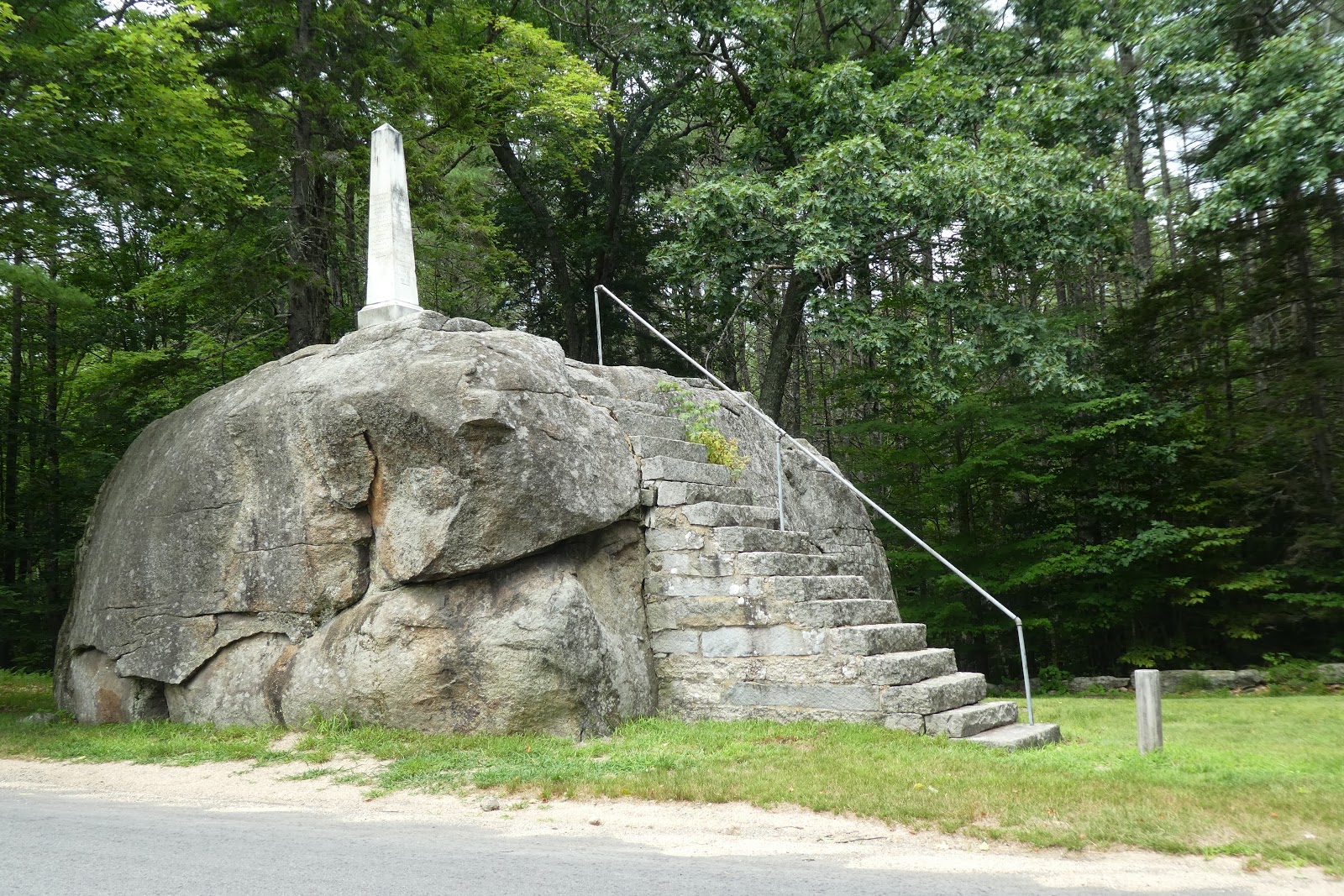
Ordination Rock, Tamworth, New Hampshire

This curious memorial is located on Cleveland Hill Road in Tamworth, New Hampshire.


About a mile from the village of Tamworth, this boulder marks the spot where Rev. Samuel Hidden was ordained in 1792 as the first minister of Tamworth, New Hampshire.  The marble monument on the top of the boulder was installed in 1862.  The granite steps climb to the top of the boulder for visitors to read the inscriptions.

Samuel Hidden graduated from Dartmouth College just before his ordination.  He was a veteran of the Revolutionary War.  Rev. Hidden was also a music teacher, supervised the town schools, and started the Tamworth Social Library.  He is buried across the street from this memorial in the town cemetery.

Here are transcriptions of the inscription on the obelisk [see the NEHGS Register Volume 22, page 72]:

South

"Memorial of the Ordination on this ROCK, Sept. 12, 1792, of the Rev. SAMUEL HIDDEN as Pastor of the Congregational Church Instituted on that day."

East

"Born in Rowley, Mass., Feb. 22, 1760.
Served in the War of the Revolution by four Enlistments 1777 - 1781.
Graduated at Dart. College, 1791.
Minister in Tamworth 46 years died Feb. 13, 1837, AEt. 77."

North

"He came into the Wilderness and left it a Fruitful field."

West

"To perpetuate the memory of his virtues and Public Services
a Grandson, bearing his honored name Provided for the erection of this Cenotaph, 1862"

On the base:

"Town Chartered 1766.  Settled in 1771.  40 Families in 1792.  Census in 1860 - 1717"


Here is a link to a YouTube video of a 2016 Tamworth town ceremony at Ordination Rock:
https://www.youtube.com/watch?v=m0yZgUBUkLo 

-------------------------

To cite/link to this blog post: Heather Wilkinson Rojo, "Ordination Rock, Tamworth, New Hampshire", Nutfield Genealogy, posted September 11, 2019, ( https://nutfieldgenealogy.blogspot.com/2019/09/ordination-rock-tamworth-new-hampshire.html: accessed [access date]).

Tuesday, September 10, 2019

Dr. Ebenezer Wilkinson of Tamworth, New Hampshire - Tombstone Tuesday

These tombstones are located at the Tamworth Town Cemetery (also known as Ordination Rock Cemetery) in Tamworth, New Hampshire.


DR. EBENEZER WILKINSON
Died
Oct. 10, 1865
AE. 67


SARAH
Wife of 
DR. E. WILKINSON
DIED
Nov. 15, 1884
AE. 84 Yrs


ELIZABETH W.
Wife of
Benja. M. Hill,
a daughter of
Dr. Wilkinson
DIED
Dec. 2, 1853,
AE. 27 ys, 9ms, & 10 ds.


HARRIET O.
daughter of
Benja. M. Hill,
DIED
Jan. 31, 1854,
AE 2ms. 10ds.


ABBY R. HILL,
Daughter of
B. M. & E. W. Hill,
DIED
Jan. 7, 1861
AEt. 11 yrs 2 mos.


Dr. Ebenezer Wilkinson (1798 - 1865) is my 2nd cousin four generations removed.  We are both descendants of James Wilkinson (1730 - about 1805) and Hannah Mead (my 5th great grandparents, and Ebenezer's great grandparents), and Thomas Wilkinson (about 1690 - 1739) and Elizabeth Caverly of Portsmouth, New Hampshire (my 6th great grandparents, Thomas being named "of London" on his marriage record).

I have been curious about Dr. Wilkinson of Tamworth for many years.  In researching genealogy records in the state of New Hampshire, I often found marriage documents in Eaton town records recorded by "Dr. Ebenezer Wilkinson, Esq." or "Ebenezer Wilkinson, Justice of the Peace".  I even took a trip to Tamworth's famous Remick Museum to speak to the staff about Dr. Wilkinson.  The Remick Museum on Cleveland Hill Road in Tamworth is the home of the country doctors Edwin Remick (1866 - 1935) and son Edwin Remick, Jr. (1903 - 1993).  No one there had heard of Dr. Wilkinson.  This just made me even more curious about him!

It turns out that Dr. Ebenezer Wilkinson was buried right down the street at the Tamworth Town Cemetery on Cleveland Hill Road.  Since the elder Dr. Remick was born in Tamworth to parents, grandparents, and great grandparents who had all lived in Tamworth, I'm sure they must have known Dr. Wilkinson. 

This summer my sister moved to the town of Tamworth, and bought a house on Cleveland Hill Road, right down the street from both the Remick Museum and the Tamworth Town Cemetery.  Small worth, 'eh?  I told her about this coincidence, and my brother-in-law went straight to the Tamworth Historical Society to find more about Dr. Wilkinson.  It turns out that he lived on Cleveland Hill Road about two farms down, between my sister and the cemetery.

Here is what I know about Dr. Wilkinson:

Ebenezer Wilkinson, son of Ebenezer Wilkinson and Elizabeth Durgin, was born on 26 July 1798 in New Hampshire (town unknown), and died 10 October 1865 in Tamworth.  He married on 24 February 1825 in Parsonsfield, Maine to Sarah Lougee, daughter of Deacon John Lougee and Elizabeth Smith.  They had three daughters, Elizabeth born about 1826; Sarah E, born about 1846; and Abbie R., born abut 1850.

Ebenezer attended both the Fryeburg Academy and the Limerick Academy in Maine.  He studied to become a physician with Dr. Moses Sweat of Parsonsfield, Maine, and with Dr. Alexander Ramsey.  He attended some classes at Bowdoin College in Brunswick, Maine. [ He is listed under "non-graduates" of the Medical School, Medical Class of 1825] He first practiced medicine for eight years in Effingham, and then went to Tamworth.  Perhaps he met his future wife while he was apprenticing with Dr. Sweat of Parsonsfield?

His daughter Elizabeth Hill is buried beside Dr. Wilkinson and his wife, along with two of her young daughters.  Mother and one child died within a few months of each other.  Perhaps the mother died in childbirth, and the baby was sickly?  Who knows, because the records are incomplete.  Benjamin Hill, the husband removed to Barton, Vermont where census records show a wife named "Elizabeth" and children.  He was back in Tamworth by the 1870 and 1880 census with his 2nd wife Elizabeth and their four children.

The eleven year old Abbie R. Hill is another child of Benjamin Hill and his first wife, Elizabeth Wilkinson.  She appears to be named for her mother's sister. 

Elizabeth's sisters (daughters of Dr. Ebenezer Wilkinson) are Sarah E. Wilkinson who married Almon P. Cooley on 19 May 1864 in Tamworth, had six children, and lived in Lawrence, Massachusetts and in Goffstown, New Hampshire; and Abbie R. Wilkinson for whom I have no further information.  Did she marry, too?

----------------------

Heather Wilkinson Rojo, "Dr. Ebenezer Wilkinson of Tamworth, New Hampshire - Tombstone Tuesday", Nutfield Genealogy, posted September 10, 2019, (https://nutfieldgenealogy.blogspot.com/2019/09/dr-ebenezer-wilkinson-of-tamworth-new.html: accessed [access date]).

Saturday, September 7, 2019

KNIGHT of York, Maine


I have previously written blog posts about two other KNIGHT ancestors (all unrelated): 
Philip Knight of Charlestown and Topsfield, Massachusetts:

John Knight of Charlestown, Massachusetts:

Robert Knight, my 11th great grandfather, was born about 1585 in England to unknown parents.  He was in York, Maine before 1643, and took an oath of allegiance on 22 November 1652.  He has depositions in the court records on 7 December 1658 (about 71 years old) and on 6 July 1671 (about 86 years old). 

Robert Knight was a mason.  He bought Robert Blaisdell’s house and land in York in 1642, and received grants of more land in 1648 and 1658. He does not appear often in the court records except for a case in 1655 when he sued Nicholas Frost for stealing his newly mown hay, and in 1668 when Arthur Clapham sued him for the expenses of treating Rowland Young’s son who Robert Knight was raising “as his owne childe” [Provincial and Court Records of Maine, 1931, Volume 2, pages 34 and 167].  According to The History of York, page 158, his children were Richard, Joan, and Margaret.

Robert Knight gave some of his land to his grandson, John Redman, Jr. on 18 February 1666.  He gave more land to his grandson Rowland Young on 12 August 1673, which was witnessed by his sister Mary Mowlton [Moulton].  He wrote his will in Boston on 23 June 1676 and his will was proved on 24 August 1676, which left his remaining land to his son Richard Knight in Boston. It is supposed that Robert Knight died in Boston sometime between these two dates.

From History of York by Banks:...

The last Will and Testament of Robert Knight of Yorke/ Concerning the small estate left by the providence of god unto me, I doe bequeath & dispose of as followeth/ Imprs:fie Acres of Marsh bounded west and by south, on the one side, West & by North on the other side, upland butting on the on Thomas Beeson & soe back unto the swampe untill it come to a parcel of land of Mr. Samll Mauericks, with an house and barn on the syd Land, of Robert Knights, also two cows & a bull all wch as above expressed, also whatsoever else shall be found to mee belonging, on or in the sayd house land or barne, I do whooley & for ever bequeath, unto my son Richd Knight liuveing in Boston, and to his Assignes for ever/ In witness of all which as above written, I have here unto set my hand & seale this 23d day of June 1676--The marke of Robert X Knight (Locus)(Sigilli) Owned & Delivered in the Presence of: Nicholas Willmott/his marke X John Tucker William Bartholomew

In the next generation I descend from his daughter Margaret (about 1622 – 1658) who married John Redman of Hampton Falls.  They had four children.  See the Surname Saturday sketch for the REDMAN lineage at this link:  https://nutfieldgenealogy.blogspot.com/2018/12/surname-saturday-redman-of-hampton-new.html  

More KNIGHT information:

Pioneers of Maine and New Hampshire 1623 to 1660, by Charles Henry Pope, 1908

York Deeds, by the Maine Historical Society, 1884, Volume 1

The History of York, by Charles Edward Banks, 1931


My KNIGHT genealogy:

Generation 1: Robert Knight, born about 1585 in England, died before 24 August 1676 probably in Boston, Massachusetts; his wife’s name is unknown. They had four children:
1.       Richard Knight, born about 1620, died about 1690 in Boston
2.      Margaret Knight, born about 1622 (see below)
3.      Daniel Knight, servant to Thomas Gorges
4.      Joan Knight, born about 1625, married Rowland Young

Generation 2:  Margaret Knight, born about 1620 in England, died 30 May 1658 in Dover, New Hampshire; married before 1647 to John Redman, born about 1620 in England and died 16 February 1700 in Hampton Falls, New Hampshire.  Four children.

Generation 3:  Mary Redman m. Leonard Weeks
Generation 4:  Joshua Weeks m. Comfort Hubbard
Generation 5:  Mary Weeks m. Jonathan Chesley
Generation 6:  Comfort Chesley m. Stephen Perkins
Generation 7:  Mary Perkins m. Nathaniel Batchelder
Generation 8:  Jonathan Batchelder m. Nancy Thompson
Generation 9:  George E. Batchelder m. Abigail M. Locke
Generation 10: George E. Batchelder m. Mary Katharine Emerson
Generation 11: Carrie Maude Batchelder m. Joseph Elmer Allen
Generation 12: Stanley Elmer Allen m. Gertrude Matilda Hitchings (my grandparents)

-----------------------------

Heather Wilkinson Rojo, “KNIGHT of York, Maine”, Nutfield Genealogy, posted September 7, 2019, ( https://nutfieldgenealogy.blogspot.com/2019/09/knight-of-york-maine.html: accessed [access date]). 

Tuesday, September 3, 2019

A Bundling Song

I saw an excerpt of this "Bundling Song" in the book The Not-Quite Puritans, written in 1928 by Henry W. Lawrence.  On page 30 there is an image of some of this poem with the following "Twentieth-century discretion permits the reproduction of only a small part of The Bundling Song which in the eighteenth was so instrumental in breaking up the practice." Of course, I was instantly curious and wanted to know the rest of the poem!  I found this image from the American Antiquarian Society online.  


Bundling Song:
Or a reproof to those young Country Women, who follow that reproachful practice, and to their Mothers
for upholding them therein.

Since bundling very much abounds,
In many parts in country towns,
No doubt but some will spurn my song,
And say I'd better hold my tongue;
But none I'm sure will take offense;
Or deem my song impertinence,
But only those who guilty be,
And plainly here their pictures see,
Some maidens say, if through the nation,
Bundling should quite go out of fashion,
Courtship would lose its sweets; and they
Could have no fun till wedding day.
If shant be so, they rage and storm,
And country girls in clusters swarm,
And fly and buz, like angry bees,
And vow they'll bundle when they please.
Some mothers, too, will plead their cause,
And give their daughters great applause,
And 'tell them, 'tis no sin nor shame,
For we, your mothers, did the same;
We hope the custom ne'er will alter,
But wish its enemies a halter.
Dissatisfaction great appear'd,
In several places where they've heard
Their preacher's bold, aloud disclaim
That bundling is a burning shame;
This too was cause of direful rout
And talk'd and told of, all about,
That ministers should disprove
Sparks, courting in a a bed of love,
So justified the custom more,
Than e'er was heard or known before.
The pulpit then it seems must yield,
And female valor take the field,
In places where there custom long
Increasing strength has grown so strong;
When mothers herein bear a sway,
And daughters joyfully obey.
And young men highly pleased, too,
Good Lord! What can't the devil do.
Can this vile practice ne'er be broke?
Is there no way to give a stroke,
To wound it or strike it dead.
And girls with sparks not go to bed?
Twill strike them more than preacher's tongue,
To let the world know what they've done,
And let it be in common fame,
Held up to view a noted shame.
Young miss if this your practice be,
I'll teach you now yourself to see:
You plead you're honest, modest too,
But such a plea will never do;
For how can modesty consist,
With shameful practice such as this?
I'll give your answer to the life:
"You don't undress like man and wife"
That is your plea, I'll freely own
But whose your bondsmen when alone,
That further rules you will not break,
And marriage liberties partake?
Some really do, as I suppose,
Upon design keep on some clothes,
And yet in truth I'm not afraid
For to describe a bundling maid;
She'll sometimes say when she lies down,
She can't be cumber'd with a gown,
And that the weather is so warm,
To take it off can be no harm:
The girl it seems had been at strift,
For widest bosom to her shift,
She gownless, when the bed they're in,
The spark, nought feels but naked skin,
But she is modest, also chaste,
While only bare from neck to waist,
And he of boasted freedom sings,
Of all above her apron strings,
And where such freedoms great are shar'd
And further freedoms feebly bar'd,
I leave for others to relate,
How long she'll keep her virgin state,
Another pretty lass we'll scan,
That loves to bundle with a man,
For many different ways they take,
Though modest rules they all will break,
Some clothes I'll keep on, she will say,
For that has always been my way,
For would I be quite naked found,
With spark in bed, for thousand pound,
But petticoats I've always said,
Were never made to wear in bed,
I'll take them off, keep on my gown,
And then I dare defy the town.
To charge me with immodesty
While I so ever cautious be.
The spark was pleased with his maide,
Of apprehension quick he said,
Her witty scheme was keen he swore,
Lying in gown open before.
Another maid when in the dark,
Going to bed with her dear spark,,
She'll tell him that 'this rather shocking,
To bundle in bed with shoes and stockings.
Nor scrupling but she's quite discreet,
Lying with naked legs and fee.
With petticoat so thin and short,
That she is scarce the fetter for't;
But you will say that I'm unfair,
That some who bundle take more care,
For some we may with truth suppose,
Bundle in bed with all their clothes,
But bundler's clothes are no defence,
Only horses push the fence;
A certain fact I'll now relate,
That's true indeed without dete.
A bundling couple went to bed,
With all their clothes from foot to head,
That the defence might seem complete,
Each one was wrapped in a sheet.
But O! This bundling's such a witch,
The man of her did catch the itch,
And so provoked was the wretch,
That she of him a bastard catch'd.
Ye bundling misses, don't you blush.
You hang pour heads and bid me hush,
If you wont' tell me how you feel,
I'll ask your sparks thy best can tell.
But it is custom you will say,
And ustom always bears the sway,
If I won't take my sparks to bed,
A laughing stock I shall be made;
A vulgar custom 'tis I own,
Admir'd by many a slut and clown,
But 'tis a method of proceading,
As much abhor'd by those of breeding.
You're welcome to the lines I've penn'd,
For they were written by a friend,
Who'll think himself quite well rewarded,
If this vile practice is discarded.


“A New bundling song: or A reproof to those young country women, who follow that reproachful practice, and to their mothers for upholding them therein,” Isaiah Thomas Broadside Ballads Project, accessed August 21, 2019, https://www.americanantiquarian.org/thomasballads/items/show/170 

-------------------------------

Heather Wilkinson Rojo, "A Bundling Song", Nutfield Genealogy, posted September 3, 2019, ( https://nutfieldgenealogy.blogspot.com/2019/09/a-bundling-song.html: accessed [access date]).