Friday, October 17, 2014

Photo Friday ~ Two Cousins in Spain


The photograph above is my mother-in-law, María Josefa, and her first cousin,  José Manuel in Spain about 1935.  The photograph below was taken of the same two children a few years later, 
during the Spanish Civil War. 


These two cousins had an especially close relationship.  Their parents were two brothers who married two sisters, so they are considered double first cousins. My mother-in-law was an only child, so her playmates were her cousins.  You can see in the photographs below, that although they are both now in their 80s, they are still very close.


Click here to see another blog post with a photo of the same two cousins:
http://nutfieldgenealogy.blogspot.com/2012/08/the-spanish-civil-war.html  

-----------------------------
The URL for this post is
http://nutfieldgenealogy.blogspot.com/2014/10/photo-friday-two-cousins-in-spain.html

Copyright (c) 2014, Heather Wilkinson Rojo

Thursday, October 16, 2014

Thank You to the County Clerks website!


In the past I have visited the County Clerks website www.county-clerks.org , but not often since in New England most vital records are not kept at the county level (except for Connecticut, where I have very few ancestors).  There was a contest at this website last month to vote for genealogy blogs, and Nutfield Genealogy came in second place!  Woot! Woot!  Thank you very much Adam Murphy, the author of this website!

The first place winner at this contest is The Memoir Writing Blog at www.womensmemoirs.com with 437 votes.  At second place, Nutfield Genealogy received 196 votes, and in third place Genealogy: Beyond the BMD, www.genealogybeyondthebmd.blogspot.ca had 167 votes.   Thank you to everyone who voted for me.  Visit the other blogs on this list. There are some good ones I didn’t know about, including The Memoir Writing Blog which is new to me.  Visit this page to see all the votes: http://www.county-clerks.com/genealogy-blog/

And don’t forget to visit the County Clerks website http://www.county-clerks.com/     It was founded by Adam Murphy of New York.  Last year he visited Salt Lake City for a ski trip and had an unexpected layover.  He spent the day exploring and visited the LDS Family History Library.  Adam had no idea that such a place existed.   He also found that genealogy was a fascinating pastime.  Upon returning to New York he continued to research his family, and the idea for the County Clerks website was born.

In order to obtain original records, a genealogist must contact a county clerk.  But it can be difficult to google which clerk, and how to contact them properly for certificates. Adam realized that there was no one website which consolidated all this information. 

Adam also told me that he will be switching domain names to CountyOffice.org soon, so stay posted at www.county-clerks.org for more information on the move to the new website.  He also plans to expand to more data useful for genealogy such as district attorneys, sheriffs, treasurers, jails and other local county research contact information.

Thank you to all my readers who voted for me, and thank you Adam!


Wednesday, October 15, 2014

Weathervane Wednesday ~ A Ship with full Rigging

Weathervane Wednesday is an on-going series of photographs I post weekly.  I started by publishing weather vanes from the Londonderry area, but now I've been finding interesting weather vanes all across New England.  Sometimes my weather vanes are whimsical, or historical, but all are interesting. Often, my readers tip me off to some very unique and unusual weather vanes, too! Today's weather vane is from a historic home in Massachusetts.

Do you know the location of weather vane #178? Scroll down to the bottom to see the answer!


Today's weather vane is on display in Four Star General George S. Patton's personal office at the Patton Homestead in Hamilton, Massachusetts.  This office wing, including a library and master bedroom, was built just before World War II.  General Patton intended to retire to this country estate after World War II, but he was killed in a jeep accident in 1945 and never came home to this office or house.

This weather vane used to be on top of the main estate house.  The house was built in the 1790s, and was owned by the Patton family from 1928 until 2012.  The Patton family donated the main house and 27 acres of land to the Town of Hamilton.  The Patton Archive is located here in the former master bedroom, just barely visible through the door in the bottom photograph.  The archivist here had no further information on this weather vane, although it was known to be on the house before the Patton family owned the building.

For another blog post about another weather vane on display at the Patton Homestead, click here:
http://nutfieldgenealogy.blogspot.com/2014/10/weathervane-wednesday-horse-vane-owned.html 

For a blog post about the Patton Estate, click here:
http://nutfieldgenealogy.blogspot.com/2014/07/the-patton-homestead-and-archives-home.html  

Click here to see the entire series of Weathervane Wednesday posts!

----------------------
The URL for this post is
http://nutfieldgenealogy.blogspot.com/2014/10/weathervane-wednesday-ship-with-full.html

Copyright (c) 2014, Heather Wilkinson Rojo

Tuesday, October 14, 2014

Tombstone Tuesday ~ Four Small Children

These tombstones were photographed at Pine Hill Cemetery in Hollis, New Hampshire.


In 
memory of two
Children, a son & dau. of
Lieut. Benjamin & Mrs. Mary
Farley

Sarah died Sept                  Noah died Sept
11th 1798 in the 7th           16th 1798 in the 5th
Year of her age.             Year of his age.


In memory of
Leonard Farley
Son of Lieut. Benjamin
& Mrs. Mary Farley
who died Sept. 27th
1796 Aged 4 days.


(To me this little carving looks like a child in a coffin)


[the stone on the right side]

IN
memory of
Caleb, Son of Lieut.
Benj & Mrs. Mary
Farley, who died
July 26, 1825
AEt. 14.


These four children of Benjamin and Mary Farley all died young.  Two died within five days of each other.  Benjamin Farley was born 27 June 1763 and married Mary Blodgett of Dunstable on 15 February 1787 in Hollis, New Hampshire.  They had nine children, and only four lived to adulthood and married.  Another child, also named Sarah, lived only from 1807 - 1822. 

Benjamin and Mary Farley lived at the Four Corners on the house property that is now the Country Kitchen restaurant in Hollis.  It is located at the intersection of Routes 130 and 122 (Proctor Hill Road and Silver Lake Road).  You can read all about their house at this link:  http://www.hollisnh.org/windowsonhollispast/historicSites/sitesAcrossHollis/sites/052-022.htm 


---------------------------------------
The URL for this post is
http://nutfieldgenealogy.blogspot.com/2014/10/tombstone-tuesday-four-small-children.html

Copyright (c) 2014, Heather Wilkinson Rojo

Monday, October 13, 2014

A Rogers Group Poem by Robert Frost


A Rogers Group
by Robert Frost

How young and unassuming
They waited in the street,
With babies in their arms
And baggage at their feet.

A trolley car they hailed
Went by with clanging gong,
Before they guessed the corner
They waited on was wrong.

And no one told them so
By way of traveler's aid,
No one was so far touched
By the Rogers Group they made.


I last blogged about Rogers Groups and the sculptor John Rogers more than a year ago at this link:  http://nutfieldgenealogy.blogspot.com/2013/09/have-you-ever-seen-rogers-group.html   These large statuettes were popular during the Victorian period, and were very sentimental and patriotic.   They were immensely popular not just in New England, where they were designed and manufactured, but all over the United States.  Each figurine featured groups of several people posed in scenes from American history, literature or popular culture.

As you read this poem by Robert Frost, can't you just imagine the street scene?  A young family, or perhaps a group of immigrants, waiting on a street corner with all their trunks and children.  After looking at photos of many, many Rogers Groups I'm surprised it wasn't the subject of one of his statuettes.  This Rogers Group sculpture was actually found in the Robert Frost house, and is now on display in the museum in the barn at the Robert Frost farm in Derry, New Hampshire.   The figurine is called "Coming to the Parson", dates from 1870, and it shows a young couple approaching a minister to discuss their upcoming wedding plans.

Robert Frost Farm
122 Rockingham Road
Derry, New Hampshire
603-432-3091
website: http://www.robertfrostfarm.org/


-------------------
The URL for this post is
http://nutfieldgenealogy.blogspot.com/2014/10/a-rogers-group-poem-by-robert-frost.html

Copyright (c) 2014, Heather Wilkinson Rojo

Saturday, October 11, 2014

Surname Saturday ~ DANE of Roxbury and Andover, Massachusetts

North Parish Church, Andover, Massachusetts
Founded in 1645, and where the
Reverend Francis Dane was the 2nd minister
DANE

The first DANE in this lineage to come to the New World was John Dane (about 1587 – 1658) who settled in Roxbury, Massachusetts from Essex, England.  He arrived about 1636 with his children Elizabeth and John, and later married the widow of William Chandler.   He was a chirurgeon (surgeon) in Roxbury and Ipswich. His son John was also a surgeon in Roxbury. You can read John Dane’s diary at this link: http://genealogysurnames.net/JOHNDANE.HTML

I descend from the younger son, Reverend Francis Dane (1615 – 1697).  He matriculated at King’s College in Cambridge, England in 1633.  He was ordained in 1648 and was the second minister of the church in Andover, Massachusetts.  He began a school and was minister for 44 years when the Salem witch hysteria began in 1692.  He and Thomas Barnard wrote a letter signed by 24 Andover residents condemning the trials.  This caused Dane and half a dozen of his relatives to be accused as witches.  Included in those arrested were his daughters Elizabeth Dane Johnson and Abigail Dane Faulkner, and daughter-in-law, Deliverance Haseltine Dane.  His two granddaughters, Abigail and Dorothy Faulkner were also arrested. (His daughter, Hannh, my ancestress, seems to have escaped suspicion). He bravely continued to preach against the witch hunt, and fortunately none of his kin were hung.  He died a few years later in 1697.

“May the Lord direct and guide those that are in place, and give us all submissive wills, and let the Lord do with me and mine what seems good in his own eyes.”  Rev. Francis Dane, 1692.

There has been much published about this family, Rev. Dane and the Salem Witch Trials, but if you are truly curious about more information on the DANE family, here are a few suggestions:

Genealogical Directory of the First Settlers of New England Showing Three Generations of those who came before May 1692 on the basis of farmers register, by James Savage, Baltimore, Genealogical Publishing Company, 1990, Volume II, page 6 and 7.

History of Andover from its Settlement to 1829, by Abiel Abbott, 1829

The Annals of Salem, by Joseph B. Felt, 1827

Salem Witchcraft by Enders A. Robinson, 1992

“Early Records of the Dane Family of Andover” compiled by Charlotte Helen Abbott, a manuscript at the Memorial Hall Library (Andover Public Library) also available online at http://www.mhl.org/abbott-genealogies     

“A Declaration of Remarkable Providences in the Course of my Life” by John Dane, The New England Historic and Genealogical Society Register, Volume VIII (1854), pages 149-156. The original manuscript is kept at the Massachusetts Historical Society in Boston.

My DANE genealogy:

Generation 1:   John Dane was from Bishop’s Stortford, Hertfordshire, England and died in Roxbury, Massachusetts on 14 September 1658; married first to Frances Bowyer about 1606 in England and had four children.  She died about 1641 in Roxbury and John married second to Annis Bayford, the widow of William Chandler, on 2 July 1643 in Roxbury. No children by the second marriage.

Generation 2:  Reverend Francis Dane, born about 1615 in England, died 17 February 1697 in Andover, Massachusetts.  He married first to Elizabeth Ingalls, daughter of Edmund Ingalls and Ann Tripp about 1639 and had nine children.  She died on 9 June 1676 in Andover and he married second to Mary Thomas on 21 September 1677.  She died on 18 February 1689 and he married third to Hannah Chandler, his step sister, daughter of William Chandler and Annis Bayford about 1690. 

Generation 3: Hannah Dane, born about 1648 in Andover; married on 14 November 1666 in Ipswich, Massachusetts to William Goodhue, son of William Goodhue and Margery Watson.  He was born about 1645 and died 12 October 1712.  Eleven children.

Generation 4: Bethiah Goodhue m. Benjamin Marshall
Generation 5: Elizabeth Marshall m. David Burnham
Generation 6: Amos Burnham m. Sarah Giddings
Generation 7: Judith Burnham m. Joseph Allen
Generation 8: Joseph Allen m. Orpha Andrews
Generation 9:  Joseph Gilman Allen m. Sarah Burnham Mears
Generation 10:  Joseph Elmer Allen m. Carrie Maude Batchelder
Generation 11:  Stanley Elmer Allen m. Gertrude Matilda Hitchings (my grandparents)

------------------------------
The URL for this post is
http://nutfieldgenealogy.blogspot.com/2014/10/surname-saturday-dane-of-roxbury-and.html

Copyright © 2014, Heather Wilkinson Rojo

Friday, October 10, 2014

1790 Milestone, Hooksett, New Hampshire


I spotted this historic marker along the side of Route 28 in Hooksett, New Hampshire. 


1790
16M
Ch X M
32 M to H


1790 MILESTONE
-------------0------------
Erected by towns or businesses to aid unfamiliar 
travelers, milestones typically stood up to 5' tall,
were crudely carved out of roughly hewn granite,
and often referred to towns by first initial only.
They could be both difficult to read and
inaccurate.
In 1790 this area of Hooksett was
part of Chester.  This milestone
told travelers it was 16 miles to 
Chester Meeting House and 32
miles to Haverhill, Mass., a regional
industrial center. 

Erected in 2008 by Manchester Sand. Gravel & Cement Co., Inc.

-------------------------
The URL for this post is
http://nutfieldgenealogy.blogspot.com/2014/10/1790-milestone-hooksett-new-hampshire.html

Copyright (c) 2014, Heather Wilkinson Rojo

Thursday, October 9, 2014

Hooksett, New Hampshire ~ 20th Century Americana

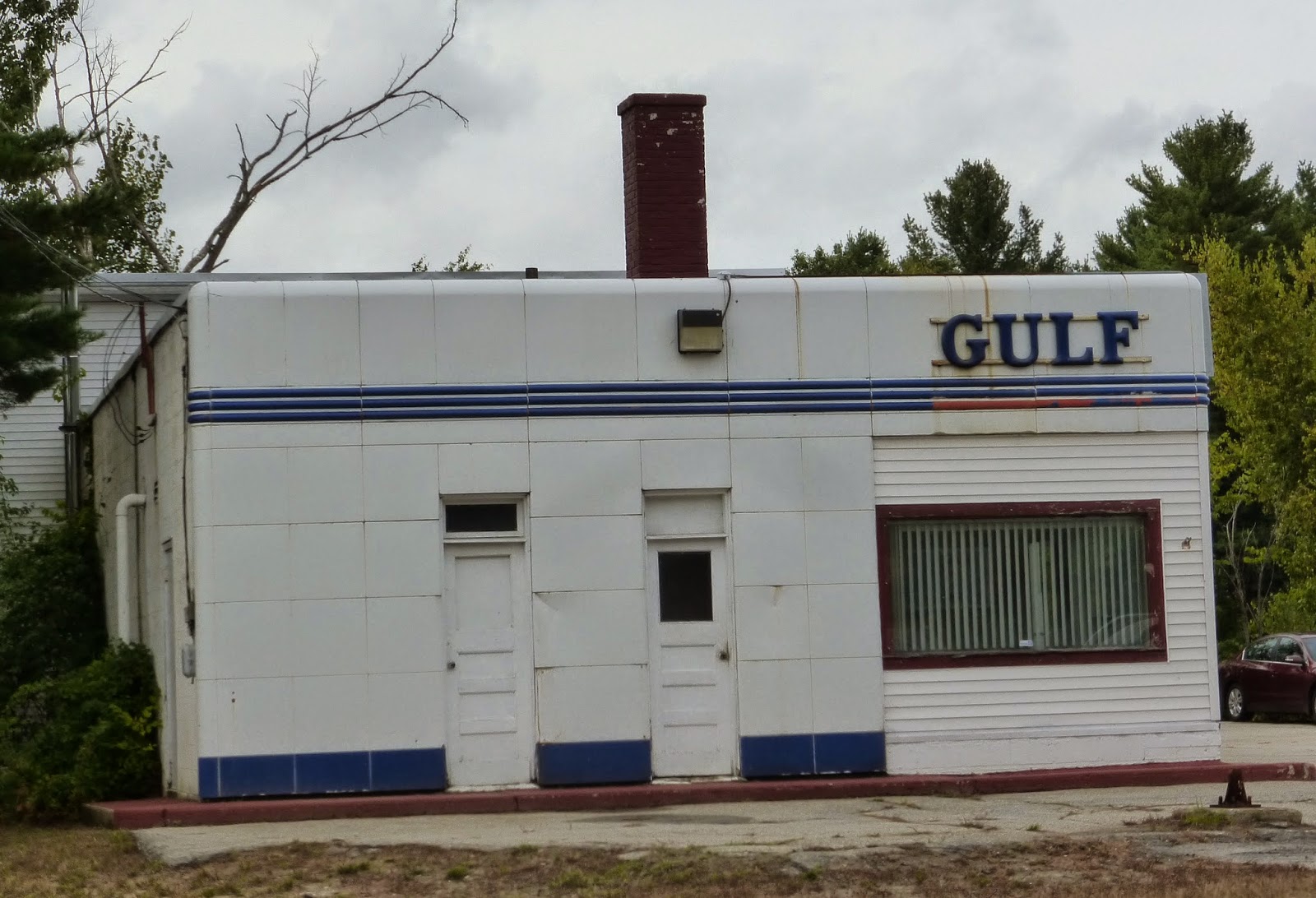
Old Gulf gas station, Route 28, Hooksett, New Hampshire

Eyesores or historical buildings?

This question has been posed in several of my "20th Century Americana" blog posts. It's my belief that since the recent past history is not treasured like the buildings of the 1600s and 1700s, we let some of these landmarks become eyesores.  The 1800s mill buildings of New England are left to decay, and their industrial history becomes a despised part of local lore.  Do we loathe these buildings because of the pollution and immigrant hardship associated with them? Or do we restore them to their former glory and celebrate the history of labor, technology, and the interesting architecture?

These empty buildings in Hooksett, New Hampshire can be seen along Route 3A and Route 28.  Both roads were busy north-south routes from Massachusetts to the great north woods and lakes regions before Interstate Highway 93 was built in the 1960s.  After the highway, some of these businesses languished and closed when the tourists no longer came through town, but drove around it without stopping.

Lately I've noticed that TV shows like "American Pickers" and PBS's "Antique Roadshow" have featured items from old gas stations and service stations.  Oil cans, signs, advertising art and automobile parts in their original boxes are selling for big money to collectors and to decorators.  I wonder if any of these collectors would like an original building to house their stuff?


This old Gulf gas station (also see above at the top of this post) has a porcelain enamel tile exterior and a curved front, which help establish it's date of origins to the 1940s or 1950s.  The National Park Service has a wonderful webpage HERE that describes how some of these old gas stations can be re-purposed for office space, coffee or ice cream shops, and small retail stores.


This old Quonset hut is next door to the old Gulf gas station.  I might have been used by the same business as a service bay or for storage.  Quonset huts have a legendary history from World War II, when they were used as quickly assembled pre-fabricated buildings. The first place of their manufacture was Quonset Point, Rhode Island.  According to Wikipedia, between 150,000 to 170,000 Quonset huts were manufactured and sent all around the globe to U.S. military installations to be used as housing, storage, administration buildings, latrines, hospitals and many other uses.  These corrugated galvanized steel buildings have been adapted to many other uses since World War II.  However, we are losing these structures at a fast pace as they are demolished for more modern buildings.


Old Texaco gas station, Route 3A, Hooksett, New Hampshire


For the truly curious:

Wikipedia - Quonset Huts
http://en.wikipedia.org/wiki/Quonset_hut

Preservation Brief 46 "The Preservation and Re-use of Historic Gas Stations"
http://www.nps.gov/tps/how-to-preserve/briefs/46-gas-stations.htm 

Texas Department of Transportation
PDF of "The Field Guide to Gas Stations in Texas"
includes how to examine old gas stations to determine their age and style
http://ftp.dot.state.tx.us/pub/txdot-info/env/toolkit/420-05-gui.pdf

A Flickr album of photographs of old gas stations, by "citizenkerr"
https://www.flickr.com/photos/citizenkerr/sets/72157623308569800/detail/?page=14

---------------------

To cite/link to this blog post:  Heather Wilkinson Rojo, "Hooksett, New Hampshire ~ 20th Century Americana", Nutfield Genealogy, posted October 9, 2014, ( http://nutfieldgenealogy.blogspot.com/2014/10/hooksett-new-hampshire-20th-century.html: accessed [access date]). 

Copyright (c) 2014, Heather Wilkinson Rojo